Telecom AI-Driven Modernization Strategies for Enterprise Platform Integration in 2026
Telecom innovations in 2026 are centered on AI-driven automation, cloud-native modernization, and integrated enterprise platforms that help operators reduce operational friction, improve customer experience, and build scalable new revenue streams. For telecom companies increasingly viewed as indistinguishable commodity service utilities, modernization is no longer only an IT upgrade; it is a competitive fortitude and commercial innovation strategy.
This article focuses on enterprise software modernization for telecom organizations: AI-first architecture, legacy system integration, workflow optimization, OSS/BSS modernization, real-time data engineering, and enterprise platform integration. It is written for telecom executives, CTOs, CIOs, and IT leaders evaluating modernization roadmaps, AI initiatives, and platform integration strategies across network infrastructure, customer service, billing, and operations.
The direct answer: telecom innovations in 2026 combine artificial intelligence, cloud platforms, AI agents, microservices, and real-time data integration to modernize existing enterprise systems while enabling faster service delivery, lower costs, and sustainable growth. Early adopters gain a competitive edge because AI systems change how telecom companies create, deliver, and capture value.
Key outcomes from a strong telecom modernization roadmap include:
Measurable ROI from modernization, including reducing operational costs and improving margins.
AI-first operational workflows for predictive maintenance, network management, and service provisioning.
Smooth integration between legacy systems, cloud-native platforms, and existing systems.
Enhanced customer experience platforms that use generative AI, AI powered chatbots, and customer analytics.
Future-ready telecom infrastructure prepared for 5G-Advanced, private 5G networks, Non-Terrestrial Networks via Low Earth Orbit satellites, edge computing, and eventually 6G.
Understanding Modern Telecom Innovation Frameworks
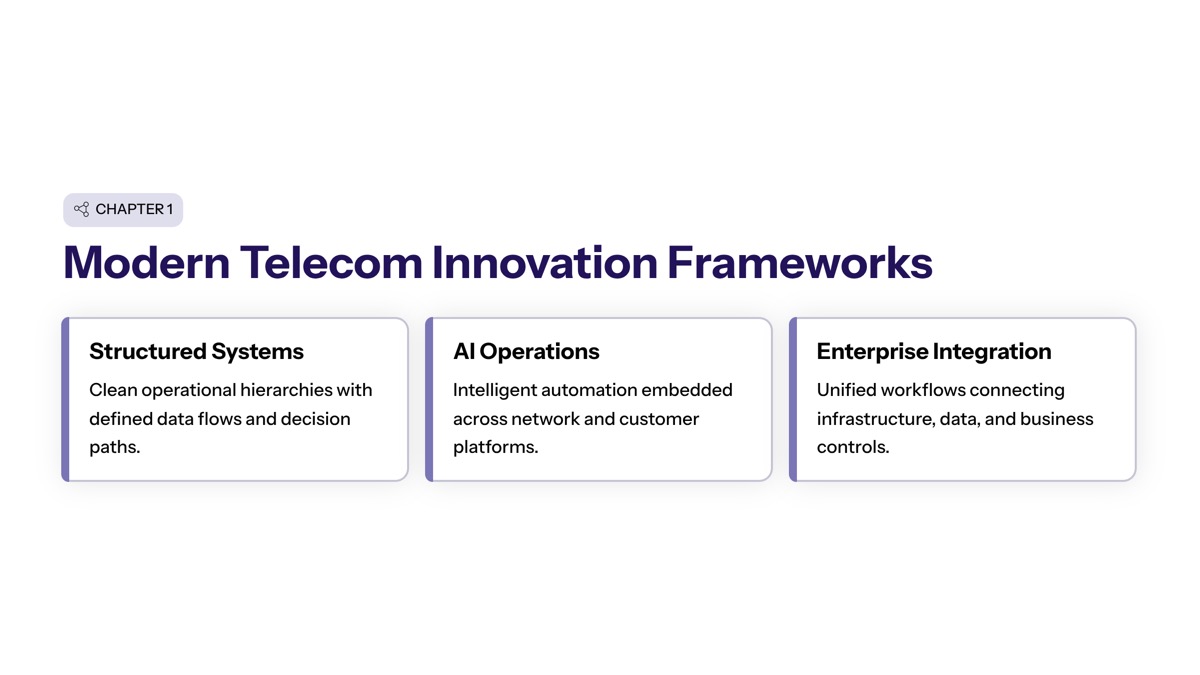
Telecom innovation in enterprise software modernization means redesigning the operating model of a communications provider around AI, cloud, APIs, automation, and unified data. It goes beyond faster connectivity. It includes modernizing OSS/BSS, improving enterprise systems, cloudifying operations, enabling AI powered automation, and creating customizable solutions that can adapt to an evolving business environment.
To enhance competitive innovation, telecom leaders must leverage emerging technologies, such as AI, to improve productivity and cost-effectiveness across various operational processes. The integration of AI into telecom operations is expected to transform how companies create, deliver, and capture value, providing a significant competitive edge for early adopters.
AI-first architecture is the foundation of this shift. In an AI-first architecture, artificial intelligence is not added after the platform is built; AI models, machine learning solutions, data pipelines, observability, model governance, and workflow orchestration are designed into the platform from the beginning. This enables data driven decision making across customer experience, network performance, field operations, billing, fraud detection, and service assurance.
The shift toward cloud-based operations in telecom is not just a trend but a necessity for enhancing scalability and innovation, allowing companies to respond more effectively to market demands. Telecom companies are increasingly adopting cloud solutions to enhance their IT services and internal processes, with a focus on “cloudifying” their operations to improve scalability and efficiency.
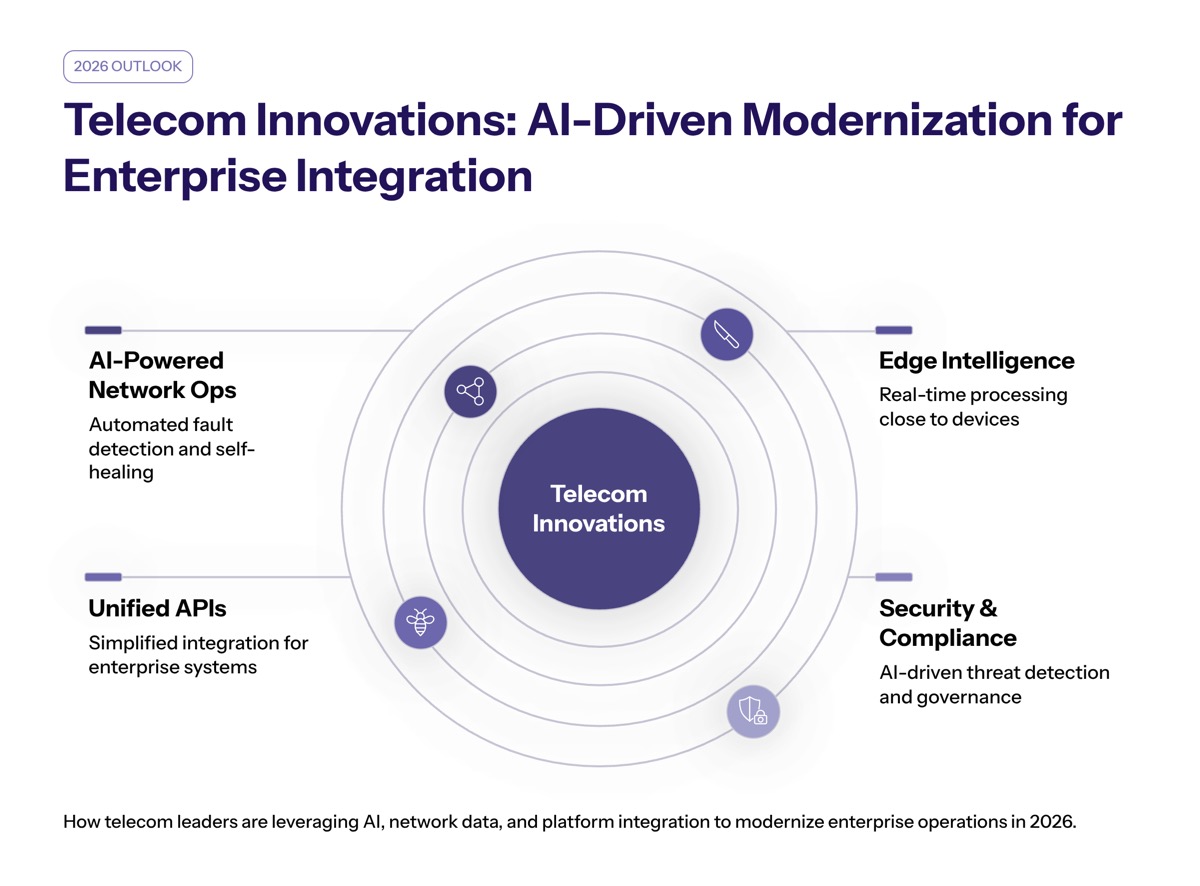
AI-Driven Network Operations
AI-driven network operations use machine learning, deep learning, generative AI, and AI agents to monitor, predict, optimize, and sometimes autonomously act across telecom networks. Practical applications include predictive maintenance, anomaly detection, traffic routing, energy optimization, service assurance, and automated incident response.
Telecom companies are increasingly using AI to enhance operational efficiency, particularly in areas such as network management and customer experience. Telecom operators are deploying autonomous systems capable of making independent decisions to optimize data routing and manage traffic. Generative AI and Extended Detection and Response platforms are also used in telecom to automate network monitoring and neutralize threats in real time.
These capabilities matter because telecom infrastructure is becoming more distributed and software-defined. Software-Defined Networking (SDN) and Network Function Virtualization (NFV) are pivotal in decoupling hardware and software in telecoms, enhancing scalability. That decoupling allows operators to move from hardware-bound upgrades to software development cycles, CI/CD, automated testing, and continuous improvement.
AI-driven network operations also support high-value use cases in real business environments. 5G infrastructure expansion brings fiber-like wireless speeds and ultra-low latency directly to devices, outperforming older network standards. Fixed Wireless Access (FWA) utilizes 5G and millimeter-wave technologies to deliver high-speed broadband without the need for fiber-optic cabling. Private 5G networks offer localized, high-security connectivity for industrial operations, enabling autonomous systems and smart city infrastructure.
Enterprise Platform Integration
Enterprise platform integration connects OSS, BSS, CRM, billing, customer support, service inventory, network management, and analytics into a coordinated operating environment. Instead of fragmented tools and duplicated data, telecom leaders can use API-first platforms, microservices, event streaming, and unified dashboards to improve operational efficiency.
Telecom companies are encouraged to rethink their customer experience strategies, as enhancing customer relationships is crucial for maintaining pricing power and reducing churn. AI technologies enable telecom companies to analyze customer data and behavior, allowing for more tailored services and proactive customer engagement strategies that can reduce churn and increase loyalty. Implementing AI-driven analytics can help telecom companies identify patterns in customer interactions, leading to improved service delivery and the ability to anticipate customer needs, thus enhancing overall customer satisfaction.
Generative AI applications and AI powered applications are especially valuable in customer support. Telecom companies can leverage AI to enhance customer experience by automating customer support through AI-powered chatbots, which can provide real-time assistance and personalized responses, thereby improving engagement and satisfaction. When integrated with billing, inventory, and network telemetry, these AI solutions can move beyond scripted replies and help enhance customer service with specific, context-aware answers.
Platform consolidation also improves cost control. AI technology can drive efficiency in high-volume processes such as supplier and customer contract management, helping telecom companies reduce operational costs. Telecom advancements also enable enhanced collaboration through high-definition video conferencing and cloud-based software across global teams, which is important for distributed operations, field service, and enterprise customers.
The next step is implementation: how telecom leaders move from strategy to cloud-native systems, AI integration, and scalable solutions without disrupting businesses running smoothly.
Strategic Implementation of Telecom Modernization
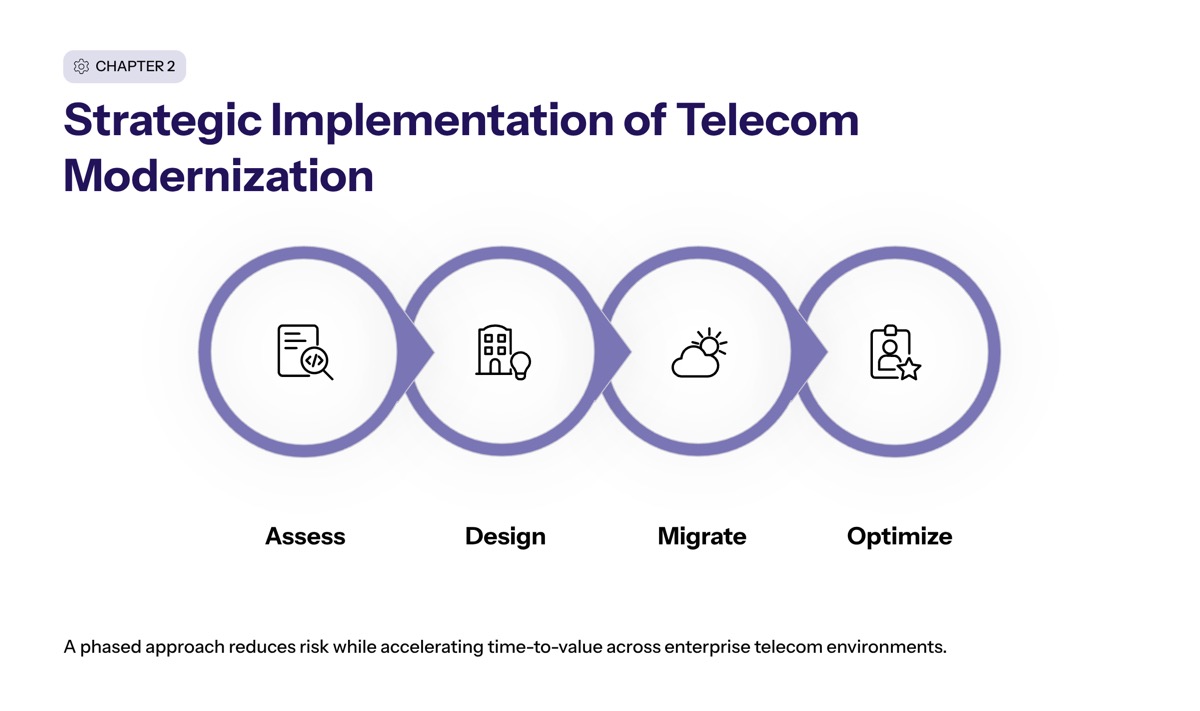
Once a telecom organization understands the innovation framework, the practical work is to modernize enterprise platforms without destabilizing critical services. This requires engineering expertise, data engineering, enterprise grade security, ongoing maintenance, and a clear balance between existing systems and new AI powered products.
Modernization should be treated as full cycle product development rather than a one-time migration. That means discovery, architecture, custom AI development, implementation, testing, monitoring, and continuous improvement. Telecom leaders may rely on internal AI engineers, an ai development company, a custom ai development company, or a broader it partnership depending on in-house AI expertise and delivery capacity.
Legacy System Modernization
Legacy systems often hinder operational efficiency and scalability, making modernization essential for organizations to remain competitive in rapidly evolving markets. In telecom, these systems often include monolithic OSS/BSS platforms, aging billing engines, proprietary network inventory databases, manual field-service tools, and fragmented customer records.
Modernizing legacy systems can involve integrating new technologies, such as cloud services and AI, to enhance functionality and reduce operational costs. A practical approach is not always a full replacement. Many operators use API wrappers, the Strangler Fig pattern, event-driven integration, and staged migration to preserve service continuity while gradually replacing high-risk components.
Organizations that modernize their legacy systems can improve data management and analytics capabilities, leading to better decision-making and increased agility. This is particularly important for telecom companies that need unified views of customer accounts, service usage, network incidents, product eligibility, and billing events.
The transition to cloud-native operations is seen as a major opportunity for telecom companies, as it extends beyond IT systems to core network services, potentially leading to significant cost savings and operational improvements. In PwC’s 2023 Cloud Business Survey, 78% of executives across various sectors reported that their organization had adopted cloud computing in most or all parts of their business. As of 2023, only 47% of telecom companies are considered “cloud-mature,” indicating a significant opportunity for growth and improvement in cloud adoption compared to other industries, where the average is 54%.
AI-First Architecture Design
AI-first architecture design starts with business outcomes, then maps AI systems, data flows, model governance, and integration patterns to those outcomes. For telecom leaders, the core focus is usually customer churn reduction, network optimization, automated service provisioning, threat detection, and improved workforce productivity.
Machine learning can predict churn by analyzing billing behavior, service incidents, plan changes, support interactions, device usage, and network quality. These insights help telecom teams enhance customer engagement through targeted retention offers, proactive service fixes, and personalized plan recommendations.
Network optimization depends on AI powered automation across traffic routing, resource allocation, congestion detection, and capacity planning. Telecom operators are already moving toward autonomous systems that can make independent decisions to optimize data routing and manage traffic. This becomes more important as recent telecom advancements transform service delivery with technologies like AI, Non-Terrestrial Networks via Low Earth Orbit satellites, and 5G-Advanced.
Generative AI is also changing the operating model. Generative AI (GenAI) is expected to significantly change how telecom companies create, deliver, and capture value, with many CEOs recognizing its potential to transform business operations. 73% of US companies have adopted AI in at least some areas of their business, indicating a significant trend towards AI integration across industries, including telecom.
An effective AI architecture can include custom ai models, machine learning solutions, deep learning for anomaly detection, computer vision for infrastructure inspection, and generative ai applications for care agents, field technicians, and enterprise sales. The right AI partner should provide ai software development services, end to end support, product quality guarantees, and experience delivering AI projects in complex challenges and diverse industries.
Real-Time Data Integration
Real-time data integration connects disparate telecom systems into a unified operational layer. This includes CRM, billing, OSS, BSS, service inventory, trouble tickets, network telemetry, field operations, fraud systems, cloud platforms, and customer engagement tools.
The goal is a unified customer view and operational dashboard that can support data driven decision making. When customer service teams, network teams, billing teams, and field teams use consistent data, the operator can reduce rework, improve first-contact resolution, prioritize outages by customer impact, and enhance customer service.
Data quality and governance are essential. Telecom data is regulated, sensitive, and often distributed across many systems. Modern platforms need encryption, access control, audit logging, data residency controls, model explainability, and enterprise grade security. These requirements become more important as AI adoption expands across high-volume operational processes.
Real-time integration also supports emerging telecom business models. Integration of satellite networks with terrestrial cellular infrastructure allows standard mobile devices to communicate directly with satellites. The global eSIM market is projected to reach approximately $19 billion, facilitating instantaneous service provider switching and eliminating physical distribution barriers. These changes make smooth integration, real-time provisioning, and accurate customer identity management critical.
Key points for telecom leaders:
Use API-first integration to connect existing enterprise systems before replacing every legacy component.
Build governed data pipelines that support AI development, observability, and compliance.
Prioritize workflows that directly affect customer experience, revenue assurance, and network reliability.
Design for cloud-native scalability while protecting critical telecom infrastructure.
Treat data center services, structured cabling systems, network installation, and software platforms as one connected modernization agenda.
These implementation choices are easier to manage with a structured framework.
RAPID Framework Application for Telecom Innovation
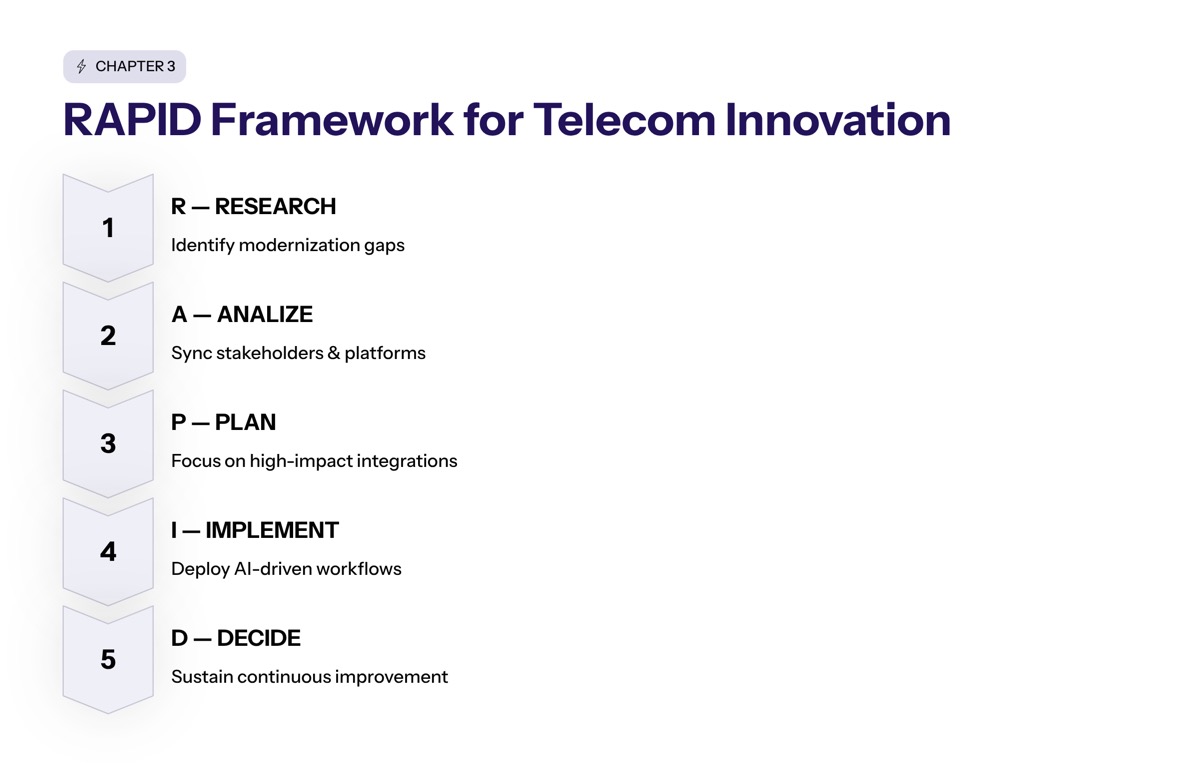
Telecom modernization succeeds when strategy, architecture, governance, and delivery are connected. Cognativ’s RAPID framework - Recognize, Assess, Plan, Implement, Deliver - gives telecom enterprises a structured way to move from fragmented modernization efforts to measurable outcomes.
The RAPID approach is useful when a telecom organization has multiple AI initiatives, aging legacy systems, rising operational costs, complex regulatory obligations, and pressure to launch new enterprise services. It helps leaders prioritize AI integration, cloud migration, custom AI development, and enterprise platform integration based on business value rather than technology hype.
Modernization Implementation Process
Telecom organizations should follow a structured modernization process when existing systems slow service launches, data quality limits AI projects, manual workflows increase cost, or customer experience gaps increase churn.
Recognize and assess current systems. Map OSS, BSS, CRM, billing, network management, field service, data platforms, data center services, and existing enterprise systems. Identify bottlenecks, duplicate data, manual processes, outage risks, and integration gaps.
Plan AI-first architecture with security and compliance requirements. Define which AI solutions will improve operational efficiency, enhance customer engagement, reduce churn, or automate service delivery. Include enterprise grade security, privacy controls, audit readiness, and model governance from the start.
Implement pilot programs for customer experience and network operations. Start with focused AI projects such as AI powered chatbots, predictive maintenance, SLO monitoring, automated billing workflows, or network anomaly detection. Pilots should use real business environments and measurable KPIs.
Deploy enterprise-wide solutions with performance monitoring. Scale proven pilots through microservices, cloud platforms, MLOps, CI/CD, observability, and integration with existing systems. This is where full cycle AI and full cycle product development discipline matter.
Deliver measurable ROI through continuous optimization. Track cost per bit, mean time to repair, customer satisfaction, churn, time to launch new services, infrastructure utilization, and revenue from new AI powered products. Continuous improvement turns modernization from a project into an operating model.
Technology Stack Comparison
Component | Legacy Telecom Architecture | Modern Cloud-Native Telecom Architecture |
|---|---|---|
OSS/BSS | Monolithic, tightly coupled, vendor-proprietary systems with slow release cycles | Modular microservices, API-first integration, event-driven workflows, and customizable solutions |
Network infrastructure | Hardware-bound appliances and manual provisioning | SDN, NFV, virtualized functions, containerized services, and AI powered automation |
Data architecture | Batch ETL, siloed data warehouses, inconsistent customer records | Real-time data streaming, data mesh patterns, unified analytics, and governed data engineering |
AI and automation | Isolated AI pilots with limited operational impact | AI agents, custom ai models, MLOps, model governance, and production-grade AI systems |
Customer experience | Disconnected CRM, billing, and support channels | Unified customer view, generative AI support, proactive engagement, and personalized services |
Security operations | Reactive monitoring and manual response | Generative AI, Extended Detection and Response platforms, automated threat detection, and audit-ready controls |
Deployment model | Long change windows and manual releases | CI/CD, cloud-native operations, blue-green deployments, and ongoing maintenance |
Enterprise services | Static connectivity products | Network APIs, private 5G, edge services, FWA, eSIM, and application-aware connectivity |
The strategic choice is not legacy versus modern in a single cutover. Most telecom organizations need deep integration between both environments while they progressively modernize. The right ai company or development company should understand telecom operations, cloud platforms, network infrastructure, product quality guarantees, and client success - not just model development.
Common Challenges and Solutions
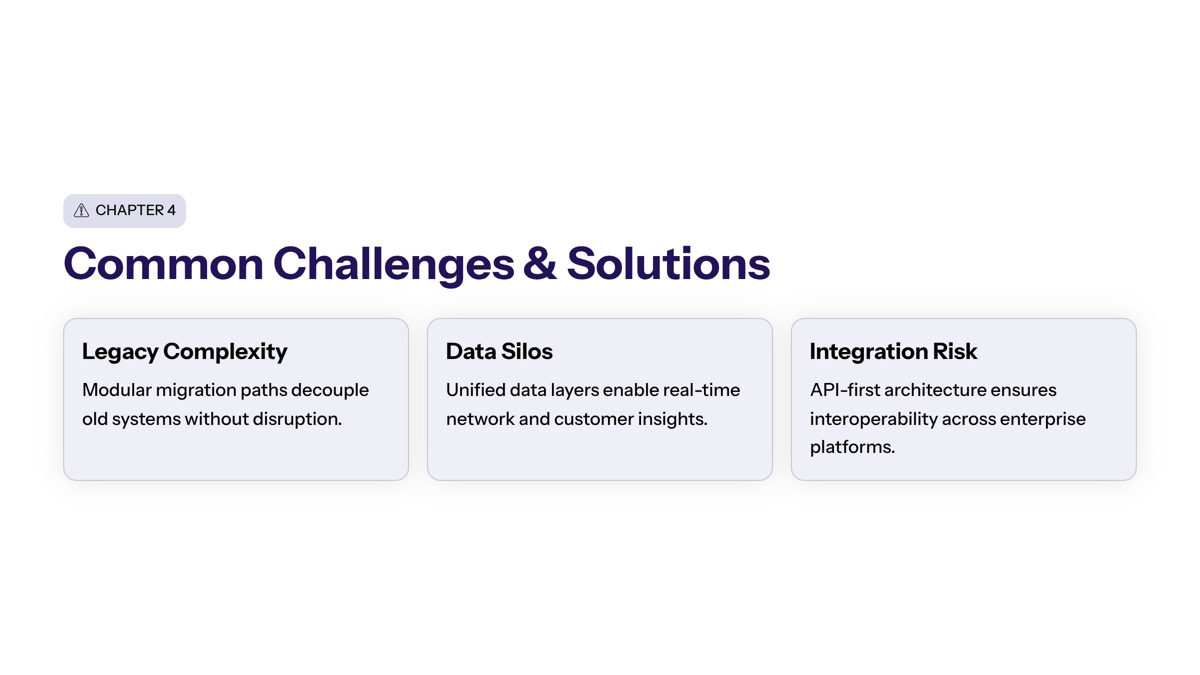
Telecom modernization has higher stakes than many enterprise digital transformation programs because network availability, regulatory compliance, customer trust, and public infrastructure obligations are involved. The most common challenges are legacy integration complexity, compliance risk, and scaling AI from pilot to production.
Legacy System Integration Complexity
The challenge is that telecom legacy systems are often decades old, poorly documented, tightly coupled, and deeply embedded in core business workflows. Replacing them too quickly can disrupt billing, provisioning, customer support, and network operations.
The solution is an API-first and event-driven integration strategy. Wrap legacy systems with stable interfaces, use progressive migration patterns, and build shared data services that allow new AI powered applications to operate alongside existing systems. This approach supports smooth integration while reducing operational risk.
Telecom leaders should also align software modernization with physical and network operations. Structured cabling systems, network installation, data center services, edge infrastructure, and cloud platforms all influence whether software modernization delivers real-world value.
Regulatory Compliance During Modernization
The challenge is that telecom companies operate under strict privacy, security, lawful access, data residency, and audit requirements. Cloud migration, AI integration, and generative AI applications can introduce new risks if governance is added too late.
The solution is security-first development and audit-ready architecture. Build encryption, access controls, identity management, logging, model explainability, data retention policies, and compliance reviews into the modernization roadmap. This is especially important for AI systems that analyze customer data, automate decisions, or support critical network management.
A strong AI consulting and ai software development services partner should provide frameworks for responsible AI, enterprise grade security, and ongoing maintenance. For telecom leaders, governance is not a blocker to innovation; it is what allows AI adoption to scale safely.
Scaling AI Across Telecom Operations
The challenge is that many AI pilots do not become enterprise-grade platforms. Common reasons include poor data quality, lack of MLOps, unclear ownership, high inference costs, model drift, disconnected workflows, and limited AI expertise.
The solution is to establish a production AI operating model. That includes AI engineers, data engineering teams, platform owners, model governance, automated monitoring, retraining workflows, and cost controls. AI systems should be evaluated on operational outcomes, not only model accuracy.
Telecom companies should also choose use cases that compound value. AI powered automation in network management can reduce downtime. Generative AI in customer support can enhance customer service. Machine learning in churn prediction can improve loyalty. AI in contract management can reduce operational costs. Together, these capabilities create scalable solutions and a durable competitive advantage.
Conclusion and Next Steps
Telecom innovations in 2026 are defined by AI-driven modernization, cloud-native operations, and enterprise platform integration. Operators that modernize legacy systems, integrate real-time data, deploy AI agents, and rethink customer experience will be better positioned to reduce cost, protect pricing power, and launch new services faster.
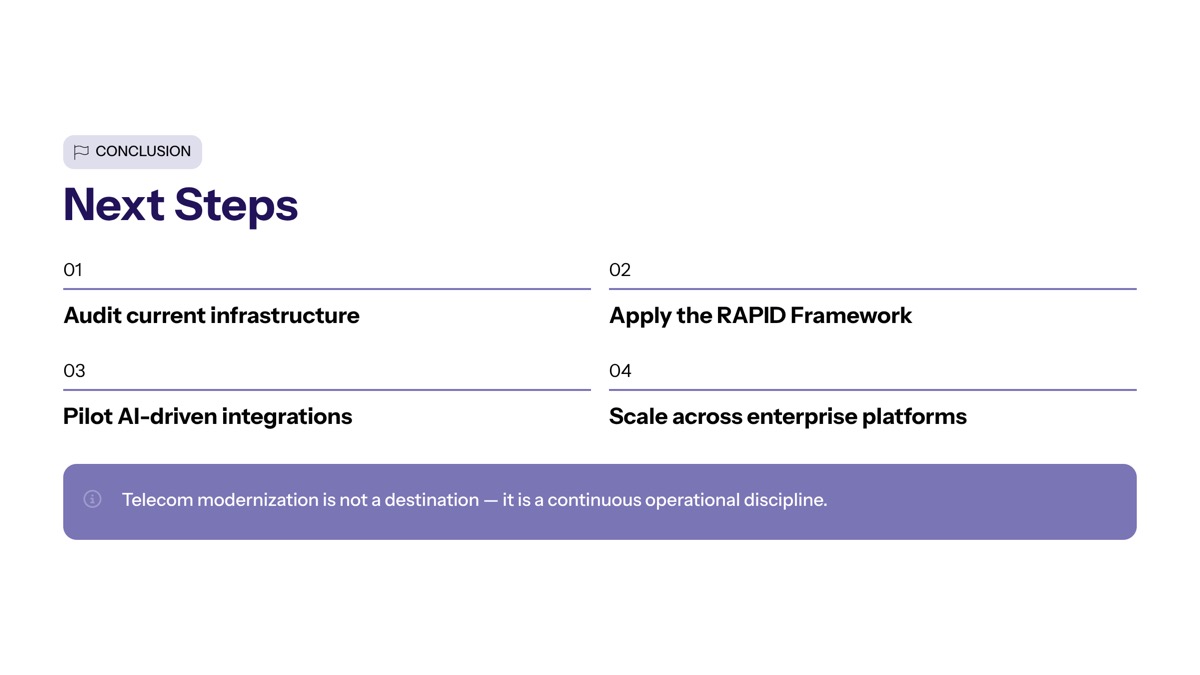
The immediate next steps are:
Assess current systems. Identify which OSS, BSS, CRM, billing, network management, and data platforms create the most operational friction.
Select high-value pilots. Prioritize AI projects in customer experience, predictive maintenance, network optimization, or contract automation where ROI can be measured quickly.
Design the modernization roadmap. Define cloud architecture, integration patterns, security requirements, data governance, and the role of custom ai development.
Build the right partnership model. Decide whether internal teams, an ai partner, an ai development company, or multiple ai software development companies will provide the required engineering expertise.
Scale through continuous improvement. Use performance monitoring, MLOps, customer metrics, and cost analytics to turn pilots into enterprise-grade capabilities.
Related topics worth exploring include telecom-specific compliance requirements, workforce training for AI adoption, private 5G and edge strategy, long-term technology strategy, and operating models for sustainable growth.
Additional Resources
For telecom leaders building modernization roadmaps, Cognativ’s telecom industry expertise can help connect AI strategy, enterprise platform integration, software development, and implementation planning.
Useful supporting resources include:
Cognativ RAPID framework implementation guidance for Recognize, Assess, Plan, Implement, and Deliver phases.
Telecom platform modernization case studies focused on OSS/BSS consolidation, cloud migration, AI integration, and ROI measurement.
AI readiness and ROI assessment tools for evaluating legacy systems, customer experience workflows, network management, and enterprise data maturity.