The Bottleneck Principle in Digital Transformation: How to Find the Constraint?
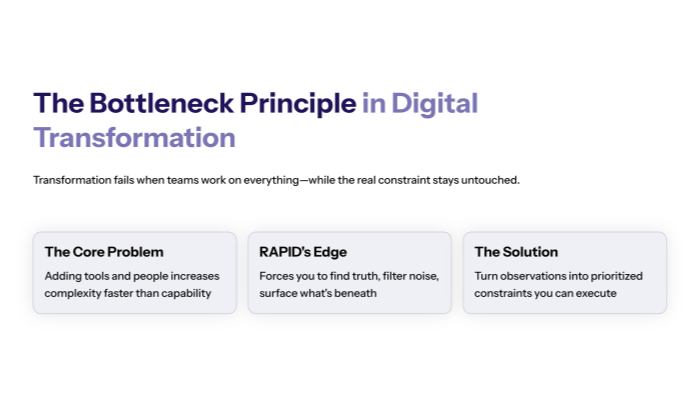
Most transformation programs don’t fail because teams aren’t working. They fail because teams are working on everything—and the real constraint stays untouched.
That’s the bottleneck principle in practice: your outcomes are limited by the system’s single biggest constraint. Until you identify and relieve that constraint, adding tools, hiring more people, or launching more initiatives often increases complexity faster than capability.
RAPID’s edge is that it forces you to find the truth (not the story), filter signal from noise, and turn observations into prioritized constraints. The Research + Analyze flywheel is designed to surface what’s “beneath the surface,” then feed better planning and decision-making.
This post is a practical guide to finding the bottleneck in digital transformation—fast, rigorously, and in a way your teams can execute.

1) Why transformation stalls at one constraint?
1.1 The “many problems” illusion
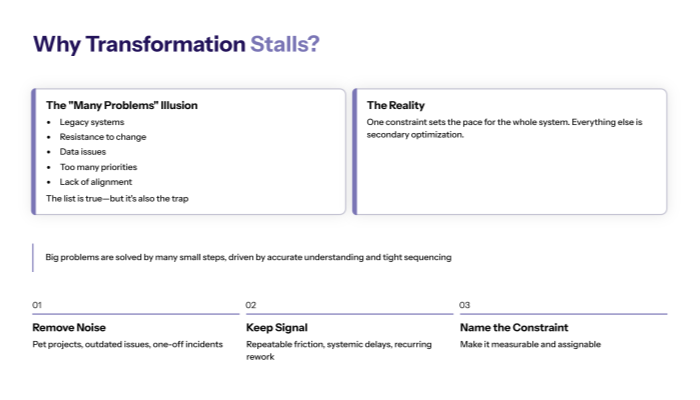
If you ask executives why transformation is slow, you’ll usually hear a long list:
- legacy systems
- resistance to change
- data issues
- too many priorities
- lack of alignment
- approvals
- “not enough capacity”
The list might be true—but it’s also the trap.
In most environments, there are multiple issues, but they don’t all carry the same weight. One constraint is usually setting the pace for the whole system (a major approval chokepoint, a broken handoff, unreliable reporting, a single overloaded team, or a skill concentration risk). Until you isolate that bottleneck in digital transformation, everything else is secondary optimization.
RAPID explicitly pushes against the “huge initiative” mindset: big problems are often solved by many small steps, one after the other, driven by accurate understanding and tight sequencing.
1.2 Why “Analyze” is where bottlenecks become visible?
RAPID draws a clean boundary: Research gathers, Analyze interprets. Analyze isn’t “more data.” It’s where you decide what matters—and what doesn’t.
In the book’s breakdown of Analyze, the first move is sorting everything into relevant and irrelevant, tossing what wastes time and resources, and keeping what helps pinpoint problems.
That’s exactly how you find the bottleneck in digital transformation:
- remove noise (pet projects, outdated issues, one-off incidents)
- keep signal (repeatable friction, systemic delays, recurring rework)
- turn that signal into a constraint you can name, measure, and assign
And RAPID adds a critical nuance: while many data points can be irrelevant, the human aspect is not—because you need to understand who does what, how they do it, and how committed they are to uncover culture and execution reality.
2) How RAPID finds the constraint?
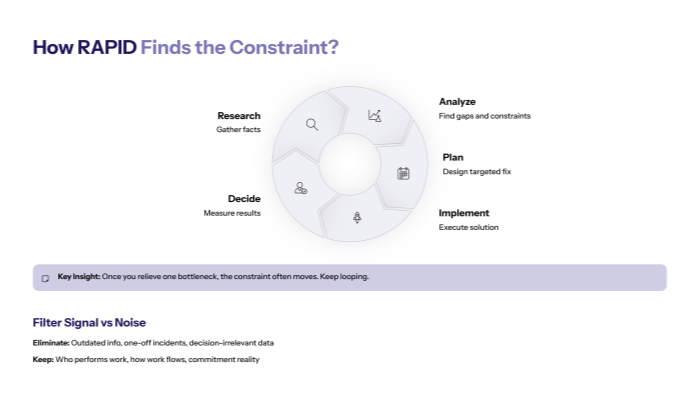
2.1 Use the Research → Analyze flywheel (not a one-time workshop)
RAPID is not a static process. It’s designed as two flywheels:
- Flywheel 1: Research + Analyze (explore and evaluate internal metrics)
- Flywheel 2: Plan, Implement, Decide (directives → outcomes)
The practical implication: you don’t “discover the constraint” once. You loop:
- gather facts
- analyze to find gaps/constraints
- plan and implement a fix
- decide based on measured results
- return to research/analyze if the constraint shifts or new gaps appear
That flywheel behavior is exactly how real bottlenecks behave: once you relieve one bottleneck in digital transformation, the constraint often moves somewhere else.
2.2 Filter signal: relevant vs irrelevant (with one exception)
RAPID’s Analyze instruction is straightforward: eliminate irrelevant data that wastes time—outdated information, one-off incidents that don’t affect the big picture, or noise that doesn’t change decisions.
But the book also warns you not to over-filter the human side. If you’re trying to locate the bottleneck in digital transformation and you ignore:
- who actually performs the work
- how the work truly flows
- what “commitment” looks like in practice
you’ll standardize or optimize the wrong thing.
RAPID frames this as an “iceberg” reality: most company problems sit beneath the surface, so you stick to relevant information to pinpoint what’s invisible and keep looping when Analyze reveals holes in your data collection.
3) The most common bottleneck patterns executives miss
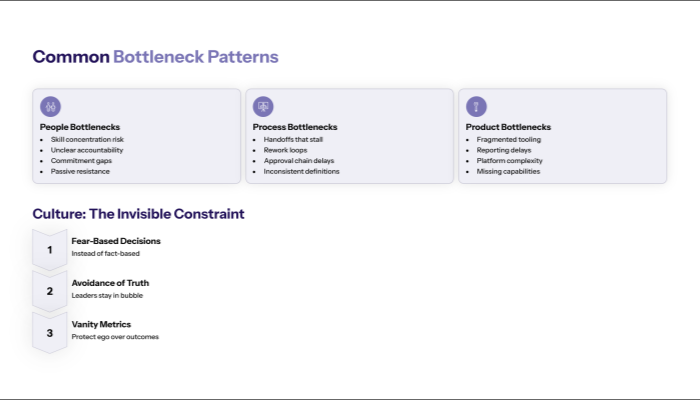
3.1 Bottlenecks across people, process, and product
RAPID repeatedly steers transformation away from vague blame and toward three variables: people, process, product. In the early run-down, it’s explicit that after analysis prompts how you’ll attack problems, planning must finalize the approach by zeroing in on these variables.
That gives you a practical constraint taxonomy:
People bottlenecks
- skill concentration (one person/team is the only “gateway” to progress)
- unclear accountability (nobody owns decisions)
- commitment gaps (passive resistance, misaligned incentives)
RAPID’s People Gap Analysis tool specifically calls out identifying skill concentration and adding it as a risk—because it creates fragility and bottlenecks.
Process bottlenecks
- handoffs that stall
- rework loops and inconsistent definitions
- approval chains that inflate cycle time
RAPID’s Process Gap Analysis is designed to translate research findings into specific process improvements—one department per line—aligned to customer value and outcomes.
Product/tool bottlenecks
- fragmented tooling creating reporting delays or duplicated work
- “platform” complexity that slows execution
- missing capabilities that teams work around manually
RAPID’s Product Gap Analysis is built to identify gaps in current products/tools and align each one to customer value and outcomes.
3.2 Culture as the invisible constraint
If your organization is “doing all the right things” on paper but execution is still slow, culture is often the hidden bottleneck in digital transformation.
RAPID is direct: culture can kill companies or save companies, and when consultants are called, it’s usually the former.
Culture becomes a constraint when it creates:
- fear-based decisions instead of fact-based decisions
- avoidance of truth (leaders stay inside the “bubble”)
- preference for vanity metrics that protect ego over outcomes
RAPID’s early chapters warn against being trapped in the bubble and emphasize that it removes doubt and fear by aligning actions around specific measurable outcomes rather than vanity metrics.
4) Make the bottleneck actionable: evidence → constraint → owner → next move
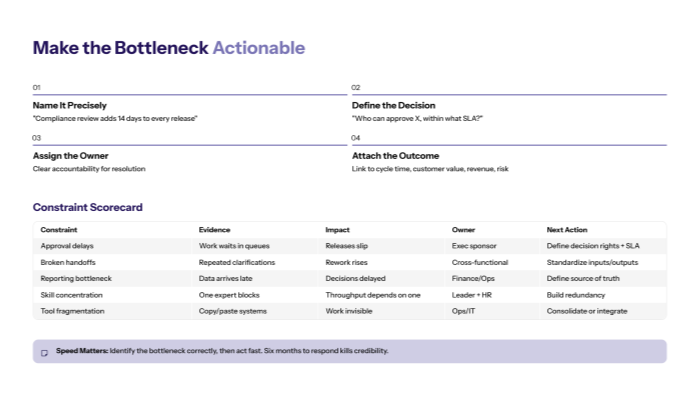
4.1 Convert the constraint into a “decision you can make”
A constraint you can’t act on is just a complaint.
RAPID’s Decision Inventory exists because “the hardest and most important management task is making decisions,” and it forces each decision to be posed as a question, assigned to an owner, and linked to outcomes and customer value.
That’s how you turn the bottleneck in digital transformation into movement:
- Name it precisely (“Compliance review adds 14 days to every release”)
- Define the decision that would change it (“Who can approve X, and within what SLA?”)
- Assign the owner (“Who?”)
- Attach the outcome it blocks (cycle time, customer value, revenue, risk)
RAPID also reinforces that decisions create momentum and don’t only happen at the end—they happen throughout every phase, and if a single decision never gets made, the outcome never happens.
4.2 Use a constraint scorecard (table) to prioritize fast
Use a simple “constraint candidate” table to avoid debate and accelerate prioritization.
|
Constraint candidate |
Evidence signals |
How it shows up |
Decision owner |
Next action |
|---|---|---|---|---|
|
Approval chain delays |
work waits in queues; escalations |
decision latency increases; releases slip |
exec sponsor / functional leader |
define decision rights + SLA |
|
Broken handoffs |
repeated clarifications; duplicate work |
rework rises; cycle time expands |
cross-functional owners |
standardize inputs/outputs |
|
Reporting bottleneck |
data arrives late; metrics don’t match |
decisions delayed; teams distrust dashboards |
finance/ops/data owner |
define source of truth + refresh cadence |
|
Skill concentration |
only one person can unblock |
throughput depends on one expert |
leader + HR |
build redundancy + training |
|
Tool fragmentation |
teams copy/paste between systems |
work invisible; rework and delays |
ops/IT leadership |
consolidate or integrate simply |
Then apply RAPID’s Analyze tools to formalize the gaps:
- People Gap Analysis
- Process Gap Analysis
- Product Gap Analysis
Finally, identify Easy Wins—low-hanging fruit designed to build confidence while delivering tangible improvements.
This step matters because the fastest way to lose credibility is to correctly identify the bottleneck in digital transformation and then take six months to act.
5) Constraint-first execution: fix, measure, repeat (without KPI theater)
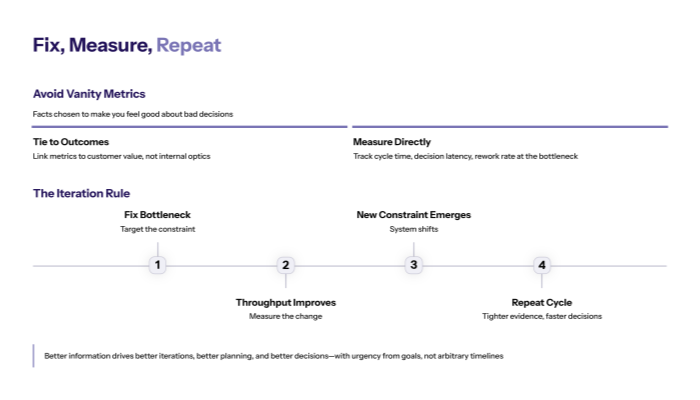
5.1 Avoid “vanity metrics” and force honest measurement
When organizations can’t face reality, they protect themselves with selective reporting. RAPID calls this out explicitly: vanity metrics are facts chosen to make you feel good about a decision that turned out to be bad—and relying on them blocks honest evaluation.
If you want to eliminate KPI theater, do two things:
- tie metrics to outcomes and customer value (not internal optics)
- measure the constraint directly (cycle time at the bottleneck, decision latency, rework rate)
This is also where the RAPID flywheel protects you: if measurement shows the fix didn’t change outcomes, you don’t “spin harder.” You return to Research/Analyze, adjust the plan, and decide again.
5.2 The iteration rule: bottlenecks move—so your baseline must evolve
RAPID emphasizes that it keeps improving itself: better information drives better iterations, better planning, and better decisions—working quickly with urgency that comes from goals, not arbitrary timelines.
In practice:
- you fix one bottleneck in digital transformation
- throughput improves
- a new constraint emerges
- you repeat the cycle with tighter evidence and faster decisioning
This is also why RAPID insists “problem-solving is creative” and the process is adaptable—each letter relies on the others to reduce friction and produce results.
Closing takeaway
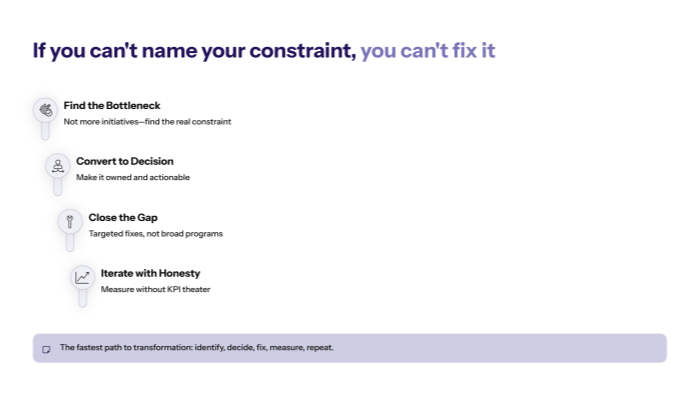
If you can’t name your constraint, you can’t fix it.
The fastest path to transformation is not “more initiatives.” It’s finding the bottleneck in digital transformation, converting it into an owned decision, closing the gap with targeted fixes, and iterating with honest measurement—without KPI theater and without tool-first fantasies.