The Data Bottleneck: Where Reporting Kills Execution
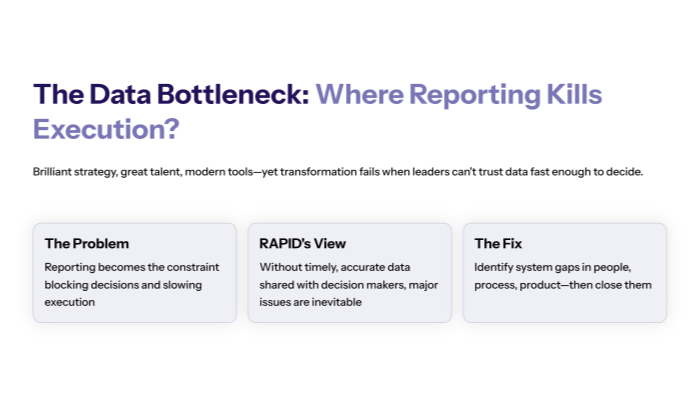
A digital transformation can have brilliant strategy, great talent, and modern tools—and still fail for one simple reason:
Leaders can’t trust the data fast enough to decide.
That’s the data bottleneck: when reporting becomes the constraint that blocks decisions, slows execution, and drives teams into workarounds. In RAPID terms, this is exactly where “reliable information” matters—because intuition isn’t enough, and decisions require factual grounding.
RAPID is unusually direct about this: if a company can’t get timely, accurate financial data and share it consistently with decision makers, major issues are inevitable. And the fix isn’t “more dashboards”—it’s identifying the system gaps (people, process, product) that corrupt the reporting chain, then closing them.
This post explains how to find and fix the data bottleneck without turning your transformation into a reporting project.

Section 1: Why the data bottleneck becomes the default constraint?
1.1 Reporting delays create decision latency (and decision latency kills momentum)
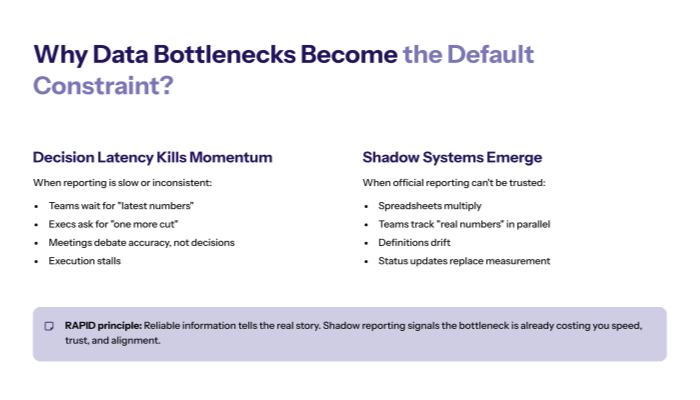
When reporting is slow or inconsistent, decision-making becomes cautious by default:
- teams wait for “the latest numbers”
- execs ask for “one more cut” of the report
- meetings become debates about accuracy instead of decisions
- execution stalls while everyone argues over reality
RAPID treats this as a fundamental operating problem: decisions are being made every day that affect value and viability, and without timely, accurate data shared appropriately with decision makers, “major issues are inevitable.”
So the data bottleneck isn’t an analytics problem. It’s an execution problem.
1.2 The most expensive part: teams build shadow systems to survive
When official reporting can’t be trusted, organizations do what they always do: adapt.
- spreadsheets appear
- teams track “the real numbers” in parallel systems
- definitions drift (“what counts as revenue?” “what is ‘done’?”)
- status updates replace measurement
RAPID’s Research phase emphasizes that “reliable information is what tells the real story” and that the right research provides the factual basis for moving forward.
Shadow reporting is your biggest signal that the data bottleneck is already active—and costing you speed, trust, and alignment.
Section 2: How RAPID diagnoses the data bottleneck ?(go to the source)
2.1 Start where the data is produced: “What system are you using for reports?”
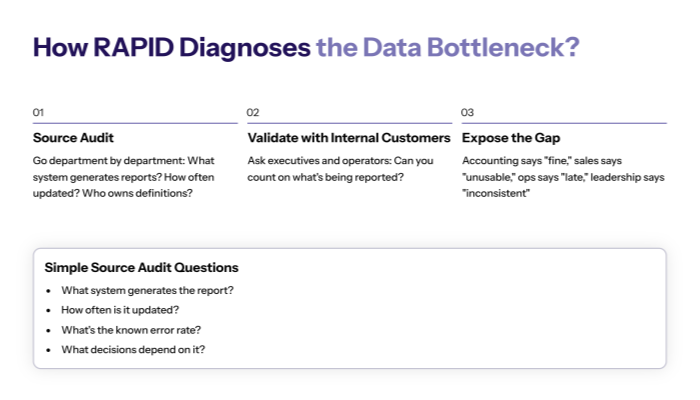
RAPID gives a very practical diagnostic method: go department by department and ask what system they use for reporting and how accurate and current the data is.
Use RAPID’s mindset here: Research gathers; Analyze sorts what’s relevant vs irrelevant and exposes what’s beneath the surface.
A simple “source audit” checklist:
- What system generates the report?
- How often is it updated?
- Who owns the data definition?
- What’s the known error rate / reconciliation gap?
- What decisions depend on it?
If you can’t answer those questions, you don’t have reporting—you have “report-shaped opinions.”
2.2 Then validate with internal customers: “Can you count on what’s being reported?”
RAPID’s next move is the one most teams skip: it treats executives and operators as internal customers of data, and it asks them whether the reporting is working, trustworthy, and sufficient for decision-making.
This is how you spot the real data bottleneck:
- accounting says data is “fine”
- sales says it’s unusable
- ops says it’s late
- leadership says it’s inconsistent week to week
RAPID even calls out how basic misunderstandings (like different time zones when running reports) can make leaders think they’re discussing “the same” numbers when they’re not.
That’s not a tooling gap. That’s an operating model gap.
Section 3: The root causes behind a data bottleneck (people, process, product)
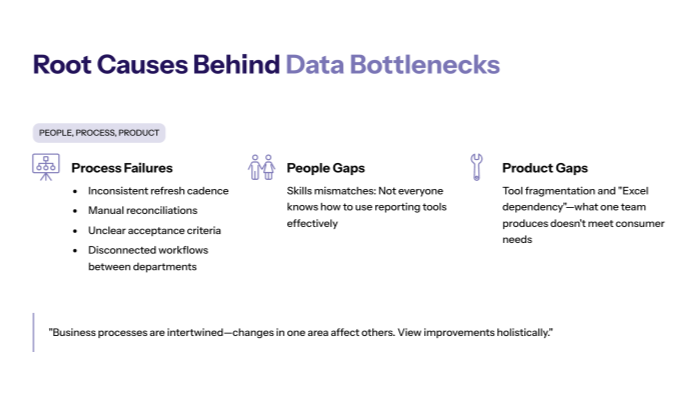
3.1 Process causes: the reporting chain is broken
Many data bottlenecks are process failures:
- inconsistent refresh cadence
- manual reconciliations
- unclear acceptance criteria for “valid” data
- disconnected workflows between departments (CRM not connected to shipping, for example)
RAPID is explicit that business processes are intertwined, and changes in one area affect others—so you need to view improvements holistically and connect processes that should obviously be connected.
If reporting spans departments, you’re only as fast as the slowest handoff in the reporting chain.
3.2 People + product causes: skills, tool fragmentation, and “Excel dependency”
RAPID points out that “internal product gaps” emerge when what one team produces doesn’t meet the needs of the teams consuming the data—and the fix can be process-oriented, tool-oriented, or sometimes just training.
A classic example in the book: a team uses Excel for forecasting, but not everyone knows how to use it—so the reporting process fails for human reasons, not technical ones.
That’s why RAPID insists you can’t fix the data bottleneck by talking only about tools. You have to examine the “holy trinity”: people, process, product.
Section 4: Fix the data bottleneck with RAPID gap analysis (make it executable)
4.1 Use Product + Process Gap Analysis to define “truth” and remove friction
Once the bottleneck is visible, RAPID pushes you to formalize gaps:
- Process Gap Analysis: where the reporting workflow fails, stalls, or loops
- Product Gap Analysis: where the reporting system/tooling fails to deliver reliable output
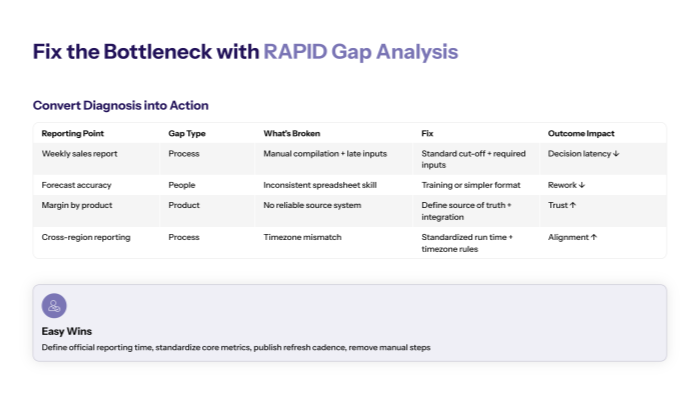
Use this table to convert diagnosis into action:
|
Reporting point |
Gap type |
What’s broken |
Fix |
Owner |
Outcome impact |
|---|---|---|---|---|---|
|
Weekly sales report |
Process |
manual compilation + late inputs |
standard cut-off + required inputs |
Sales Ops |
decision latency ↓ |
|
Forecast accuracy |
People |
inconsistent spreadsheet skill |
training or simpler format |
Sales lead |
rework ↓ |
|
Margin by product |
Product |
no reliable source system |
define source of truth + integration |
Finance/IT |
trust ↑ |
|
Cross-region reporting |
Process |
timezone mismatch |
standardized run time + timezone rules |
Finance |
alignment ↑ |
RAPID notes that where you have gaps, you’ll inevitably find friction between departments—and many friction points are “easy to fix,” especially with modern cloud environments.
4.2 Prioritize “easy wins” to restore trust quickly
If data is distrusted, transformation slows because every decision becomes political.
RAPID includes an “Easy Wins” tool for exactly this reason: pick low-effort, high-impact improvements that build confidence and create tangible results fast.
Examples of data-bottleneck easy wins:
- define one “official” weekly reporting time + timezone standard
- standardize 5–10 core metric definitions
- publish a simple refresh cadence and stick to it
- remove one manual reconciliation step by fixing an upstream input
Trust compounds. So does distrust. Easy wins are how you flip the direction.
Section 5: Prevent reporting from killing execution (make data a product)
5.1 Treat reporting like a product with internal customers
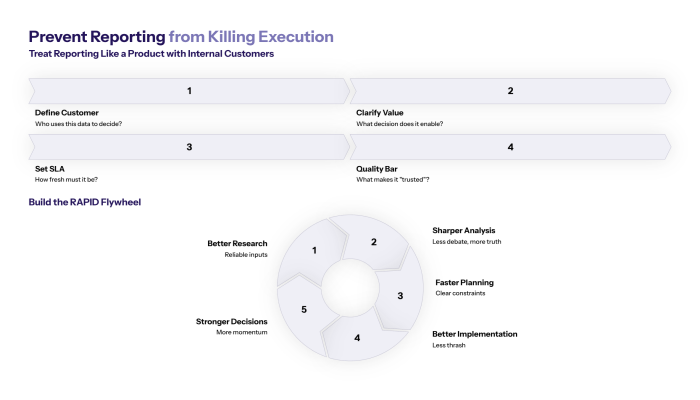
RAPID’s “internal customers” framing is the most practical way to keep reporting useful: the producers (finance/accounting/data) must serve the consumers (execs, sales, ops) with dependable output.
If you want to eliminate the data bottleneck, define:
- customer: who uses this data to decide?
- value: what decision does it enable?
- SLA: how fresh must it be to be useful?
- quality bar: what makes it “trusted”?
And keep it simple: RAPID repeatedly warns against the idea that technology should dictate strategy; if tech is involved, keep it simple.
5.2 Build the flywheel: reliable data → faster decisions → better outcomes
RAPID is a repeatable system of observation, learning, and course correction—not a one-time project.
When you fix the data bottleneck, you unlock the real RAPID loop:
- better research (reliable inputs)
- sharper analysis (less debate, more truth)
- faster planning (clear constraints)
- better implementation (less thrash)
- stronger decisions (more momentum)
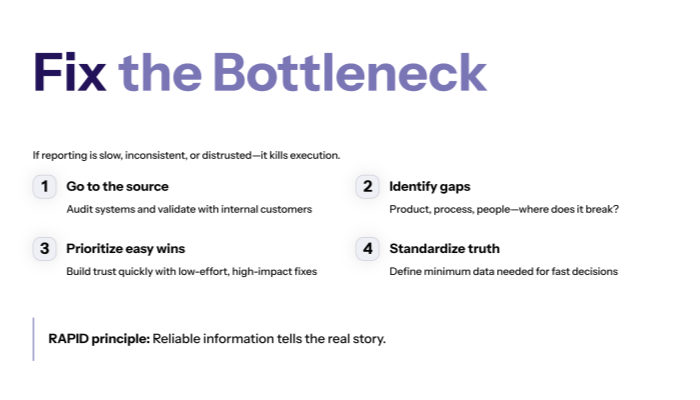
And it starts with a simple principle the book repeats: reliable information tells the real story.
Closing takeaway
If reporting is slow, inconsistent, or distrusted, it doesn’t just hurt analytics—it kills execution.
The data bottleneck is solved the RAPID way: go to the source, validate with internal customers, identify product/process/people gaps, prioritize easy wins, and standardize the minimum truth needed for decisions—fast.