The Minimum Viable Roadmap: 90 Days That Create Momentum
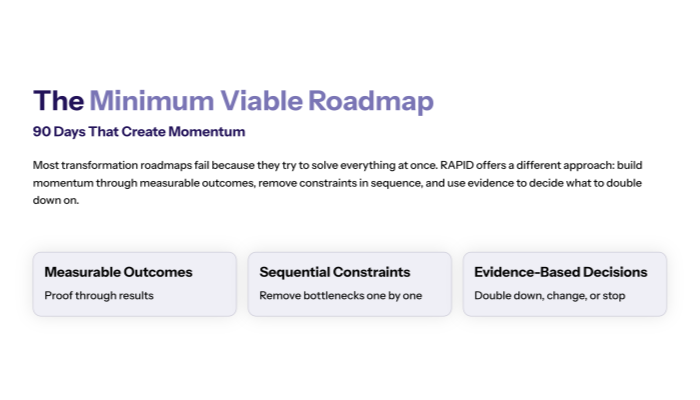
Most transformation roadmaps fail because they try to solve everything at once—over 12 to 24 months—before the organization has proven it can execute the basics.
RAPID offers a different approach: build momentum through measurable outcomes, remove constraints in sequence, and use evidence to decide what to double down on, what to change, and what to stop.
That’s what a minimum viable roadmap (MVR) is: a 90-day plan designed to create proof, trust, and execution cadence—without big-bang risk or initiative overload.
This post gives you a RAPID-aligned 90-day roadmap template that reliably creates momentum.

Why 90 days is the right window for a minimum viable roadmap?
1.1 Long roadmaps collapse under uncertainty (and fuel politics)
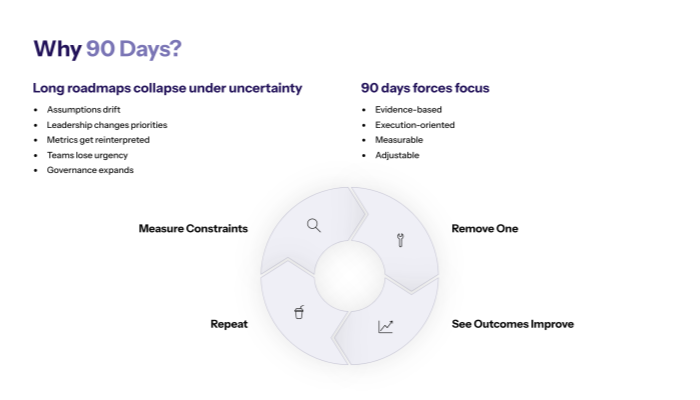
The longer the roadmap, the more it becomes a narrative exercise:
- assumptions drift
- leadership changes priorities
- metrics get reinterpreted
- teams lose urgency
- governance expands “to manage complexity”
RAPID’s system is built to avoid this by using iterative flywheels: Research/Analyze reveals truth and constraints, then Plan/Implement/Decide ships changes and re-decides based on results.
A 90-day window forces the roadmap to be:
- evidence-based
- execution-oriented
- measurable
- adjustable
1.2 Momentum is an operating system, not a motivational speech
RAPID is clear that complex problems are solved through many small steps. A minimum viable roadmap works because it creates a repeatable execution loop:
- measure constraints
- remove one
- see outcomes improve
- repeat
That loop builds trust faster than any workshop or slide deck.
Momentum becomes a system behavior, not a feeling.
The RAPID structure of a minimum viable roadmap
2.1 Outcomes first: define the “few” that matter most
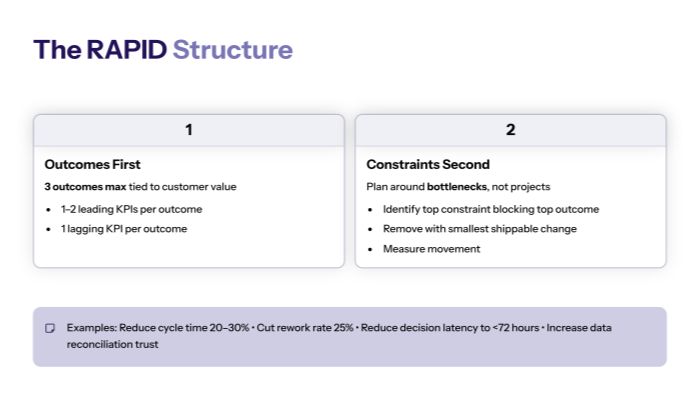
RAPID’s Outcomes tool is designed to document, validate, and rank outcomes tied to customer value—no duplicate ranks.
For a 90-day minimum viable roadmap, you usually want:
- 3 outcomes max
- 1–2 leading KPIs per outcome
- 1 lagging KPI per outcome (to confirm impact later)
Examples of 90-day outcomes (choose based on reality):
- Reduce cycle time by 20–30%
- Cut rework rate by 25%
- Reduce decision latency for top approvals to <72 hours
- Increase data reconciliation/trust rate to a defined threshold
The key is: the outcomes must be measurable and execution-ready, not aspirational.
2.2 Constraints second: plan around bottlenecks, not projects
A minimum viable roadmap is not “deliver 12 initiatives in 90 days.” It’s:
- identify the top constraint blocking the top outcome
- remove it with the smallest shippable change
- measure the movement
- move to the next constraint
RAPID’s Analyze discipline is built for exactly this: sort relevant vs irrelevant information, surface what’s beneath the surface, and convert observations into prioritized constraints.
When constraints are explicit, roadmap sequencing becomes obvious—and politics loses power.
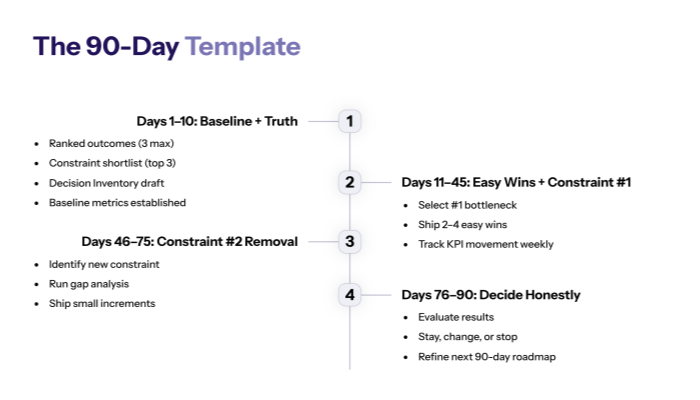
The 90-day minimum viable roadmap template (Week 1–12)
3.1 Phase 1 (Days 1–10): Baseline + truth you can trust
The purpose of the first 10 days is to establish a baseline strong enough to steer decisions. RAPID emphasizes that reliable information tells the real story—and that decisions require timely, accurate data shared appropriately.
Deliverables for Days 1–10
- Ranked outcomes (3 max) tied to customer value
- Constraint shortlist (top 3 bottlenecks)
- Decision Inventory draft (top decisions as questions + owners)
- Baseline metrics for:
- cycle time
- rework rate
- decision latency
- data reconciliation/trust (if relevant)
Rule: if you can’t measure it, you can’t steer it.
3.2 Phase 2 (Days 11–45): Easy wins + constraint #1 removal
RAPID includes “Easy Wins” for a reason: fast tangible progress builds confidence and unlocks deeper change.
Deliverables for Days 11–45
- One constraint selected as the #1 bottleneck
- Process/Product/People gap analysis for that constraint
- 2–4 “easy win” changes shipped
- KPI movement tracked weekly
Examples of easy-win constraint removals:
- standardize intake requirements (reduce rework fast)
- define decision SLAs and reduce approval layers (cut decision latency)
- unify one source-of-truth metric definition (restore data trust)
This phase is about proving the system can move.
Governance and KPIs that keep the roadmap alive
4.1 A minimum viable governance model (fast decisions, not committees)
RAPID treats decision-making as central: decisions happen throughout, and if they don’t happen, outcomes don’t happen.
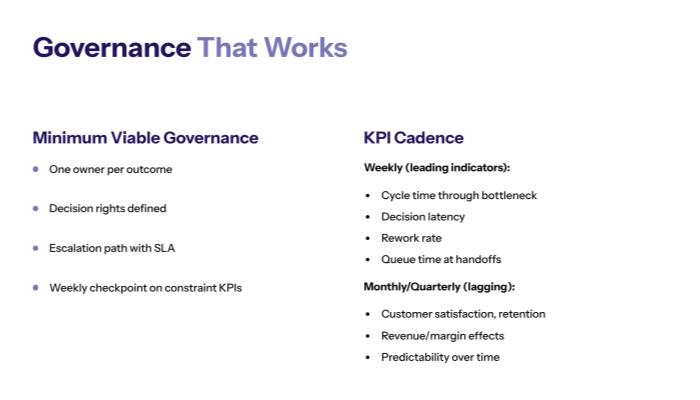
So the minimum viable roadmap needs a minimum viable governance model:
- one owner per outcome
- decision rights defined
- escalation path with SLA
- weekly checkpoint focused on constraint KPIs
RAPID’s Decision Inventory format supports this directly: decisions posed as questions, assigned owners, linked to outcomes/customer value, prioritized.
4.2 KPI cadence: leading indicators weekly, lagging indicators monthly/quarterly
To avoid KPI theater, track a small set of constraint metrics weekly:
- cycle time through the bottleneck
- decision latency
- rework rate
- queue time at handoffs
- data trust (if applicable)
RAPID warns against vanity metrics and stresses measurable evaluation of initiatives.
Then track lagging outcomes on a longer cadence:
- customer satisfaction, retention
- revenue/margin effects
- predictability over time
That keeps the roadmap steerable without drowning teams in reporting.
Day 46–90: scale what worked, stop what didn’t
5.1 Phase 3 (Days 46–75): constraint #2 removal (with better execution)
Once constraint #1 moves, the bottleneck shifts. The roadmap should shift too.
This is where the RAPID flywheel pays off:
- you already have measurement discipline
- you already have decision cadence
- you already built trust through wins
So you repeat the same structure:
- identify the new constraint
- run gap analysis
- ship small increments
- measure weekly
RAPID’s philosophy is continuous observation, learning, and course correction—like driving a car to a destination.
5.2 Phase 4 (Days 76–90): Decide honestly, stay, change, or stop
RAPID’s Decide discipline is explicit: evaluate results, then decide to stay, change, or stop based on what happened.
At the end of 90 days, your minimum viable roadmap should produce:
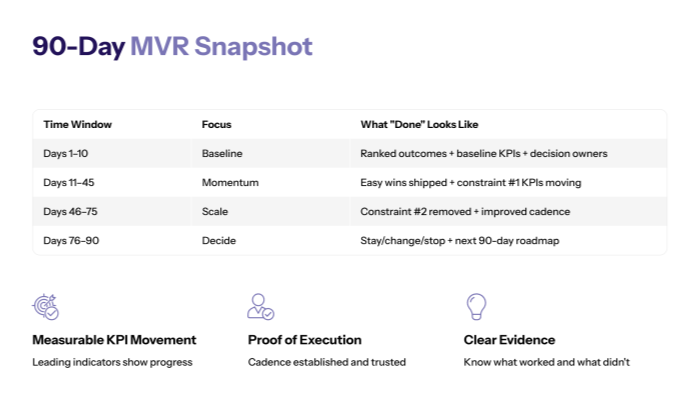
- measurable KPI movement (leading indicators)
- proof of execution cadence
- clear evidence of what worked
- a refined roadmap for the next 90 days (based on reality)
And just as importantly:
- initiatives that did not move outcomes should be changed or stopped—before they become permanent budget drains.
This is how you build transformation as an operating system.
A simple 90-day MVR snapshot (you can reuse)
|
Time window |
Focus |
What “done” looks like |
|---|---|---|
|
Days 1–10 |
Baseline |
ranked outcomes + baseline KPIs + decision owners |
|
Days 11–45 |
Momentum |
easy wins shipped + constraint #1 KPIs moving |
|
Days 46–75 |
Scale |
constraint #2 removed + improved cadence |
|
Days 76–90 |
Decide |
stay/change/stop + next 90-day roadmap |
Closing takeaway
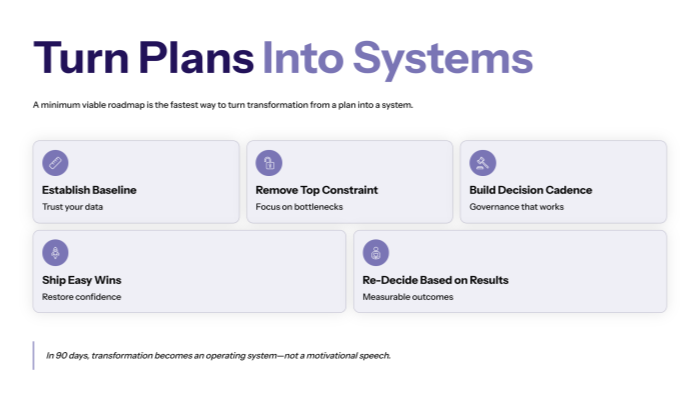
A minimum viable roadmap is the fastest way to turn transformation from a plan into a system.
In 90 days, you can:
- establish a baseline you trust
- remove the top constraint
- build decision cadence and governance
- ship easy wins that restore confidence
- re-decide based on measurable results