Transformation Delivery: Aligning Product, Ops, and IT Around Outcomes
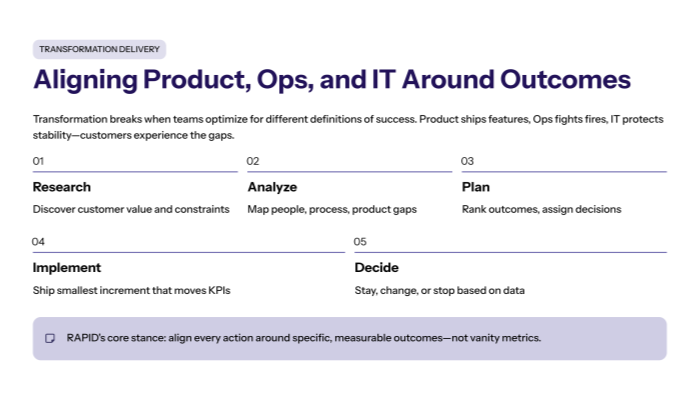
Transformation delivery breaks down when Product, Ops, and IT optimize for different definitions of “success.” Product ships features, Ops fights fires, IT protects stability—and the customer experiences the gaps between them.
RAPID’s core stance is simple: align every action around specific, measurable outcomes (not vanity metrics), then execute through an iterative flywheel of Research → Analyze → Plan → Implement → Decide.
This post is a practical playbook for aligning Product, Ops, and IT around outcomes so delivery becomes predictable, fast, and learning-driven.

Why transformation delivery fails at the seams?
1.1 “Everything is connected” (but most orgs plan in silos)
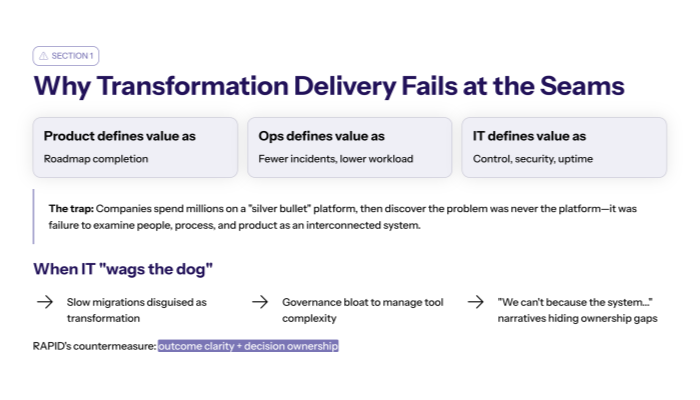
RAPID calls out the trap: companies spend millions on a “silver bullet” platform, then discover the problem was never the platform—it was failure to examine people, process, and product as an interconnected system.
That’s exactly what happens when Product, Ops, and IT run separate playbooks:
- Product defines “value” as roadmap completion
- Ops defines “value” as fewer incidents and lower workload
- IT defines “value” as control, security, and uptime
The result: each function makes rational choices locally… and the system degrades globally.
1.2 When IT “wags the dog,” delivery becomes a constraint
RAPID warns that IT can start “wagging the dog”—when the business exists to support technology instead of technology supporting the business. A key indicator is when leadership asks IT whether it can execute a business strategy (instead of leadership dictating strategy).
This isn’t anti-IT. It’s pro-delivery.
When strategy is constrained by tool limitations, delivery becomes:
- slow migrations disguised as transformation
- governance bloat to manage tool complexity
- “we can’t because the system…” narratives that hide real ownership gaps
RAPID’s countermeasure is outcome clarity + decision ownership.
The RAPID alignment model for delivery (Outcomes → Decisions → Work)
2.1 Start with Customer Value and Outcomes (one shared scoreboard)
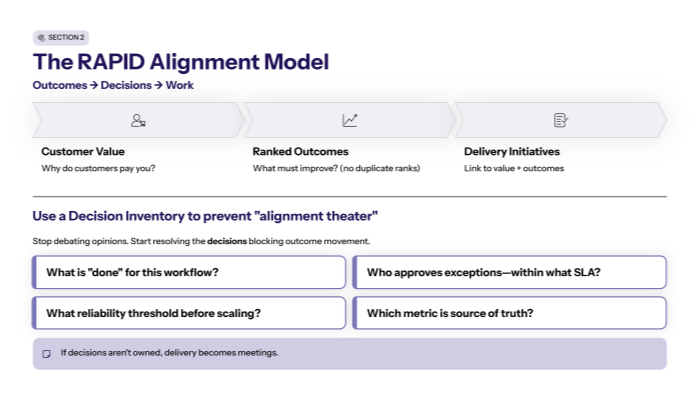
RAPID begins with a Customer Value inventory (“why do customers pay you?”) and then forces Outcomes to align to that value and be ranked (no duplicate ranks).
That’s the foundation for alignment: one scoreboard shared across Product, Ops, and IT.
If each function has a different scoreboard, you don’t have a transformation—you have three competing programs.
Practical rule: every delivery initiative must link to:
- at least one customer value
- at least one ranked outcome
2.2 Use a Decision Inventory to prevent “alignment theater”
RAPID calls decision-making “the hardest and most important management task,” and uses a Decision Inventory to list decisions as questions, assign owners, and prioritize them—linked to outcomes and customer value.
This is how you align Product, Ops, and IT in practice: you stop debating opinions and start resolving the decisions blocking outcome movement.
Example decisions that often stall delivery:
- “What is the definition of ‘done’ for this workflow?”
- “Who can approve exceptions—and within what SLA?”
- “What reliability threshold is required before scaling?”
- “Which metric is the source of truth?”
If those decisions aren’t owned, delivery becomes meetings.
A practical alignment blueprint for Product, Ops, and IT
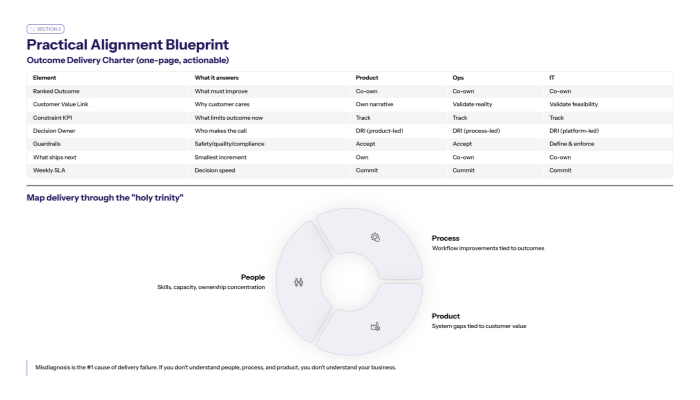
3.1 Build a shared “Outcome Delivery Charter” (one-page, actionable)
Use this table as a working artifact (keep it simple, update weekly):
|
Element |
What it answers |
Product |
Ops |
IT |
|---|---|---|---|---|
|
Ranked Outcome |
What must improve (measurable) |
Co-own |
Co-own |
Co-own |
|
Customer Value Link |
Why the customer cares |
Own narrative |
Validate reality |
Validate feasibility |
|
Constraint KPI |
What limits the outcome now |
Track |
Track |
Track |
|
Decision Owner |
Who makes the call |
DRI where product-led |
DRI where process-led |
DRI where platform-led |
|
Guardrails |
Safety/quality/compliance constraints |
Accept |
Accept |
Define & enforce |
|
“What ships next” |
Smallest increment that moves KPI |
Own |
Co-own |
Co-own |
|
Weekly SLA |
How fast decisions happen |
Commit |
Commit |
Commit |
This is straight from the RAPID logic: align around measurable outcomes, keep decisions explicit, and use small increments to reduce friction.
3.2 Map delivery through People / Process / Product gaps (so fixes aren’t misdiagnosed)
RAPID’s tools force you to analyze gaps across:
- People (skills/capacity concentration)
- Process (workflow improvements tied to outcomes and customer value)
- Product (system gaps tied to outcomes/customer value)
This matters because misdiagnosis is the #1 cause of delivery failure:
- Product wants a feature (product gap)
- Ops actually needs a standard (process gap)
- IT actually needs a skill/ownership shift (people gap)
RAPID’s “holy trinity” framing is explicit: if you don’t understand people, process, and product, you don’t understand your business.
Practical workflow:
- Identify the outcome that’s stalling
- Name the constraint KPI
- Decide whether the bottleneck is People, Process, or Product
- Ship the smallest change in that category
- Measure weekly, then Decide (stay/change/stop)
The delivery operating rhythm (how alignment stays real)
4.1 Run weekly delivery checkpoints driven by reliable data (not opinions)
RAPID stresses that reliable information tells the real story and the research/feedback loop must remain fluid—nothing operates in a frozen state.
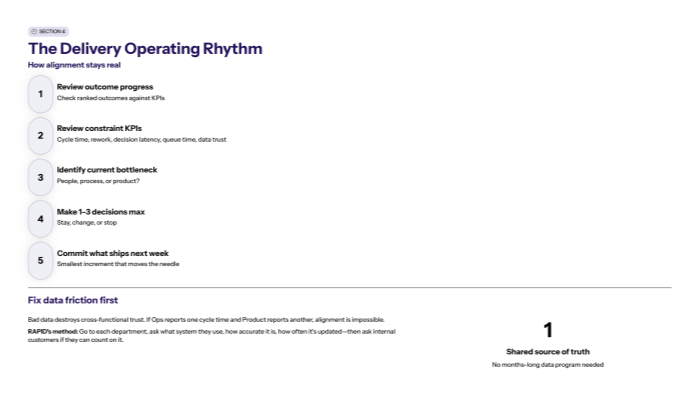
So alignment isn’t a one-time workshop. It’s an operating rhythm:
- review outcome progress
- review constraint KPIs (cycle time, rework, decision latency, queue time, data trust)
- identify the current bottleneck
- make 1–3 decisions max
- commit what ships next week
This is also where RAPID’s Decide logic becomes a weekly habit:
- stay
- change
- stop
4.2 Fix data friction first (because bad data destroys cross-functional trust)
RAPID is blunt: if a company can’t get timely, accurate financial data and share it transparently and appropriately with decision makers, major issues are inevitable.
In cross-functional delivery, “data friction” looks like:
- Ops reporting one cycle time, Product reporting another
- IT reporting uptime while Ops reports incident pain
- Finance reporting costs that don’t match what teams experience
RAPID’s method for resolving this is practical: go to each department, ask what system they use for reports, how accurate it is, how often it’s updated—then ask internal “customers” whether they can count on it.
That’s how you establish a shared source of truth without a months-long data program.
How to keep delivery moving? (ownership, simplicity, and Decide)
5.1 Keep the tech simple and outcome-serving (avoid “platform worship”)
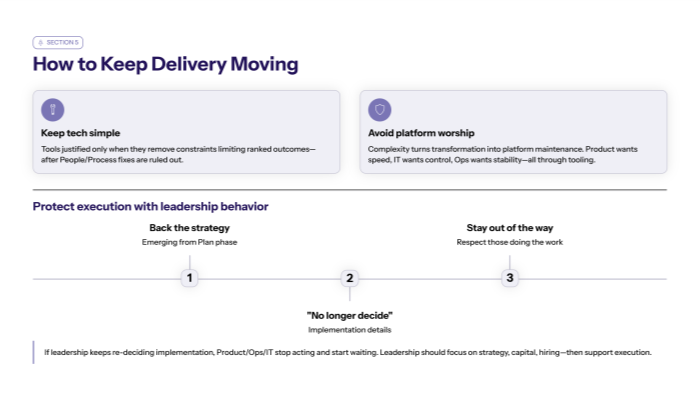
RAPID’s guidance is explicit: if tech is involved, keep it simple—because complexity turns transformation into platform maintenance.
This is where Product, Ops, and IT often misalign:
- Product wants speed through tooling
- IT wants control through tooling
- Ops wants stability through tooling
The RAPID reframe: tools are justified only when they remove the constraint limiting a ranked outcome—and when People/Process fixes aren’t the real answer.
5.2 Protect execution with leadership behavior: back the strategy, then “no longer decide”
RAPID highlights two critical management decisions:
- back the strategy emerging from Plan
- decide to “no longer decide” implementation details
That second decision is what protects delivery alignment. If leadership keeps re-deciding implementation, Product/Ops/IT stop acting and start waiting.
And RAPID is blunt about interference: if a CEO won’t stay out of the way and respect those doing the work, progress can stall or reverse—leadership should focus on strategy, capital, hiring, then support execution.
Finally, use Decide continuously: honest assessment, don’t rely on vanity metrics, and stay/change/stop based on real impact.
Closing takeaway
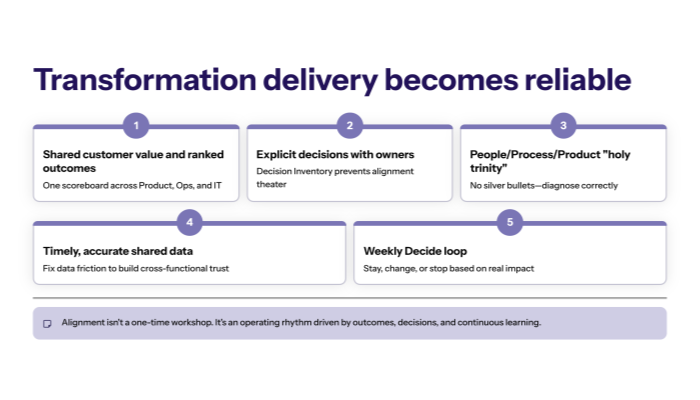
Transformation delivery becomes reliable when Product, Ops, and IT align around:
- shared customer value and ranked outcomes
- explicit decisions with owners (Decision Inventory)
- the people/process/product “holy trinity” (no silver bullets)
- timely, accurate shared data
- a weekly Decide loop: stay/change/stop