Transformation Governance: Decision Rights, Escalations, and Owners
Transformation governance is usually where good intentions go to die.
Not because governance is bad—but because most governance models are built for control, not execution. They add approvals, committees, and reporting layers until decision latency becomes the real bottleneck.
RAPID treats this differently. It makes governance practical: decisions are posed as questions, tied to outcomes and customer value, assigned owners, prioritized, and revisited based on measurable results. In other words: governance exists to speed up truth-based decisions, not to slow down risk.
This post gives you a RAPID-aligned model for transformation governance built on three fundamentals:
- decision rights
- escalations
- owners

Why transformation governance becomes a bottleneck?
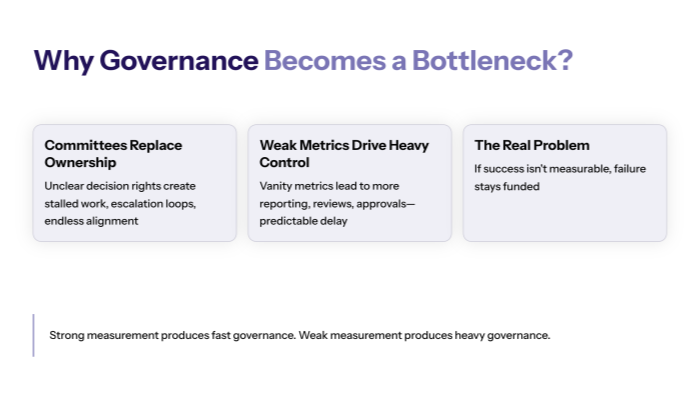
1.1 Governance fails when it replaces ownership with committees
Committees are often a symptom of unclear decision rights:
- nobody wants to own the call
- teams fear blame
- leaders want cover
So decisions get “socialized” instead of made.
RAPID’s framing helps here: decisions are central, they happen throughout transformation, and if a critical decision never gets made, the desired outcome never happens.
When governance doesn’t assign ownership, it creates:
- stalled work
- escalation loops
- endless “alignment”
- predictable delay
1.2 Governance gets worse when metrics aren’t decision-grade
If leadership can’t trust the signals, governance compensates with more control:
- more reporting
- more reviews
- more approvals
RAPID explicitly warns against vanity metrics—facts selectively chosen to feel good about decisions that may be wrong. And it emphasizes that if success isn’t measurable, you can’t evaluate initiatives, which means failure stays funded.
So weak measurement produces heavy governance. Strong measurement produces fast governance.
The RAPID model: governance as a decision system
2.1 Use a Decision Inventory (not a steering committee agenda)
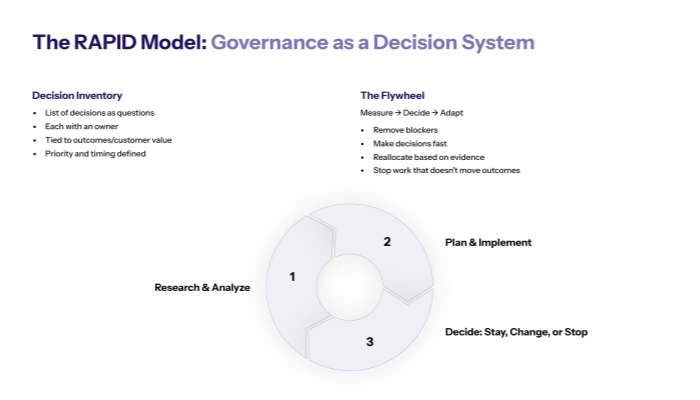
RAPID’s Decision Inventory is built to identify decisions that drive outcomes and customer value, assign owners, prioritize decisions, and document what must be decided.
That changes governance from “status review” to “decision execution.”
The governing unit becomes:
- a list of decisions (as questions)
- each with an owner
- each tied to an outcome/customer value
- each with priority and timing
Example governance questions:
- “Who owns the definition of done for intake?”
- “What decisions can be made within guardrails, and by whom?”
- “Which metrics are official source-of-truth for weekly steering?”
- “What gets stopped if cycle time doesn’t improve in 30 days?”
If your governance meeting doesn’t end with decisions, it’s not governance—it’s theater.
2.2 Governance must align with the flywheel: measure → decide → adapt
RAPID is an iterative system: you research and analyze, then plan and implement, and then decide based on results—stay, change, or stop.
Governance exists to keep that loop running:
- remove blockers
- make decisions fast
- reallocate resources based on evidence
- stop work that doesn’t move outcomes
This makes governance lighter over time, because outcomes become measurable and decision-making becomes normal.
Decision rights (who decides what—and why it matters)
3.1 Define decision rights at the level of outcomes, not org titles
In most organizations, “decision rights” are implied by hierarchy. In transformations, that breaks—because the work crosses departments.
RAPID’s approach forces decision rights to be explicit because decisions are linked to outcomes and customer value.
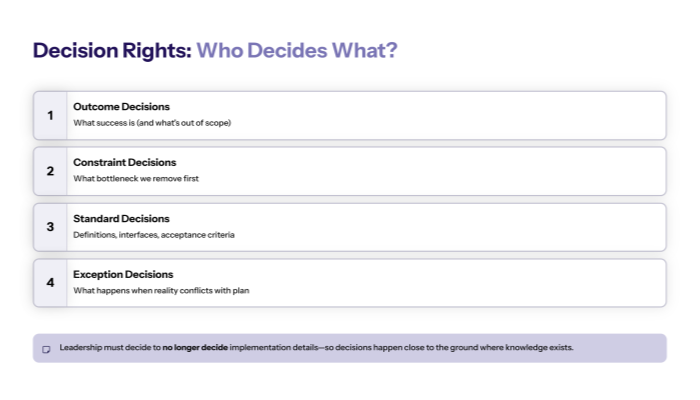
A useful decision-rights categorization:
- Outcome decisions: what success is (and what is out of scope)
- Constraint decisions: what bottleneck we remove first
- Standard decisions: definitions, interfaces, acceptance criteria
- Exception decisions: what happens when reality conflicts with the plan
If you don’t define these, everything escalates and decision latency becomes the bottleneck.
3.2 The “leadership must decide to no longer decide” principle
RAPID highlights a critical leadership shift: once leadership backs the strategy, management must decide to “no longer decide” implementation details—so decisions happen close to the ground where knowledge exists.
This is the difference between governance that enables execution vs governance that strangles it.
Good governance:
- defines outcomes and guardrails
- assigns owners
- holds teams accountable to results
- stays out of the way on execution details
Bad governance:
- demands approvals for everything
- overrides teams constantly
- slows flow and kills initiative
Escalations (how to keep exceptions from becoming paralysis)
4.1 Escalation is a process, not a panic button
In transformation, exceptions are guaranteed:
- compliance edge cases
- legacy system limitations
- customer-specific constraints
- capacity shortfalls
If escalations aren’t designed, they become:
- Slack chaos
- meeting storms
- backchannel lobbying
- stalled work
RAPID makes the principle clear: decision-making is the hardest management task, and outcomes depend on decisions happening.
So escalation must be engineered:
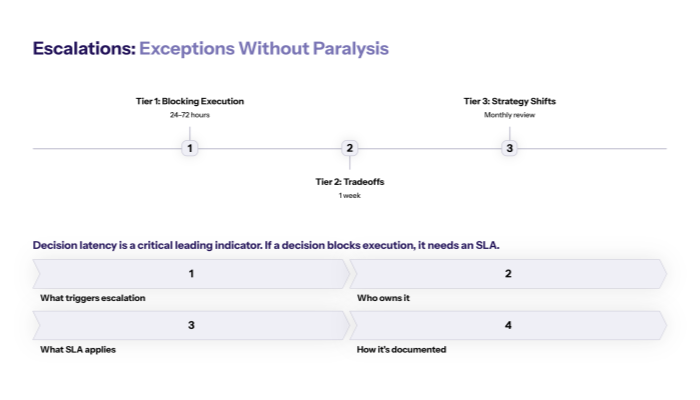
- what triggers escalation
- who is the escalation owner
- what SLA applies
- how the decision is documented and communicated
4.2 Escalation SLAs: the simplest way to reduce decision latency
Decision latency is one of the most important leading indicators in transformation governance.
A practical rule:
- If a decision blocks execution, it needs an SLA.
Example escalation SLA model:
- Tier 1 decisions (blocking execution): 24–72 hours
- Tier 2 decisions (tradeoffs): 1 week
- Tier 3 decisions (strategy shifts): monthly review
Then tie SLA breaches to governance action:
- if SLA is missed twice → governance redesigns decision rights
- if SLA is missed repeatedly → stop the initiative until rights are clarified
This supports RAPID’s “stay/change/stop” discipline based on measurable reality.
Owners (accountability that actually moves the system)
5.1 Every outcome needs one owner (or it isn’t real)
Transformation fails when accountability is diluted:
- “shared responsibility”
- “cross-functional ownership”
- “everyone is accountable”
That’s how nothing happens.
RAPID’s Decision Inventory forces explicit ownership: each decision needs an owner, and each decision links back to outcomes and customer value.
Governance should apply the same rule to outcomes:
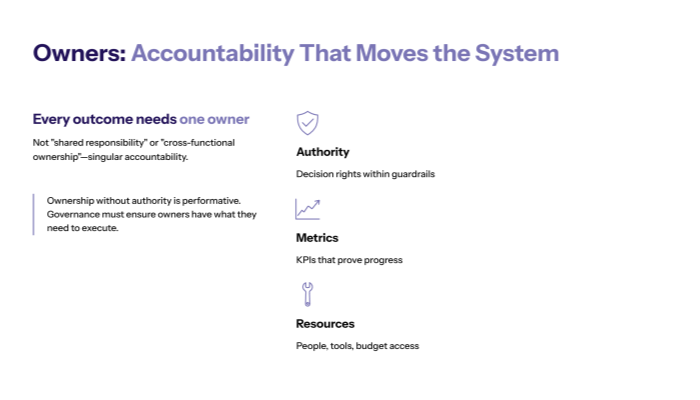
- one accountable owner per outcome
- supporting stakeholders can contribute
- but ownership is singular
Without that, governance becomes coordination instead of execution.
5.2 Owners need authority + metrics + resources
Ownership without authority is performative.
RAPID emphasizes that to reach desired outcomes, you may need to obtain resources (including people, tools, and budget) and that insufficient resources can slow momentum.
So governance must ensure owners have:
- decision rights within guardrails
- KPIs that prove progress (leading + lagging)
- access to required resources
- a path to escalate exceptions quickly
This is how governance stops being “oversight” and becomes “enablement.”
Closing takeaway
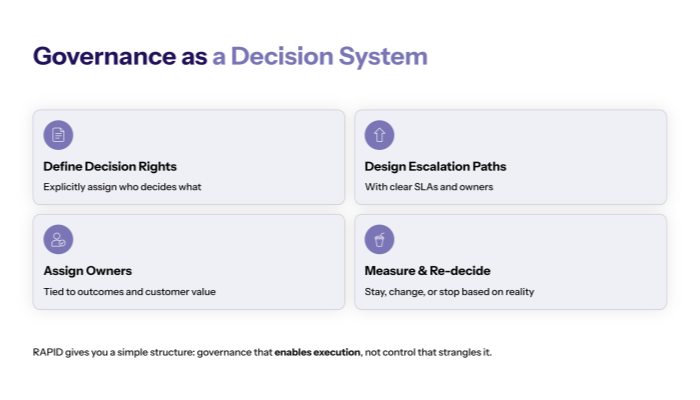
Transformation governance should be a decision system, not a control system.
RAPID gives you a simple structure that works:
- define decision rights explicitly
- design escalation paths with SLAs
- assign owners tied to outcomes and customer value
- measure results and re-decide (stay/change/stop) based on reality