Transformation Risk: How to Identify Failure Modes Early
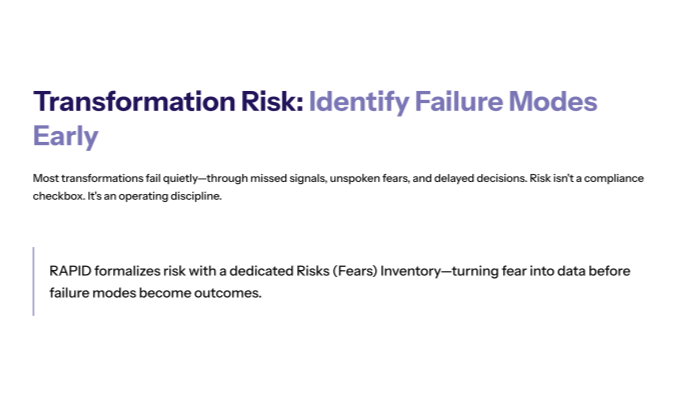
Most transformations don’t “fail” in a dramatic moment. They fail quietly—through missed signals, unspoken fears, delayed decisions, and metrics that look fine until reality arrives.
That’s why digital transformation risk needs to be treated like an operating discipline, not a compliance checkbox. In RAPID, risk isn’t something you discuss at the end. It’s something you surface early (Research), interpret honestly (Analyze), and continuously revisit as you Plan, Implement, and Decide.
RAPID even formalizes this with a dedicated Risks (Fears) Inventory—explicitly designed to turn fear into data and remove emotion—so you can identify failure modes before they become outcomes.

Why digital transformation risk is usually invisible until it’s expensive?
1.1 The “bubble” effect: leaders lose signal before they lose revenue
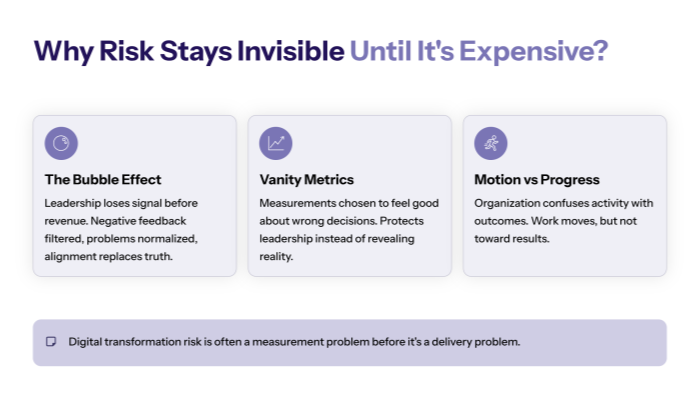
One of the earliest failure modes is the bubble: leadership can’t see the forest for the trees, bureaucracy grows, people become afraid to speak up, and decisions get defended for ego instead of corrected for truth.
Inside that bubble, digital transformation risk becomes hard to detect because:
- negative feedback is filtered
- problems are normalized (“we’ve always done it this way”)
- “alignment” replaces truth
- the organization confuses motion with progress
The work still moves—just not toward outcomes.
1.2 Vanity metrics: the most common early-warning failure
Another early failure mode is measurement theater.
RAPID explicitly warns against vanity metrics: measurements selectively chosen to make you feel good about a decision that’s actually wrong, often used to protect leadership instead of reveal reality.
This matters because digital transformation risk is often a measurement problem before it’s a delivery problem. If you can’t measure the success of initiatives in tangible ways, you’ll keep funding failure longer than you should.
Use RAPID Research to surface failure modes early (before you plan)
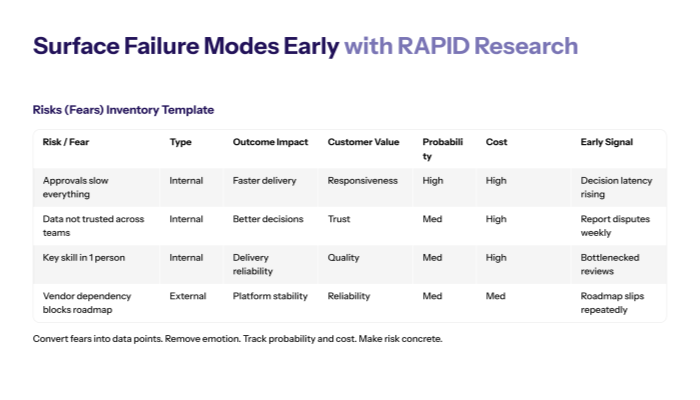
2.1 Build a Risks (Fears) Inventory to turn fear into actionable data
RAPID’s Risks (Fears) Inventory exists for a reason: convert fears and risks into fuel and results by turning them into data points (internal/external, probability, cost) and removing the emotion.
This is how you identify failure modes early—without relying on politics or vibes.
Here’s a practical template (aligned to the RAPID columns):
|
Risk / Fear statement |
Internal / External |
Outcome impacted |
Customer value impacted |
Probability |
Cost (financial / reputational / customer) |
Early signal |
|---|---|---|---|---|---|---|
|
“Approvals will slow everything down” |
Internal |
Faster delivery |
Responsiveness |
High |
High (cycle time, churn) |
decision latency rising |
|
“Data won’t be trusted across teams” |
Internal |
Better decisions |
Trust |
Med |
High |
report disputes weekly |
|
“Key skill is concentrated in 1 person” |
Internal |
Delivery reliability |
Quality |
Med |
High |
bottlenecked reviews |
|
“Vendor dependency blocks roadmap” |
External |
Platform stability |
Reliability |
Med |
Med |
roadmap slips repeatedly |
This makes digital transformation risk concrete: you can rank it, assign it, and track it.
2.2 Use Process + Product Inventories to locate risk “in the flow”
RAPID’s Process Inventory and Product Inventory both ask you to explicitly record whether a process/product contributes to risks and whether compliance is involved.
That’s an underrated advantage for managing digital transformation risk: you stop treating risk as an abstract enterprise topic and start tying it to where work actually happens.
Examples of “risk in the flow”:
- a critical process has no clear owner → failure mode: silent backlog + rework loops
- a key tool is tied to compliance but poorly understood → failure mode: teams bypass it
- multiple departments use the same product differently → failure mode: data mismatch and distrust
When risk is mapped directly to process/tool usage, you can see where a failure mode will originate—before it escalates.
The most common failure modes (and the signals that appear first)
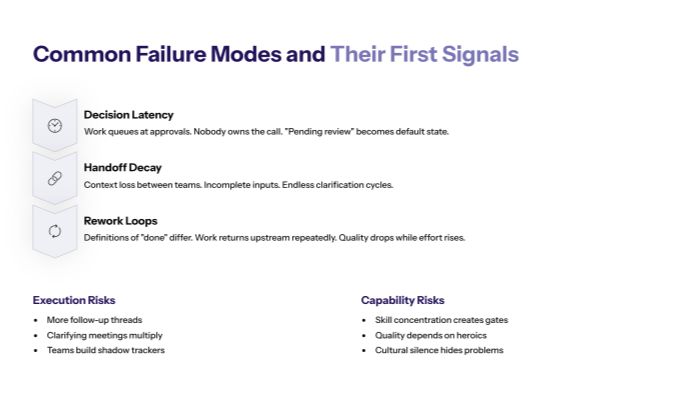
3.1 Execution failure modes: decision latency, handoff decay, and rework
These are the failure modes that quietly eat throughput:
- Decision latency: work queues at approvals; nobody owns the call
- Handoff decay: context loss between teams; incomplete inputs; endless clarification cycles
- Rework loops: definitions of “done” differ; work returns upstream repeatedly
The “first signals” are usually:
- more follow-up threads and clarifying meetings
- “pending review” becomes a default state
- quality drops while effort rises
- teams build shadow trackers to survive
In RAPID terms, this is exactly why decisions must be treated as a momentum system: decisions happen throughout, and if even one critical decision never gets made, the outcome doesn’t happen.
3.2 Capability failure modes: skill concentration and cultural silence
Some failure modes aren’t technical at all—they’re human system risks.
RAPID’s People Gap Analysis explicitly calls out skill concentration as something you must identify and add as a risk.
That’s because skill concentration creates predictable digital transformation risk patterns:
- one person becomes a throughput gate
- quality depends on heroics
- bottlenecks become “normal”
- the organization can’t scale execution
Pair that with the “bubble” dynamic—where staff are afraid to speak up—and you get a dangerous combination: the people who see the failure early don’t feel safe naming it.
Reduce digital transformation risk by designing decisions, not just plans
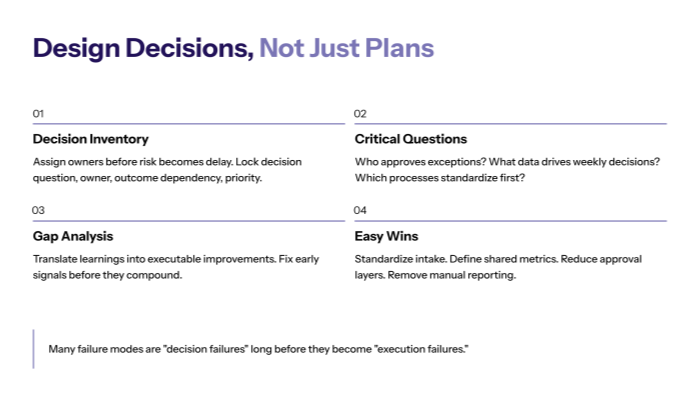
4.1 Decision Inventory: assign owners before risk becomes delay
RAPID treats decision-making as the hardest and most important management task, and the Decision Inventory is built to identify the decisions that drive outcomes and customer value.
For digital transformation risk, this is critical: many failure modes are “decision failures” long before they are “execution failures.”
Use a decision inventory to lock:
- decision question
- owner
- outcome dependency
- priority
- (optional) decision date
Example decisions that reduce risk early:
- “Who can approve exceptions within guardrails (and in what SLA)?”
- “What is the minimum data required to make weekly decisions?”
- “Which processes must be standardized first to reduce rework?”
This prevents risk from turning into waiting.
4.2 Gap analysis + easy wins: fix the early signals before they compound
RAPID’s Analyze tools (Process Gap Analysis, Product Gap Analysis, Easy Wins) exist to translate what you learned into executable improvements, then build confidence with low-hanging wins.
That matters because digital transformation risk compounds. If you ignore early signals (rework, delay, distrust), you’ll eventually “solve” them with expensive interventions:
- reorganizations
- vendor swaps
- platform rebuilds
- leadership escalations
Easy wins are how you reverse the momentum while it’s still cheap:
- standardize intake requirements
- define 5–10 shared metric definitions
- reduce approval layers by assigning decision rights
- remove one manual reporting step by fixing upstream inputs
Sustain early detection (measure honestly, then decide: stay, change, stop)
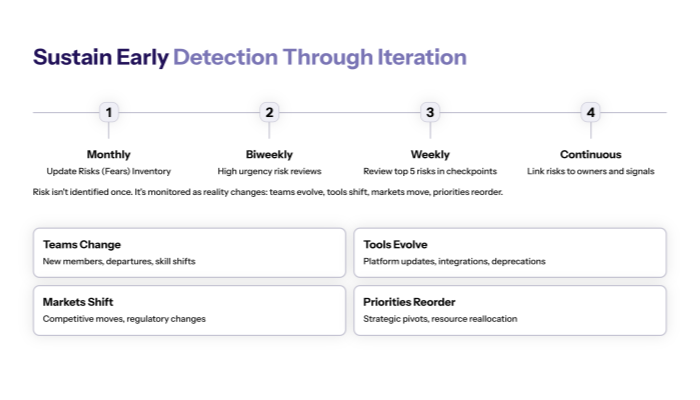
5.1 Treat risk as iterative reality, not a one-time assessment
RAPID is explicitly a fluid process: you measure results after implementation and “re-decide” as the process proceeds.
That means digital transformation risk is not “identified once.” It’s monitored as reality changes:
- teams change
- tools evolve
- market conditions shift
- priorities reorder
So your risk review cadence should be short and operational:
- update the Risks (Fears) Inventory monthly (or biweekly in high urgency)
- review the top 5 risks in weekly checkpoints
- link each risk to an owner and a measurable signal
5.2 Decide with integrity: avoid vanity metrics and make the hard calls
RAPID’s Decide logic is simple and brutal: stay, change, or stop—based on results, not narratives.
This is where many transformations fail: leadership uses vanity metrics to keep moving down a dead-end road instead of admitting the plan is wrong. RAPID calls that out directly—and frames honest assessment as the thing that saves companies, not hurts them.
So the final early-warning rule is this:
- If you can’t name the failure modes,
- assign owners,
- track leading signals,
- and re-decide honestly…
…then digital transformation risk is already winning.