Transportation IT Solutions: Custom Software for Modern Supply Chain Management
Transportation IT solutions are integrated software systems that help transportation companies optimize fleet management, logistics coordination, route planning, shipment execution, and supply chain visibility. For leaders managing complex transportation operations, these platforms connect planning, dispatch, warehouse activity, carrier communication, compliance, and real time tracking into one operational control layer.
This article focuses on custom enterprise transportation software, multimodal logistics platforms, routing optimization systems, and integration challenges for mid-market and enterprise organizations. It is written for transportation executives, logistics directors, fleet managers, and IT leaders evaluating modernization beyond disconnected tools, spreadsheets, aging ERPs, or isolated transportation management systems. It does not provide a generic comparison of every off-the-shelf platform; instead, it explains where custom software solutions create value when logistics operations are too complex for standard products.
Transportation IT solutions are custom-built software platforms that integrate TMS, WMS, fleet management, and routing systems to provide real-time visibility and operational control across multimodal transportation networks.
By the end, transportation leaders will understand how these systems support:
Reduced transportation costs through route optimization, carrier selection, and better asset utilization
Improved delivery performance with real time visibility, GPS tracking, and predictive ETAs
Stronger regulatory compliance across DOT, customs, safety, emissions, and audit requirements
Streamlined carrier management through integrated communication, performance tracking, and contract optimization
Measurable ROI through connected workflows across transportation management, warehouse management, fleet operations, and supply chain management
For a broader view of how these capabilities fit the sector, see Cognativ’s work in the transportation industry.
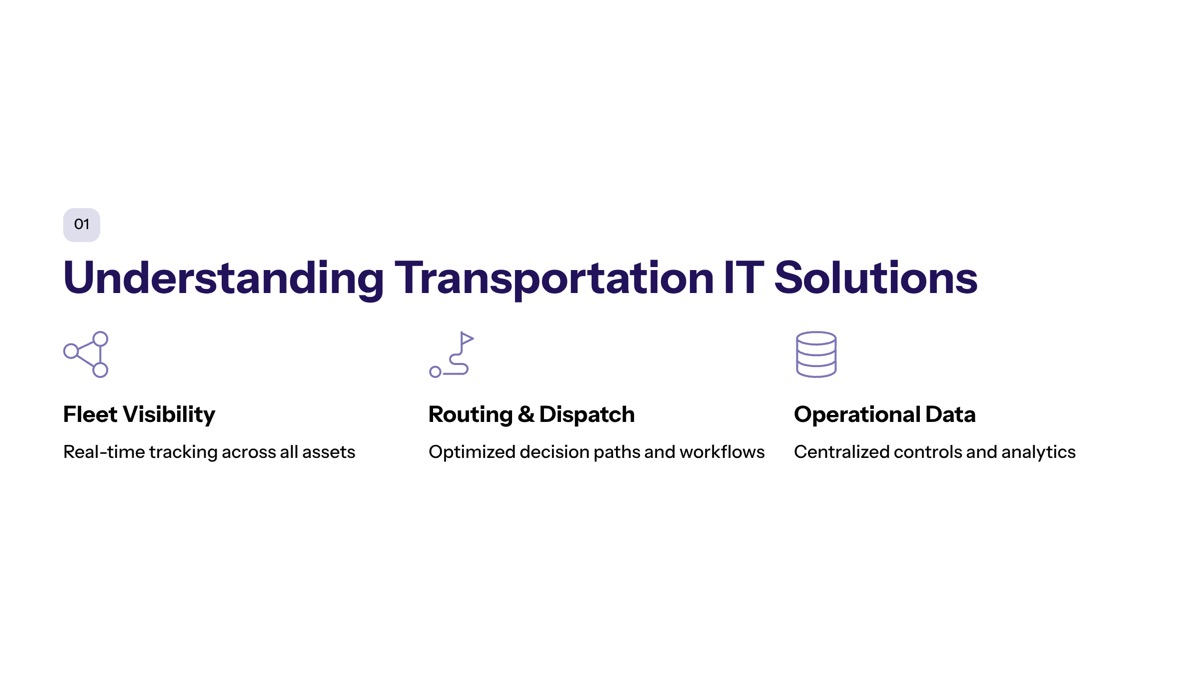
Understanding Transportation IT Solutions
Transportation IT solutions are comprehensive software ecosystems that connect transportation management, warehouse operations, fleet tracking, inventory management, carrier coordination, and supply chain visibility into unified platforms. In practical terms, they allow transportation and logistics companies to plan shipments, optimize delivery routes, track vehicles and cargo, automate document flows, monitor compliance, and make operational decisions from shared data instead of fragmented systems.
The need is growing because many logistics companies still rely on disconnected legacy systems, manual dispatch processes, spreadsheets, siloed warehouse management systems, and limited integrations between business operations. Modernizing legacy systems can significantly enhance operational efficiency and reduce costs, as outdated software often leads to inefficiencies and increased operational expenses. Legacy system modernization is essential for improving data visibility and integration across logistics operations, enabling better decision-making and responsiveness to market changes. Organizations that modernize their legacy systems can achieve measurable improvements in delivery speed and accuracy, which are critical for maintaining competitive advantage in logistics.
The market reflects this urgency. The transportation & logistics software sector was valued at approximately US$72 billion in Q1 2025 and is projected to reach US$229 billion by 2032, at around 16% CAGR. Fleet management is growing even faster, at about 19.8% CAGR, driven by AI-driven route optimization, predictive maintenance, IoT telematics, and emerging EV and autonomous vehicle requirements. The digital logistics market is estimated at US$55.57 billion in 2026, up from US$45.5 billion in 2025, and is expected to reach US$150.79 billion by 2031, at about 22.1% CAGR.
Core System Integration Components
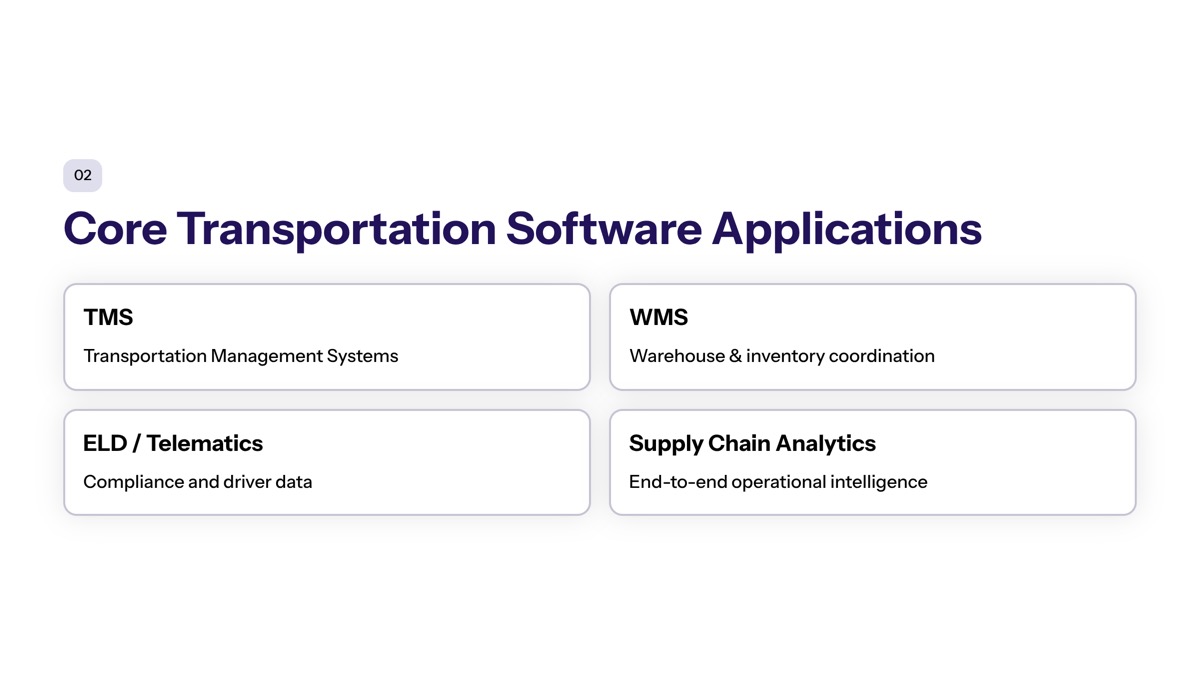
Transportation Management Systems (TMS) are designed to optimize transportation operations, improve delivery efficiency, and streamline shipment planning and execution. In custom transportation management software, a TMS typically handles shipment planning, carrier selection, rate comparison, load scheduling, route optimization, and execution visibility.
Warehouse Management Systems (WMS) help digitize and automate warehouse operations, improving speed, accuracy, and inventory visibility, which is crucial for effective logistics management. When warehouse management systems are integrated with transportation management software, teams can coordinate picking, packing, staging, dock scheduling, dispatch, and inventory control with fewer delays between distribution centers and fleet operations.
Fleet management platforms support vehicle tracking, preventive maintenance, driver compliance, fuel consumption monitoring, safety reporting, and telematics. Fleet management software becomes more valuable when combined with logistics management software because dispatchers can match vehicle availability, cargo requirements, driver hours, and route constraints in one workflow.
Supply chain visibility tools provide real time tracking, performance analytics, predictive ETAs, exception alerts, and customer delivery updates. Custom logistics software can provide real-time visibility into fleet, inventory, and delivery performance, enhancing operational control and efficiency. Supply Chain Management (SCM) software solutions coordinate the flow of goods, data, and finances across logistics networks, enhancing overall supply chain efficiency.
Together, these components eliminate data silos and improve operational decision-making. Instead of treating transportation management, warehouse operations, and fleet management as separate functions, integrated transportation and logistics software gives logistics providers a shared operating picture across the entire supply chain.
Custom vs Off-the-Shelf Considerations
Custom solutions are often necessary when transportation and logistics companies manage complex multimodal operations, cross-border shipments, specialized cargo, unique customer workflows, or strict regulatory requirements. A logistics software development company may design custom logistics software development around temperature-controlled freight, high-value cargo, hazardous materials, rail-to-road handoffs, ocean documentation, or private fleet rules that standard software cannot support cleanly.
Integration capabilities are also a major factor. Custom transportation software development can connect existing systems such as ERP, CRM, WMS, finance platforms, legacy EDI tools, carrier portals, telematics providers, and customer-facing applications. This matters because transportation operations rarely run on one system; they depend on many internal and external platforms with different data formats and process rules.
Scalability is another reason transportation software development services are used. Growing logistics organizations need scalable systems that can support new regions, higher shipment volumes, additional carriers, more distribution centers, and changing business models without forcing a complete platform replacement.
The central issue is not whether off-the-shelf logistics software is useful. It often is. The issue is whether standard logistics solutions can support the real transportation management processes, multimodal complexity, integration requirements, and long-term operating model of the business. When the answer is no, custom software solutions become a practical way to streamline supply chain operations without forcing operations to adapt to rigid software.
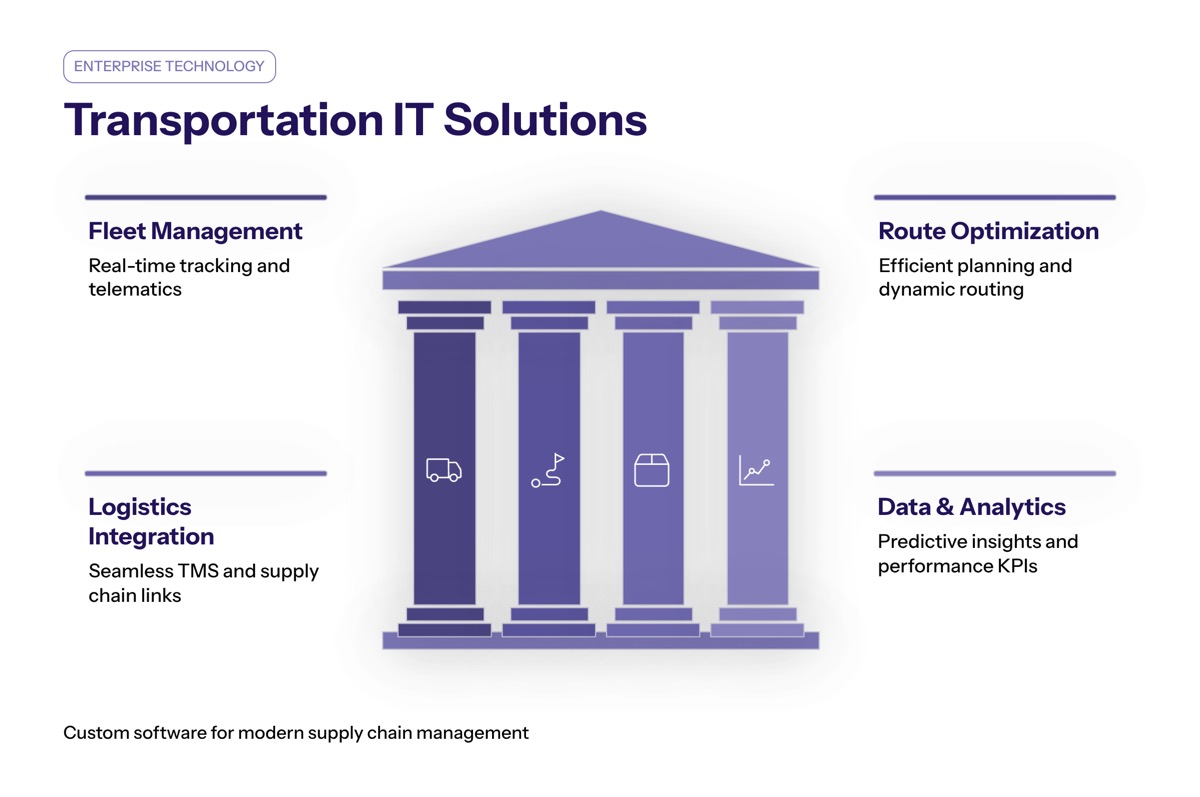
Core Transportation Software Applications
Once core systems are connected, transportation leaders can evaluate the applications that create measurable operational value. The most important areas are multimodal transportation management, routing and visibility, and logistics integration platforms that connect carriers, customers, warehouses, finance teams, and fleet operations.
Effective IT solutions for improving transportation systems focus on reducing congestion, increasing safety, and optimizing logistics. Integrating information and communication technology into transit infrastructure increases asset efficiency and helps meet sustainability targets. In commercial logistics, that means using data analytics, intelligent automation, IoT, GPS, APIs, and predictive models to optimize transportation operations across the full network.
Multimodal Transportation Management
Multimodal transportation management coordinates rail, trucking, air, and ocean freight across different carriers, schedules, regulatory environments, and handoff points. This is especially important for transportation and logistics companies that manage international shipments, port transfers, intermodal yards, regional distribution, or complex customer service commitments.
Carrier management systems help logistics service providers track vendor performance, compare rates, monitor claims or damage rates, manage contracts, and improve service levels. With better carrier scorecards, transportation companies can identify which partners deliver reliably, which lanes create delays, and where contract renegotiation may reduce transportation costs.
Load planning and optimization are also central to multimodal logistics solutions. Intelligent automation in logistics can optimize vehicle utilization and reduce empty miles by 15-25%, leading to improved operational efficiency. Companies implementing automation in logistics report 30-40% faster order fulfillment and measurable improvements in on-time delivery performance, enhancing overall operational efficiency.
Real-world results show the potential. An EFESO implementation for a wire and cable manufacturer delivered a TMS in 11 months, compared with an industry average of about 18 months, and achieved base case savings of US$6 million with potential for US$10 million, including about US$1.75 million from carrier bids. A ShipmentX multimodal logistics provider case integrated road, rail, and air operations and achieved about 20% transportation cost savings, a 30% improvement in on-time deliveries, reduced empty miles, predictive ETAs, and real-time visibility.
Real-Time Routing and Visibility
Real-time routing and visibility are where transportation IT solutions move from planning to active execution. Dynamic Route Optimization uses GPS and live data to route delivery trucks around unexpected traffic bottlenecks. Dynamic route optimization also considers traffic, weather, driver constraints, vehicle load, time windows, delivery priority, and cost per mile.
Route optimization algorithms analyze traffic, weather, and historical data to dynamically reroute fleets, reducing transit times and lowering carbon footprints. GPS and Real-Time Tracking provides precise shipment locations and enables dynamic rerouting during traffic delays. AI can enhance logistics and transportation by providing real-time visibility into fleet operations, which helps in optimizing routes and improving delivery efficiency.
Predictive analytics in logistics utilizes data from IoT devices, GPS tracking, and historical patterns to forecast demand and optimize operations. By integrating predictive analytics, logistics companies can anticipate maintenance needs and dynamically adjust routes based on real-time conditions, improving efficiency and reducing costs. Implementing predictive analytics can lead to significant improvements in operational performance, such as reducing delivery times and enhancing supply chain visibility.
Machine learning algorithms are increasingly used in transportation to predict demand patterns, optimize routes, and improve overall operational efficiency. Predictive maintenance uses vehicle diagnostics, telematics, repair history, driver behavior, and asset utilization to prevent breakdowns before they disrupt service. Internet of Things (IoT) sensors monitor cargo temperature and detect vibrations to prevent product damage.
These capabilities directly enhance multimodal coordination. A delayed truck pickup at a rail terminal can trigger an alert, update the ETA, revise labor planning at the destination warehouse, notify the customer portal, and adjust billing or carrier performance records automatically.
Logistics Integration Platforms
Logistics integration platforms connect the systems and partners that make transportation execution possible. EDI and API connectivity enables carrier communication, tender acceptance, shipment status updates, proof of delivery, bills of lading, customs documents, invoices, and payment workflows. Some carriers may support modern APIs and telematics feeds, while others still depend on EDI or file-based exchanges, so flexible integration frameworks are essential.
ERP integration links orders, inventory, invoices, customer records, and financial reconciliation with transportation execution. This is where transportation management software development becomes especially valuable: the transportation platform can automate order-to-delivery workflows instead of leaving teams to rekey data between systems.
Customer portal development gives shippers and customers access to shipment tracking, delivery coordination, exception alerts, and documents without constant email or phone updates. Custom logistics software can automate repetitive tasks, reducing costs and human error, while also providing tailored solutions for specific operational challenges. Custom logistics software can reduce manual data entry and dispatch errors by 70-80%, significantly cutting labor costs across order processing and route planning. AI-driven automation in transportation can reduce manual data entry and dispatch errors by 70-80%, significantly cutting labor costs and improving accuracy in order processing and route planning.
Transportation IT also intersects with passenger and urban mobility systems where relevant. Automated Fare Collection implements contactless ticketing and mobile payments to speed up boarding times. Intelligent Traffic Management utilizes AI, IoT, and big data to monitor road conditions and adjust traffic lights in real-time. Real-Time Passenger Information provides commuters with live bus and train arrival tracking via mobile apps. Unified Mobility Apps combine public transit, ride-sharing, and micro-mobility into a single payment platform. Mobility-as-a-Service platforms consolidate various transportation modes into a single application for planning, booking, and payment. Advanced Traffic Management Systems coordinate traffic signals in real-time using AI and cameras to smooth vehicle flow.
For enterprise freight networks, the same principle applies: integrated information, real-time decisions, and connected workflows improve logistics efficiency across transportation and logistics.
Custom Development Strategy and Implementation
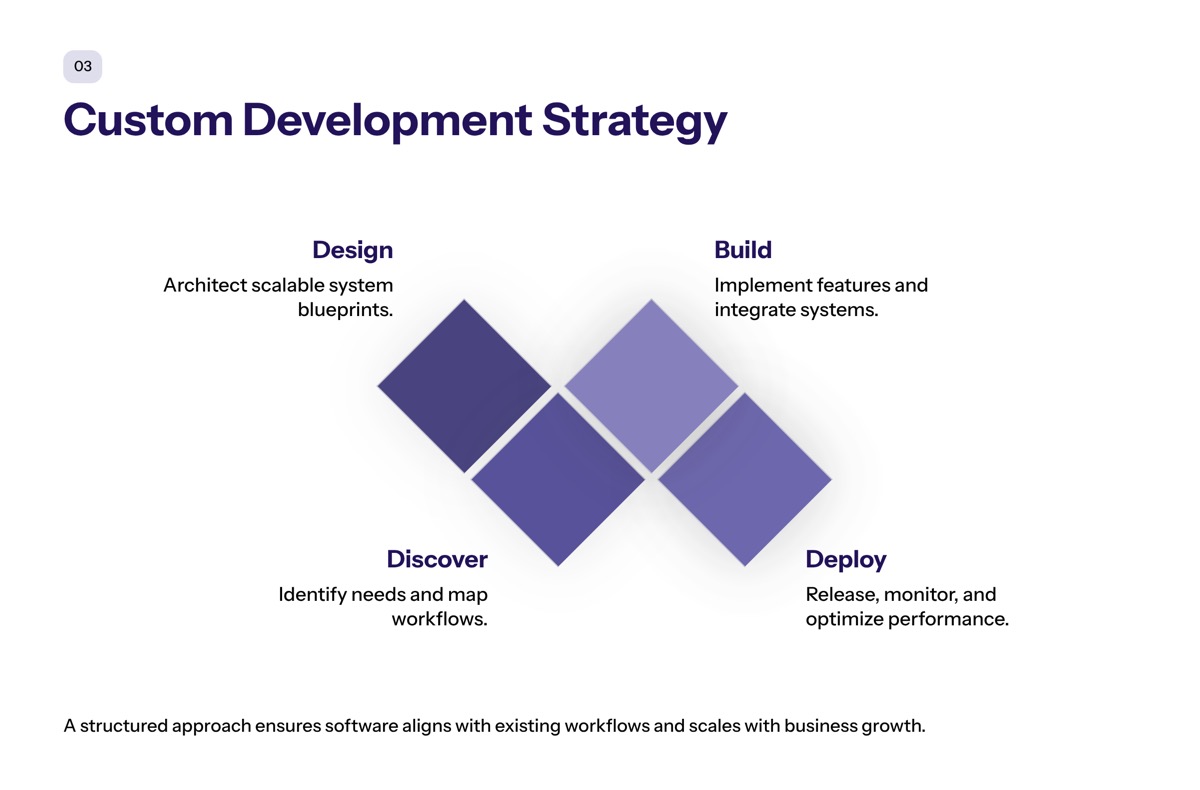
Custom transportation software development should start with the operational problem, not the technology stack. The goal is to build transportation and logistics solutions around real workflows: shipment planning, carrier selection, routing, dispatch, warehouse coordination, inventory visibility, compliance, customer communication, and financial reconciliation.
Cognativ’s RAPID framework provides a structured way to modernize transportation platforms while reducing risk. It helps transportation leaders assess current systems, define measurable business goals, design scalable architecture, pilot high-value workflows, integrate existing systems, and optimize after deployment.
RAPID Framework for Transportation Modernization
Transportation organizations need a structured modernization approach when existing systems limit visibility, increase manual work, create dispatch errors, slow order fulfillment, or prevent reliable data analytics. A RAPID-style approach keeps modernization tied to measurable business outcomes instead of becoming a long technical rebuild with unclear ROI.
Requirements analysis and current system assessment - RESEARCH
Map transportation workflows, systems, data flows, carrier touchpoints, warehouse operations, compliance processes, and pain points. Define goals such as reducing fuel costs, improving OTIF, lowering empty miles, shortening invoice reconciliation cycles, or improving visibility latency.Architecture design for scalable, secure transportation platforms - ANALIZE
Design modular platforms with AI-first capabilities, secure APIs, normalized data models, role-based access, encryption, audit trails, and support for multimodal logistics workflows. The architecture should support route optimization, predictive maintenance, fleet management, inventory management, and reporting without creating new silos.Pilot implementation with core transportation functions - PLAN
Start with a high-impact lane, fleet segment, region, or customer workflow. Measure transportation costs, delivery performance, fuel consumption, empty miles, dwell time, carrier performance, labor productivity, and user adoption before scaling.Integration with existing systems and carrier networks - IMPLEMENT
Connect ERP, WMS, finance systems, telematics, customer portals, carrier APIs, EDI feeds, and document workflows. This step is critical because logistics businesses depend on internal and external data moving accurately between systems.Deployment and optimization based on performance metrics - DECIDE
After go-live, monitor performance, improve data quality, refine routing logic, add automation, expand carrier integrations, and use operational feedback to streamline operations continuously.
Benchmarks from case studies show why disciplined implementation matters. uRoute, a cloud-based custom TMS, delivered 15-30% freight cost reduction through automated carrier selection, real-time shipment tracking, and load optimization. An Azure fleet management modernization for a multi-region transport company delivered about 50% improvement in fleet visibility, 45% fewer delivery delays, 40% gain in operational efficiency, and 35% reduction in fuel and operational costs.
Technology Stack Considerations
Technology choices should reflect transportation system complexity, modernization timeline, integration risk, and future scalability. A cloud-native model may be appropriate for organizations ready to move quickly with microservices, real-time analytics, and API-first design. A hybrid model may be better for logistics organizations that need to preserve legacy ERP, WMS, EDI, or carrier systems while adding modern logistics software development services around them.
Component | Cloud-Native Approach | Hybrid Integration Approach |
|---|---|---|
Data Processing | Real-time analytics with AI-driven insights | Legacy system integration with modern analytics layer |
Security | Zero-trust architecture with API security | Secure gateways protecting existing infrastructure |
Scalability | Microservices for independent component scaling | Modular development supporting gradual migration |
Integration | API-first design for carrier and system connectivity | EDI translation with modern API endpoints |
Cloud-native transportation software development can support event-driven workflows, real-time streaming data, containerized services, AI/ML pipelines, and rapid iteration. Hybrid integration can reduce migration risk by wrapping legacy functionality in secure gateways, exposing old systems through APIs, and gradually replacing outdated components.
Transportation leaders should choose based on operational requirements. If the business needs fast innovation, real time visibility, and elastic scaling, cloud-native architecture may be the right direction. If the business depends on aging but mission-critical systems, hybrid modernization may provide a safer path. In both cases, the platform must support ongoing support, strong security, reliable integrations, and measurable logistics efficiency.
Common Challenges and Solutions
Transportation IT modernization often fails when organizations underestimate legacy complexity, multimodal data inconsistency, compliance obligations, or carrier readiness. The right software development company should address these risks before development starts, not after the platform is already in production.
Legacy System Integration Complexity
Legacy ERP, WMS, dispatch, and carrier systems are often rigid, poorly documented, and deeply embedded in daily operations. Replacing them all at once can disrupt transportation management processes and create operational risk.
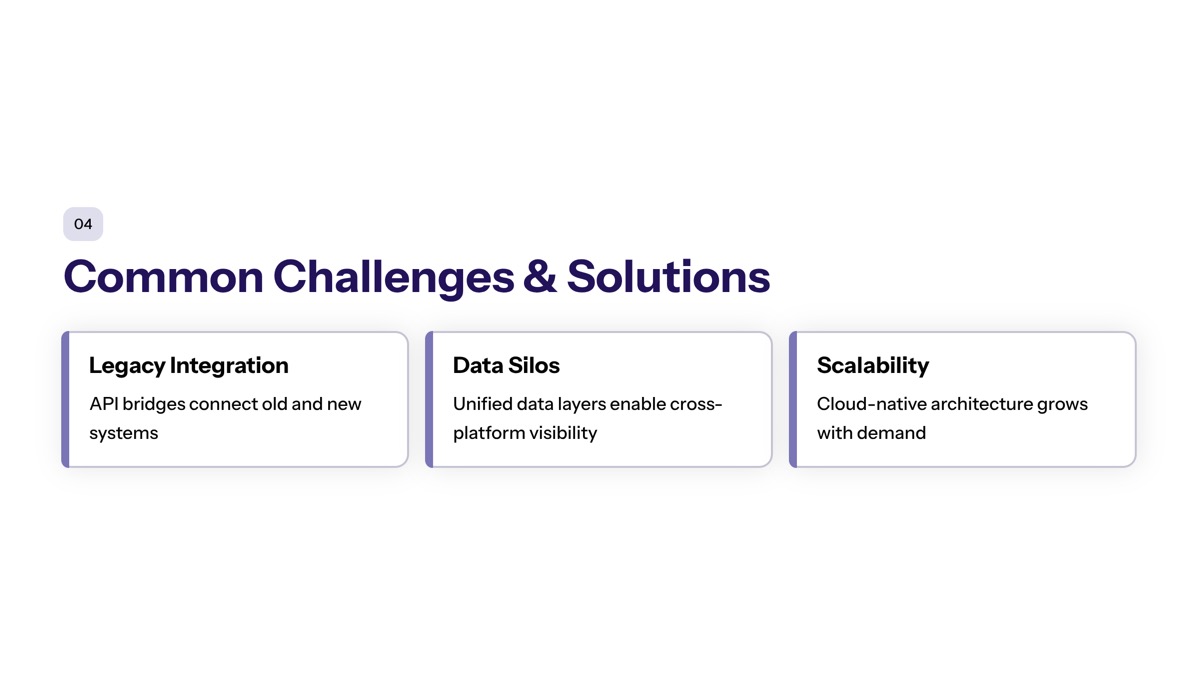
The practical solution is to develop secure API gateways that connect modern transportation platforms with existing ERP and carrier systems without disrupting operations. A phased migration strategy allows transportation companies to modernize gradually while maintaining business continuity. This approach improves visibility, reduces duplicate data entry, and enables custom logistics software to create value before every legacy component is replaced.
Multimodal Data Standardization
Rail, trucking, air, and ocean freight systems often use different event names, time zones, document formats, milestone definitions, and status rules. One carrier may define “arrived” differently from another, and one mode may report at scheduled milestones while another streams GPS updates continuously.
The solution is to create unified data models that normalize information across rail, trucking, air, and ocean freight systems for consistent reporting and analytics. Real-time data validation and cleansing processes help ensure accuracy across transportation modes. Canonical data schemas, mapping pipelines, and exception handling make multimodal logistics software more reliable for planning, customer updates, compliance, and performance measurement.
Regulatory Compliance and Security
Transportation operations often cross jurisdictions and involve sensitive shipment, customer, financial, driver, and partner data. Platforms may need to support DOT regulations, customs requirements, environmental reporting, driver safety rules, data privacy obligations, and industry-specific compliance needs.
The solution is to implement secure, auditable platforms with role-based access controls, data encryption in transit and at rest, detailed audit logs, and compliance-ready reporting. Regulatory compliance should be designed into transportation management software from the beginning, not added as an afterthought. This protects sensitive data while improving audit readiness and operational accountability.
Carrier Network Integration
Carrier network integration is difficult because logistics providers work with partners at different levels of technical maturity. Some carriers support modern APIs, GPS feeds, and real-time telematics. Others rely on EDI, spreadsheets, email, portals, or batch file exchanges.
The solution is to build flexible integration frameworks that accommodate diverse carrier technologies, from modern APIs to legacy EDI systems. Standardized communication protocols simplify carrier onboarding, shipment status exchange, document management, and performance monitoring. This gives transportation and logistics companies a more consistent way to manage carrier relationships while preserving flexibility across the network.
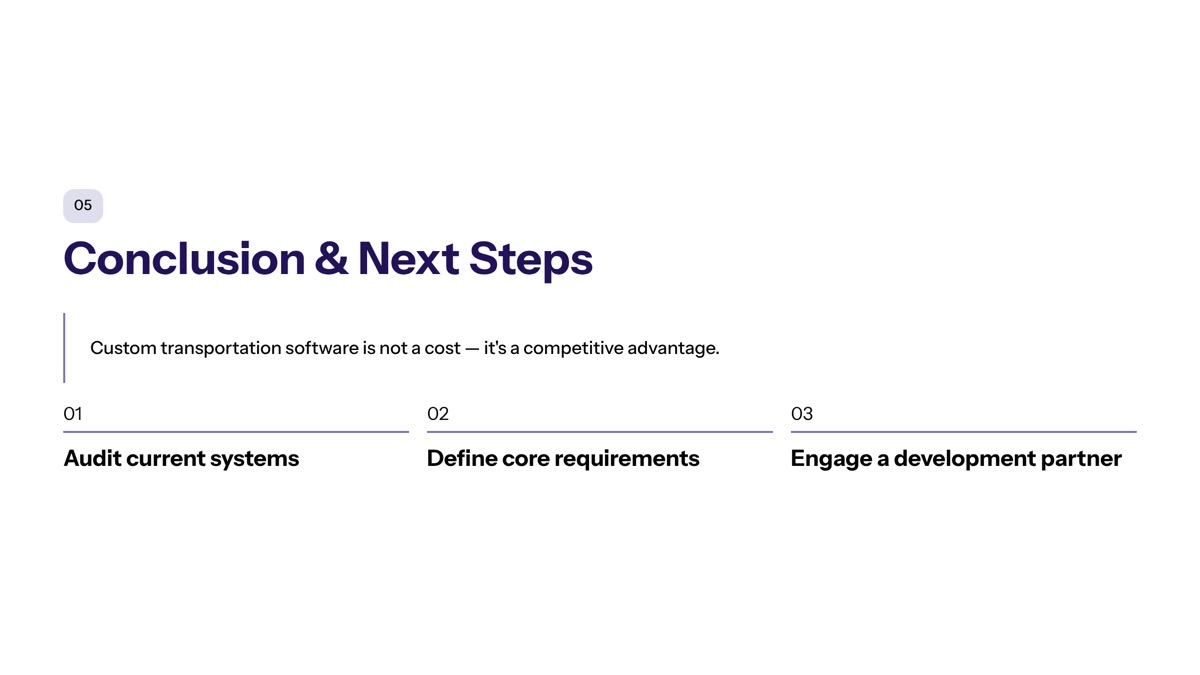
Conclusion and Next Steps
Transportation IT solutions are most valuable when they integrate TMS, WMS, fleet management, routing, visibility, compliance, and carrier communication into unified platforms that improve transportation operations end to end. For transportation leaders, the objective is not simply to add another dashboard. The objective is to build logistics software solutions that turn real-time signals into better decisions, automated workflows, lower costs, and stronger customer satisfaction.
The next steps are:
Assess current system architecture and integration challenges
Identify where legacy systems, manual processes, disconnected data, or weak carrier integrations create cost, delay, and visibility problems.Identify priority transportation workflows for modernization
Start with high-impact areas such as shipment planning, dynamic route optimization, predictive maintenance, carrier onboarding, warehouse-to-dispatch coordination, or invoice reconciliation.Evaluate AI automation opportunities
Look for use cases where intelligent automation can reduce manual entry, optimize route planning, improve fleet utilization, lower fuel costs, and strengthen supply chain resilience.Choose a custom development strategy where complexity demands it
If standard logistics systems cannot support your multimodal network, regulatory requirements, or integration needs, custom logistics software development may provide the flexibility and scalability required.
Related areas worth exploring include supply chain visibility platforms, fleet management modernization, warehouse management integration, and logistics automation. Together, these capabilities help transportation leaders streamline operations across the entire supply chain and build more resilient transportation and logistics software for the future.