Vendor and Platform Selection After Clarity: A Practical Framework
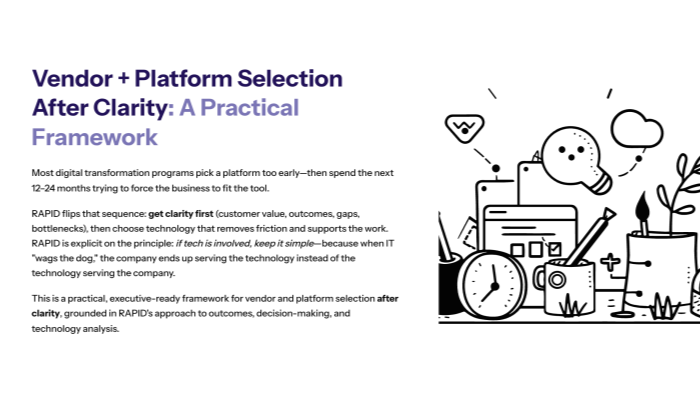
Most digital transformation programs pick a platform too early—then spend the next 12–24 months trying to force the business to fit the tool.
RAPID flips that sequence: get clarity first (customer value, outcomes, gaps, bottlenecks), then choose technology that removes friction and supports the work. RAPID is explicit on the principle: if tech is involved, keep it simple—because when IT “wags the dog,” the company ends up serving the technology instead of the technology serving the company.
This post is a practical, executive-ready framework for vendor and platform selection after clarity, grounded in RAPID’s approach to outcomes, decision-making, and technology analysis.

Why platform-first transformations fail?
1.1 The “silver bullet” myth (and why it’s so expensive)
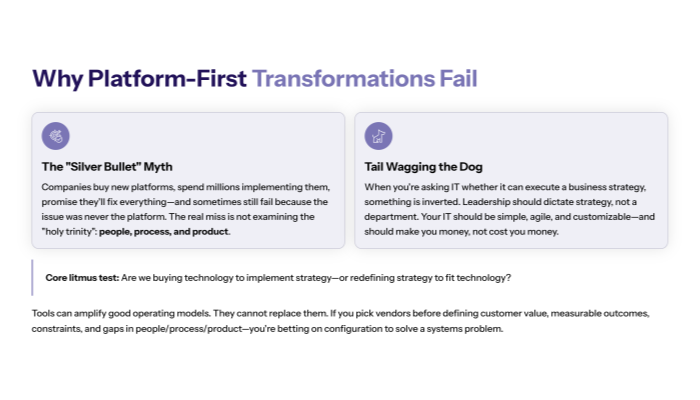
RAPID calls out a common failure pattern: companies buy a new platform, spend millions implementing it, promise it will fix everything—and sometimes the company still fails because the issue was never the platform. The real miss is not examining the “holy trinity”: people, process, and product.
Tools can amplify good operating models. They cannot replace them.
If you pick vendors before you’ve defined:
- customer value
- measurable outcomes (ranked)
- the constraint/bottleneck
- the gaps in people/process/product
…you’re betting on configuration to solve a systems problem.
1.2 “Tail wagging the dog” (when tech starts dictating strategy)
RAPID’s warning is blunt: when you’re asking IT whether it can execute a business strategy, something is inverted—leadership should dictate strategy, not a department. Your IT should be simple, agile, and customizable—and should make you money, not cost you money.
This is the core litmus test for vendor selection:
Are we buying technology to implement strategy—or redefining strategy to fit technology?
The RAPID pre-work that makes vendor selection easy
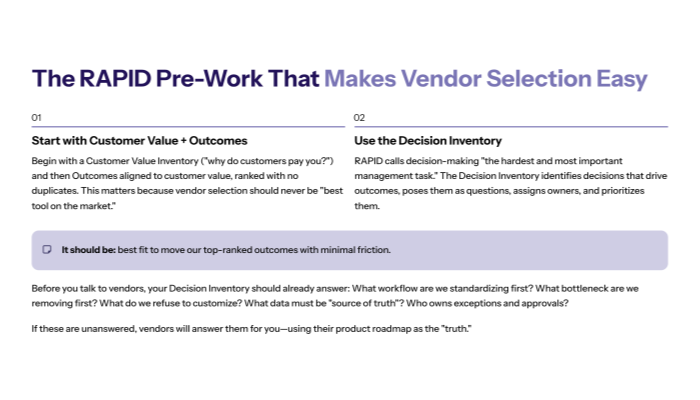
2.1 Start with Customer Value + Outcomes (your “why” and scoreboard)
RAPID starts with a Customer Value Inventory (“why do customers pay you?”) and then Outcomes aligned to customer value, ranked with no duplicates.
This matters because vendor selection should never be “best tool on the market.”
It should be: best fit to move our top-ranked outcomes with minimal friction.
If a platform can’t be mapped to:
- at least one customer value, and
- at least one ranked outcome
…it’s not transformation spend. It’s shiny-object spend.
2.2 Use the Decision Inventory to force clarity (before vendors sell you a story)
RAPID calls decision-making “the hardest and most important management task,” and the Decision Inventory exists to identify decisions that drive outcomes, pose them as questions, assign owners, and prioritize them.
Before you talk to vendors, your Decision Inventory should already answer:
- What workflow are we standardizing first?
- What bottleneck are we removing first?
- What do we refuse to customize?
- What data must be “source of truth”?
- Who owns exceptions and approvals?
If these are unanswered, vendors will answer them for you—using their product roadmap as the “truth.”
A practical vendor + platform selection framework (after clarity)
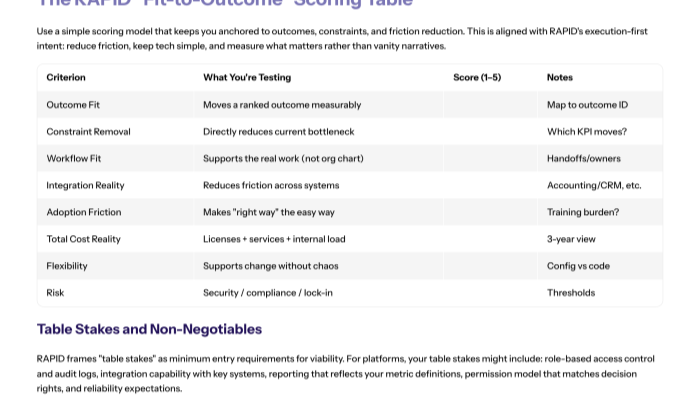
3.1 The RAPID “Fit-to-Outcome” scoring table
Use a simple scoring model that keeps you anchored to outcomes, constraints, and friction reduction.
|
Criterion |
What you’re testing |
Score (1–5) |
Notes |
|---|---|---|---|
|
Outcome Fit |
Moves a ranked outcome measurably |
Map to outcome ID | |
|
Constraint Removal |
Directly reduces current bottleneck |
Which KPI moves? | |
|
Workflow Fit |
Supports the real work (not org chart) |
Handoffs/owners | |
|
Integration Reality |
Reduces friction across systems |
Accounting/CRM, etc. | |
|
Adoption Friction |
Makes “right way” the easy way |
Training burden? | |
|
Total Cost Reality |
Licenses + services + internal load |
3-year view | |
|
Flexibility |
Supports change without chaos |
Config vs code | |
|
Risk |
Security / compliance / lock-in |
Thresholds |
This is aligned with RAPID’s execution-first intent: reduce friction, keep tech simple, and measure what matters rather than vanity narratives.
3.2 “Table stakes” and non-negotiables (don’t evaluate vendors that fail basics)
RAPID frames “table stakes” as minimum entry requirements for viability—baseline facts that must be true for a product to compete or serve its purpose.
For platforms, your table stakes might include:
- role-based access control and audit logs
- integration capability with key systems (or clear API strategy)
- reporting that reflects your metric definitions (not vendor defaults)
- permission model that matches decision rights
- reliability expectations (and what happens when it breaks)
If a vendor fails table stakes, don’t negotiate. Remove them.
The RAPID technology analysis lens (what to inspect so you don’t inherit future pain)
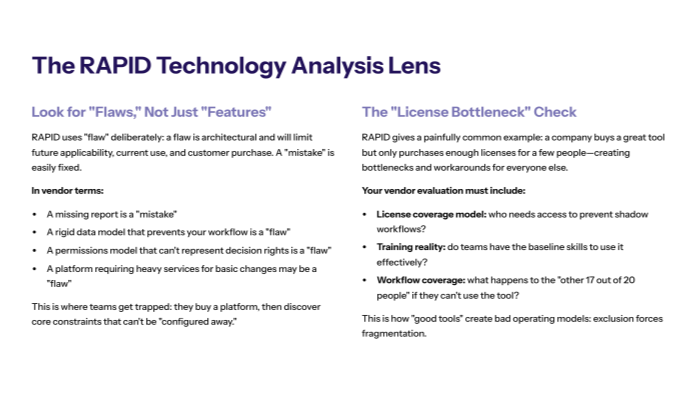
4.1 Look for “flaws,” not just “features”
RAPID uses “flaw” deliberately: a flaw is architectural and will limit future applicability, current use, and customer purchase. A “mistake” is easily fixed.
In vendor terms:
- A missing report is a “mistake”
- A rigid data model that prevents your workflow is a “flaw”
- A permissions model that can’t represent decision rights is a “flaw”
- A platform that requires heavy services for basic changes may be a “flaw”
This is where teams get trapped: they buy a platform, then discover core constraints that can’t be “configured away.”
4.2 The “license bottleneck” and hidden friction checks
RAPID gives a painfully common example: a company buys a great tool but only purchases enough licenses for a few people—creating bottlenecks and workarounds for everyone else.
So your vendor evaluation must include:
- License coverage model: who needs access to prevent shadow workflows?
- Training reality: do teams have the baseline skills to use it effectively?
- Workflow coverage: what happens to the “other 17 out of 20 people” if they can’t use the tool?
This is how “good tools” create bad operating models: exclusion forces fragmentation.
How to run a vendor selection process that actually delivers outcomes?
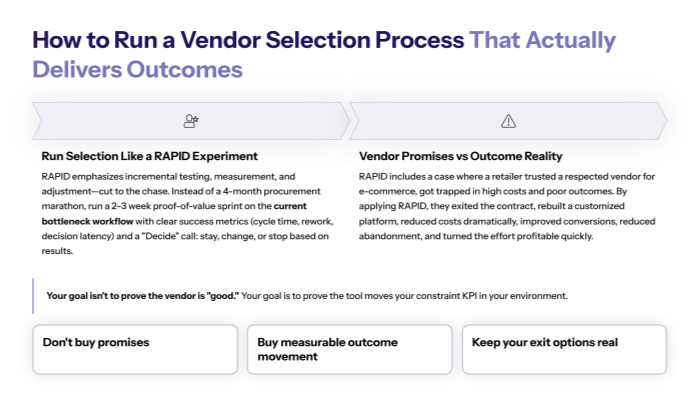
5.1 Run the selection like a RAPID experiment (small steps, measurable impact)
RAPID emphasizes incremental testing, measurement, and adjustment—cut to the chase.
So instead of a 4-month procurement marathon, run:
- a 2–3 week proof-of-value sprint on the current bottleneck workflow
- with clear success metrics (cycle time, rework, decision latency)
- and a “Decide” call: stay, change, or stop based on results
Your goal isn’t to prove the vendor is “good.”
Your goal is to prove the tool moves your constraint KPI in your environment.
5.2 A cautionary story: vendor promises vs outcome reality
RAPID includes a case where a retailer trusted a respected vendor for e-commerce, got trapped in high costs and poor outcomes, and the vendor pushed for more spend like an ad agency.
By applying RAPID, they exited the contract, rebuilt a customized platform, reduced costs dramatically, improved conversions, reduced abandonment, and turned the effort profitable quickly—delivering what the vendor promised with more speed and less expense.
Takeaway:
- Don’t buy promises.
- Buy measurable outcome movement.
- Keep your exit options real.
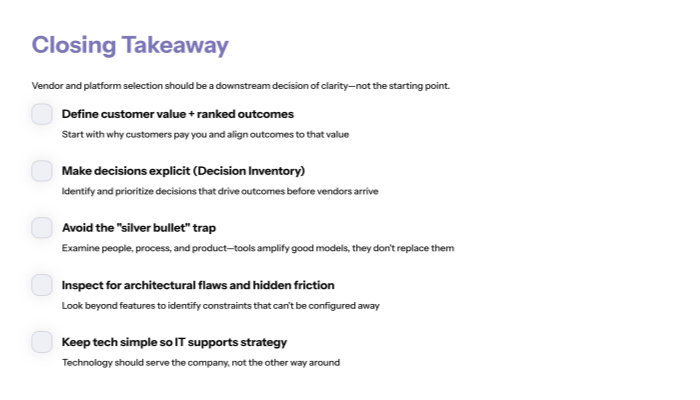
Closing takeaway
Vendor and platform selection should be a downstream decision of clarity—not the starting point.
Use RAPID to:
- define customer value + ranked outcomes
- make decisions explicit (Decision Inventory)
- avoid the “silver bullet” trap (people/process/product)
- inspect for architectural flaws and hidden friction
- keep tech simple so IT supports strategy—not the other way around