VOD Platform Development Services: Complete Guide for Media Teams
VOD platform development services help media teams build owned video streaming products that can host, protect, monetize, and deliver video content across web, mobile devices, smart TVs, and other streaming devices. These services go beyond a simple video player: they cover the architecture, applications, workflows, integrations, security, and operations behind a scalable video on demand platform.
This guide covers custom development services, technical architecture, implementation approaches, vendor selection, localization, recommendations, and content operations for teams evaluating a new vod platform or replacing fragmented vod systems. It is written for media executives, CTOs, product leaders, and content operations teams planning long-term investment in vod streaming, video monetization, and multi platform streaming.
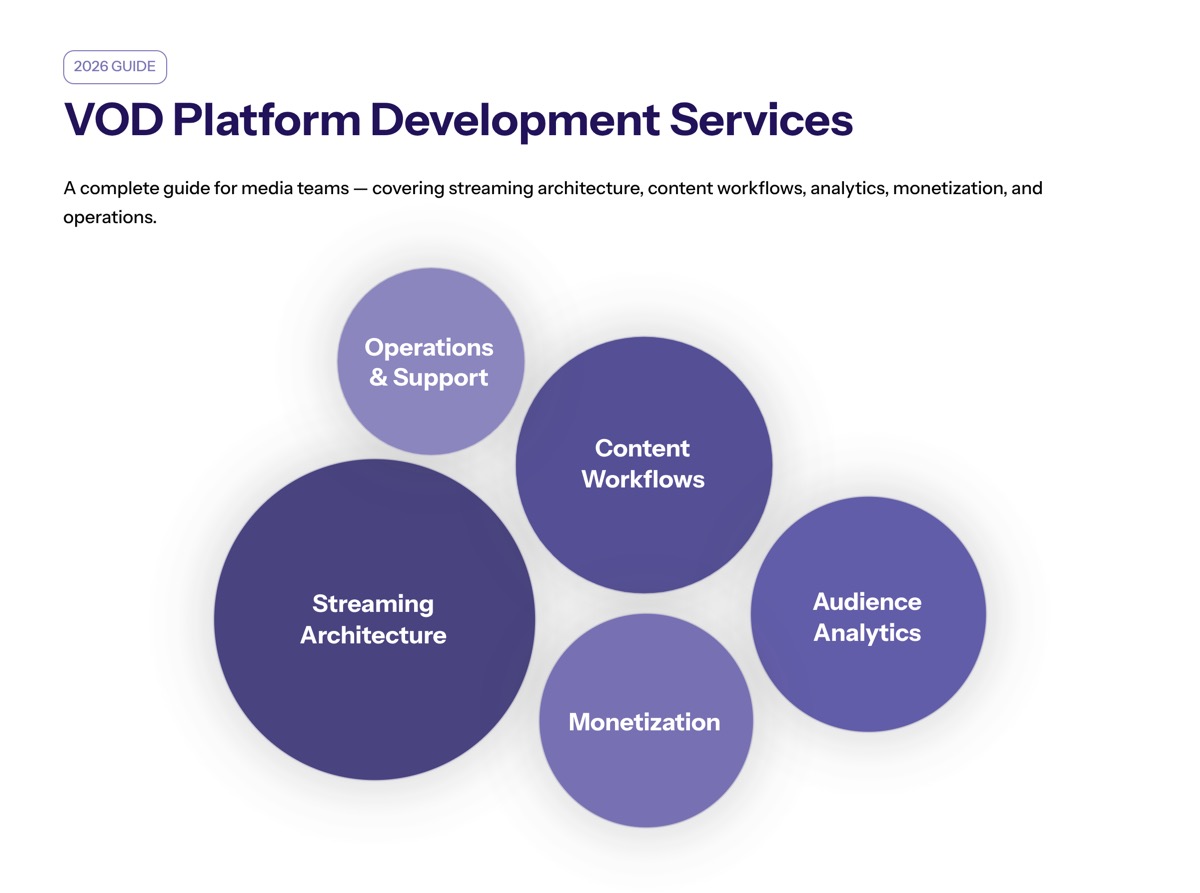
VOD platform development services provide end-to-end custom software development for building scalable, secure video streaming platforms with monetization, content management, analytics, and access control capabilities. In 2026, businesses are increasingly moving toward dedicated VOD platforms that enable owned distribution, flexible monetization, and first-party data ownership, making VOD platform selection a strategic, long-term decision.
After reading, you will understand:
The difference between custom development, a white label vod platform, and hybrid implementation.
The architecture required for high quality streaming, including video hosting, transcoding, content delivery, and security.
How vod monetization models such as SVOD, AVOD, and TVOD affect platform design.
How to evaluate vod platform providers, vod service providers, and development partners.
What costs, risks, and success metrics matter when building your own vod platform.
For broader media technology planning, this topic connects directly to media software development services, including content operations, recommendation systems, localization workflows, and digital distribution strategy.
Understanding VOD Platform Development Services
VOD stands for Video on Demand, a content delivery model that allows viewers to watch video content at any time from any device without following a restricted broadcast schedule. OTT, or Over-the-Top, refers to content delivered over the internet without traditional cable or satellite providers. While all VOD is considered OTT, not all OTT is VOD; VOD is defined by the on-demand nature of the video content, whereas OTT is defined by the delivery method over the internet.
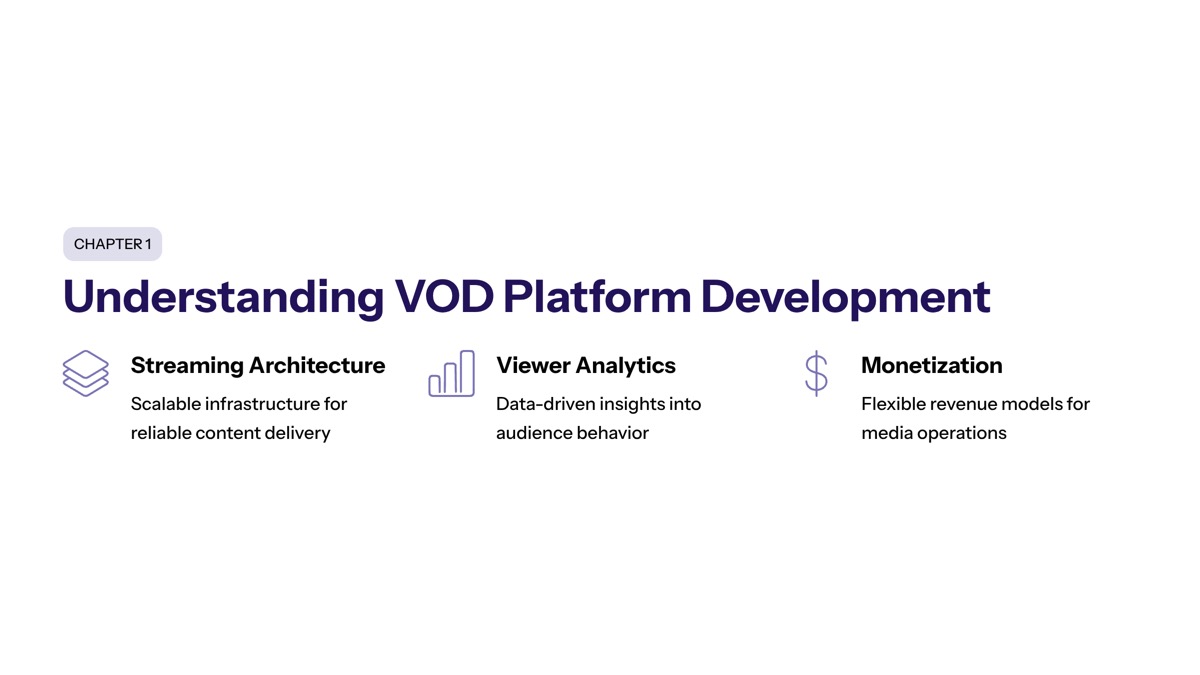
Media companies need specialized development because a serious vod streaming platform must combine video infrastructure, business logic, content workflows, user experience, security, and analytics. Many vod platforms offer an all in one solution, but off-the-shelf tools often limit data ownership, monetization flexibility, and roadmap control as the audience grows.
VOD platforms serve as the backend infrastructure that powers video hosting, monetization, analytics, and access control, whereas OTT platforms are consumer-facing distribution environments where audiences watch content. OTT platforms typically rely on VOD systems for their functionality, meaning that VOD serves as the underlying infrastructure that supports the delivery of content on OTT platforms.
Custom VOD Platform Development
Custom VOD platform development means building a purpose-built video on demand vod product from the ground up using modern backend frameworks, frontend applications, APIs, cloud infrastructure, and video services. A custom vod service may include web applications, mobile apps, smart TV apps, a video cms, payment systems, recommendation engines, and integrations with a global content delivery network.
The main benefit is control. Video on demand platforms allow businesses to regain control over revenue, data, and distribution, making them foundational infrastructure for modern businesses. VOD platforms also provide full ownership of video assets, distribution rights, and access rules, which protects intellectual property and enhances content security.
Core technical components usually include storing video files, ingesting large video files, transcoding, adaptive bitrate streaming, content delivery, user authentication, subscription billing, advertising video workflows, transactional video on demand payments, advanced analytics, and digital rights management. Building a content ingestion pipeline for securely uploading large video files is a key step in the VOD platform development process.
Custom development also connects directly to business goals. VOD platforms support multiple monetization models, including SVOD, AVOD, and TVOD, allowing businesses to optimize revenue based on audience behavior and market conditions. Businesses using owned VOD platforms report 2-3 times higher conversion rates than those relying on social video platforms, primarily due to better engagement data integration with CRM and commerce systems.
White-Label vs Custom Solutions
A white-label VOD platform is a pre-built demand platform that brands can customize with their own design, apps, pricing, and content library. White-label VOD platforms allow brands and businesses to create their own branded video services, giving them full control over user experience, monetization, and audience relationships compared with social distribution channels.
Custom development, by contrast, creates a platform around specific business requirements: rights windows, regional pricing, CRM integration, recommendation logic, localization, user roles, content access rules, and unique product experiences. It is the stronger option when a media distribution system must support complex licensing, premium video, high-scale vod streaming service usage, or differentiated user journeys.
The trade-off is speed versus flexibility. A white label vod platform can launch faster and may suit smaller libraries, limited budgets, or standard subscription video products. Custom development requires more upfront planning and investment, but it gives greater control over performance, data, roadmap, security, and long-term scalability.
When choosing a VOD platform, businesses should evaluate factors such as video hosting and streaming quality, monetization options, white-label capabilities, analytics and audience insights, security, and scalability. VOD platforms must also be evaluated based on their total cost of ownership, which includes not just monthly fees but also factors like bandwidth, storage, and monetization fees.
Technical Architecture Components
A robust vod platform requires a strategic balance of scalable architecture, secure content management, and a seamless user experience. At the infrastructure layer, the system must support video storage, origin services, transcoding pipelines, content delivery networks, streaming protocols, redundancy, monitoring, and disaster recovery.
Adaptive streaming protocols such as HLS and MPEG-DASH adjust video quality based on the user’s internet speed for smooth playback. HLS, also known as http live streaming, and dynamic adaptive streaming over HTTP are common for vod content, while live streaming use cases may require low-latency HLS, low-latency DASH, or WebRTC depending on the experience.
User-facing components include responsive web apps, native mobile apps, smart TV applications, streaming platform interfaces, and video players that support subtitles, dubbing, offline viewing, seek performance, and consistent streaming quality. Modern vod platforms must help audiences watch video content reliably across mobile devices, connected TVs, browsers, and other streaming devices.
Backend systems include a content management system, user authentication, subscription billing, payment integrations, advertising systems, marketing tools, analytics platforms, and recommendation services. Content Management Systems (CMS) are essential for organizing assets, managing metadata, and handling user subscriptions in VOD platforms.
Security and compliance are central. Digital Rights Management (DRM) tools like Widevine, FairPlay, and PlayReady are important for preventing content piracy in VOD services. Setting up geo-blocking and token-based authentication as access control measures is vital for restricted viewing in VOD services, while user authentication, including secure account creation, and payment integrations are crucial for managing subscriptions and preventing unauthorized access.
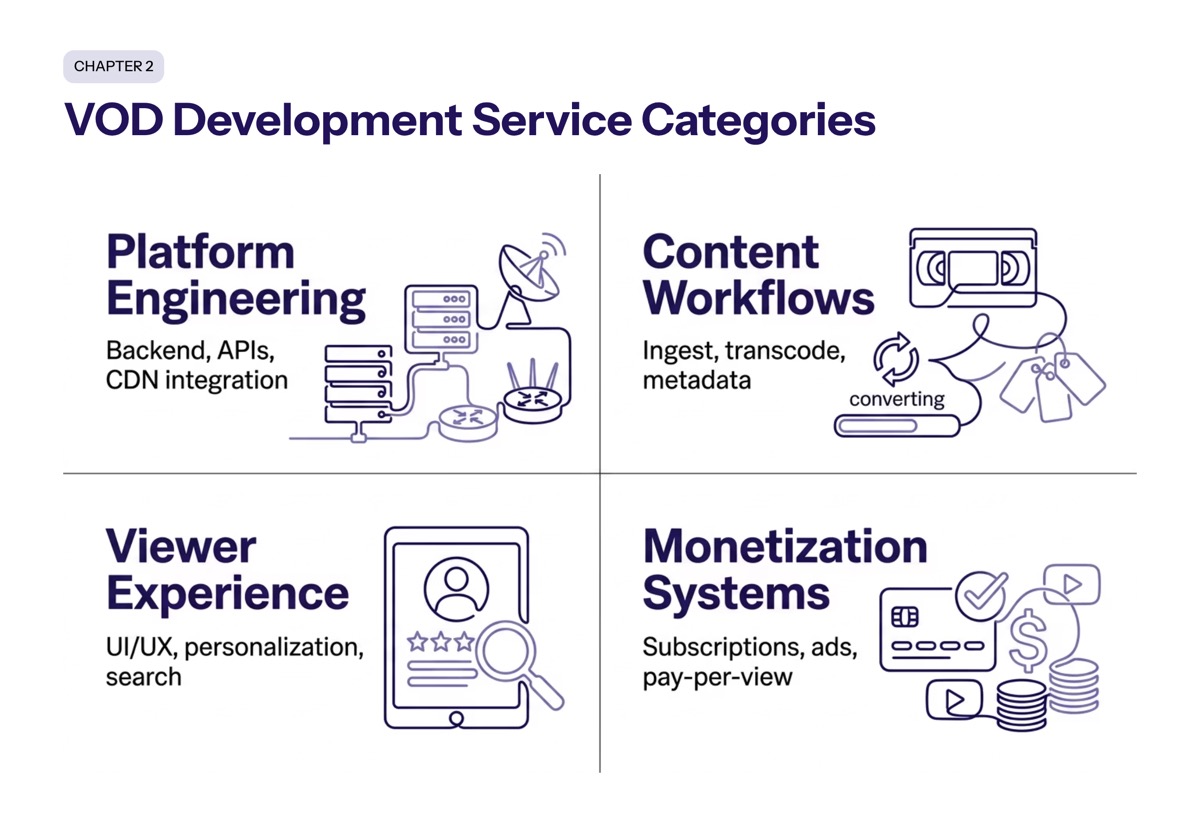
VOD Development Service Categories
VOD platforms can be classified into several types based on their target audience and monetization strategies, including enterprise-focused, white-label, creator-focused, and OTT-first platforms. Each category affects architecture, content operations, security, monetization models, and the kind of vod platform providers or development partners a team should evaluate.
The best VOD platforms in 2026 are defined by their ability to support subscription management, advertising monetization, advanced analytics, DRM, and multi-device distribution at scale. For media teams, the right vod platform is not only the one with the most features; it is the one that fits the audience, content library, revenue model, rights obligations, and growth plan.
Enterprise VOD Development
Enterprise-focused VOD platforms are designed for internal use within organizations, prioritizing security and compliance for applications like training and communications, rather than consumer monetization. These internal vod platforms are often used for employee training, executive communications, compliance documentation, product education, and archived corporate video content.
Enterprise VOD development emphasizes identity management, SSO integration, private hosting, role-based access, audit trails, retention policies, and secure content access. For regulated industries, the platform may need detailed reporting, access logs, legal retention workflows, and integrations with HR, LMS, document management, or internal communication systems.
Unlike consumer streaming services, enterprise vod monetization may be measured through cost savings, compliance completion, reduced travel, faster onboarding, or improved workforce communication. Quality of Experience (QoE) monitoring involves tracking metrics like buffering ratios and bitrates to assess user satisfaction, even when the audience is internal rather than public.
Media Company Solutions
Media company VOD solutions support broadcasters, OTT networks, studios, publishers, and content owners that need scalable video streaming, global distribution, and multiple monetization models. These platforms often replace or extend traditional television programming and broadcast tv workflows with owned digital distribution.
Advanced media platforms need subscription management, advertising monetization, transactional video, rights management, content scheduling, metadata enrichment, localization, dynamic ad insertion, recommendation engines, and multi-format publishing. AVOD, SVOD, TVOD, FAST channels, and hybrid models may all need to coexist in the same vod infrastructure.
SVOD, or Subscription Video on Demand, requires users to pay a recurring subscription fee to access a library of content, making it a popular model for predictable, recurring revenue. AVOD, or Advertising-Based Video on Demand, offers free content to viewers while generating revenue through advertisements shown before, during, or after videos, resembling traditional television programming. TVOD, or Transactional Video on Demand, charges viewers for individual pieces of content, either through rentals or one-time purchases, and is often used for premium or time-sensitive content.
Many successful VOD platforms utilize a hybrid monetization model that combines SVOD, AVOD, and TVOD, providing flexibility and maximizing revenue potential across different audience segments. This is why a media company solution should be designed around business rules, rights windows, regional availability, analytics, and content operations rather than only video hosting.
Content Creator Platforms
Creator-focused VOD platforms cater to individual content creators and small teams, emphasizing ease of use and built-in monetization features like subscriptions and pay-per-view access. These platforms help creators upload pre recorded video content, manage subscribers, monetize content, and build owned communities without needing a large internal engineering team.
Typical features include creator dashboards, subscriber management, marketing tools, couponing, pay-per-view access, community features, mobile optimization, simple video cms workflows, and payment integrations. For creators, a vod streaming service must make it easy to publish pre recorded videos, package premium video, and offer unlimited access tiers without complex technical operations.
The architecture still matters because creator businesses can grow quickly. A platform that starts with hundreds of vod users may need to support thousands or millions later, especially if the creator expands into mobile apps, smart TVs, live streaming, or branded streaming video experiences similar to popular streaming services such as Amazon Prime Video in user expectations, even if not in scale.
OTT-first VOD platforms are designed for large-scale distribution across connected TV ecosystems, focusing on app deployment and ad monetization rather than just video hosting. For creator-led media brands, this can become the next step after a white-label or SaaS launch: moving from a simple content library to a full video streaming service with cross-device reach.
VOD Development Process and Implementation
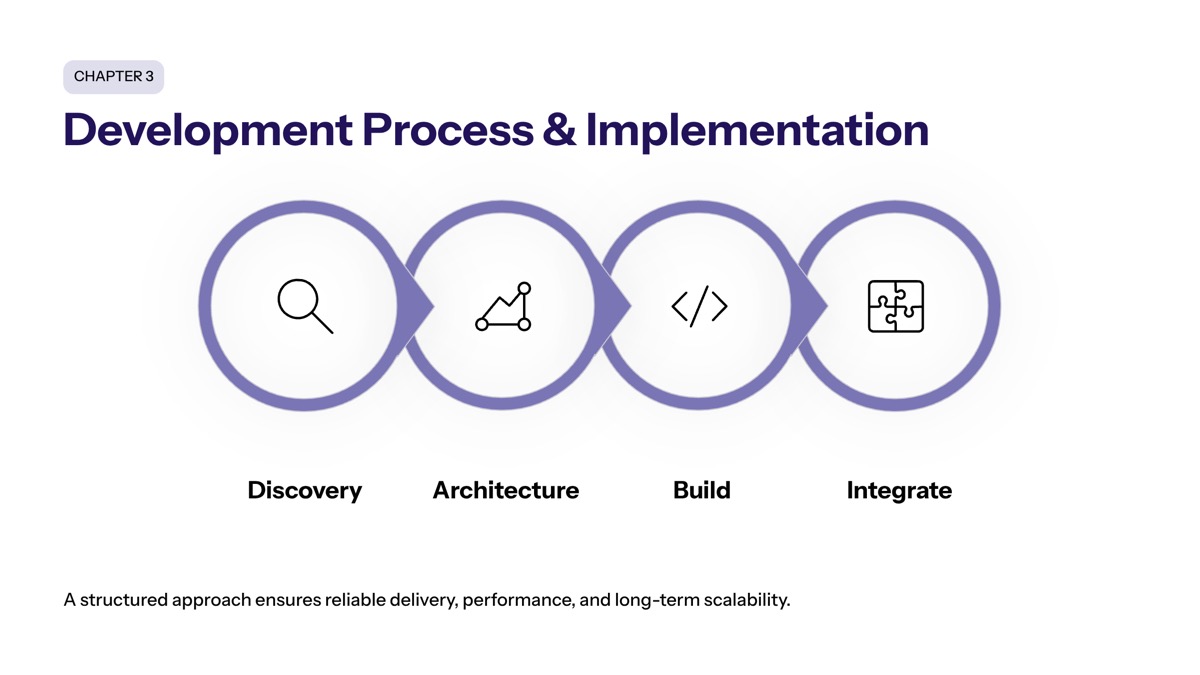
A VOD platform development project should follow a structured lifecycle: discovery, architecture, MVP, expansion, scaling, and ongoing improvement. The work is both technical and operational because the platform must support video files, licensing, monetization, content management, user experience, analytics, and customer support.
Cloud infrastructure is necessary for scalable hosting solutions to ensure low-latency, buffer-free video playback globally. Content licensing also entails securing legal distribution rights and copyright permissions before launching a VOD platform, so legal, product, engineering, and content operations teams need to plan together from the start.
Discovery and Planning Process
Thorough requirements gathering reduces expensive rework. The goal is to define the video strategy, technical architecture, content workflows, monetization models, compliance needs, and success metrics before development begins.
Business requirements analysis: Define audience segments, expected traffic, growth projections, target devices, content types, and revenue model. This includes deciding whether the vod platform will support subscription video, ad supported video, transactional video, or multiple monetization models from launch.
Technical architecture planning: Select cloud services, CDN strategy, streaming protocols, storage, transcoding, APIs, player requirements, and integration points. The plan should specify performance targets for high quality streaming, video quality, latency, uptime, and geographic distribution.
Content strategy assessment: Review catalog size, upload workflows, metadata requirements, localization needs, subtitles, dubbing, rights territories, refresh rate, and content library structure. Data analytics tools are used to track user engagement, watch time, and popular content categories in VOD platforms, so event design should begin during planning.
Compliance and security review: Identify regulations, privacy obligations, licensing rules, access controls, DRM needs, geographic restrictions, and anti-piracy requirements. In 2026, data ownership is a critical factor for businesses when selecting a VOD platform, as it allows for better audience insights and performance measurement.
Development Phases
A phased approach helps media teams reduce launch risk while still building toward a scalable vod streaming platform. It also gives stakeholders a way to validate content operations, user behavior, monetization, and streaming quality before investing in every advanced feature.
MVP development: Build core vod functionality such as secure video ingest, storing video files, basic transcoding, a web video player, user registration, content access rules, initial monetization, and basic analytics. For some teams, the MVP may also include a minimal mobile experience or limited live streaming support.
Platform expansion: Add mobile apps, smart TV apps, advanced content management, recommendation features, marketing tools, advertising workflows, localization, payment options, and richer subscriber management. This is where the vod service starts becoming a full product rather than a playback portal.
Optimization and scaling: Improve adaptive bitrate streaming, CDN routing, playback startup time, buffering ratios, error handling, analytics dashboards, API performance, and infrastructure cost efficiency. Quality of Experience monitoring should guide decisions about encoding ladders, CDN configuration, device issues, and user satisfaction.
Ongoing enhancement: Continue adding security patches, new monetization options, recommendation systems, API integrations, localization features, content operations automation, and new device support. The global video market is expanding, with paid video subscription services and ad-supported VOD models driving double-digit growth, indicating a strong demand for VOD platforms.
Development Approach Comparison
Different implementation approaches work for different business priorities. A startup with a narrow catalog may need speed; a broadcaster may need rights workflows, advanced analytics, and connected TV distribution; an enterprise may prioritize security and private access over public monetization.
Approach | Timeline | Cost | Flexibility | Risk |
|---|---|---|---|---|
Agile Custom Development | Usually 6-12+ months for a full production vod platform, depending on apps, DRM, analytics, and integrations | Higher upfront investment, often justified by ownership, lower marginal scale cost, and custom roadmap control | Highest flexibility for unique UX, multiple monetization models, recommendation logic, localization, and custom media workflows | Risk of scope creep, delayed launch, and higher delivery complexity if requirements are unclear |
Modified White-Label | Often weeks to a few months, depending on branding, apps, migration, and configuration | Lower initial cost, but monthly fees, bandwidth, storage, subscriber fees, and monetization fees affect total cost of ownership | Moderate flexibility for branding, standard features, and common vod monetization models | Risk of vendor lock-in, limited customization, and rising costs as usage scales |
Hybrid Approach | Often 3-9 months, depending on what is custom versus integrated | Balanced cost profile using existing services for commodity functions and custom development for differentiating capabilities | High flexibility where it matters, with faster delivery for common components such as billing, encoding, or analytics | Risk of integration complexity, fragmented support, and unclear ownership across vendors |
The choice depends on scale, budget, timeline, rights requirements, and internal technical maturity. Many vod platform providers, including the best vod platform providers, can support parts of the stack, but media teams should evaluate whether the vendor can evolve with their own vod platform rather than only solve the first launch milestone.
Common Challenges and Solutions
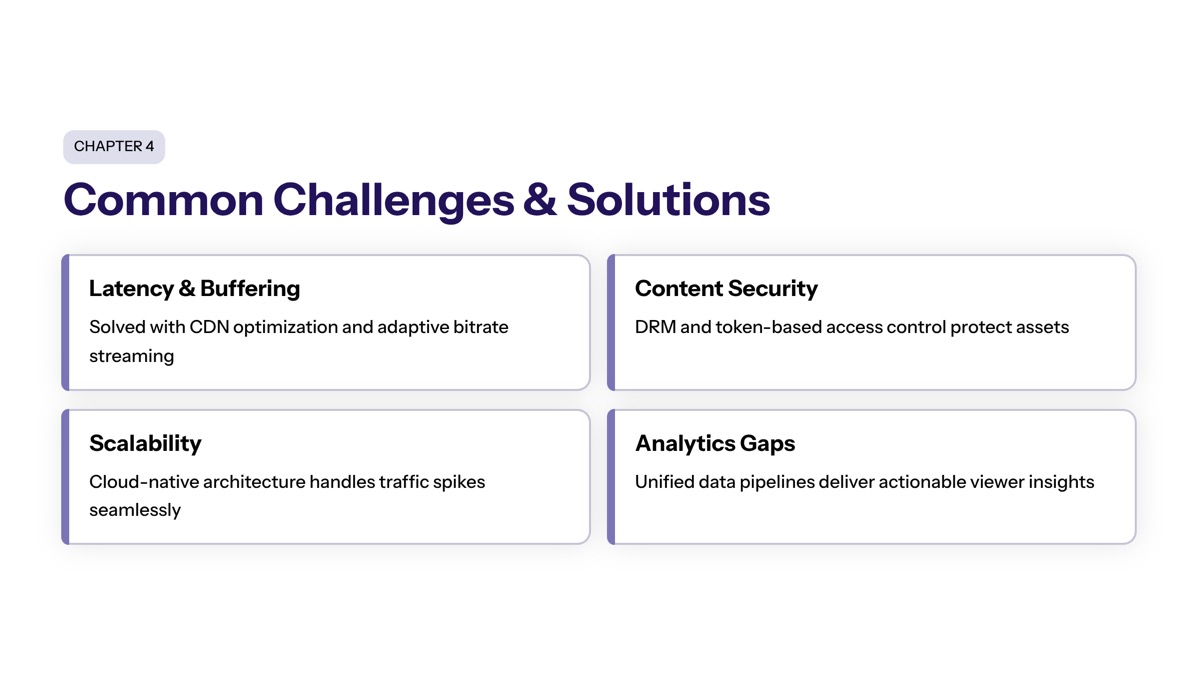
VOD development becomes difficult when teams treat it like a standard web application. Delivering video at scale requires specialized knowledge of vod infrastructure, streaming protocols, content protection, player behavior, monetization, analytics, and content operations.
Underestimating Technical Complexity
The solution is to work with development partners experienced in video streaming infrastructure and content operations. A capable team should understand CDN optimization, transcoding workflows, streaming protocols, adaptive bitrate streaming, QoE metrics, and the differences between vod streaming, live streaming, and hybrid playback models.
Technical complexity often appears in areas that are invisible during early planning: encoding profiles, device fragmentation, subtitle handling, content packaging, seek performance, smart TV app review processes, or regional CDN behavior. Before full launch, run load tests, validate playback across devices, and define measurable performance targets for streaming quality.
Inadequate Content Security Planning
The solution is to implement comprehensive DRM, access controls, and piracy protection from project start. Digital rights management should be planned alongside licensing, monetization, and app distribution rather than added after launch.
Content protection requirements vary by rights holder and revenue model. Premium video, transactional video on demand, regional licensing, and ad-supported distribution may require DRM, geo-blocking, tokenized URLs, signed playback sessions, watermarking, account limits, and audit logs. Planning these requirements early helps prevent launch delays and licensing conflicts.
Poor Monetization Strategy Integration
The solution is to design flexible monetization architecture that supports multiple revenue models and pricing strategies. A platform that launches with only one monetization model may struggle later if the market shifts toward bundles, advertising video, pay-per-view events, or mixed free and paid tiers.
SVOD supports recurring revenue, AVOD expands reach with free access, and TVOD captures value from premium or time-sensitive releases. Modern vod platforms should make it possible to test packages, promotions, ad rules, subscriptions, rentals, purchases, and hybrid access without rebuilding the core billing and entitlement system.
Insufficient Performance and Scaling Planning
The solution is to design for scale from day one with cloud-native architecture and global content delivery. A global content delivery network, auto-scaling infrastructure, observability, regional storage strategy, and failover planning are essential for reliable content delivery.
Poor scaling leads to buffering, failed playback, churn, negative reviews, and lost revenue. Performance planning should include traffic spikes, app launches, popular releases, live-to-VOD events, geographic expansion, device-specific behavior, and the cost impact of bandwidth, storage, and CDN egress.
Conclusion and Next Steps
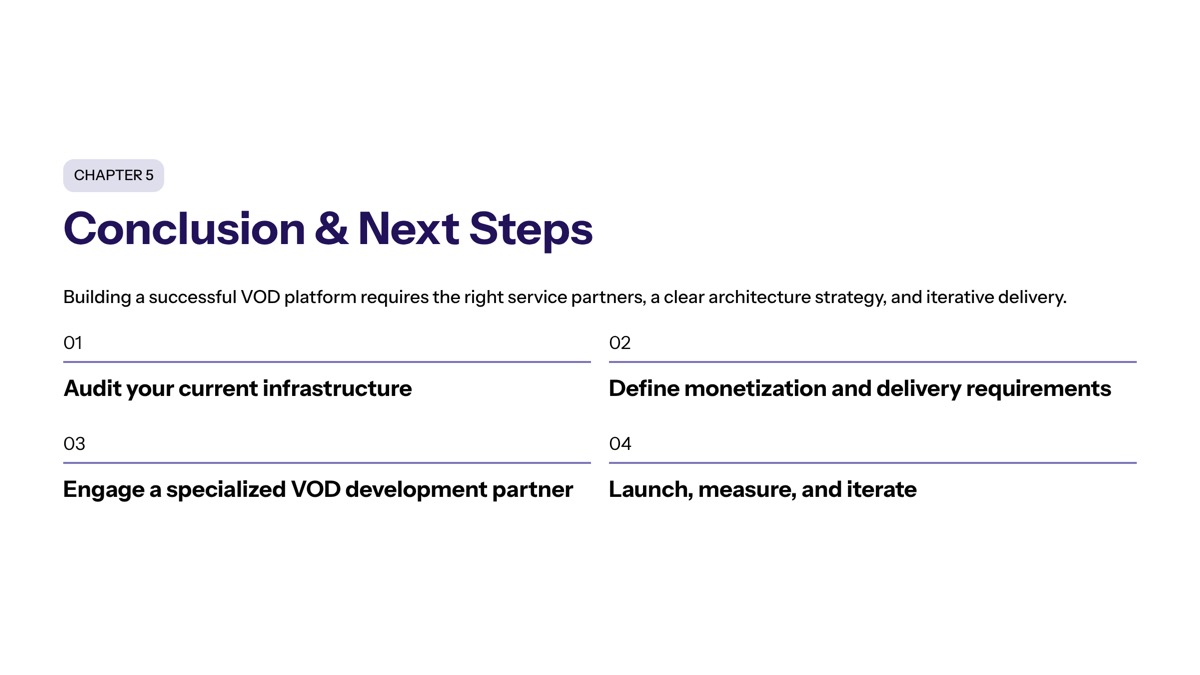
VOD platform development services require specialized expertise in video streaming technology, media operations, monetization, security, analytics, and cross-device product design. The strongest platforms are not just places for delivering video; they are owned media infrastructure for revenue control, first-party data, audience relationships, and scalable content distribution.
For media teams evaluating vod platform development, the next steps are:
Assess your content strategy and technical requirements. Define catalog size, content rights, target devices, localization needs, live streaming requirements, and whether your platform will focus on SVOD, AVOD, TVOD, or hybrid monetization.
Evaluate development partners and vod service providers carefully. Look for proven experience with video hosting, CDN strategy, DRM, adaptive streaming, mobile apps, smart TVs, advanced analytics, and content operations.
Create a detailed project roadmap. Separate MVP, expansion, optimization, and ongoing enhancement milestones, with clear success metrics for acquisition, watch time, churn, ARPU, buffering, video quality, and infrastructure cost.
Plan for ownership and long-term scalability. Include total cost of ownership, data ownership, security, compliance, platform extensibility, and future integrations in the decision-not only the first-year subscription or development cost.
Connect VOD with the broader media stack. Recommendation system development, content localization services, analytics implementation, and workflow automation should be part of the same roadmap as the core video on demand platform.
If your team is building or modernizing a media distribution system, start with the platform strategy first, then choose the implementation model. The right VOD platform should protect your content, support your revenue model, scale with your audience, and give your team the operational control needed to compete in 2026 and beyond.