What is AI Implementation? A Complete Guide for Business Leaders
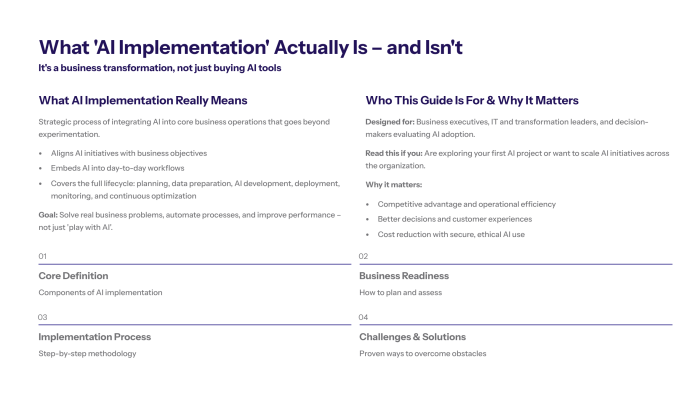
AI implementation refers to the strategic process of integrating artificial intelligence technologies into business operations to solve specific problems, automate processes, and improve organizational performance. Unlike simply purchasing AI tools or experimenting with AI capabilities, successful AI implementation involves a comprehensive AI implementation strategy that aligns AI initiatives with business objectives and transforms how organizations operate.
This process encompasses everything from initial planning and data preparation through AI development, AI deployment, monitoring, and continuous optimization of AI systems within existing business processes.
What This Guide Covers
This comprehensive guide explains AI implementation fundamentals, strategic planning considerations, step-by-step implementation processes, and practical solutions for common challenges. We’ll cover both technical components and business strategy elements, including how to integrate AI technologies such as natural language processing (NLP) and generative AI (gen AI), but won’t delve into AI model development or deep technical programming details.
Who This Is For
This guide is designed for business executives, IT managers, and decision-makers considering AI adoption. Whether you’re exploring your first AI project or looking to scale existing AI initiatives across your organization, you’ll find strategic insights and practical frameworks for successful AI implementation.
Why This Matters
Effective AI implementation drives competitive advantage, operational efficiency, and digital transformation in today’s business landscape. Organizations that implement AI successfully can automate repetitive tasks, improve decision-making processes, and leverage AI to enhance customer satisfaction while reducing operational costs—all while ensuring data security and ethical AI use.
What You’ll Learn:
-
Core definition and components of AI implementation
-
Strategic planning and business readiness assessment
-
Step-by-step AI implementation process
-
Common challenges and proven solutions for successful AI

Understanding AI Implementation Fundamentals: Aligning Business Needs and Objectives
AI implementation is the systematic integration of artificial intelligence technologies into existing business processes and workflows to achieve specific business goals. This goes beyond simply adopting AI tools—it represents a strategic transformation of how organizations operate, make decisions, and deliver value to customers.
The fundamental purpose is identifying where AI systems can solve real business problems and deliver measurable value, rather than implementing AI for technological novelty alone.
Core Components of AI Implementation Strategy
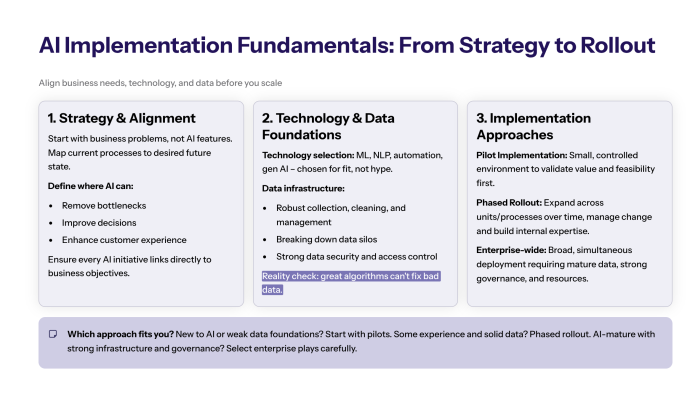
Strategic Planning and Business Alignment forms the foundation of any successful AI implementation strategy. This involves mapping current business processes against desired future states, identifying inefficiencies where AI capabilities can meaningfully intervene, and ensuring AI initiatives align with broader business objectives and business needs.
Technology Selection and Integrating AI Technologies encompasses choosing appropriate AI technologies—including machine learning algorithms, natural language processing tools, and automation platforms—based on specific business needs rather than technological trends. Organizations must evaluate whether to build custom AI solutions, purchase existing AI platforms, or extend current capabilities.
Data Infrastructure, Data Management, and Data Security represent perhaps the most critical component. AI models rely on high quality data to function effectively, making robust data collection, data cleaning, and data management processes essential. Poor data quality upstream cascades into poor AI performance downstream, regardless of algorithm sophistication. Addressing data silos and ensuring data security are paramount to safeguarding organizational and customer information.
This connects to AI implementation because these components work together as an integrated system—strategic planning guides technology selection, while data infrastructure and data strategy enable chosen technologies to deliver on strategic objectives.
Types of AI Implementation Approaches
Pilot Implementation involves testing AI solutions in controlled environments with limited scope before full deployment. This approach allows organizations to validate AI capabilities, measure initial business impact, and refine processes before broader rollout.
Phased Rollout gradually extends AI systems across different business units or processes over time. This approach helps manage change, build internal expertise, and demonstrate value incrementally while minimizing organizational disruption.
Enterprise-wide Implementation deploys AI technologies comprehensively across multiple business functions simultaneously. This approach can deliver faster transformation but requires significant resources, strong AI governance frameworks, and robust change management.
Building on previous concepts, approach selection depends on organizational readiness, available resources, and strategic objectives—pilot implementations suit organizations new to AI, while enterprise-wide approaches may benefit organizations with existing AI experience and strong data infrastructure.
Transition: Understanding these fundamentals provides the foundation for developing a strategic AI implementation strategy that aligns with business priorities and organizational capabilities.
AI Implementation Journey: Process and Strategy
Moving from conceptual understanding to strategic planning requires systematic assessment of organizational readiness and clear goal-setting frameworks that connect AI capabilities to business value creation.
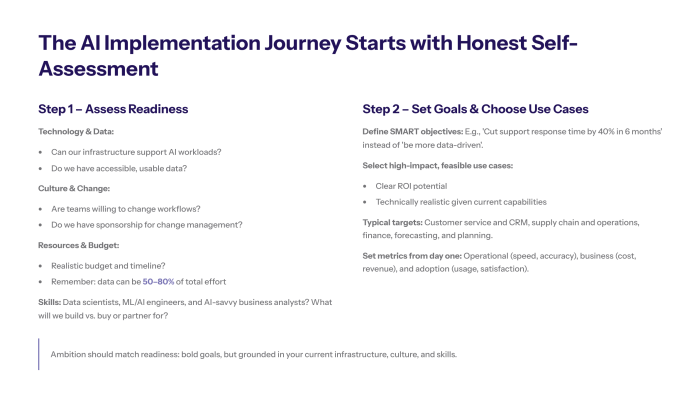
Business Readiness Assessment: Evaluating Business Needs and Resources
Technology Infrastructure Evaluation examines existing data storage systems, computational capabilities, and integration possibilities with current business operations. Organizations must assess whether their data infrastructure can support AI models’ requirements and identify gaps requiring investment.
Organizational Culture and Change Management Readiness evaluates how prepared teams are to adopt new AI tools and modify existing workflows. Successful AI implementation often requires employees to work alongside AI systems, making cultural readiness as important as technical capabilities.
Resource Allocation Analysis includes budget planning for AI investments, timeline development for implementation phases, and human capital assessment. Many organizations underestimate data-related costs, which can constitute 50-80% of total implementation expenses.
Skills Gap Identification determines what expertise organizations need to develop internally versus acquiring through partnerships. Data scientists, ML engineers, and AI specialists represent key roles, but business analysts who understand both AI capabilities and business processes often prove equally valuable.
Goal Setting and Use Case Identification: Aligning AI Innovation with Business Objectives
SMART Objectives Definition ensures AI initiatives have specific, measurable, achievable, relevant, and time-bound goals aligned with business priorities. Rather than vague aspirations like “become more data-driven,” effective objectives specify measurable outcomes like “reduce customer service response time by 40% within six months.”
High-Impact Use Case Selection focuses on business processes where AI can deliver significant ROI potential while remaining technically feasible given current organizational capabilities. Customer relationship management optimization, supply chain efficiency improvements, and financial forecasting represent common high-impact areas.
Success Metrics Establishment defines key performance indicators for measuring AI implementation effectiveness. These might include operational metrics (processing speed, accuracy rates), business metrics (cost reduction, revenue growth), or user adoption metrics (system utilization, user satisfaction).
Connection to assessment: organizational readiness directly informs what goals are realistic and achievable, helping avoid overambitious implementations that exceed current capabilities.
Technology Selection and Partnership Strategy: Choosing the Right AI Technologies
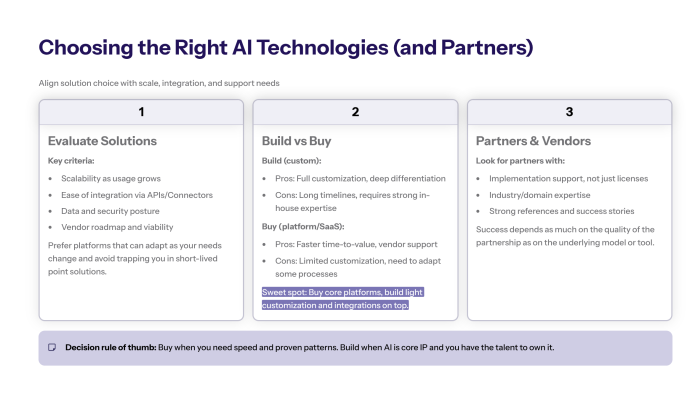
AI Solution Evaluation uses criteria including scalability potential, integration capabilities with existing systems, vendor support quality, and long-term viability. Organizations should prioritize solutions that can grow with their needs rather than requiring replacement as requirements evolve.
Build vs. Buy Decision Framework weighs custom development against purchasing existing AI platforms. Building offers customization but requires significant internal expertise and extended timelines, while buying provides faster implementation but may require process modifications.
Partner and Vendor Selection involves evaluating implementation support capabilities, industry expertise, and ongoing maintenance commitments. Strong partnerships often determine implementation success more than technology selection alone.
Transition: Strategic planning provides the foundation for moving to practical implementation steps that transform plans into operational AI systems.
Step-by-Step AI Implementation Guide: From Data Management to AI Deployment
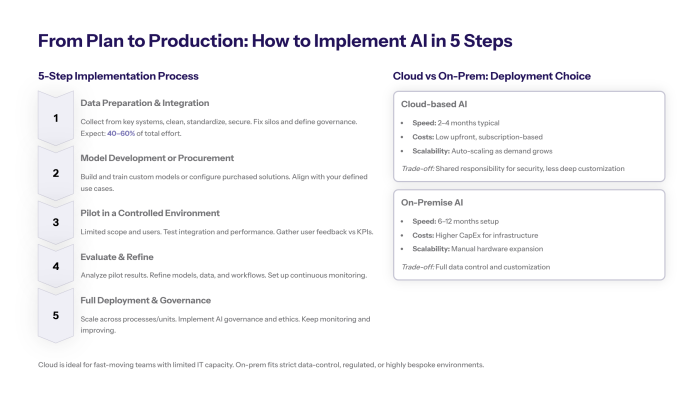
Transitioning from strategic planning to execution requires a systematic approach that manages risk while delivering measurable business value through carefully orchestrated implementation phases.
|
Step |
Description |
Key Activities |
Typical Duration |
|---|---|---|---|
|
1 |
Data Preparation and Integration |
Collect relevant data from multiple sources, implement data cleaning protocols, address data silos, and establish data management and security processes to support ongoing AI model training and operation. |
40-60% of total implementation time |
|
2 |
AI Model Development or Procurement |
Develop custom AI models using historical data and machine learning techniques, train AI models on relevant data patterns, or configure purchased AI solutions to match specific business requirements. |
Variable based on complexity |
|
3 |
Pilot Testing in Controlled Environment |
Deploy AI systems in limited scope, test integration with existing systems, measure performance against success metrics, and gather user feedback. |
2-4 months |
|
4 |
Performance Evaluation and Refinement |
Analyze pilot results using KPIs, refine AI models and business processes, and implement continuous monitoring to maintain AI performance and ethical standards. |
Ongoing |
|
5 |
Full Deployment with Monitoring Protocols |
Scale successful pilot implementations across broader business operations, establish AI governance frameworks including AI ethics, and ensure data security compliance. |
Variable based on scale |
Cloud-based vs On-premise AI Implementation Comparison
|
Feature |
Cloud-based AI |
On-premise AI |
|---|---|---|
|
Implementation Speed |
2-4 months typical deployment |
6-12 months for full setup |
|
Initial Costs |
Lower upfront investment, subscription model |
Higher capital expenditure for infrastructure |
|
Scalability |
Automatic scaling based on demand |
Manual scaling requires hardware upgrades |
|
Data Security |
Shared responsibility model with cloud provider |
Complete organizational control over data |
|
Maintenance |
Provider handles updates and maintenance |
Internal IT team manages all maintenance |
|
Customization |
Limited to provider’s configuration options |
Full customization capabilities |
Organizations with limited IT resources and need for rapid deployment often benefit from cloud-based approaches, while companies with strict data security requirements or unique customization needs may prefer on-premise solutions that provide complete control over AI systems and data processing.
Common Challenges and Solutions in the AI Adoption Process
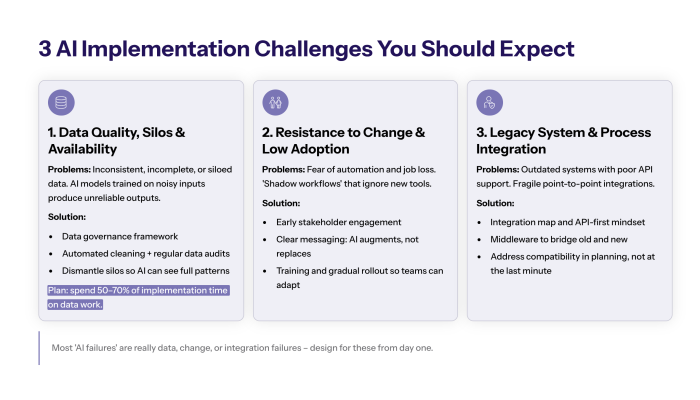
Implementation challenges often stem from underestimating data requirements, organizational change complexity, and technical integration difficulties that can derail otherwise well-planned AI projects.
Challenge 1: Data Quality, Data Silos, and Availability Issues
Solution: Implement comprehensive data governance frameworks that establish data quality standards, automated data cleaning processes, and regular data auditing procedures before beginning AI development. Addressing data silos ensures that all relevant data patterns are accessible for AI training and deployment.
Organizations should budget 50-70% of implementation time for data preparation activities, as AI algorithms require consistent, accurate, and properly formatted input data to generate reliable insights and predictions.
Challenge 2: Resistance to Change and Low User Adoption
Solution: Develop comprehensive change management strategies that include stakeholder engagement from project inception, extensive training programs that help employees understand how AI tools enhance rather than replace their work, and gradual rollout approaches that allow teams to adapt progressively.
Communication strategies should emphasize how AI implementation improves job satisfaction by automating repetitive tasks and enabling employees to focus on higher-value activities that require human creativity and judgment.
Challenge 3: Integration with Legacy Systems and Business Operations
Solution: Conduct thorough integration planning that maps data flows between AI systems and existing business operations, consider API-first approaches that enable seamless connectivity, and implement middleware solutions that bridge compatibility gaps between modern AI platforms and older enterprise systems.
Assessment of system compatibility should occur during strategic planning phases to avoid costly integration surprises during deployment phases.
AI's Impact on Business and Ethical Considerations
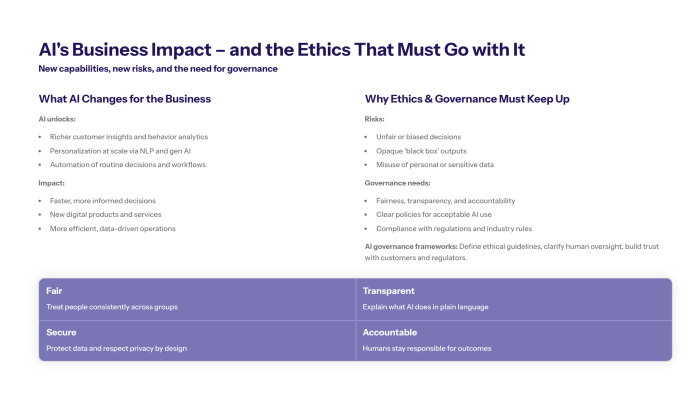
AI's impact extends beyond operational efficiency to include customer behavior insights, AI innovation, and transformation of business models. Generative AI (gen AI) and natural language processing (NLP) technologies enable new capabilities such as personalized customer interactions and advanced analytics.
However, organizations must also consider AI ethics, ensuring fairness, transparency, and accountability in AI systems. Establishing AI governance frameworks that include ethical guidelines protects both the organization and its customers, fostering trust and compliance with regulations.
Conclusion and Next Steps
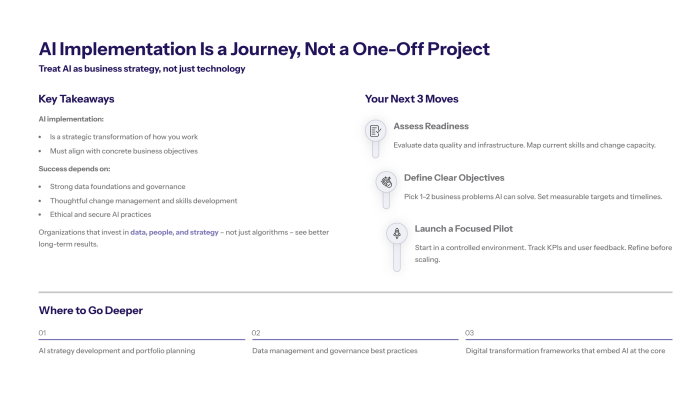
AI implementation represents a strategic business transformation that requires careful planning, systematic execution, and ongoing optimization rather than one-time technology deployment. Successful AI implementation aligns AI capabilities with specific business objectives, establishes robust data infrastructure, and creates organizational capabilities that support long-term AI adoption and innovation.
The key to implementing AI successfully lies in treating it as a comprehensive business strategy rather than isolated technology project—organizations that invest in data quality, change management, AI ethics, and strategic alignment typically achieve better outcomes than those focusing solely on AI algorithms and technical specifications.
To get started:
-
Assess current organizational readiness by evaluating data infrastructure quality, technical capabilities, and change management capacity.
-
Define clear, measurable objectives that specify how AI will solve specific business problems and create value.
-
Launch a pilot project in a controlled environment with well-defined success metrics before pursuing broader AI deployment.
Related Topics: Consider exploring AI strategy development for organizational alignment, data management best practices for AI readiness, and digital transformation frameworks that incorporate AI as part of broader modernization initiatives.
Additional Resources
-
AI Readiness Assessment Tools: Self-evaluation frameworks for determining organizational preparedness for AI implementation across technology, data, and cultural dimensions.
-
Industry-Specific Implementation Guides: Detailed case studies and best practices for AI implementation in healthcare, finance, manufacturing, and retail sectors.
-
ROI Calculation Templates: Frameworks for measuring business value from AI investments including cost-benefit analysis and success measurement methodologies.