Why Handoffs Break Transformations? (and How to Fix Them)
If you want a fast way to diagnose why transformation feels slow, look at the handoffs.
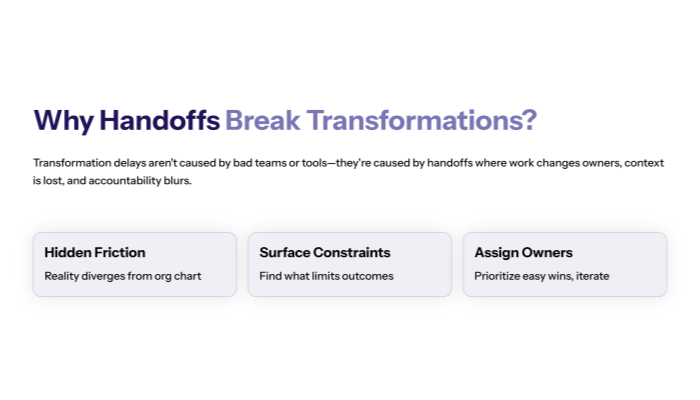
In most organizations, the biggest execution delays aren’t caused by a single “bad team” or a single “bad tool.”
They’re caused by process handoffs in digital transformation—the moments where work changes owners, context is lost, accountability blurs, and work quietly turns into waiting.
RAPID’s Research + Analyze flywheel is designed to surface exactly this kind of hidden friction—what sits beneath the surface, where reality diverges from the org chart, and which constraints actually limit outcomes. Then the method turns those findings into specific gaps, assigns owners, prioritizes easy wins, and iterates based on measurable results.
This post breaks down:
- why process handoffs in digital transformation are the silent constraint,
- how to map them fast without a 6-month effort,
- and how to standardize the “interfaces” between teams without killing flexibility.

Why process handoffs in digital transformation become the system’s slow lane?
1.1 Handoffs create queues, not progress
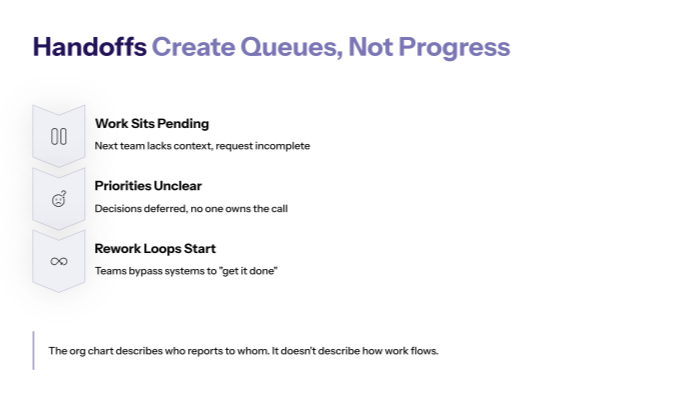
A handoff is supposed to move work forward. In practice, process handoffs in digital transformation often create queues:
- work sits “pending review”
- the next team lacks context
- the request is incomplete
- priorities are unclear
- decisions are deferred because no one owns the call
RAPID explicitly frames the early discovery as a truth-seeking effort: you eliminate irrelevant noise and focus on what actually constrains outcomes. Handoffs repeatedly show up as “relevant” because they produce consistent, measurable friction.
If your transformation includes cross-functional work (it always does), then handoffs often become the place where:
- cycle time inflates
- rework loops start
- decision latency spikes
- teams start bypassing systems to “get it done”
1.2 Why handoffs are where the org chart stops working?
The org chart describes who reports to whom. It doesn’t describe how work flows.
That’s why process handoffs in digital transformation are so dangerous: they expose the gap between “formal structure” and “execution reality.” RAPID calls this out through the iceberg idea—many problems sit beneath the surface, and you must find what’s actually happening rather than what leaders wish was happening.
In real organizations, handoffs run through:
- informal relationships (“ask Sarah, she knows the trick”)
- shadow tools (spreadsheets, Slack threads, email forwarding)
- undocumented steps (“we always check this before sending to Finance”)
- re-interpretation (“Legal wants it formatted this way now”)
When those hidden mechanics aren’t surfaced and standardized at the interface level, the transformation effort inherits all the friction—and amplifies it.
The RAPID way to map process handoffs in digital transformation (fast and truthful)
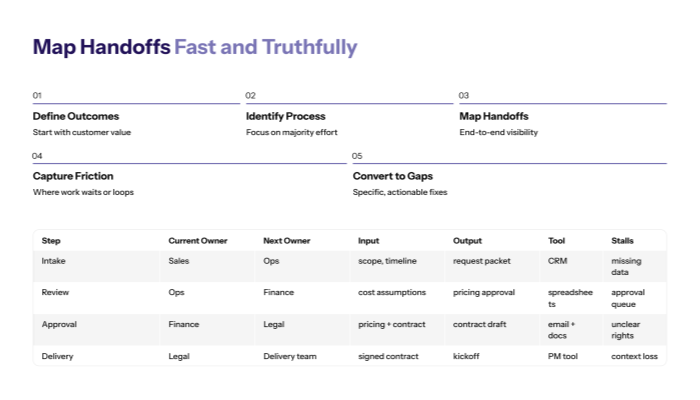
2.1 Start with outcomes and customer value, not “workflow documentation”
RAPID tools aren’t designed to create documentation for its own sake. They’re designed to create actionable data aligned to outcomes and customer value.
That’s the key to mapping process handoffs in digital transformation without turning it into a long internal project:
- Define the outcome(s) the workflow supports
- Identify the process that drives the majority of effort
- Map handoffs inside that process end-to-end
- Capture where work waits, loops back, or escalates
- Convert the friction into specific gaps and decisions
This aligns with RAPID’s Research + Analyze cycle: gather and interpret what matters, eliminate noise, and surface constraints.
2.2 Use Process Inventory to reveal handoff paths (not idealized steps)
RAPID’s Process Inventory is built to “discover and describe processes” starting from outcomes and customer value, focusing on the processes that drive most effort—and capturing risks and compliance along the way.
For process handoffs in digital transformation, you want the inventory to expose:
- which departments touch the work
- where ownership changes
- which tools are used at each step
- what the handoff input/output is
- which decisions are required to proceed
Use this lightweight “handoff mapping” template:
|
Step |
Current owner |
Next owner |
Input required |
Output produced |
Tool(s) used |
Where it stalls |
|---|---|---|---|---|---|---|
|
Intake |
Sales |
Ops |
scope, timeline |
request packet |
CRM |
missing data |
|
Review |
Ops |
Finance |
cost assumptions |
pricing approval |
spreadsheets |
approval queue |
|
Approval |
Finance |
Legal |
pricing + contract |
contract draft |
email + docs |
unclear decision rights |
|
Delivery |
Legal |
Delivery team |
signed contract |
kickoff |
PM tool |
handoff context loss |
The point is not to map every micro-step. The point is to make process handoffs in digital transformation visible enough that the bottleneck becomes undeniable.
Diagnose the handoff failure modes (the patterns that keep repeating)
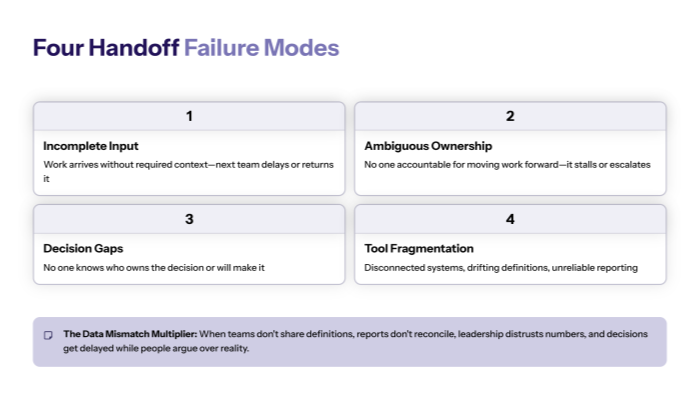
3.1 The four handoff failure modes that break flow
Across industries, most process handoffs in digital transformation break down in one of these ways:
- Incomplete input
Work arrives without required context, so the next team delays or returns it.
- Ambiguous ownership
No one is accountable for moving the work forward, so it stalls or escalates.
- Decision gaps
A decision is needed, but no one knows who owns it (or no one will make it).
- Tool fragmentation
Work moves across disconnected systems; data definitions drift; reporting becomes unreliable.
RAPID explicitly warns against “silver bullet platform” thinking—buying tools and expecting them to fix systemic issues without doing the people/process/product work first.
When handoffs break, the organization often reacts by adding approvals and more reporting—which increases friction and hides the real constraint behind bureaucracy.
3.2 The “data mismatch” handoff: the invisible multiplier
One of the most destructive forms of process handoffs in digital transformation is data mismatch:
- two teams don’t share the same definitions
- reports don’t reconcile
- leadership distrusts numbers
- decisions get delayed while people argue over reality
RAPID gives a very practical example of how basic misalignment can break reporting trust (even down to time zones and report timing), and treats reliable reporting as foundational—because leaders are “internal customers” of the data.
This matters because handoffs depend on shared truth. If teams can’t agree on what a field means, what “done” means, or which number is correct, then handoffs become friction factories—no matter how good the tool is.
Fix process handoffs in digital transformation with gap analysis + decision ownership
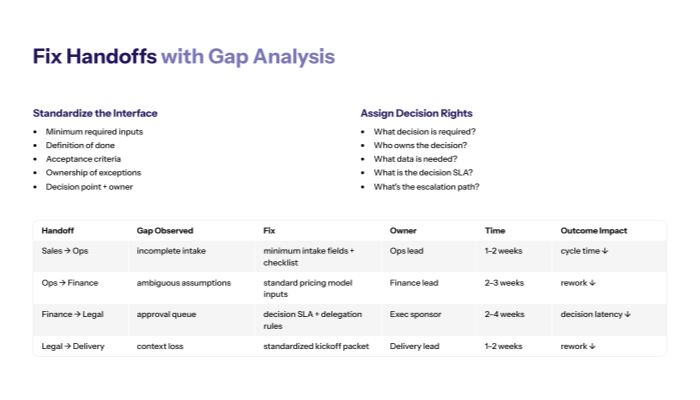
4.1 Use Process Gap Analysis to standardize interfaces, not teams
RAPID’s Process Gap Analysis translates findings into specific improvements—often one department per line—so fixes are concrete and executable, not aspirational.
This is the core move for fixing process handoffs in digital transformation: standardize the interface between teams.
What to standardize at handoffs
- minimum required inputs (intake standards)
- definition of done (for the sending team)
- acceptance criteria (for the receiving team)
- ownership of exceptions
- decision point + decision owner
Here’s a simple Process Gap table specifically for handoffs:
|
Handoff |
Gap observed |
Fix |
Owner |
Time to correct |
Outcome impact |
|---|---|---|---|---|---|
|
Sales → Ops |
incomplete intake |
minimum intake fields + checklist |
Ops lead |
1–2 weeks |
cycle time ↓ |
|
Ops → Finance |
ambiguous assumptions |
standard pricing model inputs |
Finance lead |
2–3 weeks |
rework ↓ |
|
Finance → Legal |
approval queue |
decision SLA + delegation rules |
Exec sponsor |
2–4 weeks |
decision latency ↓ |
|
Legal → Delivery |
context loss |
standardized kickoff packet |
Delivery lead |
1–2 weeks |
rework ↓ |
Notice what’s missing: “train people to communicate better.” Training can help—but the real fix is to remove ambiguity from the interface.
4.2 Assign decision rights with Decision Inventory (handoffs stall at decisions)
Handoffs often stall because a decision is required and no one owns it.
RAPID’s Decision Inventory exists to solve exactly this: decisions are framed as questions, assigned owners, prioritized, and linked to outcomes and customer value.
When you’re fixing process handoffs in digital transformation, you should explicitly capture:
- What decision is required at this handoff?
- Who owns the decision?
- What data is required (minimum viable truth)?
- What is the decision SLA?
- What’s the escalation path if the SLA is missed?
RAPID emphasizes that decisions create momentum and happen throughout the process—if a decision never gets made, the outcome never happens.
This is why “approval chains” often show up as the real bottleneck: they’re not just process steps—they’re unowned decision systems.
Make it stick: standardize handoffs without killing flexibility
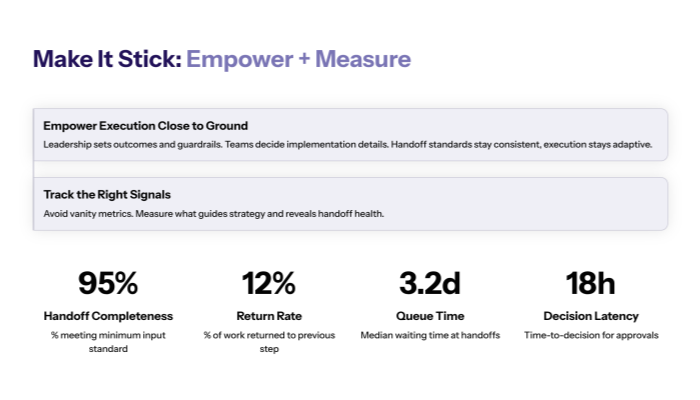
5.1 Empower execution close to the ground (or handoffs will re-break)
Even if you standardize the interface, handoffs will degrade again if execution teams aren’t empowered to act within guardrails.
RAPID makes this leadership decision explicit: once leadership backs the strategy, management should decide to “no longer decide” implementation details—so decisions happen close to the ground where knowledge exists.
This preserves flexibility while stabilizing handoffs:
- leadership sets outcomes, guardrails, and priorities
- teams decide implementation details within those constraints
- handoff standards remain consistent, but execution stays adaptive
Without empowerment, teams revert to escalation and workaround behavior, and process handoffs in digital transformation become slow again.
5.2 Track the right signals (or you’ll drift into KPI theater)
If you don’t measure handoff health, you’ll drift back into status updates and vanity metrics.
RAPID warns about vanity metrics—numbers chosen to protect a narrative rather than guide strategy—and stresses aligning around measurable outcomes.
For process handoffs in digital transformation, track the simplest leading indicators:
- Handoff completeness rate: % of handoffs meeting minimum input standard
- Return rate: % of work returned to previous step (rework loop)
- Queue time: median waiting time at handoff stages
- Decision latency: time-to-decision for handoff approvals
Then run a weekly cadence:
- review the worst handoff bottleneck
- decide the next fix
- implement one change
- re-measure and iterate (flywheel discipline)
Closing takeaway
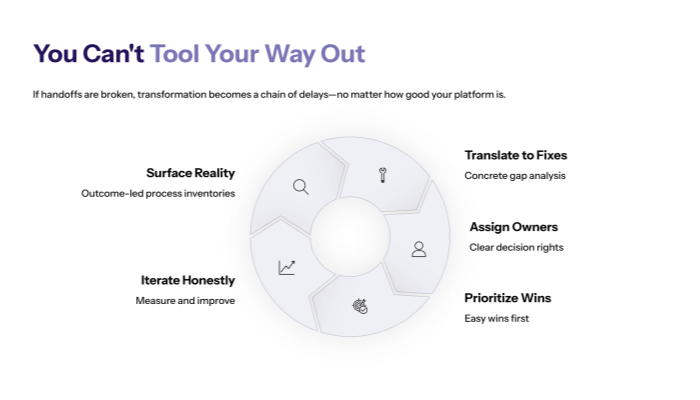
You can’t “tool your way” out of bad handoffs.
If process handoffs in digital transformation are broken, transformation becomes a chain of delays—no matter how good your platform is. RAPID’s approach is to surface handoff reality through outcome-led process inventories, translate friction into concrete gap fixes, assign decision owners, prioritize easy wins, and iterate based on honest measurement.