Adoption Isn’t Training: Designing Workflows People Actually Use
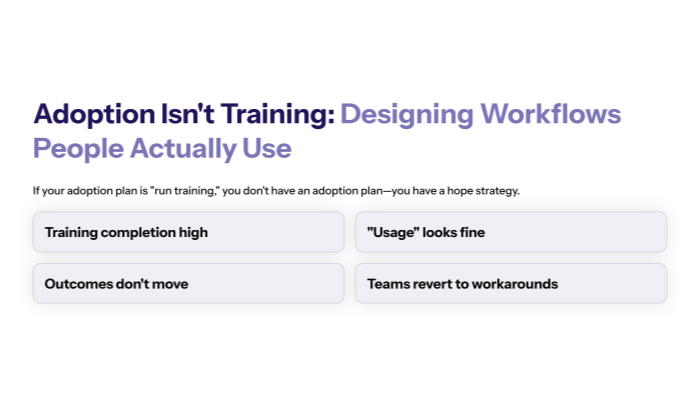
If your adoption plan is “run training,” you don’t have an adoption plan—you have a hope strategy.
Training can explain a tool. It can’t fix broken workflows, unclear decision rights, or incentives that punish the new behavior. That’s why many transformations show the same pattern:
- training completion is high
- “usage” looks fine
- outcomes don’t move
- teams quietly revert to old workarounds
RAPID is built to avoid this trap by anchoring change to measurable outcomes and decision-making, then using the Decide loop to stay/change/stop based on real impact.
This post explains the practical truth: adoption is workflow design—not training.

Why training-based adoption fails?
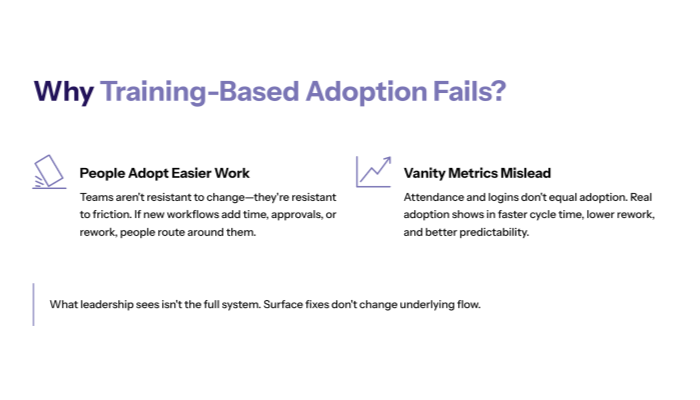
1.1 People don’t adopt tools—they adopt easier ways to get work done
Most teams aren’t “resistant to change.” They’re resistant to friction.
If the new workflow:
- takes longer
- adds approvals
- increases rework
- creates ambiguous ownership
- produces unreliable data
…people will route around it. That’s rational behavior.
RAPID’s approach starts with the reality beneath the surface (the iceberg rule): what leadership sees isn’t the full system, and surface fixes don’t change the underlying flow.
So if adoption is failing, your workflow design is failing.
1.2 Vanity metrics make training look like success
Training-based programs often measure:
- attendance
- completion rates
- number of enablement sessions
- logins / “active users”
RAPID warns against vanity metrics—numbers selected to make leaders feel good about decisions that may be wrong. Those adoption metrics are often activity signals, not outcome signals.
Real adoption must show up in:
- faster cycle time
- lower rework
- reduced decision latency
- higher data trust
- better predictability
If outcomes aren’t moving, adoption isn’t real.
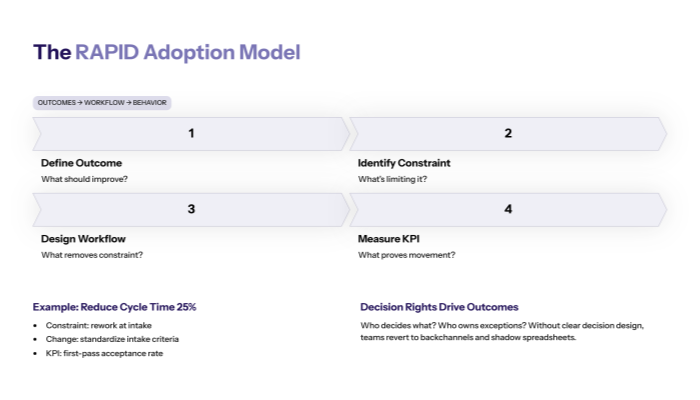
The RAPID adoption model (Outcomes → Workflow → Behavior)
2.1 Start from measurable outcomes, not feature education
RAPID emphasizes that success must be measurable; if you can’t measure success, you can’t evaluate initiatives.
So adoption starts by defining:
- what outcome should improve
- what constraint is currently limiting it
- what workflow change removes the constraint
- what KPI will prove movement
Example:
- Outcome: reduce cycle time 25%
- Constraint: rework at intake
- Workflow change: standardize intake + acceptance criteria
- KPI: first-pass acceptance rate + rework rate
Training only comes after the workflow design is complete—and only to reinforce the workflow.
2.2 Adoption requires decision rights (or people will revert)
Many “adoption failures” are actually governance failures:
- Who decides what?
- Who can reject incomplete work?
- Who owns exceptions?
- What’s the SLA for decisions?
RAPID is explicit: decisions drive outcomes, and if decisions don’t get made, outcomes don’t happen.
If decision rights aren’t designed into the workflow, people will protect themselves with:
- backchannels
- informal approvals
- shadow spreadsheets
- “just do it the old way”
So adoption is the visible symptom; decision design is often the root cause.
How to design workflows people actually use?
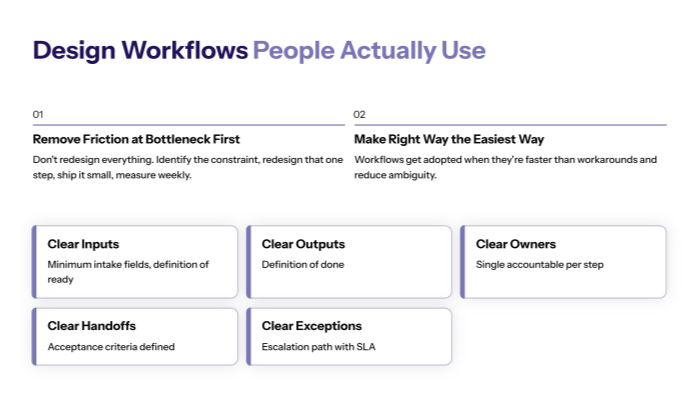
3.1 Design rule #1: Remove friction at the bottleneck first
RAPID is clear that complex problems are solved by many small steps—sequenced properly. That’s how workflow adoption becomes realistic: don’t redesign everything; redesign the bottleneck interface first.
Practical approach:
- Identify the constraint (handoff queue, rework loop, approval delay)
- Redesign that one workflow step
- Ship it as a small increment
- Measure weekly
- Expand only after KPI movement is proven
This is why RAPID encourages easy wins—momentum builds trust and reduces resistance.
3.2 Design rule #2: Make the “right way” the easiest way
A workflow gets adopted when:
- it’s faster than the workaround
- it reduces ambiguity
- it produces reliable outputs
- it lowers cognitive load
To achieve that, enforce these workflow patterns:
- Clear inputs (minimum intake fields / definition of ready)
- Clear outputs (definition of done)
- Clear owners (single accountable for each step)
- Clear handoff acceptance criteria
- Clear exception path (escalation + SLA)
If you need an hour of training to explain your workflow, it’s too complex.
Adoption measurement (what to track weekly)
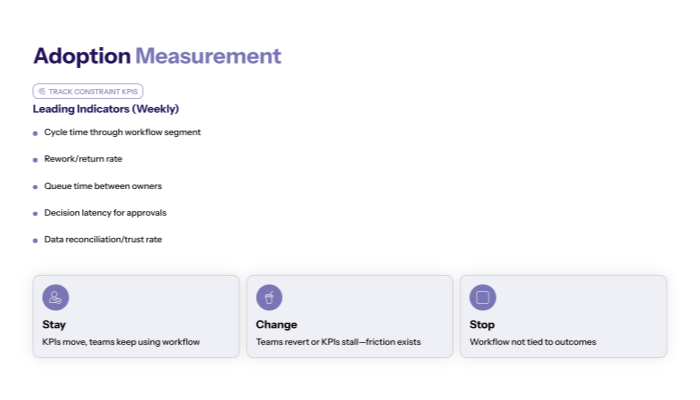
4.1 Track constraint KPIs, not “usage” KPIs
If you want to know whether adoption is real, track metrics that represent system behavior:
Leading indicators (weekly):
- cycle time through the workflow segment
- rework/return rate
- queue time between owners
- decision latency for approvals/exceptions
- data reconciliation/trust rate (where relevant)
This aligns with RAPID’s emphasis on measurable evaluation and avoiding vanity metrics.
Usage metrics can be helpful, but only as supporting signals—not the scoreboard.
4.2 Use the Decide loop to correct adoption problems without blame
RAPID’s Decide phase is explicit: evaluate results, then stay/change/stop based on what happened.
Adoption should be treated the same way:
- Stay if KPIs move and teams keep using the workflow
- Change if teams revert or KPIs stall (workflow friction exists)
- Stop if the workflow isn’t tied to outcomes or isn’t removing the constraint
This prevents adoption from turning into culture wars. It becomes a product iteration loop.
Enablement that works (training as reinforcement, not the plan)
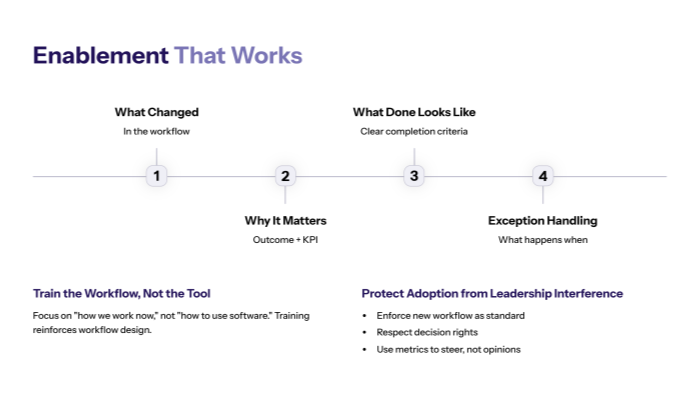
5.1 Train the workflow, not the tool
Once the workflow is designed, training becomes simple:
- what changed in the workflow
- why it matters (outcome + KPI)
- what “done” looks like
- what happens when exceptions occur
If training is focused on buttons instead of decisions and interfaces, adoption will be shallow.
Training should be “how we work now,” not “how to use software.”
5.2 Protect adoption by removing leadership interference
RAPID warns that leadership can stall or reverse progress if they won’t stay out of the way after backing the strategy.
Leadership undermines adoption when they:
- bypass the workflow
- grant exceptions informally
- demand special reporting formats
- override owners publicly
To protect adoption, executives must:
- enforce the new workflow as the standard
- respect decision rights
- use metrics to steer, not opinions
That’s how workflows become real.
Closing takeaway
Adoption isn’t training. Adoption is workflow design.
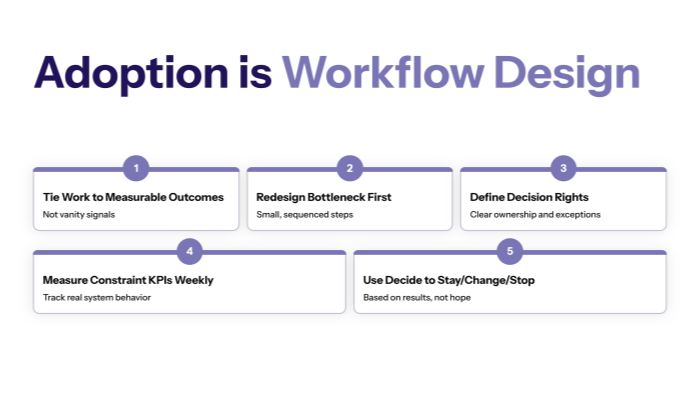
You get adoption when you:
- tie work to measurable outcomes (not vanity signals)
- redesign the bottleneck workflow first
- define decision rights and exception paths
- measure constraint KPIs weekly
- use Decide to stay/change/stop based on results