AI Implementation Challenges for Law Firms: Overcoming Barriers to Successful Technology Adoption
Introduction to AI Implementation Challenges in Law Firms
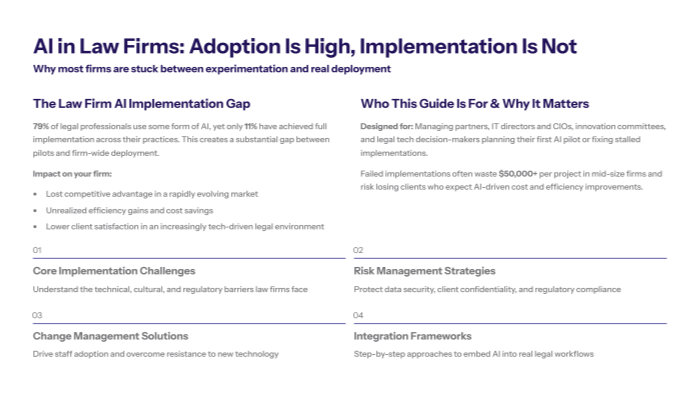
AI implementation challenges represent the primary barrier preventing law firms from realizing the full potential of artificial intelligence technology in legal practice. While 79% of legal professionals have adopted some form of AI, only 11% have achieved full implementation across their practices, revealing a significant gap between experimentation and enterprise-wide deployment.
This implementation gap costs firms competitive advantage, operational efficiency, and client satisfaction in an increasingly technology-driven legal market.
What This Guide Covers
This comprehensive guide examines the specific technical, financial, ethical, and operational barriers that prevent successful AI implementation in law firms. We’ll cover practical solutions for data privacy and stringent data protection protocols, regulatory compliance requirements, change management strategies, and integration challenges with AI systems. This is NOT a general overview of AI benefits—it focuses exclusively on implementation obstacles and proven solutions.
Who This Is For
This guide is designed for managing partners, IT directors, innovation committees, and legal technology decision-makers evaluating or struggling with adopting AI. Whether you’re planning your first AI pilot program or troubleshooting failed implementation attempts, you’ll find actionable frameworks for overcoming common barriers.
Why This Matters
Failed AI implementations waste significant resources—with mid-size firms often spending over $50,000 on unsuccessful projects. More critically, firms that fail to implement AI effectively risk losing clients who increasingly demand AI-driven cost reductions and efficiency improvements in legal services.
What You’ll Learn:
-
Core AI implementation challenges law firms face within the legal industry
-
Risk management strategies for data security and compliance
-
Practical solutions for change management and staff adoption of AI tools
-
Step-by-step frameworks for successful AI deployment and integrating AI into legal workflows

Understanding AI Implementation Challenges in the Legal Field
AI implementation challenges in law firms encompass the technical, cultural, regulatory, and financial barriers that prevent successful integration of AI technology into legal workflows and practice management.
Unlike other industries, legal professionals operate within strict ethical considerations, handle highly sensitive client data, and work in risk-averse organizational cultures that resist technological change. These factors create implementation challenges far more complex than simple software adoption.
Current data reveals this complexity: while artificial intelligence shows AI's ability to automate approximately 74% of billable hours in legal tasks, most firms struggle to move beyond pilot programs to achieve meaningful AI automation at scale.
Technical Infrastructure Barriers and AI Systems Integration
Legacy system integration represents a fundamental challenge for law firms implementing AI tools. Most legal practices rely on established case management systems, document management platforms, and billing software that weren’t designed for AI integration.
This connects to broader implementation challenges because technical barriers create cascading effects—when AI solutions cannot seamlessly connect with existing legal workflows and AI powered tools, adoption rates plummet and user resistance increases.
Regulatory and Compliance Constraints in the Legal System
American Bar Association Model Rules and state bar association guidelines create complex compliance requirements for AI use in legal practice. These regulations vary significantly across jurisdictions, creating confusion for multi-state firms about permissible AI applications.
Building on technical barriers, compliance constraints add layers of complexity that require legal teams to carefully evaluate every AI software and generative AI platform against ethical concerns, confidentiality requirements, and professional responsibility standards before implementation.
Transition: Understanding these foundational challenges provides context for examining the specific implementation barriers that firms encounter most frequently.
Core AI Implementation Challenges Law Firms Face
The transition from AI awareness to successful implementation reveals distinct barriers that consistently emerge across legal organizations of all sizes, each requiring targeted strategies for resolution.
Data Privacy, Security, and Client Confidentiality Risks
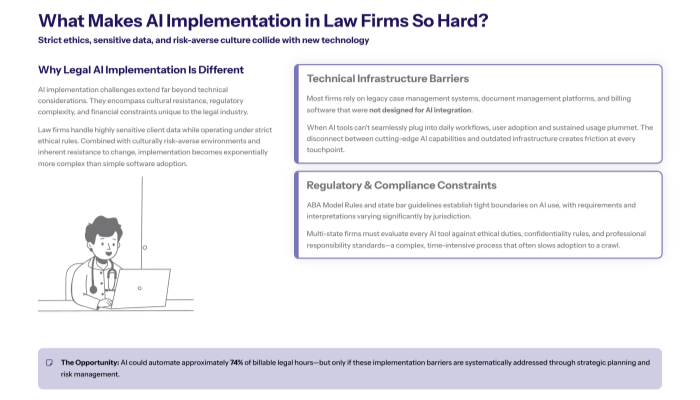
Attorney-client privilege protection becomes complicated when using third-party AI powered tools that may store or process sensitive client information. Many generative AI platforms, including popular new AI tools, retain user inputs in their databases, potentially exposing confidential legal documents to unauthorized access.
Data retention policies of AI vendors create particular concern—some platforms use submitted content for model training unless specific opt-out procedures are followed. This creates scenarios where sensitive client information could theoretically appear in responses to other users, fundamentally violating client confidentiality and stringent data protection protocols.
Cost, Billable Hours, and Resource Allocation Challenges
Initial software licensing costs for legal AI solutions typically range from $100 to $500+ per user monthly, representing significant expense for firms already managing tight budgets. Beyond licensing, training and change management expenses often exceed $50,000 for mid-size firms implementing comprehensive AI systems.
ROI uncertainty compounds cost concerns—most firms cannot predict when AI implementation will generate measurable benefits, making budget approval challenging for conservative legal practice management accustomed to billing billable hours.
Staff Resistance, Training Barriers, and Ethical Considerations
Generational differences in technology adoption create internal resistance, particularly among senior partners who may view AI tools as unnecessary complexity rather than efficiency improvements. Fear of job displacement affects junior associates and paralegals who worry that AI automation will eliminate their roles.
Time investment required for effective training conflicts with billable hour pressures, creating a practical barrier where legal professionals cannot allocate sufficient time to master new AI capabilities without impacting revenue generation.
Additionally, ethical considerations and risk management related to AI algorithms require human lawyers to maintain oversight and accountability to avoid potential bias or discriminatory outputs.
Key Points:
-
Client confidentiality concerns require careful vendor evaluation and data handling protocols aligned with stringent data protection protocols
-
Implementation costs often exceed initial software licensing by 3-5x when including training and change management
-
Staff resistance stems from cultural factors specific to legal profession risk aversion and ethical concerns about AI use
Transition: These challenges require strategic approaches that address technical, financial, and human factors simultaneously.
Strategic Solutions and Best Practices for Adopting AI in Law Firms
Successful AI implementation in law firms requires systematic approaches that acknowledge the unique constraints and requirements of legal practice while building organizational confidence through measured progress.
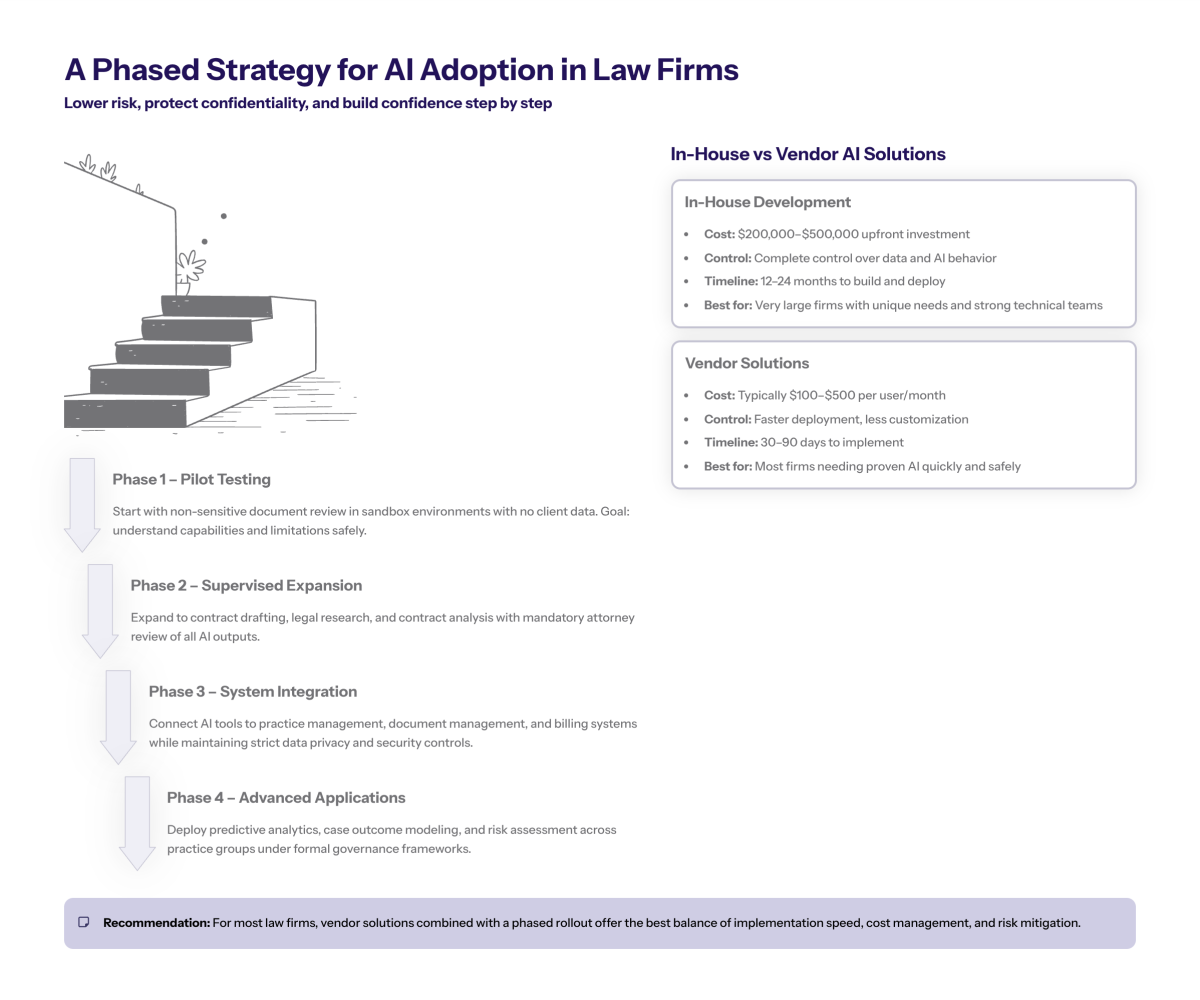
Step-by-Step: Phased AI Implementation Approach with AI Tools
When to use this: This approach works best for firms with limited technical resources, high risk aversion, or complex regulatory requirements across multiple jurisdictions.
-
Phase 1: Pilot Testing: Begin with non-sensitive document review tasks using AI powered tools in sandbox environments, allowing legal teams to evaluate AI capabilities without client data exposure.
-
Phase 2: Supervised Expansion: Expand to drafting contracts, legal research, and contract analysis with mandatory attorney oversight, establishing workflows that combine AI efficiency with human validation and strategic thinking.
-
Phase 3: System Integration: Connect AI tools and AI systems with core practice management systems, enabling seamless workflow integration while maintaining data privacy and security protocols.
-
Phase 4: Advanced Applications: Implement predictive analytics, case outcome modeling, risk assessment, and automated legal research across practice groups with established governance frameworks.
Comparison: In-House vs Vendor AI Solutions
|
Feature |
In-House Development |
Vendor Solutions |
|---|---|---|
|
Cost |
$200,000-500,000 initial |
$100-500 per user monthly |
|
Control |
Complete data control |
Limited customization options |
|
Timeline |
12-24 months development |
30-90 days implementation |
|
Security |
Custom security protocols |
Vendor-managed security |
Vendor solutions typically provide faster implementation with lower initial costs, making them suitable for most firms seeking proven AI capabilities. In-house development makes sense only for large firms with significant technical resources and highly specialized requirements.
Transition: Even with clear implementation strategies, firms must anticipate and prepare for common pitfalls that derail AI adoption efforts.
Common Implementation Pitfalls and Solutions in the Legal World
Understanding typical implementation failures helps legal teams avoid costly mistakes and build more effective AI adoption strategies from the beginning.
Pitfall 1: Inadequate Due Diligence on AI Vendor Security and Data Privacy
Solution: Develop comprehensive vendor assessment checklists that verify SOC 2 compliance, data encryption standards, and clear policies on client data usage for model training.
Essential security certifications include ISO 27001 compliance, regular penetration testing results, and explicit contractual guarantees about data handling and confidentiality protection.
Pitfall 2: Underestimating Change Management Requirements and Ethical Concerns
Solution: Implement structured change management programs with designated AI champions in each practice group and regular feedback collection from end users.
Successful change management typically requires 6-12 months of dedicated effort, including ongoing training sessions, user support, and iterative improvements based on practitioner feedback.
Pitfall 3: Insufficient Ethical Guidelines, Oversight, and Outside Counsel Involvement
Solution: Establish formal AI use policies aligned with ABA guidelines, Bloomberg Law insights, and specific state bar requirements, including mandatory review processes for all AI-generated work product.
These policies should explicitly define acceptable AI usage scenarios, require human validation of AI outputs, and establish clear accountability for AI-assisted legal work. When needed, seek outside counsel expertise to address complex ethical considerations.
Transition: With proper preparation and strategic approaches, law firms can successfully navigate implementation challenges to realize AI’s significant potential.
Conclusion and Next Steps for Integrating AI in Law Firms
Successful AI implementation in law firms requires addressing technical infrastructure limitations, regulatory compliance complexities, and cultural resistance through systematic, phased approaches that prioritize data security and ethical compliance.
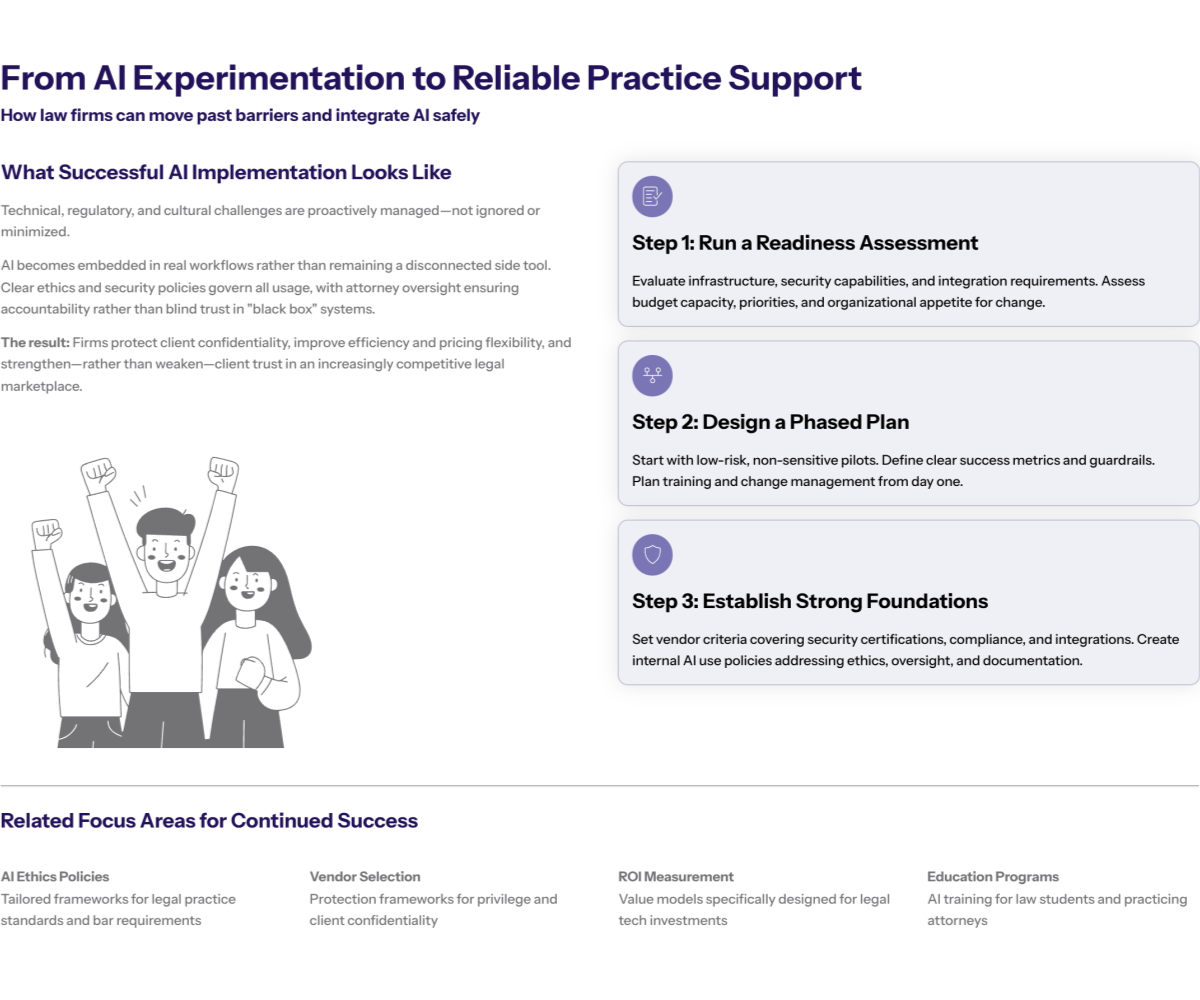
To get started:
-
Conduct internal readiness assessment evaluating current technical infrastructure, budget availability, and organizational appetite for change
-
Develop phased implementation timeline starting with low-risk pilot programs in non-sensitive practice areas
-
Establish vendor evaluation criteria prioritizing security certifications, compliance frameworks, and integration capabilities with existing systems
Related Topics: Developing comprehensive AI ethics policies for legal practice, creating vendor selection criteria that protect client confidentiality, and establishing ROI measurement frameworks for legal technology investments will support long-term AI implementation success. Additionally, law students and legal professionals should be educated on AI strategies and ethical considerations to prepare for the evolving legal world.