Analysts Warn of a Possible AI-Driven Debt and Asset Bubble
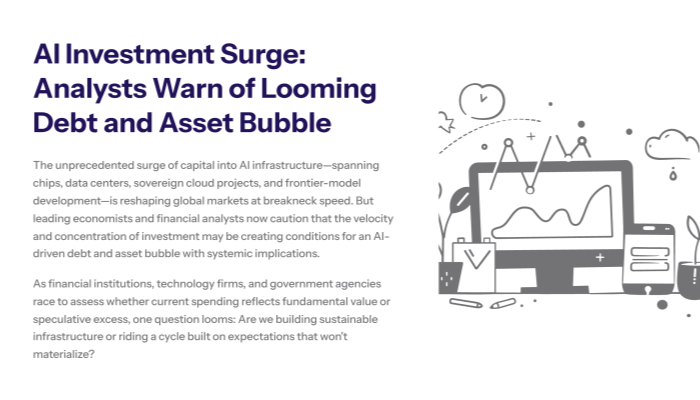
The surge of capital flowing into AI—spanning chips, data centers, sovereign cloud projects, and frontier-model development—is reshaping global markets at an unprecedented pace. But analysts now caution that the speed and concentration of investment may be creating the conditions for an AI-driven debt and asset bubble. Financial institutions, technology firms, and government agencies are trying to assess whether current spending reflects fundamental value or a cycle built on expectations that may not sustain themselves over a decade.
This article explores why economists are sounding alarms, how AI capital expenditures are reshaping macroeconomic indicators, and what these dynamics mean for enterprises planning their next wave of digital transformation.
Key Takeaways
- AI capital expenditure has accelerated faster than revenue realization, raising systemic risk.
- Debt markets may be absorbing outsized pressure as firms rely on financing for compute build-outs.
- Enterprises must prepare for volatility and adopt long-range AI portfolio strategies built on resilience, not hype cycles.

The Roots of the AI Investment Surge
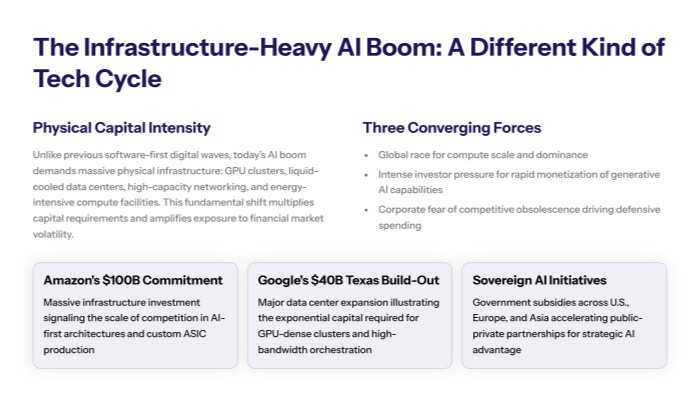
The current AI cycle is unlike prior waves of digital transformation. Instead of software-first models, this boom is grounded in physical infrastructure—GPUs, liquid-cooled data centers, high-capacity networking, and energy-intensive compute clusters. This shift has multiplied capital intensity and widened exposure to financial market fluctuations.
Analysts point to three forces driving the acceleration: a global race for compute scale, investor expectations for rapid monetization of generative AI, and corporate fear of competitive irrelevance.
A Global Race for Compute Capacity
The world’s largest firms are pouring billions into infrastructure and AI-first architectures . These investments range from custom ASIC production to next-generation inference stacks, the same types of technologies enterprises leverage when adopting advanced AI development services . Recent moves such as Amazon’s $100 billion AI investment and Google’s $40 billion Texas data-center build-out illustrate the scale and speed of this race. The capital required to compete has increased exponentially because frontier models depend on GPU-dense clusters and high-bandwidth orchestration.
Rising Pressure from Markets and Boards
Boards across industries—from manufacturing to retail—are shifting budgets to automation, predictive intelligence, and agentic systems. This parallels broader transformations seen in sectors adopting enterprise software solutions to improve operational resilience. But the pressure to deliver short-term AI-driven gains is distorting investment horizons, pushing organizations to overspend before real ROI is validated.
Government and Sovereign Investment Waves
Governments, especially in the U.S., Europe, and Asia, are subsidizing AI infrastructure to secure strategic advantage. Public-private partnerships are boosting demand for cloud, silicon, and national AI labs, repeating patterns observed whenever states pursue large-scale digital transformation programs.
Yet despite strong tailwinds, economists are increasingly concerned about mispriced risk.
Why Analysts Fear an AI Debt Bubble
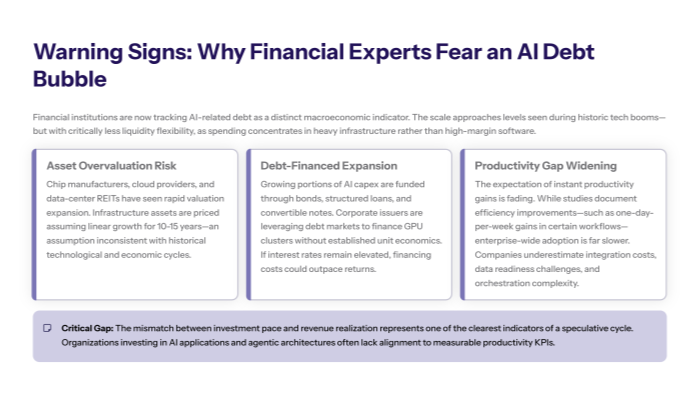
Financial institutions now track AI-related debt as a distinct macroeconomic signal, as documented in analyses of how corporate AI capex meets debt markets and how global stock markets react to AI bubble fears . The scale resembles levels seen during historic tech booms—but with far less liquidity flexibility, because much of the spending is tied to heavy infrastructure rather than software margins.
External research indicates three accelerating risks: asset overvaluation, unsustainable debt structures, and the possibility that AI productivity gains will take years longer than projected.
Overvalued Assets in AI Infrastructure
The valuation of chip manufacturers, cloud providers, and data-center REITs has expanded rapidly. While AI infrastructure is essential for modern businesses—especially those building systems around scalable AI integration—the pace of expansion is prompting caution. Analysts argue that infrastructure assets are being priced as if growth will continue linearly for 10–15 years, an assumption inconsistent with technological and economic cycles.
Debt-Financed AI Expansion
A growing portion of AI capex is funded through debt markets. Corporate issuers are leveraging bonds, structured loans, and convertible notes to finance GPU clusters and AI-ready facilities. This follows the same pattern seen in companies undertaking large-scale software development transformations without established unit economics, and echoes recent patterns where venture funding dips as AI startups face ROI pressure . If interest rates remain elevated, the cost of financing could outpace returns.
How Debt Concentration Creates Fragility
Debt-funded expansions are most fragile when revenue models are unproven. Some enterprises are investing in AI applications, private AI platforms, and agentic architectures without aligning them to measurable productivity KPIs. As noted in earlier analyses of business consulting strategies, organizations often struggle when they invest in technology before restructuring their operating models.
This mismatch magnifies bubble risk.
AI Productivity Gains Are Taking Longer to Materialize
The narrative that AI will instantly boost productivity is fading. Studies show improvement, such as documented one-day-per-week efficiency gains in certain workflows , but enterprise-wide adoption is far slower. Companies adopting AI-first strategies often underestimate integration costs, data readiness challenges, and the complexity of orchestrating AI workloads across hybrid environments.
This gap between expectation and realization is one of the clearest indicators of a speculative cycle.
Structural Factors Accelerating Bubble Conditions
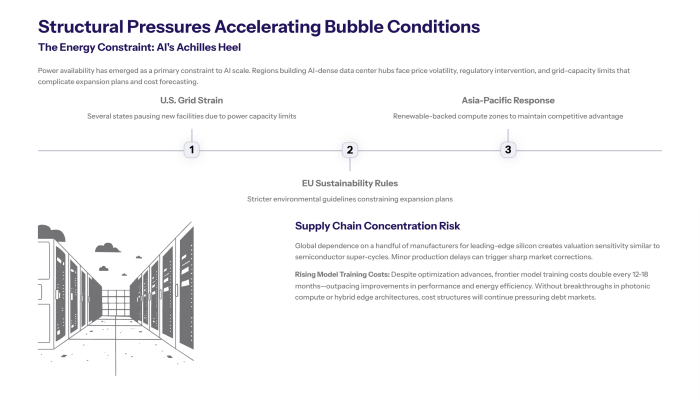
Economists identify several structural pressures shaping today’s environment: energy constraints, supply-chain bottlenecks, and model-training costs that continue to rise faster than compute efficiency gains.
The Energy Barrier to AI Scale
Power availability has emerged as one of the primary constraints. Regions building AI-dense data-center hubs are facing price volatility, regulatory intervention, and grid-capacity limits. These constraints echo challenges seen in organizations modernizing their AI infrastructure, where energy efficiency becomes central to planning.
Regional Disparities
- Some U.S. states are pausing new facilities due to grid strain.
- The EU is drafting stricter sustainability guidelines.
- Asia-Pacific regions are pushing renewable-backed compute zones to remain competitive.
Supply-Chain Pressures and GPU Concentration
The global supply chain remains heavily dependent on a small number of manufacturers for leading-edge silicon. This creates valuation sensitivity similar to the semiconductor super-cycle, where even minor production delays can inflate stock prices or trigger sharp corrections.
For enterprises considering AI development services, these supply constraints complicate cost forecasting, as hardware availability can determine training windows, deployment strategies, and expansion roadmaps.
Model Costs Outpacing Efficiency
Despite progress in inference optimization and quantization, the cost of training frontier models continues to rise. Metrics shared by independent labs show training costs doubling every 12–18 months, a rate that exceeds improvements in model performance and energy efficiency.
Unless breakthroughs occur in photonic compute, sparsity optimization, or hybrid edge architectures, cost structures will continue pressuring debt markets.
Implications for Enterprises Planning AI Adoption
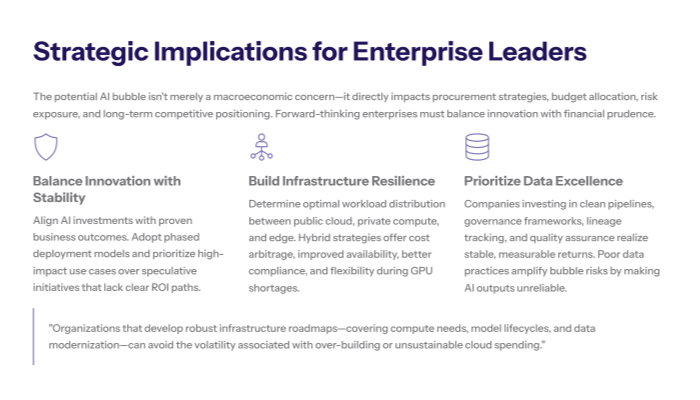
For business leaders, the potential AI bubble is not just a macroeconomic concern—it affects procurement, budgeting, risk exposure, and long-term strategy.
Balancing Innovation with Risk Management
Enterprises must weigh innovation against core financial stability. Recommendations include aligning AI investments with proven business-intelligence services and a clear business strategy , adopting phased deployment models, and prioritizing high-impact use cases over speculative initiatives.
Prioritizing Infrastructure Resilience
Building a resilient infrastructure stack is essential. Organizations adopting AI-first architectures or scaling AI software development efforts must determine which workloads should run on public cloud, which require private compute, and how to optimize orchestration for cost and performance.
Why Hybrid and Multi-Cloud Strategies Matter
Hybrid environments reduce dependency risk and allow organizations to scale incrementally. For companies evaluating multi-cloud strategies, this approach offers:
- Cost arbitrage
- Improved availability
- Better compliance alignment
- Flexibility during GPU shortages
This model supports sustained value beyond hype cycles.
Focusing on Data Quality and Governance
Data remains the foundation of durable AI strategy. Companies that invest early in strong data practices—clean pipelines, governance frameworks, lineage tracking, and quality assurance—are more likely to realize stable, measurable returns. This aligns with findings from firms adopting modern AI data services to support advanced model workflows.
Poor data practices, in contrast, amplify bubble risks by making AI outputs unreliable.
How Enterprises Can Protect Themselves from AI Bubble Volatility?
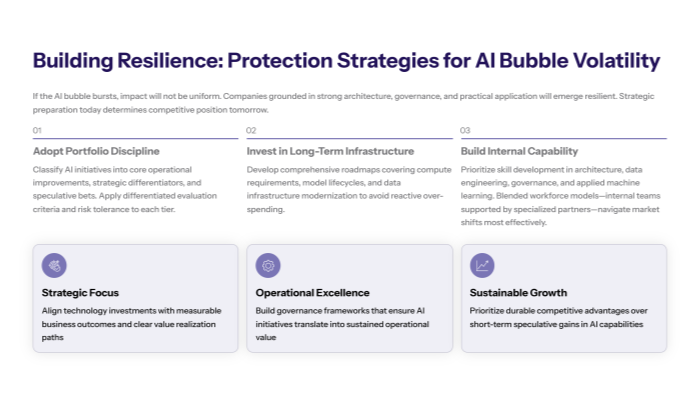
If the AI bubble bursts, the impact will not be uniform. Companies grounded in strong architecture, governance, and practical application will remain resilient.
Adopt Disciplined AI Portfolio Management
Executives should evaluate initiatives through a portfolio lens, classifying AI projects into:
- Core operational improvements (automation, decision support)
- Strategic differentiators (personalization, predictive analytics)
- Speculative bets (agentic AI, multimodal reasoning, frontier model fine-tuning)
This tiered approach mirrors best practices used in digital-transformation strategies .
Invest in Long-Term Infrastructure Strategy
Enterprises that develop a robust roadmap—covering compute needs, model lifecycles, and data-infrastructure modernization—can avoid the volatility associated with over-building or relying on unsustainable cloud spending.
Business leaders often work with AI consulting services to calibrate long-range strategy and ensure alignment between technology and financial planning.
Strengthen Internal Capability
Organizations should prioritize skill development in architecture, data engineering, governance, and applied machine learning. This ensures that AI investments translate into operational value rather than stranded cost.
Enterprises that adopt a blended workforce model—internal teams supported by specialized partners—tend to navigate market shifts more effectively.
Conclusion
The AI boom is rewriting the logic of global investment, but rapid capital inflows carry inherent risks. Analysts warn that unsustainable debt structures, inflated valuations, and mismatched ROI timelines resemble early-stage bubble dynamics. For enterprises, the priority is not avoiding AI—but approaching it with disciplined strategy, careful governance, and an architecture built for resilience. AI remains a transformative force, but its benefits will favor organizations that invest with clarity and pragmatism rather than momentum.