Decision Rights Matrix Template for Effective Decision-Making
Effective decision making is a cornerstone of successful organizations, especially in today’s dynamic business environment where complex choices must be made swiftly and with confidence. This article explores the concept of the decision rights matrix template—a structured, analytical tool designed to clarify decision-making authority and enhance decision quality.
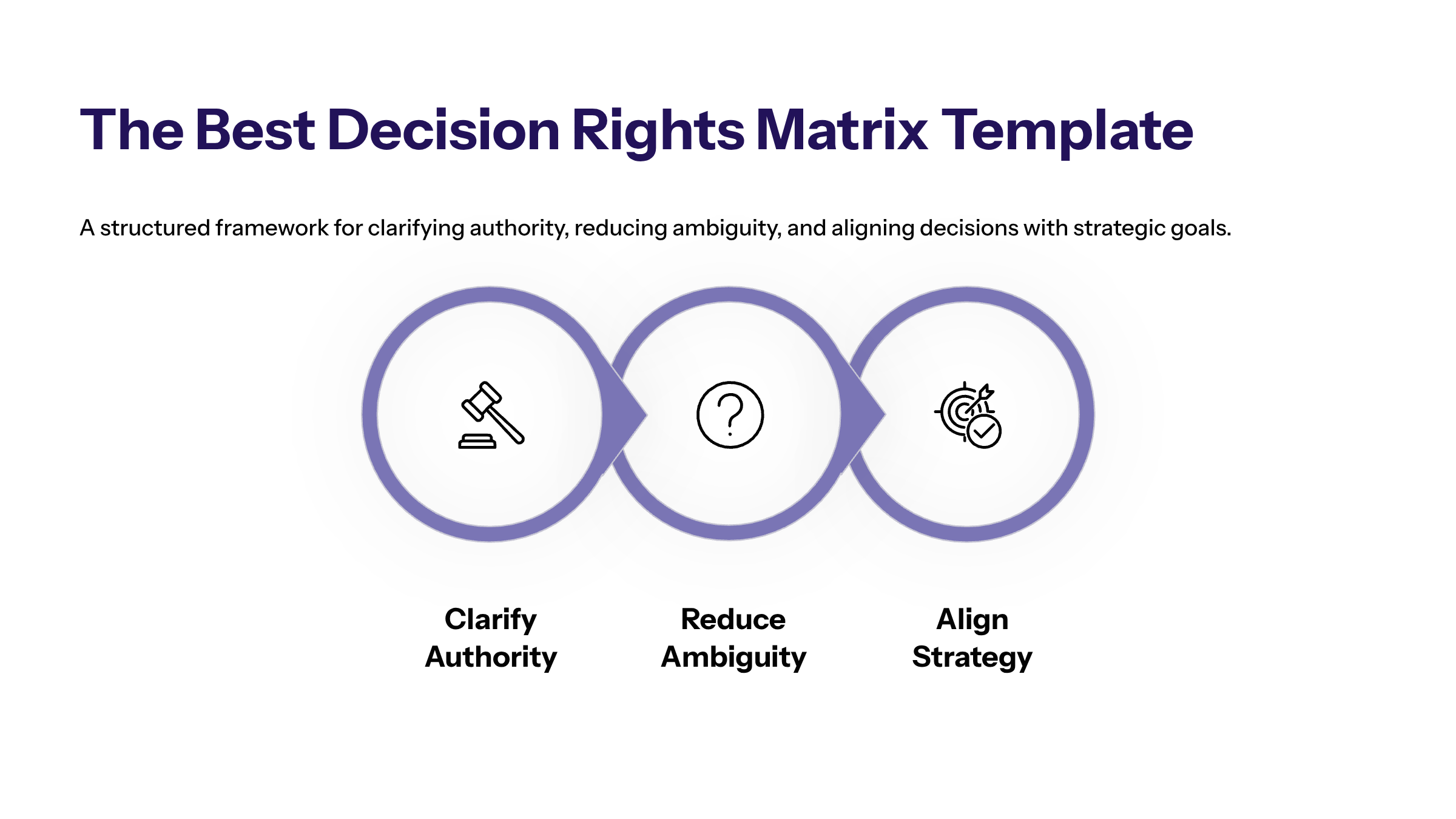
By leveraging this framework, executives and teams can navigate multiple variables and criteria, and the decision rights matrix template is especially useful for narrowing down a large list of options to a manageable number, reduce ambiguity, and align decisions with organizational priorities and strategic goals.
Key Takeaways
-
A decision rights matrix template provides a logical viewpoint for assigning decision-making roles and evaluating options based on several criteria, improving decision quality and accountability.
-
Weighted decision matrix templates help prioritize critical factors by assigning relative weight to different criteria, enabling data-driven, transparent, and objective choices.
-
Free decision matrix templates are available for immediate download and help users make informed choices by simplifying complex decisions and supporting objectivity.
-
Integrating decision rights matrices with frameworks like RACI and tools such as the Eisenhower matrix supports resource allocation, stakeholder buy-in, and efficient handling of routine and complex decisions.

Introduction to Decision Making
Definition and Purpose
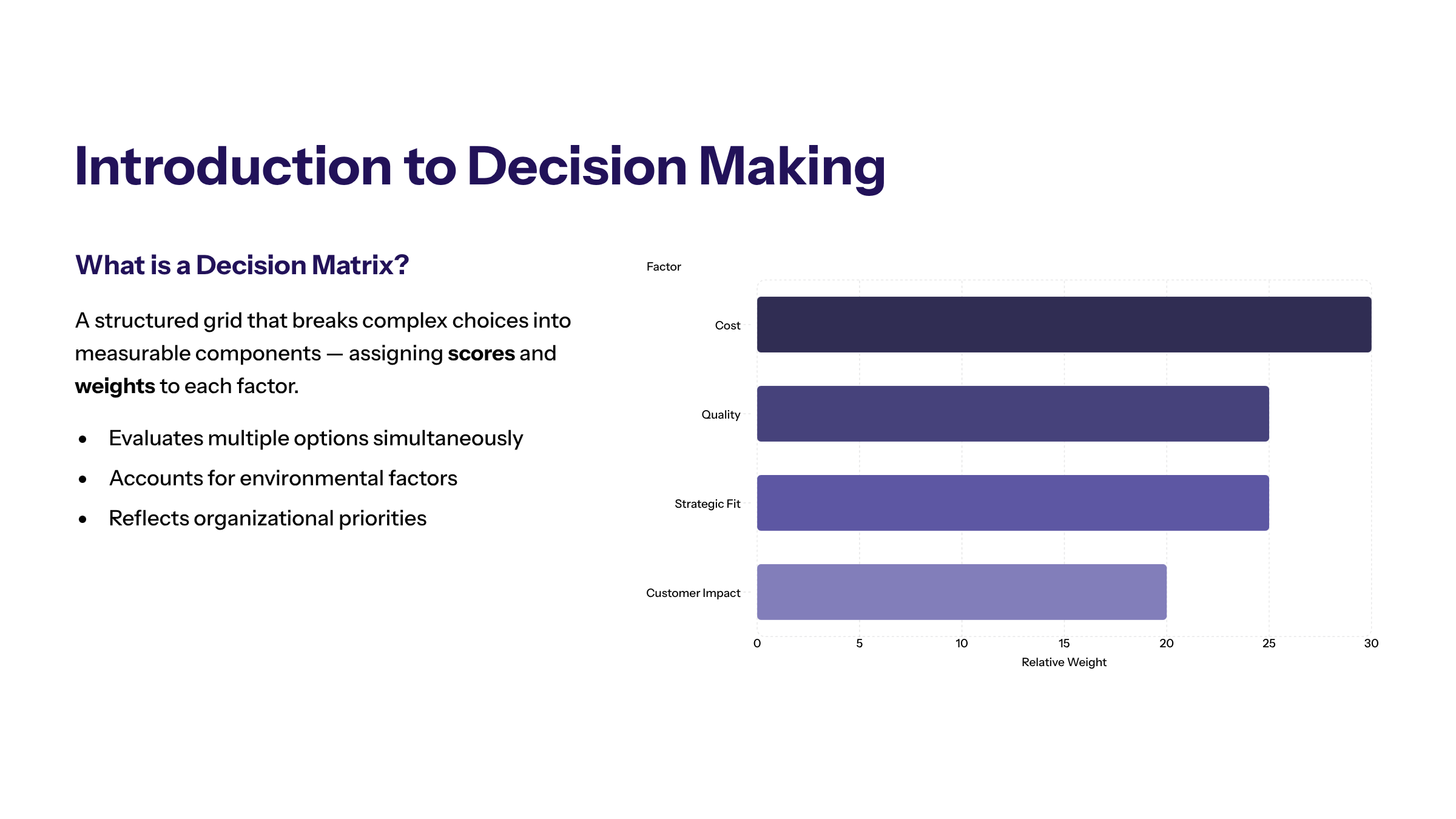
A decision matrix is a powerful tool and decision making tool used in the decision-making process to evaluate multiple options against various criteria. It serves as a decision grid that systematically breaks down complex choices into manageable components, allowing decision makers to assign scores and weights that reflect the relative importance of each factor.
The primary purpose of a decision rights matrix template is to provide a structured approach to decision making, ensuring that all relevant factors—including environmental factors, customer pain points, and organizational priorities—are considered. In this process, different factors and important criteria can be assigned a rank order to reflect their significance in the decision making process. This structured approach reduces bias, improves decision quality, and promotes transparency and accountability among relevant stakeholders and key stakeholders involved in the process.
In a competitive business landscape, effective decision making is critical. Organizations such as Microsoft and IBM have integrated decision matrices into their project management and strategic planning to maintain competitive advantage and optimize resource allocation.
Benefits of Using a Decision Matrix
Advantages of Decision Matrices
Decision matrices offer several key benefits that enhance the decision-making process:
-
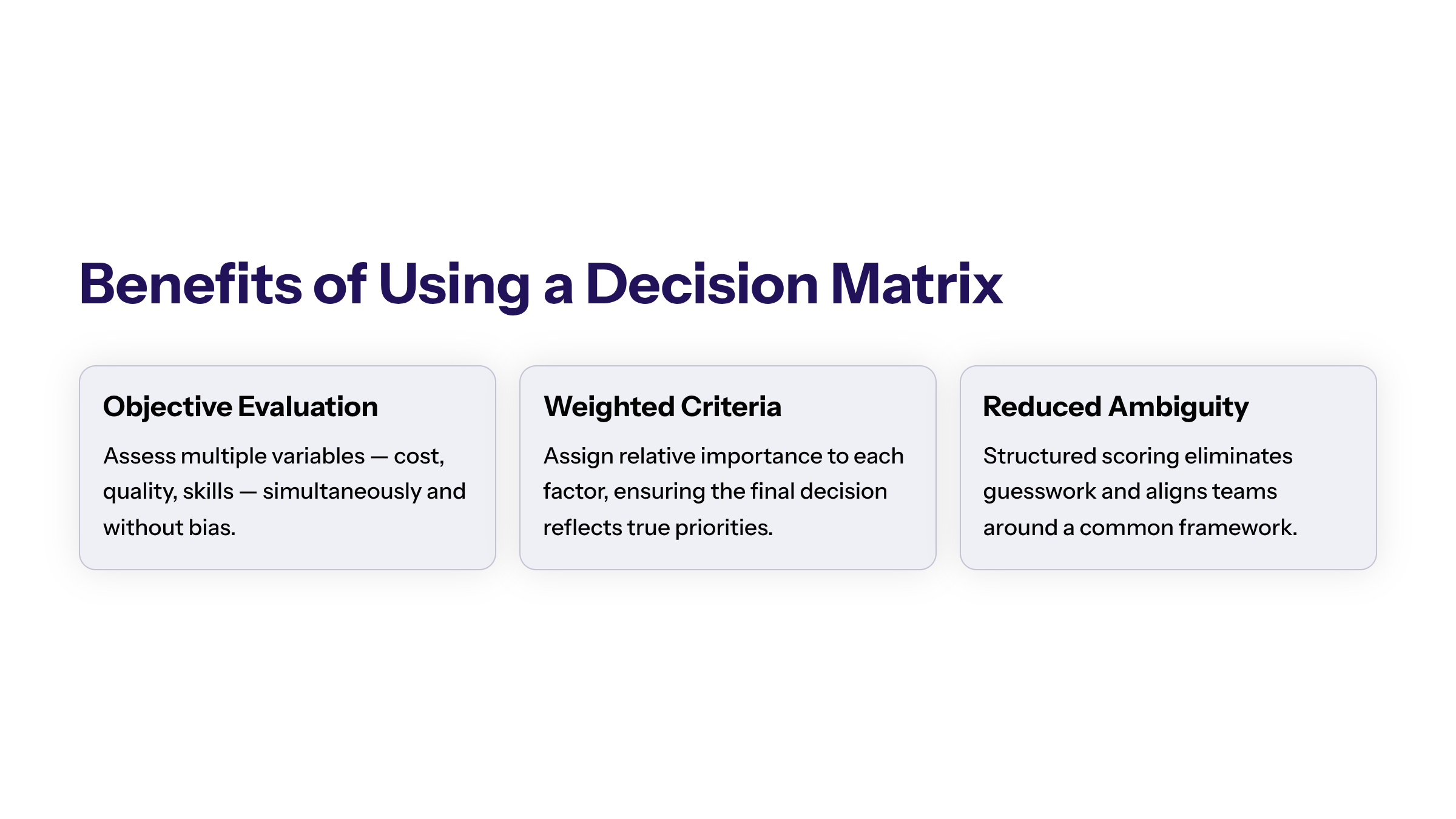
Objective Evaluation of Multiple Variables: By considering several criteria simultaneously, decision matrices allow organizations to evaluate options comprehensively, balancing factors such as cost, quality, and interpersonal skills.
-
Prioritization Through Weighted Criteria: Weighted decision matrix templates assign relative weight to different criteria, reflecting their importance to the final decision. This ensures that critical factors—such as customer facing capabilities or low cost—are prioritized appropriately.
-
Data-Driven and Transparent Decisions: Using a scoring system and criteria rating form, decision makers can quantify the pros and cons of each option, leading to data-driven decisions that are less influenced by subjective judgment.
-
Facilitation of Stakeholder Buy-In: By clearly documenting the evaluation criteria, scores, and weights, decision matrices promote transparency, which is essential for gaining buy-in from relevant stakeholders and key decision makers.
-
Adaptability to Various Decision Contexts: Whether for external hiring, product selection, or strategic initiatives, decision matrices can be customized to evaluate complex choices or routine decisions.
Organizations like Deloitte and Accenture utilize decision matrices in their consulting engagements to streamline client decision making and improve decision quality.
Creating a Decision Matrix Template
Components of a Decision Matrix Template
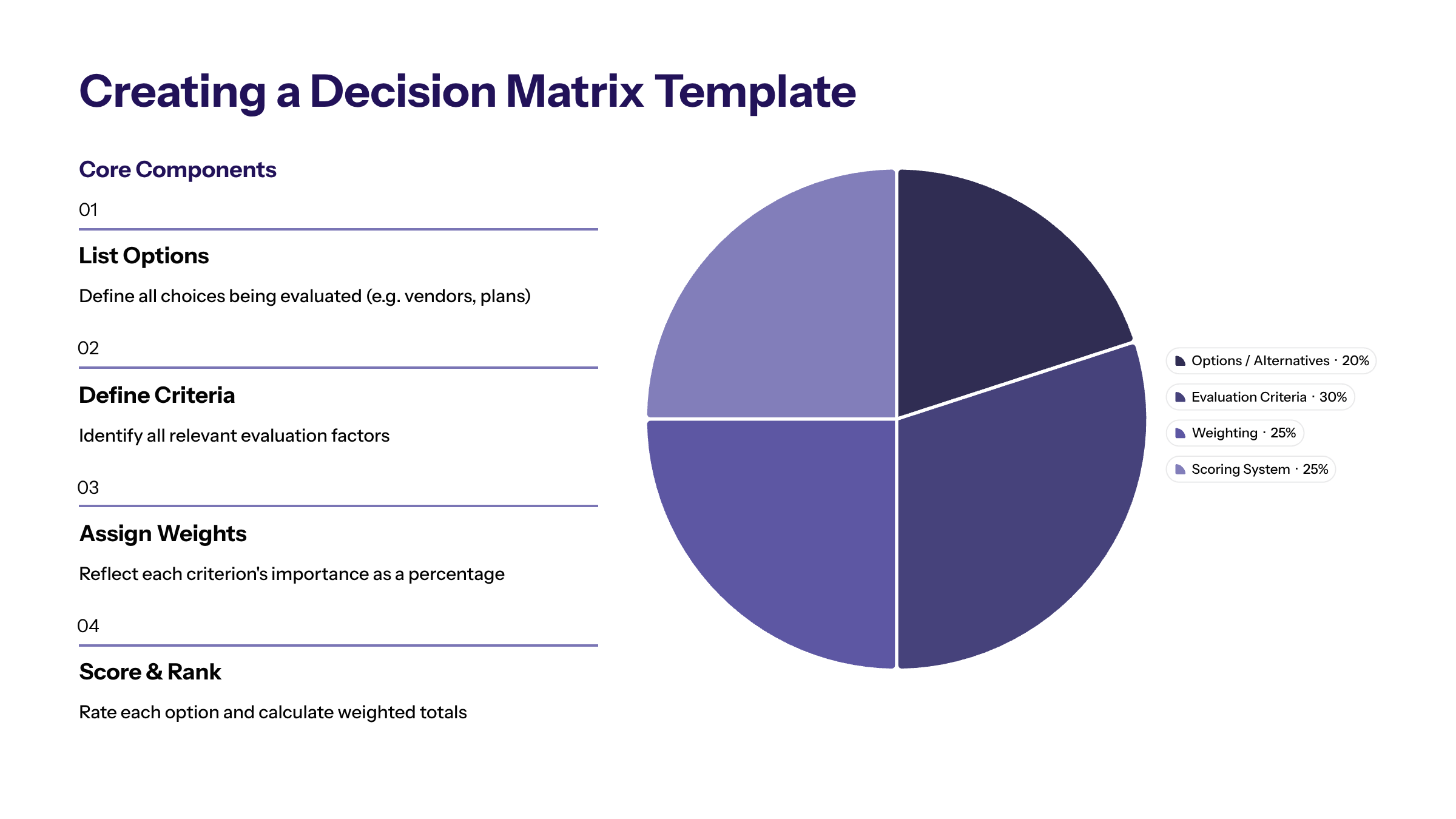
A well-designed decision matrix template typically includes the following elements:
|
Component |
Description |
|---|---|
|
Options/Alternatives |
The different choices or solutions being evaluated, such as software vendors or project plans. |
|
Criteria |
The decision-making criteria used to evaluate options, such as cost, functionality, and support. |
|
Rating Scale |
A scoring system (e.g., 1-5 or 1-10) to rate how well each option meets each criterion. |
|
Weights |
Assigned relative weight to each criterion reflecting its importance in the decision. |
|
Weighted Scores |
Calculated by multiplying the rating by the criterion’s weight to emphasize key benefits. |
|
Total Scores |
Summation of weighted scores to identify the highest score option, guiding the final decision. |
Identifying alternatives is the first step in creating a decision matrix, as it sets the foundation for the evaluation process.
Scoring and Weighting
Assigning weights to criteria allows decision makers to adjust weights based on organizational priorities or environmental factors. For example, a company prioritizing cost efficiency may assign a higher relative weight to low cost, while another focused on customer pain reduction may emphasize customer support.
The scoring system should be consistent and objective, ideally using a criteria rating form to standardize evaluations across multiple decision makers. This approach aligns with multi criteria decision analysis methodologies and enhances decision quality.
Spreadsheet software like Microsoft Excel or Google Sheets can be used to create custom templates for a decision rights matrix, providing flexibility and ease of use.
Decision Matrix Example
Real-World Application: Selecting Project Management Software
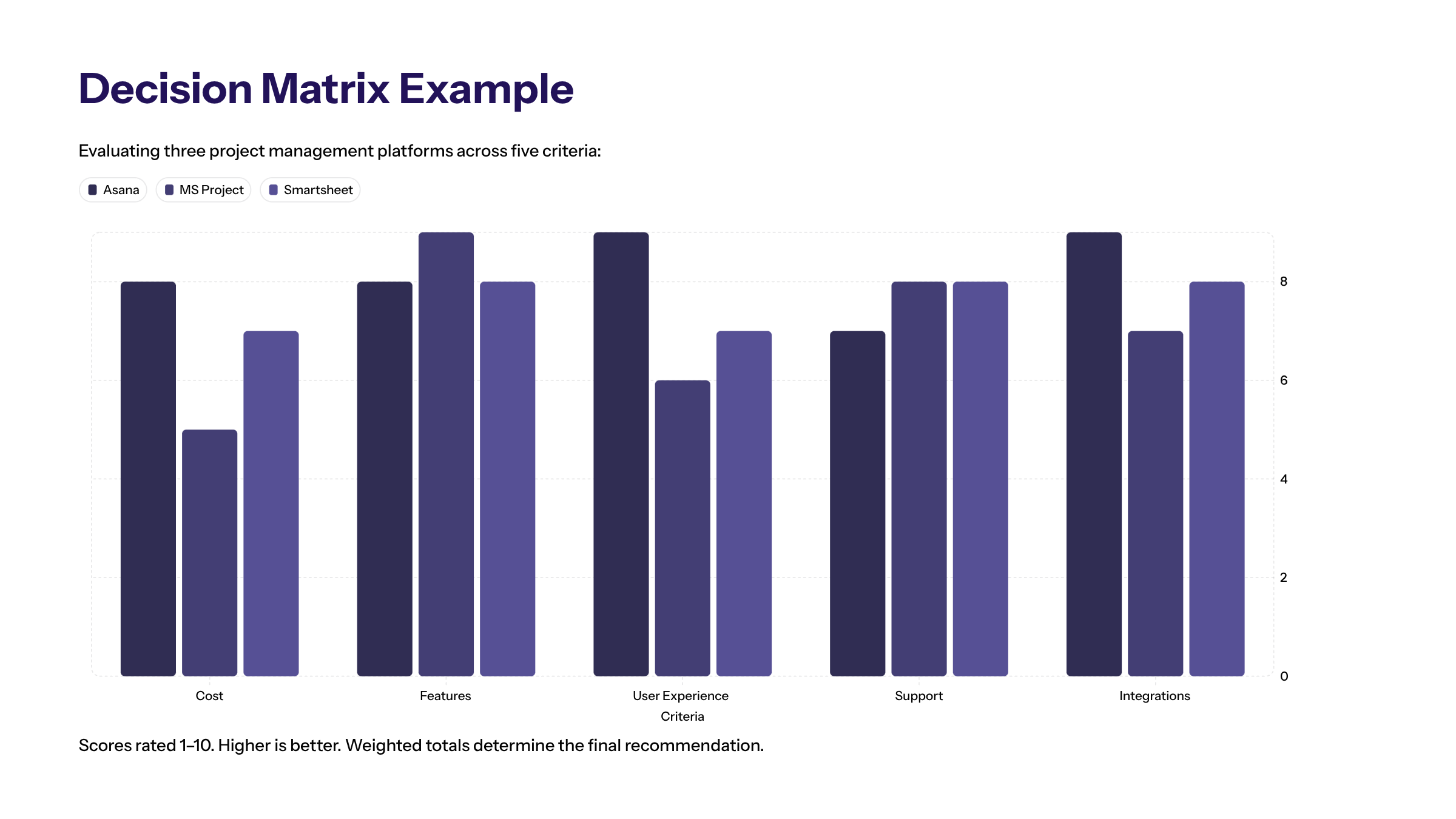
Consider a company evaluating three project management platforms—Asana, Microsoft Project, and Smartsheet.
The decision matrix includes criteria such as cost, features, user experience, customer support, and integration capabilities.
|
Criteria |
Weight |
Asana (Score) |
MS Project (Score) |
Smartsheet (Score) |
|---|---|---|---|---|
|
Cost |
0.3 |
4 |
3 |
3 |
|
Features |
0.25 |
4 |
5 |
4 |
|
User Experience |
0.2 |
5 |
3 |
4 |
|
Customer Support |
0.15 |
4 |
4 |
5 |
|
Integration |
0.1 |
5 |
4 |
4 |
|
Total Score |
|
4.3 |
3.7 |
4.1 |
Based on weighted scores, Asana emerges as the preferred option, balancing cost-effectiveness with user experience and integrations. This data-driven decision aligns with the company’s strategic priorities and secures buy-in from relevant stakeholders.
Asana provides a Decision Matrix Skeleton useful for tracking vendor selection and project-specific choices, demonstrating how project management tools facilitate transparent and efficient decision making.
Decision Matrix Templates
Available Templates and Their Uses
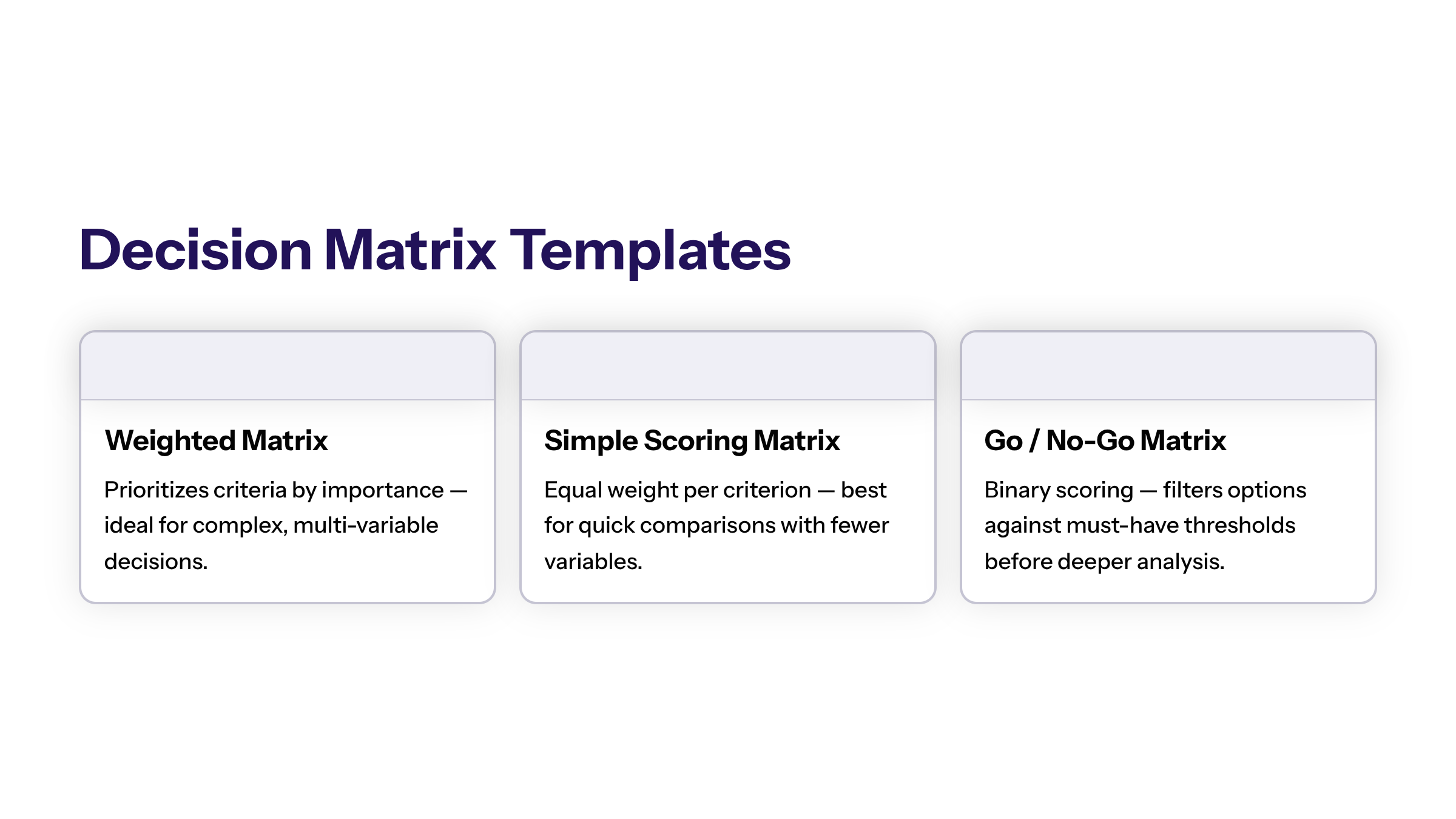
Several popular decision matrix templates cater to different decision-making needs:
-
Weighted Decision Matrix Template: Incorporates weighted criteria to prioritize important factors, ideal for complex choices involving several criteria and multiple variables.
-
Unweighted Decision Matrix Template: Treats all criteria equally, suitable for quick or less critical decisions.
-
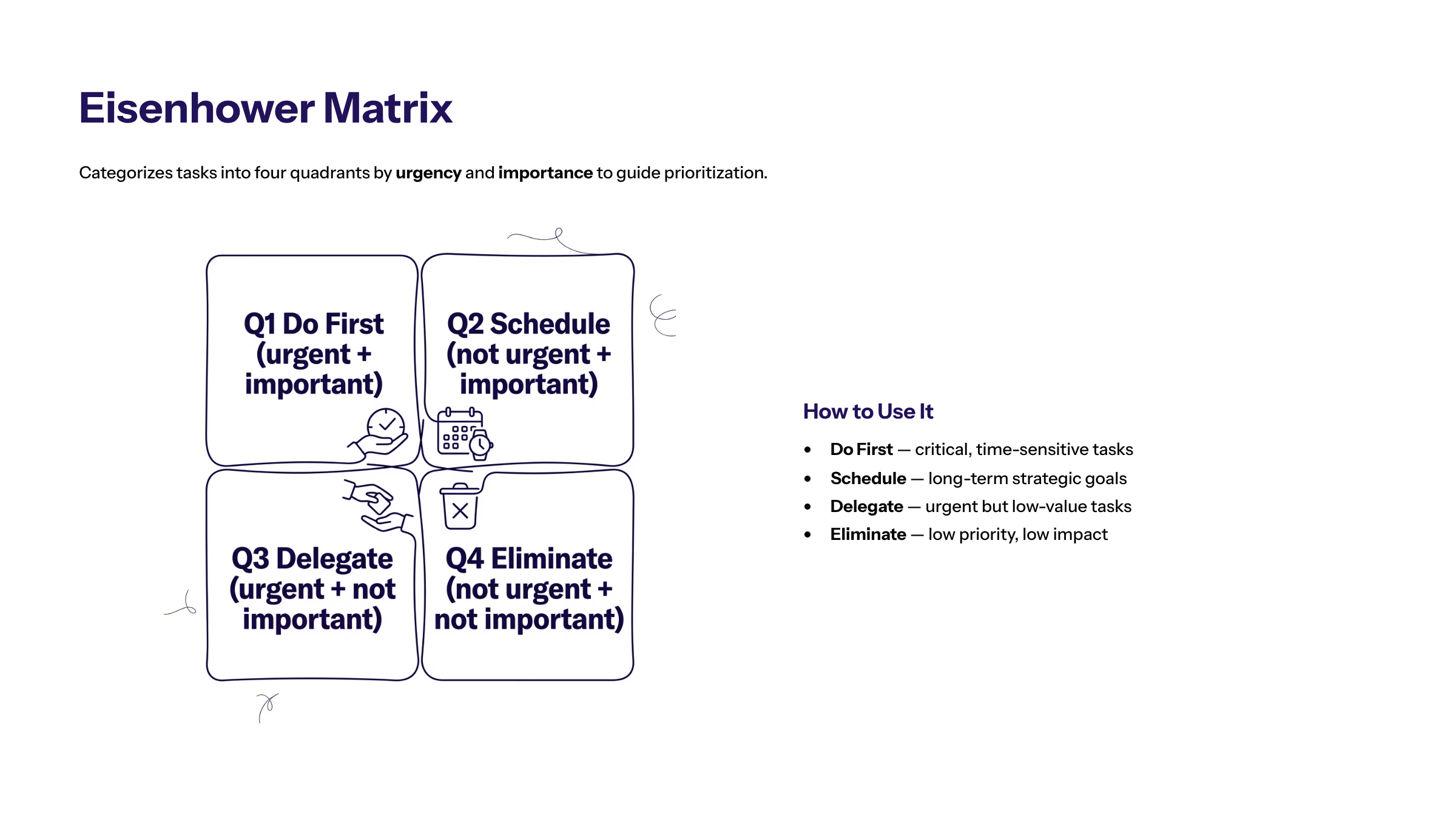
Eisenhower Matrix (Urgent Important Matrix): Focuses on task prioritization by urgency and importance, helping allocate resources effectively.
-
Pugh Matrix: Compares alternatives against a baseline, often used in design and engineering decisions.
-
Decision Grid: A visual tool that maps options against criteria for straightforward comparison.
Each template supports different decision-making frameworks and can be integrated with organizational tools such as Microsoft Excel, Google Sheets, or project management software like Asana and ClickUp.
Project management tools like Asana, Miro, or Smartsheet offer pre-built templates for decision matrices and RACI charts, making it easier for teams to implement structured decision-making processes.
Templates for a decision rights matrix, primarily in the form of a RACI chart, are widely available and support clear role assignments.
Eisenhower Matrix
Prioritization Tool for Decision Making
The Eisenhower matrix is a strategic tool that categorizes tasks or decisions into four quadrants based on urgency and importance:
|
Quadrant |
Description |
Action |
|---|---|---|
|
Urgent and Important |
Tasks requiring immediate attention |
Do Now |
|
Important but Not Urgent |
Tasks critical for long-term goals |
Schedule |
|
Urgent but Not Important |
Tasks that can be delegated |
Delegate |
|
Not Urgent and Not Important |
Tasks with low priority |
Eliminate or Defer |
This matrix helps decision makers focus on high-impact activities, optimize resource allocation, and improve overall decision quality. It is widely used in executive time management and operational planning.
Effective Decision Making
Integrating Decision Rights Matrices with Organizational Frameworks
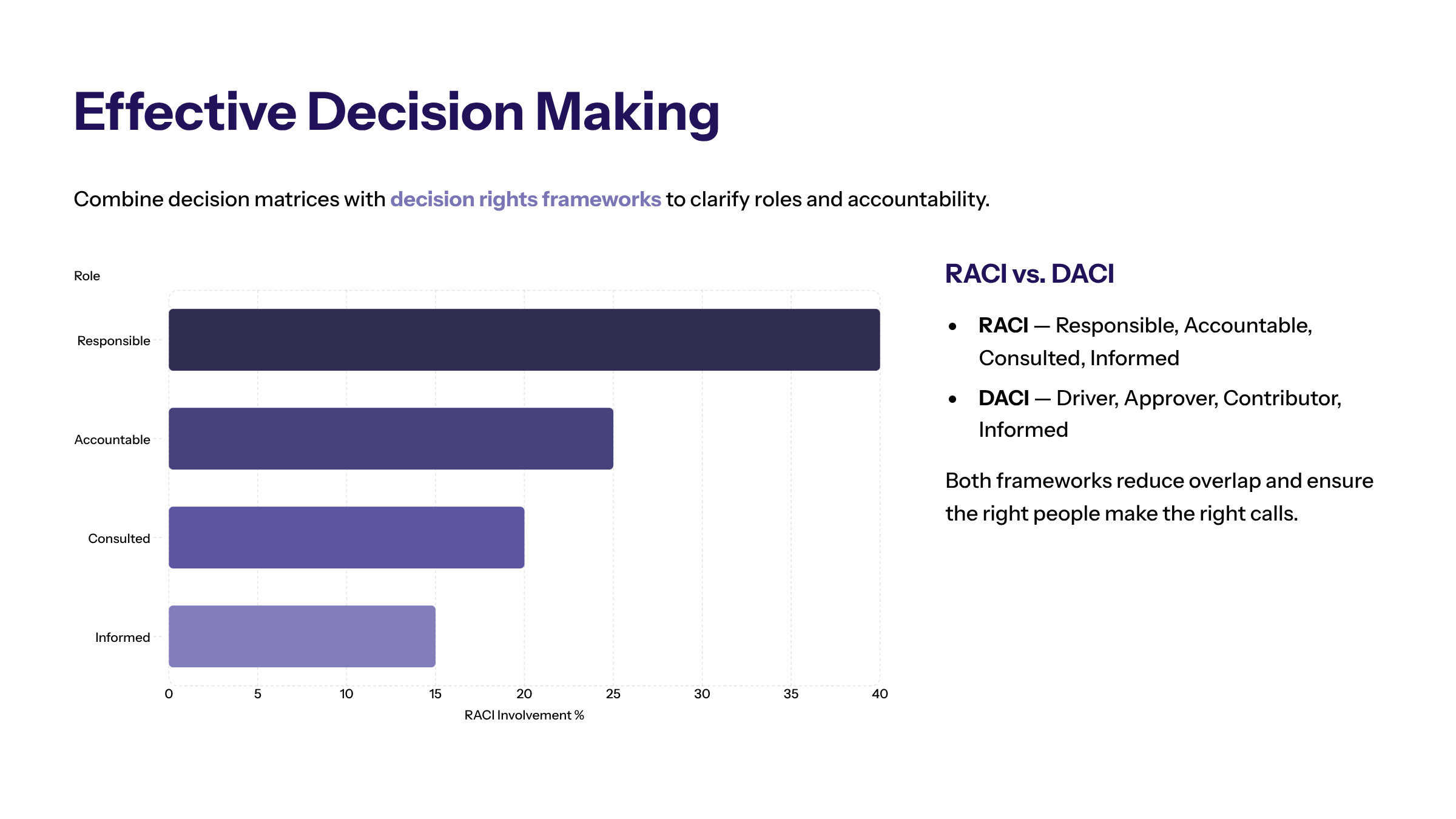
To maximize the benefits of decision matrices, organizations often combine them with decision rights frameworks such as RACI (Responsible, Accountable, Consulted, Informed) or DACI (Driver, Approver, Contributor, Informed). These frameworks clarify roles and responsibilities, ensuring that:
-
The Accountable person has final decision authority, with only one A per task in the RACI framework.
-
Responsible individuals perform tasks to support the decision.
-
Consulted stakeholders provide input through two-way communication.
-
Informed parties receive updates post-decision, involving one-way communication.
The DACI framework stands for Driver, Approver, Contributor, Informed, with the Approver making the final call, offering an alternative approach to role assignment.
The RAPID framework, another decision-making model, stands for Recommend, Agree, Perform, Input, Decide, assigning strong gatekeeping functions to the Agree role.
This integration reduces confusion, streamlines workflows, and enhances buy-in from relevant stakeholders.
Monitoring and Continuous Improvement
Decision making does not end with the final decision. Effective organizations implement monitoring mechanisms to track outcomes and adjust strategies as needed. Periodic reviews of the decision rights matrix are necessary as project scopes, roles, or team dynamics change, ensuring sustained decision quality.
Best Practices
Implementing a decision matrix effectively requires more than just filling out a template—it demands a thoughtful approach to ensure that every important factor is considered and that the decision making process remains objective and aligned with organizational goals. Here are some best practices to help you get the most out of your decision matrix template:
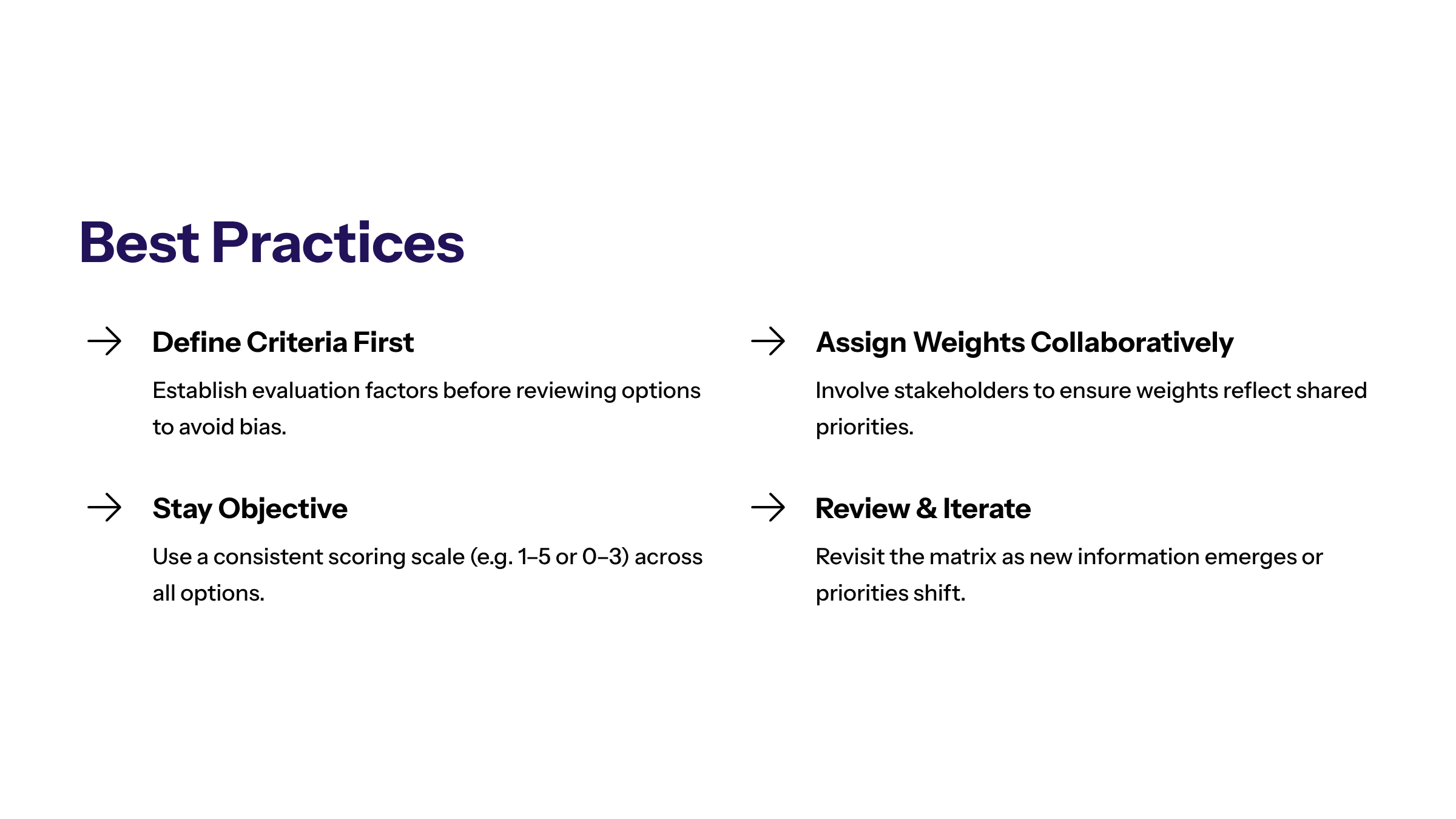
Start by clearly defining your evaluation criteria. Identify the key criteria that will drive your decision, such as cost, quality, customer satisfaction, or operational efficiency. Use a criteria rating form to standardize how each option is assessed, ensuring consistency across all decision makers.
Assign weights to each criterion based on its relative importance to your project or organizational priorities. A weighted decision matrix template is especially useful when certain factors, like customer pain points or environmental factors, should carry more weight in the final decision. For decisions where all criteria are equally important, an unweighted decision matrix template can be used for a straightforward comparison.
Leverage different matrix templates to suit your needs. For example, use the Eisenhower matrix to prioritize tasks by urgency and importance, or the Pugh matrix (decision grid) to compare options against a baseline. Free decision matrix templates are widely available for immediate download and can be customized to fit your specific requirements.
Incorporate input from key stakeholders and relevant stakeholders throughout the process. This not only improves buy-in but also ensures that all perspectives are considered, especially when evaluating options that impact customer facing teams or address critical customer pain.
Automate workflows where possible to streamline the decision making process and improve decision quality. Many project management tools now offer built-in matrix templates and automated scoring systems, making it easier to evaluate options based on multiple variables and criteria.
To ensure fairness and transparency, document your process and rationale for assigning weights and scores. Adjust weights as needed to reflect changing organizational priorities or new information, and use a decision matrix example to illustrate your approach to the team.
Decision Grid
A decision grid is a visual tool that helps compare multiple options against a set of decision making criteria. It provides a clear overview of how each alternative measures up, enabling decision makers to quickly identify the most suitable choice. The grid format organizes options in rows and criteria in columns, allowing for side-by-side evaluation. This method is particularly useful when dealing with complex choices involving several factors, as it simplifies the comparison process and highlights trade-offs effectively.
Assign Weights
Assigning weights is a crucial step in the decision making process that reflects the relative importance of each criterion. By giving more weight to critical factors, decision makers can ensure that the evaluation emphasizes what matters most to the organization or project. For example, in a weighted decision matrix template, weights might be assigned on a scale of 1 to 5, where 5 represents the highest priority. Adjusting weights allows for flexibility in aligning the decision with organizational priorities, customer pain points, or environmental factors, ultimately leading to more accurate and relevant outcomes.
Decision Making Criteria
Decision making criteria are the specific factors or standards used to evaluate and compare options. Establishing clear and relevant criteria is essential for an effective decision matrix, as it ensures that all important aspects are considered objectively. Criteria can include cost, quality, customer satisfaction, resource allocation, and other critical factors depending on the context. Using a criteria rating form helps standardize assessments, promoting consistency across different decision makers and reducing bias in the evaluation process.
Data-Driven Decisions
Data-driven decisions rely on quantifiable information and structured analysis rather than intuition or subjective judgment. Utilizing tools like a weighted decision matrix template supports data-driven decision making by providing a transparent framework to score and weigh options based on measurable criteria.
This approach enhances decision quality, promotes accountability, and facilitates stakeholder buy-in by clearly documenting the rationale behind choices. Organizations that embrace data-driven decisions are better equipped to navigate complex choices, optimize resource allocation, and maintain a competitive advantage in dynamic markets.
Conclusion
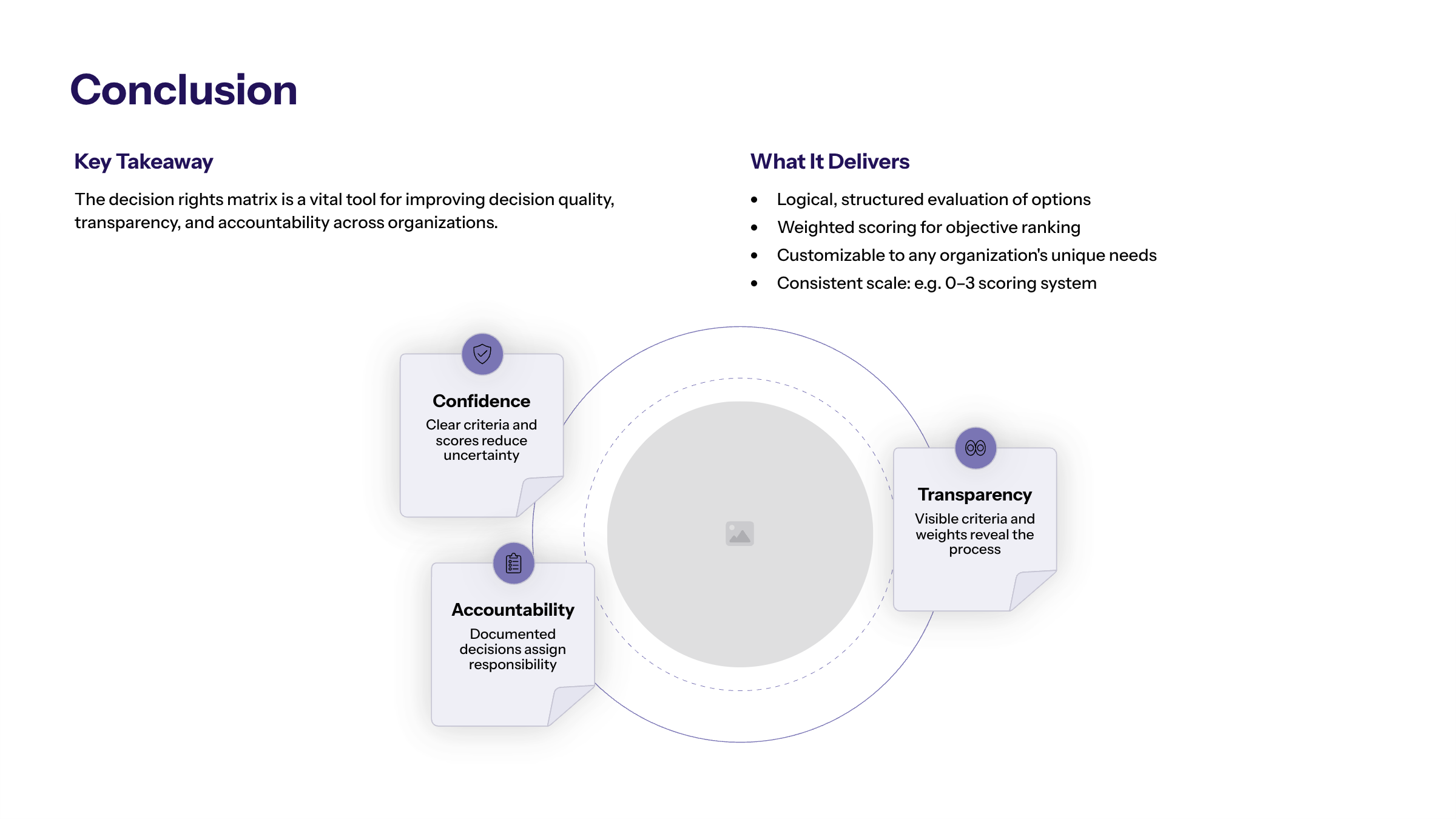
The decision rights matrix template stands as a vital tool for executives and organizations aiming to improve decision quality, transparency, and accountability. By providing a logical viewpoint and structured approach to evaluate options based on weighted criteria, it empowers decision makers to navigate complex choices with confidence.
Organizations can even develop their own decision matrix tailored to their unique needs, utilizing a scoring system such as 0/1–3 to rate options consistently and objectively. This structured method supports informed decisions by incorporating opportunity analysis and aligning with existing systems to ensure seamless integration into current workflows.
Moreover, the availability of free templates makes it easier for teams to adopt this approach without significant upfront investment. Utilizing a problem selection matrix alongside the decision rights matrix can further refine choices by filtering and prioritizing issues that warrant attention.
Integrating this tool with established frameworks and prioritization matrices not only enhances its effectiveness but also drives strategic alignment and competitive advantage in an ever-evolving business landscape.
Sources:
-
Harvard Business Review on Decision Making
-
Project Management Institute (PMI)
-
AIHR on Decision Matrix Templates
-
Asana and Microsoft Project product documentation