Decision SLA: Complete Guide to Service Level Agreements for Business Decision-Making

Introduction
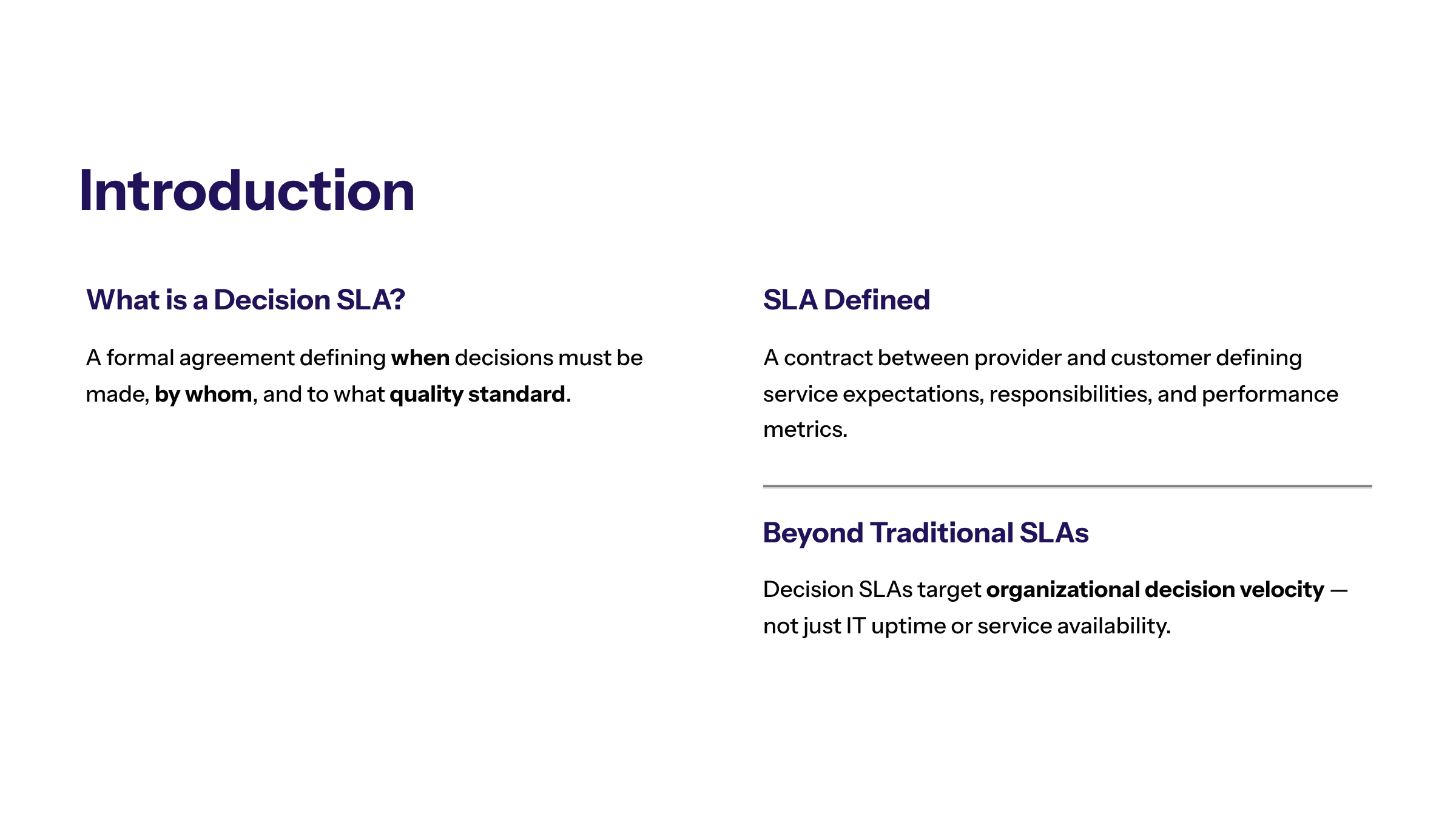
A decision SLA is a service level agreement that establishes specific timeframes, accountability measures, and quality standards for business decision-making processes. SLA stands for "service level agreement," which is a formal contract between a provider and a customer that defines service expectations, responsibilities, and performance metrics. Unlike traditional SLAs focused on IT services or service availability, decision SLAs address the often-overlooked bottleneck of organizational decision velocity—how quickly and effectively your business can make and communicate critical choices.
This guide covers approval workflows, escalation procedures, and decision response times across organizational hierarchies. A service level agreement (SLA) serves as a formal contract between a provider and a customer, setting clear performance expectations and accountability for both parties. The scope encompasses formal decision governance frameworks applicable to both the service provider and internal business teams managing decision-dependent workflows. Target audience includes business leaders, project managers, operations directors, and anyone responsible for processes where delayed decisions create cascading bottlenecks. This matters because missed deadlines on decisions directly translate to project delays, lost opportunities, and diminished customer satisfaction.
Direct answer: A decision SLA typically guarantees decision responses within 24-72 hours for standard requests and 2-4 hours for critical business decisions, with clear escalation procedures when initial decision makers are unavailable.
By the end of this guide, you will understand:
How to structure decision response time commitments that align with business velocity needs
The key components of decision quality standards and documentation requirements
Practical frameworks for implementing decision SLAs across different organizational levels
Solutions to common challenges that derail decision governance initiatives
Measurable metrics for tracking decision SLA performance and driving continuous improvement
How decision SLAs integrate with broader service level agreements (SLAs) and their associated metrics, ensuring alignment with overall service performance standards
Understanding Decision Service Level Agreements (SLAs)
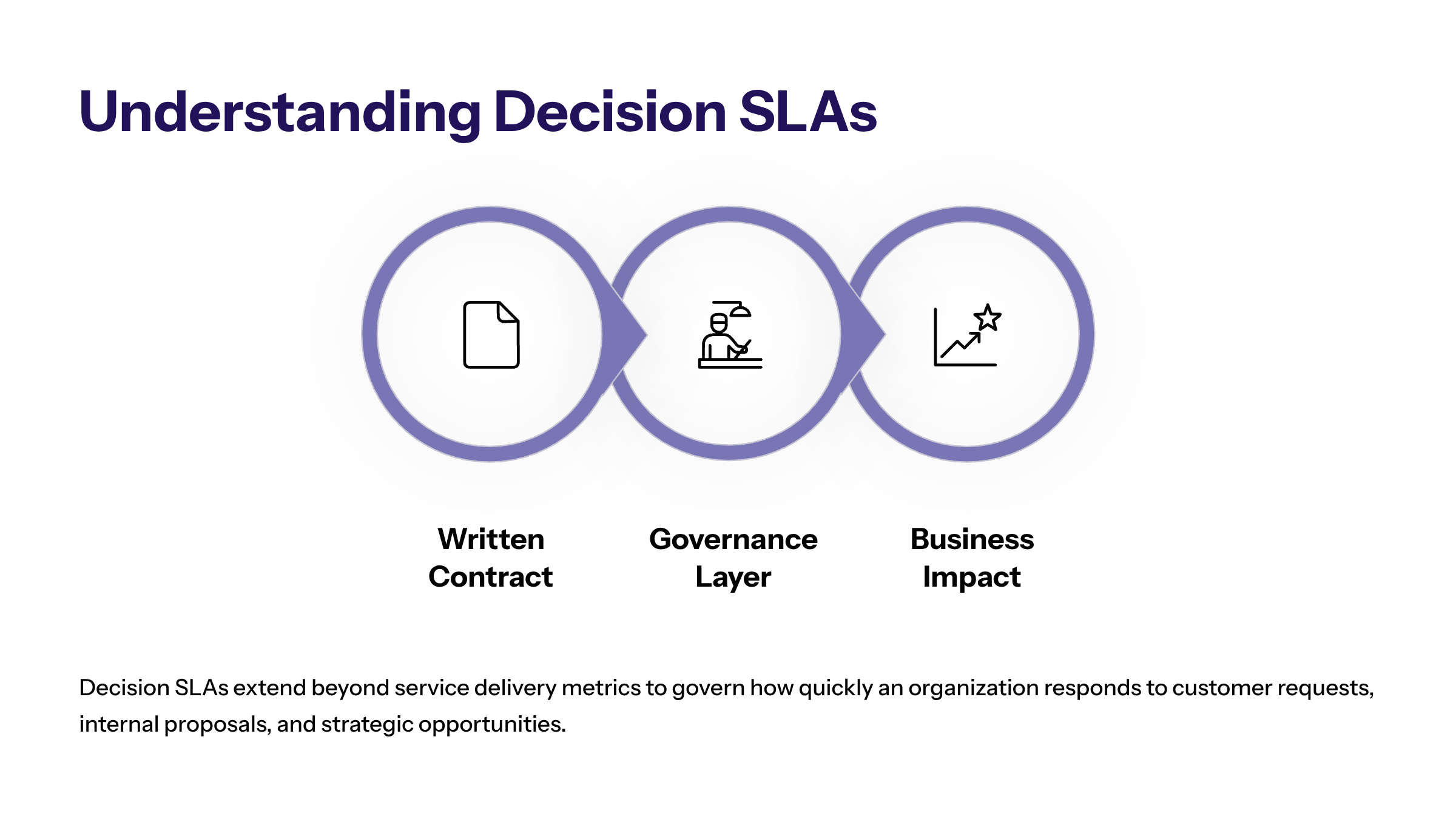
A decision SLA functions as a written contract—either formal or operational—that defines when decisions must be made, by whom, and to what quality standard. The SLA definition in this context extends beyond traditional service delivery metrics to encompass the governance layer that determines how quickly an organization can respond to customer requests, internal proposals, and strategic opportunities.
The relevance to business operations is substantial. When a service provider agrees to deliver services within specific timeframes, those commitments become meaningless if internal approval bottlenecks delay implementation by weeks. Decision SLAs close this gap by creating clear expectations for every stakeholder in the decision chain. A service level SLA is a formal contract that specifies consistent service standards for multiple customers, ensuring uniform expectations for support and incident response times.
SLAs typically contain specific service-level objectives (SLOs) for defined service level indicators (SLIs), such as mean time between failures, mean time to repair, and uptime. For each particular service, SLOs are defined to set performance standards and metrics within the broader SLA. In the context of decision SLAs, these metrics translate into measurable response and resolution times, decision quality standards, and escalation triggers.
SLAs should include a performance section that details the agreed upon service availability and service performance standards, and what metrics will be used to measure performance. This ensures that decision SLAs are not isolated agreements but part of a comprehensive service level framework that supports business objectives.
Both the provider and the customer agree to the SLA terms, including penalties or service credits, to ensure clear understanding and commitment to performance standards.
SLAs are a critical component of any outsourcing and technology vendor contract. The output received by the customer as a result of the service provided is the main focus of the service level agreement.
Decision Response Time Commitments
Response time in decision contexts measures the interval between a decision request submission and the initial acknowledgment or preliminary response. Resolution time extends further—it captures the complete cycle from request to final decision delivery with documented rationale.
This distinction matters for business velocity. A service level indicator tracking only response times might show excellent performance while actual decisions remain in limbo. Organizations achieving high customer experience scores typically maintain response times under 4 hours for acknowledgment and resolution times calibrated to decision complexity—24 hours for routine approvals, 72 hours for strategic choices requiring analysis.
SLAs typically include response times, uptime, error reporting, and error rates as part of their service quality standards. Error rates are a key metric for assessing technical quality and compliance with SLAs, as they indicate the frequency of service failures or deviations from defined standards such as SLOs and KPIs. For decision SLAs, uptime can be interpreted as the availability of decision makers or decision-making systems, while error reporting relates to the accuracy and completeness of decisions made. Performance metrics like response times and error rates are measured over a given period to determine whether service levels are being met consistently.
Decision Quality Standards
Decision quality metrics quantify the technical quality and completeness of decisions rendered. These performance metrics typically include: decision accuracy rates (percentage of decisions not requiring reversal), documentation completeness scores, and stakeholder alignment indices measuring whether all parties involved received appropriate consultation. Quality standards and metrics are tailored to the specific services provided, ensuring that each offering—along with its delivery timelines, maintenance requirements, dependencies, and operational details—is transparently defined and measured.
The relationship to governance frameworks is direct. Robust decision SLAs integrate with risk management protocols, ensuring that decisions affecting compliance, financial exposure, or customer group commitments receive appropriate review depth. This creates a measurable bridge between speed and quality—avoiding the trap of quick solutions that generate downstream problems.
Understanding these foundations prepares you to apply decision SLAs across specific business scenarios, which vary significantly in complexity and urgency.
Benefits of Decision SLAs
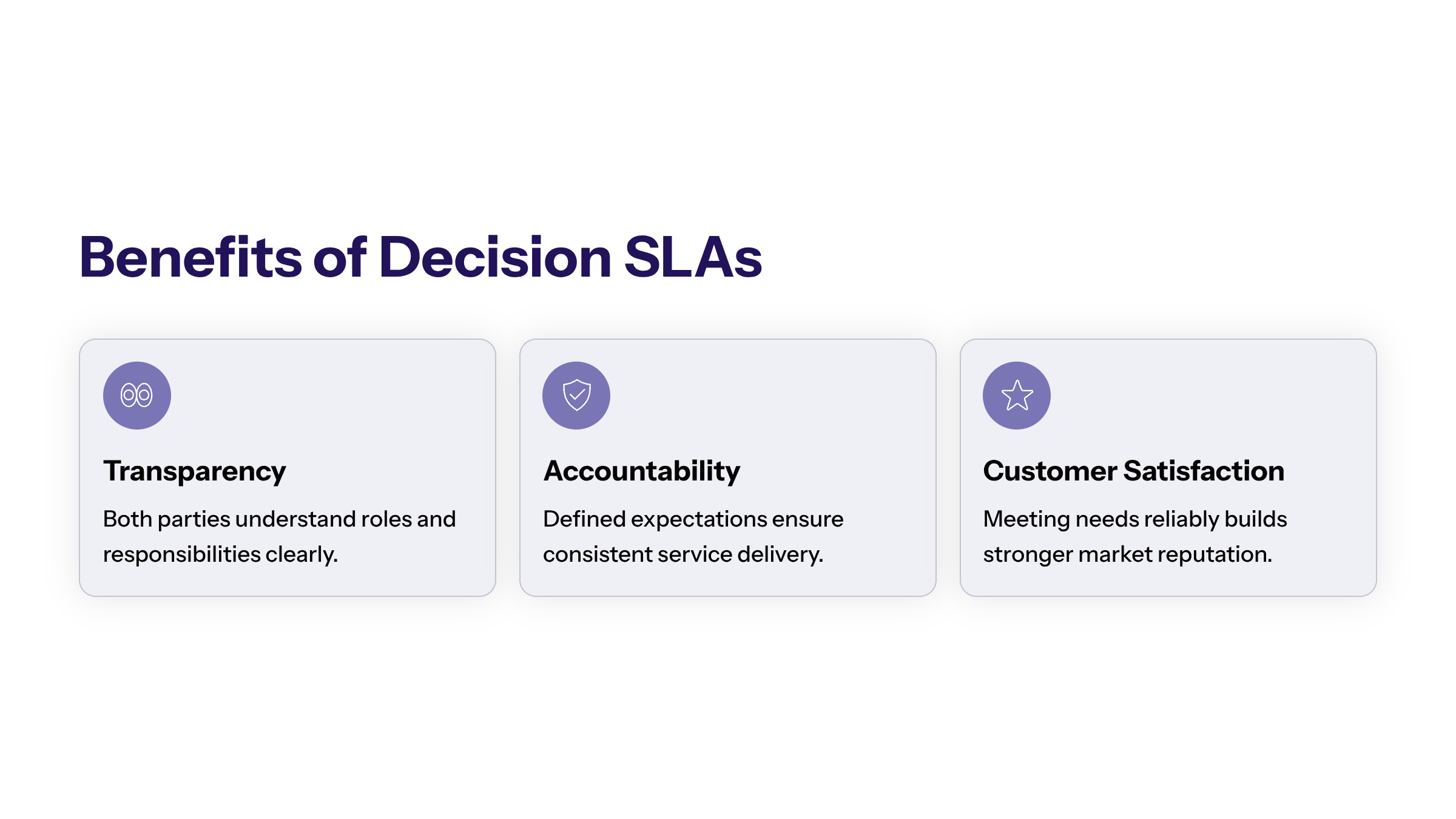
Implementing Decision SLAs brings significant advantages to both the service provider and the customer. By clearly defining service delivery expectations, these agreements foster transparency and accountability, ensuring that both parties understand their roles and responsibilities. This clarity helps the service provider consistently meet customer needs, leading to higher customer satisfaction and a stronger reputation in the market.
Decision SLAs also provide a structured approach to managing response times and service availability, which minimizes the risk and impact of service disruptions. With measurable metrics in place, service providers can monitor their performance, quickly identify areas for improvement, and make data-driven decisions to enhance their services. For customers, this means reliable service delivery and confidence that their requests will be handled promptly and efficiently.
Furthermore, Decision SLAs support continuous improvement by establishing a feedback loop between service performance and customer expectations. This proactive approach not only optimizes operations but also builds long-term trust, as customers see their needs prioritized and addressed within agreed-upon timeframes.
Key Components of a Decision SLA
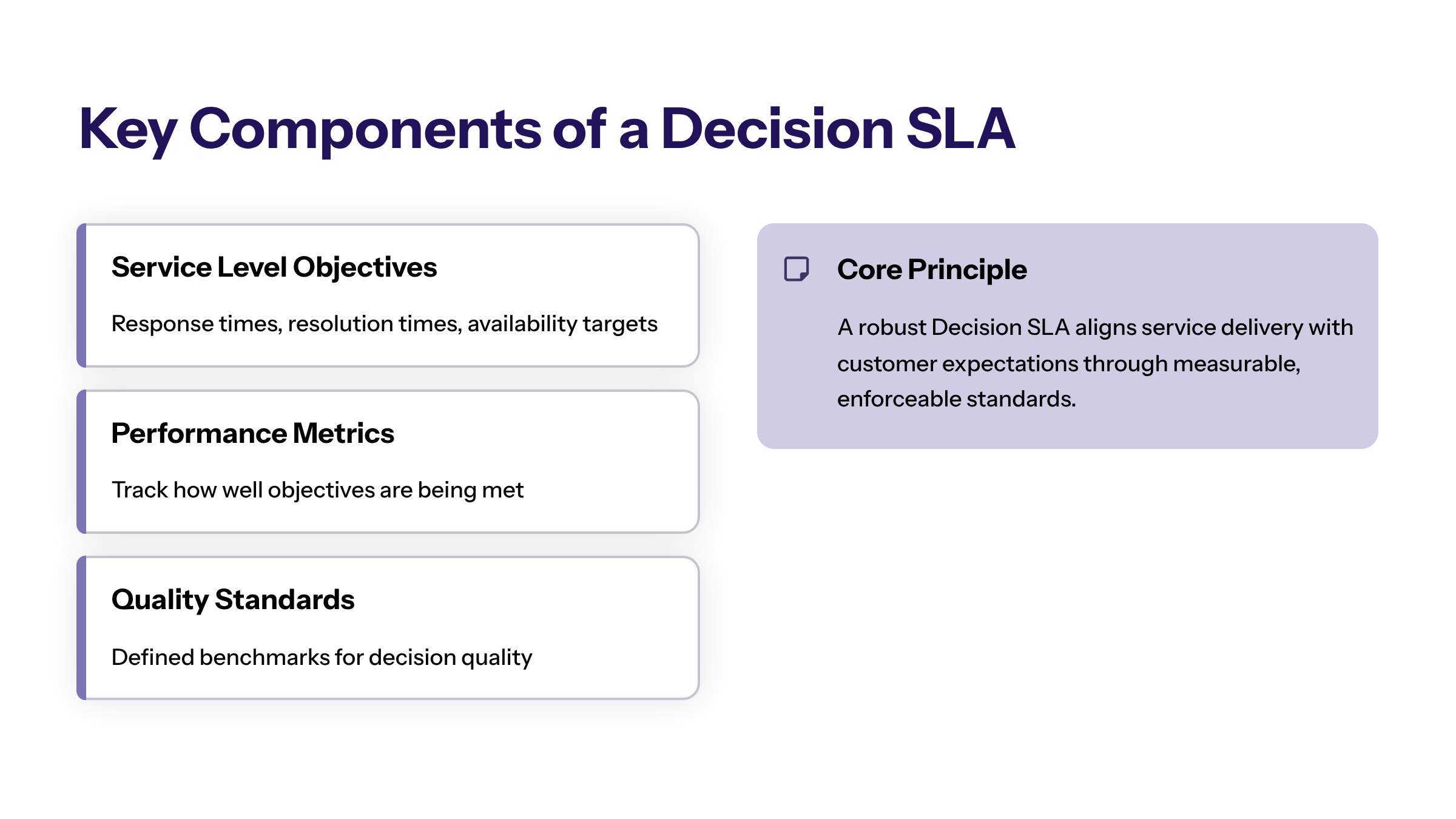
A robust Decision SLA is built on several key components that collectively ensure effective service delivery and alignment with customer expectations. At its core, the agreement defines clear service level objectives—such as specific response times, resolution times, and service availability targets—that set the standard for the level of service to be provided.
Performance metrics are essential for tracking how well the service provider meets these objectives. Common metrics include first-call resolution rates, mean time to resolve, and customer satisfaction scores. These measurable indicators provide both the service provider and the customer with a transparent view of service quality and areas for improvement.
Escalation procedures are another critical element, detailing the steps to be taken if service delivery falls short of expectations or if incidents occur. These procedures outline notification protocols, escalation timelines, and resolution targets, ensuring that issues are addressed promptly and do not impact overall service performance.
By incorporating these key components, a Decision SLA creates a comprehensive framework that supports consistent service delivery, meets customer expectations, and drives ongoing improvement in both performance and customer satisfaction.
Types of Decision SLAs
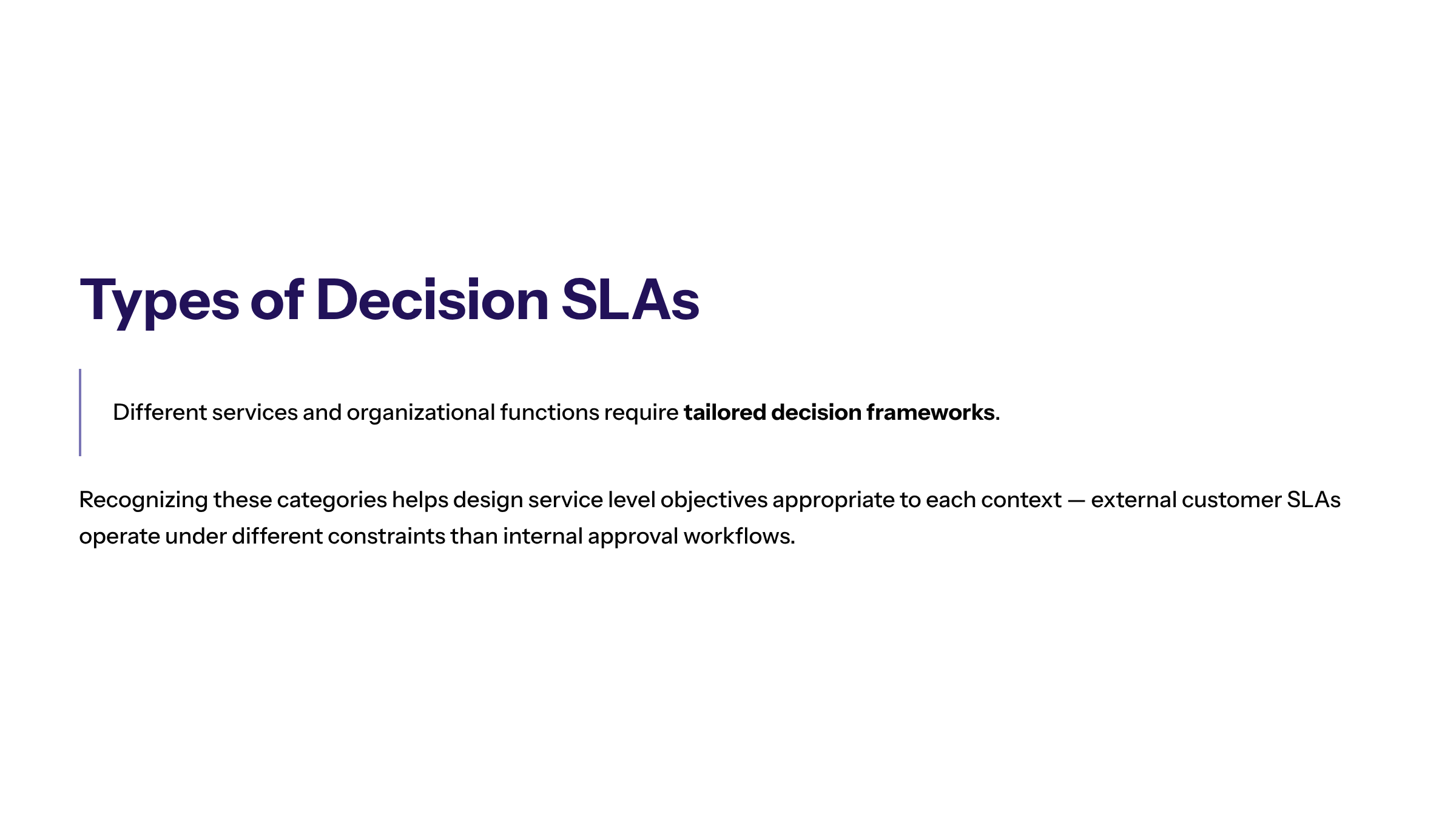
Different services and organizational functions require tailored decision frameworks. A customer based SLA for external-facing decisions operates under different constraints than internal approval workflows. Recognizing these categories helps you design service level objectives appropriate to each context.
SLAs can differ for every single type of service provided, but they can be broadly classified into three main types: customer level SLAs (customer-based SLA), service level SLAs (service-based SLA), and multilevel SLAs. Decision SLAs may incorporate elements from all three types depending on whether decisions affect external customers, internal teams, or multiple organizational layers.
Approval Workflow SLAs
Budget approvals, procurement decisions, and project sign-offs represent the highest-volume decision category in most organizations. A service based SLA for approvals typically specifies: 24-hour turnaround for expenditures under $10,000, 72-hour windows for major purchases, and same-day processing for pre-approved vendor transactions. Development and business teams particularly benefit from clear approval timelines, as project schedules frequently hinge on resource allocation decisions. Performance targets should account for approval complexity tiers, with escalation procedures activating when standard timeframes cannot be met.
SLAs should be based on priority levels to ensure clarity and timely resolution of incidents. For example, high-priority approvals might have shorter response and resolution times, while routine authorizations allow longer windows.
Escalation Decision SLAs
Crisis response decisions, issue escalation timelines, and management intervention protocols demand compressed timeframes. When service disruptions occur or customer expectations are threatened, decision latency directly impacts resolution quality. Best practices establish escalation decision SLAs with response times measured in hours or minutes: critical incidents require 15-minute acknowledgment and 2-hour resolution decisions, while standard escalations operate on 4-hour cycles. These SLAs must specify backup decision authority to prevent single points of failure.
Strategic Planning Decision SLAs
Quarterly planning decisions, resource allocation choices, and strategic initiative approvals operate on longer cycles but require equal precision. A multilevel SLA approach works well here, with corporate-level strategic decisions following 2-week cycles, departmental resource allocations on weekly cadences, and tactical adjustments processed within 48 hours. The key metric shifts from pure speed to decision thoroughness—ensuring business results reflect comprehensive analysis rather than rushed conclusions.
Key takeaway: Match decision SLA stringency to business impact. Routine tasks need efficiency; strategic choices need deliberation time with defined boundaries.
These categories provide the framework for implementing decision governance in your specific organizational context.
Implementing Decision SLAs in Your Organization
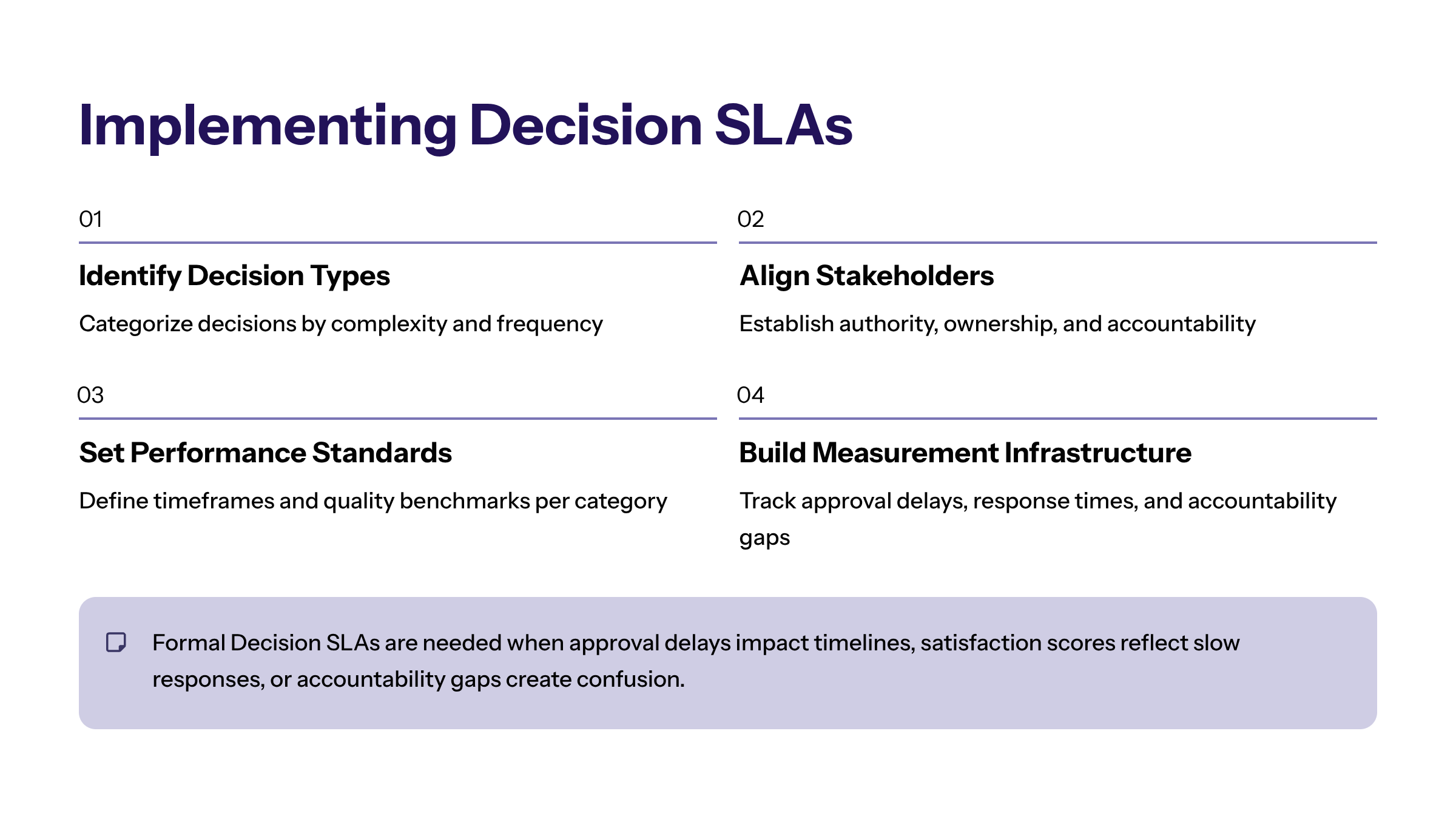
Moving from concept to operational reality requires systematic design, stakeholder alignment, and measurement infrastructure. The implementation process builds on understanding decision types and establishing appropriate service performance standards for each category.
Decision SLA Design Process
Organizations typically need formal decision SLAs when: approval delays consistently impact project timelines, customer satisfaction scores reflect slow response times, or accountability gaps create confusion about decision authority. The following process addresses these triggers:
Map current decision workflows and identify bottlenecks. Document every decision point in critical processes, measuring actual cycle times and identifying where delays accumulate. This actual measurement baseline prevents setting unrealistic targets.
Define decision categories and complexity levels. Classify decisions by urgency (critical, standard, routine), complexity (simple approval, analysis required, strategic impact), and stakeholder scope (individual, team, cross-functional).
Set realistic timeframes based on decision complexity. Establish service level targets that balance business needs with decision maker capacity. A common SLA framework uses 4-hour/24-hour/72-hour tiers corresponding to complexity levels.
Establish escalation procedures and accountability measures. Define backup decision makers, timeout thresholds triggering escalation, and consequences for SLA breaches. Include an indemnification clause protecting decision makers acting within guidelines from third party litigation costs.
SLAs should include a clearly defined framework for modification during the term of the contract to adapt to changing business needs. This ensures decision SLAs remain relevant as organizational priorities and capacities evolve.
SLAs should document how the services are to be monitored, including how the data will be captured and reported. For decision SLAs, this might involve automated workflow tracking, dashboards for real-time SLA compliance, and regular reporting to stakeholders.
Decision SLA Metrics Comparison
Decision Type | Target Response Time | Resolution Time | Escalation Trigger | Service Credits/Penalties |
|---|---|---|---|---|
Critical Approvals | 15 minutes | 2 hours | 30-minute timeout | Priority processing queue |
Standard Approvals | 4 hours | 24 hours | 8-hour timeout | Expedited review process |
Strategic Decisions | 24 hours | 72 hours | 48-hour timeout | Executive intervention |
Routine Authorizations | 2 hours | 8 hours | 4-hour timeout | Auto-approval activation |
This comparison helps you select appropriate performance levels for your organization’s specific context. The service agreement between decision requesters and decision makers should specify these parameters explicitly.
Managing SLAs effectively requires regular review cycles—quarterly assessments ensure targets remain aligned with business velocity requirements and decision maker capacity. Cloud computing and workflow automation tools can automate routine tasks, freeing decision makers for complex judgments.
SLAs generate performance data, creating a feedback loop to identify bottlenecks and measure process effectiveness. This data-driven approach supports continuous improvement and transparency.
Implementation inevitably surfaces challenges requiring proactive solutions.
Incident Management and Resolution in Decision SLAs
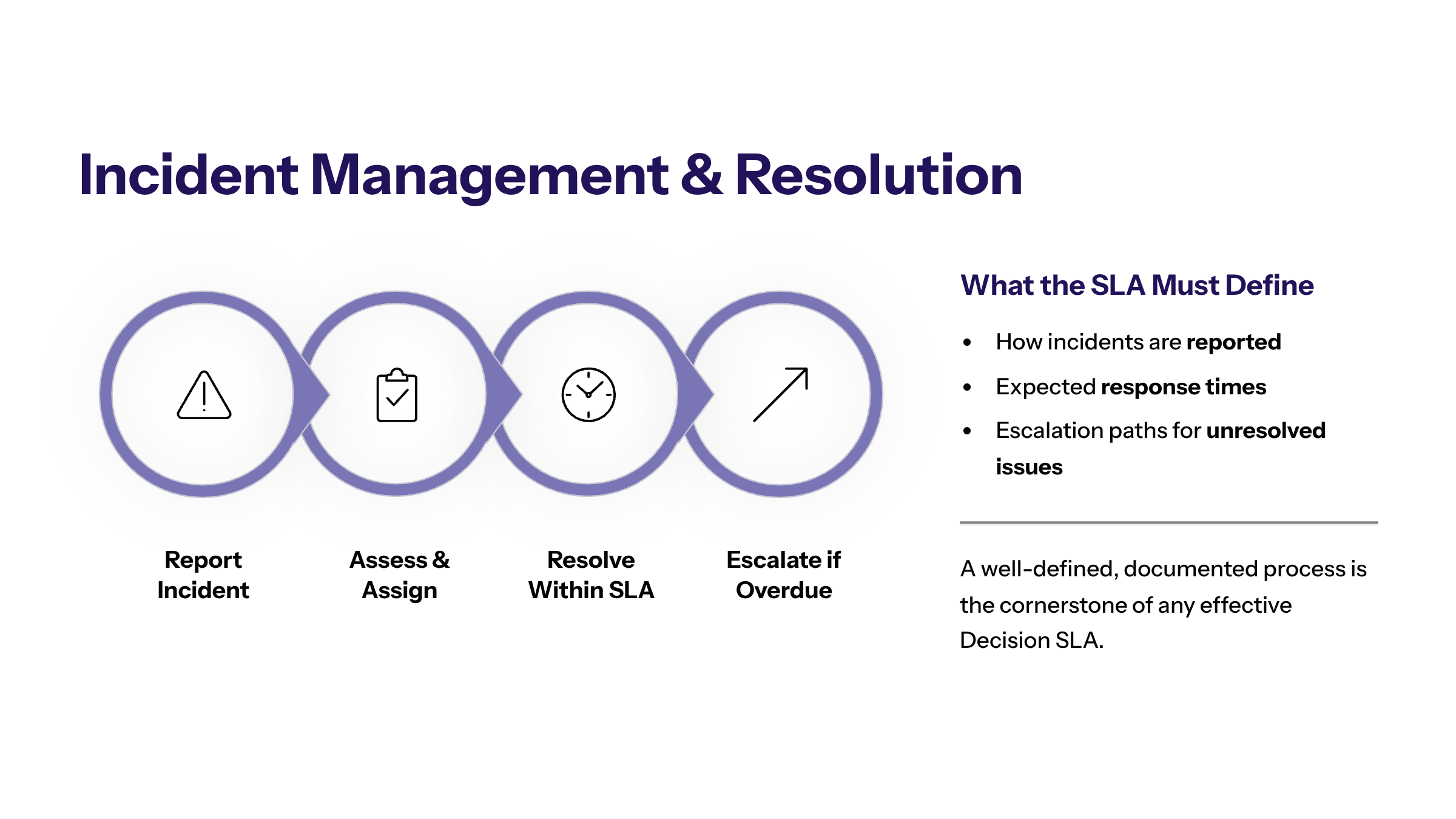
Incident management is a cornerstone of any effective Decision SLA. The service provider must have a well-defined process for handling incidents, from initial notification through to resolution. This process should be clearly documented within the SLA, specifying how incidents are reported, the expected response times, and the escalation paths if issues are not resolved within agreed timeframes.
Service availability is closely monitored to ensure that disruptions are minimized and quickly addressed. By tracking response times and resolution times for each incident, the service provider can identify patterns, address root causes, and implement improvements to prevent future disruptions.
A robust incident management system also includes comprehensive reporting and root cause analysis, enabling the service provider to learn from each incident and enhance overall service reliability. This approach not only reduces downtime but also reassures customers that their business operations are protected and that any service disruptions will be managed swiftly and effectively.
Security and Risk Management for Decision SLAs
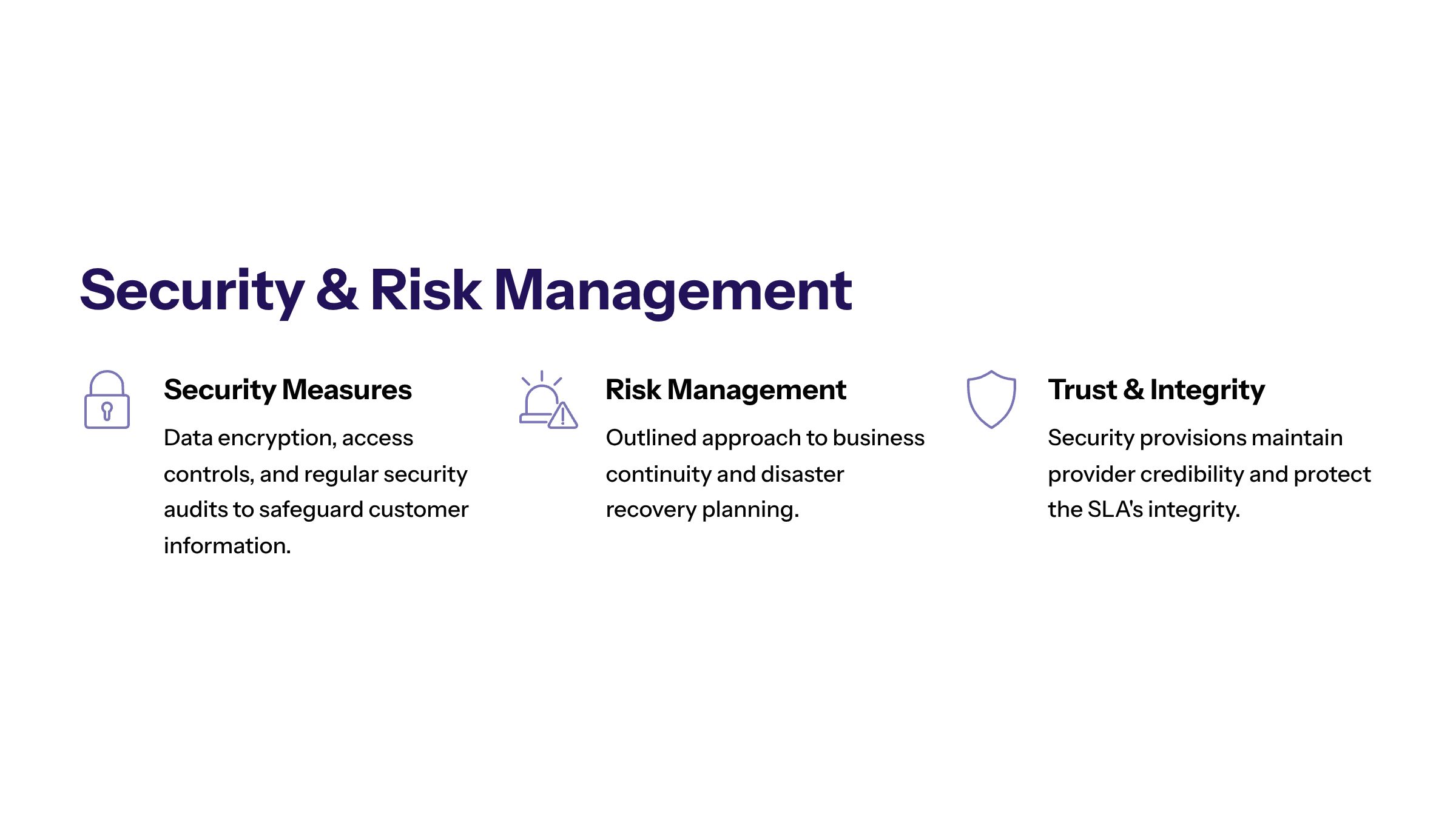
Security and risk management are vital to the integrity of Decision SLAs. The service provider must implement strong security measures—such as data encryption, access controls, and regular security audits—to safeguard customer information and maintain trust. The Decision SLA should also outline the provider’s approach to risk management, including business continuity and disaster recovery planning.
By proactively identifying and mitigating potential risks, the service provider can minimize the likelihood and impact of service disruptions. This includes conducting regular risk assessments, maintaining up-to-date incident response plans, and ensuring that all staff are trained in security best practices.
For customers, these provisions offer peace of mind that their data and business operations are protected, even in the face of unexpected events. A comprehensive approach to security and risk management within the Decision SLA not only reduces vulnerabilities but also strengthens the overall relationship between the customer and the service provider.
Decision SLA Standards
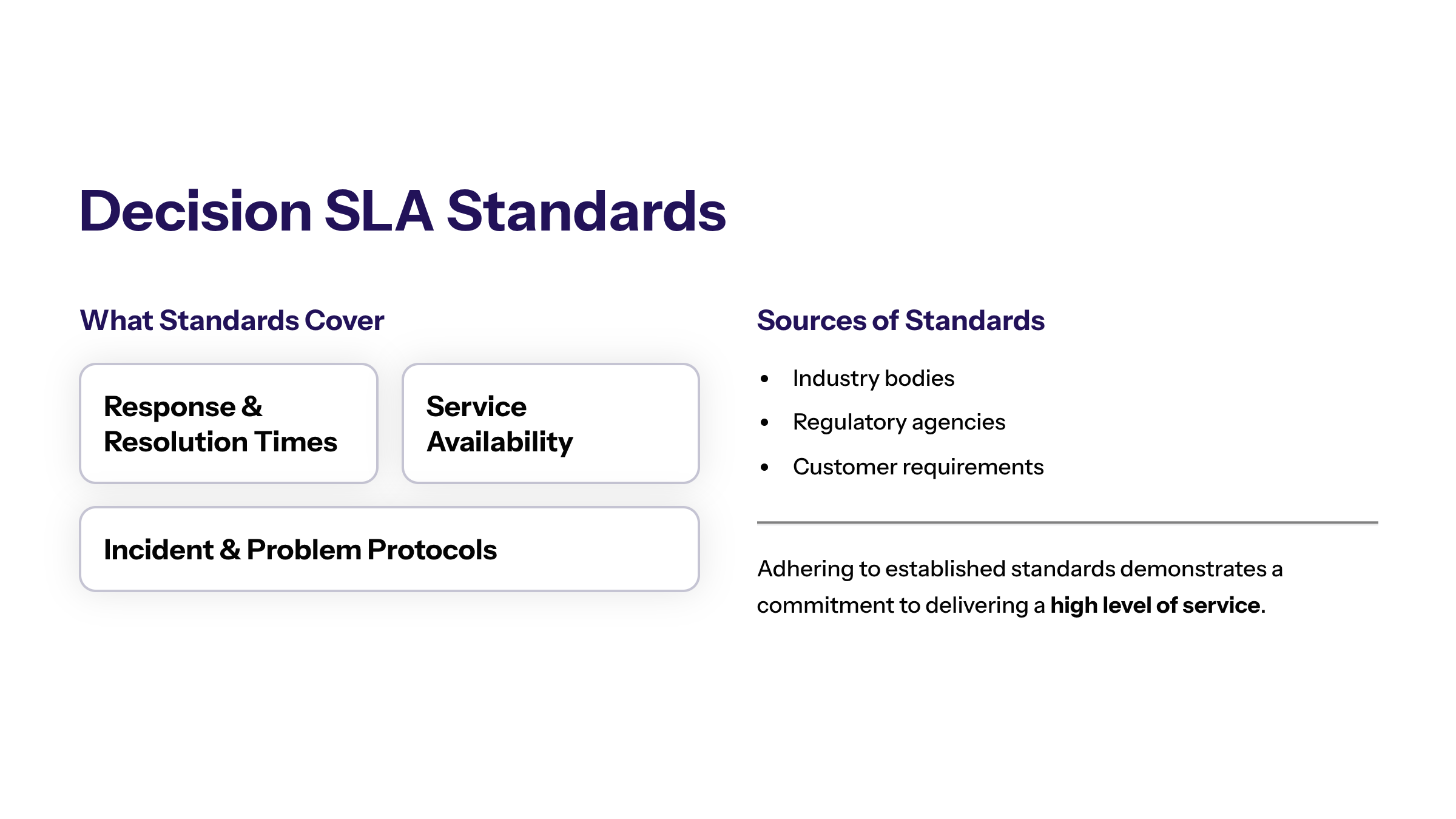
Decision SLA standards set the benchmark for service delivery, ensuring that the service provider consistently meets or exceeds minimum requirements. These standards typically include specific metrics for response times, resolution times, and service availability, as well as protocols for incident management and problem resolution.
By adhering to established standards—whether defined by industry bodies, regulatory agencies, or customer requirements—the service provider demonstrates a commitment to delivering a high level of service. This accountability helps customers feel confident that their needs will be met and that any issues will be addressed promptly and professionally.
Including these standards in a Decision SLA also facilitates regular performance reviews and continuous improvement, as both parties can measure actual service delivery against agreed benchmarks. Ultimately, Decision SLA standards help ensure that services are delivered reliably, efficiently, and in line with customer expectations, supporting long-term business success for both the service provider and the customer.
Common Challenges and Solutions
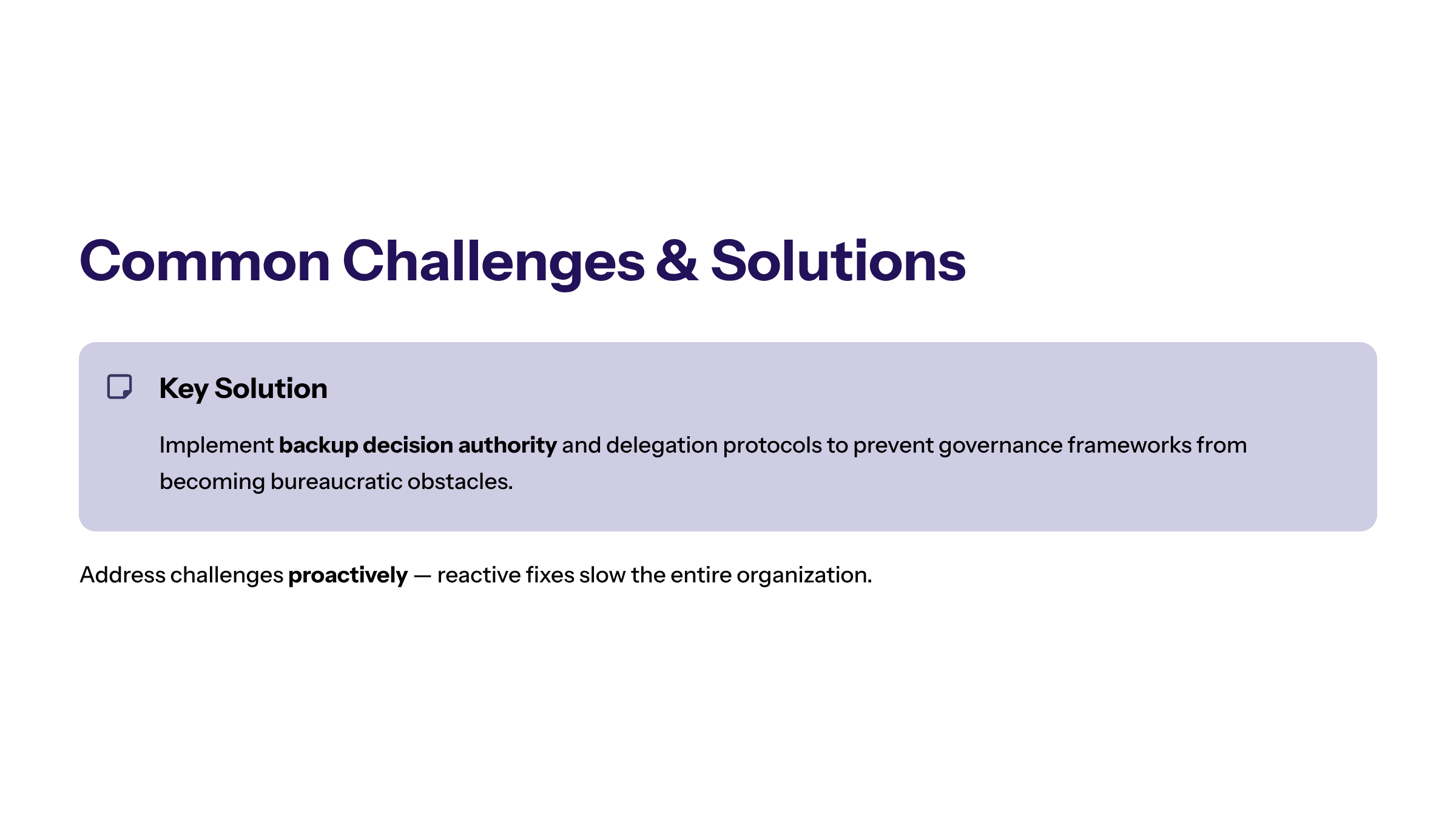
Even well-designed decision SLAs encounter operational friction. Addressing these challenges proactively prevents governance frameworks from becoming bureaucratic obstacles rather than business accelerators.
Decision Maker Availability Issues
Solution: Implement backup decision authority and delegation protocols. Every decision SLA should specify at least one alternate decision maker with equivalent authority. Time window rules should activate alternates automatically—if the primary decision maker hasn’t responded within 50% of the SLA timeframe, the alternate receives notification and authority to proceed. This prevents customer experience degradation from individual unavailability.
Complex Decision Requirements
Solution: Create decision templates and information gathering checklists to streamline processes. Many decision delays stem from incomplete information rather than deliberation time. Standardized request formats ensure decision makers receive everything needed for informed judgment on first submission. For decisions requiring analysis, separate the data driven decisions preparation phase from the approval phase, with distinct SLAs for each. This approach helps incident management scenarios where rapid triage depends on complete initial reports.
Inconsistent Decision Quality
Solution: Establish decision criteria frameworks and required documentation standards. Quality of service in decisions means consistency and defensibility, not just speed. Define minimum documentation requirements for each decision tier: routine decisions need brief rationale notes, standard decisions require documented alternatives considered, and strategic decisions demand formal analysis with risk assessment. Legal counsel should review frameworks affecting compliance or contractual obligations for legal protection.
These solutions create sustainable decision governance rather than unsustainable heroics.
Conclusion and Next Steps
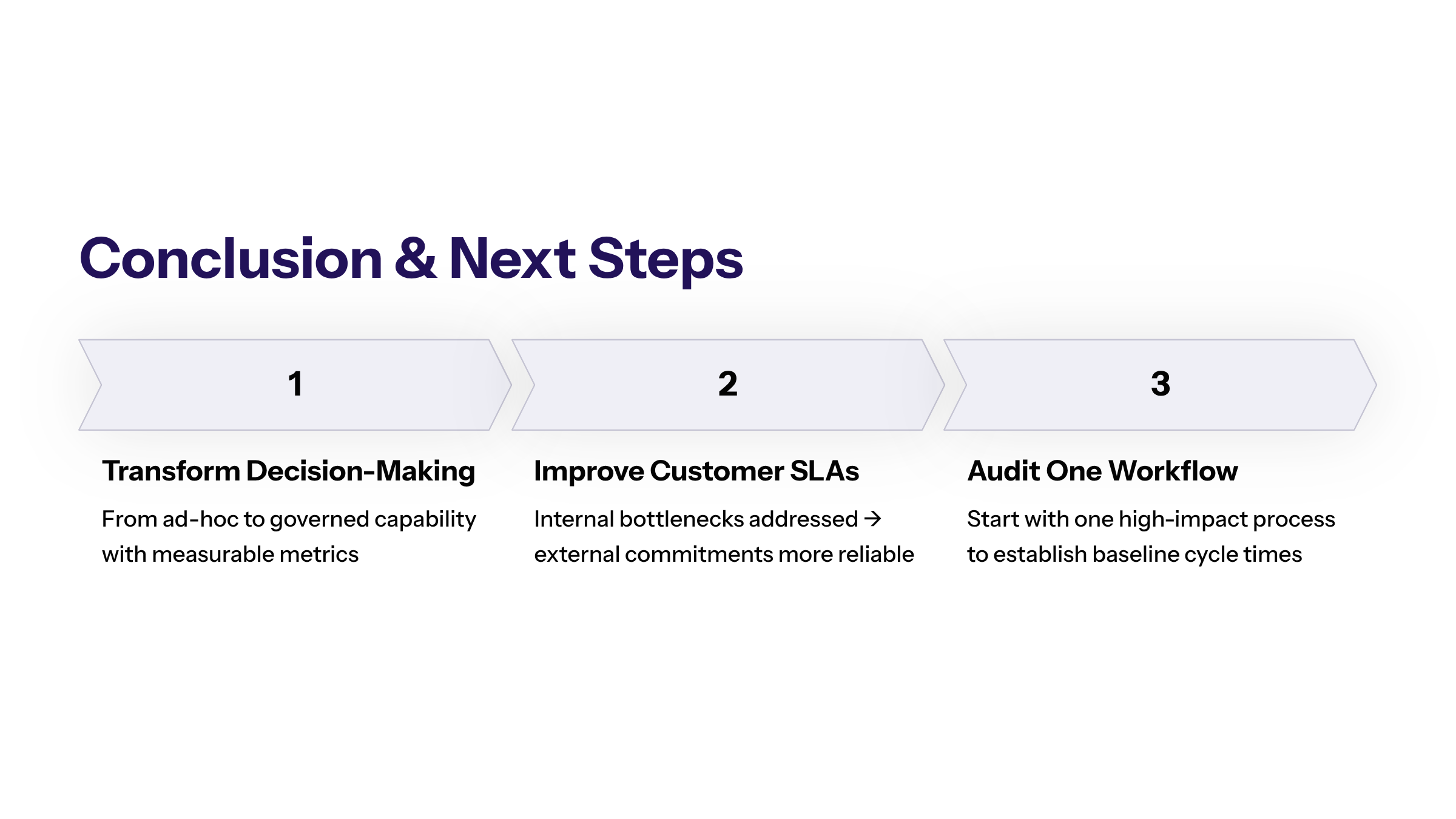
Decision SLAs transform organizational decision-making from an ad-hoc process into a governed capability with measurable metrics, clear accountability, and continuous improvement mechanisms. The impact extends beyond internal efficiency—customer level SLA commitments become more reliable when internal decision bottlenecks are systematically addressed.
Immediate actionable steps:
Audit current decision processes in one high-impact workflow to establish baseline cycle times
Identify the three most critical decision points causing project or customer delays
Draft a pilot decision SLA for one approval category using the framework outlined above
Establish a 30-day measurement period with weekly reviews before expanding scope
Related topics worth exploring: Workflow automation tools that can automate routine tasks and flag SLA timeout risks, governance frameworks for multi level SLA structures across complex organizations, and decision support systems that accelerate analysis phases without compromising quality. Software development teams often pioneer these practices through sprint planning governance—their approaches translate effectively to broader business contexts.
Additional Resources
Decision SLA Template Components:
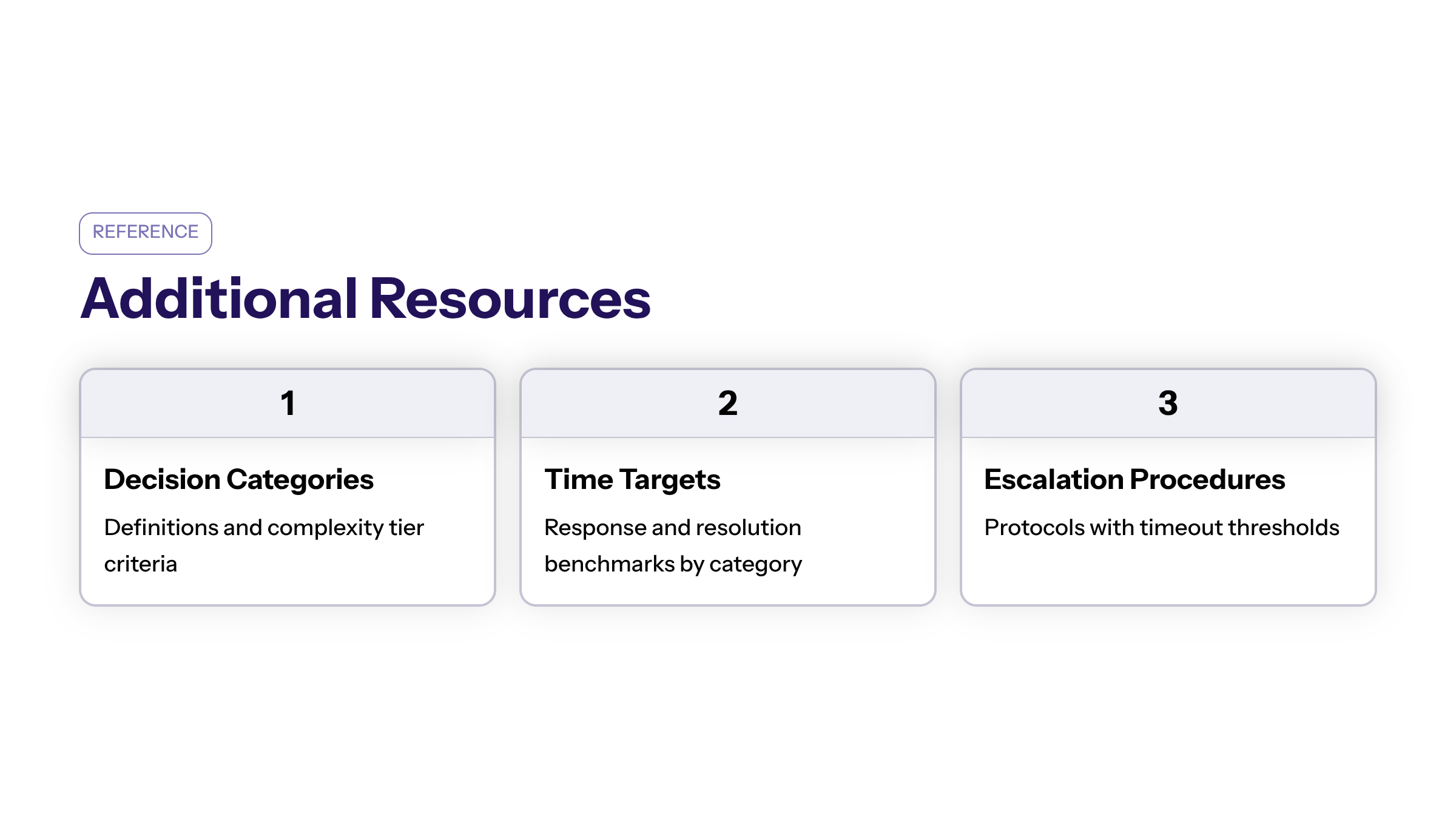
Decision category definitions and complexity tier criteria
Response and resolution time targets by category
Escalation procedures with timeout thresholds
Documentation requirements by decision tier
Measurement and reporting specifications
Industry Benchmarks for Decision Response Times:
IT change approvals: 4-24 hours (ITIL framework standards)
Procurement decisions: 24-72 hours (standard commercial practice)
Customer escalation responses: 2-4 hours (customer satisfaction baseline)
Strategic resource allocation: 5-10 business days (enterprise planning cycles)
Integration Considerations: Decision SLA governance integrates with service desk ticketing systems, project management platforms, and workflow automation tools. Look for solutions supporting SLA management dashboards with real-time compliance tracking and predictive breach alerts—these capabilities transform decision governance from reactive measurement to proactive management.
Organizations are increasingly shifting from technical SLAs to Business Level Agreements (BLAs) that align decision metrics with business KPIs. In 2026, modern platforms integrate AI to automatically route and prioritize requests based on SLA urgency. Decision SLAs guide teams and partners, preventing delays from misunderstandings and fostering trust for smoother operations. Organizations using Decision SLAs can better track and fix stagnant decisions, which currently affects nearly 50% of companies. In 2026, Decision SLAs function as critical operational roadmaps that transform subjective decision-making into a structured process.