Digital Transformation: The RAPID Framework for Accelerated Business Modernization
Rapid digital transformation is the accelerated use of digital technologies to deliver measurable business value in 6-18 months instead of waiting through multi-year modernization programs. For business leaders, CTOs, finance professionals, and transformation executives, the goal is not simply to move faster; the goal is faster decision making, tighter execution control, and measurable improvement in how the business operates.
This article focuses on mid-market and enterprise organizations facing competitive pressure, regulatory deadlines, customer demands, outdated processes, or operational bottlenecks that require immediate modernization. It is especially relevant when legacy systems, manual data entry, fragmented data analytics, or slow business processes are limiting operational efficiency, customer experience, employee experience, or overall performance.
Rapid digital transformation uses a structured approach such as RAPID to compress traditional 3-5 year transformation efforts into focused 12-18 month implementations with measurable ROI. RAPID works as an operating model: it helps business and IT leaders Research the current reality, Analyze constraints and opportunities, Plan high-impact work, Implement with governance, and Decide based on evidence.
In this guide, you will learn how to:
Understand why rapid transformation is different from traditional digital transformation.
Apply the RAPID methodology as an execution model for urgent modernization.
Select implementation priorities that increase transparency, reduce manual steps, and deliver real time insights.
Manage common challenges such as legacy systems, cybersecurity vulnerabilities, cultural resistance, and talent gaps.
Measure ongoing success through ROI, adoption, cost savings, and business process effectiveness.
Understanding Rapid Digital Transformation
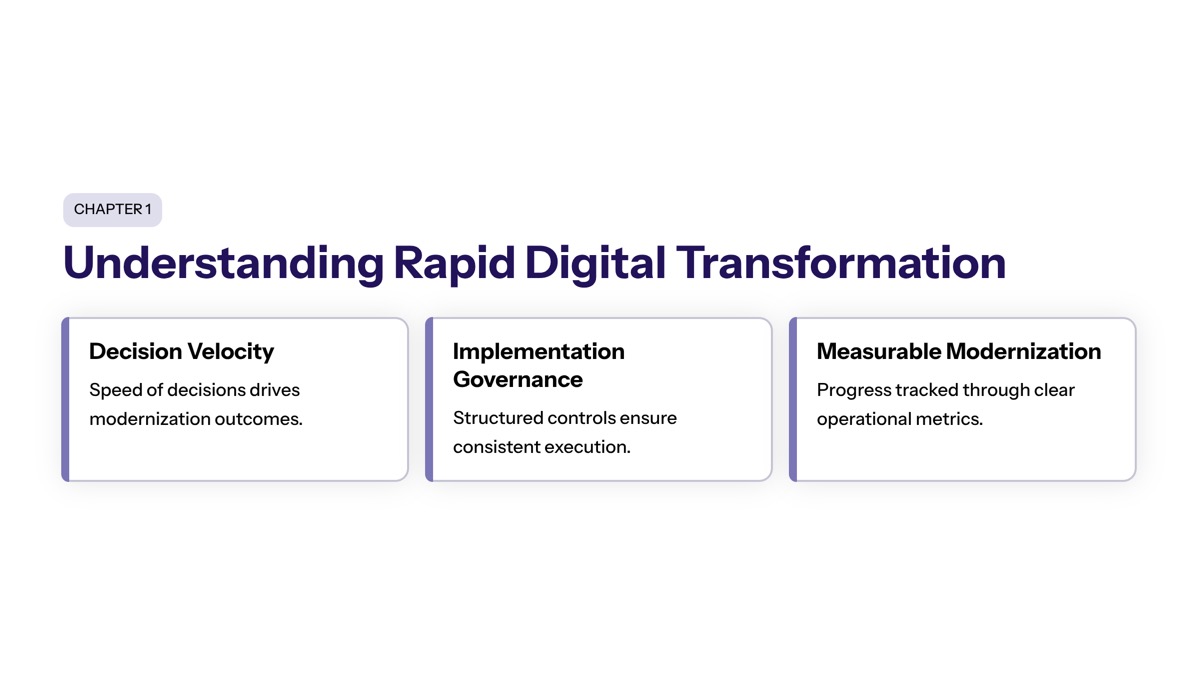
Digital transformation is the integration of digital technology into all areas of a business, fundamentally changing how businesses operate and deliver value to customers. Rapid digital transformation narrows that broad ambition into business-driven modernization focused on immediate operational improvements, not a comprehensive enterprise-wide overhaul that takes years to complete.
Traditional digital transformation often includes large-scale platform replacement, cultural transformation, new business models, and deep restructuring of business strategy, processes, technologies, or even company culture itself. Rapid transformation still supports transformational change, but it works in smaller, higher-value increments. The transformation process begins with a problem statement, a clear opportunity, or an aspirational goal, such as improving customer experience, reducing friction, increasing productivity, or enabling data driven decision making.
Digital transformation matters because it is now imperative for all businesses that want to remain competitive and relevant in an increasingly digital world. Organizations face pressure to modernize operations to remain competitive, and digital transformation is increasingly seen as a survival issue in a rapidly evolving market. Global digital transformation spending is projected to reach $3.4 trillion, which reflects how strongly market conditions, technological advancements, and consumer needs are pushing modernization onto the executive agenda.
The COVID-19 pandemic accelerated the urgency for digital transformation by compelling organizations to adapt quickly to supply chain disruptions and changing customer expectations. The COVID-19 pandemic also forced many organizations to speed up their transformation efforts to adapt to rapid changes in consumer behavior and market dynamics. Cloud computing became essential because cloud computing provides the highly scalable, cost-effective infrastructure needed to launch remote operations rapidly, while cloud-based operations enable faster deployment of new products and global collaboration.
Business Pressure Drivers for Rapid Change
Rapid transformation usually starts when the cost of delay becomes visible. Organizations are driven to transform due to market disruptions, technological advancements, shifts in customer preferences, and the need to improve operational efficiency. Modern consumers expect instant, customized, and frictionless interactions across every brand touchpoint, which means slow systems and disconnected workflows directly affect revenue and loyalty.
Market disruption requires immediate competitive response within quarters, not years. Emerging tech, artificial intelligence, machine learning, cloud based systems, and automated workflows are changing how entire business models compete. Automated workflows and data-driven insights provide competitive advantages in the digital transformation landscape because they reduce delays, reveal patterns earlier, and help leaders adjust to changing customer demands.
Regulatory pressure is another key driver. Strict global data privacy laws and cybersecurity threats make digital transformation an operational imperative. Changing regulations require secure, automated audit trails and digital tracking in business operations, especially in regulated industries such as healthcare, insurance, banking, and finance digital transformation programs.
Operational bottlenecks also force acceleration. Legacy technology in enterprise IT hinders organizations’ ability to successfully embark on digital transformation strategies because maintaining outdated systems consumes a significant portion of IT budgets. When current processes depend on manual data entry, spreadsheets, disconnected approvals, or slow reporting cycles, the business loses speed, increases risk, and limits real time insights.
Finance digital transformation is a practical example. Digital transformation in finance involves the strategic integration of technologies such as AI, machine learning, and robotic process automation to modernize workflows and improve decision-making across financial operations. Organizations that embrace digital transformation in finance can close their books faster, deliver more transparent reporting, and provide leadership with real-time financial visibility, enhancing their strategic role within the business.
Speed vs. Scope Trade-offs
Rapid digital transformation requires scope discipline. Instead of replacing every platform or redesigning every workflow at once, leaders focus implementation on specific business processes that produce visible gains in cost savings, customer experience, employee engagement, or compliance readiness.
The best candidates are high-impact, low-complexity changes that deliver immediate ROI. Examples include reducing manual steps in finance teams, using robotic process automation for invoice matching and data entry, integrating customer data for real time insights, or automating audit trails for compliance. Robotic process automation is utilized in finance to handle repetitive tasks, such as invoice matching and data entry, which increases efficiency and allows finance teams to focus on higher-value activities.
This trade-off does not mean ignoring long-term business goals. It means aligning every near-term decision to business strategy while avoiding overextended transformation efforts. Automating manual operations drastically reduces costs, while real-time analytics enable organizations to rapidly pivot in response to market disruptions. AI and machine learning are increasingly used in finance to improve forecasting accuracy by analyzing historical and real-time data, identifying spending patterns, and predicting cash flow more effectively than manual methods.
Because speed increases delivery pressure, rapid transformation needs a structured operating model. That is where RAPID helps business leaders convert urgent business needs into prioritized action, governed execution, and measurable outcomes.
The RAPID Framework for Accelerated Implementation
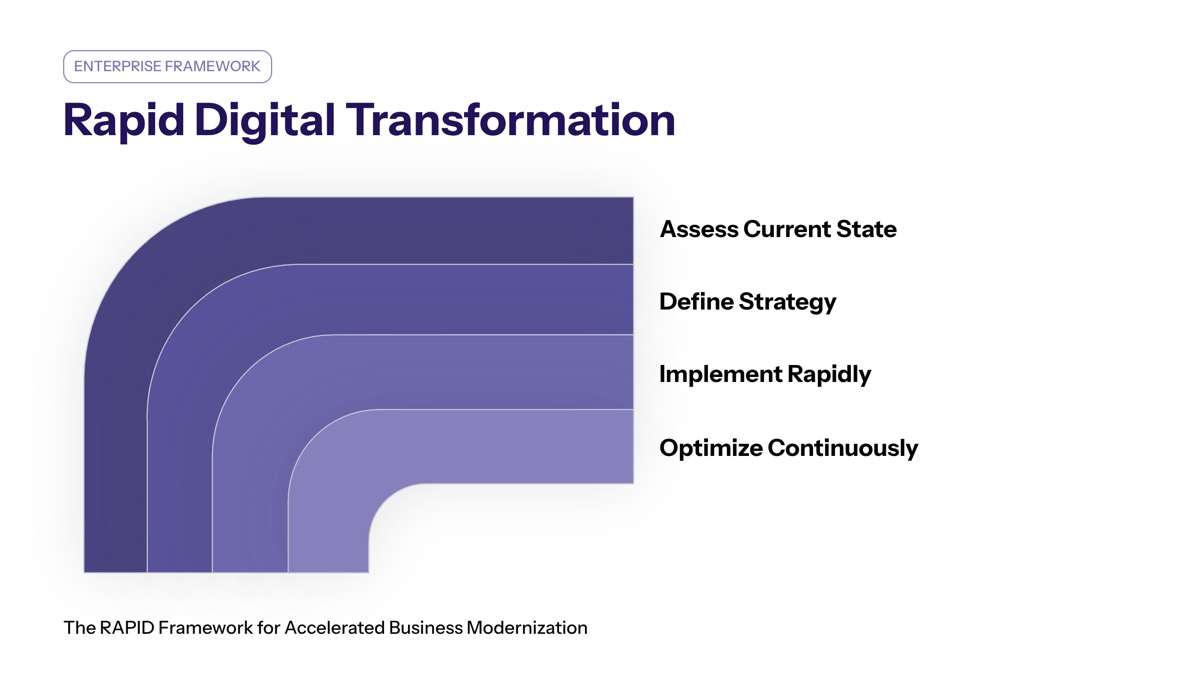
RAPID is Cognativ’s operating model for moving from business pressure to controlled, accelerated implementation. It gives transformation leaders a structured approach for accelerating transformation without turning speed into unmanaged risk.
Traditional transformation approaches often fail under time pressure because they expand scope too early, delay decision making, separate business goals from technology choices, or treat change management as a final-stage activity. Rapid digital transformation increases agility and efficiency but frequently suffers from high failure rates due to cultural resistance and cybersecurity vulnerabilities. Many organizations face challenges in digital transformation, including budgeting constraints, talent shortages, and cultural resistance to change.
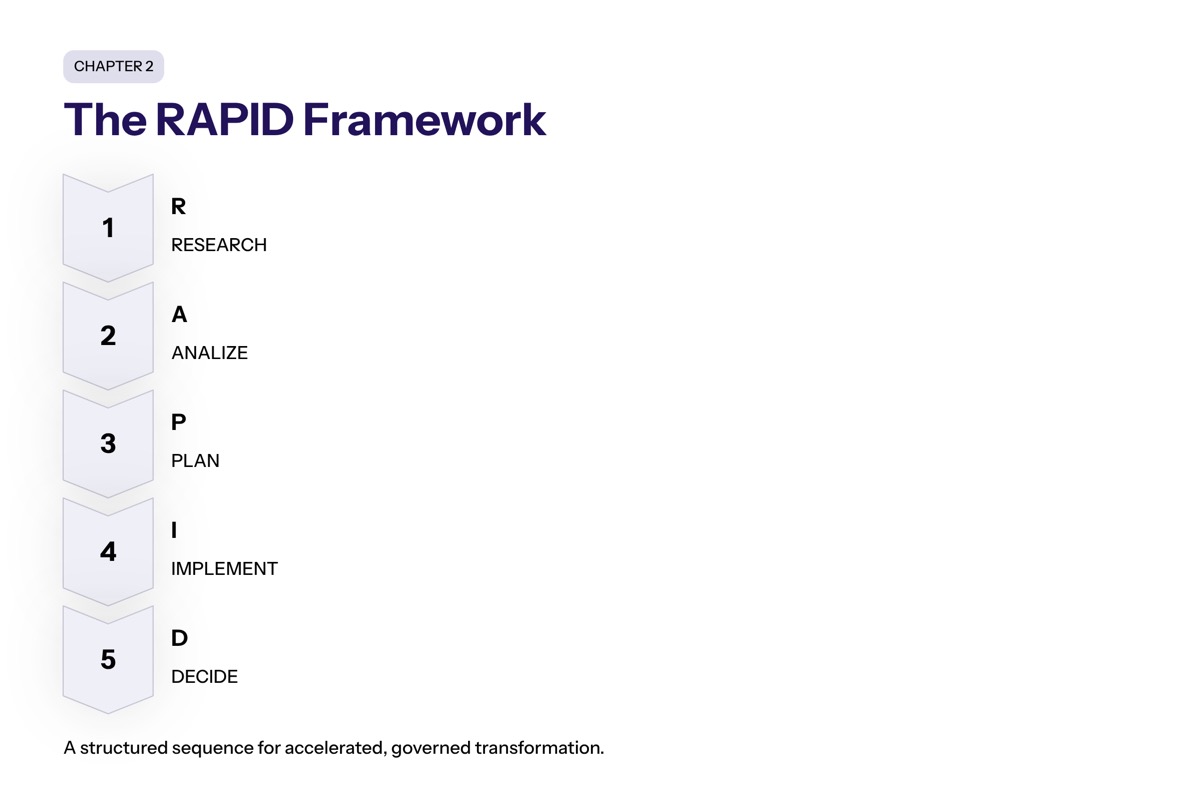
RAPID addresses those issues through Ali Davachi’s five-part framework: Research, Analyze, Plan, Implement, and Decide. The model keeps discovery, evidence, planning, execution, and decision cadence connected so urgent transformation work stays tied to measurable business outcomes.
Research Business Constraints and Opportunities
The first RAPID phase is Research. Cognativ maps where the business is constrained, where modernization can create measurable value, and which facts should guide the transformation plan. This includes operational bottlenecks, legacy system limitations, fragmented data, customer churn risks, compliance deadlines, stakeholder needs, and competitive threats from new technologies or new business models.
A strong transformation journey starts with clear leadership. Effective leadership is crucial in driving transformation, as leaders must champion the vision, formulate strategies, and mobilize the workforce towards common goals. Effective leadership is also pivotal in steering a winning transformation, as leaders must champion the vision, formulate the strategy, and mobilize the workforce toward the common goal.
At this stage, Cognativ helps internal stakeholders define the problem, the opportunity, and the value case. A structured approach to business transformation helps manage complexity, minimize risk, and prove measurable results, which includes assessing current processes, defining clear goals, and identifying high-impact quick wins.
Analyze Current State and Define Target Architecture
The second RAPID phase is Analyze. Teams examine existing systems, data flows, integration points, workflows, controls, user pain points, risks, dependencies, and value drivers. This is where business and IT leaders identify what should be reused, connected, modernized, automated, retired, or deferred.
The target architecture should be focused enough to support immediate business needs and flexible enough for continuous innovation. The Modern Business Transformation Framework emphasizes agility and flexibility in the transformation journey, allowing organizations to adapt and innovate in response to changing business needs and market dynamics.
Cloud based systems are often central to this target state. The shift to cloud-based systems in finance allows for centralized data management, reducing IT complexity and enabling real-time integrations, which enhances organizational agility and lowers total cost of ownership. In broader enterprise programs, cloud platforms also support remote and hybrid work by enabling faster provisioning, secure access, and scalable collaboration.
Plan Implementation Around Business Impact
The third RAPID phase is Plan. Cognativ sequences work around business value, implementation complexity, readiness, ownership, and risk. This prevents transformation efforts from becoming a collection of disconnected technology projects. It also helps leaders decide which digital tools, integrations, automations, or data analytics capabilities should be delivered first.
Priority should go to initiatives that support business goals and produce measurable improvement. Common priorities include workflow automation, data integration, modern digital tools for employees, improved reporting, customer-facing self-service, secure audit trails, and user experience improvements.
To measure the ROI of digital transformation, organizations should take a portfolio view rather than evaluating individual projects, as this helps to understand overall performance and build tolerance for necessary risks. Quantifying the success of digital transformation initiatives is crucial for continued investment, as traditional business value calculations may become less effective due to the ongoing and evolving nature of these efforts.
Implement with Governance and Risk Controls
The fourth RAPID phase is Implement. Governance is built in from the start because speed does not remove the need for security, compliance, testing, documentation, and operational control. It makes those disciplines more important.
Security-by-design should be embedded into development cycles. Automated testing and validation tools help maintain continuous security assessment, while secure audit trails and digital tracking help regulated organizations meet changing requirements. Implementing technology alone is insufficient; it must be tied to monitoring key performance indicators related to customer insights and business process effectiveness to accurately measure ROI.
Strong governance also depends on cross functional collaboration. Cross functional teams should include business owners, technology leads, security, compliance, operations, finance teams, and change management. Clear communication, effective communication, and consistent communication prevent delays and help maintain buy in across internal stakeholders.
Decide with Evidence and Continuous Improvement
The fifth RAPID phase is Decide. RAPID is not a one time project; it is an operating model for keeping decisions active throughout transformation. Leaders use evidence from delivery, adoption, risk, financial impact, and stakeholder feedback to decide what to continue, change, scale, or stop.
Success metrics should include time-to-value, operational efficiency gains, cost savings, process cycle-time reduction, adoption rates, customer satisfaction, employee experience, compliance readiness, and revenue impact where applicable. For finance teams, metrics may include faster close cycles, fewer manual steps, reduced reconciliation effort, improved forecast accuracy, and real-time financial visibility.
Continuous learning matters because new systems change how people work. Cultural resistance and talent gaps slow down the adoption of new digital technologies, making true transformation heavily reliant on people and processes. RAPID therefore combines digital tools with employee engagement, training, feedback loops, decision ownership, and leadership reinforcement.
Rapid Implementation Strategy and Execution
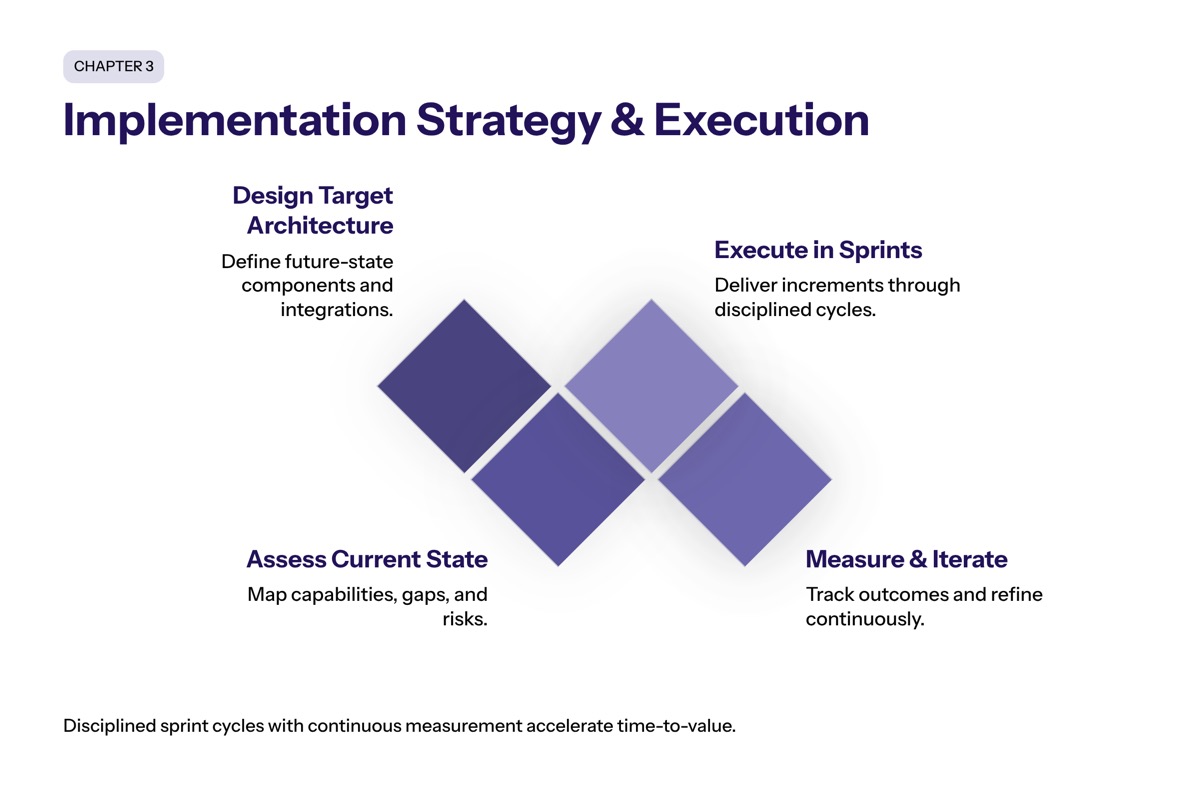
RAPID translates strategy into execution by moving teams through Research, Analyze, Plan, Implement, and Decide. The objective is not uncontrolled speed; the objective is a repeatable transformation process that helps business leaders make faster decisions, gives technology teams clearer delivery priorities, and gives transformation executives better control over risk.
12-Week Sprint Implementation Model
A 12-week sprint model is useful when compressed timelines are essential for business continuity, compliance deadlines, competitive response, or operational recovery. It creates a practical rhythm for accelerating transformation without losing visibility.
Weeks 1-3: Business assessment and architecture planning. Cognativ works with business and IT leaders to assess current processes, gather feedback from internal stakeholders, document pain points, review legacy systems, define business goals, and create a target architecture aligned to business strategy.
Weeks 4-8: Core system development and integration. Cross functional teams build minimal viable capabilities, connect data sources, implement workflow automation, integrate modern digital tools, and reduce manual data entry through robotic process automation where appropriate.
Weeks 9-10: Testing, security validation, and user training. Teams validate security controls, compliance requirements, data quality, integrations, and user workflows. Focused training supports buy in and reduces resistance to change.
Weeks 11-12: Production deployment and optimization. Teams deploy the new systems, monitor performance, measure early KPIs, provide transition support, and identify the next wave of improvements.
This model can work alongside agile delivery practices while keeping the RAPID decision model intact. Businesses must also digitally transform internal communication and project management tools to maintain productivity and attract talent in remote and hybrid work environments, so the execution model should include collaboration platforms, transparent ownership, and decision logs.
Technology Selection for Rapid Deployment
Technology choices should follow business needs, not the other way around. A successful transformation uses digital technologies that reduce friction, increase transparency, and support measurable business outcomes.
Technology option | Best rapid transformation use case | Business value | Risk control consideration |
|---|---|---|---|
Cloud computing and cloud based systems | Fast infrastructure provisioning, remote operations, global collaboration, scalable applications | Cloud computing provides the highly scalable, cost-effective infrastructure needed to launch remote operations rapidly | Requires identity controls, data governance, and cost management |
API-first integration and middleware | Connecting legacy systems to modern applications without full replacement | Enables gradual modernization and protects critical operations | Requires dependency mapping and integration monitoring |
Robotic process automation | Automating invoice matching, data entry, reconciliations, approvals, and repetitive tasks | Increases productivity and lets finance teams focus on higher-value work | Requires exception handling and process ownership |
Artificial intelligence and machine learning | Forecasting, anomaly detection, document intelligence, customer insights, and predictive workflows | Improves data driven decision making and can deliver real time insights | Requires data quality, model governance, and explainability |
Data analytics and real-time dashboards | Leadership reporting, operational monitoring, customer behavior analysis, and performance management | Enables faster decision making and rapid response to market dynamics | Requires KPI definition and trusted data sources |
Low-code and workflow platforms | Rapid prototyping, internal tools, approval flows, and process digitization | Reduces delivery time for targeted business processes | Requires architecture standards to prevent shadow IT |
The strongest technology stack favors speed without sacrificing control. For example, finance digital transformation may combine cloud-based financial systems, robotic process automation, machine learning forecasting, and data analytics dashboards to reduce manual steps, improve forecast accuracy, and provide leadership with real time insights.
Risk Mitigation During Accelerated Implementation
Compressed timelines amplify risk, so risk mitigation must be part of the implementation plan rather than a post-launch review. Parallel system operation helps ensure business continuity while new systems are validated against existing workflows.
Incremental data migration with validation checkpoints reduces the risk of data loss, poor data quality, and failed reporting. This is especially important when finance teams, operations teams, or customer service teams depend on accurate information for real-time decision making.
Change management should be integrated into development cycles. Resistance to change is often rooted in fear of the unknown or perceived threats to job roles, making effective communication and involvement of employees crucial for successful transformation. User training, role-specific support, clear communication, and continuous feedback help employees build new skills and adopt new digital tools with confidence.
Common Challenges and Solutions in Rapid Transformation
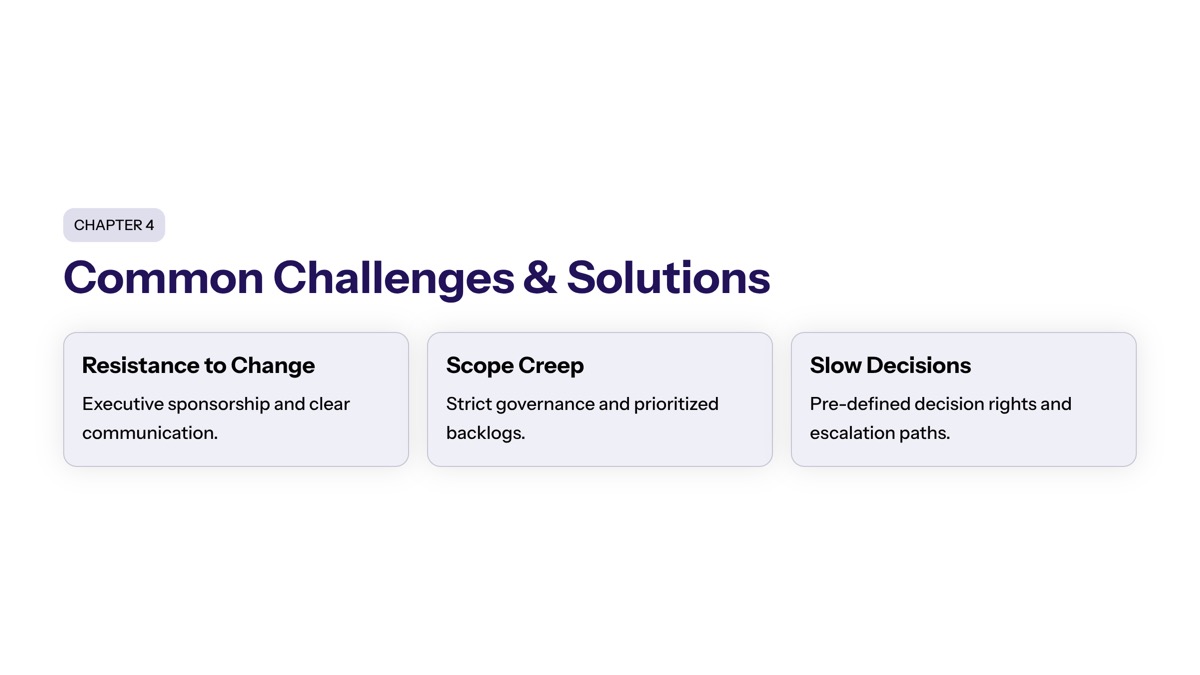
Compressed timelines make common challenges more visible. Legacy complexity, limited resources, unclear ownership, cultural resistance, cybersecurity threats, and insufficient training can all slow or derail rapid transformation unless leaders manage them deliberately.
Legacy System Integration Under Time Pressure
Legacy systems often contain critical business logic, sensitive data, and undocumented dependencies. Replacing every outdated system at once is usually too risky for rapid transformation.
The practical solution is an API-first integration strategy that enables gradual modernization without complete system replacement. Middleware can connect legacy systems to modern applications, allowing the organization to automate workflows, deliver real time insights, and improve customer experience while preserving business continuity. This approach also helps reduce the IT budget pressure caused by maintaining outdated technology.
Resource Allocation and Team Coordination
Rapid transformation requires dedicated cross functional teams with the authority to make decisions. Business stakeholders, technology leads, security specialists, compliance owners, finance professionals, operations leaders, and change management teams should work from one roadmap.
Daily standup meetings and weekly steering committee reviews support rapid decision-making. A lack of clear vision and direction can derail transformation efforts, highlighting the need for a detailed roadmap that outlines objectives, strategies, and expected outcomes. Limited resources, including financial and human capital, can hinder transformation efforts, making it essential to secure adequate support and invest in training and upskilling.
Security and Compliance in Accelerated Timelines
Security and compliance cannot be deferred in rapid digital transformation. Strict global data privacy laws, cybersecurity threats, and changing regulations make secure design a core business requirement.
A security-by-design approach integrates compliance requirements into development from day one. Automated testing, validation tools, access controls, audit logs, and secure deployment pipelines help teams move quickly without increasing exposure. For regulated industries, secure automated audit trails and digital tracking are essential to both compliance and operational confidence.
User Adoption and Change Management
Technology adoption succeeds when employees see how new tools improve their daily work. Cultural barriers can impede transformation, necessitating a shift towards a culture of openness, innovation, and adaptability to foster employee buy-in and support.
Early user involvement in design and testing helps ensure the solution meets real workflow needs. Focused training programs, transition support, employee engagement, continuous learning, and gather feedback sessions help reduce fear and increase adoption. Effective communication from the transformation leader also helps employees understand why change is happening, how roles may evolve, and how new skills will support ongoing success.
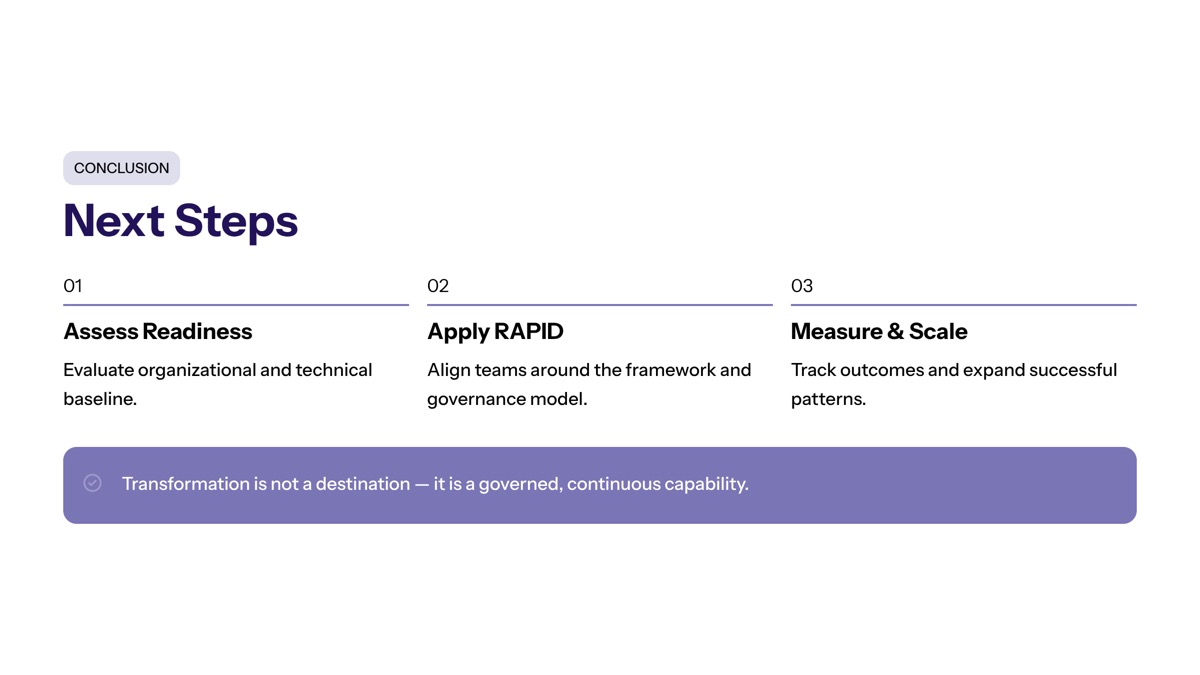
Conclusion and Next Steps
Rapid digital transformation helps organizations respond to market dynamics, customer demands, regulatory pressure, and operational bottlenecks without waiting years for value. RAPID gives leaders an operating model for faster decision-making, clearer implementation priorities, stronger governance, and reduced delivery risk during urgent business modernization.
To move from urgency to execution:
Assess transformation urgency. Identify where legacy systems, manual data entry, outdated processes, compliance gaps, or slow decision making are creating measurable business risk.
Define high-impact modernization opportunities. Start with business processes that can improve operational efficiency, customer experience, employee experience, reporting transparency, or cost savings within a short delivery window.
Evaluate execution capacity. Determine whether internal teams have the time, skills, governance, and cross functional collaboration required for rapid transformation.
Establish measurable success criteria. Use a portfolio view of ROI, monitor customer insights and process effectiveness, and track adoption, cost savings, time-to-value, and overall performance.
Use RAPID as the execution model. Research constraints, analyze the current state, plan around business impact, implement with governance, and decide based on evidence.
If your organization needs faster transformation decisions and stronger execution control, discuss a RAPID transformation assessment with Cognativ’s experts through the RAPID transformation service page.
Related areas to explore include AI-driven automation implementation, legacy system modernization strategies, finance digital transformation, and secure platform development for regulated industries.