Digital Transformation Without Clarity: Why Tools Don’t Fix Broken Systems?
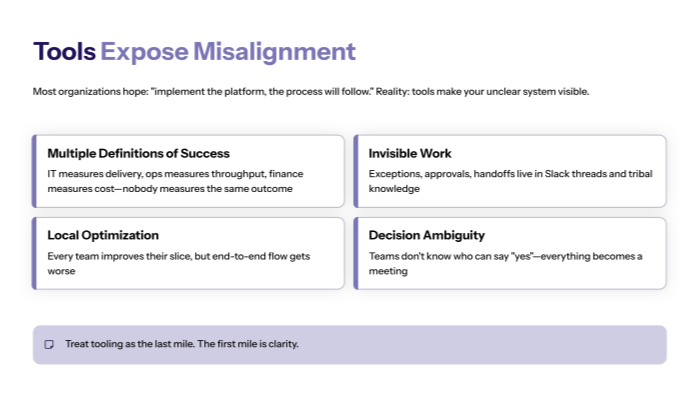
Digital transformation doesn’t fail because teams “picked the wrong software.” It fails because the organization never established clarity: what work actually happens, where value is created, who owns decisions, and what “better” means in measurable terms. When clarity is missing, new tools simply automate confusion—faster meetings, faster handoffs, faster rework.
Key Takeaways
- Tools amplify the operating model you already have—good or bad.
- Clarity is a system outcome: shared baseline, decision rights, and metrics.
- A RAPID-style approach starts with a brutally honest “audit” of current reality, then turns that reality into an execution plan.

1) Tools Don’t Create Alignment—They Expose Misalignment
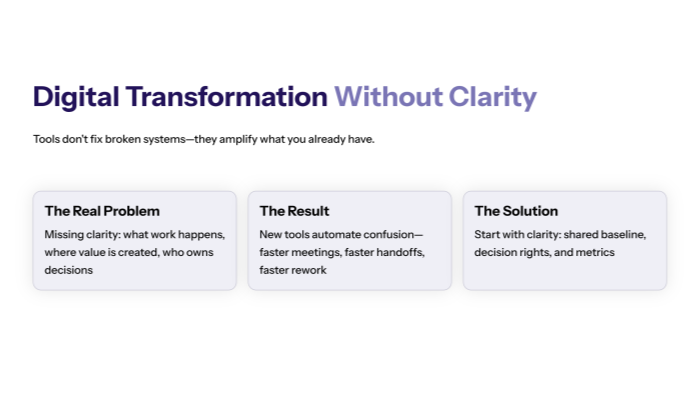
Most organizations buy tools with an implicit hope: “If we implement the platform, the process will follow.” In practice, the opposite happens. Tools make your existing system visible. If your system is unclear, the tool becomes a high-speed mirror.
Here’s what “unclear” looks like inside a transformation:
- Multiple definitions of success: IT measures delivery, ops measures throughput, finance measures cost, leadership measures “progress.” Nobody measures the same outcome.
- Invisible work: the actual work that makes the business run—exceptions, approvals, handoffs, escalations—lives in Slack threads, inboxes, and tribal knowledge.
- Local optimization: every team improves their slice, but the end-to-end flow gets worse (more queues, more approvals, more status reporting).
- Decision ambiguity: teams don’t know who can say “yes,” so everything becomes a meeting—or worse, a “soft yes” that collapses later.
A new tool doesn’t fix any of this. It formalizes it. Work gets documented—but not standardized. Dashboards get built—but not trusted. Automation gets shipped—but triggers more edge cases and downstream firefighting.
If you want digital transformation to stick, treat tooling as the last mile. The first mile is clarity: what is the system, where is it failing, and what must change first.
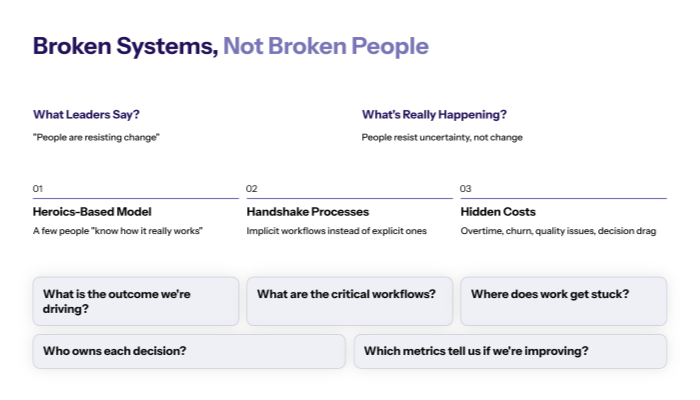
2) The Root Problem: Broken Systems, Not Broken People
When leaders say “people are resisting change,” they’re often describing a systems issue:
- People resist uncertainty, not change.
- Teams avoid accountability when decision rights are unclear.
- Execution slows down when the system creates rework and approval loops.
In RAPID terms, transformation begins with an audit—a brutally honest assessment of current reality before you try to optimize it. That means confronting uncomfortable truths:
- The operating model may be built around heroics (a few people who “know how it really works”).
- The org may rely on handshake processes rather than explicit workflows.
- The business may be “doing fine” only because it’s absorbing waste as hidden cost: overtime, churn, quality issues, opportunity cost, and decision drag.
This is why tool-first transformations disappoint. Tools assume a baseline: defined workflows, consistent definitions, stable data, clear ownership. If your baseline is “it depends,” your tool becomes an expensive place to store exceptions.
Clarity is not a document. It’s the shared ability to answer:
- What is the outcome we’re driving?
- What are the critical workflows that produce it?
- Where does work get stuck?
- Who owns each decision—and what are the guardrails?
- Which metrics tell us if the system is improving?
3) How to Create Clarity Fast: Audit the System, Not the Org Chart
If you want clarity without a 6-month program, don’t start with org structure. Start with the work.
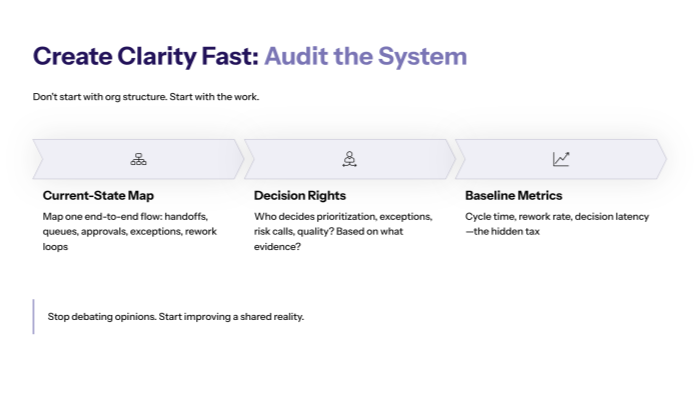
A practical clarity sprint focuses on three artifacts:
1) A “current-state” map of one value stream
Pick one end-to-end flow that matters (quote-to-cash, incident-to-resolution, onboarding-to-activation, claim-to-payment). Map what actually happens—not what the policy says. Your goal is to see:
- Handoffs and queues
- Approval points
- Exceptions and rework loops
- Systems used (and where people bypass them)
2) A decision-rights snapshot
List the decisions that slow the flow:
- Prioritization (what gets done next)
- Exceptions (what happens when the standard path fails)
- Risk calls (security, compliance, finance)
- Quality calls (definition of done, acceptance criteria)
Then ask: who decides, based on what evidence, and within what timeframe? If the answer is “we escalate,” you’ve found decision latency.
3) A baseline metrics triangle
Forget vanity metrics. Start with three that reveal system health:
- Cycle time: how long work takes end-to-end (including waiting)
- Rework: how often work bounces back, gets reopened, or needs correction
- Decision latency: how long approvals/escalations take (the hidden tax)
These three metrics turn “we feel slow” into measurable constraints you can attack.
This is the clarity advantage: you stop debating opinions and start improving a shared reality.
4) Why “Good Data” Beats “More Data” in Transformation
When transformations stall, leadership often responds by asking for more reporting, more dashboards, more fields, more governance. That usually increases friction without improving trust.
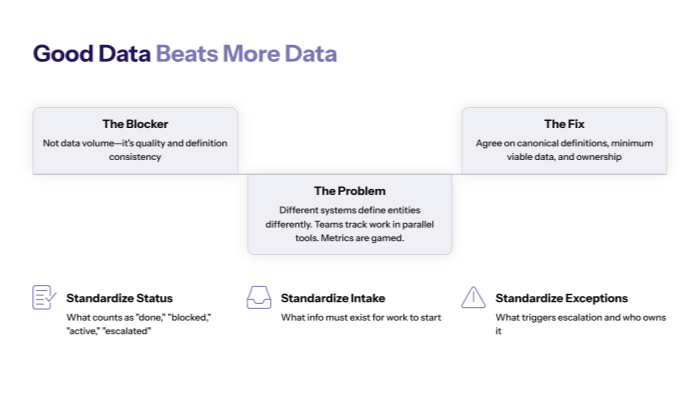
The real blocker is rarely data volume—it’s data quality and definition consistency:
- Different systems define the same entity differently (customer, account, project, incident).
- Teams track work in parallel tools because the “system of record” isn’t usable.
- Metrics are gamed because incentives don’t match outcomes.
- Dashboards are questioned because nobody trusts the inputs.
Clarity means agreeing on:
- Canonical definitions (what counts as “done,” “blocked,” “active,” “escalated”)
- Minimum viable data required to run the operating model
- Ownership for data and decisions (who is accountable when the metric is wrong)
A practical approach is to standardize just enough to reduce chaos without killing flexibility:
- Standardize status states and “definition of done”
- Standardize intake (what info must exist for work to start)
- Standardize exception handling (what triggers escalation and who owns it)
- Keep flexibility in how teams execute within guardrails
Transformation isn’t “more structure.” It’s the right structure—applied where the system is leaking value.
5) The RAPID Way to Start: 10 Days to a Baseline You Can Trust
If you want a concrete starting point, run a 10-day clarity sprint aligned to RAPID principles (audit first, then move through research → analyze → plan → implement → decide).
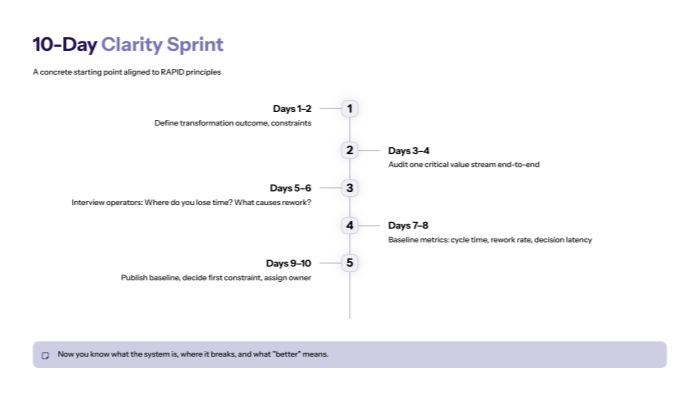
Days 1–2: Define the transformation outcome
- One outcome statement (business result, not “implement X”)
- A short list of constraints (risk, compliance, capacity)
Days 3–4: Audit one critical value stream
- Map the real workflow end-to-end
- Capture top friction points: queues, approvals, rework loops
Days 5–6: Stakeholder interviews that reveal the real work
Ask operators and managers:
- Where do you lose time?
- What causes rework?
- What decisions slow you down?
- What do you do outside the system to make it work?
Days 7–8: Baseline the metrics that matter
- Cycle time (by stage if possible)
- Rework rate (reopens, returns, defect loops)
- Decision latency (top 3 approval points)
Days 9–10: Publish the baseline and decide the first constraint
- One-page baseline summary
- One bottleneck to attack first
- Clear owner + decision rights + weekly checkpoint cadence
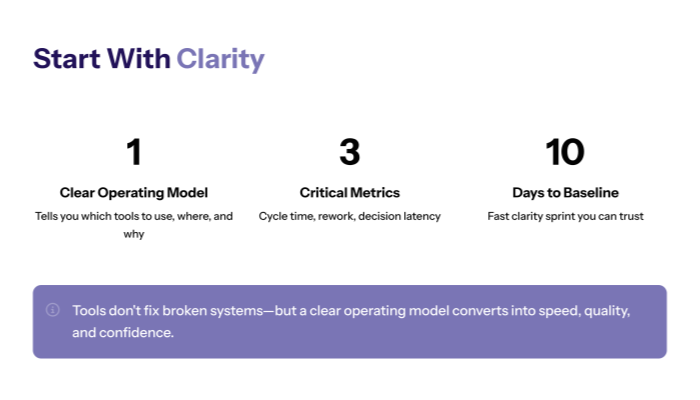
This is the moment where tools become useful—because now you know what the system is, where it breaks, and what “better” means.
If you want digital transformation that actually converts into speed, quality, and confidence, start with clarity. Tools don’t fix broken systems—but a clear operating model tells you exactly which tools to use, where, and why.