Generative AI Implementation Services: From Use Case to Production Workflow
Generative AI implementation services help enterprises assess, design, integrate, test, govern, and support generative AI workflows. The goal is to move from isolated experiments into production systems that connect data, people, approvals, and measurable business outcomes.
CTOs, AI program owners, operations leaders, and enterprise buyers can use this article to evaluate implementation support for generative AI. It covers service scope, workflow use cases, NLP and conversational AI implementation, contract workflow automation with generative AI, architecture, governance, partner evaluation, and implementation roadmap.
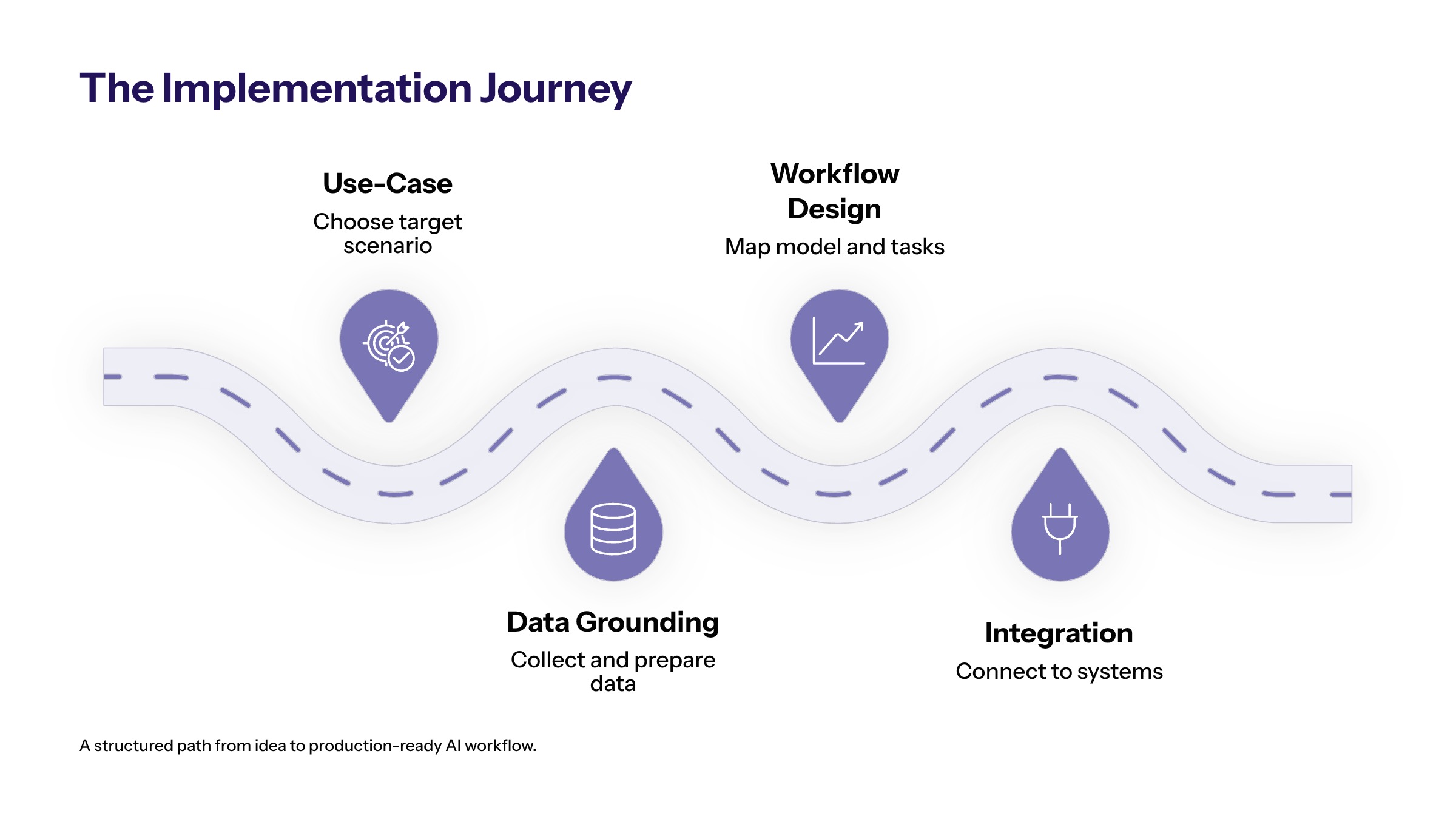
Generative AI implementation is not only prompt engineering. Production generative AI requires use-case selection, data grounding, system integration, workflow design, human review, testing, adoption, monitoring, and secure deployment. Without those elements, a demo may never become an operating capability.
The stronger evaluation path is to define the business use case, assess data readiness, review security requirements, and choose an implementation model that can move from pilot to governed production.
What Generative AI Delivery Services Include
Generative AI delivery services usually begin with assessment. Teams identify business problems, evaluate workflows, review data readiness, and decide where generative AI can produce value. The assessment should clarify whether the use case needs summarization, drafting, question answering, document review, conversational support, or workflow automation.
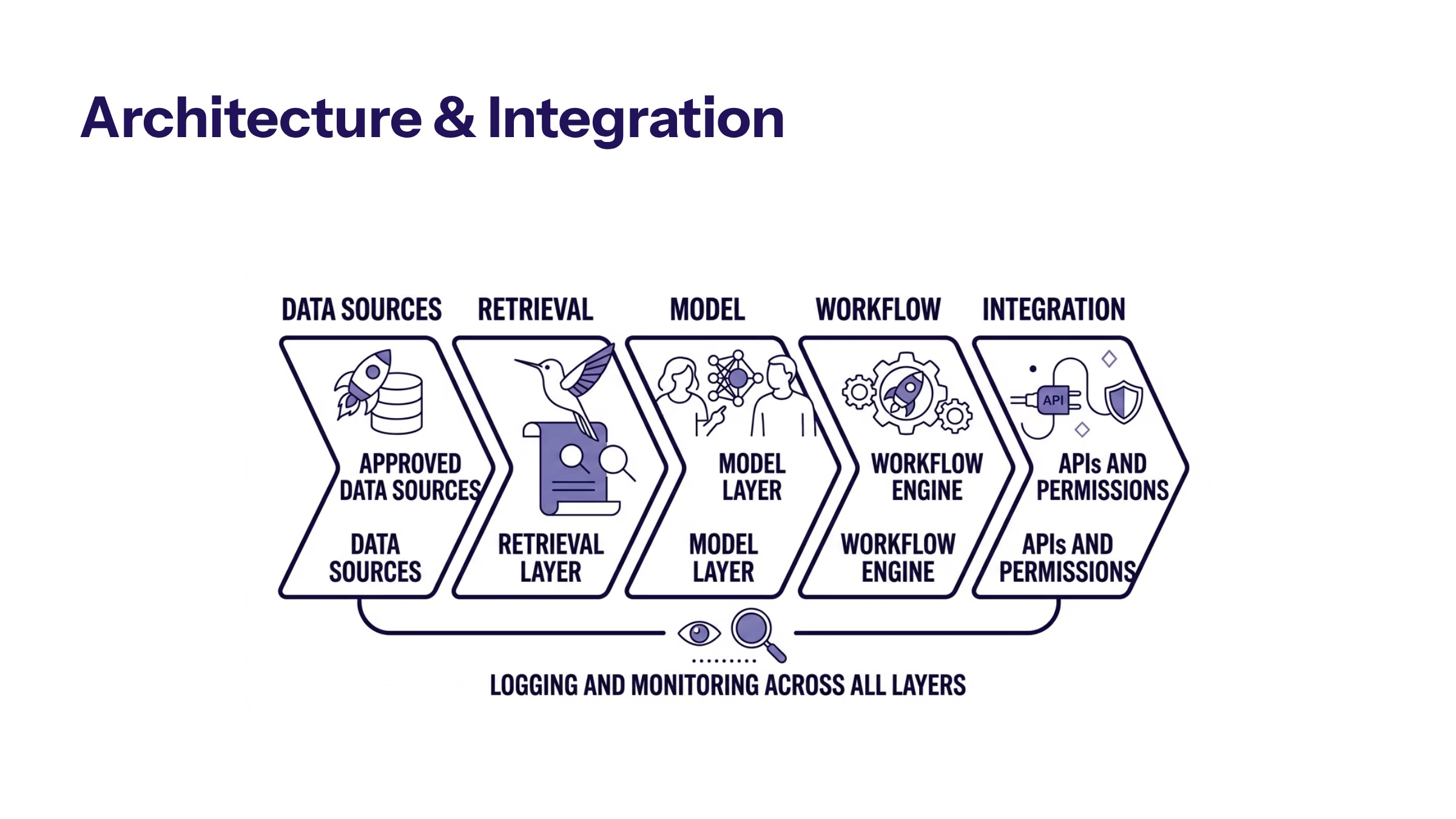
The next layer is architecture. Generative AI must connect to approved data sources, applications, identity systems, workflow tools, and reporting. It also needs guardrails, logging, human review, and monitoring. Implementation services should define this operating system around the model.
Delivery includes pilot design, integration, testing, user training, deployment, and post-launch support. In enterprise settings, implementation support should also address ownership: who maintains prompts, data sources, integrations, review rules, and performance metrics after launch.
Generative AI Workflow Automation Use Cases
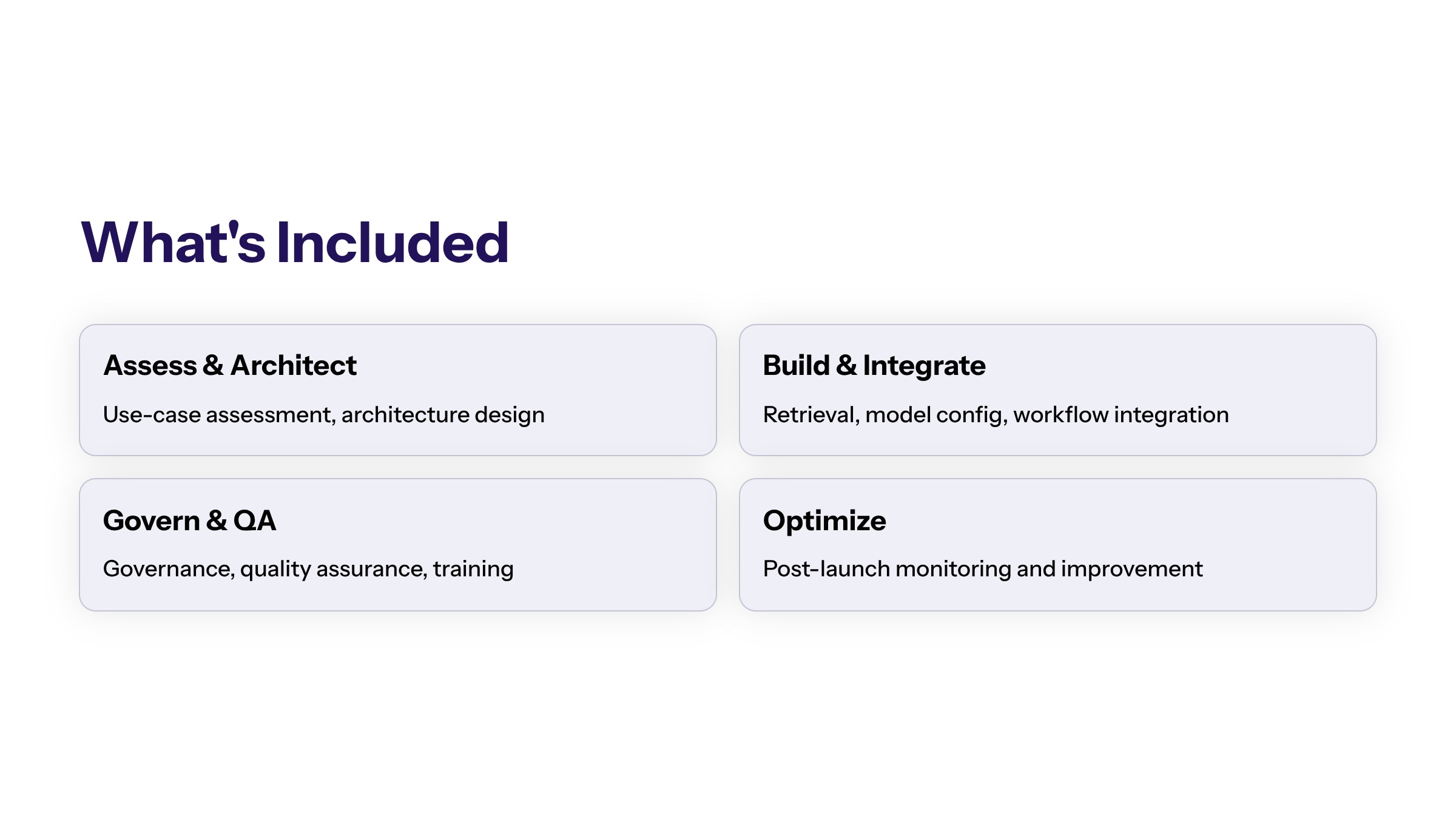
Generative AI workflow automation is useful when teams repeatedly interpret language, summarize information, prepare drafts, or route work based on documents and messages. Common workflow patterns include support summaries, internal knowledge assistance, contract review support, proposal drafting, report notes, policy lookup, and operations status summaries.
The best use cases are bounded. They have defined inputs, approved data sources, review points, and measurable outcomes. A broad goal like "use generative AI for operations" is too vague. A bounded workflow like "summarize support cases and recommend escalation category" is easier to test and govern.
Use Case | Generative AI Role | Workflow Need | Control |
|---|---|---|---|
Support summaries | Summarize tickets and account history. | CRM and ticketing integration. | Human review before customer-facing response. |
Contract review support | Extract clauses and draft review notes. | Document repository and approval workflow. | Business or legal owner review. |
Knowledge assistance | Answer questions from approved sources. | Retrieval layer and source governance. | Source citation and feedback loop. |
Reporting notes | Draft summaries from structured inputs. | Analytics and reporting access. | Reviewer confirms figures and context. |
NLP and Conversational AI Implementation Services
NLP and conversational AI implementation services are part of the broader generative AI implementation category. Natural language processing can help classify text, extract information, identify intent, summarize documents, and support conversational workflows. Conversational AI can help users interact with systems through chat or voice interfaces.
Conversational AI is one interface or workflow pattern. Generative AI delivery also includes architecture, integrations, governance, testing, and adoption for many non-conversational workflows.
For example, an internal knowledge assistant may use conversational interaction, but implementation still requires approved sources, retrieval design, access control, logging, feedback, and ownership. A contract workflow may not be conversational at all, but it can still use generative AI for extraction and summarization.
Teams evaluating NLP implementation support should compare service capabilities rather than relying on generic provider rankings. Useful criteria include data readiness, integration depth, security controls, domain knowledge, testing approach, and post-launch ownership.
Generative AI for Contract Workflow Automation
Contract workflow automation with generative AI is a strong implementation pattern because contracts contain language-heavy information that teams repeatedly review. Generative AI can help summarize obligations, extract fields, flag missing sections, compare terms against a checklist, and draft review notes.
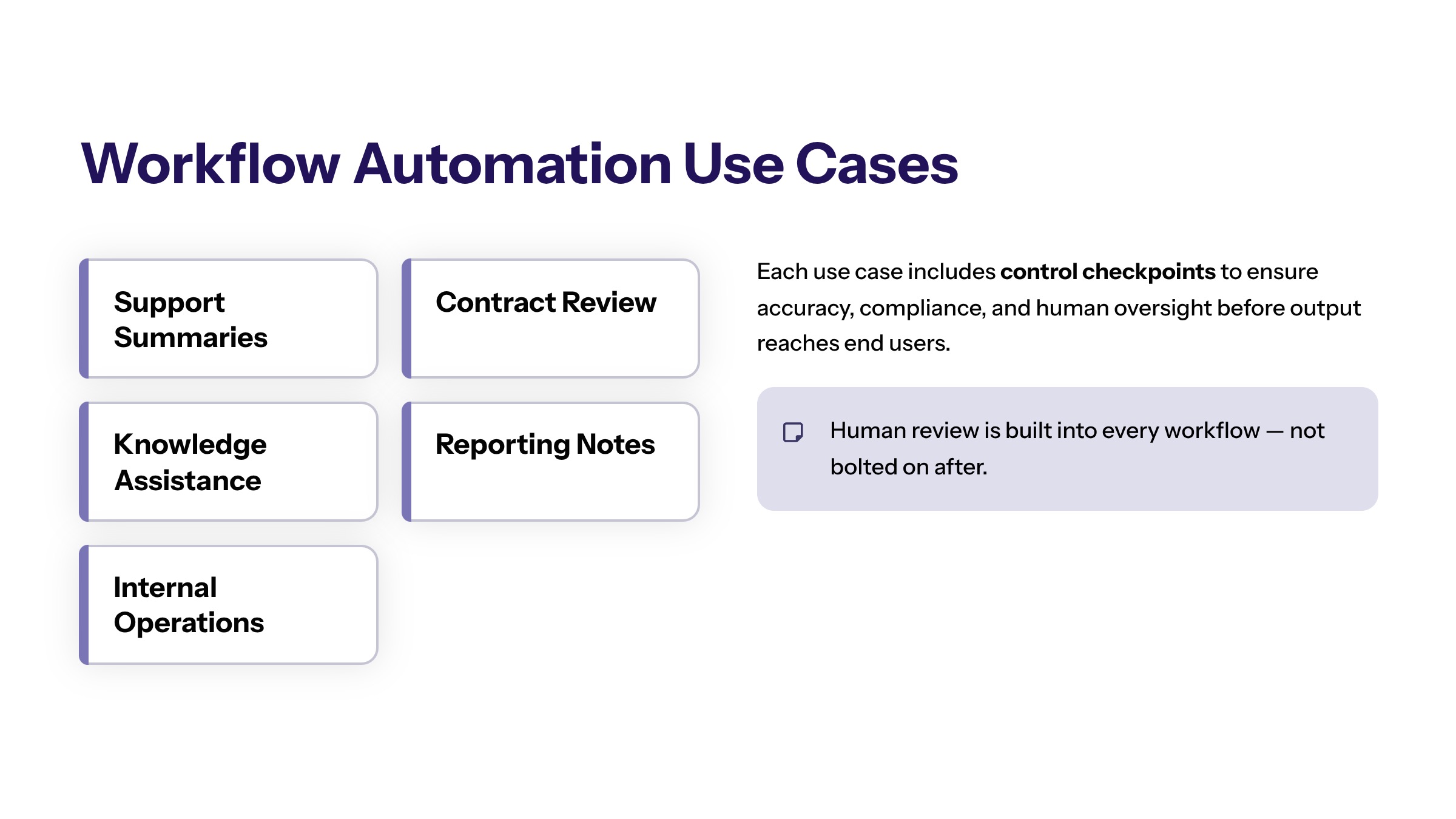
The workflow should include human review. Generative AI can support review, but it should not be positioned as final legal approval. The business should define which outputs are draft-only, which require review, and which actions are prohibited.
A practical implementation starts with intake. A contract enters a document repository. The AI system classifies the document, extracts key information, retrieves approved playbook guidance, prepares a summary, and routes the document to the right reviewer. The workflow logs the output, reviewer decision, and final status.
This pattern depends on AI-first architecture. The system needs document access, retrieval, permissions, workflow state, review interface, audit logging, and monitoring. A model alone does not create a governed contract workflow.
Architecture, Data, and Integration Requirements
Generative AI delivery work should define the architecture before production rollout. Core components may include approved data sources, retrieval layer, model orchestration, workflow engine, APIs, identity and permission controls, logs, monitoring, and user interfaces.
Data grounding is essential. Generative AI outputs should be based on approved sources where possible, especially in enterprise workflows. If the system answers from internal knowledge, the team should know which sources are included, who owns them, and how they are updated.
Integration is where many pilots stall. A generative AI assistant that cannot connect to the systems where work happens may remain a side tool. Production workflows need connections to CRM, ERP, ticketing, document management, analytics, identity, or custom applications depending on the use case.
Architecture should also define feedback loops. Users need a way to flag bad outputs, correct summaries, and report missing context. Those signals help teams improve prompts, sources, workflows, and controls after launch.
Governance and Review for Generative AI Workflows
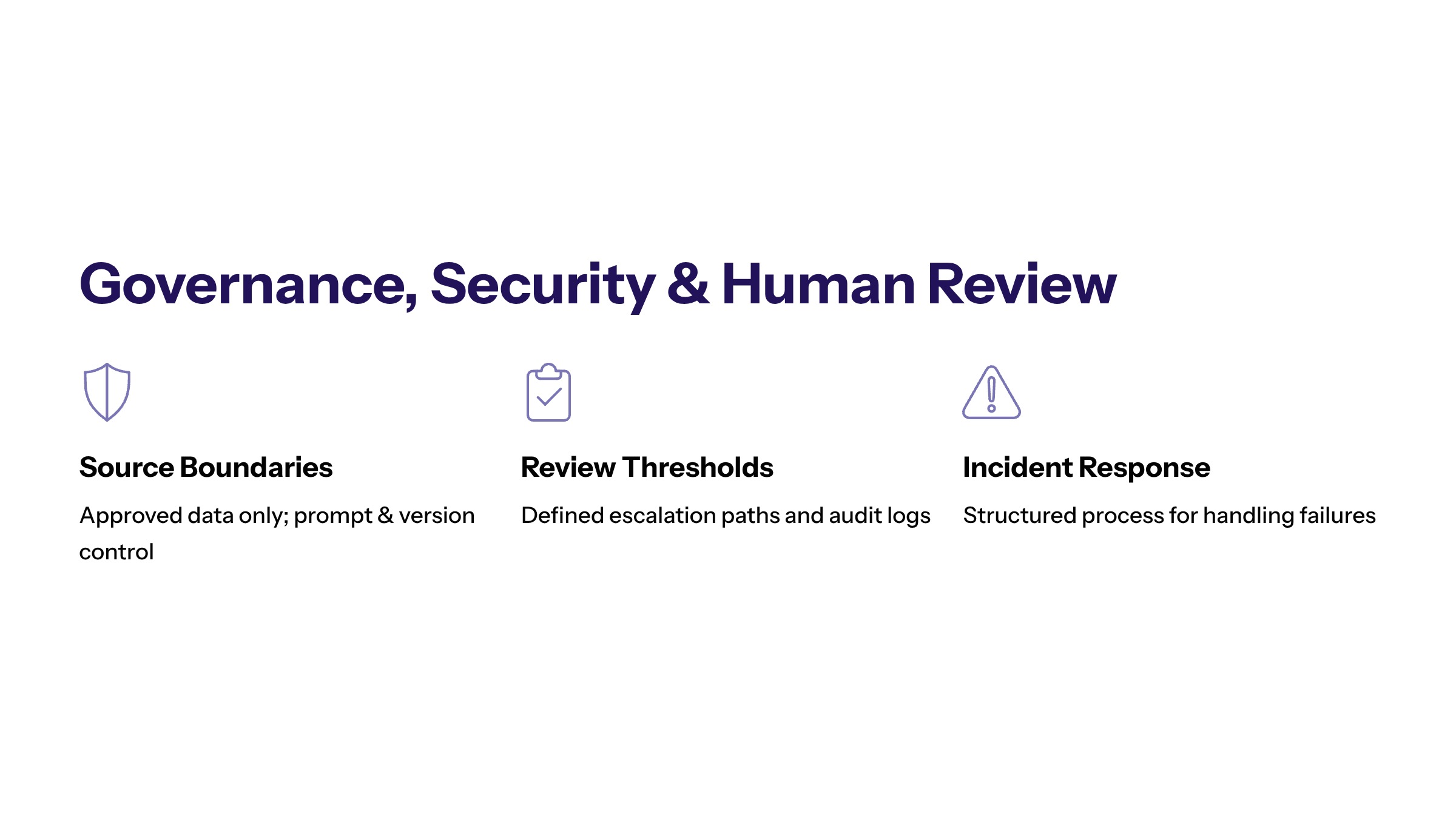
Secure development for generative AI implementation includes access control, data boundaries, human review, audit trails, monitoring, input handling, and output-quality checks. Governance should be designed into the workflow rather than documented separately.
Human review should match risk. Drafting an internal note may need lighter review than generating customer-facing responses, contract interpretations, or sensitive operational recommendations. The workflow should define review thresholds and escalation paths.
Generative AI also needs output-quality controls. Teams should test normal cases, edge cases, missing data, ambiguous inputs, source conflicts, and low-confidence outputs. A workflow is not ready for scale until the team understands how it behaves outside ideal demos.
Data handling should be explicit. Teams should know what data enters the system, where outputs are stored, who can access them, and whether data is used outside the organization's approved context. These questions should be resolved before production use.
How to Evaluate a Generative AI Implementation Partner
Generative AI implementation partners should be evaluated by their ability to connect strategy, architecture, workflow design, governance, integration, testing, and support. A partner that only builds a demo may not be enough for enterprise implementation.
Evaluation criteria should include use-case assessment, data readiness, architecture design, secure integration, workflow implementation, user adoption, monitoring, and support. The partner should be able to explain how the AI system will fit into existing operations and who owns it after launch.
Buyers should also ask about portability and control. Can workflows, prompts, logs, and data mappings be exported? Can the organization change models or platforms later? Can the implementation be maintained by internal teams or another partner if needed?
The more useful approach is to evaluate service capability and fit: whether the team can design the workflow, connect the right systems, govern outputs, support adoption, and improve the implementation after launch.
Generative AI Implementation Roadmap
A practical roadmap starts with a workflow, not a model announcement. Choose one use case where generative AI can support a measurable business process and where controls can be clearly defined.
Assess use cases. Identify workflows with language-heavy work, repeated review, and measurable friction.
Map data and systems. Define approved sources, applications, users, and integration paths.
Design the workflow. Decide where AI drafts, summarizes, retrieves, routes, or recommends.
Set controls. Define permissions, human review, logs, escalation, and output-quality checks.
Pilot and test. Test real cases, edge cases, missing data, and user feedback.
Scale with ownership. Assign support, monitoring, change control, and improvement cadence.
Common Implementation Mistakes
A common generative AI mistake is treating a demo as implementation. A demo can prove that a model can produce an output, but implementation requires workflow fit, data access, user review, integration, monitoring, and support. Without those layers, the business may get novelty without operational value.
The second mistake is selecting use cases without ownership. If no business owner is responsible for the workflow outcome, the implementation team may build a system that no one maintains. Ownership should be assigned before the pilot begins.
The third mistake is ignoring source quality. Generative AI systems that answer from internal knowledge need approved, current, and maintained sources. If source ownership is weak, output quality will decline over time.
The fourth mistake is scaling before testing edge cases. Production workflows should be tested against missing information, conflicting sources, unusual requests, and user overrides. A workflow that handles only clean examples is not ready for enterprise use.
Post-Launch Operating Model for Generative AI
Generative AI workflows need maintenance. Teams should define who owns prompts, sources, workflows, permissions, integrations, testing, user feedback, and release control. This prevents the system from becoming an unowned dependency after launch.
The operating model should include monitoring and review. Teams should track usage, output quality, corrections, exceptions, unresolved issues, and business outcomes. The review cadence should be more frequent during pilot and early production, then stabilize once the workflow is reliable.
Support should also cover user training. People need to know what the system can do, what it cannot do, when to trust outputs, and how to escalate concerns. Adoption improves when users understand the workflow and the boundaries.
Readiness Checklist for Generative AI Implementation
Before implementation starts, teams should confirm that the use case is bounded, the data sources are approved, the output has a human review model, and the workflow has a business owner. They should also confirm that the system can produce logs and that users have a feedback path when outputs are incomplete or wrong.
Readiness also includes adoption planning. A generative AI workflow may be technically sound and still fail if employees do not understand how to use it. Training should explain the workflow purpose, source limitations, review expectations, and escalation process. That practical guidance helps turn implementation into a reliable operating capability.
Scale Gates for Generative AI Implementation
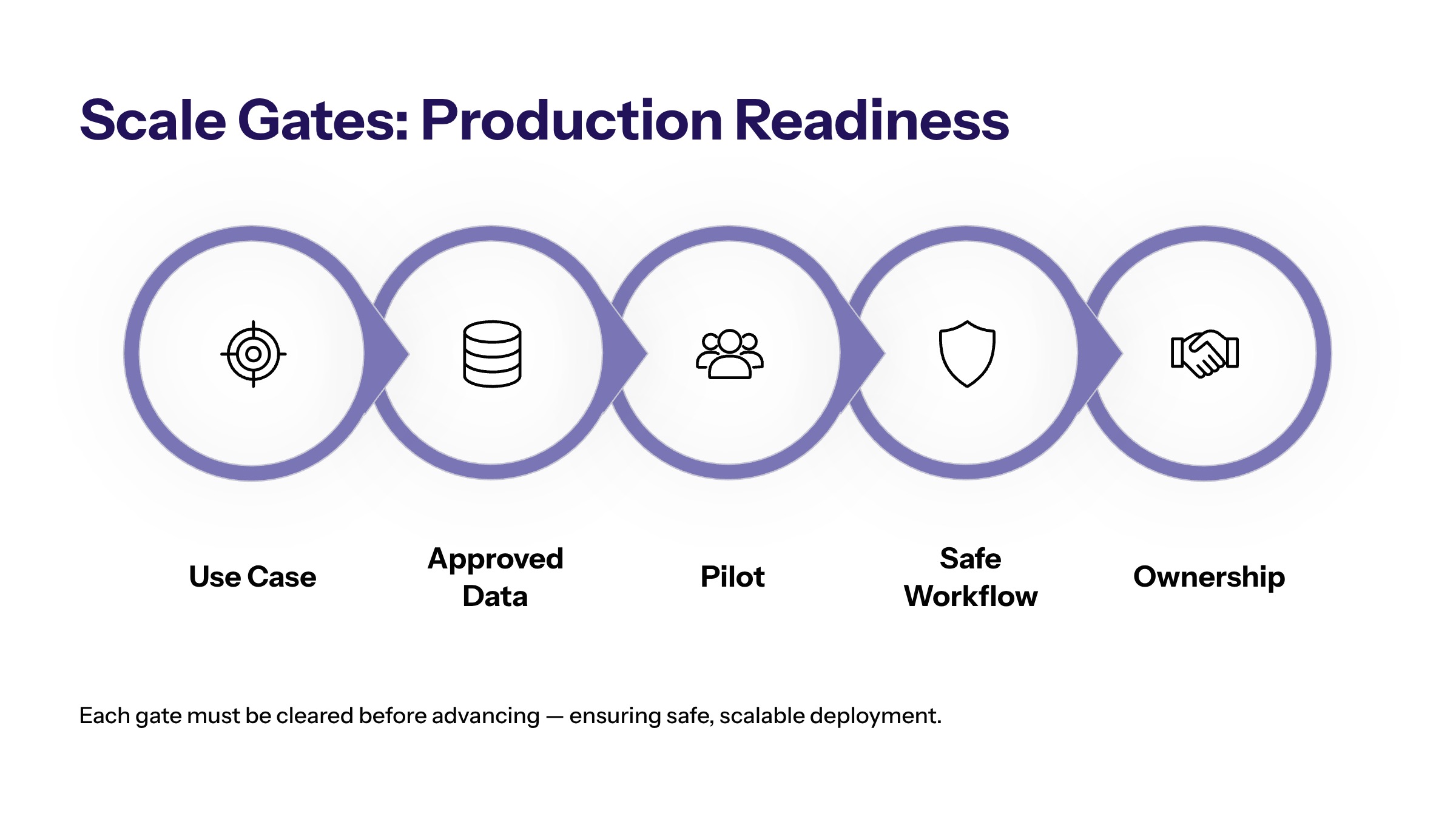
Generative AI implementation should move through decision gates. The first gate confirms that the use case is real and measurable. The second confirms that the pilot works with approved data and real users. The third confirms that the workflow is safe enough for production support.
Each gate should use evidence. Useful signals include user adoption, correction rate, source quality, unresolved exceptions, review time, workflow impact, and audit completeness. If the evidence is weak, the team should revise the workflow instead of scaling a fragile implementation.
The final gate should confirm ownership. A generative AI workflow is not production-ready until someone owns sources, prompts, integrations, permissions, support, and improvement after launch. Without that owner, the workflow can drift as source content changes, users create workarounds, and unresolved exceptions become a quiet operational burden.
How to Move Generative AI Into Production
Generative AI implementation services are most valuable when they connect AI capabilities to real workflows, governed data, secure architecture, and measurable outcomes. Start with one bounded use case and build the controls required for production trust.
The goal is not to create another AI demo. The goal is to create a workflow that people can use, review, improve, and own over time.
Frequently Asked Questions About Generative AI Implementation Services: From Use Case to Production Workflow
No. Prompt design is one component. Production implementation also requires use-case selection, data grounding, integrations, governance, testing, adoption, and support. For related reading, see generative AI development.
Conversational AI is one use case. Generative AI implementation can also support document review, contract workflows, knowledge assistance, reporting notes, and internal operations. For related reading, see AI and ML development.
No. High-risk outputs should include human review and clear escalation. Many enterprise workflows start with draft-only or recommendation-only AI support. For related reading, see AI implementation planning.
A production ready implementation has clear use cases, approved data, tested outputs, security controls, user review, monitoring, and ownership. A prototype alone is not production readiness. For related reading, see AI automation services.
Teams should choose a use case with visible friction, accessible data, manageable risk, and measurable improvement. The best first use case is specific enough to test. For related reading, see enterprise AI services.
Teams should monitor output quality, usage, exceptions, user edits, policy compliance, data access, cost, and workflow outcomes. Monitoring should connect technical signals to business value. For related reading, see AI consulting services.