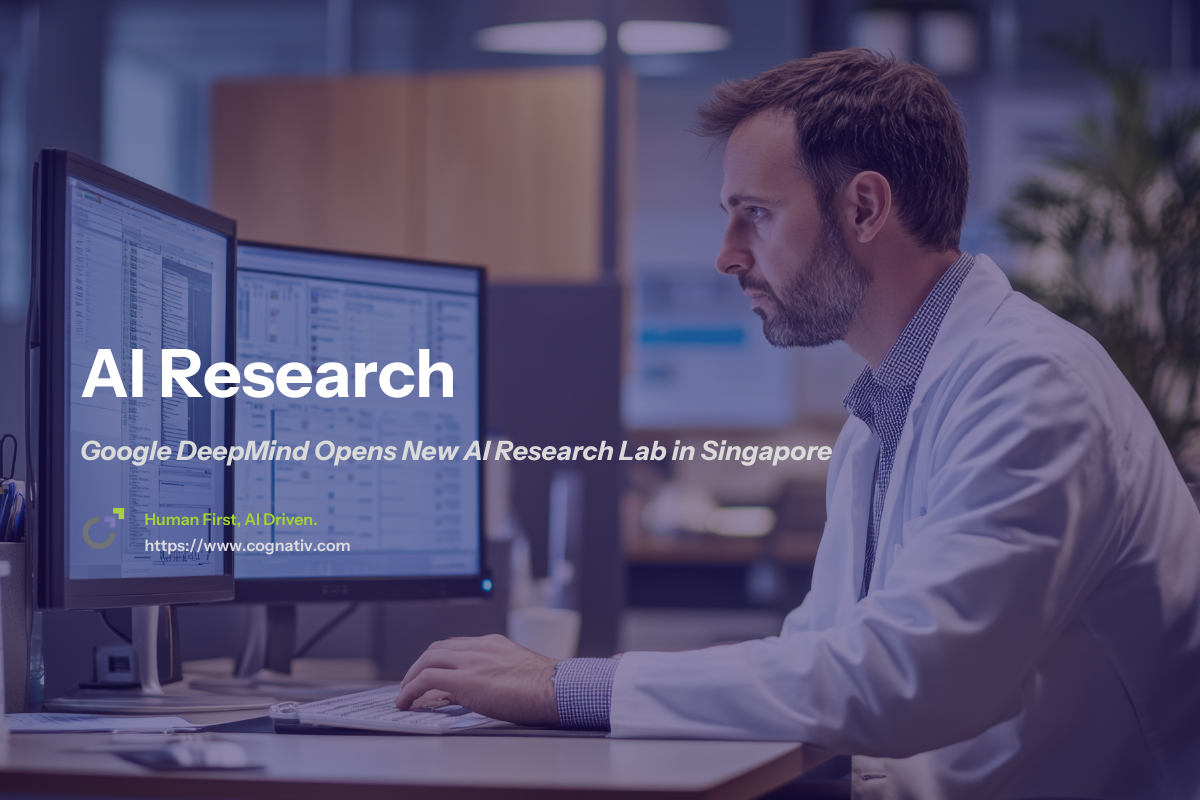
Google DeepMind Opens New AI Research Lab in Singapore
Google DeepMind has officially opened a dedicated AI research lab in Singapore, marking one of the company’s most strategic global expansions since its early scaling in London and California.
The new hub positions Singapore as a central node in DeepMind’s worldwide research network and strengthens the city-state’s ambition to become a leading center for advanced AI science, compute infrastructure and regional talent development.
For executives and policymakers observing this shift, the move signals a future in which frontier AI development becomes structurally international, multi-polar and deeply embedded in regional scientific ecosystems.
Key Takeaways
- DeepMind’s Singapore lab strengthens the city-state’s role as a global hub for frontier AI, compute strategy and advanced scientific research.
- The expansion reflects intensifying demand for distributed AI research centers capable of operating near emerging Asian talent markets and regulatory frameworks.
- Singapore’s clear governance, compute investments and strong academic ecosystem make it a strategic choice, accelerating regional AI leadership and cross-border collaboration.

DeepMind’s Global Strategy and Why Singapore Matters
Google DeepMind has historically expanded only in locations that amplify long-term research capability rather than market access. Singapore fits that pattern with exceptional precision. It offers a mix of technical education, geopolitical neutrality, resource planning and regulatory clarity rarely matched in other regions.
Singapore’s national AI strategy, updated continuously since 2018, has consistently emphasized compute access, safety governance, and integration of AI into scientific discovery. DeepMind’s arrival is not simply a tech-ecosystem win—it is a validation of Singapore’s decade-long policy design aimed at attracting elite research organisations.
This move also aligns with a broader AI-first strategy trend in global enterprises and governments. Organisations that treat AI as foundational, rather than as an add-on, are restructuring their infrastructure, governance and operating models accordingly. For leaders designing similar roadmaps, Cognativ’s guidance on AI-first strategy and how to avoid common pitfalls offers a useful complement to the strategic direction signaled by DeepMind’s expansion.
Singapore’s government has built an environment where advanced AI models can be tested, audited and monitored under mature guidelines. This makes it an optimal location for research entities seeking predictability as global regulation intensifies.
A New Center for Advanced AI Research
DeepMind did not publish a full technical blueprint for the new lab, but early statements outline three main research priorities: algorithmic efficiency, scientific discovery and regional safety frameworks.
These align with global challenges in AI: scale, cost, sustainability and governance.
Optimizing Model Efficiency
Developing smaller, faster, more resource-efficient models has become core to frontier AI research. With GPU access tightening and governments increasingly regulating compute, new research hubs must prioritize algorithmic efficiency. Singapore’s compute strategy, which includes public-private GPU investments, supports precisely this need.
The research lab is expected to work on architectures that reduce training cost and improve inference performance. This includes:
- energy-efficient transformer variants
- improved sparsity techniques
- new reinforcement-learning approaches
- scalable training pipelines suitable for regions with limited compute
These innovations can help global enterprises reduce the cost of deploying large-scale AI systems, a major constraint for both public and private sectors. For organisations that are already grappling with capacity, cost and architecture choices, Cognativ’s deep dive on the billion-dollar AI infrastructure race provides additional context on how infrastructure investment and research breakthroughs interact.
AI for Scientific Discovery
DeepMind’s global reputation was amplified by breakthroughs such as AlphaFold and AlphaTensor. Singapore is positioned as a natural extension of that tradition.
The country’s universities and biomedical research centers provide a fertile environment for collaborative scientific AI. Expect joint projects in:
- computational biology
- material science
- quantum simulation
- protein engineering
- drug discovery pipelines
These areas depend heavily on reliable compute and structured data environments—capabilities Singapore has spent years shaping carefully.
Singapore’s Advantage in the Global AI Landscape
Singapore offers a combination of talent density, research funding and geopolitical agility that few regions can match. This trifecta has turned the city-state into a strategically valuable site for global AI labs.
A Region Rich in Engineering and STEM Talent
Southeast Asia has one of the world’s youngest and fastest-growing technical labour markets. Universities in Singapore, Malaysia, Indonesia and Vietnam produce a steady pipeline of engineers, many of whom specialize in applied AI, cloud infrastructure and computational research.
DeepMind’s presence will amplify regional mobility, attract top-tier researchers and stimulate new PhD programs and AI fellowships. The effect often mirrors what happened in London: when DeepMind opened there, local academic output and STEM enrollments surged noticeably.
A Geopolitical Safe Zone for AI Research
Positioned between the United States and China, Singapore offers unique neutrality. As compute regulation tightens globally, research environments must avoid entanglement in geopolitical restrictions.
Singapore’s neutrality reduces friction related to:
- cross-border data access
- model testing
- compute procurement
- international researcher mobility
This makes it a preferred location for labs that work at the forefront of AI, where political constraints can slow or block progress.
Regulatory Stability and Clear AI Governance
The world is watching EU AI Act delays, US federal debates and China’s evolving stance on AI deployment. In contrast, Singapore has stable, predictable frameworks.
Examples include:
- Model testing standards under the updated National AI Strategy
- Transparent guidelines for responsible AI deployment
- A national sandbox for AI auditing
- Safety frameworks aligned with OECD and global AI safety principles
For a research lab like DeepMind, this translates into scientific continuity and lower compliance uncertainty. For enterprises designing their own AI infrastructure and governance stack, Cognativ has analysed how AI infrastructure solutions can be shaped for real-world use cases , which complements the policy environment Singapore is building.
How the Expansion Fits Global AI Trends
The new DeepMind lab reflects two macro shifts in global AI development: the geographic decentralization of research and the rising strategic importance of regional compute ecosystems.
Shift 1: Distributed AI Research
Frontier research no longer exists exclusively in Silicon Valley hubs. Major labs now expand into:
- Paris (Meta FAIR)
- Tokyo (Google Brain collaborations)
- Toronto and Montreal (NLP, reinforcement learning)
- Seoul (Samsung AI Center)
- Tel Aviv (AI in cybersecurity)
DeepMind’s presence in Singapore adds an Asian anchor to this emerging lattice of global AI development. Distributed research mitigates compute bottlenecks and diversifies scientific talent.
Shift 2: Compute as National Infrastructure
AI development is now tightly linked to sovereign compute strategies. Singapore recognized early that access to GPUs will define economic competitiveness.
The country has:
- expanded its national GPU cluster programs
- invested in green data-center cooling for AI workloads
- pursued international compute partnerships
- supported AI-specific cloud and networking infrastructure
DeepMind entering this environment reinforces the idea that national compute ecosystems matter as much as talent or capital. For organisations navigating this landscape, Cognativ’s perspective on how the company is shaping the future of AI infrastructure offers an applied view on orchestrating infrastructure in a world where research, compute and policy are tightly coupled.
Impact on Enterprise AI Adoption
DeepMind’s presence in Singapore will have far-reaching implications for enterprise adoption across Asia Pacific.
Lower Barriers to Access Frontier Research
Corporations will gain proximity to new research prototypes, model architectures and early safety tools. This proximity accelerates enterprise experimentation with advanced AI systems.
Better Access to Regional AI Talent
Enterprises in finance, healthcare, logistics and energy—sectors where Singapore is strong—will benefit from a deeper talent pool trained through collaborations with DeepMind.
Evolving Regulatory Expectations
Enterprises operating in jurisdictions governed by Singapore’s frameworks may need to:
- update AI readiness assessments
- adopt more rigorous safety standards
- increase transparency in model deployment
- integrate governance into their MLOps processes
These expectations are increasingly part of procurement and compliance, not optional checks.
More Demand for Scalable, Cost-Efficient Models
If DeepMind’s research leads to efficiency gains, enterprises may transition from heavy cloud-GPU reliance to lighter, more specialized compute architectures.
That shift directly affects:
- budget forecasting
- infrastructure strategy
- cloud vendor negotiations
- cybersecurity posture
Regional Effects on Academia, Startups and Policy
A major lab often reshapes the surrounding ecosystem.
Impact on Universities
Expect a rapid rise in:
- joint research centers
- postgraduate research funding
- specialized curricula in RL, ML safety and efficiency research
- cross-appointments between universities and DeepMind researchers
Impact on Startups
DeepMind’s presence signals a maturing deep-tech environment. Investors often follow research talent, which could accelerate funding flows into:
- robotics
- AI drug discovery
- scientific computing
- climate modeling
- enterprise AI tooling
Startups benefit from spillover effects, mentorship networks and an expanded investor pipeline. Many of these young companies will also need to make early strategic choices about platforms, stacks and delivery models—questions covered in depth across the Cognativ AI and software insights blog .
Impact on Policymakers
Singapore’s policymakers will likely expand their focus on:
- sovereign compute planning
- model evaluation infrastructure
- cross-border scientific agreements
- AI safety alignment with international partners
This contributes to a broader trend where governments begin treating AI infrastructure like energy or telecom—strategic national assets.
Where This Development Leads Next
DeepMind’s expansion is an early indicator of a new chapter in global AI development: one where research hubs emerge across continents, backed by national compute programs, regional talent and clear governance frameworks. Singapore is now positioned to influence global AI standards, scientific breakthroughs and enterprise innovation across Asia Pacific.
The next three to five years may see:
- more cross-lab scientific collaboration between Singapore and global DeepMind hubs
- rapid growth in regional AI PhD output
- deeper integration of AI into biomedical and climate science research
- accelerated enterprise adoption of frontier AI systems
- stronger alignment between regulatory bodies across Asia and Europe
Singapore’s methodical approach—balancing innovation with governance—offers a model for how nations can create credible environments for frontier AI research.
Conclusion
Google DeepMind’s new research lab in Singapore represents a strategic shift in global AI development. By choosing a region with strong scientific infrastructure, stable governance and significant talent potential, DeepMind is contributing to a more globally distributed AI ecosystem. The decision strengthens Singapore’s role as a hub for scientific discovery and signals to enterprises, researchers and policymakers that the future of AI research will be multi-centered, collaborative and deeply integrated with national compute strategies.
The move also highlights the increasing influence of regional AI governance, talent ecosystems and scientific networks in shaping frontier research. For organisations across Asia Pacific, this development is both an opportunity and a call to adapt: enterprise strategy, policy design and innovation agendas must evolve to leverage the new capabilities emerging from this research presence.
Stay in front of the next wave of AI and infrastructure change. Join What Goes On, Cognativ’s weekly tech brief, for curated news, deep analysis and executive-ready insights straight to your inbox.