How Does Edge Computing Impact Real-Time AI Applications Effectively?
In today’s fast-paced digital world, the demand for instant data processing and decision-making is higher than ever. Edge computing is revolutionizing how artificial intelligence operates by bringing computation closer to the source of data generation. This shift enables faster, more secure, and efficient real-time AI applications across various industries.
Key Takeaways
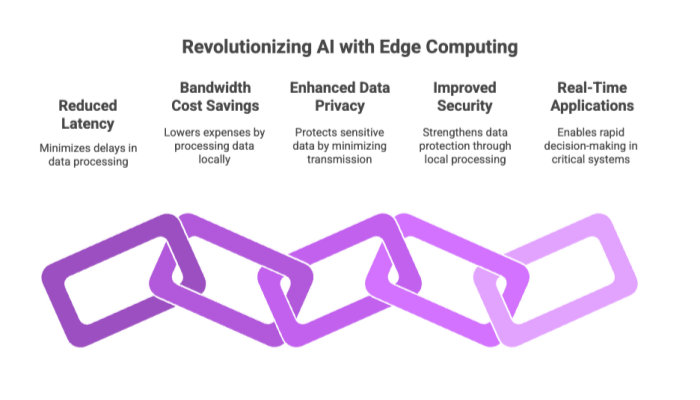
Edge computing reduces latency and bandwidth costs by processing data locally on edge devices, enabling faster and more efficient AI-driven decisions.
Integrating AI with edge computing enhances data privacy and security by minimizing sensitive data transmission to centralized cloud servers.
Edge AI empowers critical real-time applications such as autonomous vehicles, industrial automation, and smart cities by delivering rapid decision-making and operational efficiency.

Introduction to Edge Computing
In the modern digital economy, edge computing ensures that organizations can move beyond the limitations of centralized cloud servers. At its core, edge computing refers to the practice of processing data locally on edge devices, reducing reliance on remote cloud servers for critical tasks. This shift represents a fundamental change in how businesses approach real-time data processing and decision making.
Where traditional cloud computing centralized workloads in data centers, edge computing brings processing closer to the physical world — where data is generated. For instance, instead of sending raw data from a factory machine across the internet to a data center for analysis, edge devices equipped with AI models can process that information instantly, producing faster results and lowering risks.
Why Edge Computing Matters?
Efficient data processing: By processing data locally, organizations reduce data transmission requirements and increase speed.
Real-time responsiveness: Supports applications like autonomous driving, industrial robotics, and healthcare monitoring that demand near-instant results.
Improved user experiences: Consumers benefit from faster services with fewer lags, whether in gaming, shopping, or smart home technologies.
Operational efficiency: Reduces bandwidth usage, minimizes latency, and enhances overall productivity.
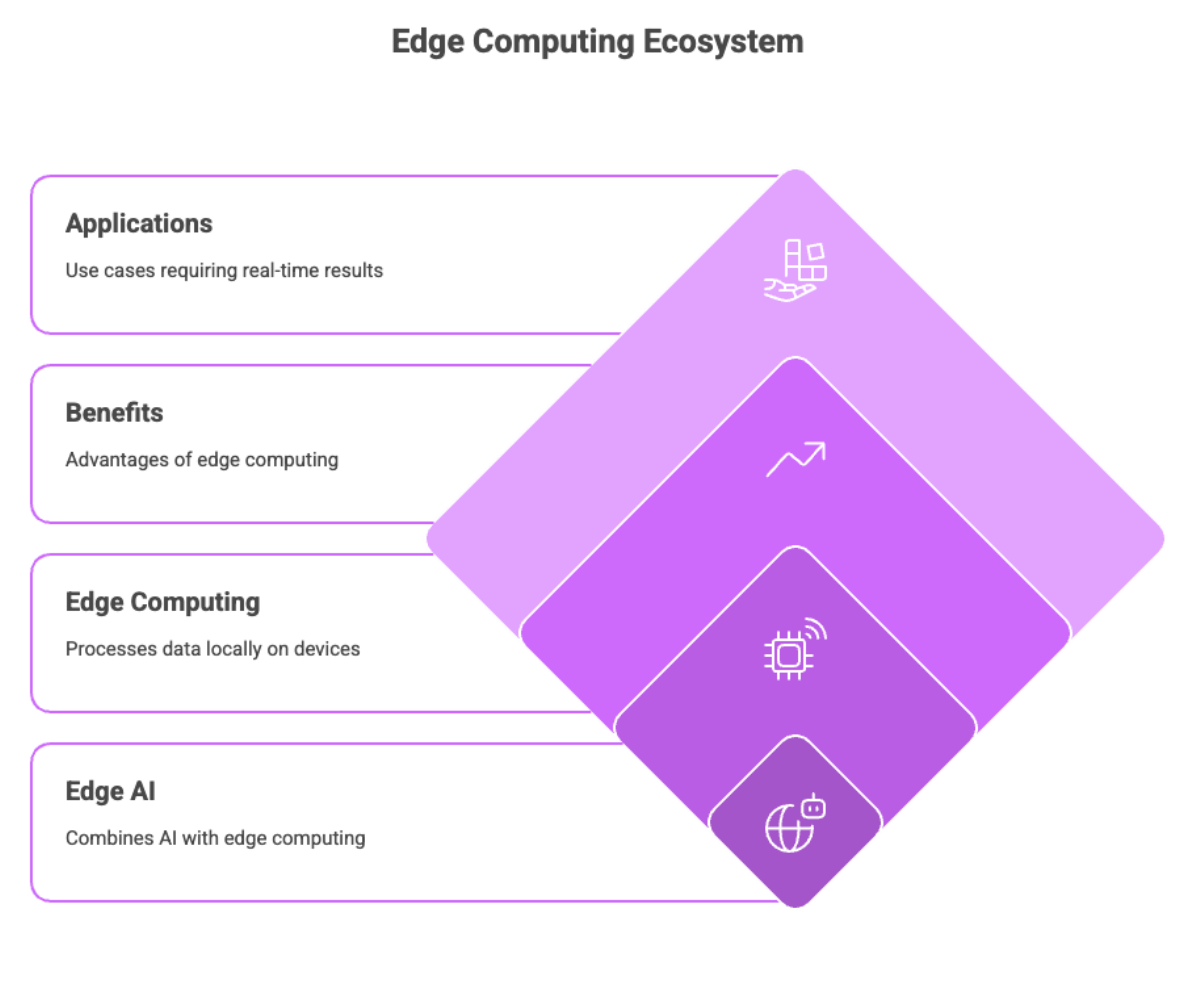
By combining artificial intelligence with edge computing, organizations can solve complex problems that previously required centralized infrastructure. This combination, known as edge AI, is at the heart of the next generation of real-time AI applications.
Edge AI and Real-Time Applications
The convergence of AI and edge computing is transforming industries by enabling systems to think and act closer to the source of data. Instead of sending signals back and forth between cloud servers and local hardware, edge AI performs analysis on-site, providing rapid decision making when it matters most.
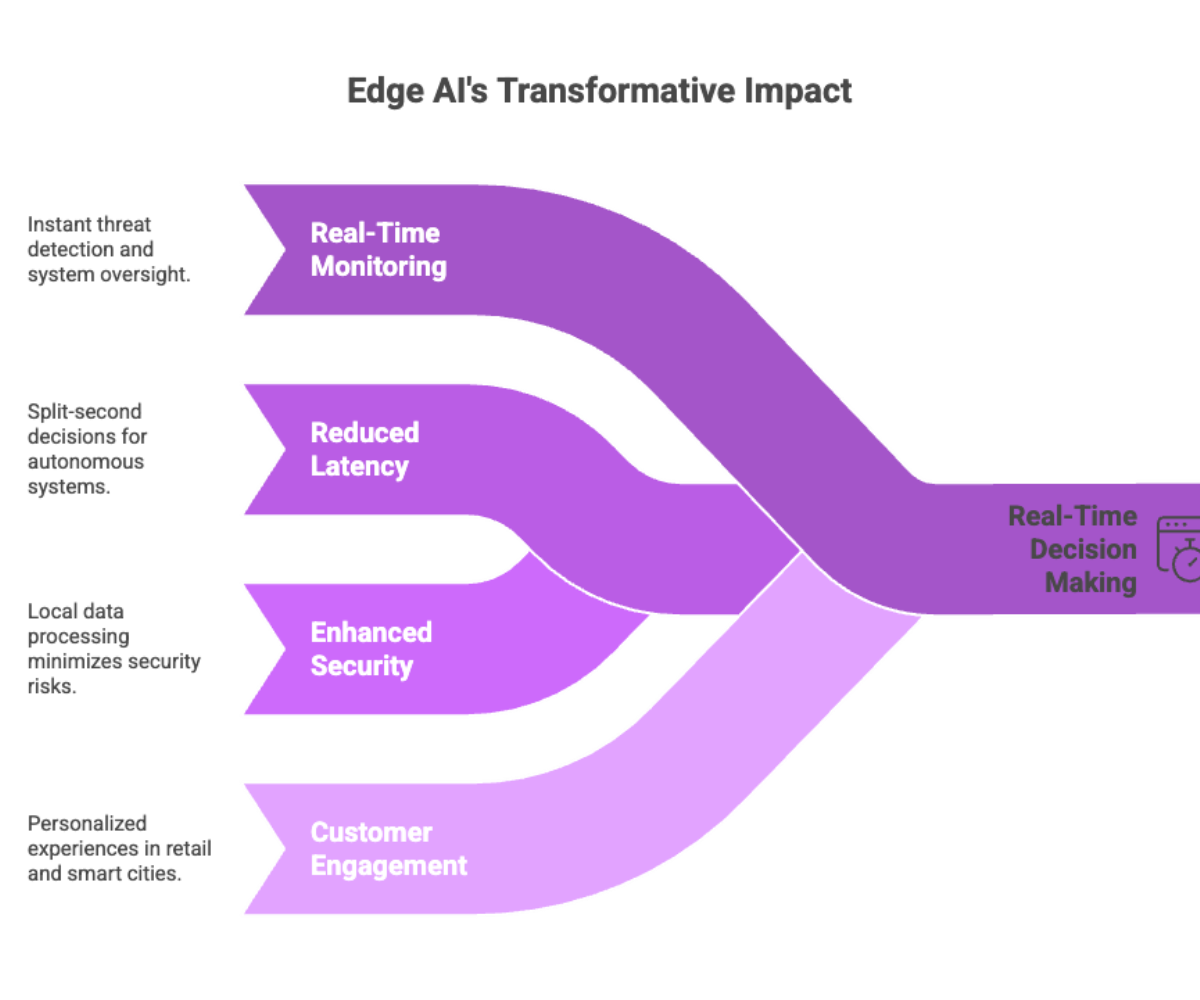
Core Benefits of Edge AI
Real-time monitoring: Critical for security systems, industrial operations, and critical systems like energy grids.
Reduced latency: Supports split-second decisions in autonomous vehicles and drones.
Enhanced security: Keeps sensitive data local, minimizing exposure during data transmission.
Customer engagement: Enables faster personalization in retail experiences and smart cities.
Key Use Cases
Security Cameras
Modern security cameras equipped with edge AI models detect threats instantly without needing to stream footage to distant servers. This ensures real-time monitoring of environments with minimal bandwidth usage.
Autonomous Vehicles
Perhaps the most iconic example, autonomous vehicles rely on edge devices to analyze sensor feeds in milliseconds. From collision avoidance to traffic flow optimization, edge computing ensures safety through split-second decisions.
Industrial Automation
In factories, edge computing powers industrial automation, enabling predictive maintenance of industrial machinery. Systems analyze vibrations, temperature, and other signals in real time to anticipate failures before they happen.
Smart Cities and Retail
Edge AI plays a crucial role in managing traffic signals, reducing congestion, and enabling interactive retail experiences like cashierless shopping.
By embedding AI algorithms into edge solutions, industries unlock real-time decision making that is reliable, private, and cost-effective.
Data Processing and Analysis
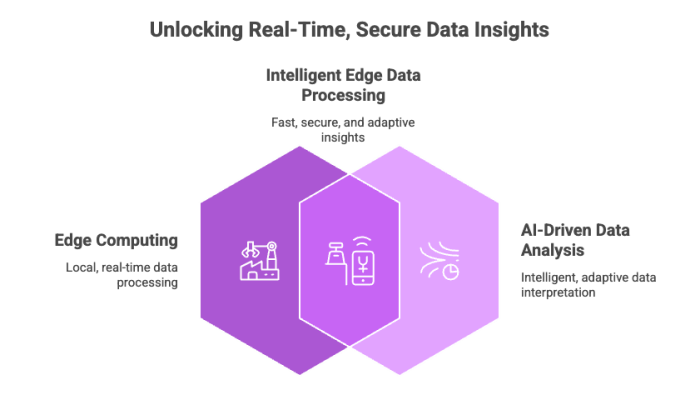
The essence of edge computing lies in how effectively it handles data processing. Traditional systems relied heavily on sending raw data to centralized cloud servers for analysis, introducing delays and potential security concerns. By contrast, edge computing emphasizes processing data locally, ensuring that critical data is managed at the network edge.
Edge Data Processing
Processing data directly on-site avoids the round trip to remote locations.
Supports real-time monitoring and rapid decision making.
Improves data privacy by keeping sensitive data within local environments.
For example, industrial machinery in a production plant can use machine learning models at the edge to detect anomalies. Instead of sending streams of sensor data across networks, edge devices deliver insights immediately.
Cloud vs. Edge in Data Analysis
Cloud computing excels at analyzing massive datasets, training new AI models, and running big data analytics.
Edge computing is superior for real-time data processing, real-world conditions, and handling critical data that must be processed locally.
Security and Privacy Advantages
Data privacy is one of the strongest reasons for adopting edge systems. By minimizing data transmission, businesses reduce opportunities for breaches while maintaining compliance with regulations. This is particularly crucial in healthcare, finance, and defense sectors.
Together, edge computing and AI make data processing faster, safer, and more adaptable to real world conditions, giving enterprises a competitive advantage in handling incoming data.
Cloud Computing Comparison
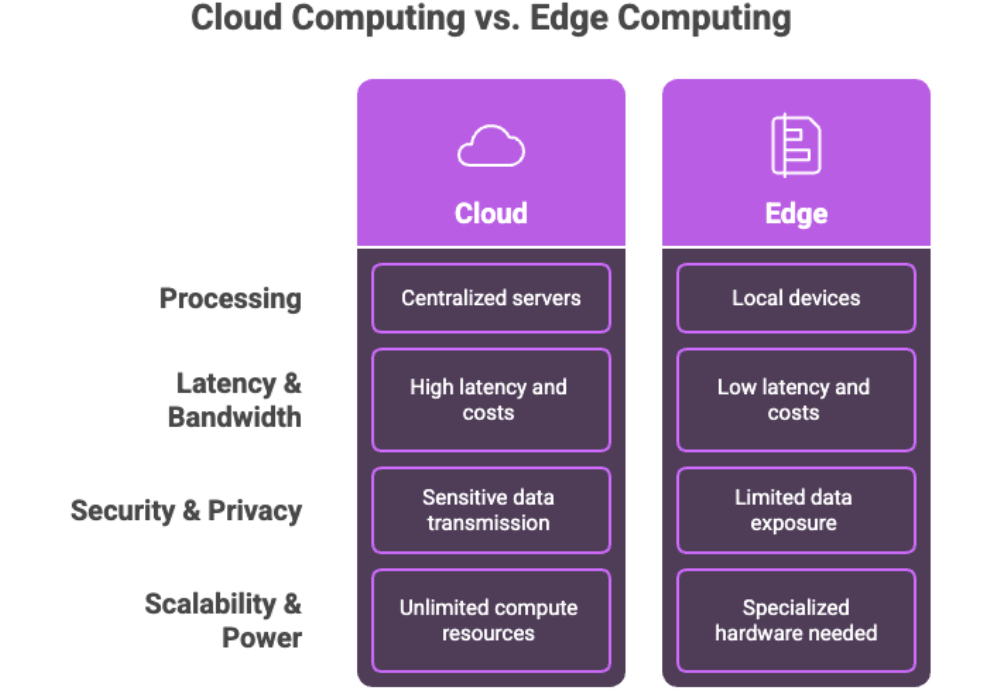
It’s impossible to talk about edge computing without contrasting it with cloud computing. While the two are complementary, their differences shape deployment strategies for AI and edge computing solutions.
Key Differences
Centralization vs. Local Processing
Cloud computing relies on centralized cloud servers and centralized systems for storage and computation.
Edge computing emphasizes local processing, pushing workloads to edge devices near the data source.
Latency and Bandwidth Costs
Cloud servers require data transmission that increases latency and drives up bandwidth costs.
Edge computing minimizes latency by processing data locally, leading to both performance gains and cost savings.
Security and Privacy
Cloud computing requires careful handling of sensitive data transmitted across networks.
Edge devices reduce exposure by limiting what data leaves the local environment.
Scalability and Compute Power
Cloud computing offers unmatched scalability with virtually unlimited computing resources.
Edge solutions require more careful planning to ensure specialized hardware is available where needed.
Complementary Roles
While cloud computing remains critical for model training, global analytics, and centralized updates, edge computing is indispensable for real-time responsiveness and low latency environments. Enterprises that combine both unlock the best of scalability and speed.
Artificial Intelligence in Edge Computing
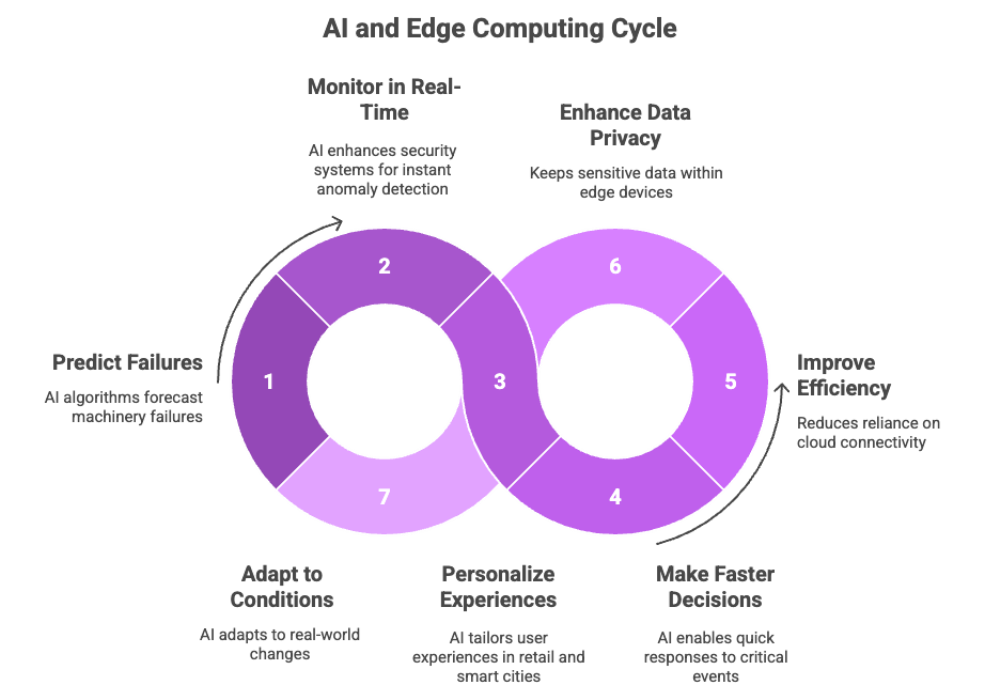
The real game-changer is the integration of artificial intelligence within edge computing. By embedding AI models directly on edge hardware, enterprises gain systems that can learn, adapt, and react instantly to changing conditions.
AI’s Role at the Edge
Predictive maintenance: AI algorithms predict failures in industrial machinery, reducing downtime.
Real-time monitoring: AI-enhanced security systems detect anomalies instantly.
Customer engagement: AI personalization engines at the edge tailor user experiences in retail and smart cities.
Decision making: AI systems processed locally enable enabling faster responses to critical events.
Benefits of AI at the Edge
Operational efficiency: Reduces reliance on cloud connectivity and centralized management.
Data privacy: Keeps sensitive data within edge devices.
Continuous improvement: AI at the edge allows for real-time adaptation to relevant information and real world conditions.
The synergy of AI and edge computing transforms how enterprises address complex problems, creating edge solutions that are not only efficient but also intelligent. Learn more about AI consulting strategies that can maximize your business impact.
Autonomous Vehicles and Edge Computing
Few industries showcase the impact of edge computing more vividly than the automotive sector. Autonomous vehicles are essentially rolling supercomputers, constantly collecting raw data from cameras, LiDAR, radar, and GPS sensors. To function safely, they need real-time data processing and rapid decision making at the network edge, without relying solely on cloud servers.
Why Edge Computing is Essential for Autonomous Vehicles?
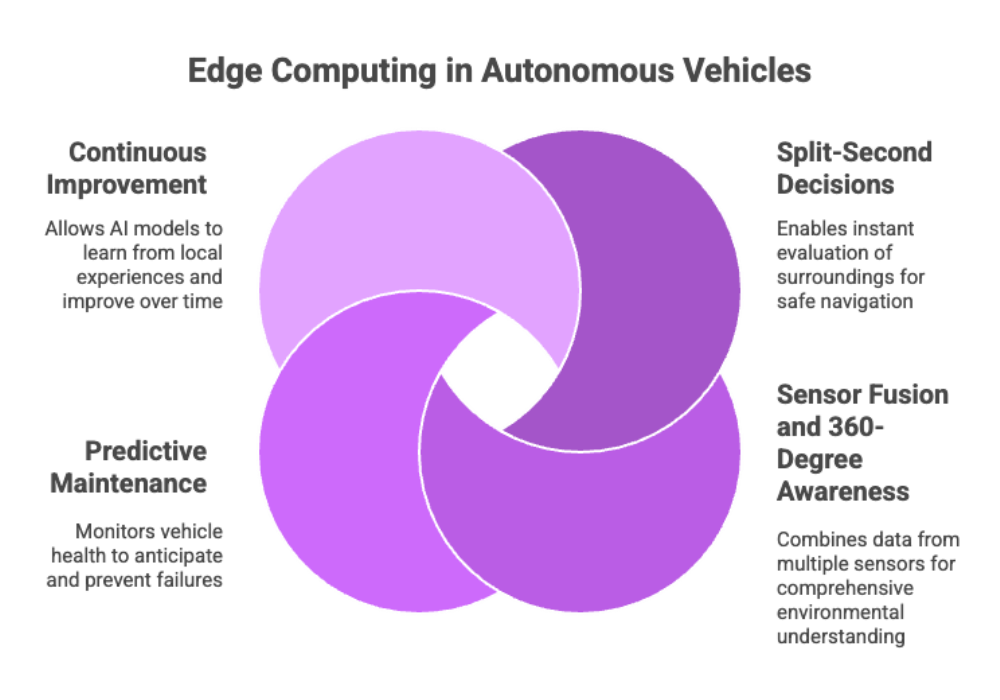
Split-Second Decisions
When a self-driving car approaches an intersection, it must evaluate pedestrians, traffic lights, and other vehicles instantly. Edge computing ensures that these split-second decisions happen directly on-board without a round trip to a distant data center.
Sensor Fusion and 360-Degree Awareness
Cars rely on multiple sensors to interpret their environment. Processing data locally allows for immediate fusion of incoming data from radar, LiDAR, and cameras, creating a real-world conditions model that supports collision avoidance.
Predictive Maintenance
Beyond driving, AI models at the edge monitor the health of critical systems inside the car. By analyzing vibration patterns, temperature, and fuel efficiency, vehicles can anticipate component failures, reducing breakdowns.
Continuous Improvement
Edge devices equipped with AI algorithms can learn from localized experiences and upload summarized patterns to cloud servers. This hybrid loop supports continuous improvement of AI models while minimizing bandwidth usage.
In short, autonomous vehicles represent the ultimate example of how AI and edge computing combine to enable real-time monitoring, operational efficiency, and safety-critical applications.
Broader Industry Applications of Edge Computing
Although cars grab headlines, the power of edge computing extends to multiple industries where efficient data processing and real-time responsiveness are mission-critical.
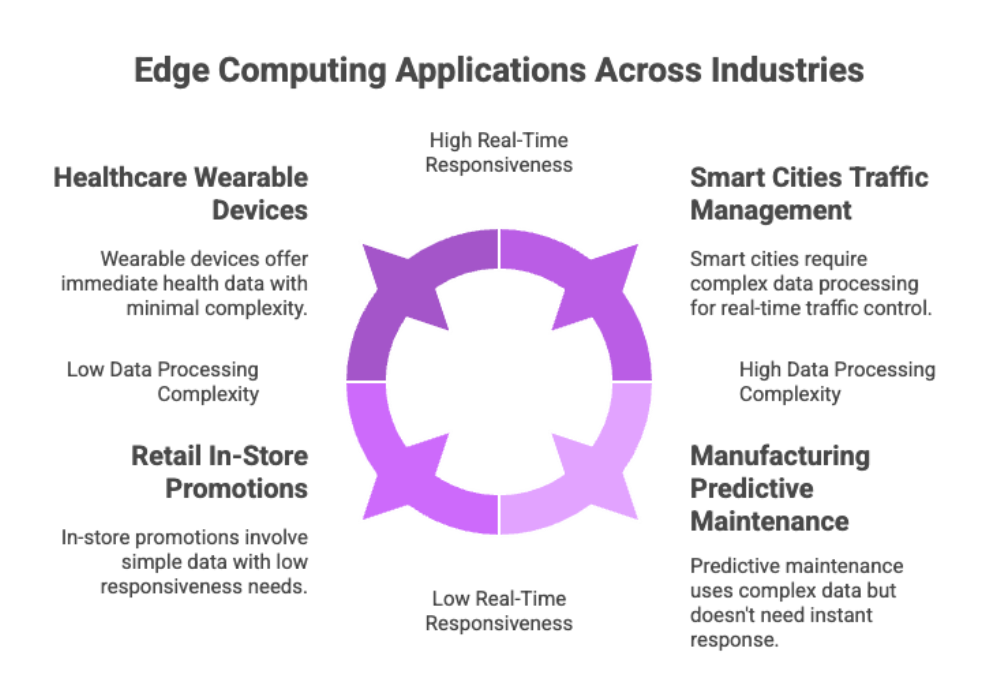
Manufacturing and Industrial Automation
Predictive maintenance of industrial machinery prevents costly downtime.
Real-time monitoring of assembly lines enables production processes to adapt instantly.
AI models processed locally help identify defects early, increasing efficiency and reducing costs.
Smart Cities
Edge AI manages traffic flow by analyzing video feeds from multiple devices like cameras and sensors.
Security cameras with embedded intelligence enhance security systems, detecting anomalies in real time.
Smart cities use edge solutions to optimize energy grids and public safety operations.
Healthcare
Wearable devices provide real-time monitoring of vital signs, alerting doctors to irregularities immediately.
Local edge AI devices safeguard sensitive data by ensuring it doesn’t leave the hospital environment unnecessarily.
Medical imaging systems use AI models to analyze scans locally, speeding up diagnosis.
Retail Experiences
In-store systems use customer engagement data to tailor promotions.
Edge AI enables real-time processing of shopping patterns to optimize inventory.
Checkout-free shopping relies on local processing for enabling faster recognition of products.
Energy and Utilities
Edge computing supports critical systems such as power grids, monitoring equipment for faults.
Data locally processed ensures safety and resilience during outages.
Across these sectors, edge computing reduces reliance on centralized systems, improves user experiences, and lowers bandwidth costs by cutting unnecessary data transmission.
Challenges in Edge Computing Deployment
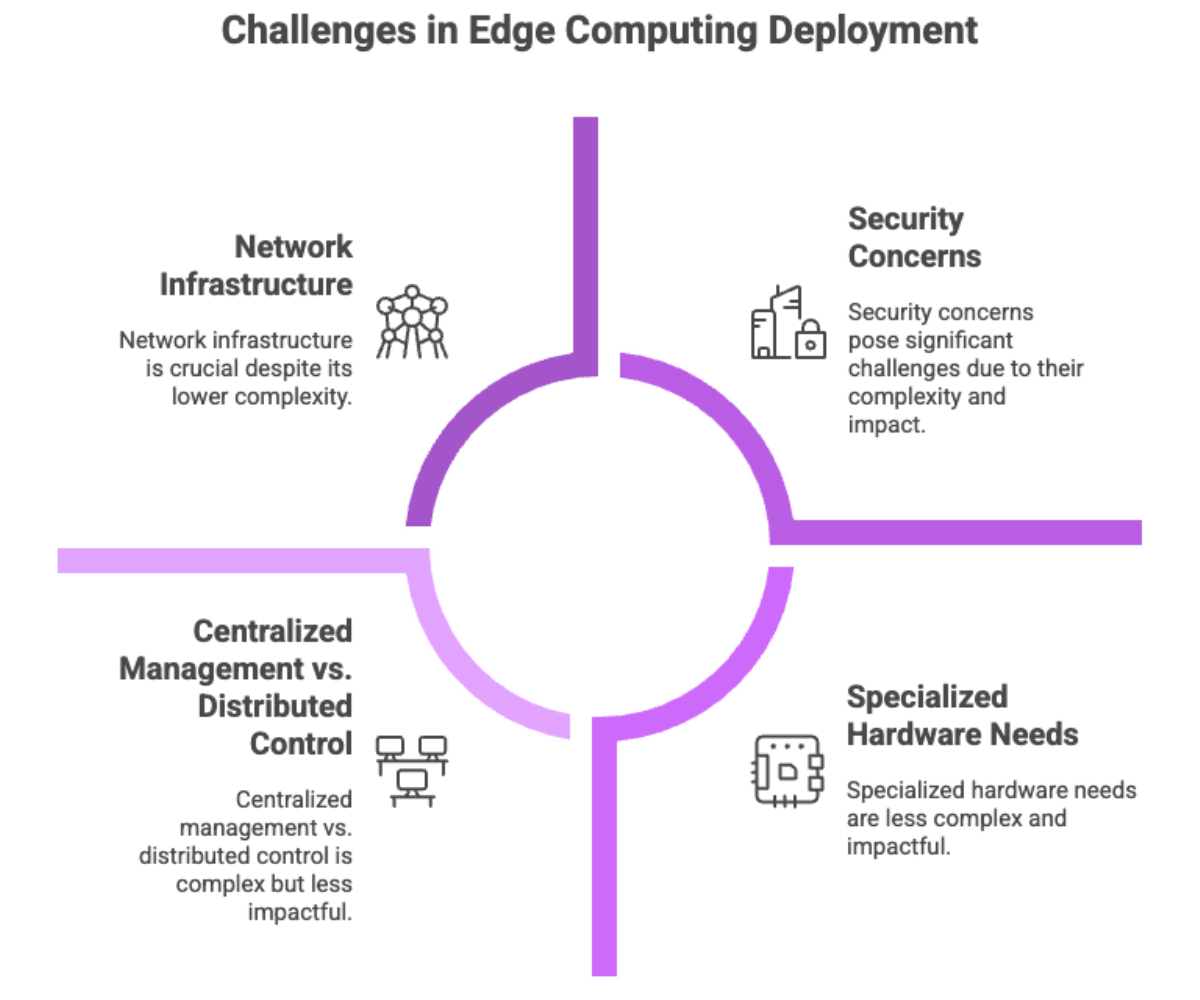
While the benefits are clear, organizations must also address challenges when deploying edge computing.
1. Network Infrastructure
Even though edge computing reduces dependency on cloud connectivity, reliable network infrastructure is still needed to sync AI models between devices and the cloud. Weak connectivity can delay continuous improvement cycles.
2. Security Concerns
Although data privacy is enhanced by processing data locally, security concerns remain. Attackers may target edge hardware directly, requiring robust encryption, authentication, and monitoring.
3. Specialized Hardware Needs
Certain edge solutions demand specialized hardware optimized for real-time processing and AI algorithms. Enterprises must balance cost against the performance gains of edge hardware.
4. Centralized Management vs. Distributed Control
Enterprises accustomed to centralized management may struggle with monitoring fleets of edge devices. New tools for orchestration and compliance are essential to ensure consistency across multiple devices.
Overcoming these challenges requires investment in tools, training, and a balanced strategy that integrates both cloud computing and edge computing effectively.
Best Practices for Effective Edge AI Deployment
To fully realize the benefits of edge computing for real-time AI applications, businesses should adopt proven strategies.
Key Best Practices
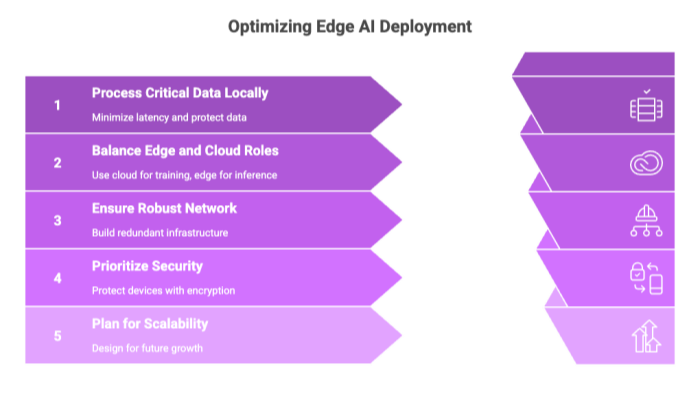
Process Critical Data Locally
Keep critical data on edge devices to minimize latency and protect sensitive data.
Balance Edge and Cloud Roles
Use cloud computing for training new AI models, while deploying inference at the edge for real-time responsiveness.
Ensure Robust Network Infrastructure
Build redundant network infrastructure to support hybrid deployments without bottlenecks.
Prioritize Security Systems
Protect edge devices with encryption, monitoring, and updates to reduce risks to critical systems.
Plan for Scalability
Anticipate growth in AI and edge computing applications. Design edge solutions that can handle more incoming data over time.
Measure Operational Efficiency
Track improvements in user experiences, decision making, and reducing costs to justify investments.
By following these practices, enterprises can maximize the effectiveness of edge AI, ensuring systems are both efficient and secure.
Conclusion
So, how does edge computing impact real-time AI applications effectively? The answer lies in its ability to combine efficient data processing, low latency, and local processing with the intelligence of AI models.
Edge computing ensures that real-time monitoring and rapid decision making can happen where it matters most — at the network edge.
By integrating artificial intelligence, enterprises gain systems capable of predictive maintenance, customer engagement, and continuous improvement.
Compared to cloud computing, edge computing reduces bandwidth usage, enhances data privacy, and improves operational efficiency.
From autonomous vehicles making split-second decisions to industrial automation predicting failures in critical systems, the combination of AI and edge computing is redefining what’s possible in the digital era.
As industries evolve, the future will not be about choosing between cloud servers or the network edge — but about integrating both into intelligent, hybrid ecosystems that deliver speed, safety, and smarter user experiences.