Main AI Implementation Challenges: Complete Guide to Overcoming Barriers in 2026
Introduction to AI Models, Adoption, and Deployment
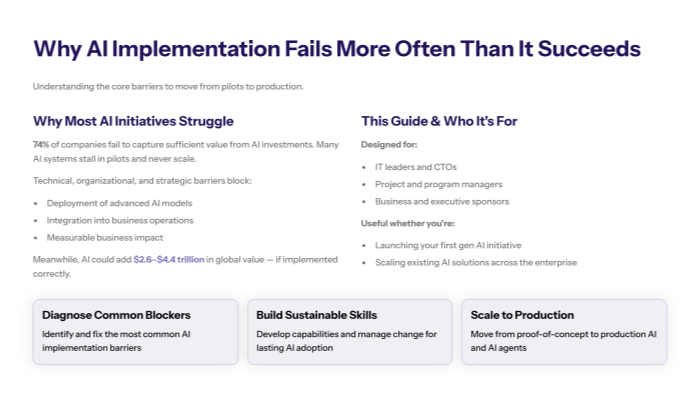
Main AI implementation challenges prevent 74% of companies from capturing sufficient value from their AI tools and artificial intelligence investments, despite widespread adoption efforts. Organizations worldwide struggle with deploying AI systems and integrating advanced AI models that deliver measurable business impact, often finding their AI initiatives stalled in pilot phases or failing to scale beyond initial experiments.
What This Guide Covers
This comprehensive analysis examines the technical barriers that block successful AI implementation—including data quality issues, legacy system integration, and challenges specific to generative AI models and their capabilities—organizational hurdles that derail AI projects such as skills gaps and change management failures, and strategic challenges that prevent scaling AI applications and AI deployment across business operations.
Who This Is For
This guide is designed for IT leaders, CTOs, project managers, and executives planning or currently struggling with AI adoption initiatives. Whether you’re launching your first gen AI initiative or trying to scale existing artificial intelligence technologies and solutions across your organization, you’ll find proven strategies to overcome common AI adoption challenges and implementation roadblocks.
Why This Matters
Artificial intelligence technologies could add $2.6 to $4.4 trillion in annual global economic value, yet 94% of executives expect AI transformation while most AI initiatives remain trapped in pilot purgatory. Understanding and proactively addressing these predictable challenges is crucial for achieving competitive advantage through successful AI deployment.
What You’ll Learn:
-
How to identify and overcome technical implementation barriers that block AI deployment, including addressing poor quality data and integrating real world data for training data sets
-
Proven organizational strategies for building AI skills, managing change resistance, and fostering continuous learning throughout the AI journey
-
Strategic approaches to demonstrate ROI and secure leadership buy-in for scaling AI applications and gen AI capabilities
-
Actionable frameworks for moving from proof of concept to production-ready AI systems and AI agents that enhance business operations

Understanding AI Adoption Challenges and the AI Journey
AI adoption challenges are the specific barriers that prevent organizations from successfully deploying and scaling artificial intelligence solutions beyond experimental phases into production environments that deliver measurable business value.
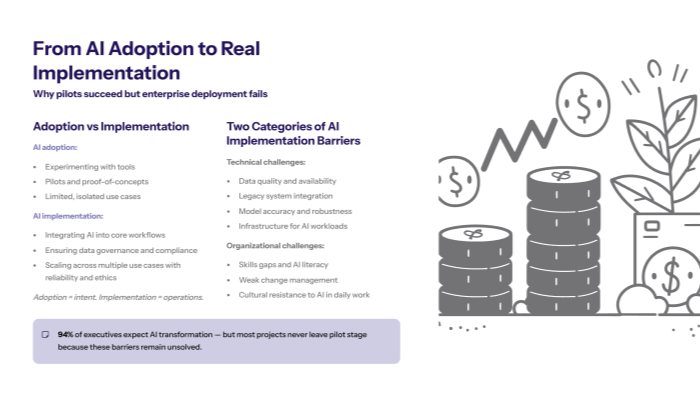
While 94% of executives expect AI transformation in their organizations, most AI projects never progress from pilot to enterprise-wide deployment. This disconnect highlights a critical gap between AI adoption intentions and actual AI success.
AI adoption differs fundamentally from AI integration and implementation. Adoption involves experimenting with AI tools and running proof-of-concept projects. Implementation requires integrating AI systems into existing business operations, ensuring data governance compliance, and scaling AI solutions across multiple use cases while maintaining accuracy, reliability, and ethical AI practices.
Categories of AI Implementation Barriers
Technical challenges encompass data quality issues, system integration complexities, and model accuracy concerns that create foundational infrastructure requirements for AI success. These barriers often require significant upfront investment in data management systems, architectural changes to support AI workloads, and addressing ethical concerns related to AI usage and data breaches.
This connects to the broader implementation challenge because technical infrastructure forms the backbone that enables all other AI capabilities and gen AI initiatives.
Organizational Challenges in AI Adoption
Organizational barriers include skills gaps, change management failures, and cultural resistance to adopting artificial intelligence technologies within existing workflows. Building on technical foundations, organizational readiness determines how effectively teams can leverage AI applications and integrate them into daily operations.
Unlike technical challenges that can be solved with technology investments, organizational barriers require sustained effort in training, communication, and cultural transformation to achieve lasting AI success.
Transition: While understanding these challenge categories provides the framework for implementation planning, examining specific technical barriers reveals why so many AI projects encounter deployment difficulties.
Core Technical Implementation Challenges of AI Models and Gen AI Capabilities
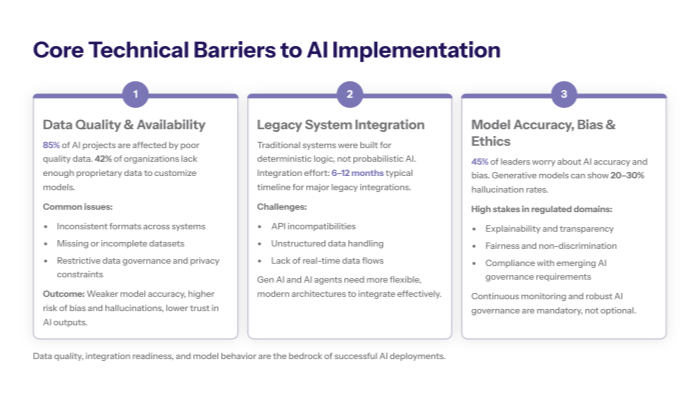
Organizations face three primary technical barriers when implementing AI solutions: data quality and availability issues, legacy system integration challenges, and model accuracy concerns that affect AI outputs and business confidence.
Data Quality and Availability Issues Impacting AI Adoption
Poor quality data affects 85% of AI projects, with 42% of organizations lacking sufficient proprietary data to customize AI models effectively for their specific business needs. AI models rely heavily on high quality training data for accurate predictions, making data management and data governance the foundation of successful AI implementation.
Common data challenges include inconsistent data formats across systems, missing or incomplete datasets, and data governance requirements that restrict access to sensitive data needed for training AI algorithms. Organizations struggle with data integration from multiple sources while maintaining data privacy compliance and ensuring ethical AI practices.
Effective data analysis and the use of real world data are essential to improve AI model accuracy and reduce risks of bias and hallucinations in generative AI models. Additionally, organizations must proactively address concerns related to data breaches and poor data quality to maintain trust and regulatory compliance.
Legacy System Integration Challenges in AI Deployment
Traditional deterministic systems struggle to accommodate probabilistic AI workloads and unstructured data processing requirements. Unlike conventional software that follows predictable logic paths, AI systems process data in ways that legacy infrastructure wasn’t designed to support.
API compatibility issues create significant obstacles when integrating AI tools with existing business operations. Organizations typically require 6-12 months to complete legacy system integration projects, involving middleware solutions and architectural changes to enable seamless data flow between AI models and operational systems.
Moreover, the integration of real time translation tools and AI agents into legacy environments demands modern, flexible architectures to unlock the full potential of gen AI capabilities.
Model Accuracy, Bias, and Ethical Concerns
45% of business leaders worry about AI accuracy and bias affecting AI outputs, particularly with generative AI solutions where large language models can produce hallucinations at rates of 20% to 30%. These accuracy concerns create significant challenges for deploying AI systems in regulated industries where explainability, transparency, and ethical AI usage are required.
Model outputs must be continuously monitored for bias, especially when AI applications affect decision-making processes involving sensitive data or human resources. Effective AI governance frameworks are essential for maintaining trust in AI solutions while ensuring compliance with evolving regulatory requirements.
Key Points:
-
Data quality issues impact 85% of AI projects and require comprehensive data governance strategies addressing poor quality data and data breaches
-
Legacy integration timelines average 6-12 months and demand architectural planning to support AI integration and gen AI initiatives
-
Model bias and accuracy concerns create legal and reputational risks requiring ongoing monitoring and adherence to ethical AI standards
Transition: While technical challenges create the foundation for implementation problems, organizational factors often determine whether AI projects ultimately succeed or fail in real-world deployment scenarios.
Organizational and Strategic AI Adoption Challenges
Successful AI implementation requires addressing human factors and business strategy alignment that extend far beyond technical capabilities, including AI skills development, change management, and demonstrating clear return on investment.
Step-by-Step: Addressing AI Skills Gap Challenges
When to use this: Organizations facing the skills shortage in AI expertise that affects implementation timelines and project quality across AI initiatives.
-
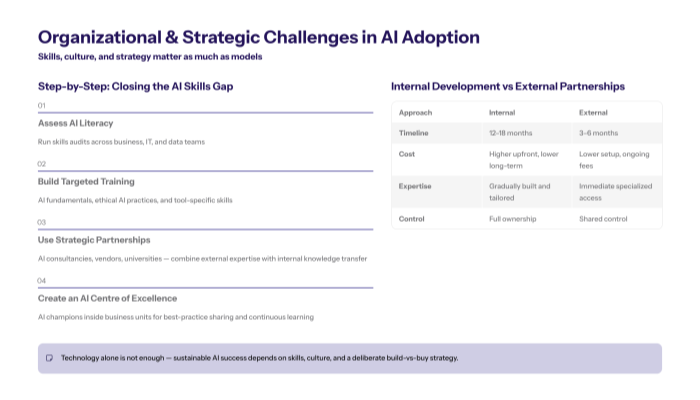
Assess current AI literacy levels: Conduct comprehensive skills audits across teams to identify specific gaps in AI knowledge, from basic AI concepts to specialized skills in machine learning, natural language processing, and gen AI models.
-
Develop targeted training programs: Create learning paths covering AI fundamentals, ethical AI practices, and tool-specific skills that align with your organization’s AI applications and business objectives.
-
Establish strategic partnerships: Collaborate with AI specialists, consulting firms, or academic institutions to access specialized expertise while building internal capabilities through knowledge transfer.
-
Create AI centers of excellence: Designate AI champions within business units to spread AI literacy, share best practices, and support continuous learning as the evolving AI landscape introduces new artificial intelligence technologies and gen AI capabilities.
Comparison: Internal Development vs External Partnerships in AI Adoption
Factor |
Internal Development |
External Partnerships |
|---|---|---|
Timeline |
12-18 months for capability building |
3-6 months for initial deployment |
Cost Control |
Higher upfront investment, long-term savings |
Lower initial costs, ongoing partnership fees |
Expertise Level |
Gradual skill building, customized to needs |
Immediate access to specialized knowledge |
Strategic Control |
Full ownership of AI journey and outcomes |
Shared control, potential vendor dependence |
Organizations with substantial AI investments and long-term transformation goals typically benefit from internal development, while companies seeking rapid deployment or lacking technical infrastructure often find external partnerships more effective for initial AI adoption.
Transition: Understanding skills development approaches helps organizations build capability, but avoiding common implementation pitfalls requires addressing broader strategic and operational challenges.
Common AI Adoption Pitfalls and Solutions
Organizations encounter predictable failure points when implementing AI solutions, with three primary challenges accounting for the majority of stalled AI projects and unsuccessful deployments.
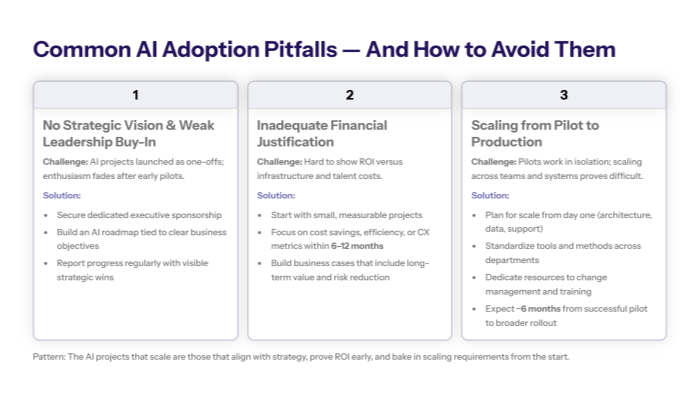
Challenge 1: Lack of Strategic Vision and Leadership Buy-in for AI Initiatives
Many AI initiatives fail because they lack clear strategic direction and sustained executive support beyond initial enthusiasm phases.
Solution: Secure dedicated executive sponsorship with defined accountability, create comprehensive AI roadmaps linking specific AI applications to business objectives, and provide regular progress updates highlighting strategic value and competitive advantages gained through AI deployment.
Maintaining momentum requires demonstrating quick wins while building toward larger transformation goals that revolutionize business operations through AI integration and gen AI capabilities.
Challenge 2: Inadequate Financial Justification for AI Adoption
Organizations struggle to demonstrate clear ROI for AI investments, particularly when implementing AI solutions requires significant upfront costs for data infrastructure, AI skills development, and ethical AI compliance.
Solution: Use phased investment approaches starting with small, measurable projects that demonstrate concrete cost savings or revenue opportunities, quantify benefits through specific metrics like operational efficiency gains or customer experience improvements, and build comprehensive business cases that account for long-term value creation.
AI projects should target specific business challenges where AI tools can deliver measurable impact within 6-12 months to build credibility for larger initiatives.
Challenge 3: Scaling Difficulties from Pilot to Production in AI Deployment
Many organizations successfully complete AI pilots but encounter unexpected barriers when scaling AI solutions across business operations and multiple use cases.
Solution: Develop explicit scaling strategies that address infrastructure requirements from project inception, standardize AI tools and methodologies to enable consistent deployment across departments, and build scalability considerations into initial project design rather than treating scaling as an afterthought.
Successful scaling typically requires 6 months average timeline from pilot to enterprise deployment, with dedicated resources for change management and user training.
Transition: Recognizing and addressing these common pitfalls provides the foundation for developing a systematic approach to successful AI implementation across your organization.
Conclusion and Next Steps in Your AI Journey
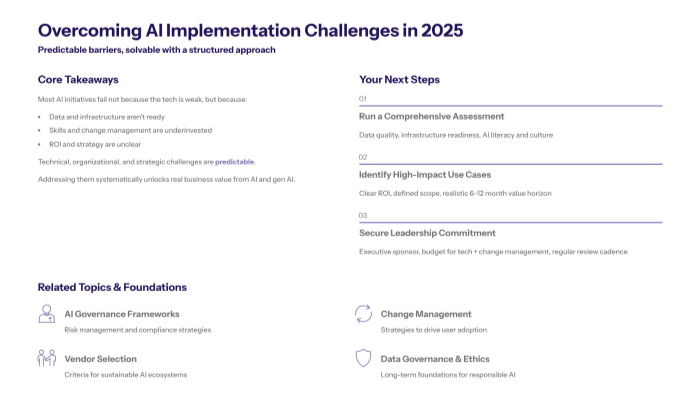
While AI implementation challenges are widespread, they are fundamentally predictable and solvable with proper planning, strategic alignment, and systematic approaches to addressing technical, organizational, and business requirements for successful AI deployment.
To get started:
-
Conduct comprehensive assessment: Evaluate current data quality, infrastructure capabilities, and team AI literacy to identify specific gaps that could impact your AI journey
-
Identify high-impact use cases: Select AI applications with clear ROI potential and manageable complexity to build credibility and demonstrate value from AI investments
-
Secure leadership commitment: Establish dedicated executive sponsorship and allocate sufficient resources for both technical implementation and organizational change management
Related Topics: AI governance frameworks for managing risk and compliance, change management strategies for user adoption, and vendor selection criteria for building sustainable AI partnerships that support long-term success.
Additional Resources for Successful AI Adoption
For organizations beginning their AI implementation journey, focus on developing robust data governance policies, establishing clear AI ethics guidelines, and creating measurable success metrics that align AI outcomes with business objectives. These foundational elements enable sustainable AI adoption that delivers lasting competitive advantage through effective AI integration and leveraging gen AI initiatives.