Prompt Engineering And Effective AI Use
You’ve asked ChatGPT to write something important, waited with anticipation, and received… garbage. Generic responses that miss the mark, irrelevant outputs that waste your time, or vague answers that require extensive revision. This frustration is common, but it’s not the ai model’s fault—it’s a prompt engineering problem. Prompt engineering is the practice of designing natural language instructions that effectively guide generative ai models to produce specific, high-quality, and relevant outputs.
Prompt engineering transforms AI interactions from disappointing to powerful by treating prompts as “programs written in natural language” that control AI behavior with precision and clarity.
What This Guide Covers
This comprehensive guide covers practical prompt engineering techniques for ChatGPT and other large language models, including zero shot prompting, few shot prompting, chain of thought prompting, and advanced techniques for complex tasks. What IS included: actionable examples, prompt engineering best practices checklists, and real-world applications across industries. What ISN’T included: technical AI model training, complex machine learning concepts, or programming language requirements.
Who This Is For
This guide is designed for professionals, students, and creators who use ai tools like ChatGPT, Claude, or other generative ai systems daily. Whether you’re getting inconsistent results from user prompts or want to maximize AI productivity for complex reasoning tasks, you’ll find actionable prompt engineering skills. No technical background required—focus is on practical communication and critical thinking skills.
Why This Matters
Poor prompts lead to wasted time, frustration, and missed opportunities with powerful generative ai tools. Effective prompt engineering can increase AI output quality by 10x while saving hours of revision work on desired outputs. These prompt engineering skills become more valuable as artificial intelligence integration accelerates across industries, with organizations actively hiring prompt engineers.
What You’ll Learn:
-
How to define prompts as structured instructions that control large language models llms behavior
-
Core prompt engineering concepts: personas, context, format specifications, and desired outcomes
-
Zero shot prompting and few shot prompting techniques with practical ChatGPT examples
-
Advanced prompting techniques like chain of thought prompting for complex tasks and multi-step workflows

Understanding Prompt Engineering
Prompt engineering is the iterative process of designing, structuring, and refining natural language instructions to guide generative ai models toward producing specific, high-quality, and relevant responses. The fundamental insight is that prompts function as “programs written in natural language”—this metaphor is critical because just as traditional programming requires precise syntax and logic, effective prompt engineering requires precision in language, structure, and context.
The distinction between casual user queries and engineered prompts is significant. While a typical user might ask “write me something about climate change,” a prompt engineer would craft something far more specific with defined parameters, tone, style, and expected response format. This precision transforms ai systems from general information tools into targeted problem-solving assistants.
Core Concept: Personas and Role Definition
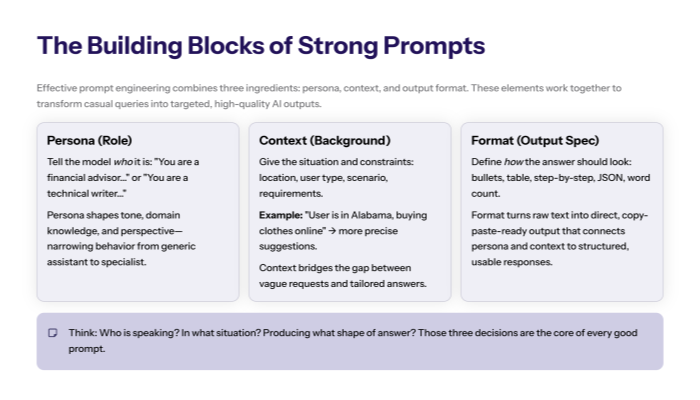
Personas involve instructing the ai model to adopt a specific role or perspective, fundamentally shaping how the language model approaches tasks. Rather than asking for general advice, you specify “You are a financial advisor specializing in retirement planning” or “You are a technical writer documenting software for non-technical users.” This guides the model’s tone, knowledge domain, and response style by constraining the vast probability space of possible outputs.
This connects to prompt engineering because personas provide contextual frameworks that help ai tools understand not just what to say, but how to say it and from whose perspective.
Core Concept: Context and Background Information
Context refers to the background information, constraints, and situational details provided in user prompts. Instead of “Where to purchase a shirt,” an effective prompt specifies “You are a sales assistant for a clothing company. A user, based in Alabama, United States, is asking you where to purchase a shirt.” The addition of location, role, and context dramatically improves relevance and generates more accurate responses.
Building on personas, context works with role definition to create comprehensive AI understanding that bridges the gap between vague user queries and specific, actionable outputs.
Core Concept: Format and Output Specifications
Format pertains to how the desired output should be structured—whether as bullet-pointed lists, tables, step-by-step instructions, JSON data, or specific word counts. These specifications act as parsers for generative ai models, helping them organize responses in immediately useful ways.
Connection to previous concepts: Format specifications ensure that personas and context produce usable, structured outputs rather than generic responses that require extensive revision.
Transition: Understanding these core concepts provides the foundation for applying specific prompting techniques that leverage different approaches to guide large language models .
Types of Prompts and Techniques
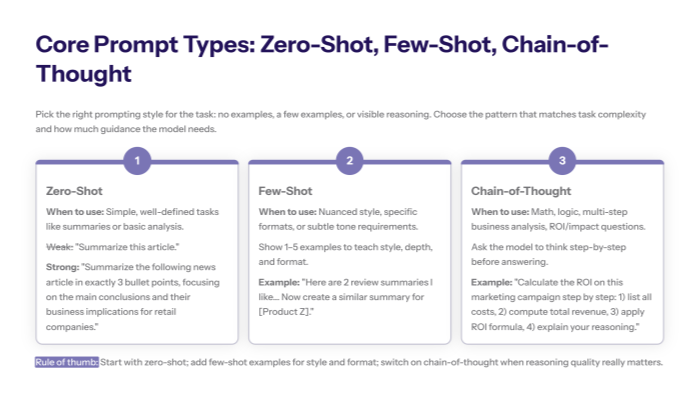
The following fundamental prompting techniques work across ChatGPT, Claude, and other large language models, each serving distinct purposes in effective prompt engineering based on task complexity and available examples.
Zero Shot Prompting
Zero shot prompting involves providing direct instruction without examples, relying entirely on the language model’s pre-training knowledge. This approach works best for simple, well-defined tasks where the ai model can understand requirements from clear instructions alone.
When to use: Simple tasks like summarization, basic analysis, or straightforward content generation where the desired output format is obvious.
Example:
-
Weak prompt: “Summarize this article”
-
Strong prompt: “Summarize the following news article in exactly 3 bullet points, focusing on the main conclusions and their business implications for retail companies.”
Few Shot Prompting
Few shot prompting provides 1-5 specific examples to demonstrate the desired output pattern, teaching ai models through pattern recognition rather than explicit instruction. This technique proves more suitable for complex tasks than zero shot prompting because examples implicitly communicate style, format, and depth requirements.
When to use: Complex formatting requirements, specific style needs, or nuanced tasks where examples clarify expectations better than instructions.
Example:
Here are examples of product review summaries I want:

Example 1: "Camera X delivers exceptional image quality with intuitive controls, though battery life disappoints during extended shoots. Best for: Portrait photographers prioritizing image sharpness."

Example 2: "Laptop Y combines powerful performance with lightweight design, but fan noise becomes intrusive under heavy workloads. Best for: Developers who travel frequently."

Now create a similar review summary for [Product Z].
Chain of Thought Prompting
Chain of thought prompting breaks down complex reasoning into intermediate steps, forcing ai models to articulate their reasoning process before reaching final answers. This technique helps improve accuracy by making the model’s logic transparent and reducing errors in multi-step problems.
When to use: Mathematical problems, logical reasoning tasks, analysis requiring multiple considerations, or any situation where intermediate steps improve accuracy.
Example:
-
Direct prompt: “What’s the ROI on this marketing campaign?”
-
Chain of thought prompt: “Calculate the ROI on this marketing campaign step by step: 1) First, identify all costs involved, 2) Then calculate total revenue generated, 3) Finally, apply the ROI formula and explain each step.”
Key Points:
-
Zero shot works for straightforward tasks with obvious requirements
-
Few shot examples teach patterns more effectively than lengthy instructions
-
Chain of thought improves accuracy for complex reasoning by showing work
Transition: These fundamental techniques provide the building blocks for more sophisticated prompt engineering approaches that combine multiple methods.
Prompt Engineering Best Practices
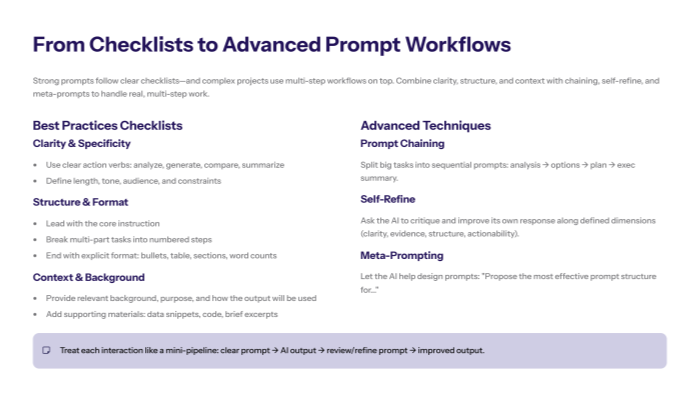
Implementing these actionable checklists immediately improves ai tool interactions by ensuring prompts contain the essential elements for generating desired outputs consistently.
Clarity and Specificity Checklist
Essential clarity principles for crafting effective prompts:
-
Use specific action verbs: Replace “help me with” with “analyze,” “summarize,” “generate,” or “compare”
-
Define technical terms: Include definitions for industry jargon, acronyms, or specialized concepts within prompts
-
Specify output parameters: State desired length (word count, bullet points), tone (professional, casual, technical), and target audience explicitly
-
Include constraints: Define what to avoid, exclude, or limit to prevent unwanted content or scope creep
Structure and Format Checklist
Organizational principles that improve prompt effectiveness:
-
Lead with core instruction: Place the most important request or question at the beginning of the prompt
-
Use numbered steps: Break multi-part requests into clearly numbered sequential steps
-
Separate context from instructions: Use clear formatting to distinguish background information from specific tasks
-
End with format requirements: Conclude with explicit output structure specifications (bullet points, paragraphs, tables)
Context and Background Checklist
Information-gathering principles for comprehensive prompts:
-
Provide relevant background: Include industry context, company information, or domain-specific requirements upfront
-
Define purpose and goals: State the end objective and how the output will be used
-
Specify audience needs: Describe who will consume the ai model’s output and their level of expertise
-
Include supporting materials: Reference relevant data, sources, or existing code when applicable for context
Transition: These best practices form the foundation for advanced prompt engineering techniques that handle complex, multi-step workflows.
Advanced Prompt Engineering Techniques for ChatGPT and Large Language Models
Sophisticated prompt engineering techniques leverage the full capabilities of modern generative ai systems for complex tasks requiring multiple iterations, self-reflection, or coordinated workflows across multiple interactions.
Prompt Chaining and Multi-Step Workflows
Prompt chaining breaks complex projects into sequential prompts that build on each other, maintaining context across multiple AI interactions while allowing for refinement at each stage. This approach proves essential for research analysis, content creation pipelines, and comprehensive problem-solving workflows.
Implementation approach:
-
Initial analysis prompt: “Analyze this market data and identify the top 3 trends”
-
Building prompt: “Based on those trends, develop 5 strategic recommendations ”
-
Refinement prompt: “For each recommendation, create an implementation timeline with specific milestones”
-
Final synthesis: “Compile everything into a 2-page executive summary for the CEO”
Self-Refine and Iterative Improvement Prompts
This technique involves having ai models critique and improve their own outputs through structured feedback loops, leading to higher-quality results through systematic revision and enhancement processes.
Template for self-refinement: “Review your previous response and suggest improvements in: 1) Clarity of arguments, 2) Supporting evidence quality, 3) Logical flow between sections, 4) Actionability of recommendations. Then provide a revised version addressing these areas.”
Meta-Prompting and Prompt Generation
Meta-prompting uses artificial intelligence to help design better prompts for specific tasks, optimizing prompt engineering through AI-assisted prompt development and testing different approaches systematically.
Example meta-prompt: “I need to create a prompt that will help a language model generate high-quality product descriptions for e-commerce. The descriptions should be persuasive, SEO-friendly, and highlight key features. What would be the most effective prompt structure for this task?”
Transition: These advanced techniques demonstrate the sophistication possible in prompt engineering, but their effectiveness depends on understanding the difference between good and bad prompt construction.
Good vs Bad Prompt Examples for ChatGPT
These side-by-side comparisons illustrate how specific prompt engineering elements dramatically improve ai model output quality and relevance, showing the practical impact of applying prompt engineering best practices.
Content Creation Examples
Bad Prompt: “Write a blog post about marketing”
Good Prompt: “You are a digital marketing expert writing for small business owners who have limited marketing budgets. Write a 800-word blog post titled ‘Email Marketing on a Shoestring Budget’ that includes: 1) An introduction explaining why email marketing offers the best ROI for small businesses, 2) 5 specific, actionable strategies with real examples, 3) A section on free tools and resources, 4) A conclusion with 3 immediate next steps. Use a conversational tone with bullet points for easy scanning.”
Analysis: The good prompt includes persona (digital marketing expert), audience (small business owners), specific requirements (title, structure, word count), format specifications (bullet points), and clear expectations for actionable content.
Data Analysis Examples
Bad Prompt: “Analyze this data: [raw sales numbers]”
Good Prompt: “You are a business analyst reviewing quarterly sales data for an e-commerce company. Analyze the attached sales figures and provide: 1) A 3-sentence executive summary of overall performance, 2) Identification of the top 3 trends (positive or negative), 3) Specific recommendations for improving Q4 performance, 4) Potential risks to watch. Present findings in a table format with clear categories: Metric, Current Performance, Trend Direction, Recommended Action.”
Analysis: The structured approach provides context (business analyst role, e-commerce industry), specific deliverables, and format requirements that transform raw data into actionable business intelligence .
Problem-Solving Examples
Bad Prompt: “My team has communication problems”
Good Prompt: “You are an organizational consultant helping a 12-person software development team that struggles with project communication. The team works remotely, uses Slack and Jira, but frequently misses deadlines due to unclear requirements and status updates. Analyze this situation and provide: 1) Root cause analysis of communication breakdowns, 2) 3 specific workflow improvements with implementation steps, 3) Tools or processes to prevent future miscommunication, 4) Success metrics to track improvement over 60 days.”
Analysis: The effective prompt provides specific context (team size, industry, tools, symptoms), defines the consultant role, and requests structured solutions with measurable outcomes rather than generic advice.
Transition: These examples demonstrate prompt engineering principles in action across different use cases, showing how the same techniques apply to various real-world applications.
Real-World Applications of Prompt Engineering
Organizations across industries apply prompt engineering skills to solve specific business challenges, automate workflows, and enhance productivity through strategic ai tool implementation that delivers measurable results .
Business and Marketing Applications
Customer Service Automation: Companies use role-based prompts to transform generic chatbots into specialized support agents. Example prompt structure: “You are a technical support specialist for [Company]. When customers report login issues, follow this troubleshooting sequence: 1) Verify account status, 2) Check browser compatibility, 3) Guide through password reset, 4) Escalate to human agent if unresolved.”
Content Marketing Workflows: Marketing teams combine research, writing, and optimization prompts for comprehensive content creation. Sequential prompts might include keyword research analysis, competitor content review, draft generation with SEO specifications, and social media adaptation for multiple platforms.
Education and Training
Personalized Learning Content: Educators use adaptive prompting techniques to create customized materials. Example: “Generate 5 practice problems for high school algebra students who struggle with quadratic equations, ensuring each problem relates to real-world scenarios like sports statistics or construction measurements.”
Curriculum Development: Training designers employ iterative prompting for comprehensive course creation, starting with learning objective identification, progressing through module development, and culminating in assessment design that aligns with specific competency requirements.
Software Development and Technical Writing
Code Generation and Review: Developers use context-rich technical prompts for generating code snippets, debugging assistance, and documentation creation. Example: “Review this Python function for error handling, suggest improvements for readability, and generate comprehensive docstrings following Google style guidelines.”
API Documentation: Technical writers employ format-specific prompting patterns to create consistent, user-friendly documentation that explains complex technical concepts for different audience expertise levels.
Transition: These practical applications demonstrate why clarity of thought becomes essential—successful prompt engineering requires clear understanding of objectives before crafting instructions.
Clarity of Thought Precedes Clear Prompts
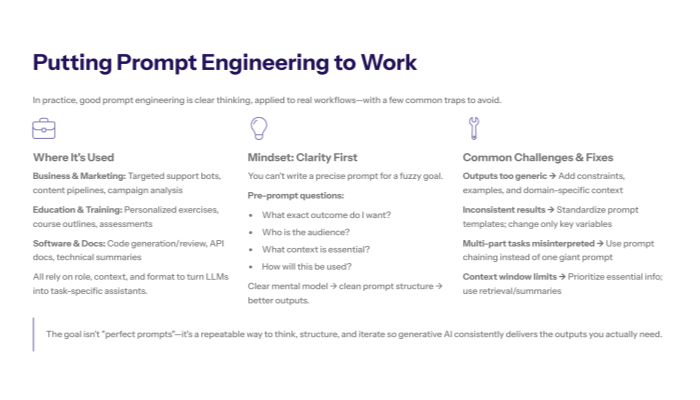
Effective prompt engineering fundamentally depends on clear thinking because you cannot write precise instructions about something you don’t understand clearly yourself. Fuzzy objectives lead to vague prompts, which generate unfocused outputs that require extensive revision and iteration.
Pre-Prompt Planning Framework
Essential questions to clarify before writing any prompt:
-
What specific outcome do I want? Define success criteria and deliverable specifications
-
Who is the intended audience? Identify expertise level, role, and information needs
-
What context is essential? Determine background information, constraints, and relevant parameters
-
How will this output be used? Consider downstream applications and required formats
-
What would failure look like? Anticipate potential problems and include preventive constraints
From Mental Models to Prompt Structure
Well-defined thinking translates directly into effective prompt components through systematic organization of objectives, constraints, and specifications. Clear goals enable specific instructions, comprehensive context, and measurable success criteria.
Example transformation:
-
Unclear thinking: “I need help with marketing”
-
Clarified thinking: “I need to increase email newsletter open rates for my SaaS product’s user onboarding sequence by creating more compelling subject lines that highlight specific feature benefits for new users”
-
Resulting prompt: “You are an email marketing specialist for B2B SaaS companies. Create 10 subject line variations for our user onboarding email sequence. Each subject line should: 1) Reference specific product features, 2) Create urgency around getting started, 3) Stay under 50 characters, 4) A/B test different emotional appeals (curiosity, benefit-focused, fear-of-missing-out). Target audience: new users who signed up but haven’t completed initial setup.”
This demonstrates how mental clarity about objectives, audience, and constraints directly enables precise prompt construction that generates relevant outputs.
Transition: Even with clear thinking and well-structured prompts, common challenges arise that require specific solutions and troubleshooting approaches.
Common Challenges and Solutions
These frequent problems occur when learning prompt engineering skills, along with proven solutions that improve consistency and effectiveness in ai tool interactions.
Challenge: AI Outputs Are Too Generic or Irrelevant
Solution: Add specific context, constraints, and few examples to narrow focus and eliminate generic responses that don’t meet specific needs.
Technique for increasing specificity: Include industry terminology, company-specific requirements, target audience details, and explicit constraints about what to avoid or exclude from desired outputs.
Challenge: Inconsistent Results Across Similar Prompts
Solution: Standardize prompt structure and test variations systematically to identify which elements most significantly impact output quality and consistency.
Create reusable prompt templates that include consistent role definitions, context frameworks, and format specifications, then modify only the variable elements for different use cases while maintaining structural consistency.
Challenge: AI Misunderstands Complex Multi-Part Requests
Solution: Break complex tasks into sequential steps using prompt chaining rather than attempting to accomplish everything in a single comprehensive prompt.
When to use sequential approaches: Tasks requiring intermediate validation, multi-stage analysis, or outputs that build upon previous results benefit more from systematic progression than single-prompt attempts.
Transition: Understanding these solutions reinforces the core principle that prompt engineering rewards structured, thoughtful approaches to ai tool utilization.
Understanding Generative AI and Desired Outputs
Understanding generative AI and how to achieve desired outputs is fundamental to effective prompt engineering. Generative AI systems, powered by large language models (LLMs), create content such as text, images, and code based on the input they receive. However, the quality and relevance of their outputs depend heavily on how well users craft their prompts.
By mastering the art of designing clear, specific, and context-rich instructions, users can guide AI models to produce accurate and tailored responses that meet their unique needs. This section explores the core concepts behind generative AI, the importance of defining desired outputs, and strategies to optimize prompt design for the best possible results.
Generative AI and Its Models
Generative AI, or gen AI, refers to advanced artificial intelligence systems capable of creating content such as text, images, and code based on input prompts. These generative AI models leverage large language models (LLMs) that have been trained on vast datasets, enabling them to understand and produce human-like language. The model's ability to interpret prompts and generate relevant, coherent, and contextually appropriate outputs is central to prompt engineering important for optimizing interactions with these AI systems.
One key aspect of generative AI models is their capacity to handle structured data and incorporate additional context, such as uploaded documents or relevant background information, which enhances the quality of their model's responses. Techniques like retrieval augmented generation (RAG) allow these models to access external knowledge bases dynamically, improving accuracy and reducing hallucinations by grounding responses in verified data.
Defining and Achieving Desired Output
Crafting a prompt that leads to a specific output is a core challenge in prompt engineering. The desired output must be clearly defined to guide the AI model toward producing optimal outputs. This includes specifying the format, style, and level of detail expected. For example, when asking a model "how many apples" remain after a series of transactions, chain of thought rollouts can help the AI break down the problem into intermediate steps, leading to the most commonly reached conclusion.
Providing examples within prompts is a powerful strategy to clarify expectations and improve the model's accuracy, especially for complex coding tasks or question answering scenarios. By guiding the AI through structured instructions and relevant context, prompt engineers can ensure the AI delivers a specific output aligned with user goals.
AI Models, Context Windows, and Critical Thinking in Prompt Engineering
Effective prompt engineering requires a solid understanding of AI models and their operational limits, such as the context window—the maximum amount of information the model can process at once. Knowing how to manage this context window ensures that prompts include the most relevant data without overwhelming the model.
Additionally, critical thinking plays a vital role in crafting prompts that balance clarity, specificity, and context, enabling AI systems to generate accurate, meaningful, and ethically sound responses. By combining technical insight into AI capabilities with thoughtful prompt design, users can unlock the full potential of generative AI models.
The Role of Context Window and AI Model Capabilities
The context window defines the amount of information a generative AI model can consider when generating a response. Understanding and managing this window is critical, as exceeding it can lead to loss of important details or degraded performance. Prompt engineering must account for this limitation by prioritizing essential information and structuring prompts efficiently.
The model's ability to process structured data and incorporate additional context, such as uploaded documents, directly impacts the relevance and accuracy of its responses. Advanced gen AI systems use retrieval augmented generation to pull in up-to-date information beyond their training data, enhancing their performance on real-world tasks.
Critical Thinking and the Human Element in Prompt Engineering
While AI models demonstrate impressive capabilities, they still rely on human intelligence to frame effective prompts. Critical thinking is essential for designing prompts that balance clarity, specificity, and context. This human oversight ensures that generative AI systems produce outputs that are not only accurate but also ethically sound and relevant.
As organizations recognize the value of prompt engineering, hiring prompt engineers has become a growing trend. These professionals blend technical knowledge with creative problem-solving to develop prompts that harness AI's full potential across various use cases, from generating images and code snippets to supporting complex question answering and decision-making workflows. Their expertise is vital to bridging the gap between raw AI capabilities and practical, impactful applications.
Conclusion and Next Steps
Prompt engineering transforms AI interactions from frustrating to powerful by treating generative ai systems as sophisticated tools that reward precise thinking and clear communication. The key insight is that ai models excel when users invest effort in clarifying objectives, providing context, and structuring requests systematically rather than expecting intuitive understanding of vague queries.
To get started:
-
Practice the clarity framework: Before your next three AI interactions, spend 2 minutes clarifying your specific objective, target audience, and desired output format
-
Master one prompting technique: Choose either few shot prompting with examples or chain of thought prompting for complex reasoning, and apply it consistently for one week
-
Implement the best practices checklist: Use the specificity, structure, and context checklists to immediately improve your prompt engineering skills and generate more accurate responses
Related Topics: AI safety and responsible ai considerations in prompt design, advanced prompt engineering for specific generative ai models and platforms, and building AI-powered workflows that integrate multiple prompting techniques for comprehensive automation systems. If you’d like to learn more or discuss your project, contact Cognativ’s AI and software experts .