The Hidden Cost of “We’re Doing Fine”: Signs Your Operating Model Is Failing
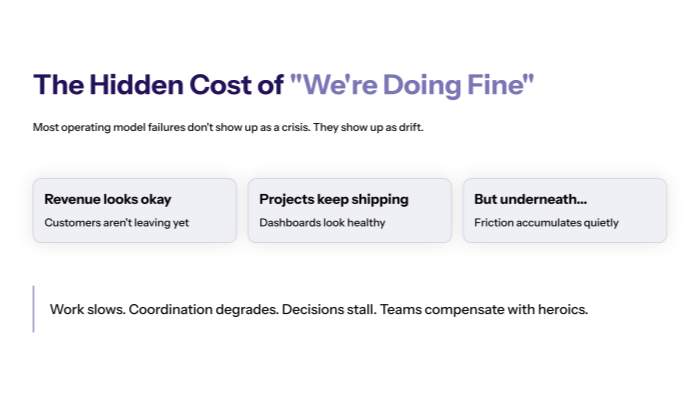
Most operating model failures don’t show up as a crisis. They show up as drift.
Revenue is “okay.” Customers aren’t leaving yet. Projects keep shipping. Leaders can point to dashboards that make the company look healthy. But underneath, the system is quietly accumulating friction: work slows down, coordination degrades, decisions stall, and teams start compensating with heroics.
RAPID is built for this exact moment—when the organization is trapped inside its own bubble and needs a brutally honest assessment of reality (“the audit”) to clear the fog, drive accountability, and align actions around measurable outcomes instead of vanity metrics.
Below are the most common signs your operating model is failing—and the hidden costs you’re already paying—plus a practical RAPID-aligned way to diagnose and fix it without turning the business into chaos.

Why “We’re Doing Fine” Is a Dangerous Story?
1.1 Vanity metrics create a false sense of control
One of the most consistent failure patterns in struggling companies is leadership relying on vanity metrics—numbers that feel reassuring but don’t explain performance in a way that improves future strategy. RAPID calls this out directly: vanity metrics are selected facts used to protect a decision or narrative, even when reality has changed.
Common “we’re doing fine” vanity signals:
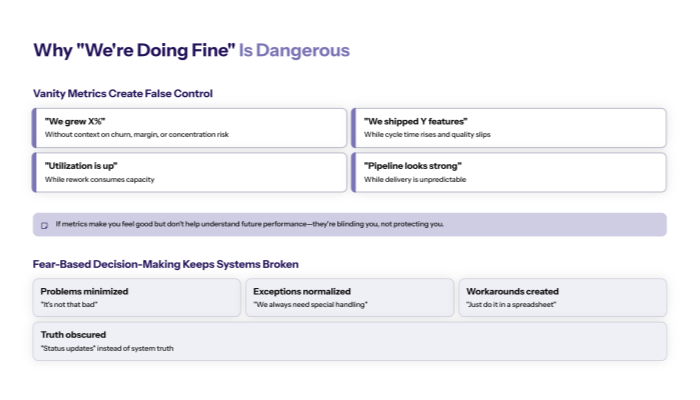
- “We grew X%” (without context on churn, margin, or concentration risk)
- “We shipped Y features” (while cycle time is rising and quality is slipping)
- “Utilization is up” (while rework is consuming capacity)
- “Pipeline looks strong” (while delivery is unpredictable)
RAPID’s stance is simple: if your metrics make you feel good but don’t help you understand performance in terms of future strategies, they’re not protecting you—they’re blinding you.
1.2 Fear-based decision-making keeps systems broken
When an operating model is failing, decision-making often becomes fear-based: leaders avoid the hard truths, teams avoid accountability, and everyone preserves short-term comfort. RAPID explicitly asks whether decisions are fear-based instead of fact-based—and whether leadership is open to information that contradicts their opinions.
This creates a predictable loop:
- Problems are minimized (“it’s not that bad”)
- Exceptions become normal (“we always need special handling”)
- People compensate with workarounds (“just do it in a spreadsheet”)
- Leaders get “status updates” instead of system truth
That’s why RAPID starts with the audit: a brutally honest assessment that clears fog created by ineffective communication and forces the organization back into reality.
The Hidden Costs You’re Paying (Even If Numbers Look Fine)
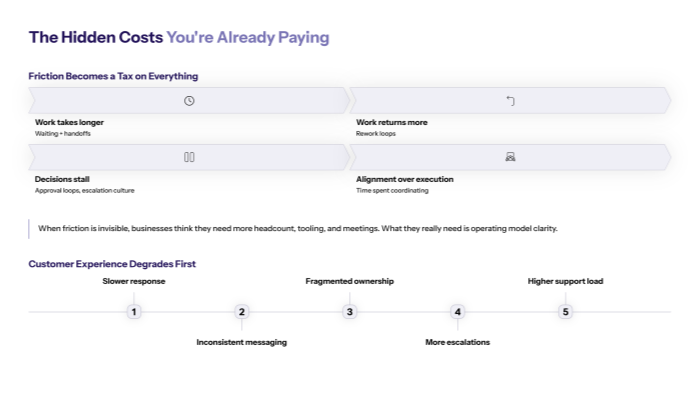
2.1 Friction becomes a tax on speed, quality, and capacity
When operating models fail, the business rarely collapses immediately. Instead, friction quietly taxes everything:
- Work takes longer (waiting + handoffs)
- Work returns more often (rework)
- Decisions stall (approval loops, escalation culture)
- Teams spend time aligning instead of executing
RAPID’s intent is to reduce friction and “cut to the chase” through quick, incremental measurement and adjustment.
If leaders don’t measure the right things, this tax becomes invisible. And when the tax is invisible, the business “feels” like it needs:
- more headcount
- more tooling
- more meetings
- more reporting
…but what it really needs is operating model clarity.
2.2 Customer experience degrades before churn shows up
A failing operating model hits customers long before revenue reflects it.
RAPID includes a Customer Relationship Quality (CRQ) check that focuses on basics like setting clear expectations, speaking with one voice, listening more than talking, underpromising/overdelivering, and responding the same day.
When CRQ starts slipping, the hidden costs show up as:
- slower response times
- inconsistent messaging across teams
- fragmented ownership (“not my department”)
- more escalations and exceptions
- higher support load (and lower trust)
These don’t immediately read as “churn,” but they are the early warning system that your operating model is losing coherence.
The Warning Signs Your Operating Model Is Failing
3.1 People and culture signals: the system is relying on heroics
RAPID is blunt: when it comes to the human aspect, “nothing is irrelevant.” You need to know who’s who, what they do, how they do it, and how committed they are—because culture can kill companies or save them.
Operating model failure often looks like:
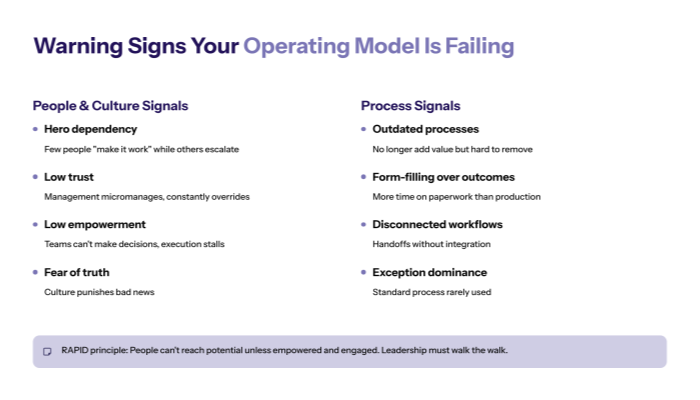
- Hero dependency: a few people “make it work” while everyone else escalates
- Low trust: management interferes too much, micromanages, or constantly overrides
- Low empowerment: teams can’t make implementation decisions close to the ground, so execution stalls
- Fear of truth: people avoid surfacing issues because the culture punishes bad news
RAPID emphasizes that people can’t reach their potential unless they’re empowered and engaged, and that leadership must “walk the walk” or it short-circuits the culture.
3.2 Process signals: bureaucracy outlives value
RAPID’s process planning guidance is direct: processes are supposed to save time and generate consistent outcomes—but many become outdated, more complex than helpful, and hard to dislodge because of bureaucracy and habit.
Signs process is driving operating model failure:
- You have processes for things that no longer need a process
- People spend more time filling forms than producing outcomes
- Workflows are disconnected across departments (handoffs without integration)
- Exceptions dominate (the “standard process” is rarely used)
- Teams work outside systems to get work done (shadow processes)
RAPID reminds you to apply the flywheel principle: one department’s processes affect others, and changes must be holistic.
A Practical Diagnostic (RAPID Audit) You Can Run in 5–10 Days
4.1 Use RAPID inventories to surface reality quickly
RAPID gives you a structured audit toolkit: inventories for customer value, outcomes, decisions, risks/fears, processes, products, and financial research.
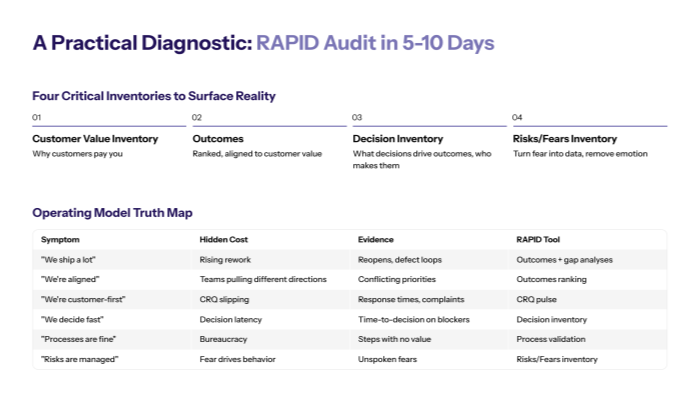
Start with these four, because they expose operating model failure fastest:
- Customer Value Inventory (why customers pay you)
- Outcomes (ranked, aligned to customer value)
- Decision Inventory (what decisions drive outcomes, who makes them)
- Risks/Fears Inventory (turn fear into data, remove emotion)
Then add:
- CRQ (customer relationship quality pulse)
- Self-awareness pulse (purpose, objectives, aligned actions)
This is how you replace “we’re doing fine” with evidence.
4.2 Turn symptoms into evidence using this table
Use this as your operating model “truth map”:
|
Symptom (“We’re doing fine” story) |
Hidden cost |
Evidence to collect |
RAPID tool to use |
|---|---|---|---|
|
“We ship a lot” |
Rising rework + low predictability |
Reopens, returns, defect loops |
Outcomes + gap analyses |
|
“We’re aligned” |
Teams pulling different directions |
Conflicting priorities by team |
Outcomes ranking |
|
“We’re customer-first” |
CRQ slipping silently |
Response times, complaints, inconsistent messaging |
CRQ pulse |
|
“We decide fast” |
Decision latency / escalation culture |
Time-to-decision on top blockers |
Decision inventory |
|
“Processes are fine” |
Bureaucracy and outdated workflows |
Steps that add no value, handoff delays |
Process plan validation |
|
“Risks are managed” |
Fear drives behavior |
Unspoken fears, avoidance patterns |
Risks/Fears inventory |
RAPID’s logic matters here: Research and Analyze form a flywheel, because analysis often reveals holes in what you collected and forces you back to research—most problems are “beneath the surface.”
The Fix: Stabilize the Operating Model Before You Scale Change
5.1 Build momentum with decisions and follow-up (not more reporting)
In RAPID, decisions are essential to keep momentum going—and they happen throughout the process, not only at the end.
Two operating-model-killer patterns:
- Decisions aren’t getting made (so work waits)
- Decisions are made without follow-up (so nothing changes)
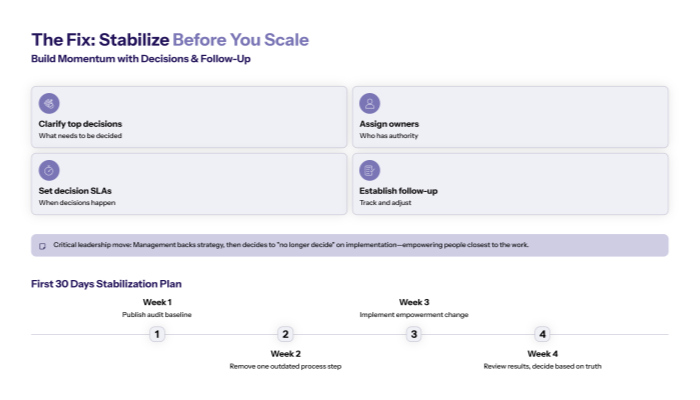
RAPID’s “Decide” phase includes a critical leadership move: management backs the strategy, then decides to “no longer decide” on implementation details—empowering the people closest to the work.
If your operating model is failing, your fastest win is usually:
- clarify top decisions
- assign owners
- set decision SLAs
- establish follow-up cadence
5.2 Prioritize easy wins that restore trust in execution
Once you have evidence, you need traction. RAPID emphasizes quick, incremental progress and making it easy for the organization to see improvement.
Use the Project Inventory to organize plans and force-rank wins (easy wins at the top), linking each to customer value and outcomes.
Practical “first 30 days” stabilization
- Week 1: publish audit baseline (outcomes + CRQ + top decisions + top friction)
- Week 2: remove one outdated process step that adds no value
- Week 3: implement one empowerment change (decision rights closer to execution)
- Week 4: review results, decide to stay/change/stop based on truth—not vanity metrics
Bottom line
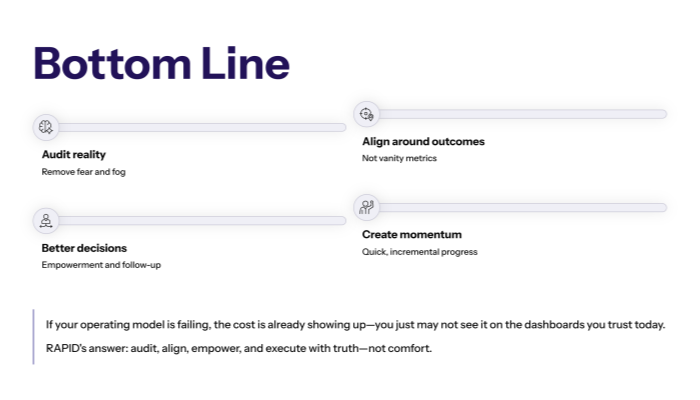
If your operating model is failing, the cost is already showing up—you just may not see it on the dashboards you trust today.
RAPID’s answer is to audit reality, remove fear and fog, align around measurable outcomes (not vanity metrics), and create momentum through better decisions, empowerment, and follow-up.