Transfer Learning for AI: Complete Guide to Efficient Model Development
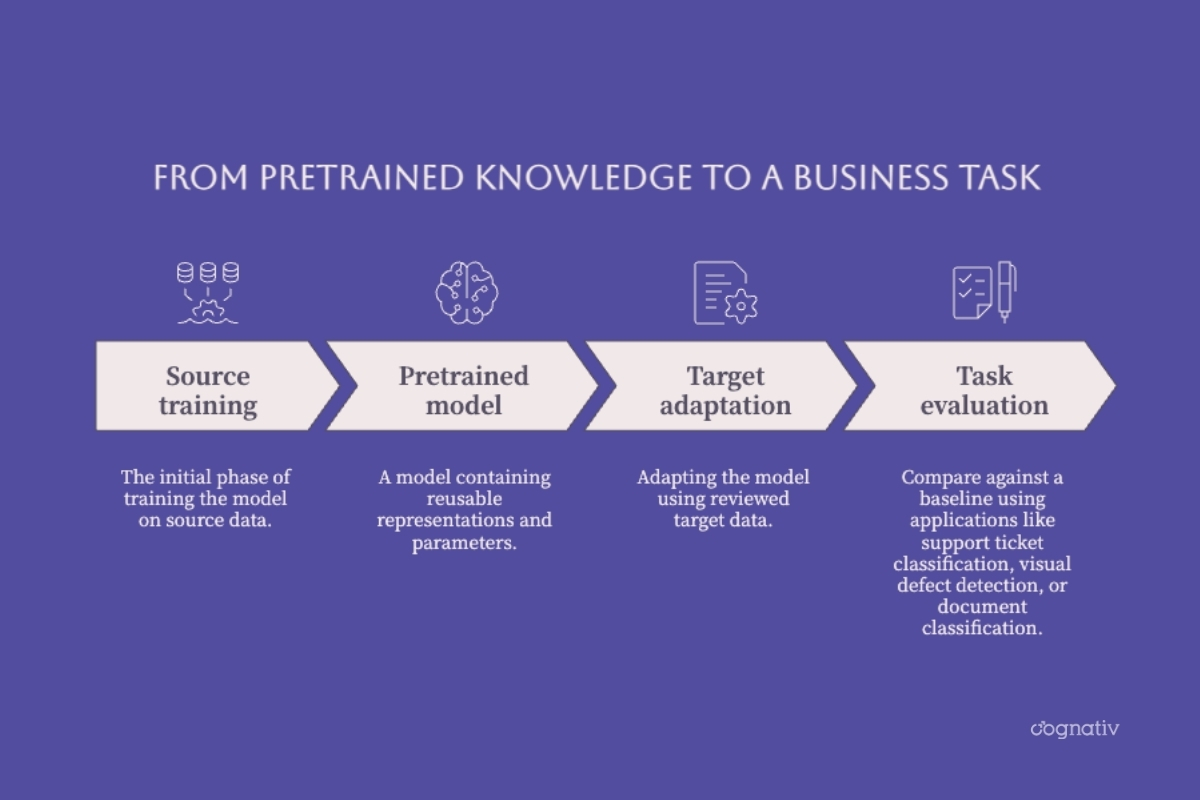
Transfer learning reuses knowledge learned from a source task or domain to help solve a target problem. Instead of training every machine learning model from scratch, enterprise teams can adapt pretrained representations or parameters to tasks such as document classification, visual inspection, and customer support analysis. The potential benefit is a better starting point, not a guaranteed reduction in data, cost, or development time.
This guide covers transfer learning fundamentals, model selection, adaptation methods, data preparation, evaluation, and deployment. It is written for enterprise development teams, AI project managers, and technology leaders connecting model performance to measurable business outcomes. The focus is implementation decisions rather than a framework-specific training tutorial.
The practical answer: define the target task, establish a baseline, select a compatible pretrained model, and test the smallest useful adaptation. Increase training complexity only when independent evaluation justifies it. A successful experiment must also fit the application's latency, security, integration, and operating requirements.
By the end of this article, you will understand:
- How source knowledge can support an enterprise target task.
- How inductive, transductive, and unsupervised transfer settings differ.
- When to use feature extraction, parameter-efficient adaptation, or full fine-tuning.
- How to prevent evaluation leakage and detect negative transfer.
- How to measure business value and release an adapted model responsibly.
Understanding Transfer Learning Fundamentals
Transfer learning is useful when existing knowledge can support a new task and collecting enough representative target data is difficult. However, a model trained on broad data can still fail on specialized inputs. The implementation must demonstrate that the reused knowledge helps the actual workload.
Core Concepts and Knowledge Transfer
A source domain describes the original input environment and distribution. A source task describes what the model learned to predict or produce. The target domain and target task describe the new operating problem. They may differ in language, image characteristics, labels, business processes, or data collection methods.
For example, a language model's representations may support support-ticket classification, while a visual backbone may provide useful features for identifying manufacturing defects. These are candidate applications, not evidence that any pretrained model will transfer successfully. Target evaluation must reflect the ticket categories or defect types the business actually needs to distinguish.
Pretrained Models and Enterprise Requirements
Model selection is also an architecture decision. Confirm the supported inputs, output interface, preprocessing, license, deployment options, and model version. A hosted service may permit inference but not customer-controlled fine-tuning. Downloadable weights provide a different operating model, but do not automatically make deployment inexpensive, private, or compliant.
Before committing to a model, define data boundaries and integration needs through AI-first architecture for enterprise systems. This helps prevent a promising training experiment from becoming incompatible with production requirements.
Keep an inventory of candidate artifacts and their provenance. Record why each candidate is plausible for the task and which restrictions could disqualify it. This creates a defensible comparison rather than selecting a model solely because it is large, popular, or performs well on an unrelated benchmark.
What Knowledge Can Transfer?
Reusable knowledge can include representations, model parameters, selected source examples, or relationships between entities. Visual features and language representations are common examples, but their usefulness depends on the relationship between the original training environment and the new task.
Distinguish reusing a representation from changing model behavior through training. Adding current documents to a retrieval workflow changes the information supplied at inference time; fine-tuning changes trained parameters or adapters. If the business problem is missing current information rather than task-specific behavior, evaluate retrieval before assuming additional training is required.
Choose an Adaptation Method
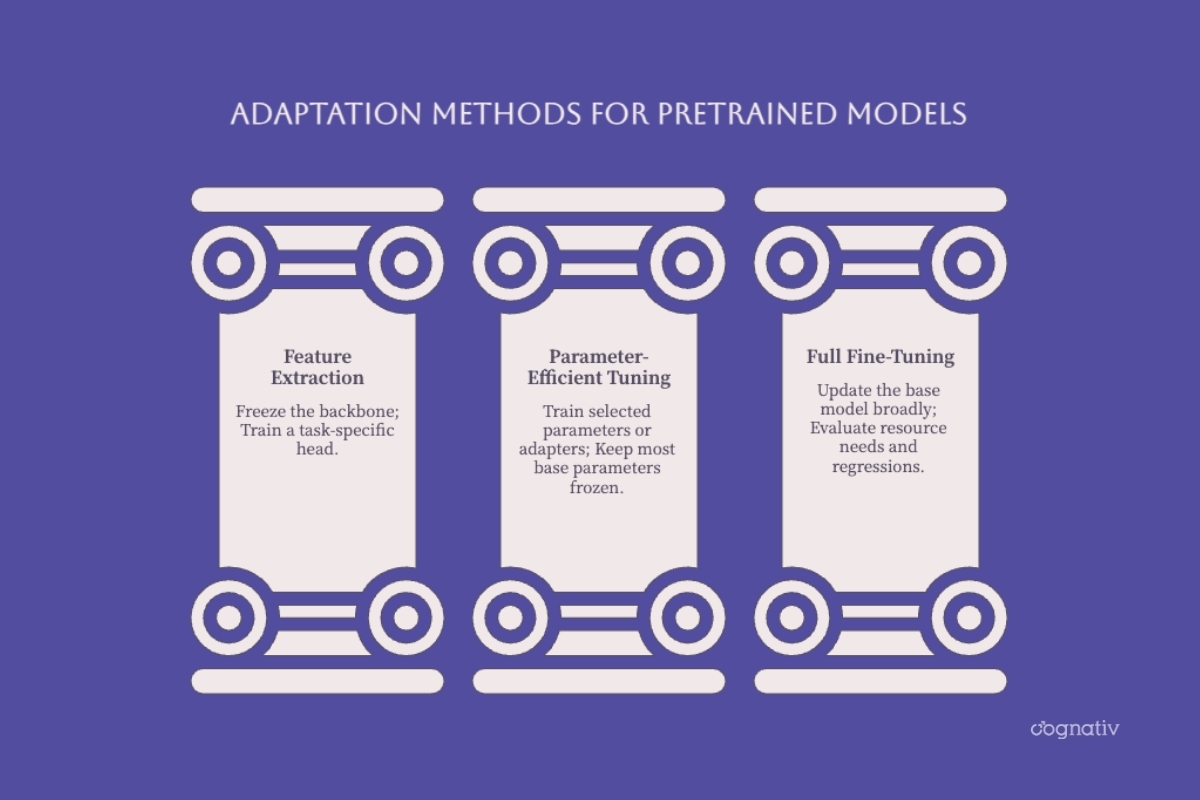
Feature extraction, parameter-efficient tuning, and full fine-tuning are implementation choices. They are not a mandatory sequence, and the training framework must support the selected method.
Feature Extraction with a Frozen Backbone
A common starting point is to keep the pretrained backbone frozen and train a task-specific head on its representations. The official Keras transfer learning guide explains this pattern and optional fine-tuning. It also distinguishes trainable weights from training versus inference behavior, which matters for layers such as BatchNormalization.
A frozen representation can be a useful baseline even if a more flexible method eventually wins. It provides a concrete answer to whether the existing features already separate the target categories sufficiently well.
Parameter-Efficient Adaptation
The original LoRA research paper describes freezing pretrained weights while learning low-rank updates. This reduces the number of trainable parameters relative to full fine-tuning in the studied configurations. The exact training-memory, quality, and serving implications still depend on the chosen model and implementation.
Adapters are not a guarantee against behavioral regression. Keep both the base-model version and adaptation artifact identifiable, and validate the combined model. For additional background, see how low-rank adaptation works in language models.
Full Fine-Tuning
Full fine-tuning updates the base model broadly. Consider it when a simpler adaptation does not meet the target requirements and the available data, compute, and evaluation process justify the additional scope. More trainable parameters do not automatically produce a better production outcome.
| Method | What changes | Key evaluation question |
|---|---|---|
| Frozen features and task head | The task-specific predictor; backbone weights stay frozen | Do existing representations support the target task? |
| Parameter-efficient tuning | Selected parameters or added adaptation components | Does adaptation improve quality within the resource budget? |
| Full fine-tuning | Base-model parameters broadly | Does the gain justify training cost and regression risk? |
Types of Transfer Learning Approaches
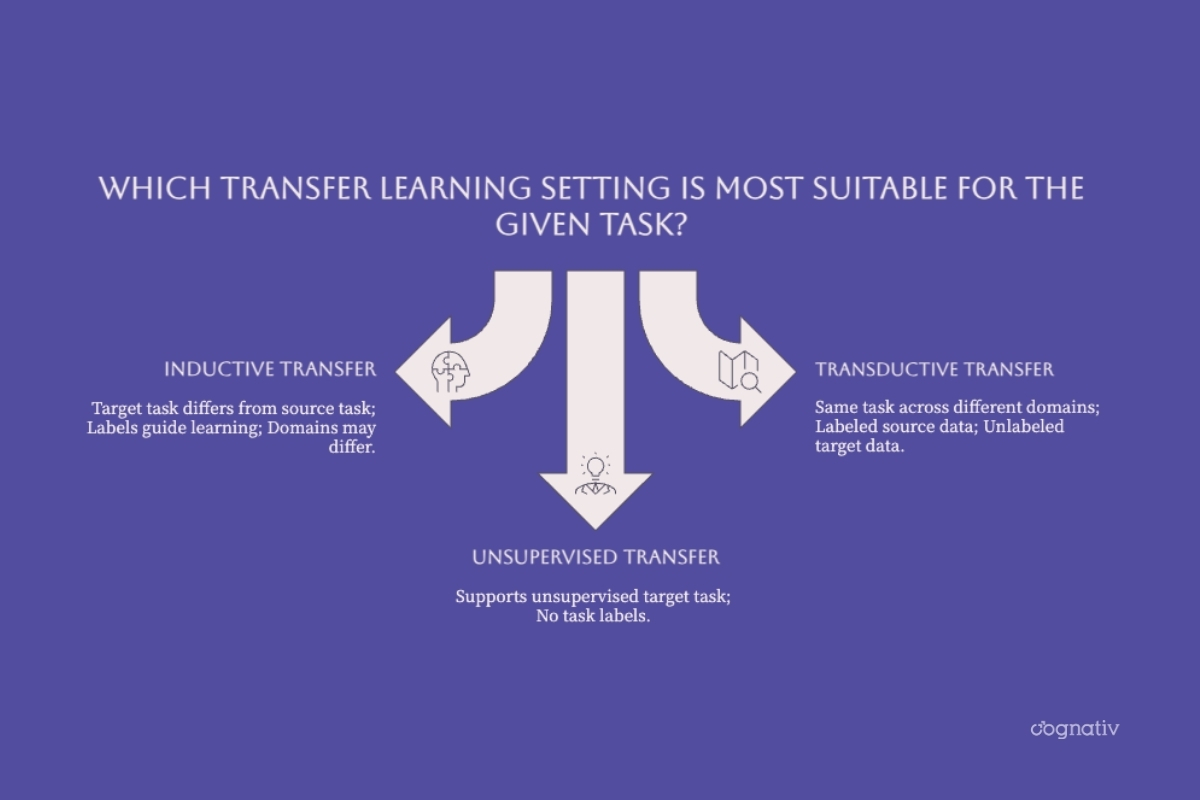
The classic taxonomy in Pan and Yang's A Survey on Transfer Learning separates settings by the relationship between domains, tasks, and available labels. These categories describe the learning problem rather than a specific training library or adapter.
Inductive Transfer Learning
The target task differs from the source task, and labeled target data is available. Source and target domains may be the same or different. Adapting pretrained language representations to a labeled contract-classification task is an example. Similar domains are not a requirement of the definition.
Transductive Transfer Learning
In the classic setting, the task stays the same while domains differ, with labeled source data and no labeled target training data. Domain adaptation addresses related distribution-shift problems. An unchanged classification objective applied to a different input environment is a candidate setting, but target performance still needs credible evaluation.
Unsupervised Transfer Learning
The classic unsupervised setting concerns related but different tasks without labeled source or target training data, such as transferring representations for clustering. It is not synonymous with every zero-shot application or self-supervised training procedure. Avoid ranking its accuracy or labeling savings against other settings without a common task and evaluation.
For project planning, write down the actual source task, target task, and label availability instead of relying only on a category name. This also exposes missing requirements: an unlabeled target dataset may support adaptation experiments while leaving the business unable to verify whether the resulting predictions are useful.
Implementing Transfer Learning in Enterprise Projects
Implementation begins with a reproducible dataset and a measurable task. Training settings should follow those decisions, not substitute for them.
Dataset Preparation and Domain Assessment
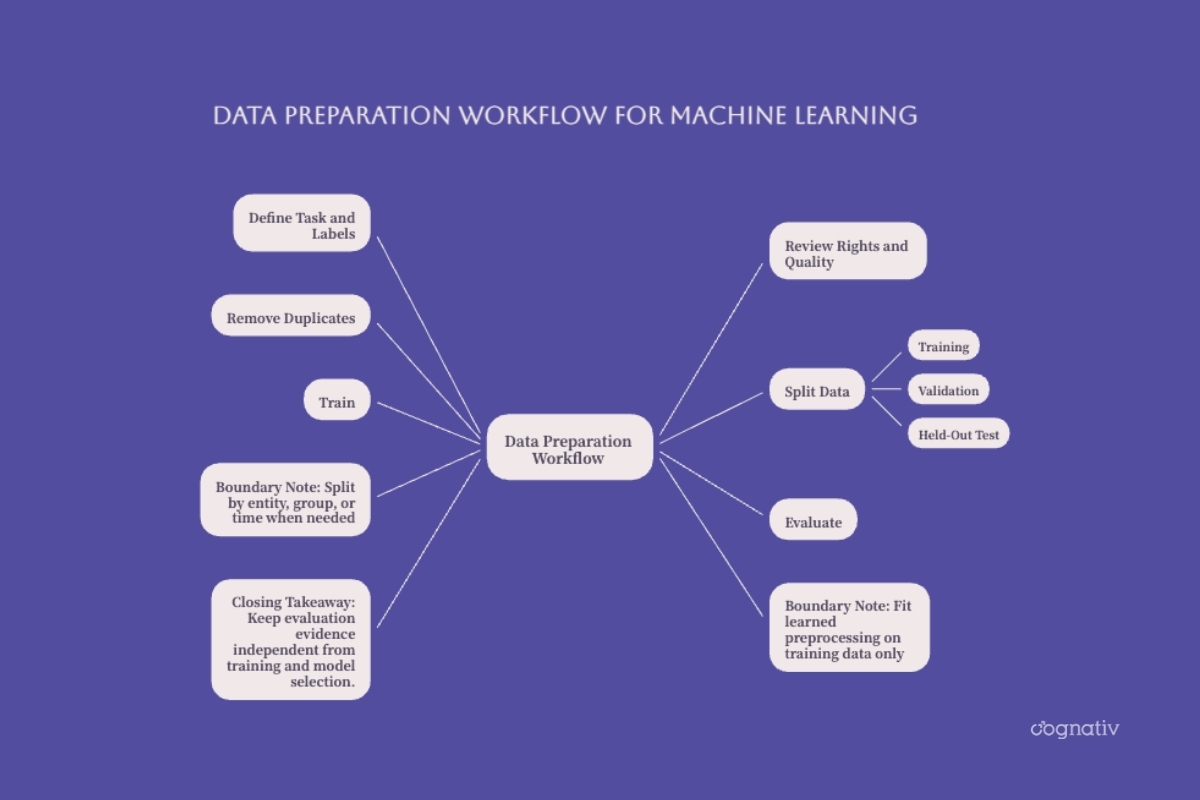
- Define the task and labels. Document class meanings, ambiguous cases, exclusion rules, and the intended output.
- Review rights and provenance. Confirm permitted data use, source-model terms, access controls, and retention requirements.
- Inspect quality and shift. Check label consistency, missing inputs, duplicates, class imbalance, and differences from expected production data.
- Create independent splits. Separate training, validation, and held-out test data before augmentation. Split by customer, document family, production batch, or time where ordinary random splitting could leak information.
- Version the evidence. Record dataset versions, split assignments, preprocessing, and review decisions so that experiments can be compared.
Use training data to fit learned preprocessing. Apply the resulting transformation consistently to validation and test data. Training augmentation should preserve the target label; do not use augmented test examples as a substitute for an independent evaluation set. Domain visualizations can guide investigation but do not establish that transfer will work.
There is no universal minimum dataset size. Measure performance as representative training coverage grows, examine errors in rare but important categories, and decide whether additional labels or a different formulation would be more valuable than a larger model.
Model Selection and Architecture Strategy
Match the model family to the required output. A classification backbone is not a complete object detector, and a text encoder is not interchangeable with a generative language model.
| Candidate family | Potential application | Check before selection |
|---|---|---|
| Visual backbones, such as ResNet or EfficientNet | Image classification and visual features | Input resolution, preprocessing, domain fit, and task head; detection needs an appropriate detector |
| Text encoders, such as BERT or RoBERTa | Text classification and document representations | Tokenizer, language coverage, sequence limits, and target labels |
| Generative language models | Text generation and structured responses | Adaptation support, output evaluation, memory, and serving constraints |
| Vision-language models, such as CLIP | Image-text retrieval and representation matching | Modality alignment, domain-specific vocabulary, and retrieval evaluation |
Benchmark on the intended serving environment. Training memory and inference memory are different budgets, and preprocessing or downstream validation may dominate end-to-end latency. Include model loading, concurrency, and failure handling in the operating plan rather than reporting accelerator throughput alone.
Training and Fine-Tuning Process
Establish a baseline, train a supported adaptation, select settings using validation data, and reserve the held-out test for evaluation of the selected candidate. Keep experiment identifiers linked to code, data, and model versions.
For a frozen-backbone workflow, train the new head before considering unfreezing. Fine-tuning may require a lower learning rate and framework-specific handling of trainability changes. Progressive unfreezing is an option, not an essential step for every architecture. Consult the framework documentation rather than applying one recipe universally.
For language-model projects, review practical fine-tuning preparation and evaluation alongside the exact model's supported training interface. Prompting an unchanged model can be a baseline, but it is not the same operation as training an adapter.
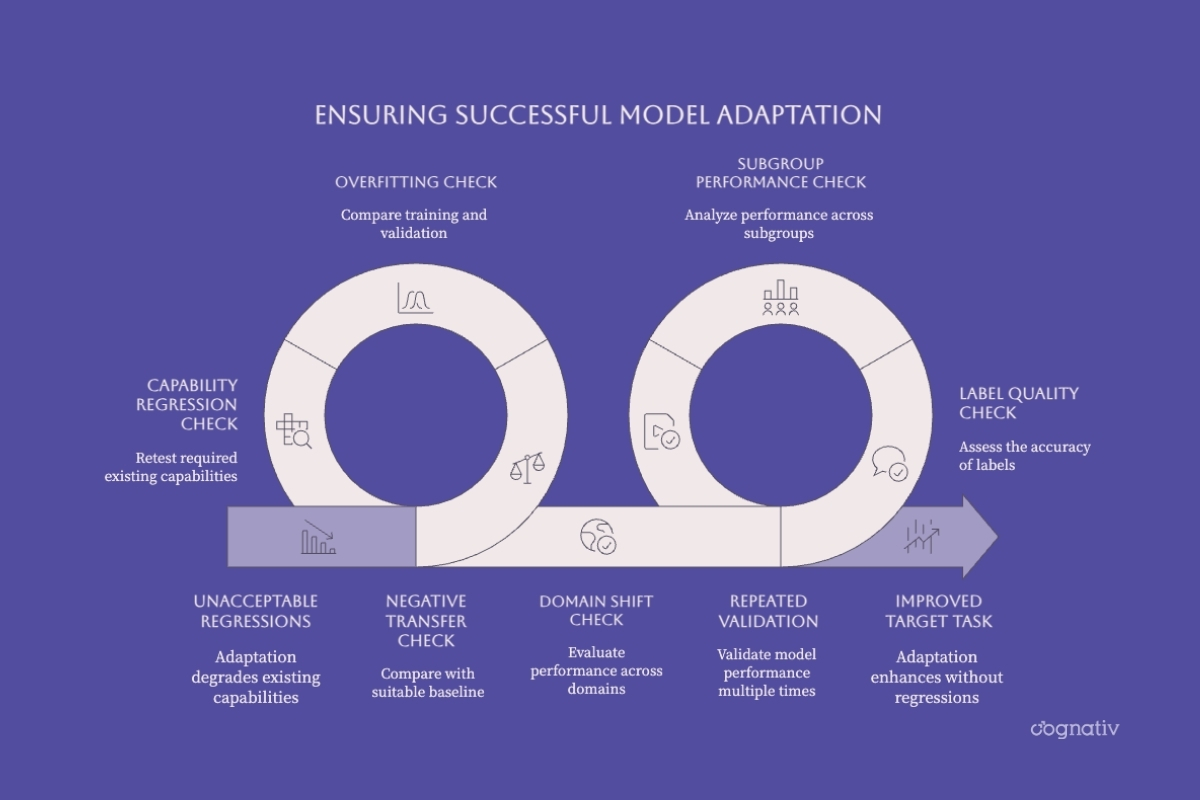
Improved target performance without unacceptable regressions is an acceptance criterion, not a guaranteed result of adaptation. Compare candidates against independent evaluation evidence.
Common Challenges and Solutions
Inspect failures before increasing training complexity. An apparent modeling problem may originate in inconsistent labels, leakage, incompatible preprocessing, or an unsuitable task definition.
Domain Mismatch and Negative Transfer
Negative transfer means the transferred knowledge harms target performance relative to an appropriate comparison. It can occur even when tasks appear related. Compare against a simple target-data baseline and, where useful, the unadapted model under the same evaluation conditions.
If the candidate loses, examine source suitability, label quality, adaptation settings, and distribution differences. Consider a different source model or a narrower task rather than assuming more fine-tuning will solve the problem. Report uncertainty when the evaluation set is too small to distinguish candidates reliably.
Overfitting and Catastrophic Forgetting
Overfitting occurs when training improvements do not generalize to independent data. Monitor validation behavior and consider regularization, early stopping, better data coverage, or a smaller adaptation. Catastrophic forgetting concerns loss of previously learned capabilities after additional training.
Retest capabilities that the product must retain, not only the new target task. Frozen base weights preserve that artifact, but an attached adapter can still change the combined system's behavior. Keep a known-good version available and document any accepted regressions explicitly.
Resource, Security, and Deployment Constraints
Budget for training, evaluation, storage, serving, monitoring, and maintenance. Parameter-efficient methods can reduce trainable state, but the base model still needs to run. Quantization or other inference changes require their own quality checks; they are not automatically equivalent to the evaluated training configuration.
Protect datasets and model artifacts according to their sensitivity. Avoid placing private examples or credentials in experiment logs. Define who can approve a model for release and which results must accompany the approval. Model adaptation does not itself establish compliance or production readiness.
Measure ROI and Plan a Controlled Release
Evaluate transfer learning against the current workflow, not only against training from scratch. The useful alternative might be a smaller model, an existing classifier, retrieval, or a process improvement. Count avoided effort only when the team can demonstrate that the new workflow actually removes it.
Track task quality, human correction effort, end-to-end latency, and cost per accepted result. For imbalanced classification, examine precision and recall at an operating threshold that reflects error costs. For generative tasks, use representative examples and review criteria that distinguish a fluent response from a correct one.
Report the measurement period, workload, sample size, and assumptions behind any ROI estimate. Include preparation, labeling, integration, and ongoing review costs. Training speed is useful operational evidence, but is not a complete measure of business value.
A staged release should move from an offline baseline to a controlled experiment, limited pilot, and approved deployment. Monitor production inputs and reviewed outcomes for changes that invalidate the evaluation. Maintain a rollback path and define who decides when to retrain, recalibrate, or pause the system.
This is where AI software development for production workflows connects the adapted model to application interfaces, monitoring, ownership, and support. A successful training run is one component of that delivery process.
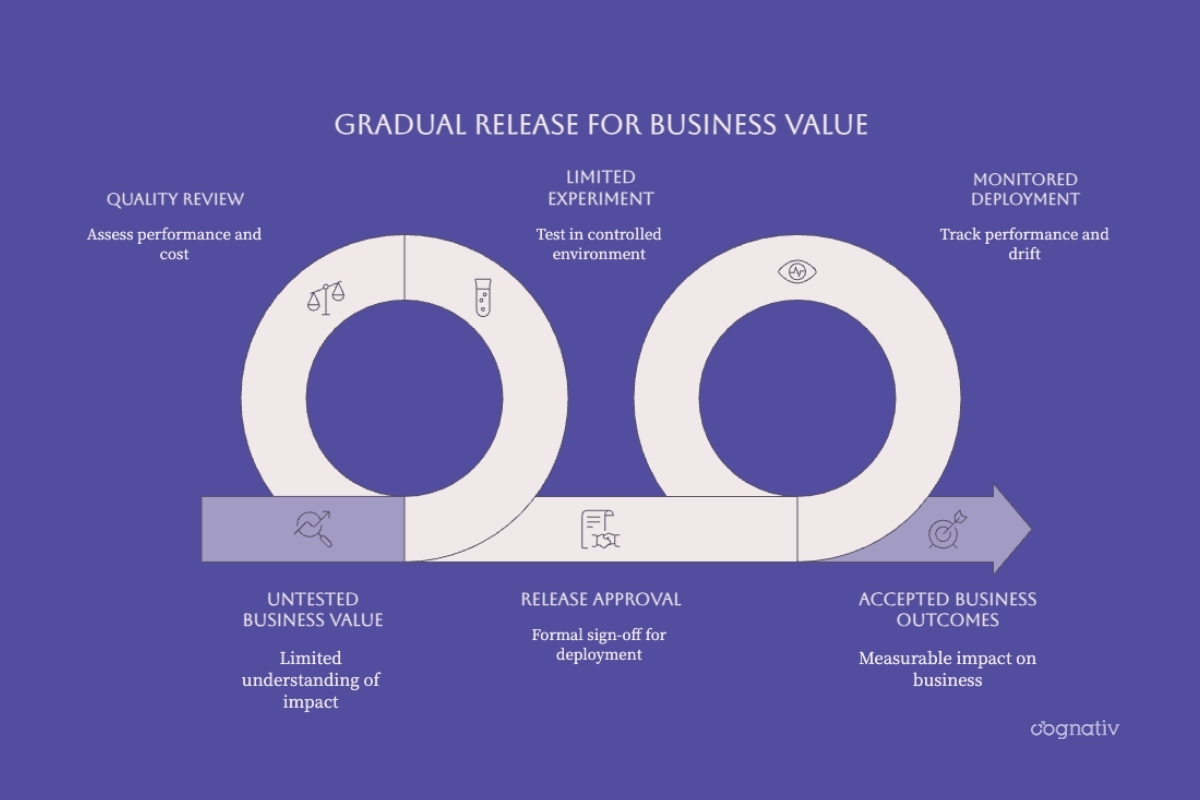
Establish a baseline before the limited experiment, then review quality and cost before approving deployment. Monitoring informs later evaluation; it does not replace the release gate.
Conclusion and Next Steps
Transfer learning offers a practical way to build on existing knowledge, but enterprise success depends on target-task evidence. Select a suitable source, preserve independent evaluation, compare adaptation methods, and validate the complete deployment rather than promising universal savings.
- Choose one target task with a clear owner and measurable outcome.
- Review candidate models, data rights, and deployment constraints.
- Compare a simple baseline with a supported adaptation method.
- Approve release only after quality, cost, and regression checks.
To scope a practical implementation, discuss your enterprise transfer learning project with Cognativ. Bring the target workflow, available data, candidate models, and current performance baseline so the next step addresses the actual delivery requirements.