Travel AI Software Development Services: Custom Solutions for Modern Travel Companies
Travel AI software development services create custom enterprise systems that use machine learning, natural language processing, predictive analytics, computer vision, and generative AI to improve travel booking platforms, operations management, and customer experience workflows. For travel companies, these services turn artificial intelligence into practical software solutions for faster booking, better personalization, smarter forecasting, stronger security, and more efficient service delivery.
This article covers AI-enabled booking automation, personalization engines, revenue forecasting, operations optimization, and customer workflow enhancement for mid-market and enterprise travel companies. It is written for travel industry executives, technology leaders, operations managers, travel agencies, and digital product teams evaluating AI implementation for competitive advantage, operational efficiency, and scalable modernization across existing travel management systems.
In short: travel AI software development services build custom intelligent systems that automate the booking process, personalize customer experiences, and optimize pricing strategies using ai technologies tailored to travel business workflows. The best ai solutions are not generic tools; they are tailored ai solutions that connect with reservation systems, booking platforms, payment processors, customer service tools, and real time data sources.
By the end, you will understand how travel ai solutions can support:
Enhanced booking conversion rates through personalized recommendations and reduced booking friction
Reduced operational costs by automating repetitive tasks, guest check-ins, inventory management, and staff scheduling
Improved customer satisfaction through ai powered chatbots, virtual assistants, personalized itineraries, and 24/7 support
Real-time pricing optimization using dynamic pricing algorithms, market trends, customer behavior, and travel demand signals
Scalable automation capabilities that improve operational efficiency across customer service, forecasting, resource management, and disruption handling
Understanding Travel AI Software Development
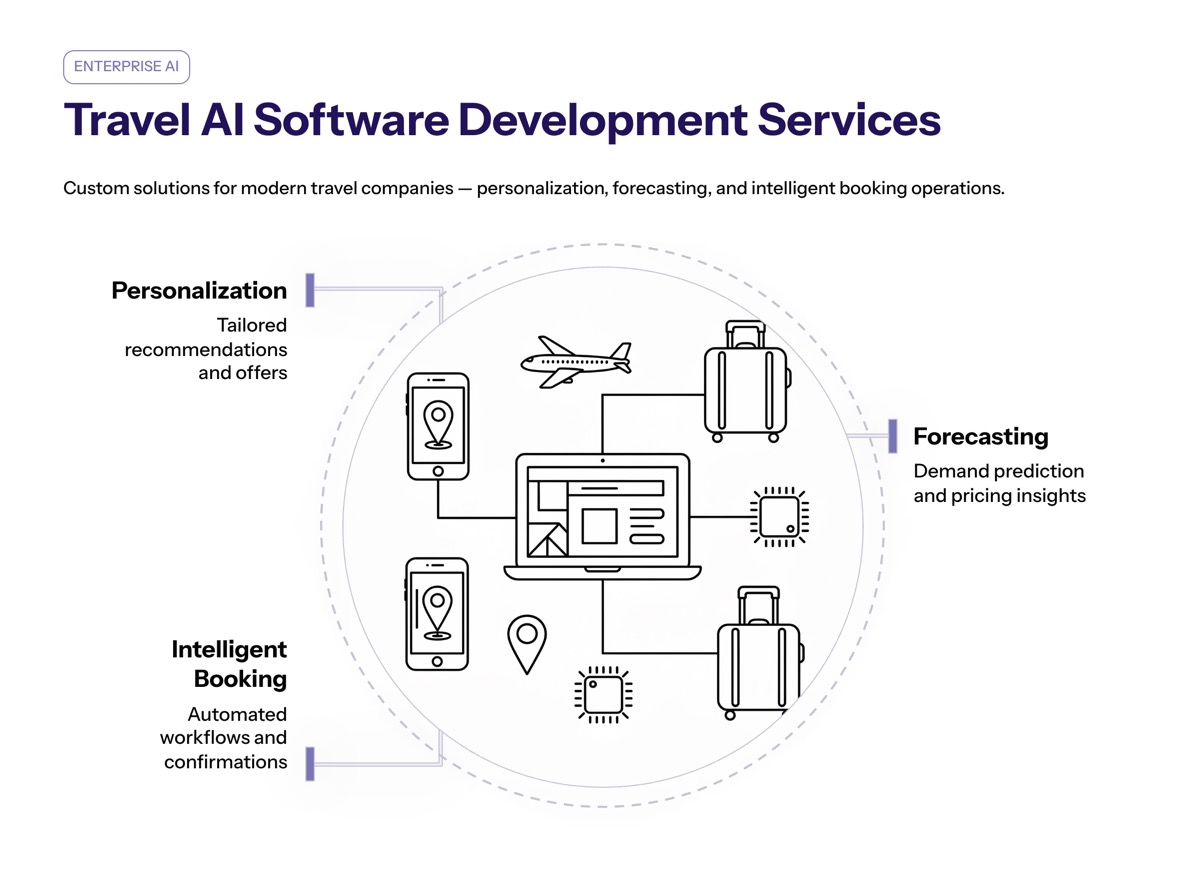
Travel AI software development is specialized custom software development that combines travel industry expertise with artificial intelligence to solve complex operational, commercial, and customer experience problems. It includes building ai models, data pipelines, user interfaces, workflow automation, and integrations that help travel businesses analyze data, predict customer behavior, optimize pricing strategies, and deliver personalized services at scale.
This differs from generic ai solutions because the travel and tourism industry has specific constraints: live inventory, changing flight and hotel prices, cancellation rules, payment security, multi-currency transactions, location data, customer preferences, past travel history, loyalty programs, supplier APIs, and unpredictable disruption events such as flight delays. AI-based travel software development requires balancing data personalization with complex, real-time logistics, which is why custom ai solutions are often more effective than plug-and-play tools.
AI automates complex processes and hyper-personalizes user experiences in travel software. AI solutions can streamline the customer journey by integrating various travel services, guiding customers smoothly from planning to booking and beyond, which positively influences user experience and increases conversion rates. AI solutions can also streamline the organizational journey by offering integrated solutions that guide customers smoothly from planning to booking, positively influencing user experience and increasing conversion rates.
Core AI Technologies for Travel
Machine learning algorithms are central to travel ai solutions because machine learning can analyze historical data, customer data, pricing trends, customer behavior, travel history, and external market trends to support demand forecasting, dynamic pricing, fraud detection, personalization, and resource management. Predictive analytics helps travel companies forecast travel demand, optimize inventory, plan staffing, and identify market opportunities before competitors react.
Natural language processing powers ai powered chatbots, virtual assistants, ai travel assistants, and ai travel agent workflows that can understand traveler intent, answer questions, process changes, and escalate complex cases. AI-powered chatbots can provide 24/7 customer support, handling inquiries and bookings in real-time, which enhances overall customer service efficiency without the need for constant human intervention. These tools enhance customer service by reducing wait times, improving consistency, and supporting modern travelers across websites, apps, messaging channels, and call center workflows.
Computer vision supports document verification, identity checks, baggage workflows, streamlined check-in processes, and security use cases. Computer vision can help travel companies validate passports or IDs, support kiosk-based check-ins, and reduce manual review in regulated operational environments.
Generative AI expands travel planning capabilities by creating personalized itineraries, destination summaries, service recommendations, and conversational trip-planning experiences. An ai powered ultimate travel companion can use customer preferences, personal preferences, user preferences, past travel history, real-time information, and booking constraints to suggest flights, hotels, activities, and add-ons in a way that feels relevant rather than generic.
Integration with Travel Industry Systems
Effective ai integration depends on secure API connectivity with Global Distribution Systems, direct supplier APIs, booking platforms, reservation systems, property management systems, customer databases, loyalty systems, and payment processors. Data cleanliness involves cleansing legacy Global Distribution System (GDS) data formats for high-quality training inputs, because inconsistent supplier data can weaken ai models and reduce forecasting accuracy.
Real-time data synchronization is equally important. Real-time pipelines enable instant processing of live flight updates and inventory changes in travel software, while connected systems keep reservation management, customer service platforms, pricing engines, and mobile apps aligned. Unified profiles centralize data from loyalty programs, browsing history, and mobile app interactions into a single customer view, allowing travel businesses to improve personalized recommendations and targeted marketing campaigns.
Secure payment gateways, multi-currency workflows, and compliance controls must be built into travel ai solutions from the start. Securing payment systems in travel software requires compliance with PCI DSS, and data privacy compliance is crucial for travel technology, particularly with regulations like GDPR and CCPA.
Once these foundations are in place, ai development can move from isolated experiments to practical applications across booking, personalization, forecasting, operations, and customer workflows.
Essential Travel AI Software Development Services
The strongest travel AI software development services translate ai capabilities into production-ready software solutions that improve business performance. Rather than adding artificial intelligence as a surface-level feature, custom ai development connects models, data, workflows, and user experiences across the travel business.
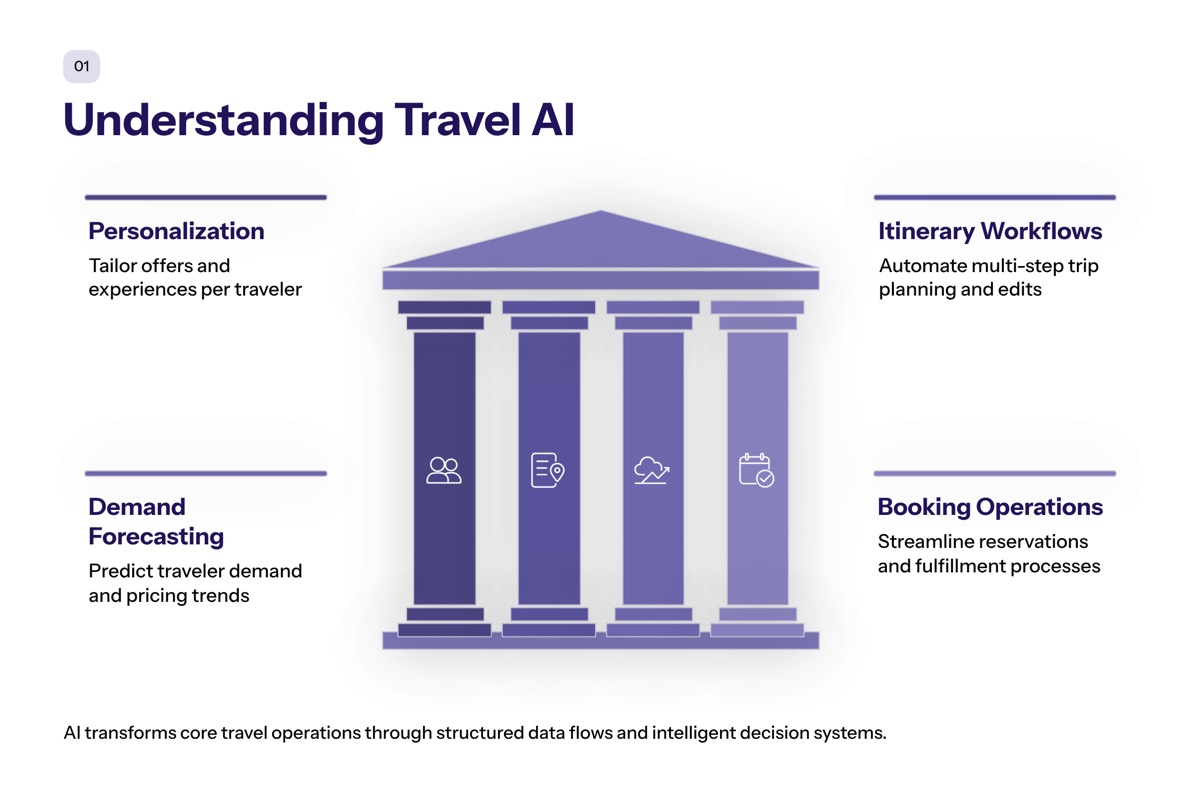
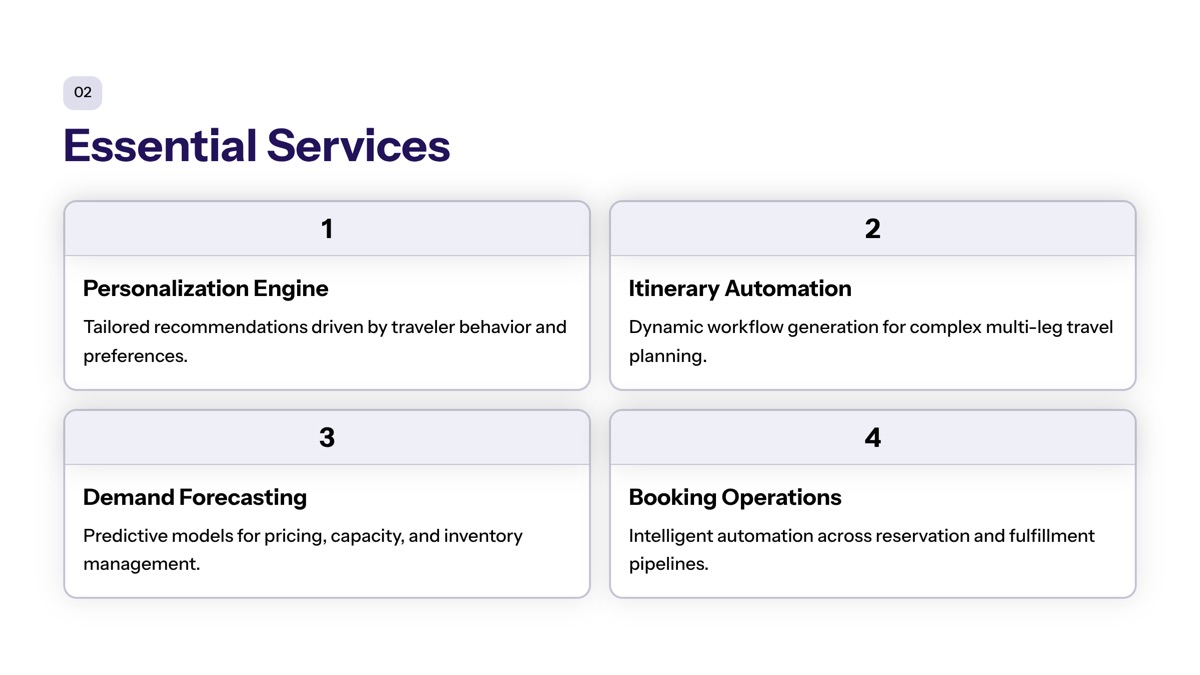
For most travel companies, the highest-value areas are intelligent booking and reservation systems, customer experience personalization platforms, and revenue forecasting and analytics solutions. These services help travel agencies, online travel agencies, tour operators, hospitality groups, transport providers, and corporate travel platforms compete on speed, relevance, and operational efficiency.
Intelligent Booking and Reservation Systems
AI-powered search optimization personalizes flight, hotel, and package recommendations based on customer behavior, customer preferences, individual preferences, past travel history, and user behavior. AI can automate and personalize the travel booking process by analyzing customer preferences and past behaviors to suggest tailored travel options, streamlining the booking flow, and increasing conversion rates.
AI can simplify the booking process by automating tasks such as price comparison, availability checks, and itinerary creation, which reduces friction in the customer journey and leads to faster conversions. AI-powered chatbots can enhance the booking experience by providing real-time assistance, handling inquiries, and facilitating bookings without the need for constant human intervention.
Dynamic pricing is another core service. AI-powered dynamic pricing allows travel companies to adjust prices in real time based on various factors, including demand, competition, and customer behavior, maximizing revenue and improving load factors. Dynamic pricing strategies in the travel industry utilize machine learning algorithms to analyze market data, competitor prices, and demand patterns, enabling businesses to optimize their pricing in real time. By leveraging AI for dynamic pricing, travel companies can identify optimal price points that customers are willing to pay, leading to increased bookings and improved profitability.
Automated booking workflow management reduces cart abandonment, failed bookings, rebooking delays, and manual intervention. When flight delays or supplier disruptions occur, ai powered solutions can help identify affected travelers, suggest alternatives, and route exceptions to travel agents or support teams.
Customer Experience Personalization Platforms
Hyper-personalization in travel software analyzes user behavior to suggest tailored itineraries, hotels, and activities. AI technology enables travel businesses to personalize interactions by analyzing individual preferences, behaviors, and booking history, enhancing customer loyalty.
Machine learning recommendation engines can suggest tailored destinations, personalized itineraries, accommodations, excursions, insurance, upgrades, and add-on services. AI-driven recommendation systems analyze user data to provide tailored suggestions for travel destinations, accommodations, and activities, improving customer satisfaction. AI can create personalized travel itineraries by considering customer preferences, historical data, and real-time information, leading to unique travel experiences.
Behavioral analysis systems track customer interactions across mobile apps, websites, email, call centers, chat, and in-destination touchpoints. This allows travel companies to predict customer behavior, identify intent, and adapt marketing strategies based on real preferences rather than broad audience assumptions.
AI can also analyze customer feedback, reviews, and social media mentions to gauge customer sentiment, providing insights for improving services and offerings in the travel industry. These data driven insights help customer service teams, product teams, and operations leaders understand where service delivery is working and where the customer experience needs improvement.
Revenue Forecasting and Analytics Solutions
Predictive analytics platforms forecast demand patterns, seasonal trends, pricing trends, customer behavior, and market opportunities. AI can harness predictive analytics to forecast travel demand, pricing trends, and customer behavior, enabling businesses to optimize pricing, manage inventory, and tailor marketing strategies effectively based on anticipated travel patterns and market demand.
By analyzing large datasets that include historical booking data, search trends, economic indicators, and social media sentiments, AI improves travel forecasting accuracy, allowing tourism boards to make informed decisions on marketing campaigns and resource allocation. For travel companies, the same forecasting discipline supports smarter route planning, hotel allotment decisions, staffing, supplier negotiations, and revenue management.
Pricing optimization algorithms help maximize revenue per customer while maintaining competitiveness. These systems combine competitor prices, demand signals, booking windows, cancellation patterns, customer segments, and inventory constraints to recommend rate changes or automate approved pricing actions.
Performance dashboards convert complex ai outputs into operationally useful views. Dashboards can show booking trends, cancellation risk, conversion paths, support demand, inventory exposure, predicted demand spikes, and business performance metrics. AI-driven insights enable travel businesses to create targeted initiatives to attract visitors during off-peak periods, balancing tourist flow throughout the year and enhancing overall destination management.
Travel AI Software Development Process and Implementation
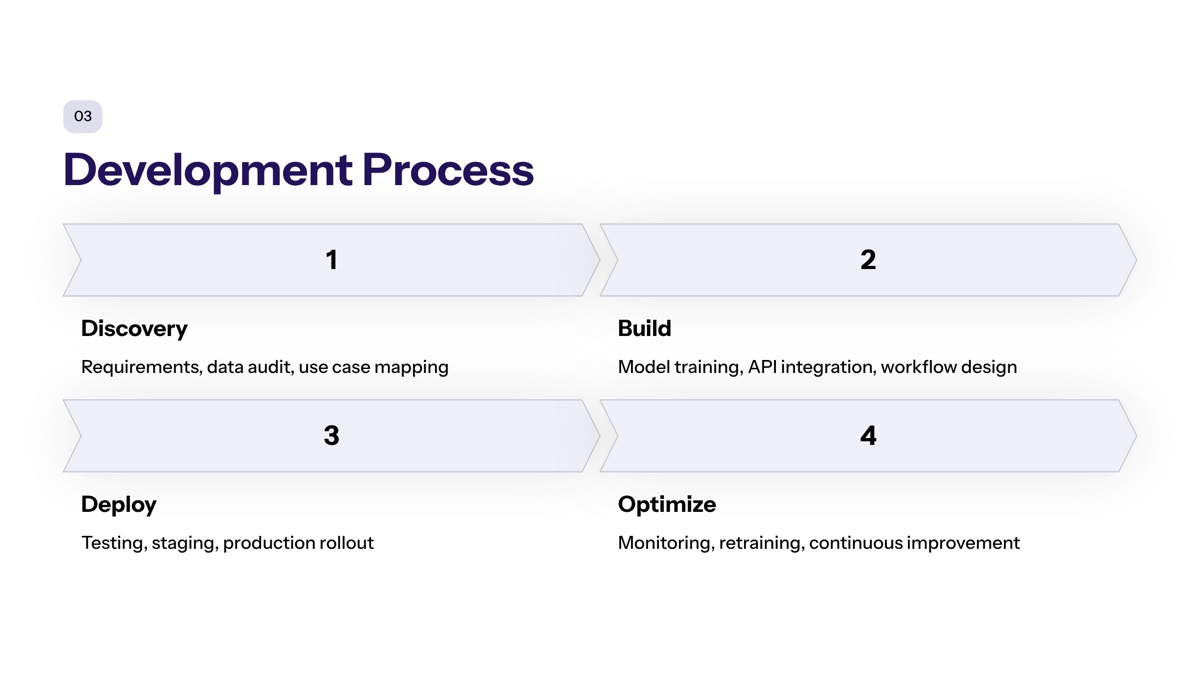
Moving from ai concepts to working travel software requires a structured process. Successful ai implementation is not only a model-building exercise; it includes data readiness, workflow design, systems integration, security, user adoption, and continuous optimization.
Cognativ’s RAPID framework provides a practical structure for AI-driven modernization in travel companies. It helps teams move from business case to production while reducing risk across booking platforms, customer workflows, forecasting systems, and operations.
RAPID Framework for Travel AI Implementation
Use the RAPID framework when a travel business needs a clear path from AI opportunity to measurable production impact.
Requirements assessment and business case development
Identify where ai development services can create the most value: booking optimization, customer service automation, dynamic pricing, demand forecasting, fraud detection, predictive maintenance, or personalization. Define success metrics such as conversion rate, customer satisfaction, average booking value, support cost reduction, staff workload, and revenue uplift.Architecture design for secure, scalable AI systems
Design ai powered solutions that integrate with existing travel management systems, GDS connections, supplier APIs, reservation systems, payment gateways, CRM platforms, and customer service tools. The architecture should support real time data, batch processing, model monitoring, role-based access, encryption, and compliance requirements.Pilot development and testing with real travel data and user scenarios
Build a controlled pilot using historical data, live workflow constraints, and representative traveler scenarios. Pilot testing of AI systems is important for validating AI-generated content for accuracy and relevance, especially for generative ai itinerary planning, ai travel assistants, pricing recommendations, and support responses.Implementation rollout with staff training and change management
Roll out the software in phases, often starting with internal tools before customer-facing features. AI can automate routine administrative tasks such as guest check-ins and inventory management, leading to decreased workload and increased service delivery speed. AI can also automate routine administrative tasks, such as guest check-ins and inventory management, leading to decreased workload and increased service delivery speed. Staff training ensures travel agents, revenue managers, support teams, and operations leaders understand how to use ai recommendations responsibly.Deployment monitoring and continuous optimization
Monitor model accuracy, latency, conversion rates, support outcomes, customer feedback, pricing performance, security alerts, and operational exceptions. AI can proactively detect threats, automate incident responses, and enhance overall system resilience, making it a powerful tool for improving data security in travel applications.
Technology Integration Considerations
Different travel business models need different ai capabilities, integration priorities, and timelines. An online travel agency may prioritize booking personalization and dynamic pricing, while a tour operator may need itinerary planning, resource management, and operations automation. Corporate travel platforms often require policy compliance, expense management, and reporting automation.
Business Model | AI Integration Focus | Key Technologies | Implementation Timeline |
|---|---|---|---|
Online Travel Agency | Booking optimization and personalization | ML recommendation engines, dynamic pricing | 3-6 months |
Tour Operator | Itinerary planning and operations | Predictive analytics, workflow automation | 4-8 months |
Corporate Travel | Policy compliance and expense management | NLP chatbots, automated reporting | 2-5 months |
Vendor partnerships with existing enterprise tools can accelerate time-to-market for new travel technology solutions, especially when ai solutions must connect with established CRM, ERP, payment, analytics, or customer service platforms. The right build-partner approach depends on business model, data maturity, integration complexity, security requirements, and the degree of customization needed.
Transport providers may also need predictive maintenance. Predictive maintenance helps forecast fleet or equipment failures to reduce downtime for transport providers, which improves operational efficiency and reduces service disruption for travelers.
The best ai development approach is usually incremental: start with a high-impact use case, validate outcomes, improve data quality, then expand into adjacent workflows. That approach reduces implementation risk and prepares the organization for the challenges that often appear in travel AI development.
Common Challenges and Solutions in Travel AI Development
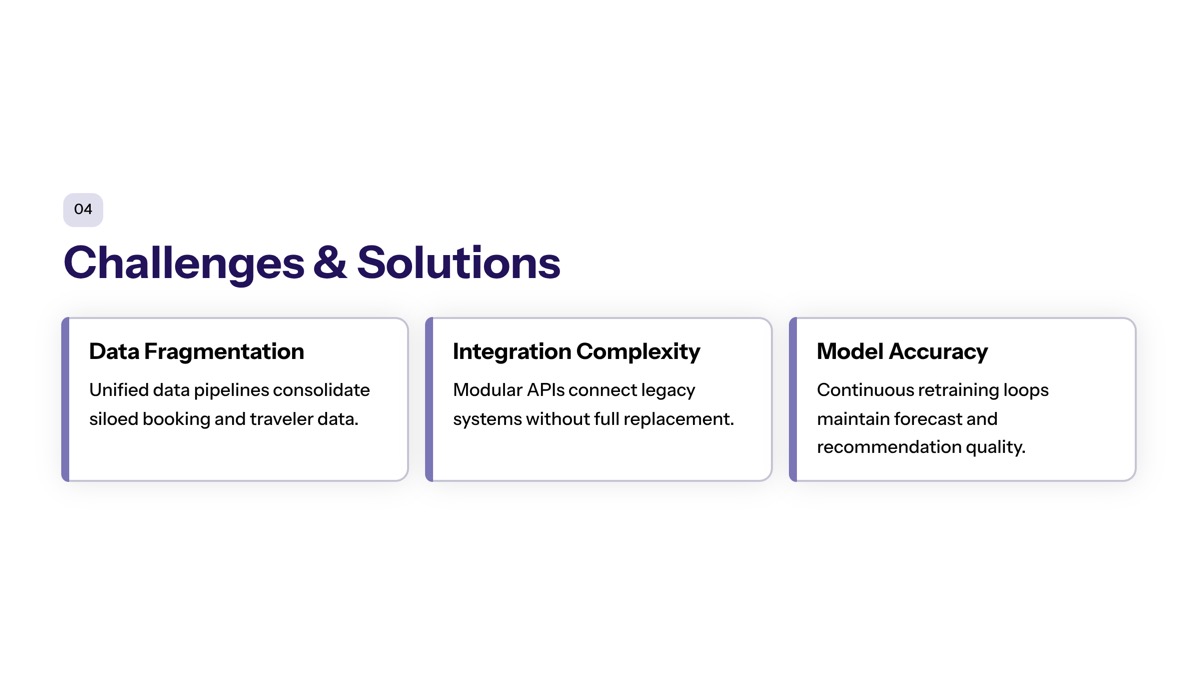
Travel AI development can create major value, but travel companies must address technical, operational, and compliance challenges early. The most common issues involve fragmented data, payment and privacy requirements, legacy platforms, and performance demands during peak booking periods.
Data Integration and Quality Management
The solution is to implement robust data governance frameworks that clean and standardize travel data from multiple sources, including GDS systems, direct supplier APIs, booking platforms, loyalty systems, customer touchpoints, and customer service tools. The integration of AI in travel operations allows for improved data quality and actionable insights, enabling smarter decision-making across marketing, operations, and customer service.
By leveraging AI, travel businesses can process vast amounts of data to uncover trends and insights, enabling smarter decision-making across operations and marketing. To support accurate ai models, travel companies should create unified customer profiles, normalize supplier data, validate historical data, and establish rules for missing or inconsistent fields.
Data quality is especially important for personalization and forecasting. Poor data can cause irrelevant recommendations, inaccurate travel demand forecasts, flawed pricing decisions, and biased marketing strategies.
Regulatory Compliance and Security Requirements
The solution is to design AI systems with built-in compliance controls for PCI DSS payment processing, GDPR data protection, CCPA privacy requirements, and industry-specific regulations while maintaining secure customer data handling throughout AI workflows. Implementing strong security measures, including compliance with industry standards such as encryption protocols and secure payment gateways, is essential for protecting sensitive customer information in travel software development.
AI algorithms can analyze booking patterns and payment methods to detect and prevent fraudulent transactions, enhancing security for both businesses and customers in the travel industry. Security-focused ai models can also support identifying suspicious patterns in account behavior, refund requests, card usage, bot traffic, and high-risk bookings.
Privacy controls should include consent management, data minimization, role-based access, audit logs, retention policies, anonymization where appropriate, and clear governance for the use of customer data in personalization and forecasting.
Legacy System Integration Complexities
The practical solution is to develop API-first AI architectures that connect with existing reservation systems, accounting platforms, customer databases, and existing travel management systems without disrupting current operations or requiring complete system replacements. Many travel companies still rely on legacy booking engines, older GDS workflows, monolithic internal systems, and manually managed spreadsheets.
A phased architecture can wrap legacy systems with APIs, introduce microservices for new ai capabilities, and gradually modernize the most valuable components. This allows custom ai solutions to improve service delivery without forcing a risky full-platform replacement.
For example, a travel business can add ai powered chatbots to customer service first, then connect those virtual assistants to booking changes, customer profiles, refund rules, and disruption workflows over time.
Scalability and Performance Optimization
The technical solution is to build cloud-native AI solutions using microservices architecture that automatically scale during peak booking periods and maintain sub-second response times for customer-facing applications. Travel systems often face demand spikes around holidays, major events, weather disruptions, flash sales, and airline schedule changes.
AI-driven automation can streamline various operational tasks, from scheduling staff based on predicted demand to managing inventory, thereby improving efficiency and reducing costs. Caching, load balancing, queue-based processing, real-time pipelines, model monitoring, and fallback workflows help travel companies maintain reliability when booking volume increases.
Performance design should separate model training from inference, prioritize low-latency services for customer-facing interactions, and create human override paths for sensitive decisions such as refunds, denied bookings, identity verification, and high-value itinerary changes.
Conclusion and Next Steps
Travel AI software development services help travel companies gain a competitive edge through intelligent automation, personalized customer experiences, dynamic pricing, predictive analytics, and data driven insights. The strongest ai powered solutions are custom-built around travel workflows, not generic models layered onto complex booking and operations systems.
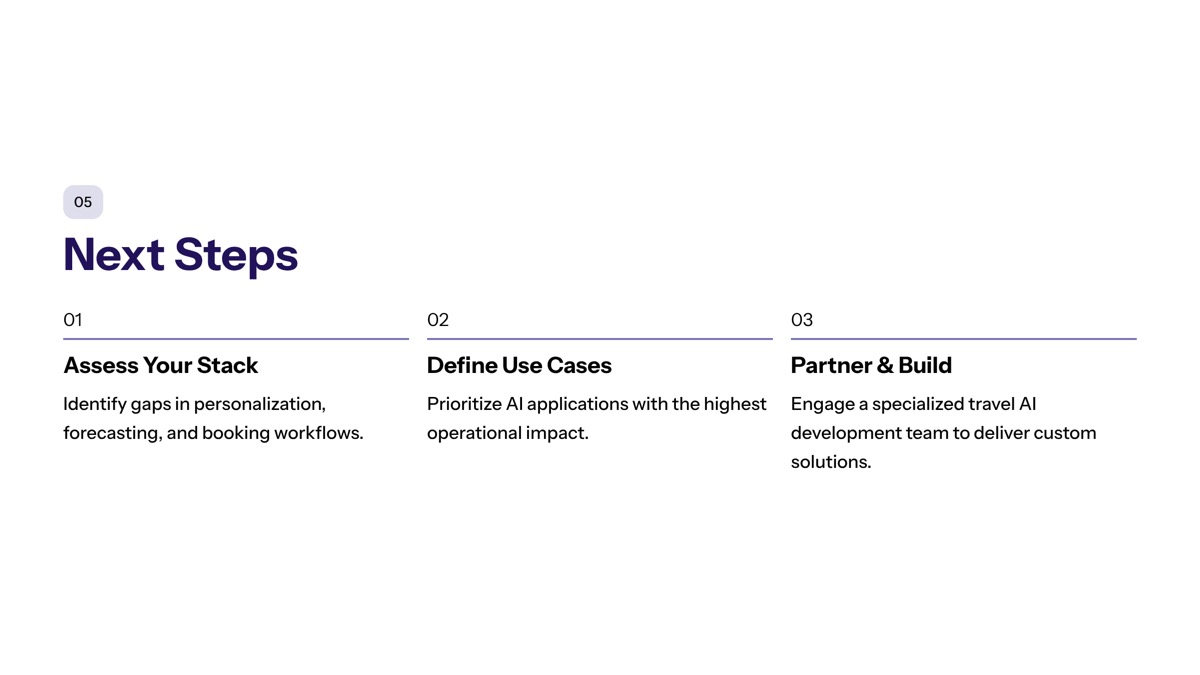
For travel companies evaluating ai implementation, the most practical next steps are:
Conduct an AI readiness assessment of current systems, data quality, customer workflows, booking platforms, and integration constraints.
Identify high-impact use cases such as booking automation, dynamic pricing, customer service automation, demand forecasting, fraud detection, or predictive maintenance.
Evaluate data and integration requirements across GDS data, supplier APIs, customer profiles, payment systems, reservation systems, and real time data sources.
Start with a measurable pilot that validates accuracy, relevance, operational impact, and business performance before scaling.
Plan for governance and continuous optimization so ai models remain secure, compliant, accurate, and aligned with customer satisfaction goals.
Related modernization topics include legacy system upgrades, cloud infrastructure optimization, data platform modernization, customer experience redesign, and comprehensive digital transformation strategies for the tourism industry. For broader context on modernization in this sector, explore Cognativ’s travel industry software development services.
Additional Resources
Cognativ’s RAPID framework methodology for structured AI implementation, from requirements assessment and architecture design to pilot testing, rollout, monitoring, and continuous optimization.
Travel industry case studies showing measurable ROI from ai driven modernization projects in booking automation, personalization, revenue forecasting, customer support, and operations.
Technical specifications for travel AI integration with common travel technology platforms, including GDS systems, reservation systems, secure payment gateways, customer service tools, analytics platforms, and existing travel management systems.