
Web3 Healthcare Software Development: A Complete Guide for Healthcare Leaders
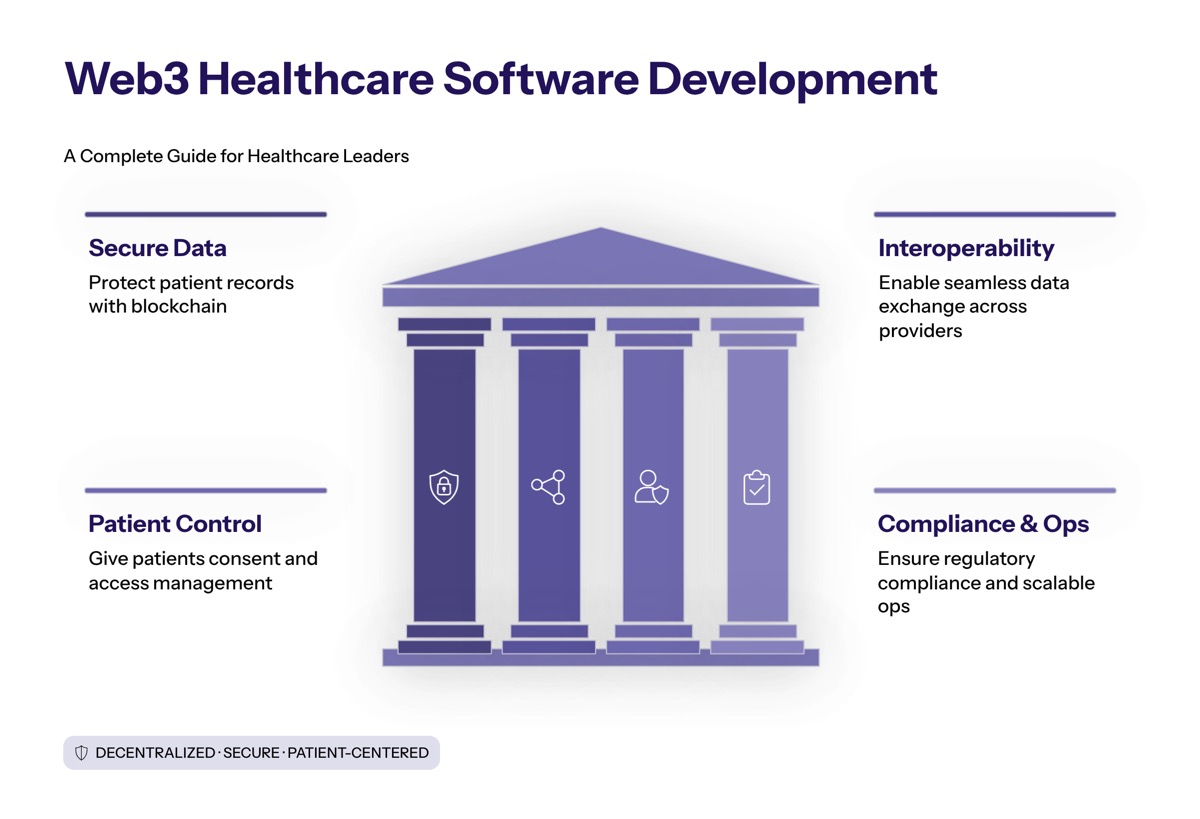
Web3 healthcare software development creates decentralized, secure, and user-controlled healthcare platforms built on blockchain, smart contracts, decentralized data storage, and cryptographic identity. For healthcare organizations, it can support secure patient data management, decentralized identity systems, and regulatory-compliant healthcare workflows without replacing every existing clinical system at once.
This guide focuses on secure custom software development, Web3-adjacent modernization, identity management, privacy frameworks, and regulated data systems for healthcare organizations. It is written for healthcare executives, IT directors, compliance officers, and digital transformation leaders who are evaluating blockchain solutions for patient care, data security, operational efficiency, and long-term business value.
The direct answer: web3 healthcare software development creates decentralized, patient-controlled health data platforms while maintaining HIPAA compliance and integrating with existing EHR systems. In practice, the strongest healthcare use cases usually combine permissioned blockchain networks, off-chain protected health information storage, FHIR-based data exchange, and custom software solutions that fit real clinical and administrative workflows.
In this article, you will learn how to:
Understand blockchain applications in healthcare, including EHR access, supply chain traceability, and clinical trial data integrity.
Evaluate security, HIPAA, GDPR, FDA, and privacy requirements before starting the software development lifecycle.
Plan modernization roadmaps that connect Web3 capabilities with existing systems, legacy systems, and third party systems.
Select development approaches, including hybrid architectures, custom application development services, agile software development, and quality assurance practices.
Measure ROI for Web3 healthcare initiatives through cost savings, increased efficiency, revenue generation, user experience, and long-term benefits.
For a broader view of healthcare-specific digital transformation, secure platforms, and regulated software solutions, see our healthcare software development services.
Understanding Web3 Healthcare Software Development
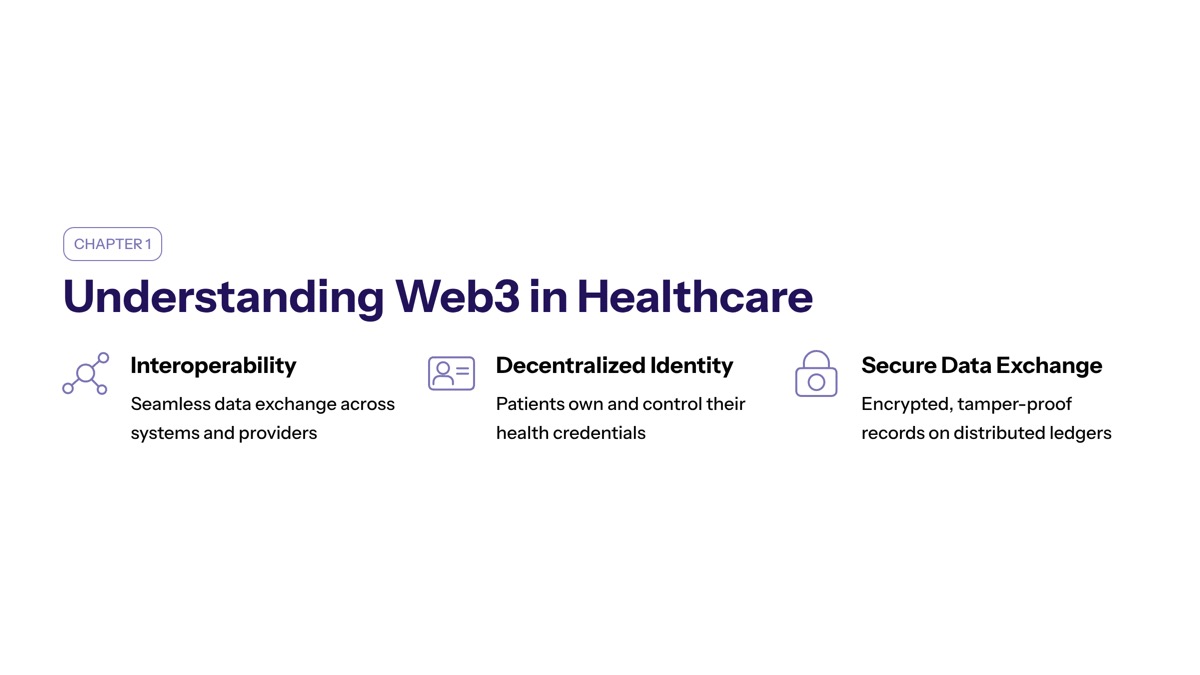
Web3 healthcare software is blockchain-powered custom software that enables patient data sovereignty, secure interoperability, and decentralized healthcare services while maintaining regulatory compliance. Instead of relying only on centralized databases controlled by one provider, a Web3 healthcare system can use distributed ledgers, cryptographic keys, decentralized identifiers, smart contracts, and off-chain encrypted storage to manage trust between healthcare providers, payers, laboratories, researchers, and patients.
This matters because traditional Electronic Health Record (EHR) systems are fragmented, complicating secure patient data sharing among hospitals. Healthcare leaders face disconnected data management, rising privacy expectations, legacy software constraints, cyberattack risk, and interoperability gaps that slow care delivery. Web3 principles transform healthcare by enhancing security, automating workflows, and shifting data ownership to patients and providers.
Custom software development is especially important in this context. Custom software development is the process of creating software solutions to meet the specific needs of a particular organization or business, involving several stages and requiring expertise in various technologies. Unlike off the shelf software, custom software development allows businesses to solve challenges that commercial, off-the-shelf software can’t meet, providing the agility to pivot to rapidly changing needs.
Decentralized Patient Data Management
Decentralized patient data management means patients hold and control access to their health records through cryptographic identity, self-sovereign keys, and decentralized wallets. Patient data ownership allows individuals to manage their own health data through self-sovereign cryptographic keys, and patients hold their records in decentralized wallets, granting access to doctors via cryptographic keys.
This model improves patient data sovereignty because users can hold and control their medical history directly. Patients can selectively grant and revoke access to their health records through decentralized identifiers, which gives healthcare providers a more transparent consent model than manual forms, faxed records, or disconnected patient portals.
The practical architecture is usually hybrid. Raw health data should not be stored directly on public blockchains because storing raw health data directly on public blockchains conflicts with privacy laws like GDPR. Instead, sensitive medical data remains in encrypted databases, cloud computing environments, provider endpoints, or other compliant off-chain repositories, while the blockchain stores hashes, pointers, consent events, and tamper-proof audit trails.
Blockchain-Enabled Healthcare Interoperability
Blockchain-enabled healthcare interoperability uses secure data sharing protocols to coordinate information between hospitals, clinics, laboratories, insurance systems, and other medical services. Web3 decentralized applications facilitate secure longitudinal patient record sharing between disparate healthcare providers, reducing the fragmentation that often prevents clinicians from seeing a full patient history.
Web3 enhances interoperability by eliminating data silos across hospital networks, allowing seamless data sharing. Web3 technology also enables interoperability by allowing different hospital systems to access a unified data ledger without custom API integrations for every bilateral relationship, although most production-ready healthcare platforms still use FHIR, SMART on FHIR, and API middleware for safe integration with EHRs and billing systems.
In a realistic healthcare system, blockchain does not replace HL7 FHIR. It complements FHIR by recording who requested access, what consent was granted, when records were exchanged, and whether the data integrity of a record can be verified. This gives healthcare leaders a path to seamless integration with existing systems while strengthening secure data exchange.
Smart Contracts for Healthcare Workflows
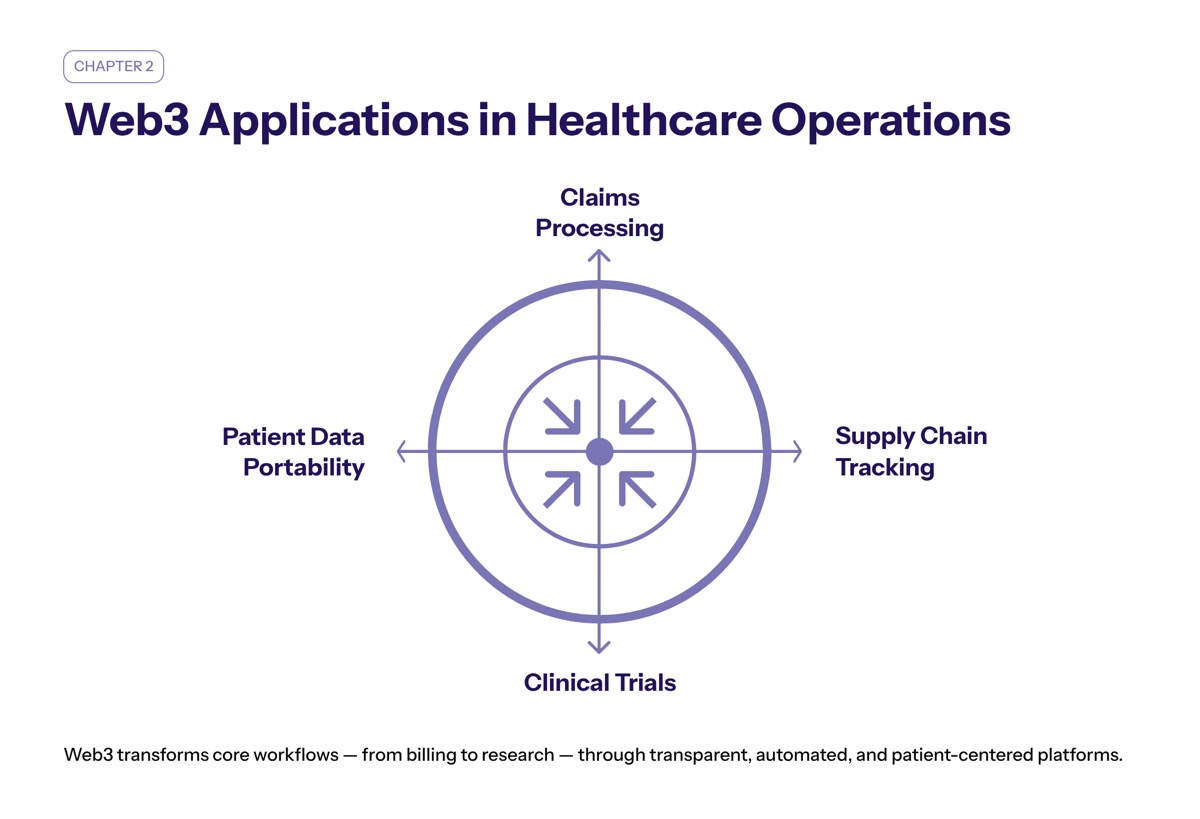
Smart contracts are self-executing programs that eliminate administrative middlemen in healthcare processes. In Web3 healthcare software development, smart contracts can automate insurance claims processing, patient consent management, clinical trial protocols, supply chain alerts, medical billing rules, and tamper-proof logging for healthcare records access.
Self-executing contracts in Web3 can automate insurance claims and settlements, reducing delays. Smart contracts provide tamper-proof logging capabilities for healthcare records access, and blockchains create tamper-proof audit trails for medical logs and clinical trial results. This can streamline processes across business functions where manual review, duplicate entry, and fragmented approvals slow operations.
The best custom software developers do not expose clinicians or patients to blockchain complexity. They design user interfaces, identity flows, and automated business processes so the core functionality feels like familiar healthcare software while the underlying software architecture provides stronger auditability, consent enforcement, and data security.
Web3 Applications in Healthcare Operations
Once the foundational concepts are clear, healthcare leaders can evaluate where Web3 creates practical business value. The strongest opportunities are not speculative cryptocurrency features; they are secure data exchange, patient-controlled access, immutable audit trails, process automation, and interoperability across business processes that already exist in healthcare operations.
These applications often require custom software application development because every provider network has different EHR systems, compliance requirements, payer connections, data models, and workflow constraints. Custom software can streamline healthcare processes such as patient management, electronic health records (EHR) systems, and medical billing, leading to improved operational efficiency and accuracy.
Electronic Health Records on Blockchain
Electronic Health Records on blockchain usually means patient-owned medical records with granular access controls, not raw EHR databases copied to a public chain. Patients can grant a specialist temporary access, revoke access after treatment, and maintain visibility into who viewed their information. For compliance teams, every access event can be logged in an immutable audit trail.
Integration with Epic, Cerner, and other major EHR systems typically happens through API layers, FHIR interfaces, SMART on FHIR apps, and middleware. This approach allows Web3 platforms to seamlessly integrate with existing systems, third party systems, billing platforms, laboratory information systems, and legacy systems without interrupting care delivery.
HIPAA compliance mechanisms usually include private or permissioned blockchain networks, encryption at rest and in transit, least-privilege access, identity verification, audit logging, Business Associate Agreements where needed, and off-chain protected health information storage. Decentralization removes single points of failure and reduces massive data breach risks in healthcare software, but it must be paired with robust security measures and compliance controls.
Healthcare Supply Chain Transparency
Healthcare supply chain transparency is one of the clearest Web3 healthcare use cases. Blockchain technology ensures end-to-end traceability for pharmaceuticals and prevents counterfeit drugs. End-to-end traceability in pharmaceuticals ensures every step of a drug’s journey is logged on an immutable ledger, from manufacturer to distributor, pharmacy, hospital, and patient.
This helps reduce counterfeit medications and strengthens recall readiness. Medical device provenance tracking can also support FDA compliance and recall management by creating an auditable chain of custody for devices, implants, batches, and components. When a defect or contamination event occurs, the healthcare organization can identify affected lots faster.
Smart contracts can integrate with IoT sensors to monitor conditions during shipping. For example, temperature, humidity, GPS, and custody events can trigger alerts if a cold-chain shipment deviates from approved conditions. These systems can connect to procurement, ERP, warehouse management, and inventory management platforms so Web3 traceability becomes part of normal operations rather than a separate tool.
Clinical Trial Data Integrity
Clinical trial data integrity depends on trust, reproducibility, and regulatory audit readiness. Blockchain can timestamp trial events, consent records, protocol updates, adverse event reports, and research data submissions so changes are visible and tampering is detectable. Blockchains create tamper-proof audit trails for medical logs and clinical trial results, which can support FDA, EMA, sponsor, and institutional review board expectations.
Patient consent management is also a strong fit for blockchain-based identity verification systems. A patient can provide informed consent using decentralized identifiers, and trial administrators can verify consent status without exposing more personal health information than necessary. Zero-knowledge proofs can further support privacy by proving eligibility or authorization without revealing raw health data.
For healthcare organizations, this becomes a custom development challenge as much as a blockchain challenge. The platform must support research workflows, data integrity, privacy controls, staff permissions, analytics, reporting, and integration with clinical systems. That is why the next step is a structured implementation framework rather than a technology-first build.
Implementation Framework for Web3 Healthcare Software Development
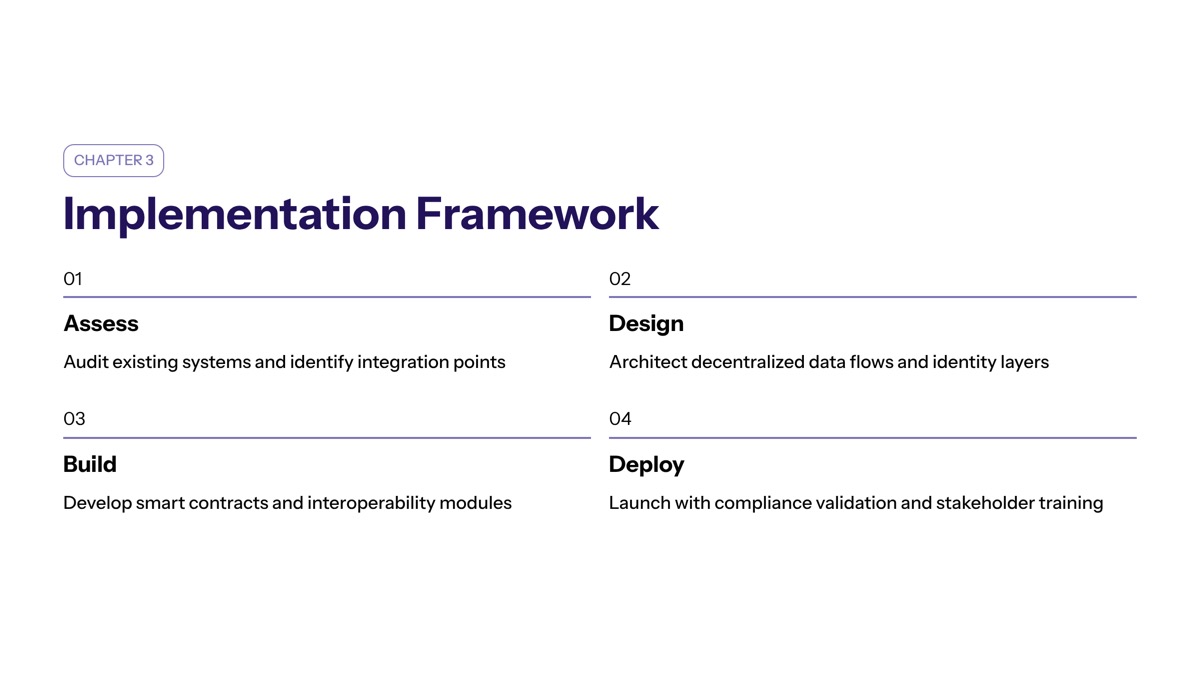
Web3 healthcare projects need disciplined project management because they touch patient safety, regulatory compliance, existing systems, clinical workflows, and sensitive data. Cognativ’s RAPID framework structures the development process so healthcare organizations can move from idea to production without losing control of compliance, interoperability, quality assurance, or operational continuity.
This type of framework is useful when healthcare leaders are modernizing legacy technology, building custom solutions, or evaluating whether bespoke software is more appropriate than off the shelf software. Legacy system modernization is essential for organizations to improve operational efficiency, reduce costs, and enhance service delivery. Modernizing legacy systems can also help organizations meet regulatory compliance requirements and improve data security.
RAPID Framework for Web3 Healthcare Projects
Healthcare organizations should adopt a structured blockchain implementation approach when the use case involves protected health information, identity, consent, audit trails, claims, supply chain traceability, or clinical data exchange. A controlled software development lifecycle lowers risk and helps align technology decisions with business goals.
Requirements Analysis: Assess current data flows across EHRs, labs, payer systems, CRM systems, ERP systems, e-commerce platforms if relevant to commerce or patient payments, and reporting tools. Identify HIPAA, GDPR, FDA, state privacy, security, and data retention requirements. This stage should define business needs, customer data risks, integration points, project costs, and success metrics.
Architecture Design: Plan a hybrid blockchain-traditional infrastructure that supports real-time care delivery and patient safety. The software architecture should define permissioned blockchain use, off-chain storage, cloud-based solutions, decentralized identity, encryption, zero-knowledge proofs, FHIR APIs, mobile development needs, programming languages, and the broader tech stack. The process of legacy system modernization often involves migrating to cloud-based solutions, which can provide scalability and flexibility for future growth.
Pilot Development: Build a proof of concept around a constrained use case, such as patient consent, supply chain tracking, medical billing automation, or clinical trial logging. Agile software development and iterative development help the project manager, custom software developers, compliance team, and clinical stakeholders validate assumptions early.
Integration Testing: Validate interoperability with EHR systems, billing platforms, laboratory systems, regulatory reporting tools, and other third party systems. Continuous testing practices, test automation, penetration testing, usability testing, and quality assurance should confirm that the system supports secure data exchange, data integrity, and clinical workflow requirements.
Deployment Strategy: Roll out Web3 capabilities in phases while maintaining operational continuity, fallback procedures, user training, and support. Deployment should include documentation, governance, monitoring, access reviews, compliance reporting, and change management so the organization can create solutions that improve adoption and business success.
Technology Stack Comparison
Component | Traditional Healthcare IT | Web3 Healthcare Platform |
|---|---|---|
Data Storage | Centralized databases | Distributed ledger + off-chain storage |
Identity Management | Provider-controlled access | Patient-controlled digital identity |
Interoperability | HL7 FHIR APIs | Blockchain protocols + FHIR |
Compliance | Audit logs and access controls | Immutable audit trails + encryption |
Traditional healthcare IT is often easier to operate in the short term because teams already understand centralized databases, role-based access, and vendor-managed EHR workflows. Web3 healthcare platforms offer stronger patient control, tamper-evident auditability, decentralized trust, and new digital capabilities, but they require more careful governance, cryptography, compliance review, and custom software development process discipline.
Most healthcare organizations should start with hybrid architecture rather than a full Web3 replacement. Hybrid platforms allow regulated data to remain off-chain while blockchain records consent, access events, provenance, and verification proofs. This enables organizations to improve operational efficiency without forcing clinicians into unfamiliar tools.
Custom software solutions can embed security and regulatory compliance into applications at the design level, ensuring they meet industry-specific standards and automate compliance reporting and monitoring. In regulated industries, it is essential to implement robust security measures, including secure coding practices and compliance with standards such as ISO 27001 and SOC 2, to protect sensitive data and maintain system integrity.
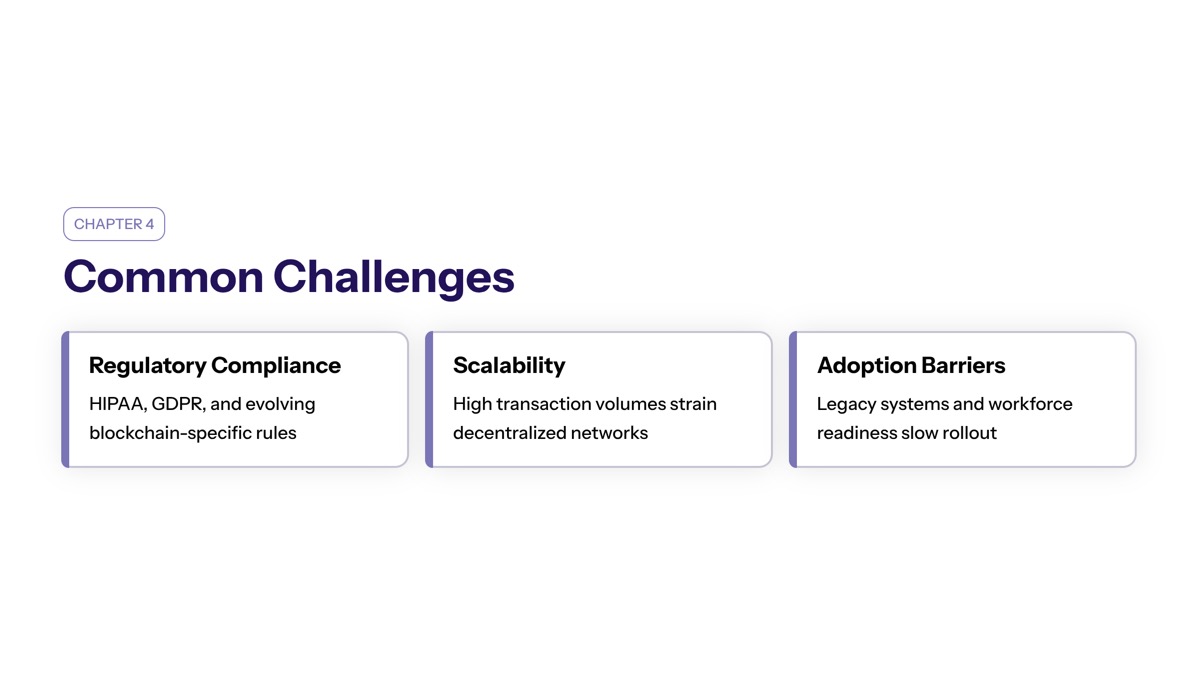
Common Challenges in Web3 Healthcare Development
Web3 healthcare software development can create business value, but the risks are real. Challenges in developing Web3 healthcare applications include high costs of on-chain storage and compliance with regulations like HIPAA. Healthcare leaders should address regulatory, technical, financial, and operational hurdles before committing to a production roadmap.
A strong custom software development company will treat these risks as part of the development lifecycle, not as late-stage fixes. Organizations must ensure that their custom software development processes include thorough documentation and adherence to compliance requirements to facilitate audits and maintain regulatory standards.
HIPAA Compliance and Data Privacy
HIPAA compliance and data privacy should shape the platform from the beginning. The safer pattern is to implement private blockchain networks with encrypted patient data and off-chain storage for sensitive information. Public ledgers can be useful for some proofs or settlements, but protected health information should not be exposed to immutable public infrastructure.
Zero-knowledge proofs can verify patient identity, eligibility, consent, or attributes without exposing personal health information. This supports privacy-preserving verification while maintaining secure data exchange between healthcare providers, payers, and researchers.
The solution is privacy-by-design custom software. Embed consent management, minimum necessary access, encryption, key management, access logging, breach response workflows, and compliance monitoring directly into the platform. That is how custom software solutions can provide enhanced security compared to off-the-shelf software.
Legacy System Integration
Legacy system integration is often harder than blockchain development itself. Many healthcare providers operate legacy systems, legacy software, HL7 v2 feeds, proprietary databases, on-prem infrastructure, and departmental tools that were never designed for decentralized data exchange.
The solution is API middleware that connects blockchain platforms with existing EHR, billing, laboratory, supply chain, and reporting systems. Custom software can be designed to automate routine tasks, freeing employees’ time to focus on more critical tasks, and can also be integrated with existing systems to streamline processes and reduce errors.
Real-time synchronization must not disrupt clinical workflows or patient care delivery. Custom software development can help organizations improve efficiency and operational agility by automating processes and integrating with existing systems, thus enhancing digital workflows. In practice, this requires careful mapping, monitoring, queueing, fallback logic, and quality assurance.
Regulatory Approval and FDA Compliance
Some Web3 healthcare applications may fall under FDA software as a medical device expectations, especially when they influence diagnosis, treatment, monitoring, or clinical decision-making. Regulatory approval and FDA compliance require documentation, validation, verification, risk management, cybersecurity controls, and post-market surveillance planning.
The solution is to establish documentation frameworks that support FDA software as medical device requirements for blockchain applications. Smart contracts, consensus rules, audit logs, access controls, AI modules, and clinical workflow rules should be explainable, testable, and version-controlled.
Audit trails should support regulatory submissions and post-market surveillance obligations. AI-driven automation can help organizations meet regulatory requirements by ensuring compliance through automated logging and rule-driven processes, but automated rules must still be governed, tested, and monitored.
Staff Training and Adoption
Clinicians and administrative teams should not need to understand cryptographic proofs, validator nodes, or wallet infrastructure to use the system. User experience design plays a crucial role in custom software development as it focuses on creating software that is intuitive, efficient, and enjoyable for users.
UX design emphasizes a user-centric approach, where developers strive to understand the target audience and their requirements through user research and feedback. Conducting usability testing at different stages of custom software development helps identify usability issues, gather feedback, and validate design decisions, ensuring the end product meets user expectations.
Accessibility in UX design ensures that software applications are usable and inclusive for individuals with disabilities, promoting equal access and participation. For adoption, focus staff training on patient care benefits, reduced administrative overhead, faster data access, and fewer manual tasks rather than technical blockchain language.
Conclusion and Next Steps
Web3 healthcare software development is a strategic approach to patient data sovereignty, regulatory compliance, secure data exchange, and operational efficiency without compromising care quality. The best solutions are usually hybrid: permissioned blockchain for trust and auditability, off-chain storage for sensitive data, FHIR-based integration for interoperability, and custom software application development for workflows that match real healthcare operations.
Custom software development provides tailored solutions that meet an organization’s specific requirements, improved efficiency, and enhanced security compared to off-the-shelf software. Implementing custom software solutions can automate routine business processes, reducing the time and effort required for manual tasks, which enhances overall operational efficiency. Web3 can also reduce administrative overhead and enhance patient data security against cyberattacks.
Measuring the ROI of custom software development involves assessing financial benefits such as cost savings, increased efficiency, revenue generation, and long-term benefits. Common approaches to measure the ROI of custom software development include evaluating cost savings from reduced labor costs and increased productivity, as well as revenue growth from new business opportunities. To measure the ROI of custom software, organizations should consider both quantitative metrics, such as cost avoidance and revenue generation, and qualitative factors like customer satisfaction and user experience.
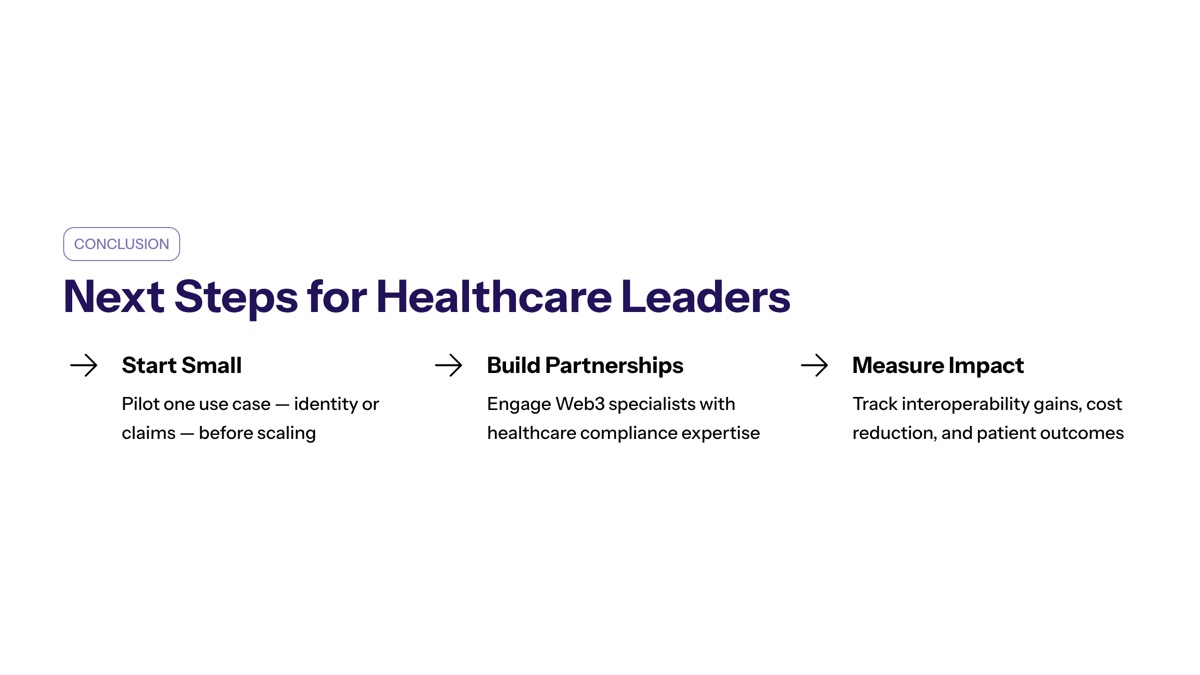
Recommended next steps:
Assess current data governance frameworks: Identify where patient data, customer data, consent records, audit logs, and interoperability workflows currently break down.
Evaluate pilot use cases: Start with consent management, claims automation, supply chain traceability, clinical trial logging, or secure longitudinal records.
Engage compliance and legal teams early: Review HIPAA, GDPR, FDA, ISO 27001, SOC 2, state privacy rules, vendor agreements, and documentation requirements before development.
Modernize legacy systems strategically: Prioritize cloud computing, API middleware, FHIR readiness, identity management, and scalable architecture before attempting full decentralization.
Partner with experienced Web3 healthcare developers: Choose custom software developers with deep expertise in healthcare services, regulatory compliance, data security, agile software development, and project success.
Related topics worth exploring include AI-driven healthcare automation, cloud migration strategies for healthcare data, and comprehensive digital transformation roadmaps for healthcare organizations. AI-driven automation can significantly enhance operational efficiency in healthcare by streamlining processes, reducing manual errors, and improving data accuracy. Integrating AI into healthcare software solutions can lead to improved patient care by enabling faster diagnosis, personalized treatment plans, and better resource management.
Additional Resources
Healthcare blockchain compliance frameworks and regulatory guidance documents: Use these to align software development, documentation, privacy controls, and audit readiness with HIPAA, GDPR, FDA, ISO 27001, SOC 2, and healthcare-specific security obligations.
Web3 healthcare development tools and platforms comparison: Compare permissioned ledgers, decentralized identity tools, zero-knowledge proof frameworks, FHIR servers, API gateways, cloud infrastructure, mobile development options, and programming languages.
Case studies of successful blockchain implementations in hospital systems and health networks: Prioritize examples that show measurable business value, improved data integrity, secure data exchange, and adoption by clinicians or administrative users.
Integration guides for connecting Web3 platforms with major EHR vendors: Focus on FHIR, SMART on FHIR, HL7 v2 mapping, middleware, test automation, continuous testing practices, and safe rollout strategies for clinical environments.
Healthcare digital transformation planning: For broader strategy, explore our healthcare software development services to connect Web3 modernization with secure custom software, AI automation, cloud migration, and regulated data platforms.