Industry Context
Ecommerce and retail
A quick view of the retail context, multi-brand platform focus, leadership model, and teams involved in a SmartSaaS ecommerce transformation.
Ecommerce and retail
Multi-brand fashion, lifestyle, and off-season retail
Platform rebuild under Virtual CTO leadership
Merchandisers, inventory teams, marketing, CX, and executive leadership
A luxury ecommerce operator managing multiple retail brands was struggling to grow because its legacy tech stack had become a platform bottleneck.
Product data was unreliable, inventory syncing was inconsistent, and every change required technical involvement.
Adding brands took months of custom development, while overwhelmed internal teams and costly external resources kept growth expensive.
A modular SmartSaaS platform could support faster brand launches, centralized merchandising, supplier-linked inventory, and leaner operations.
Cognativ focused the transformation on architecture, brand scalability, and operational control under Virtual CTO leadership.
Redesign ecommerce architecture for faster brand launches, centralized merchandising, and supplier-linked inventory feeds.
Move from custom-coded dependence to modular SmartSaaS capabilities controlled by business users.
Deliver a stable platform that supports growth in brands, traffic, product complexity, and fulfillment models.
The client had built a strong presence in off-season retail and luxury overstock, but the backend could not keep up with growth.
SKUs were entered by hand, supplier feeds were pulled through spreadsheets, promotions required developer support, and new brand launches were blocked by platform constraints.
Customer experience suffered as items appeared out of stock, sizing information became outdated, and order routing logic broke too often.
Custom-coded systems were fragile, slow to change, and unable to support modern ecommerce demands.
Inventory sync, product entry, and promotions required constant technical or operational intervention.
Each new store or SKU line required weeks of configuration, making growth expensive and unsustainable.
Engineering was consumed with bug fixes, blocking innovation and growth initiatives that mattered to customers.
Inventory data from brands and warehouses was out of sync, causing customer service issues and lost sales.
The platform was expensive to support, with poor ROI on both internal and outsourced technical labor.
Cognativ helps ecommerce companies turn technical debt into technical leverage, especially when growth depends on platform decisions that internal teams cannot keep carrying alone.
Whether operating one brand or many, SmartSaaS architecture enables faster brand deployment, automated fulfillment workflows, and centralized control over product, pricing, and performance.
Cognativ creates modular storefront foundations that let operators launch brands without rebuilding from scratch.
Supplier-linked inventory and product data flows reduce customer-facing errors and support leaner operations.
RAPID gives leadership a practical path to prioritize fixes, align teams, and remove platform friction quickly.
Cognativ stepped in as Virtual CTO, aligning business goals with platform capability and leading a full-stack ecommerce transformation.
Cognativ identified friction in inventory logic, order routing, merchandising workflows, and brand launch procedures.
The product catalog, inventory sync layer, pricing engine, and customer experience stack were rebuilt on a modular SmartSaaS foundation.
Business users gained control over merchandising, brand theming, SKU onboarding, pricing rules, and marketing workflows without developer involvement.
Four additional brands launched with a templated brand-shell framework, allowing updates and launches in hours instead of weeks.
“The challenge wasn’t ambition—it was architecture. RAPID gave us a clear path to align teams, rebuild fast, and eliminate the friction holding everything back.”
– Ali Davachi, Cognativ Founder
Cognativ reviewed inventory logic, order routing, product data, brand launch steps, and merchandising workflows.
The team identified where manual SKU work, fragile feeds, and custom scripts were slowing growth.
The roadmap prioritized brand-shell reuse, supplier-linked inventory, pricing control, and CX stability.
The TotalCommerce rebuild shifted core platform control from developer queues to business-ready workflows.
Revenue growth, brand launches, staffing needs, and inventory accuracy guided the next roadmap phases.
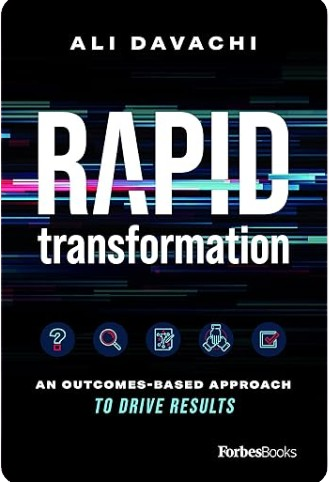
RAPID —Research, Analyze, Plan, Implement, Decide— is Cognativ’s transformation methodology for aligning strategy to systems and outcomes.
Outlined in RAPID Transformation: An Outcomes-Based Approach to Drive Results, the framework helps ecommerce operators reduce waste, sequence decisions, and deliver platform change with less friction.
Get The BookCognativ redesigned the platform, removed manual dependencies, and launched new revenue-driving capabilities under a Virtual CTO engagement.
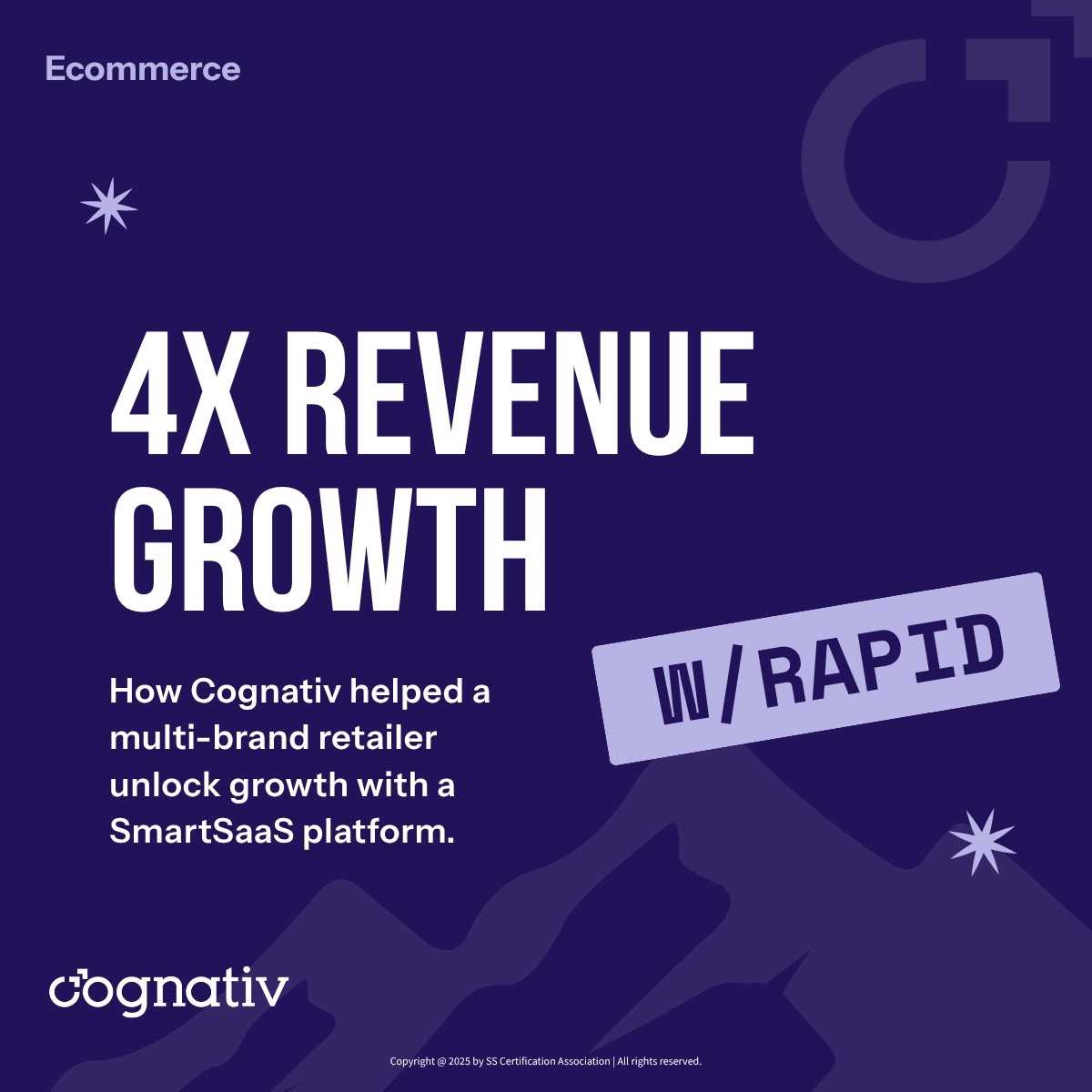
Using RAPID and SmartSaaS architecture, the company scaled to four additional brands, reduced tech staffing needs, and increased total revenue 4x.
The transformation improved inventory accuracy and product availability through real-time supplier integration without increasing headcount or infrastructure spend.
More brands, better inventory, and faster merchandising helped the business scale without bloating overhead.
The client can now spin up branded storefronts by reusing infrastructure and content models.
Business control and backend automation lowered engineering dependence without sacrificing innovation.
Real-time supplier syncing reduced errors, improved sell-through, and cut customer service escalations.
Internal teams launched four new properties with no net tech headcount increase.
Merchandising and operations teams took control of their tools, reducing developer involvement.
Clean inventory logic and real-time updates showed customers what was actually available.
Observability and modular design made issue resolution faster.
The company supports drop-ship, warehouse, and hybrid fulfillment from the same platform.
Promotions, pricing rules, and UX experiments can be deployed without code changes.
Platform automation enables lean, high-output operations across brands.
Cognativ remains engaged on roadmap expansion, personalization, and internationalization planning.
Bring product data, supplier feeds, merchandising, pricing, and fulfillment under a platform model that supports growth without overwhelming your technical team.
Modernize Multi-Brand Commerce