
Technology should serve your business.
Cognativ exists to help people take back control of the work that matters. For small and midsize businesses, every technology decision competes for time, budget, and attention.
We want leaders and teams to understand their systems, make informed decisions, and change how they operate without being constrained by tools that no longer fit. Better technology is a means to that end, not the mission itself.
More tools should not mean less control
SaaS and AI can make work easier. They can also introduce disconnected data, overlapping subscriptions, opaque decisions, and dependencies that are difficult to change.
Adding another platform or automating an unclear process can leave a team with more complexity and less visibility.
Our starting point is the business problem: where work slows down, who owns the decision, what information is missing, and what a better outcome would look like. We help teams decide what to keep, buy, build, integrate, or retire.
We are not against SaaS or in favor of AI for its own sake. We are for technology that earns its place in your operations.
That decision becomes clearer when the team separates the outcome it needs from the features a product offers. We examine the workflow, test the constraints, and narrow the options against operating cost, data access, and the ability to change.
The result is a decision the business can explain and an owner who can carry it forward.
Business need
Business need
Define the outcome, the people affected, and where the current work breaks down.
Operating constraints
Operating constraints
Check dependencies, data access, total cost, and who can approve or maintain a change.
Accountable choice
Accountable choice
Choose an approach with a named owner, acceptance criteria, and a review point.
Keep, buy, build, integrate, or retire
Ali Davachi and RAPID: turn direction into action
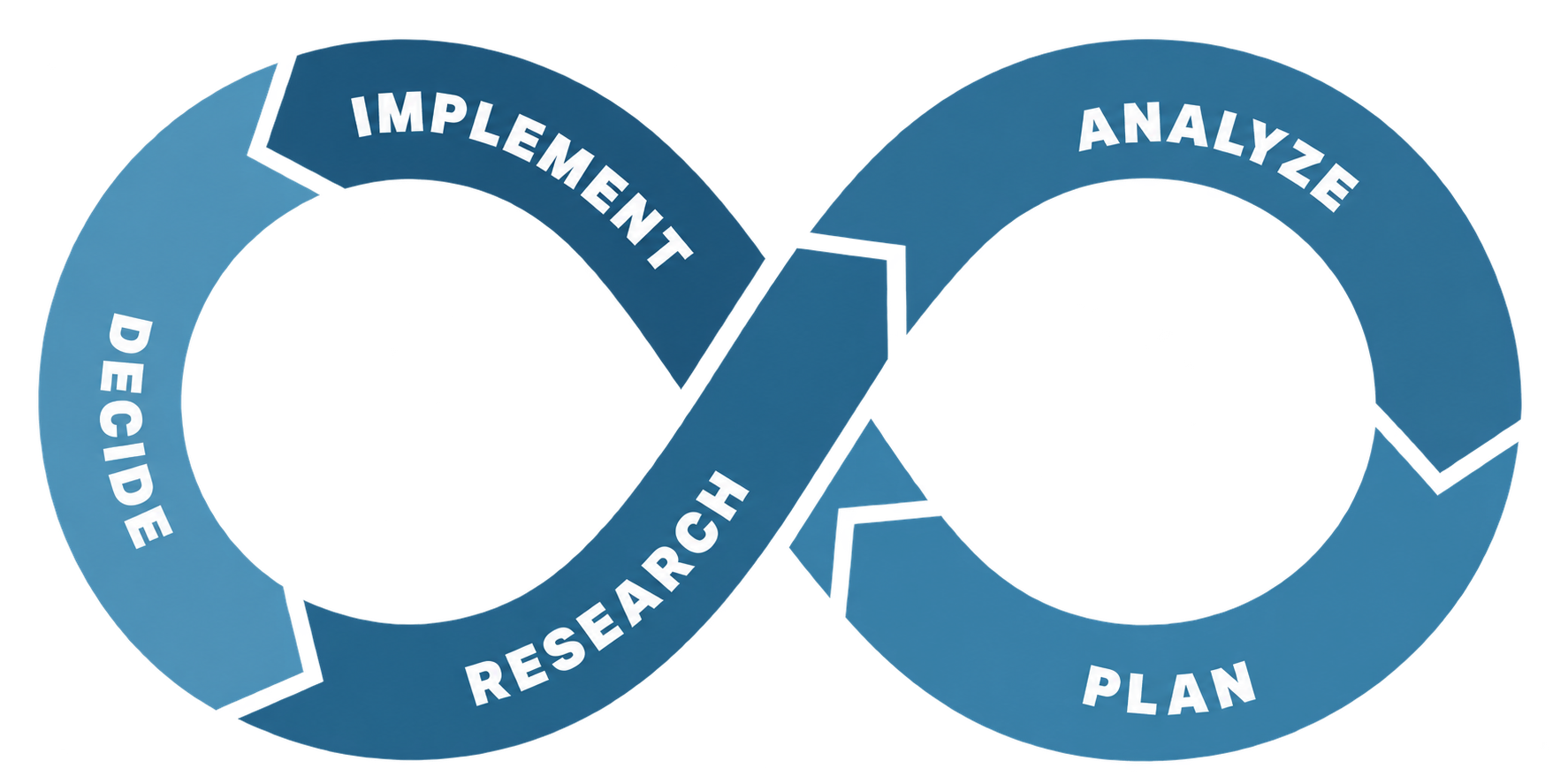
Founder and CEO Ali Davachi connects this mission with RAPID Transformation: Research, Analyze, Plan, Implement, Decide. The framework brings business priorities and implementation together so a strategy can become work with clear ownership, meaningful measures, and decisions informed by evidence.
At Cognativ, that means understanding the real workflow before choosing a solution, identifying the constraint that matters, sequencing the work, and reviewing what changes in practice.
RAPID connects two learning cycles. Research and Analyze establish what is happening and which constraint deserves attention. Plan, Implement, and Decide turn that understanding into a manageable change, then use the results to determine the next move.
New evidence can send the team back to an earlier question without losing sight of the business outcome.
Research + Analyze
Observe the work, test assumptions, and identify the constraint that matters to the business.
Plan + Implement + Decide
Assign ownership, deliver a focused change, and use the evidence to continue, adjust, or stop.
SmartSaaS: make control part of the design
SmartSaaS gives that mission a set of software principles: ownership, transparency, data portability, security, and adaptability.
We use these principles to ask practical questions about a system:
- Can you access and move your data?
- Understand its costs and dependencies?
- Integrate it with the rest of the business?
- Change it as your needs evolve?
The goal is not to replace every subscription with custom software. It is to make deliberate choices about what your organization needs to own and where a service genuinely helps.
These principles work together. Data portability needs usable exports and clear access rights; adaptability needs understood dependencies; security needs named operating responsibilities.
Reviewing the full chain makes those connections visible before a contract, integration, or platform decision limits the next step.
-
Ownership
Know which data, workflows, and operating rights remain under your control.
-
Transparency
Understand costs, dependencies, and the terms that govern change.
-
Data portability
Retrieve complete, usable data and test it in its next destination.
-
Security
Define access, protection, recovery, and incident responsibilities.
-
Adaptability
Keep a practical path to configure, integrate, extend, or replace the system.
People stay accountable. Technology supports them.
We approach AI as support for human judgment and useful work. That requires clear boundaries, appropriate access to data, and ways to review results and intervene.
Connecting those safeguards with RAPID execution and SmartSaaS principles keeps the focus on an operating model your team can understand, govern, and improve.
That is what putting you back in control means to us: clearer decisions, systems that work together, and the freedom to shape your next move around your business rather than around a vendor or a tool.
A named person remains responsible for the decision, even when software performs part of the work. Teams need to know what a system may do, when a result needs review, and how to pause or correct an action.
Each review feeds the next set of instructions, so control improves with experience rather than ending at launch.
Set boundaries
Name the accountable owner, define permitted actions, and agree when human approval is required.
Support execution
Use technology within those limits, keeping the inputs and results available for review.
Review and decide
Check the outcome, investigate exceptions, and decide what to change before the next cycle.