
Adaptive product delivery and the wider business question
Both approaches embrace learning.
The distinction is primarily one of scope.
Does your organization need an adaptive way to deliver a product or solution, a broader process for determining what transformation should occur, or both?
Adapt delivery as customer needs evolve
Agile principles emphasize early and continuous value delivery, collaboration, adaptability, working solutions, technical excellence, and regular reflection.
Agile helps teams work effectively when requirements, customer needs, and implementation details are expected to evolve.
Instead of attempting to define every detail before delivery begins, Agile approaches encourage shorter feedback loops, incremental value, collaboration, and adaptation as teams learn.
Investigate the wider business response
Cognativ’s RAPID Transformation framework connects Research, Analyze, Plan, Implement, and Decide around the business outcome an organization needs to improve.
RAPID begins with a broader business question. The organization may know an outcome needs to improve but still need to determine whether the response should involve software, AI, process change, organizational change, data, customer experience, operating-model changes, or a combination of these.
Research establishes what is happening. Analyze evaluates causes, value, risk, dependencies, resistance, and feasibility. Plan defines the response. Implement creates measurable movement. Decide determines what should happen next.
Understand the RAPID framework
RAPID vs. Agile: scope, feedback and ownership
Compare learning, planning, ownership, implementation, and business outcomes. Agile supports discovery and customer value as well as delivery; RAPID can connect this work with technical and nontechnical transformation decisions.
| Compare by | RAPID | Agile |
|---|---|---|
| Primary purpose | Turn a business challenge into evidence-backed action and measurable progress. | Deliver value adaptively through short feedback loops, collaboration, and iterative improvement. |
| Starting point | A business outcome, opportunity, constraint, risk, or unresolved problem. | A product, service, solution, or body of work where needs and implementation can evolve through feedback. |
| Primary emphasis | Research, evidence, prioritization, implementation, ownership, risk, and recurring decisions. | Customer value, adaptability, collaboration, incremental delivery, feedback, and continuous improvement. |
| Requirements | Can emerge through investigation before and during implementation. | Expected to evolve as teams learn from users, stakeholders, and delivered increments. |
| Planning | Planning follows Research and Analyze and connects priorities, dependencies, measures, risks, and ownership. | Planning occurs iteratively at the appropriate cadence rather than being completed entirely upfront. |
| Implementation | Implementation can involve software, operations, AI, process, organizational, or other transformation work. | Delivery occurs incrementally through Agile practices appropriate to the product or team environment. |
| Feedback | Evidence from implementation informs the Decide phase and subsequent RAPID cycles. | Frequent stakeholder, customer, product, and team feedback informs future work. |
| Best suited to address | Broader transformation where the problem and appropriate response span multiple business and technical dimensions. | Complex product or delivery environments where learning and adaptation during execution are valuable. |
Connect adaptive delivery with broader business transformation
Agile provides a powerful way to manage complexity during delivery. Teams can release working increments, collect feedback, adjust priorities, improve technical decisions, and change direction as new information becomes available.
That reduces the risk of spending long periods building against assumptions that have never been tested.
But some of the most important transformation decisions exist outside the product backlog. The organization may need to determine whether software should be built at all. A customer problem may originate in process or policy rather than the interface. An AI initiative may fail because data or governance is not ready. A modernization effort may be blocked by organizational ownership rather than architecture.
Compare sequential delivery and transformation
Connect product learning with the wider operating system
RAPID operates across that wider environment. Research establishes the business reality. Analyze evaluates the evidence and possible responses. Plan defines the intervention. Implement turns the plan into observable change. Decide uses what happened to determine the next move.
When software development is part of the response, Agile can be an effective delivery approach inside the RAPID implementation phase.
RAPID does not replace Agile. It helps connect adaptive delivery with the larger transformation question the organization is trying to resolve.
Agile is not limited to executing a predefined solution. Its principles prioritize customer value and adaptation; Scrum, one Agile framework, also uses a Product Goal. The approaches can overlap in discovery and outcome evaluation.
Connect objectives with business decisions
Locate the uncertainty before choosing a delivery approach
Not every uncertain initiative requires the same type of adaptation.
Use Agile for evolving product needs
Sometimes the organization understands the product or solution it needs to develop, but requirements will evolve as customers use it and teams learn more.
Agile approaches can provide an effective delivery model for that environment.
- Requirements will evolve. Teams expect customer needs, technical understanding, or product priorities to change during delivery.
- Frequent feedback matters. Users and stakeholders can provide meaningful evidence as working increments become available.
- Incremental value is possible. The solution can be delivered and evaluated in useful pieces rather than only as one final release.
- Cross-functional collaboration matters. Business, product, design, engineering, and other disciplines need to work closely throughout delivery.
- Adaptation is valuable. Teams should be able to respond when new information changes what should be built next.
- Continuous improvement matters. Teams regularly review both the product and how they work to improve future delivery.
- Technical learning is expected. Architecture, implementation details, and requirements can become clearer as development progresses.
Compare enterprise delivery coordination
Apply RAPID when the intervention is still uncertain
Other situations contain uncertainty at a broader level. The organization may not yet know whether a new application should be built, whether an existing platform should be modernized, whether automation would solve the problem, whether the operating process itself should change, or whether the real constraint exists elsewhere.
That uncertainty needs investigation before the delivery method becomes the central question.
- The solution itself is uncertain. The organization understands the desired outcome but has not yet determined what intervention is appropriate.
- The problem crosses business boundaries. Customers, people, process, technology, data, ownership, and operating conditions may all contribute.
- Several responses are possible. Software development may be one option among automation, process redesign, organizational change, AI, data work, or other interventions.
- Priorities compete. Multiple transformation initiatives, risks, dependencies, and investments need to be evaluated together.
- Implementation extends beyond product delivery. The response may require coordination across engineering, operations, leadership, vendors, or business functions.
- Business evidence matters. Success needs to be evaluated against the intended outcome rather than delivery activity alone.
- The next decision depends on what happens. Implementation results should determine whether the organization continues, changes, stops, or expands the response.
- Adaptive delivery / Agile
- We need to learn through product increments, customer feedback and evolving priorities.
- Outcome-led transformation / RAPID
- We need to investigate which technical and nontechnical changes can improve the business outcome.
- Agile and RAPID
- We need product learning connected to operating changes, ownership and transformation decisions.
Customer learning in its operating context
Product feedback becomes more useful when teams connect it with the operating context and the business outcome they need to improve.
Business Outcome
Define the measurable result the organization ultimately needs to improve.
Product and Customer Evidence
Understand user needs, feedback, product performance, adoption, and the value delivered through the solution.
Operating Context
Examine processes, technology, data, organizational conditions, ownership, dependencies, and constraints surrounding delivery.
Implementation and Decisions
Deliver, learn, evaluate the evidence, and determine whether the wider transformation should continue or change direction.
From product feedback to the next RAPID decision
Research and Analyze test the understanding of the business problem. Plan, Implement, and Decide connect the response with implementation evidence; Agile delivery can contribute working increments and customer feedback throughout that learning.
Research and Analyze
Understand the business outcome before assuming what should be built.
Research examines customers, stakeholders, workflows, technology, data, existing products, organizational conditions, constraints, and previous initiatives.
Existing Agile artifacts such as product goals, backlog evidence, user research, and delivery metrics can contribute useful context.
Determine which problems and opportunities deserve attention.
Analysis evaluates customer value, technical feasibility, risk, dependencies, organizational resistance, capability gaps, investment requirements, and expected impact.
The result may confirm that software development is appropriate—or reveal that another intervention should happen first.
Research
Understand the business outcome before assuming what should be built.
Analyze
Determine which problems and opportunities deserve attention.
Plan, Implement and Decide
Translate the evidence into a practical response.
Planning defines priorities, ownership, dependencies, measures, risks, sequencing, change requirements, and implementation boundaries.
Where Agile teams already exist, RAPID can use their product and delivery structures rather than replace them.
Put the selected response into practice.
When software or digital-product development is required, implementation can use Scrum, Kanban, Extreme Programming, continuous delivery, or other Agile practices appropriate to the team.
Other parts of the response may involve process, data, AI, organizational, or operating-model changes.
Review what implementation revealed.
The evidence may support continuing the product direction, changing priorities, revisiting the solution, stopping work, scaling what succeeded, or beginning another RAPID cycle.
This creates a feedback loop between delivery and the wider transformation.
Plan
Translate the evidence into a practical response.
Implement
Put the selected response into practice.
Decide
Review what implementation revealed.
Keep product increments aligned with modernization
Consider an organization developing a new digital platform as part of a larger modernization program.
Agile can help teams adapt how they build.
RAPID can keep that delivery connected to the broader business change the organization needs to create.
Guide adaptive product delivery
Agile can guide how the product team delivers.
- Product direction. Maintain a clear product goal while allowing detailed requirements to evolve.
- Incremental delivery. Release useful improvements in smaller increments rather than waiting for one final implementation.
- Customer feedback. Use real stakeholder and user evidence to influence future priorities.
- Adaptive planning. Change upcoming work when new information alters assumptions or expected value.
- Continuous improvement. Regularly inspect both the product and the team’s delivery practices.
Explore customer value and continuous improvement
Connect delivery with the wider transformation
RAPID can coordinate the wider transformation.
- Define the wider outcome. Clarify why the platform matters to the business beyond completing product features.
- Research the surrounding system. Examine operating processes, customers, data, organization, architecture, and business constraints.
- Evaluate transformation priorities. Determine which technical and nontechnical interventions deserve investment.
- Connect implementation with results. Keep product delivery, operational changes, ownership, risks, and outcome measures visible together.
- Review the business evidence. Determine whether the transformation is producing the intended result and what should happen next.
Connect architecture with business change
Platform changes with customer outcomes in view
These Cognativ engagements connect commerce and employee-support platform changes with customer and business outcomes. They illustrate transformation in context, not evidence that the clients implemented Agile or a guarantee of identical results.
Ecommerce: 300x Conversion Growth
Ecommerce Development
Platform Modernization
Commerce Integration
TotalCommerce
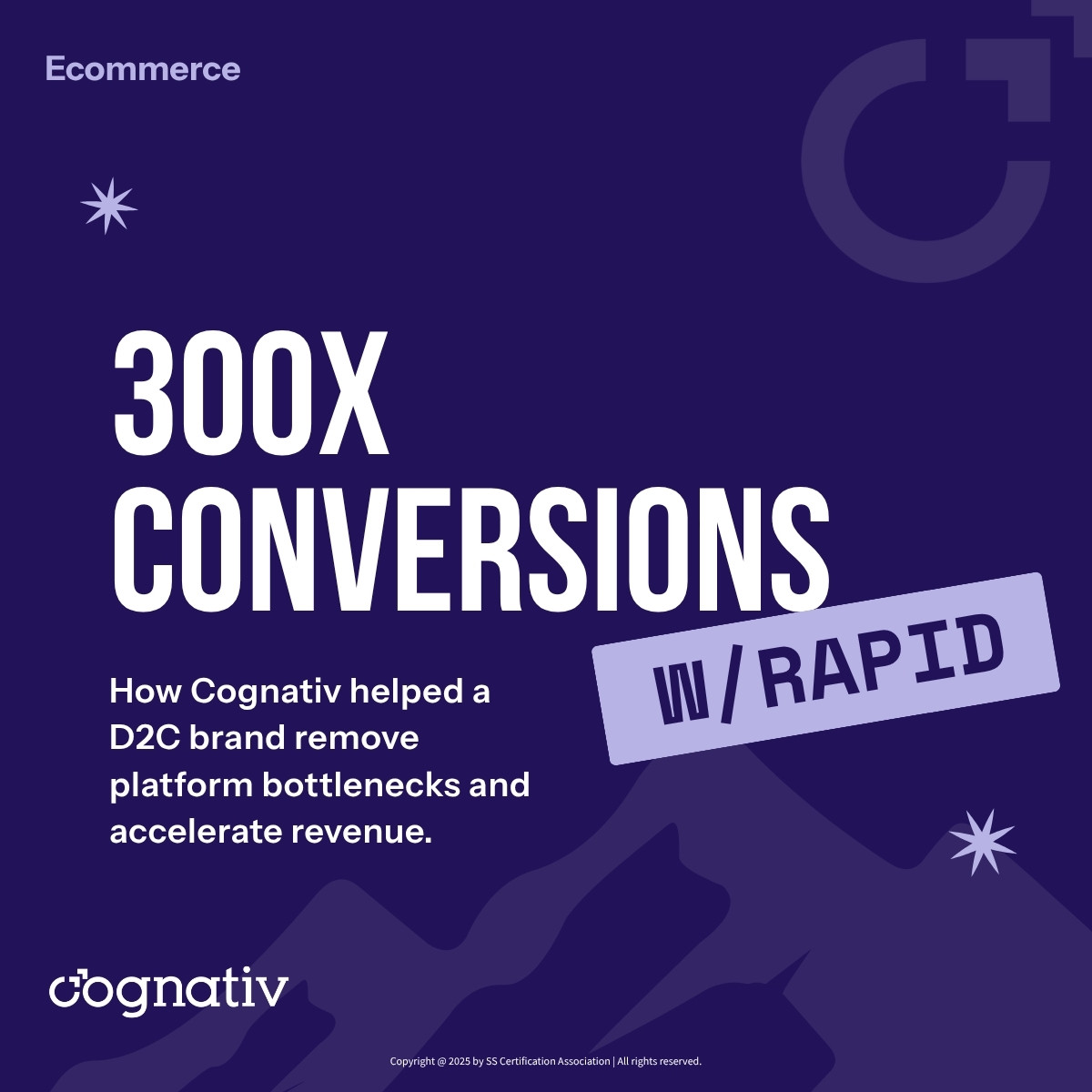
Ecommerce: 300x Conversion Growth
Cognativ rebuilt a generic ecommerce platform into a scalable TotalCommerce stack, centralizing fragmented systems and giving the business more control over merchandising, operations, and fulfillment.
The result was a 300x conversion improvement and a 150% lift in average order value without increasing ad spend.
See the 300x Conversion Lift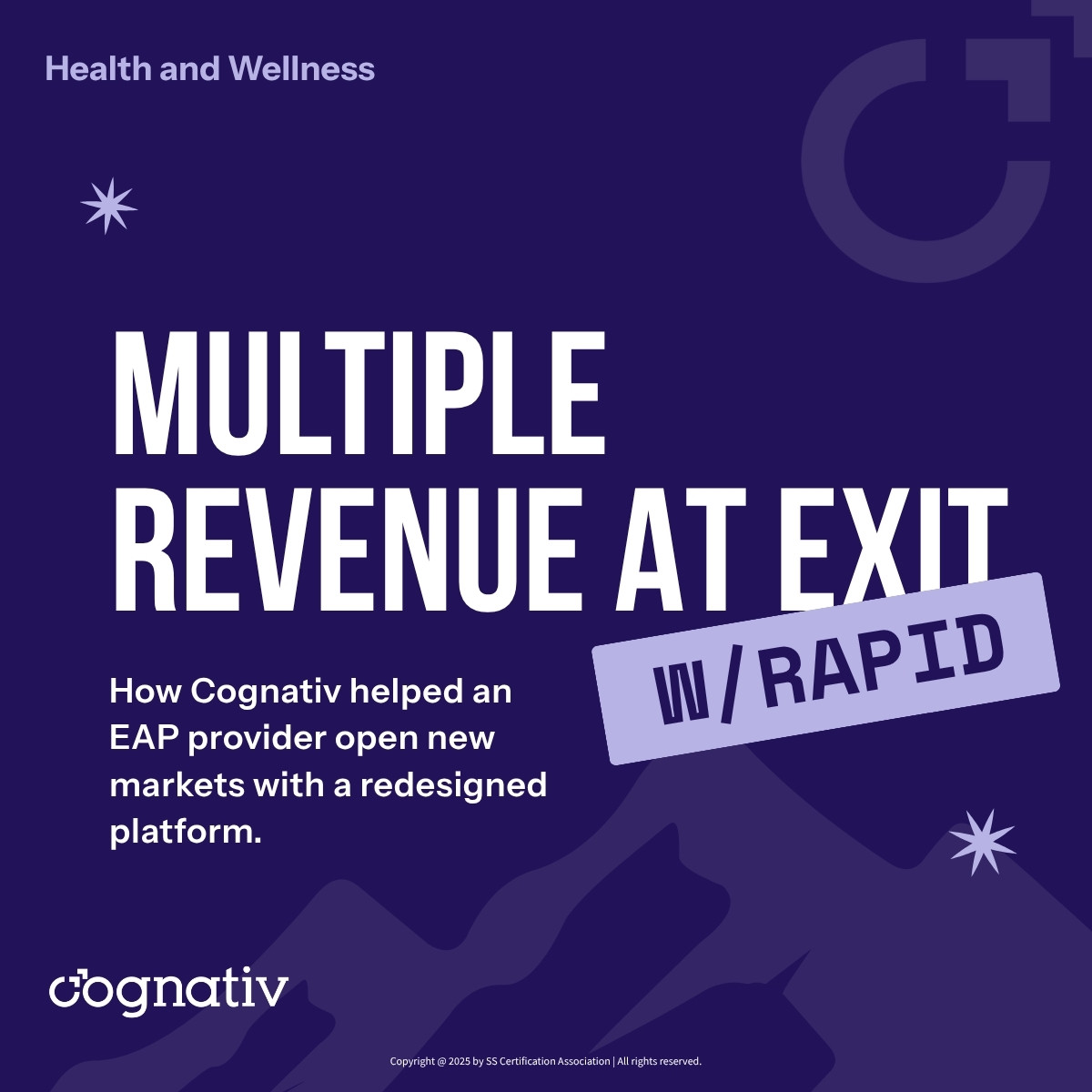
EAP Platform Opens New Online Channels
Benefits Platforms
Access Control
HR Reporting
Audit Trails
EAP Platform Opens New Online Channels
Cognativ redesigned a benefits platform for an EAP provider, helping the company open new online channels and modernize its market position.
The platform transformation contributed to multiple-times revenue growth ahead of a strategic sale.
Explore the Market ExpansionWhat delivery feedback tells the wider business
Agile delivery produces valuable evidence through working solutions, customer feedback, product metrics, technical discoveries, and team learning.
RAPID helps leadership connect that evidence with business priorities, operational conditions, investment decisions, organizational constraints, and the next transformation decision.
Bring product and delivery evidence into the conversation
Organizations already using Agile often have substantial product and delivery evidence available.
Connect product feedback with the evidence you already have
Product goals, backlogs, sprint outcomes, customer feedback, release data, product analytics, technical risks, architecture decisions, retrospectives, and delivery metrics can all contribute to the initial picture.
- Business Outcome
- Define the measurable improvement the transformation ultimately needs to create.
- Product Direction
- Existing product goals, customer problems, roadmap priorities, and intended value.
- Delivery Evidence
- Backlogs, release history, sprint outcomes, product metrics, technical risks, and implementation progress.
- Customer and Stakeholder Evidence
- Research, feedback, adoption information, support signals, and other indicators of value.
- People and Ownership
- Product leaders, engineers, designers, operators, business stakeholders, and decision makers.
- Constraints and Dependencies
- Architecture, data, technology, organizational, commercial, regulatory, and resource conditions affecting delivery.
Identify what the backlog does not yet explain
The objective is not to recreate those artifacts.
It is to connect what teams already know with the broader business outcome and identify which questions exist outside the current delivery boundary.
See How the First 30 Days Begin

Turn adaptive delivery into measurable business change
Cognativ can help connect customer evidence, product delivery, technology, operations, organizational constraints, implementation, and decision ownership without replacing the Agile practices already working inside your teams.
RAPID vs. Agile FAQs
Clarify scope, implementation and the role of existing evidence before selecting the support your organization needs.
What is the main difference between RAPID and Agile?
Agile describes principles and practices for delivering value adaptively through collaboration, feedback, incremental delivery, and continuous improvement.
RAPID is Cognativ’s outcomes-based transformation framework connecting Research, Analyze, Plan, Implement, and Decide around a broader business challenge.
Agile commonly guides how teams deliver. RAPID can span the wider business, technical, operational, and organizational environment surrounding that delivery.
Understand the RAPID framework
Is RAPID an Agile methodology?
No. RAPID is not a software-development methodology.
Agile practices can be used during RAPID implementation when software or product development is part of the transformation response.
Can RAPID and Agile be used together?
Yes. An Agile team can continue using Scrum, Kanban, XP, continuous delivery, or another adaptive delivery approach while RAPID connects that work with broader research, transformation priorities, implementation decisions, and business outcomes.
Are Agile and Scrum the same thing?
No. Agile refers to a broader set of values and principles for adaptive delivery.
Scrum is one specific framework that teams can use to apply an empirical and iterative approach to complex product work.
Does Agile address business outcomes?
Yes. Agile emphasizes customer value and working solutions, and frameworks such as Scrum include concepts such as Product Goals and Sprint Goals.
RAPID differs by operating across a broader transformation context that can include product delivery alongside process, organization, technology, data, operations, and other business factors.
When does RAPID make more sense than Agile alone?
RAPID can be useful when the main uncertainty exists outside the product-delivery process.
Examples include determining whether software should be built, evaluating AI adoption, modernizing an operating model, resolving cross-functional constraints, choosing between transformation investments, or investigating a business outcome whose causes are not yet clear.
Does RAPID replace Agile?
No. Organizations can continue using Agile delivery practices while applying RAPID to broader transformation work.
Existing Agile evidence and delivery structures can become inputs into Research, Analyze, Plan, Implement, and Decide.
Can Agile teams work inside the RAPID Implement phase?
Yes. When software or product delivery is part of the selected response, Agile teams can deliver increments, collect feedback, adapt the backlog, and continuously improve during RAPID implementation.
The resulting evidence can then inform the Decide phase.