
Process variation and the surrounding business system
Both approaches use evidence.
The difference is primarily the scope of the question being investigated.
Does the organization need to improve the performance of a defined process, determine what broader transformation should happen, or coordinate both?
Improve a defined process with DMAIC
Six Sigma provides a disciplined, data-driven approach for defining problems, measuring performance, analyzing root causes, improving processes, and controlling results.
Six Sigma begins with a process that needs to perform more consistently.
Its DMAIC methodology—Define, Measure, Analyze, Improve, and Control—helps teams understand performance, identify the causes of variation or defects, implement improvements, and sustain the gains.
Investigate the wider business system
Cognativ’s RAPID Transformation framework connects Research, Analyze, Plan, Implement, and Decide around the business outcome an organization needs to improve.
RAPID begins with a broader business outcome, opportunity, constraint, or unresolved challenge.
The process itself may be part of the problem, but RAPID also examines technology, customer experience, data, organizational conditions, dependencies, ownership, risk, and competing priorities before determining what should change.
Understand the RAPID framework
Six Sigma and RAPID across measurement and implementation
Compare the business question, measurement needs, implementation, and sustaining results. This comparison focuses on DMAIC for existing processes; Six Sigma also includes approaches for designing new products and processes.
| Compare by | RAPID | Six Sigma |
|---|---|---|
| Primary purpose | Turn a business challenge into evidence-backed action and measurable progress. | Improve process capability by reducing variation, errors, defects, and inconsistent performance. |
| Starting point | A business outcome, opportunity, constraint, risk, or unresolved problem. | A defined process or performance problem that can be measured and improved. |
| Primary emphasis | Evidence, prioritization, implementation, ownership, risk, and recurring decisions. | Measurement, root-cause analysis, process capability, statistical evidence, and sustained control. |
| Measurement | Measures are selected according to the business outcome and evidence needed for decisions. | Measurement and quantitative analysis are central to understanding and improving process performance. |
| Planning | Plans evolve as evidence, dependencies, implementation, and results reveal new information. | Improvement work follows a structured DMAIC cycle with defined objectives and measures. |
| Implementation | Implementation produces evidence that informs subsequent decisions. | Improvements are tested and introduced after analysis identifies the factors driving performance. |
| Sustaining results | Teams repeatedly review outcomes and determine whether to continue, adjust, stop, or begin another cycle. | The Control phase helps sustain improvements and prevent the process from returning to previous performance levels. |
| Best suited to address | Complex transformation where business, technology, people, process, and organizational decisions need to remain connected. | Defined process problems where variation, defects, quality, reliability, or consistency need systematic improvement. |
Connect process evidence with broader transformation decisions
Six Sigma provides a disciplined way to investigate process performance. DMAIC helps teams define the problem, establish a measurable baseline, analyze likely causes, introduce improvements, and create controls that sustain the result.
That structure is particularly valuable when variation or defects can be observed and measured inside a known process.
But some transformation challenges begin before a process-improvement project can be properly defined. An organization may need to decide whether the process itself should exist in its current form. Software may need modernization. Automation may change the workflow. AI may create a different operating model. Customer expectations may have changed. Ownership may be unclear. Several systems may contribute to the same result.
Compare continuous improvement and transformation
Place process improvement within the transformation
RAPID works across that wider decision environment. Research establishes what is happening. Analyze identifies the most important causes, opportunities, risks, and dependencies. Plan defines a controlled response. Implement creates observable change. Decide uses the evidence to determine what happens next.
Six Sigma can become part of that work when process variation is one of the important factors.
RAPID does not replace statistical improvement discipline. It provides a broader structure for determining where that discipline is relevant and how its results connect to the wider business outcome.
Connect measures with objectives
Define the problem boundary before selecting the method
Not every performance issue requires a broad transformation program.
That requires a wider investigation before the improvement method can be selected.
Use Six Sigma for defined process variation
Sometimes the organization knows which process is failing. Quality varies. Errors occur too frequently. Cycle times are inconsistent. Customer expectations are not being met reliably. The available data can be used to investigate causes and improve the process.
That is a strong environment for Six Sigma.
- Reduce process variation. Improve consistency where outcomes differ unnecessarily between transactions, products, services, teams, or operating conditions.
- Reduce defects and errors. Identify the causes of failures and systematically reduce their frequency.
- Strengthen process capability. Understand whether an existing process can reliably meet customer or business requirements.
- Use quantitative evidence. Apply measurement and statistical analysis when sufficient data exists to investigate performance.
- Find root causes. Separate symptoms from the factors actually driving variation or failure.
- Improve repeatable operations. Strengthen established processes where consistency, quality, reliability, or compliance matter.
- Sustain improvements. Introduce controls that help prevent gains from disappearing after the improvement project ends.
Compare service management and transformation
Use RAPID to assess changes beyond the process
Other situations are less contained.
The organization may not know whether the problem originates in the process, technology, operating model, customer experience, ownership, data, strategy, or the interaction between several of those factors.
- Define the business outcome. Clarify what materially needs to improve before deciding whether process improvement is the right intervention.
- Research the wider system. Examine people, processes, customers, technology, data, incentives, constraints, and existing initiatives together.
- Analyze competing causes. Determine whether the issue is primarily process variation or whether other operating conditions are responsible.
- Prioritize across boundaries. Make tradeoffs when multiple systems, teams, initiatives, investments, or risks compete for attention.
- Connect strategy with implementation. Translate decisions into sequenced work with clear responsibilities and measures.
- Measure the response. Use implementation evidence to determine whether the chosen intervention is improving the intended outcome.
- Make the next decision. Continue, change, stop, escalate, or begin another transformation cycle based on evidence.
- Process improvement / Six Sigma
- We have a defined process and need to understand why its performance varies.
- Outcome-led transformation / RAPID
- We know the business outcome is wrong, but still need to determine what should change.
- Six Sigma and RAPID
- We need broader transformation and rigorous process improvement within it.
Quality evidence within the operating context
Rigorous process improvement and broader transformation decisions can reinforce each other when measurement stays connected to customer requirements and the business outcome.
Business Outcome
Define what customers, operations, employees, or the organization ultimately need to experience differently.
Process Evidence
Understand performance, variation, defects, errors, cycle times, capability, and the conditions affecting the process.
Transformation Context
Consider technology, organizational design, customer needs, ownership, investment, dependencies, and strategic constraints surrounding the process.
Implementation and Decisions
Apply the appropriate intervention, observe the result, and use new evidence to determine the next action.
Test the causes and evaluate the implemented change
Process data can inform Research and Analyze without predetermining the intervention. Plan, Implement, and Decide keep the chosen improvement connected to ownership, operating constraints, and the result the organization needs.
Research and Analyze
Establish what is actually happening before selecting the intervention.
Research may include process data, customer expectations, stakeholders, systems, technology, workflow, operating conditions, existing improvement projects, and organizational constraints.
Existing Six Sigma data can be highly valuable during this phase.
Determine which factors matter most.
Analysis evaluates process evidence alongside value, risk, dependencies, feasibility, resistance, technology constraints, capability gaps, and expected impact.
A Six Sigma project may emerge as the appropriate response when variation or defects are identified as material causes of the business problem.
Research
Establish what is actually happening before selecting the intervention.
Analyze
Determine which factors matter most.
Plan, Implement and Decide
Turn the evidence into an executable response.
Planning defines priorities, responsibilities, measures, dependencies, sequencing, implementation boundaries, mitigation, and early proof points.
Where Six Sigma is part of the solution, DMAIC activities can operate inside that plan.
Put the selected response into practice.
Implementation may involve Six Sigma improvements, software modernization, automation, operating-model changes, data work, AI, organizational change, or combinations of these.
The objective is measurable movement against the business outcome.
Evaluate what happened and determine the next action.
Evidence may support continuing the improvement, adjusting the plan, escalating another constraint, stopping ineffective work, or starting another RAPID cycle.
This prevents the transformation from becoming tied to a method rather than the result.
Plan
Turn the evidence into an executable response.
Implement
Put the selected response into practice.
Decide
Evaluate what happened and determine the next action.
Coordinate process controls with wider transformation
Consider an organization experiencing inconsistent service delivery, customer complaints, fragmented systems, and a modernization initiative already underway.
The methodologies can therefore contribute at different levels without requiring one to replace the other.
Improve and control the defined process
Six Sigma can help investigate and improve the defined process.
- Define the performance problem. Establish the scope, customer requirements, and improvement objective.
- Measure the current state. Collect reliable data describing how the process currently performs.
- Analyze root causes. Determine which inputs or conditions are driving defects, errors, or variation.
- Improve the process. Test and introduce changes intended to improve capability and customer outcomes.
- Control the gains. Monitor important measures so improvements remain stable over time.
Connect architecture with process change
Coordinate the surrounding transformation
RAPID can operate around the broader business transformation.
- Clarify the intended outcome. Determine what measurable result matters beyond the process metric itself.
- Connect multiple causes. Consider process performance alongside technology, organizational, customer, data, and strategic factors.
- Prioritize investment. Determine which improvements or broader changes deserve resources first.
- Coordinate implementation. Keep ownership, risks, dependencies, milestones, and measures visible.
- Review business impact. Determine whether process improvements are materially contributing to the wider outcome.
Compare organizational change and transformation
Reporting and consulting delivery improvements
These Cognativ engagements improve reporting workflows and the consistency and capacity of consulting delivery through software and operating changes. They illustrate business improvement, not evidence that the clients implemented Six Sigma or a guarantee of identical results.
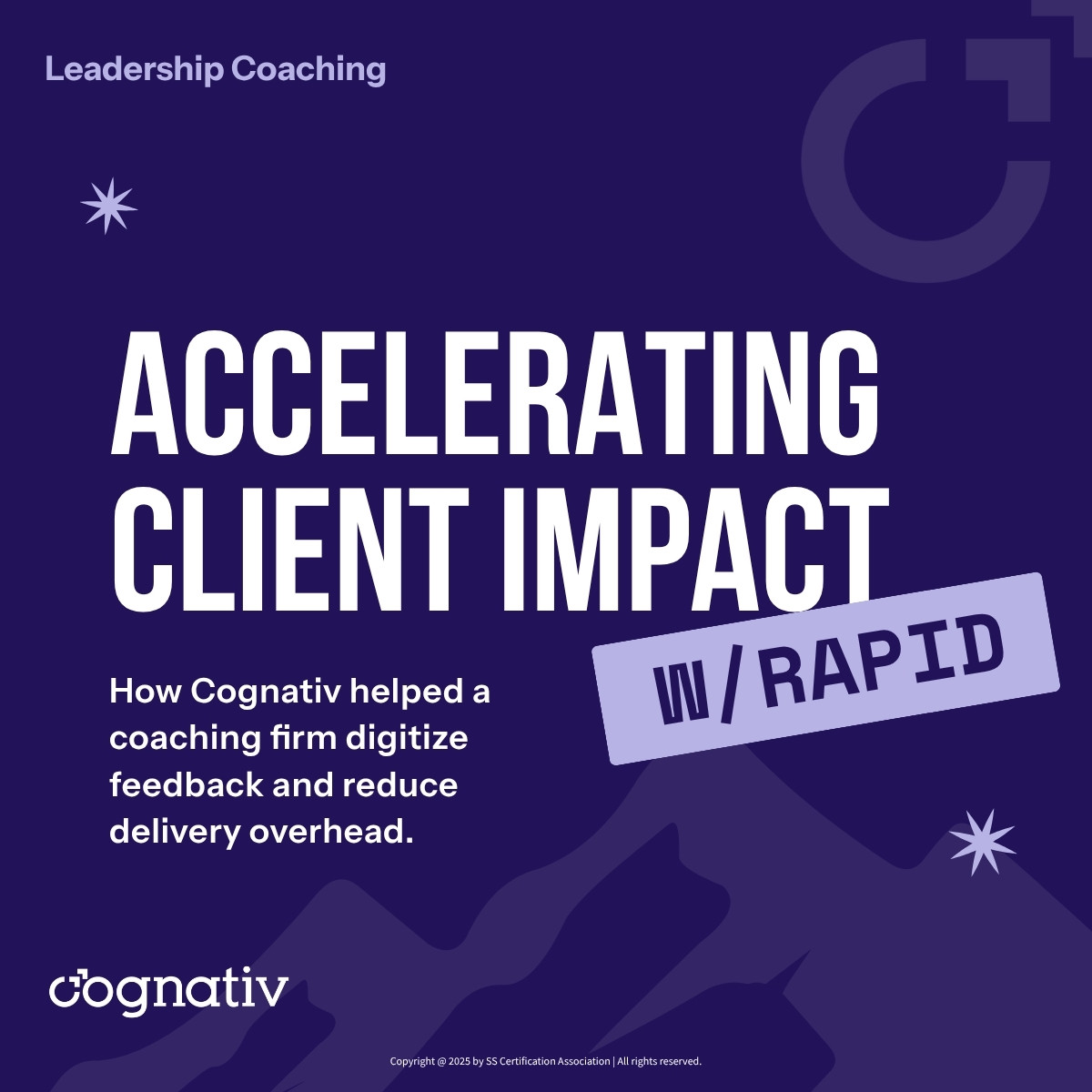
Leadership Reviews: 70% Faster Reporting
Custom Software
Reporting Automation
Access Control
Audit Trails
Leadership Reviews: 70% Faster Reporting
Cognativ transformed a 360-degree review system for a leadership coaching firm, replacing outdated back-end processes with a more scalable digital workflow.
The result was 70% faster report turnaround, 60% lower admin overhead, and new coaching tiers for enterprise clients.
Explore the Review Workflow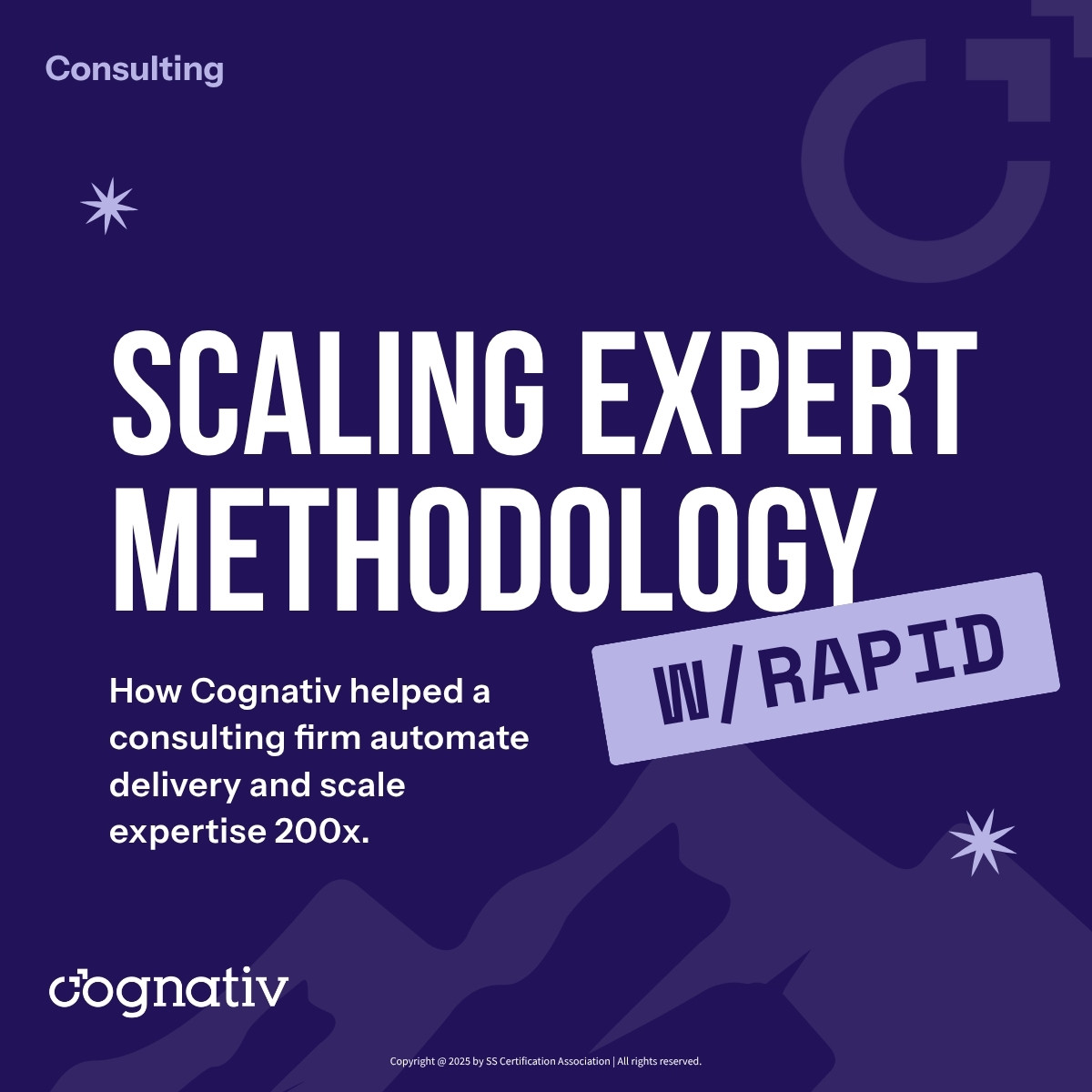
Consulting Platform Expands Capacity 200x
Custom Software
Workflow Automation
Access Control
SmartSaaS
Consulting Platform Expands Capacity 200x
Cognativ turned a senior-partner-led consulting methodology into a scalable custom software platform.
The solution reduced engagement time by 50%, improved delivery quality, and increased capacity by 200x so junior consultants could execute premium engagements independently.
Explore the 200x ScaleupDecide what the measurements justify
Measurement creates evidence.
RAPID helps leadership connect that evidence with business priorities, technology decisions, organizational constraints, customer outcomes, implementation tradeoffs, and the next decision that needs to be made.
Bring process measurements and unresolved questions
Organizations already using Six Sigma often have substantial evidence available before a RAPID engagement begins.
Connect process measurements with the business outcome
Process maps, DMAIC project documentation, control charts, capability measures, defect data, customer requirements, root-cause analyses, and improvement backlogs can all provide valuable context.
- Business Outcome
- Define the measurable improvement the organization ultimately needs to create.
- Process Baseline
- Current workflows, performance data, defects, errors, variation, capability, and known problem areas.
- Customer Requirements
- The expectations, quality conditions, service levels, or outcomes the process needs to satisfy.
- Existing Analysis
- DMAIC documentation, root-cause analysis, statistical findings, improvement initiatives, and previous experiments.
- People and Ownership
- Process owners, practitioners, operational teams, technical stakeholders, and decision makers.
- Constraints and Dependencies
- Technology, organizational, data, compliance, financial, and operating conditions affecting the response.
Agree which causes need further investigation
The objective is not to repeat that work.
It is to connect the existing evidence with the broader business outcome and determine which questions remain unresolved.
See How the First 30 Days Begin

Turn process evidence into measurable business change
Cognativ can help connect process evidence, customer requirements, technology, organizational constraints, implementation, and decision ownership without discarding the Six Sigma practices already in place.
RAPID vs. Six Sigma FAQs
Clarify scope, implementation and the role of existing evidence before selecting the support your organization needs.
What is the main difference between RAPID and Six Sigma?
Six Sigma is a disciplined, data-driven approach for improving process capability by reducing variation, errors, and defects.
RAPID begins with a broader business outcome and connects Research, Analyze, Plan, Implement, and Decide across the transformation environment.
Understand the RAPID framework
Is RAPID a process-improvement methodology?
RAPID can include process improvement, but its scope is broader.
It can address business strategy, software, data, AI, operations, organizational conditions, customer experience, and other factors that influence the intended outcome.
Can RAPID and Six Sigma be used together?
Yes. Six Sigma can provide rigorous process analysis and improvement inside a broader RAPID transformation.
RAPID can help determine where process improvement belongs within the overall transformation and how the resulting evidence should influence subsequent decisions.
What is DMAIC?
DMAIC stands for Define, Measure, Analyze, Improve, and Control.
It is a structured improvement cycle commonly associated with Six Sigma for improving existing processes that are not meeting performance or customer requirements.
Is Six Sigma only for manufacturing?
No. Six Sigma originated in manufacturing but its process-improvement principles and tools are also used in service, healthcare, financial, transactional, and other environments where measurable process performance matters.
When does RAPID make more sense than Six Sigma alone?
RAPID can be useful when the organization has not yet determined whether the primary problem is process variation.
For example, the business may need to evaluate technology modernization, organizational structure, AI adoption, ownership, customer experience, data, or several interconnected constraints before deciding which improvement approach to use.
Does RAPID replace Six Sigma?
No. Organizations can continue using Six Sigma for quality and process improvement while applying RAPID to broader transformation decisions.
Existing Six Sigma projects, measurements, and analyses can become evidence within the RAPID cycle.
Can Six Sigma tools be used during RAPID?
Yes. Process maps, control charts, root-cause analysis, capability measures, hypothesis testing, failure analysis, and other Six Sigma techniques can contribute to RAPID when the business problem requires that level of process analysis.
The appropriate tools depend on the evidence needed for the decision.