
Stable requirements and unresolved transformation choices
The useful comparison is therefore not which approach is universally faster.
Does your organization already understand what needs to be delivered, or does it first need to determine what should change and why?
Deliver work with stable requirements
Waterfall organizes delivery into defined phases such as requirements, design, implementation, testing, deployment, and maintenance.
Waterfall works best when the organization can define the work with a high degree of confidence before execution begins. Requirements establish what should be delivered. Design determines how it will be built. Implementation follows the agreed specification. Testing verifies the result before deployment and maintenance.
That structure can provide clarity when requirements are stable and the expected solution is already reasonably well understood.
Investigate what should change and why
Cognativ’s RAPID Transformation framework connects Research, Analyze, Plan, Implement, and Decide around the business outcome an organization needs to improve.
RAPID starts earlier in the uncertainty. The organization may know that an important outcome needs to improve but still need to determine what the real problem is, which assumptions are correct, which intervention deserves investment, or how several business and technical constraints interact.
Research establishes the current reality. Analyze determines what matters. Plan defines the response. Implement creates evidence. Decide determines what should happen next.
Understand the RAPID framework
Compare sequential delivery with outcome-led change
Compare the level of certainty, requirements, planning, implementation, and treatment of change. A sequential delivery model can suit bounded work; transformation may still require investigation outside that project boundary.
| Compare by | RAPID | Waterfall |
|---|---|---|
| Primary purpose | Turn a business challenge into evidence-backed action and measurable progress. | Deliver defined work through a structured sequence of project phases. |
| Starting point | A business outcome, opportunity, constraint, risk, or unresolved problem. | A sufficiently defined scope, requirements set, and expected deliverable. |
| Primary emphasis | Research, evidence, prioritization, implementation, ownership, risk, and recurring decisions. | Requirements, planning, sequential execution, documentation, milestones, and verification. |
| Requirements | Can develop as Research and Analyze improve understanding of the problem. | Generally established early so downstream design and implementation can proceed predictably. |
| Planning | Planning follows investigation and can change as implementation generates new evidence. | Detailed planning typically occurs before major implementation phases begin. |
| Implementation | Implementation is part of a learning cycle and can influence subsequent decisions. | Implementation follows requirements and design established in earlier phases. |
| Change | New information becomes evidence that can change priorities or the response. | Changes are managed against an established scope and may require revisiting previous planning or design. |
| Best suited to address | Transformation where the problem or appropriate response is still uncertain. | Bounded projects where requirements, dependencies, deliverables, and acceptance criteria are relatively stable. |
Connect predictable project delivery with broader transformation decisions
Waterfall provides a useful structure when the work can be decomposed into defined phases. Requirements create the foundation for design. Design guides implementation. Testing evaluates the completed work against expectations. Deployment introduces the result into its intended environment.
The strength of the approach comes from reducing ambiguity before downstream work begins.
But enterprise transformation often contains uncertainty that cannot be resolved entirely through upfront specification. The organization may not yet know whether a system should be replaced, redesigned, automated, integrated, or retired. Customer evidence may challenge the original assumption. Operational analysis may reveal that the apparent technology problem is actually a process or ownership problem.
Compare adaptive delivery and transformation
Keep bounded projects connected to changing evidence
RAPID works across that wider decision environment.
Research establishes what is happening. Analyze identifies the important factors and options. Plan defines an appropriate response. Implement creates observable change. Decide determines whether the evidence supports continuing, adjusting, or changing direction.
Once RAPID identifies a sufficiently defined project, a sequential delivery model may still be appropriate for executing that portion of the transformation. The two approaches therefore do not need to compete for the same role.
Connect architecture with business change
Separate known deliverables from assumptions to test
Not every project needs continuous discovery.
In those situations, locking the solution too early can turn assumptions into requirements.
Plan sequential delivery for well-understood requirements
Sometimes the organization already knows what must be delivered. Specifications are stable. Dependencies are understood. Acceptance criteria are clear. Stakeholders agree on the intended result. The principal challenge is executing the work reliably.
A sequential delivery model can provide useful structure in that environment.
- Requirements are well understood. The organization can define what needs to be delivered with reasonable confidence before implementation.
- The solution is bounded. The project has a clear scope, deliverables, acceptance criteria, and endpoint.
- Dependencies are predictable. Technical, operational, contractual, or physical dependencies can be planned in advance.
- Sequential work is appropriate. Later phases genuinely depend on completed outputs from earlier phases.
- Documentation matters. Detailed specifications, design records, approvals, and handoffs are important to the delivery environment.
- Change is relatively limited. The organization does not expect the fundamental requirements to shift continuously during execution.
- Milestone visibility matters. Stakeholders benefit from clear phase boundaries and defined deliverables.
Compare coordination at enterprise scale
Investigate the response before fixing the project scope
Other initiatives begin with a much less certain problem.
A platform is underperforming but the cause is unclear. Customer behavior is changing. AI may alter the operating model. Existing processes no longer support the business. Several modernization options compete for investment.
- The problem still needs investigation. The organization knows the outcome is wrong but not yet what intervention will improve it.
- Requirements depend on discovery. Customer, business, technical, or operating evidence may change what should ultimately be built.
- Several responses are possible. The solution could involve process, software, AI, data, organizational change, operating-model changes, or combinations of these.
- Priorities compete. Multiple initiatives, dependencies, risks, or investment options need to be evaluated together.
- Implementation should create learning. What happens during execution needs to influence subsequent decisions.
- Ownership crosses boundaries. The outcome depends on several teams, functions, systems, or stakeholders.
- The transformation may change direction. New evidence can legitimately alter the plan without representing project failure.
- Sequential delivery / Waterfall
- We understand the requirements, solution and expected deliverable.
- Outcome-led transformation / RAPID
- We understand the desired outcome but still need to determine the right response.
- Waterfall and RAPID
- We need discovery at transformation level and predictable delivery for specific projects.
The business context around a bounded project
A predictable delivery method can operate inside a broader transformation that continues to learn. Keep project scope, delivery constraints, and new evidence connected to the intended business change.
Business Outcome
Define what ultimately needs to improve for customers, operations, employees, or the organization.
Requirements and Scope
Determine what is sufficiently known to establish specifications, deliverables, acceptance criteria, and boundaries.
Delivery Environment
Understand technology, dependencies, teams, contracts, governance, risks, and implementation constraints.
Evidence and Decisions
Use delivery results and new operating evidence to determine what the organization should do next.
Learn before committing and after delivering
Research and Analyze distinguish known requirements from assumptions that still need investigation. Plan, Implement, and Decide can include a sequential project while continuing to evaluate what that project changes for the wider business.
Research and Analyze
Understand the outcome before assuming the solution.
Research examines customers, stakeholders, processes, systems, technology, data, constraints, previous projects, organizational conditions, and existing requirements.
The purpose is to determine which parts of the problem are already known and which still require discovery.
Evaluate the available evidence and possible responses.
Analysis considers value, feasibility, risk, dependencies, resistance, technical constraints, organizational capability, and expected impact.
This can reveal whether the appropriate response is a bounded project suitable for sequential delivery or something requiring additional experimentation.
Research
Understand the outcome before assuming the solution.
Analyze
Evaluate the available evidence and possible responses.
Plan, Implement and Decide
Turn the evidence into an executable response.
Planning defines priorities, responsibilities, requirements, dependencies, milestones, measures, implementation boundaries, risks, and governance.
Where the solution is sufficiently stable, the plan may deliberately use a Waterfall-style delivery model.
Execute the selected response.
Implementation may involve a sequential project, iterative software delivery, process change, automation, data work, AI, organizational changes, or combinations of these.
RAPID does not prescribe a single project-management methodology underneath the transformation.
Evaluate what implementation revealed.
The evidence may support continuing the project as planned, changing another part of the transformation, revisiting assumptions, adjusting investment, or beginning another RAPID cycle.
This keeps project delivery connected to the wider outcome.
Plan
Turn the evidence into an executable response.
Implement
Execute the selected response.
Decide
Evaluate what implementation revealed.
Place a sequential project inside an evolving transformation
Consider an organization modernizing infrastructure while also changing how the business operates.
Waterfall can provide predictable execution for well-defined work.
RAPID can keep those projects connected to a transformation that may still contain uncertainty.
Deliver the bounded project
Some parts of the work may already be highly defined.
Waterfall can structure those bounded projects.
- Requirements. Establish the detailed specifications the project needs to satisfy.
- Design. Translate those requirements into an agreed technical or operational solution.
- Implementation. Build or execute according to the established design.
- Verification. Test the output against requirements and acceptance criteria.
- Deployment and handoff. Introduce the completed deliverable into the operating environment.
Connect delivery measures with objectives
Review the transformation around the project
RAPID can manage the broader transformation questions.
- Define the intended outcome. Clarify why the project matters to the wider business.
- Research the surrounding system. Examine customer, operating, organizational, and technical conditions outside the project boundary.
- Evaluate alternatives. Determine which projects, interventions, or investments deserve priority.
- Connect projects with outcomes. Keep project milestones, business measures, ownership, risks, and dependencies visible together.
- Review what changed. Determine whether completed projects are actually improving the business outcome.
Compare service management and transformation
A mobile launch and a platform stabilization
These Cognativ engagements connect a defined mobile launch and platform stabilization with customer and operating outcomes. They illustrate implementation in context, not evidence that the clients used Waterfall or a guarantee of identical results.

Branded Mobile App Launches in Under 90 Days
Mobile App Development
Multi-Brand Platforms
SmartSaaS
Mobile Platforms
Branded Mobile App Launches in Under 90 Days
Cognativ designed and launched a mobile app that helped a promotional goods company turn commoditized gifting products into branded, interactive digital experiences.
The app launched in under 90 days, increased brand recall 3x, and supported stronger renewals and margins.
See the Mobile App Launch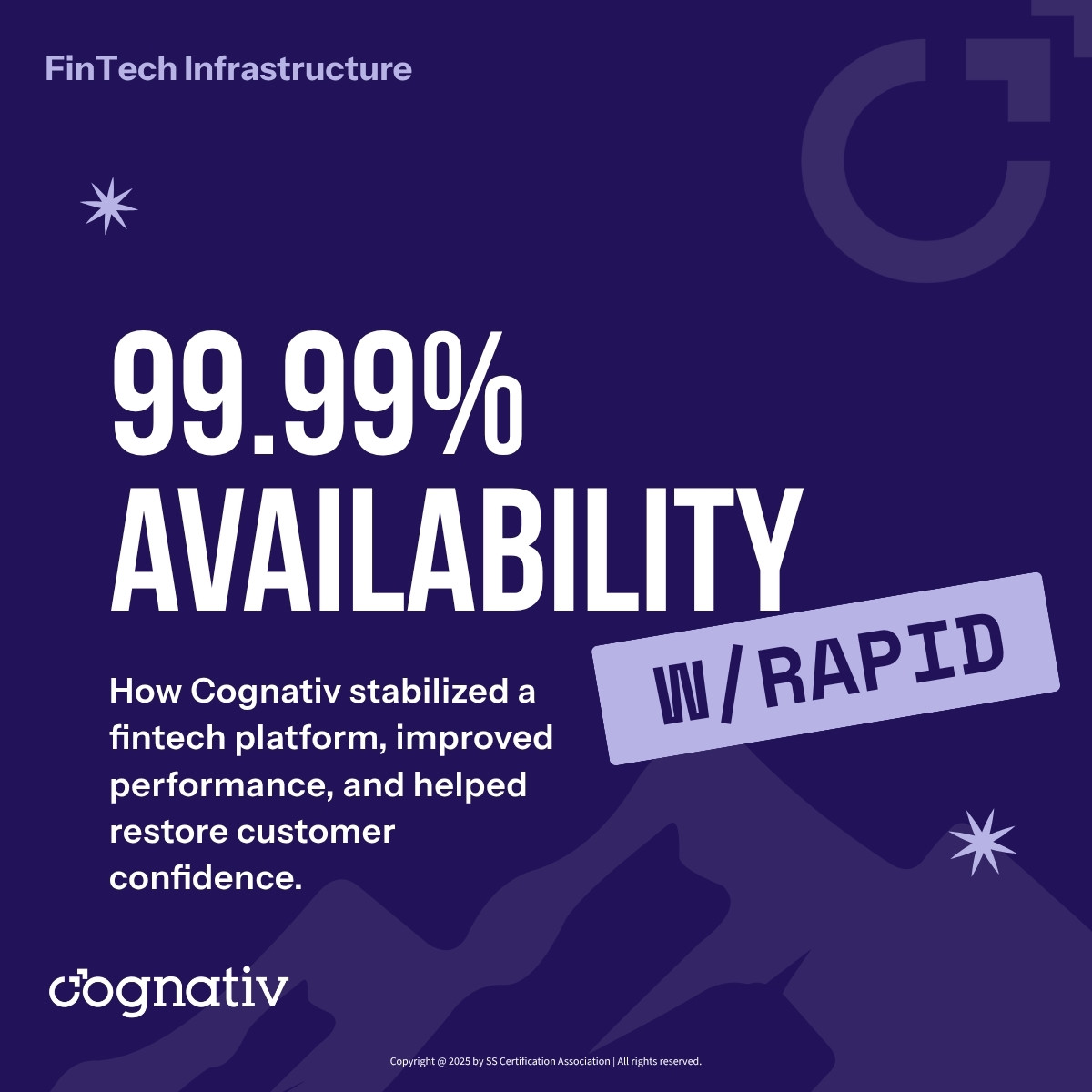
Fintech Platform Reaches 99.99% Availability
Platform Modernization
Elastic Scaling
Observability
Virtual CTO
Fintech Platform Reaches 99.99% Availability
Cognativ stepped in with Virtual CTO leadership to stabilize a fintech platform affected by reliability, performance, and scalability pressure.
The engagement helped the client reach 99.99% availability, restore customer confidence, and create a stronger foundation for regulated growth.
See the Fintech Stability CaseEvaluate what the completed project changes
A project can meet its requirements and milestones while the wider business outcome continues to depend on other conditions.
RAPID helps leadership connect project delivery with customer evidence, operational performance, organizational constraints, technology decisions, investment priorities, and the next transformation decision.
Use project records to clarify the wider outcome
Organizations already working through sequential projects often have substantial documentation available.
Connect project documentation with the wider outcome
Requirements specifications, project plans, architecture documents, design records, risk registers, test plans, milestone reports, contracts, and change requests can all provide valuable evidence.
- Business Outcome
- Define the measurable improvement the project or transformation ultimately needs to support.
- Requirements and Scope
- Existing specifications, acceptance criteria, deliverables, assumptions, and project boundaries.
- Project Evidence
- Plans, milestones, status reporting, risks, test results, issues, and completed deliverables.
- Architecture and Dependencies
- Systems, integrations, infrastructure, vendors, physical dependencies, and technical constraints.
- People and Ownership
- Project owners, technical leaders, operators, business stakeholders, and people able to make important decisions.
- Constraints and Commitments
- Contracts, regulation, budgets, timelines, organizational conditions, and existing commitments.
Resolve uncertainty before the next project commitment
The purpose is not to recreate that material.
It is to determine how the project relates to the wider business outcome and identify which questions exist outside the current project boundary.
See How the First 30 Days Begin

Turn predictable delivery into measurable business change
Cognativ can help connect project requirements, technology, operating evidence, organizational constraints, implementation, and decision ownership without replacing delivery methods that are already appropriate for the work.
RAPID vs. Waterfall FAQs
Clarify scope, implementation and the role of existing evidence before selecting the support your organization needs.
What is the main difference between RAPID and Waterfall?
Waterfall is a sequential delivery model in which work moves through defined phases such as requirements, design, implementation, testing, and deployment.
RAPID is Cognativ’s outcomes-based transformation framework connecting Research, Analyze, Plan, Implement, and Decide around a business challenge.
The primary difference is therefore scope: Waterfall structures project delivery, while RAPID structures a broader transformation and can accommodate different delivery methods within it.
Understand the RAPID framework
Is RAPID an alternative to Waterfall?
Not necessarily. RAPID does not prescribe a single software-development or project-management lifecycle.
A Waterfall project can operate within a RAPID transformation when the project requirements and solution are sufficiently stable.
When is Waterfall appropriate?
Waterfall can work well when scope and requirements are clearly defined, dependencies are predictable, the desired deliverable is understood, and significant changes are not expected during execution.
It can also provide useful structure where documentation, formal handoffs, and milestone visibility are important.
Does Waterfall allow changes?
Changes are possible, but they can require revisions to requirements, design, plans, budgets, or downstream work that already depends on earlier decisions.
This makes the cost of significant change more important to consider in sequential delivery than in approaches designed around frequent iteration.
Can RAPID and Waterfall be used together?
Yes. RAPID can help establish the business outcome, investigate uncertainty, prioritize work, and evaluate results.
Once a specific project is sufficiently understood, Waterfall can provide the delivery structure for executing that project.
Does RAPID require Agile?
No. RAPID is not an Agile software-development framework.
Implementation can use Agile, Waterfall, hybrid delivery, operational change, consulting work, AI development, process redesign, or other approaches appropriate to the problem.
When does RAPID make more sense than Waterfall alone?
RAPID can be useful when the organization does not yet have enough certainty to define the complete solution upfront.
Examples include modernization strategy, AI adoption, customer-experience problems, operating-model change, competing technology investments, or transformations involving several interconnected business and technical constraints.
Can Waterfall projects become inputs to RAPID?
Yes. Requirements, project plans, architecture, testing evidence, risks, milestones, delivery results, and operational outcomes can all provide useful evidence during Research, Analyze, Implement, and Decide.