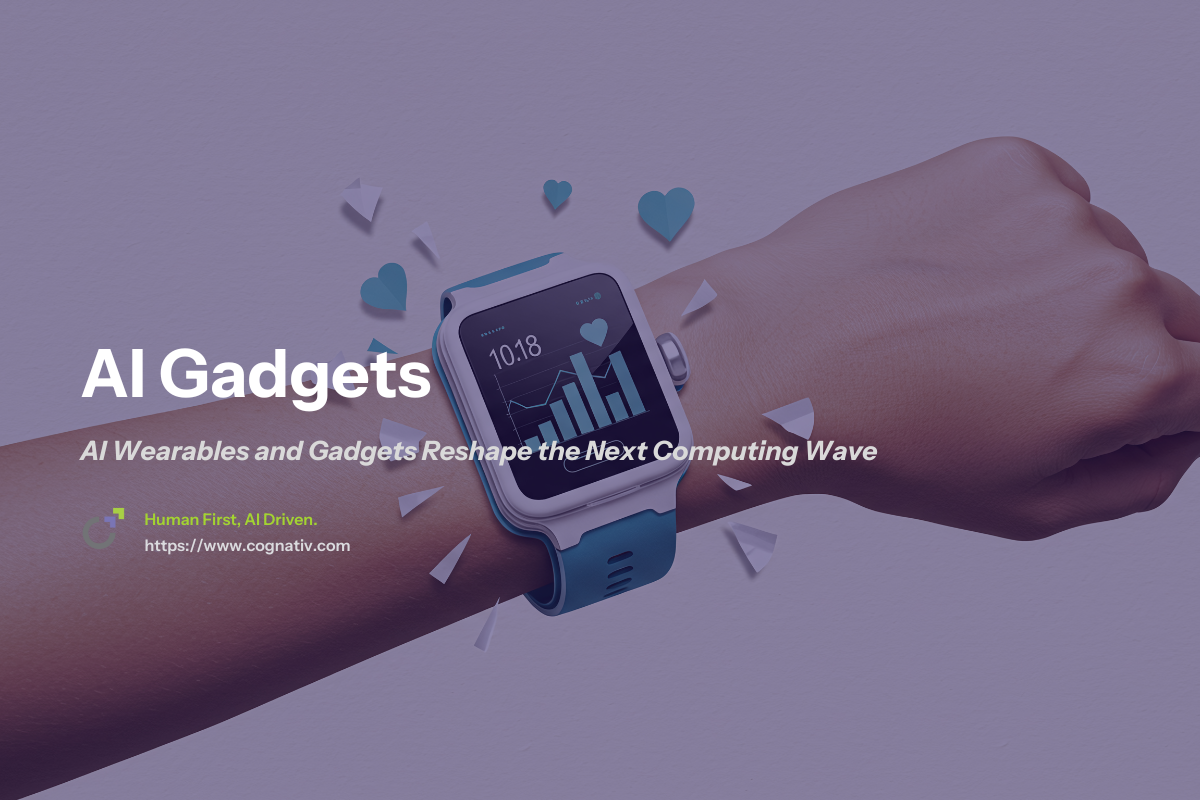
AI Wearables and Gadgets Reshape the Next Computing Wave
The latest wave of AI wearables and gadgets looks very different from the fitness bands and smartwatches of a decade ago. Headsets, pins, glasses and smart earbuds now ship with embedded models, natural language interfaces and tight integration with cloud AI services. Some devices promise to summarise your day, handle messaging, translate on the fly or coach you in real time, all without pulling out a phone. Others quietly analyse movement, voice, context and biometrics in the background.
Under the marketing gloss sits a serious strategic question. If AI follows you everywhere, on your wrist, face or ear, who controls that experience, what data is collected and how is value created and shared. For enterprises, this is not only a consumer electronics story. It is a new frontend for AI that will touch retail, logistics, healthcare, travel, media and more.
Key takeaways
-
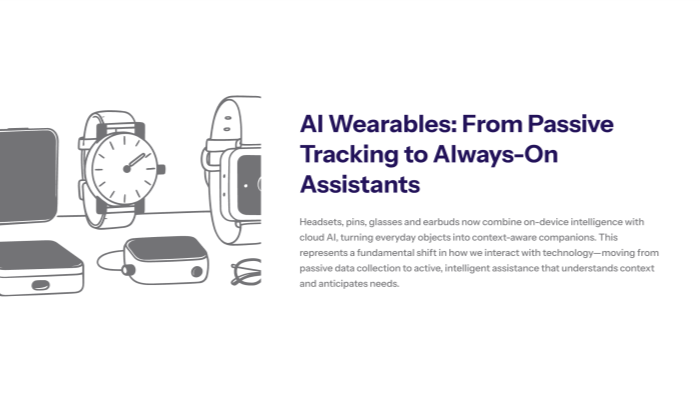
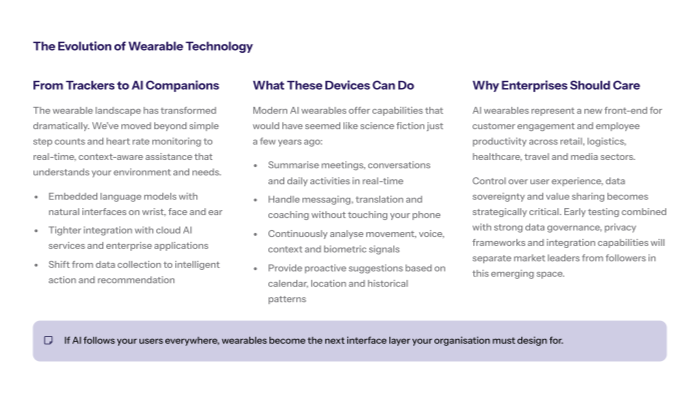
AI wearables are shifting from passive tracking to real time, context aware assistants that combine on device intelligence with cloud AI.
-
The winners will be those that treat AI wearables as part of an ecosystem spanning devices, applications, data infrastructure and services, not as isolated gadgets.
-
Enterprises should start testing AI wearable use cases now, while investing in the data, privacy and integration capabilities needed to scale safely.

The new wave of AI wearables and companion gadgets
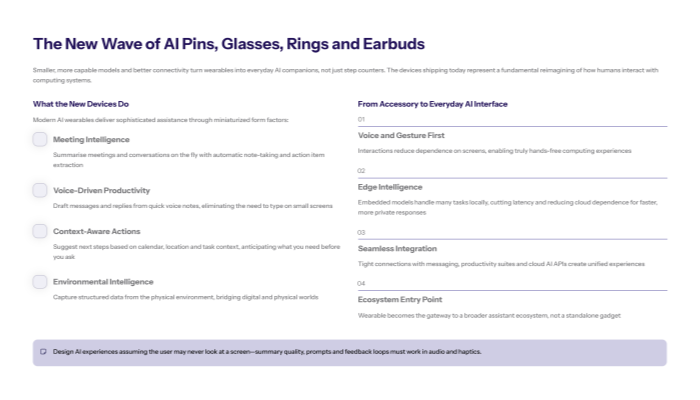
Today’s AI hardware boom includes smart pins, camera glasses, AI enhanced headphones, rings and wrist devices that overlay everyday activities with machine perception and guidance. Many look inspired by earlier Sony, Apple or Google experiments, but the underlying capability is different. Models are smaller, more efficient and far better at natural language, vision and multimodal fusion.
Instead of just counting steps, these devices aim to understand what you are doing, where you are, who you are with and what you might need next. That includes:
-
summarising meetings or conversations
-
drafting messages or replies from voice notes
-
suggesting actions based on calendar, location or task context
-
capturing structured data from the physical environment
What makes this wave credible is not only better hardware, but also the maturity of AI platforms, edge accelerators and connectivity that link devices to powerful backends when needed.
From niche gadget to everyday AI interface
A decade ago, most wearables were accessory products. Today, several strategic shifts are visible:
-
Voice and gesture first interactions mean less reliance on screens.
-
Embedded models can handle many tasks locally, reducing latency and dependence on constant connectivity.
-
Integration with ecosystems such as messaging platforms, productivity suites and cloud AI APIs makes the wearable an entry point to a broader assistant rather than a standalone novelty.
For software and AI leaders, this is the moment to design experiences that assume the user may not be looking at a screen at all. That has implications for prompt design, feedback loops and how results are summarised in speech or haptics.
Cognativ’s work on AI application development services for innovative solutions is relevant here, because the real differentiation will come from how applications interpret context and orchestrate responses across devices and channels.
What makes AI wearables different from past device booms
On the surface, AI wearables resemble earlier hardware cycles. A closer look shows structural differences in how value is generated and where the risks sit.
From sensor centric to model centric devices
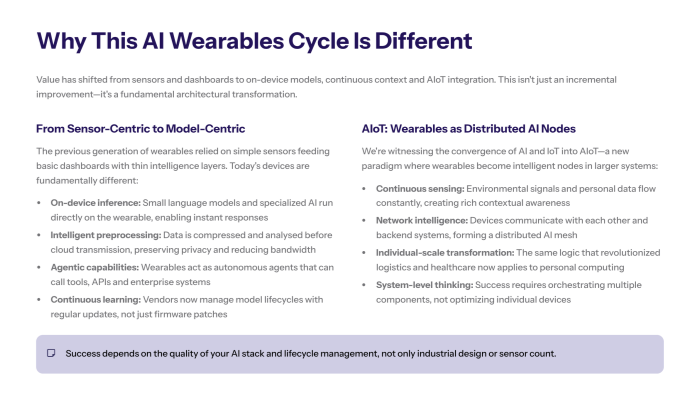
Previous wearables revolved around sensors and dashboards. Step counts and heart rate data were sent to a phone and visualised in an app. The intelligence layer was thin.
The current generation is model centric:
-
Devices run small language models or other inference workloads on device.
-
They compress and pre process data before sending it to the cloud.
-
They act as agents that can call tools, APIs or enterprise systems.
That means the quality of the AI stack matters as much as industrial design. It also means vendors must think about lifecycle management for models, not just firmware and hardware.
Continuous context and the AIoT dimension
AI wearables sit at the intersection of artificial intelligence and the internet of things. They constantly ingest environmental signals and personal data. That creates opportunities for more helpful assistance, but also adds complexity and risk.
To understand this convergence, it is useful to see AI wearables as part of a broader AIoT landscape, where devices, sensors and models work together. Cognativ’s analysis of the impact of IoT and artificial intelligence on modern industry solutions illustrates how AI plus connected hardware can transform sectors from logistics to healthcare.
For wearables, the same logic applies at individual scale. Devices are no longer just sensors; they are nodes in a distributed AI system.
Strategic opportunities for enterprises and brands
For many enterprises, the key question is not whether AI wearables will exist, but how they will reshape customer interactions, employee workflows and data flows.
New engagement surfaces for consumer brands
Retailers, media companies and consumer services can use AI wearables as new engagement channels:
-
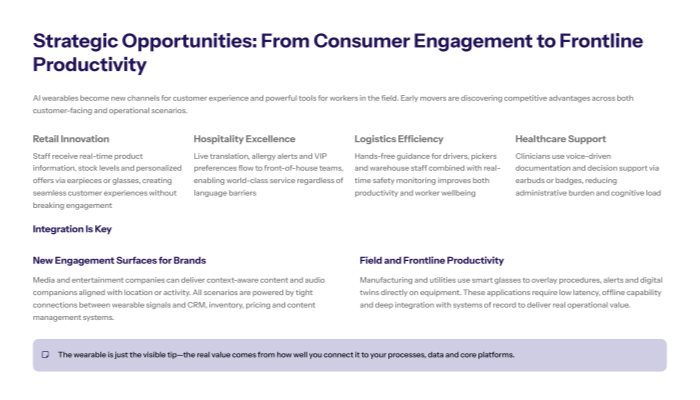
Retail assistants that whisper product information, stock levels or personalised offers to store staff.
-
Hospitality staff receiving real time translations, allergy alerts or VIP preferences through earpieces.
-
Media and entertainment companies delivering context aware content or audio companions aligned with location or activity.
These experiences depend on the ability to connect wearable data and events back into core systems such as CRM, inventory, pricing and content management.
Cognativ’s coverage of enterprise software solutions for business efficiency and AI services for efficient business impact shows how robust back office systems and AI services underpin these kinds of front end innovations.
Productivity and safety in field and frontline work
Beyond consumers, AI wearables can change how work happens on the ground:
-
In logistics and transportation, hands free devices can guide drivers, pickers and warehouse staff through optimal routes or tasks while monitoring safety conditions.
-
In manufacturing and utilities, smart glasses can overlay instructions, alerts or digital twins on physical equipment, aiding repairs and inspections.
-
In healthcare, clinicians can use voice driven notes, decision support hints or patient summaries through earbuds or badges, reducing screen time at the bedside.
These scenarios require tight control over latency, offline capability and integration with existing systems of record. They also require clear boundaries between assistance and automation, especially in safety critical environments.
Data, privacy and trust in AI on body devices
If AI follows users everywhere, data protection and trust become non negotiable. The intimacy of wearable devices means that even small missteps can have outsized reputational and regulatory consequences.
Sensitive data and continuous observation
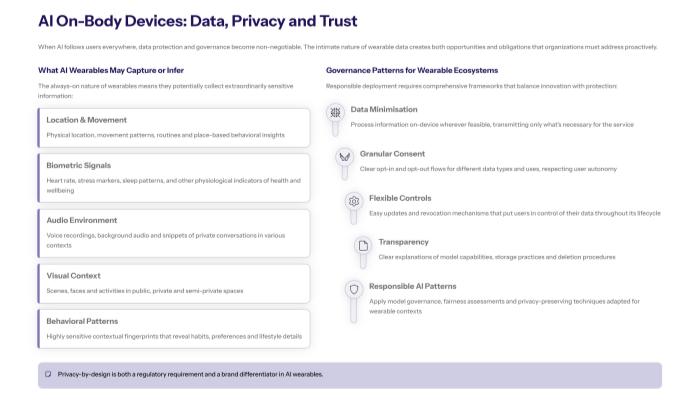
AI wearables can capture or infer:
-
physical location and movement
-
biometric signals such as heart rate or stress markers
-
voice, background audio and snippets of private conversations
-
potentially, visual scenes and faces in public or semi private spaces
Enterprises working with such devices, either as sellers or integrators, need strong governance around what is captured, how it is processed, where it is stored and for how long.
Designing for privacy by default and by design is not just a regulatory mandate; it is a competitive differentiator. Users will increasingly choose ecosystems that provide genuine control rather than verbose policies.
Governance patterns for AI wearable ecosystems
Governance for AI wearables should cover:
-
Data minimisation and on device processing where feasible.
-
Clear opt in and opt out flows for different data types and use cases.
-
Granular consent management that can be updated easily.
-
Transparent explanations of what models do, what is stored and how to delete history.
The same principles apply whether an enterprise is deploying wearables internally or building consumer facing products. Organisations that already have experience with responsible AI, model governance and local AI architectures can adapt this knowledge to the wearable context.
Cognativ’s work on local and private AI, such as what is a local LLM and understanding private AI advantages , provides a useful reference for architectures that keep sensitive processing close to the user or enterprise boundary.
Designing AI wearable ecosystems and infrastructure
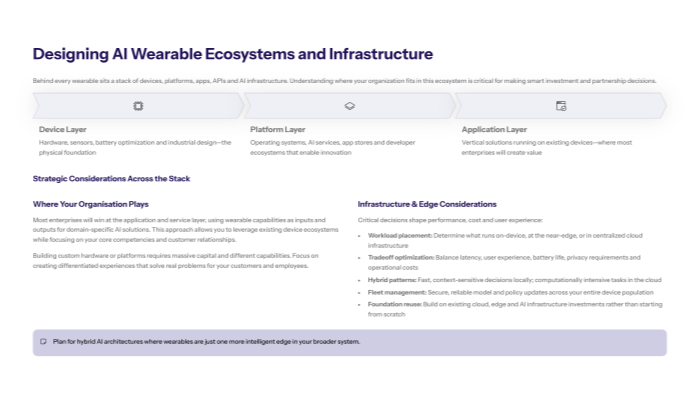
Behind every wearable there is an ecosystem of applications, APIs, data services and infrastructure. For enterprises, deciding where to participate in this stack is a strategic choice.
Device, platform or application play
There are three broad roles an organisation can play:
-
Device maker: design and manufacture hardware, including sensors, battery and industrial design.
-
Platform provider: run the operating system, AI services, app store and developer ecosystem around wearables.
-
Application or service layer: build vertical solutions that run on top of existing devices and platforms.
Most enterprises will not become device makers, and only a few will operate broad platforms. For the rest, the highest leverage lies in building applications and services tailored to their domain, using AI wearable capabilities as inputs and outputs.
That requires strong integration capabilities, robust APIs and a clear understanding of how wearable data flows into analytics, decision engines and operational systems. Cognativ’s AI services and AI development services for transforming business solutions are aligned with this layer, helping clients build domain specific AI that can surface on any device.
Infrastructure and edge considerations
AI wearables sit on a spectrum between local and cloud processing. Decisions about where to run which workloads affect:
-
latency and user experience
-
energy consumption and battery life
-
privacy and compliance
-
cost of compute and networking
Enterprises need to plan for hybrid architectures where:
-
quick, context sensitive decisions happen on device or at the near edge
-
heavier tasks such as training, long-horizon planning or multi source retrieval rely on cloud infrastructure
-
models and policies can be updated securely across fleets of devices
This is where existing investments in cloud, edge and AI infrastructure become a foundation rather than a constraint. Organisations that already work with edge AI patterns, as explored in Cognativ’s content on edge computing and AI benefits and applications , will be better positioned to extend their capabilities to wearable form factors.
Sector specific use cases beyond consumer novelty
While much attention is on consumer gadgets, several industries stand to gain from AI wearables if they are deployed thoughtfully.
Healthcare and life sciences
In healthcare, AI wearables can support:
-
remote monitoring of chronic conditions with early warning signals
-
rehabilitation programmes guided by on body sensors and personalised coaching
-
clinician tools that reduce administrative overhead and cognitive load
These applications must meet high standards of security, validation and clinical relevance. They also require close integration with electronic health records and care pathways.
Logistics, manufacturing and field services
For logistics and operations intensive sectors:
-
Smart glasses can guide picking, packing and loading with visual cues.
-
Wrist or badge devices can track location and status of personnel for safety and coordination.
-
AI powered headsets can support technicians with just in time manuals, diagnostics or remote expert assistance.
In each case, the wearable is only one component; success depends on the underlying process design and systems integration. Cognativ’s industry focus on logistics solutions and manufacturing solutions illustrates how domain knowledge and AI engineering come together to create operational value.
Retail, travel and hospitality
For customer facing sectors:
-
Travel agents and front line staff can use wearables for real time itinerary updates, disruption handling suggestions and language support.
-
Retail associates can access inventory, recommendations and cross sell prompts without leaving the customer.
-
Hotels and venues can equip staff with discreet assistants that coordinate service delivery and personalise experiences.
These scenarios will become more common as AI wearables move from early adopters to mainstream users.
Conclusion
AI wearables and gadgets mark the next frontier in how people interact with digital systems. The step change is not just in form factor but in the combination of continuous sensing, on device intelligence and deep integration with cloud AI. For enterprises, this wave brings both opportunity and responsibility. New interfaces can unlock richer customer experiences, safer operations and more productive employees, but only if they are grounded in robust architecture, governance and respect for privacy.
The strategic work now is to map where AI wearables genuinely add value, design experiences that fit real workflows, and ensure that data and models are handled with care. Organisations that treat AI wearables as part of a coherent AI and digital strategy, rather than as isolated pilots or marketing experiments, will be best placed to benefit as the ecosystem matures.
If your organisation is exploring AI enabled devices, assistants or multi channel experiences, discover how Cognativ’s AI services and broader AI infrastructure and solutions expertise can help you design, build and scale the right foundations.
To keep up with how AI hardware, infrastructure and regulation evolve together, subscribe to What Goes On, Cognativ’s weekly tech digest, via the Cognativ AI and software insights blog for ongoing executive level analysis.