Amazon Expands AI Cloud Power With 50 Billion Plan
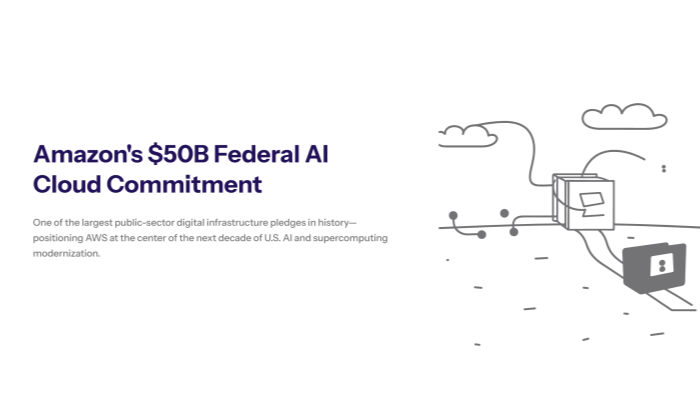
Amazon’s decision to pledge up to 50 billion dollars to expand artificial intelligence and supercomputing cloud services for the U.S. government marks one of the largest public-sector digital infrastructure commitments to date.
The initiative signals a sharp acceleration in federal adoption of frontier AI capabilities and positions Amazon Web Services as a central supplier in the next decade of U.S. digital modernization. Beyond the headline number, the move confirms a strategic shift: federal agencies are no longer testing AI at the edges, they are building it into core mission systems.
Key Takeaways
-
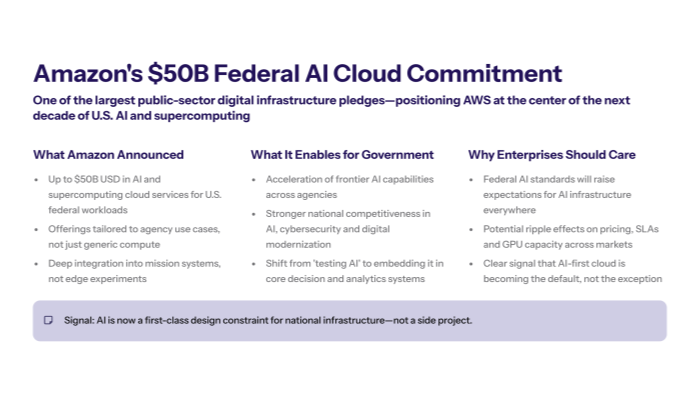
Amazon plans up to 50 billion dollars in new AI and supercomputing cloud services tailored to U.S. federal workloads.
-
The expansion strengthens U.S. national competitiveness in AI, cybersecurity, and large-scale digital modernization.
-
Enterprises should expect downstream impacts in AI infrastructure expectations, pricing, and market competition.

Why Amazon’s 50 Billion AI Cloud Plan Matters Now
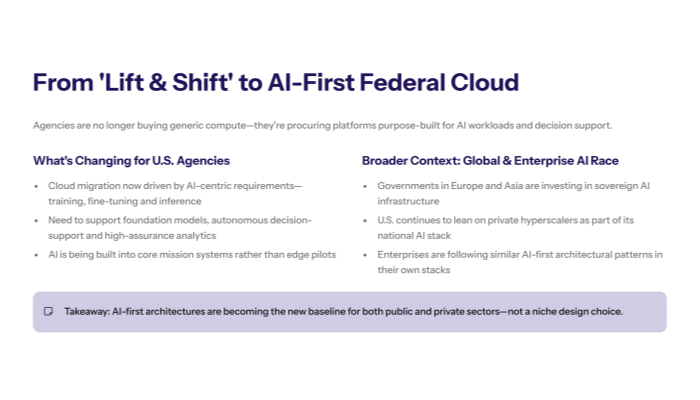
The announcement lands at a moment when both capital markets and governments are re-pricing the role of AI infrastructure. Over the last decade, U.S. agencies have gradually migrated workloads to the cloud. In 2025, that migration shifts from “lift and shift” to “AI-first by design.”
Instead of procuring generic compute, agencies are looking for platforms that can support model training, foundation-model fine-tuning, autonomous decision-support, and high-assurance analytics. This mirrors a broader global race in AI infrastructure, with governments in Europe and Asia investing heavily in their own sovereign capabilities. Amazon’s commitment signals that the U.S. will continue to rely on private hyperscalers as part of its national AI stack.
For enterprises, the direction is familiar. Many are already exploring AI-centric architectures similar to those described in Cognativ’s work on AI infrastructure and modern data solutions and AI-first architectural strategy . The difference is that, at federal scale, these decisions have macroeconomic and geopolitical consequences.
Security And Sovereignty As First-Class Requirements
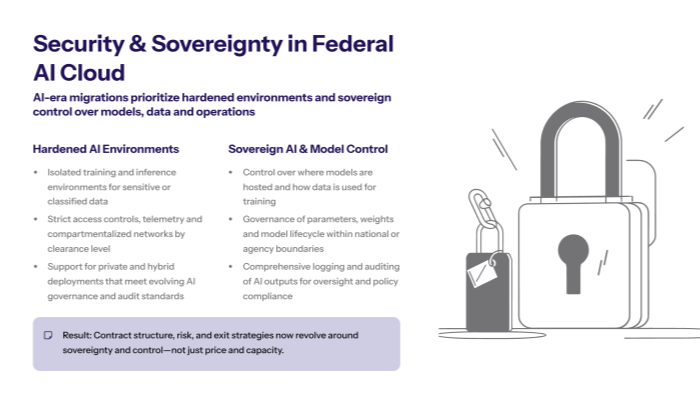
Traditional cloud migrations for government prioritized compliance and cost. AI-era migrations prioritize security, sovereignty, and mission continuity.
Hardened AI environments for sensitive data
Federal workloads often involve highly sensitive or classified data. That requires:
-
isolated training and inference environments
-
strict access controls and telemetry
-
compartmentalized networks for different clearance levels
-
support for private and hybrid deployments
Amazon’s federal cloud services will need to accommodate not only today’s compliance regimes, but upcoming AI-specific governance standards and audit requirements. This aligns with the kind of designs explored in Cognativ’s work on AI infrastructure solutions and use cases , where security and performance have to be balanced from the start.
Sovereign AI and model control
Governments increasingly want control over:
-
where models are hosted
-
what data they train on
-
how parameters and weights are governed
-
how outputs are logged and audited
The result is a move toward sovereign AI: architectures where the government maintains strategic control over models, even if they run on private-cloud hardware. That has consequences for contract structure, exit strategies, and vendor dependency.
How Amazon’s Government AI Expansion Reshapes Competition
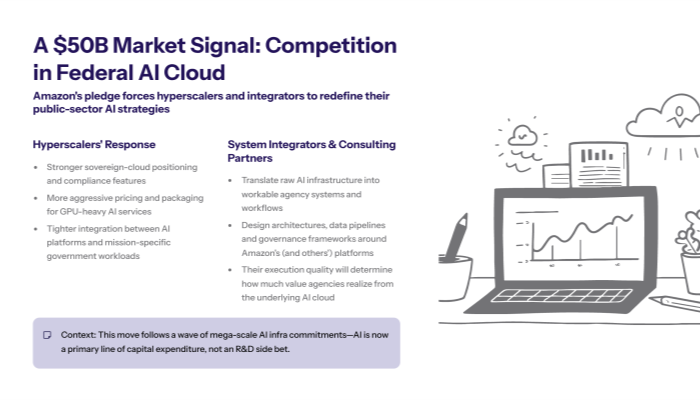
A 50 billion dollar pledge is not just a procurement line; it is a market signal. It tells other hyperscalers, systems integrators, and defense contractors where the federal AI center of gravity is moving.
Hyperscalers in a public-sector arms race
Microsoft, Google, Oracle, and other vendors have been building their own government clouds and AI offerings. Amazon’s new plan forces them to respond in at least three ways:
-
stronger sovereign cloud positioning and compliance features
-
more aggressive pricing for AI and GPU-intensive services
-
tighter integration between AI platforms and public-sector applications
This move also comes after other large-scale AI infrastructure commitments across the private sector, such as Amazon’s broader cloud and AI investment strategy highlighted in earlier analyses like the Amazon 100 billion dollar AI investment overview . Together, these announcements illustrate how quickly AI has shifted from speculative innovation to core capital expenditure.
System integrators and consulting partners
Large consulting firms and integrators will play a key role in translating AI infrastructure into working systems for agencies. Their ability to design architectures, manage data pipelines, and implement governance frameworks will determine how much value gets realized from Amazon’s underlying platform.
Here, enterprises and agencies face similar challenges. Many will need help connecting infrastructure decisions to real business outcomes, a topic covered deeply in Cognativ’s perspective on AI consulting services that turn strategy into execution .
AI Supercomputing For Government Missions
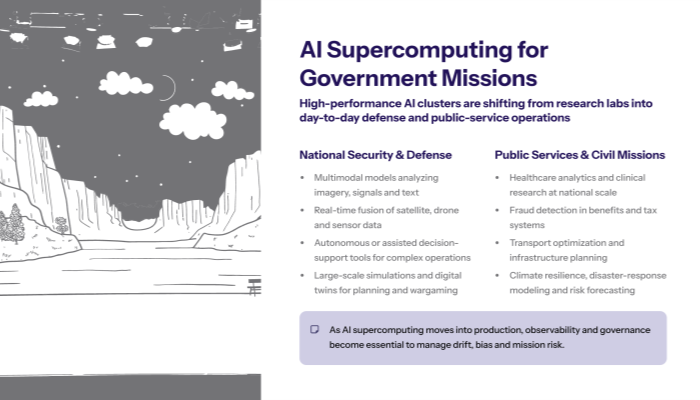
Supercomputing has historically been associated with scientific research and national labs. AI is changing that. Federal agencies increasingly need high-performance compute to support operational missions.
National security and defense
Modern defense and intelligence operations rely on:
-
multi-modal models that analyze imagery, signals, and text
-
real-time fusion of satellite, drone, and sensor data
-
autonomous or semi-autonomous decision-support tools
-
large-scale simulations and digital twins for planning
These workloads are compute-intensive and latency-sensitive. They require dedicated GPU clusters, high-throughput networking, and robust observability. For example, in adjacent domains, specialized supercomputing deployments like Nvidia’s AI systems for the U.S. energy ecosystem show what is possible when national-scale compute is deployed with a clear mission in mind.
Public services, healthcare, and benefits
Outside defense, AI supercomputing can enhance:
-
healthcare analytics and clinical research
-
fraud detection across benefits and tax systems
-
transportation optimization and infrastructure planning
-
climate resilience and disaster-response modeling
As agencies deploy AI in production, they will also need rigorous monitoring and governance. This is where modern observability practices, such as those discussed in Cognativ’s guide on optimizing AI observability , become essential to keep drift, bias, and failure modes in check.
Economic And Infrastructure Ripple Effects
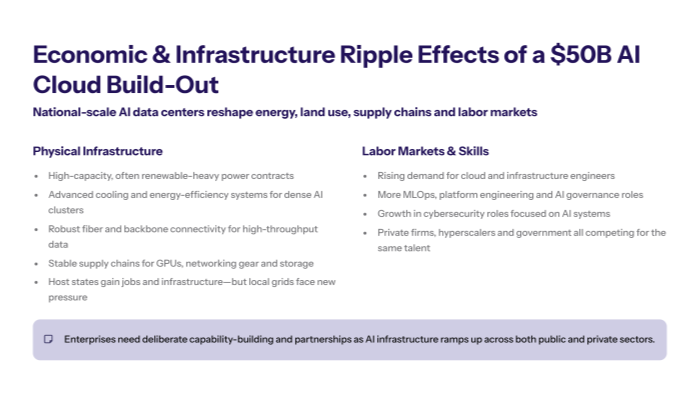
A 50 billion dollar AI cloud commitment has direct and indirect economic impacts.
Power, land, and supply chains
Large-scale AI data centers demand:
-
high-capacity, often renewable-heavy power contracts
-
sophisticated cooling and energy-efficiency systems
-
robust fiber and backbone connectivity
-
stable supply chains for GPUs, networking, and storage
States hosting new facilities stand to benefit through construction, long-term operations jobs, and enhanced digital infrastructure. At the same time, rising AI power needs may pressure local grids and accelerate the debate around sustainable energy for compute.
Labor markets and skills
Government AI adoption at this scale will increase demand for:
-
cloud and infrastructure engineers
-
MLOps and platform engineers
-
AI governance and risk specialists
-
cybersecurity professionals focused on AI systems
Private organizations will be competing for the same talent pool that federal agencies and hyperscalers are trying to attract, making capability building and partnerships even more important.
Policy, Governance, And Concentration Risks
Despite the upside, the expansion raises policy and risk questions that executives should not ignore.
Vendor concentration and systemic dependency
Relying heavily on a small number of hyperscalers introduces concentration risk:
-
operational: outages, supply chain disruptions, or security incidents
-
strategic: changes in pricing or business models
-
geopolitical: extraterritorial regulatory pressure or export controls
These concerns are not limited to the public sector. Enterprises are asking similar questions and many are exploring multi-cloud or hybrid designs, as described in Cognativ’s work on multi-cloud and AI-first architectures , to avoid lock-in and improve resilience.
Regulatory and ethical oversight
Government use of AI for surveillance, benefits eligibility, law enforcement, and border management comes with serious ethical and legal questions. As infrastructure scales, so will scrutiny over:
-
explainability and audit trails
-
bias mitigation
-
due process for impacted citizens
-
transparency around where and how AI is used
The infrastructure itself does not resolve these issues, but it can make robust governance easier if designed with auditability and policy constraints in mind.
What Enterprise Leaders Should Take From Amazon’s Move
For most enterprises, Amazon’s federal AI expansion is not a contract opportunity, but it is a strategic signal.
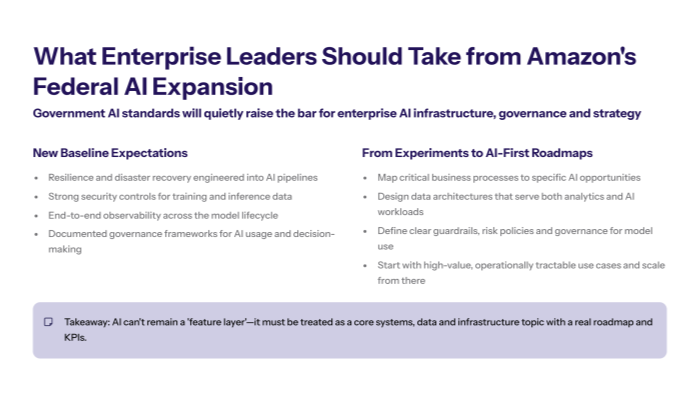
Raising the baseline expectations
As government agencies standardize on secure, AI-ready cloud architectures, enterprise boards and regulators will internalize similar expectations for:
-
resilience and disaster recovery in AI pipelines
-
security controls for training and inference data
-
observability across model lifecycle stages
-
documented governance frameworks for AI usage
Companies that treat AI as an add-on feature rather than a core systems and infrastructure topic will struggle to keep pace with these new norms.
From experimentation to AI-first roadmaps
Enterprises that want to stay ahead should:
-
map critical business processes to AI opportunities
-
design data architectures that support both analytics and AI
-
define clear guardrails and governance for model use
-
start with high-value, operationally tractable use cases
Cognativ’s portfolio of AI services and insights on AI-first strategies and pitfalls are built around helping organizations translate infrastructure trends like Amazon’s into actionable roadmaps with measurable outcomes.
Conclusion
Amazon’s plan to invest up to 50 billion dollars in AI and supercomputing cloud services for the U.S. government is more than another cloud contract. It marks a structural shift in how public institutions think about infrastructure, national competitiveness, and digital resilience in the AI era. For enterprise leaders, it sets a new reference point for the scale, security posture, and architectural ambition that AI programs will be measured against.
Organizations that start adapting now—by modernizing their data foundations, refining AI governance, and aligning infrastructure with business outcomes—will be better positioned to ride the next decade of AI-driven change rather than reacting to it.
If you want to connect these trends to your own roadmap, explore Cognativ’s AI infrastructure and implementation insights and our broader services portfolio for AI-first architecture and delivery.
Stay ahead of AI and tech strategy. Visit the Cognativ blog and subscribe to What Goes On, our weekly executive tech digest for deeper analysis and curated insights.