HP AI restructuring reshapes global jobs and strategy ahead
Hewlett Packard’s decision to cut up to 6,000 jobs while restructuring its business around artificial intelligence is another clear signal that AI is now a primary driver of corporate strategy, not a side bet. The move comes as AI infrastructure spending surges and both investors and regulators ask tougher questions about return on investment. For technology buyers and enterprise leaders, HP’s pivot is less about one company and more about how the next wave of AI adoption will reshape employment, infrastructure and competition.
Key takeaways
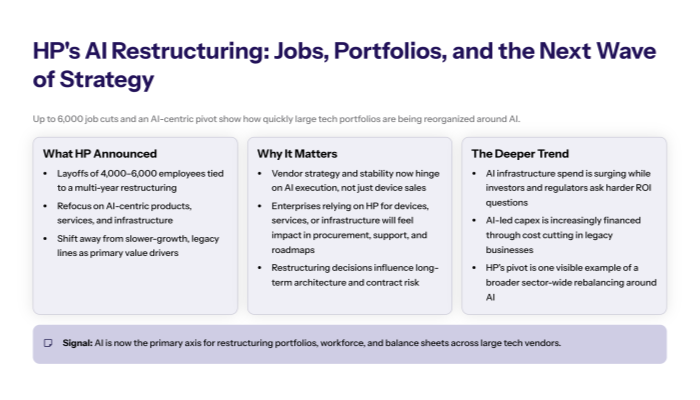
HP’s restructuring illustrates how quickly AI is becoming the organizing principle for large tech portfolios. Enterprises that depend on HP for devices, services or infrastructure will feel the impact in procurement, support and long-term architecture planning. It also highlights a deeper trend: AI-centric capital expenditure is being financed through aggressive cost cutting in legacy lines of business.
-
HP plans to lay off between 4,000 and 6,000 employees as it pivots toward AI-centric products and services.
-
The restructuring aligns HP with a broader
AI infrastructure race
already reshaping balance sheets across the sector, as seen in recent large-scale data center and cloud investments.
-
Enterprises must assume that AI-led cost optimization, portfolio pruning and workforce reshaping will continue across vendors, affecting support models, pricing and contract risk.

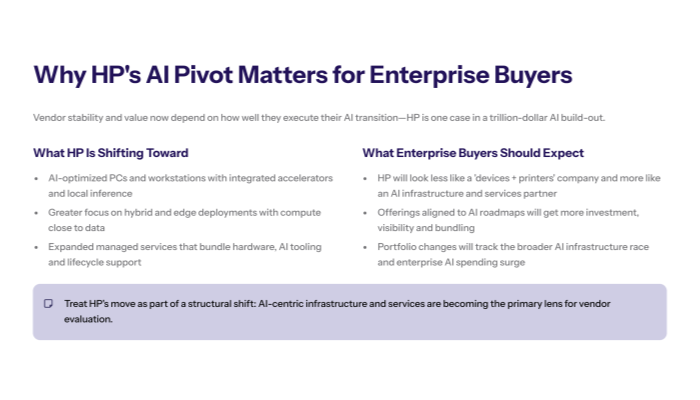
Why HP’s AI restructuring matters for enterprise buyers
HP is not the first major technology company to reorient its business around AI, but the scale of the job cuts and the explicit link to AI strategy make this move a useful case study. For CIOs, CTOs and procurement leaders, it is a reminder that vendor stability now depends on how well those vendors execute their AI transition.
HP’s decision lands in a market already defined by what analysts describe as a trillion-dollar bet on AI, with hyperscalers, chipmakers and infrastructure providers racing to deploy capital into compute, networking and data platforms. That investment wave has been explored in depth in Cognativ’s work on the trillion-dollar AI investment cycle and the broader enterprise AI spending surge , which together frame HP’s move as part of a much larger structural shift.
From devices to AI infrastructure and services
For most of the last decade, HP has been best known for personal systems and printers. Those businesses remain material, but margins are under pressure and demand is cyclical. AI offers higher growth and, if executed well, better long-term economics.
In practice, an AI-centered HP strategy likely means:
-
More focus on AI-optimized PCs and workstations with integrated accelerators and local inference capabilities.
-
A stronger push into hybrid and edge deployments, where compute is placed close to data and workloads, supported by partners and integrators.
-
Expanded managed services offerings that bundle hardware, AI tooling and lifecycle support in multi-year contracts.
For enterprises that are modernizing infrastructure, this shift lines up with the broader move towards specialized AI infrastructure and data solutions, where hardware, storage and networking are designed around model training and inference rather than generic compute. Cognativ has detailed how vendors and enterprises can align around best practices for AI infrastructure rather than ad-hoc hardware upgrades.
Layoffs as a signal of portfolio risk and focus
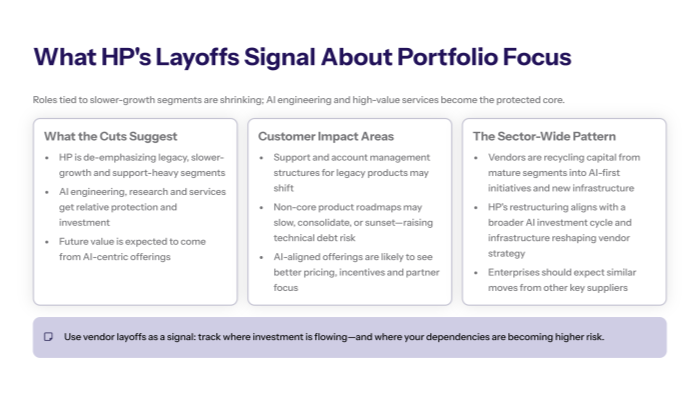
The headline job cuts are painful for employees, but from a strategic perspective they signal where HP expects future value to come from. Roles tied to slower-growth segments or legacy support may be de-emphasized, while engineering, AI research and high-value services teams are protected or expanded.
For enterprise customers, this has several implications:
-
Support and account management structures may change, particularly for legacy product lines.
-
Product roadmaps in non-core segments could slow down or be consolidated, increasing technical debt risk for customers who stay on older platforms.
-
AI-aligned offerings will likely receive preferential pricing, marketing and partner attention.
This is consistent with what we see across the sector. Cognativ’s coverage of the broader AI investment cycle shows that vendors are recycling capital from mature segments into AI-first initiatives and new infrastructure. HP’s restructuring fits squarely in that pattern and echoes themes from Cognativ’s analysis of how AI infrastructure is reshaping vendor strategy .
The wider AI infrastructure race shaping HP’s choices
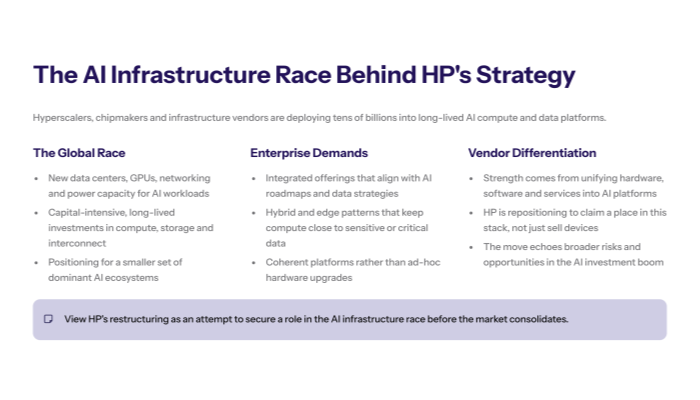
HP’s strategy needs to be viewed within the context of a global infrastructure build-out. Hyperscalers and cloud providers are investing tens of billions into new data centers, GPUs, networking and power capacity to support AI workloads. That race is not only about scale, but also about how intelligently capital is deployed and governed.
From a strategic standpoint:
-
AI infrastructure requires long-lived, capital-intensive investments in compute, storage and interconnect.
-
Enterprises are demanding integrated offerings that align with their own AI roadmaps and data strategies.
-
Vendor differentiation increasingly depends on how well hardware, software and services are unified into coherent AI platforms.
Cognativ’s perspective on the billion-dollar AI infrastructure race and the risks behind the AI investment boom is directly relevant here: HP’s restructuring is an attempt to define its place in that race before it hardens around a smaller set of dominant ecosystems.
Strategic implications for enterprise IT and procurement
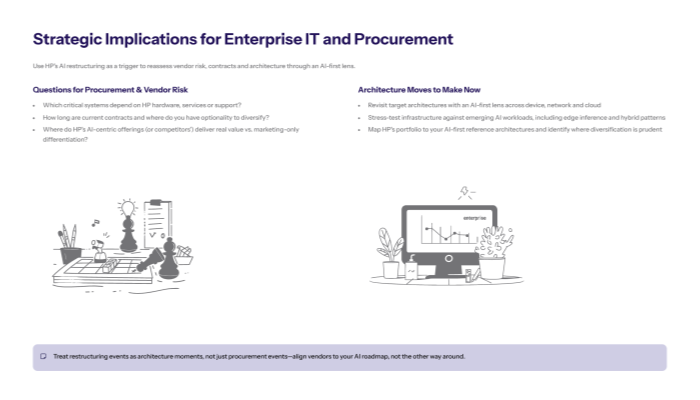
For enterprise buyers, HP’s AI restructuring should trigger a structured review of risk exposure and opportunity. The goal is not to react to headlines, but to align vendor decisions with your own AI and infrastructure strategy.
Key questions to ask include:
-
Which critical systems depend on HP hardware, services or support?
-
How long are your current contracts and what optionality do you have to switch or diversify?
-
Where can AI-centric offerings from HP (or its competitors) actually deliver measurable value, rather than just marketing differentiation?
Cognativ’s work on AI infrastructure strategy and solutions and enterprise AI infrastructure choices shows that the largest benefits come when technology strategy, vendor selection and operating model are aligned. A restructuring event like HP’s is a good moment to reassess that alignment.
Enterprise architecture and AI-first design
Enterprises that rely heavily on HP for end-user devices, print and infrastructure should translate this news into architecture decisions, not only procurement discussions.
At a minimum, this means:
-
Revisiting target architectures with an AI-first lens, ensuring that device, network and cloud decisions support your AI roadmap.
-
Stress-testing infrastructure plans against emerging AI workloads, including inference at the edge and hybrid patterns that distribute compute.
-
Mapping where HP’s portfolio intersects with AI-first reference architectures and where diversification is prudent.
Cognativ’s AI-first architecture services are designed to help enterprises perform exactly this kind of analysis, connecting vendor shifts to concrete design choices, deployment patterns and governance.
Workforce and organizational risk in an AI-led restructuring
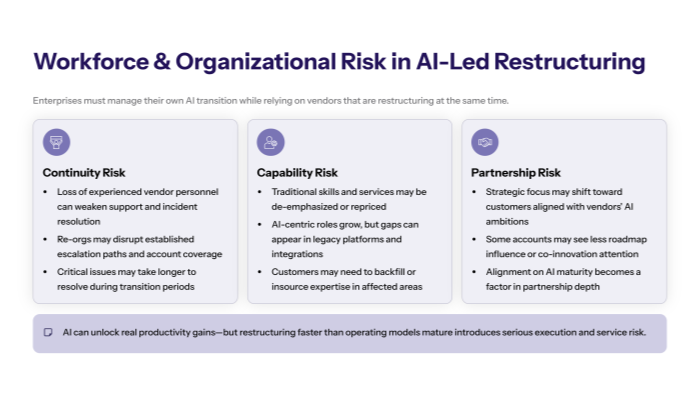
HP’s job cuts also highlight a broader pattern: AI is being used as a lever to justify workforce reshaping, sometimes faster than organizations can adapt. For enterprises, this is a double exposure. You must manage your own workforce transition while also depending on vendors that are restructuring in parallel.
There are at least three dimensions to watch:
-
Continuity risk: Loss of experienced vendor personnel can affect support quality and incident resolution.
-
Capability risk: As vendors prioritize AI, some traditional skills or services may be de-emphasized or priced higher.
-
Partnership risk: Strategic account focus may shift toward customers that align more closely with a vendor’s AI ambitions.
Independent research that Cognativ has covered on AI and productivity, including work showing that AI can unlock the equivalent of an extra workday per week, supports the idea that AI can uplift output if adoption is thoughtful and well governed. But those gains are uneven, and restructuring before operating models mature can introduce real execution risk.
Lessons for CIOs and CFOs from HP’s AI pivot
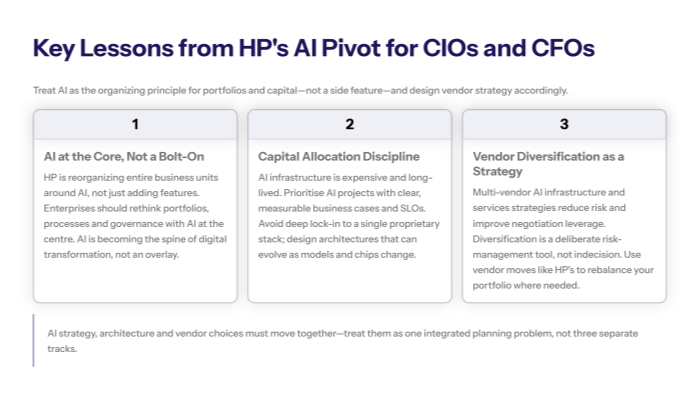
HP’s move offers several practical lessons for technology and finance leaders planning their own AI transitions.
First, AI should not be treated as a bolt-on feature. HP is reorganizing entire business units around AI; enterprise buyers should be ready to do the same with portfolios, processes and governance. This aligns with the broader trend captured in Cognativ’s analysis of AI’s impact on enterprise tech spending , where AI is increasingly the core of digital transformation rather than an add-on.
Second, capital allocation discipline matters. AI infrastructure is expensive. The most successful enterprises will combine selective AI infrastructure investment with careful management of technical debt, legacy systems and vendor lock-in. That means:
-
Prioritizing AI projects with clear, measurable business cases.
-
Avoiding over-commitment to any single vendor’s proprietary stack where possible.
-
Designing architectures that can evolve as models, chips and platforms change.
Third, vendor diversification remains a strategic tool, not a sign of indecision. As suppliers like HP restructure, having a multi-vendor strategy for AI infrastructure, devices and services can reduce risk and strengthen your negotiation position.
Cognativ’s AI services and business strategy consulting teams regularly work with enterprises to integrate AI into business strategy, operating models and architecture, ensuring that large vendor moves do not destabilize long-term plans.
How Cognativ can help enterprises respond?
For many organizations, the question is not whether vendors like HP will keep pivoting to AI – they will – but how to respond in a way that protects resilience while capturing upside.
There are three immediate moves that can help:
-
Conduct a dependency and risk assessment on critical vendors in light of their AI transitions.
-
Align your AI roadmap with infrastructure and architecture plans, rather than treating each separately.
-
Build a governance and measurement framework so AI investments can be evaluated like any other capital project.
Cognativ supports clients in these areas through AI-first architecture design, AI services delivery and sector-specific expertise in hi-tech ecosystems . By combining technical depth with an independent view of vendor landscapes, we help enterprises turn disruptive announcements into structured strategic action.
Conclusion
HP’s restructuring around AI is not an isolated story about one company’s cost-cutting plan. It is another indicator that AI is now the center of gravity for global technology strategy and capital allocation. For enterprises, the right response is not panic, but disciplined reassessment of vendor exposure, architecture, workforce plans and investment priorities.
Staying ahead of this transition will require a clear view of the AI infrastructure race, a realistic understanding of productivity and risk, and a willingness to reshape portfolios in line with an AI-first world. Vendors will continue to pivot. The enterprises that win will be the ones that do so on their own terms.
To stay ahead of AI and tech strategy, follow Cognativ’s latest analysis across our coverage of AI infrastructure strategy , enterprise AI investment risks and how Cognativ is shaping AI infrastructure – and speak with our teams about aligning your roadmap with the next wave of AI-driven vendor change.