Meta Unveils AI Morning Brief to Challenge Assistants
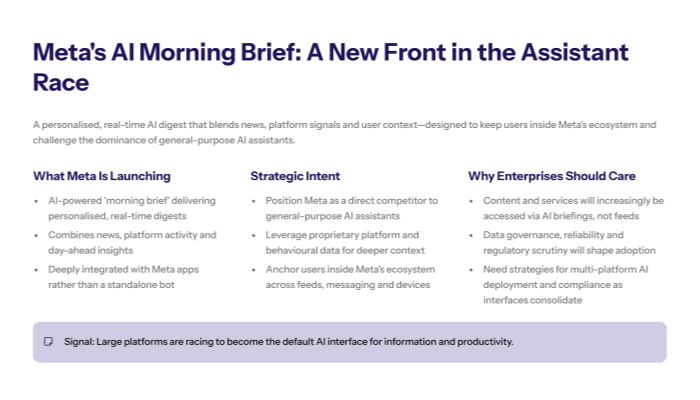
Meta Platforms is rolling out an AI-powered “morning brief,” a feature designed to give users a personalized, real-time digest of news, platform signals, and day-ahead insights. While it resembles ChatGPT-style daily summaries, Meta is positioning it as a deeper integration between user context, platform activity, and generative reasoning. The move signals a renewed push to anchor users inside Meta’s ecosystem and to compete more directly with standalone AI assistants.
This article examines what the launch means for enterprises, how Meta’s strategy challenges existing AI ecosystems, and why large platforms are racing to become the default interface for information and productivity.
Key Takeaways
- Meta’s AI morning brief positions the company as a direct competitor to generalized AI assistants by leveraging unique platform data.
- The feature could reshape content consumption, raising questions about data governance, reliability, and regulatory scrutiny.
- Enterprises should expect accelerated consolidation of AI interfaces, requiring strategies for multi-platform deployment, integration, and compliance.

Meta’s AI Morning Brief Signals a New Phase in Platform Competition
Meta’s morning brief is designed to aggregate public news, user-preference signals, and high-level summaries that reflect personal context across Meta applications. Instead of offering static daily updates, the system builds a continuously refreshed information layer that sits between users and external content sources.
Executives familiar with the rollout describe it as Meta’s attempt to deliver “a private information concierge,” aligning with the company’s broader vision of ambient AI integrated across its messaging apps, feeds, and mixed-reality devices. The launch follows a year of steep investment in generative AI infrastructure and the expansion of Meta’s LLaMA-based models.
How It Works Behind the Scenes
The morning brief uses a combination of:
- User interaction history (likes, follows, topics, saved posts).
- Public news streams filtered by relevance, geography, and domain expertise.
- Platform-specific signals such as group memberships, event participation, or creator engagement.
These dynamic signals allow the AI to build a personalized, context-rich snapshot of what matters “right now,” merging personal interest discovery with general information needs.
Meta’s Strategic Advantage
Meta’s key differentiator is its proprietary behavioral graph — a dataset that no standalone AI assistant can match. While tools such as ChatGPT or Perplexity offer breadth, Meta is betting on depth: a direct feed of real-world user behavior.
This strategic direction aligns with recent enterprise movements towards AI infrastructure modernization, where organizations are replacing fragmented data sources with unified intelligence layers. Cognativ has explored similar themes in its analysis of AI infrastructure and data solutions , highlighting why context-rich environments significantly improve model output quality.

Meta vs. AI Assistants: Understanding the Competitive Landscape
The AI morning brief sits at the intersection of competitive assistant ecosystems — OpenAI, Google, Anthropic, and now Meta. This shift is not just about launching a new feature; it’s about controlling the entry point of digital interaction.
The Rise of the AI Summary Layer
Generative AI is creating a new interface: the “summary layer.”
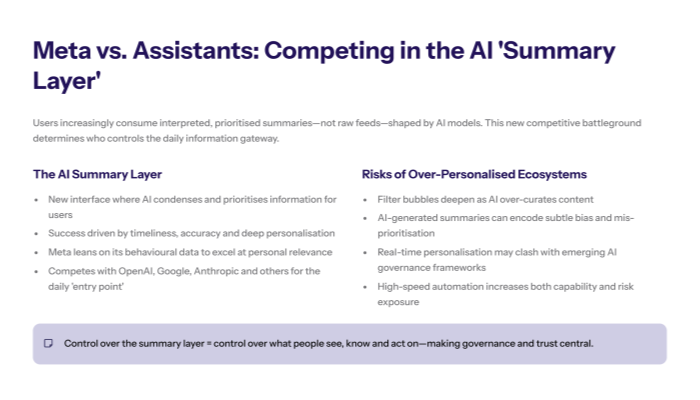
In this layer, users no longer seek raw content. Instead, they consume interpreted, condensed, and prioritized information filtered through personalized AI models.
Companies competing in this layer focus on:
- Timeliness (the brief must update fast).
- Quality (summaries must be accurate and stable).
- Personalization (output must reflect user context).
Meta’s approach excels in personalization due to its real-time behavioral data. However, it faces challenges in reliability, misinformation mitigation, and regulatory expectations.
The Risks of an Over-Personalized Information Ecosystem
While personalization improves user engagement, it raises structural risks:
- Over-curation may strengthen filter bubbles.
- AI-generated summaries can introduce subtle biases.
- Real-time personalization may conflict with emerging AI governance frameworks.
This mirrors ongoing concerns about AI-generated outputs highlighted in Cognativ’s article on AI-generated code and security risks . While focused on software code, the underlying principle applies: high-speed automation increases both capability and risk exposure.
What Enterprises Should Learn From Meta’s AI Strategy
The launch of the morning brief reveals broader lessons for enterprise technology leaders.
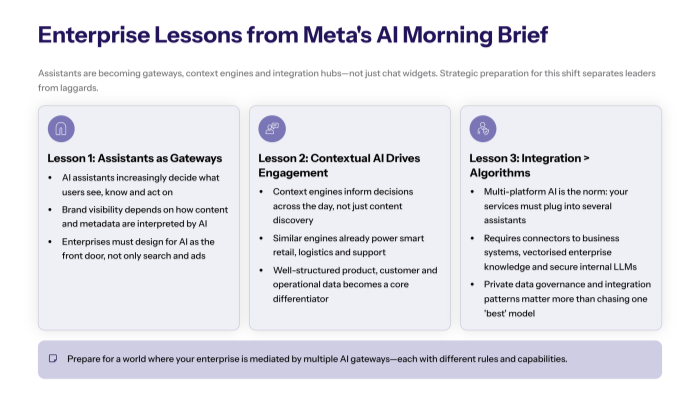
Lesson 1: AI Assistants Will Become Gateways to Services
AI assistants are no longer tools; they are gateways.
They decide:
- what users see
- what they know
- what they act on
For enterprises, this means that brand visibility increasingly depends on how well their content, metadata, and structured information are interpreted by AI systems.
Lesson 2: Contextual AI Will Reshape Engagement and Commerce
Meta’s morning brief is more than a news digest — it is a context engine that informs decisions users make throughout the day. In enterprise ecosystems, similar context engines already power:
- smart retail recommendations
- automated logistics workflows
- supply chain visibility tools
- customer support orchestration
Cognativ’s coverage of top retail software development solutions illustrates how these capabilities translate into operational ROI.
Lesson 3: Integration Will Matter More Than Algorithms
Enterprises must prepare for a multi-platform AI environment.
This includes:
- connecting business systems to multiple AI assistants
- using vector databases to map enterprise knowledge
- deploying secure internal LLMs
- implementing private data governance policies
Cognativ frequently advises organizations on this transition, as discussed in our analysis of AI integration services .
The Technical Foundation: Why Meta Is Doubling Down on AI Infrastructure
Meta has been aggressively investing in GPU clusters, distributed inference systems, and LLaMA model iterations. The morning brief depends on three critical building blocks:
- High-frequency summarization pipelines capable of real-time updates.
- User-graph intelligence that ingests signals from billions of interactions daily.
- Distributed inference optimized for mobile and cross-platform deployment.
Infrastructure Implications for Enterprise Leaders
Enterprises observing Meta’s strategy should evaluate:
- whether their current infrastructure can support large-scale summarization
- if they have a unified data layer or face fragmentation risks
- whether their AI systems are extensible enough for real-time personalization
Companies that fail to modernize risk falling behind competitors who adopt AI-native architectures early.

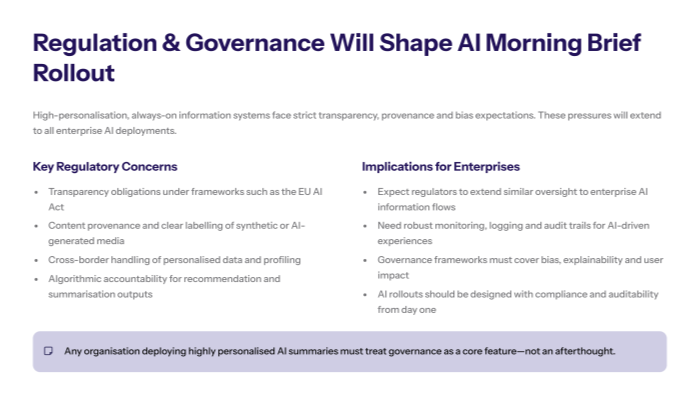
Regulatory and Governance Pressure Will Shape the Rollout
Meta’s morning brief will operate under intense scrutiny.
Key regulatory concerns include:
- transparency obligations under the EU’s AI Act
- content provenance and synthetic media labeling
- cross-border transfer of personalized data
- algorithmic accountability for recommendation outputs
Regulators across the EU and APAC regions have made it clear that high-personalization systems must provide clear auditability and minimal bias amplification.
While Meta maintains internal AI governance frameworks, enterprise leaders watching this rollout should expect global regulators to accelerate requirements for monitoring AI-driven information flows.
Conclusion
Meta’s AI-powered morning brief marks an important moment in the evolution of AI assistants. It signals a shift toward context-rich, dynamically updated information environments where large platforms become the primary gateways to knowledge, productivity, and digital decision-making.
For enterprises, the implications are clear: AI ecosystems are consolidating, and organizations must prepare for a future in which personalization, integration, governance, and infrastructure maturity dictate strategic advantage.
Staying ahead requires not only adopting AI — it requires understanding how platforms like Meta redefine the rules of engagement.
Stay ahead of AI and tech strategy. Subscribe to What Goes On, Cognativ’s weekly tech digest for deeper insights and executive analysis.