ModelOps Implementation Strategy for AI Governance: Complete Enterprise Guide
Introduction to ModelOps Implementation Strategy for AI Governance
ModelOps implementation strategy for AI governance represents the critical bridge between experimental AI initiatives and production-ready enterprise AI systems that operate under comprehensive regulatory compliance and ai risk management frameworks. As organizations scale their AI portfolio and manage multiple models beyond pilot projects, traditional IT governance approaches prove insufficient for managing autonomous AI systems that continuously learn and make business decisions.
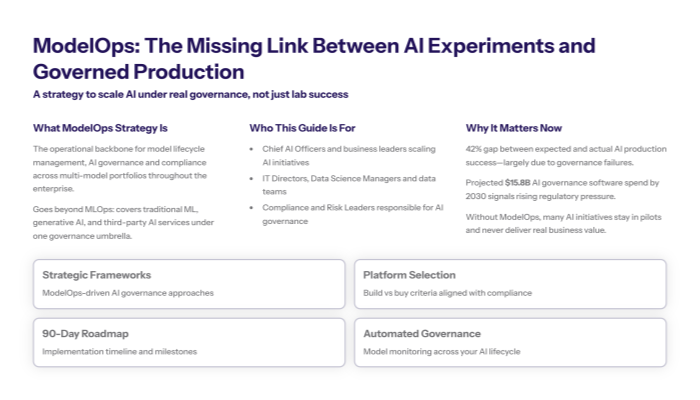
The fundamental challenge lies in the 42% gap between expected and actual AI production success, primarily attributed to governance failures that prevent AI models from transitioning from data science experiments to reliable business applications.
What This Guide Covers
This comprehensive guide provides strategic frameworks for implementing ModelOps as your enterprise AI governance backbone, including technology platform selection criteria, cross-functional team structures, regulatory compliance integration with ai governance frameworks like the EU AI Act, and practical deployment roadmaps. We focus specifically on operational governance strategies rather than theoretical AI ethics or basic machine learning concepts.
Who This Is For
This guide is designed for Chief AI Officers, business leaders, IT Directors, data teams, Data Science Managers, and Compliance Leaders responsible for scaling enterprise AI initiatives while maintaining regulatory adherence and risk mitigation. Whether you’re managing a portfolio of 10 AI models or planning for hundreds across multiple business units, you’ll find actionable frameworks for implementing effective model operations and governance strategy.
Why This Matters
The projected $15.8 billion AI governance software spend by 2030 reflects growing regulatory pressure and the essential foundation required to implement responsible AI practices at scale. Organizations without systematic model compliance and governance risk operational failures including regulatory violations, model drift incidents, and failed AI investments that never deliver measurable business value.
What You’ll Learn:
-
Strategic framework development for ModelOps governance across your entire AI lifecycle and AI portfolio
-
Technology platform selection criteria balancing build-vs-buy decisions with compliance requirements and digital transformation goals
-
Implementation roadmap creation with practical 90-day deployment timelines for model operationalization
-
Governance automation setup integrating existing business processes with AI lifecycle management and model monitoring

Understanding ModelOps AI Governance Fundamentals and AI Governance Frameworks
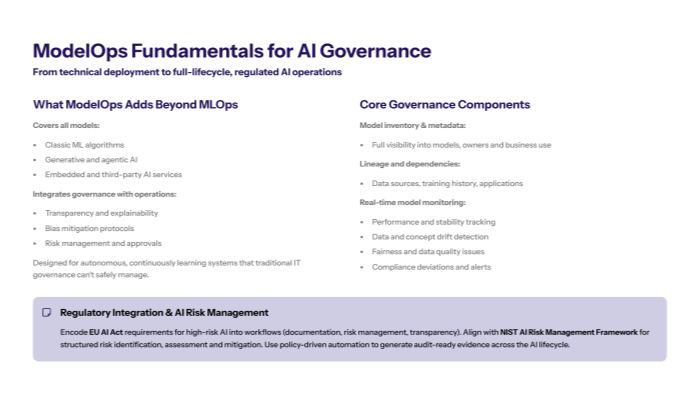
ModelOps represents a comprehensive framework extending beyond MLOps to govern the entire lifecycle of AI and ML models, including traditional machine learning models, generative AI systems, and third-party AI services across all business applications. Unlike MLOps, which focuses primarily on model deployment and technical monitoring, ModelOps integrates governance structures with operational workflows to ensure responsible AI practices throughout the AI lifecycle.
AI governance encompasses transparency requirements, explainability standards, bias mitigation protocols, regulatory compliance automation, and comprehensive ai risk management for AI decisions that impact business operations. Traditional IT governance approaches fail with AI systems because artificial intelligence models exhibit autonomous decision making capabilities and continuous learning behaviors that require specialized oversight mechanisms.
Core Components of ModelOps Governance and Model Monitoring
Model inventory and metadata tracking forms the essential foundation, providing comprehensive visibility into AI assets across traditional ML algorithms, agentic AI systems, and embedded third-party AI services within existing business processes. This inventory captures model lineage, data dependencies, business applications, and performance metrics enabling AI governance frameworks to scale with growing AI portfolios.
Real-time model monitoring capabilities extend beyond model performance to include automated monitoring for data drift, concept drift, fairness violations, data quality issues, and regulatory compliance deviations. This connects to foundational governance oversight because comprehensive model tracking enables proactive risk assessments and compliance monitoring before issues impact business decisions.
Regulatory Compliance Integration and AI Risk Management
EU AI Act requirements for high-risk AI systems mandate specific documentation standards, risk management protocols, and transparency obligations that ModelOps platforms can automate through policy-driven workflows. These requirements extend beyond European operations as multinational organizations adopt consistent governance standards globally.
NIST AI Risk Management Framework alignment provides structured approaches for identifying, assessing, and mitigating AI risks throughout the model creation and deployment process, while emerging state-level AI regulations in the US create additional compliance complexity. Building on automated monitoring capabilities, compliance automation scales with regulatory complexity by encoding regulatory frameworks into governance workflows that generate audit-ready documentation and evidence trails.
Transition: Understanding these foundational concepts enables strategic planning that aligns ModelOps implementation with specific organizational needs and regulatory demands to manage AI effectively.
Strategic Planning for ModelOps Implementation in the AI Journey
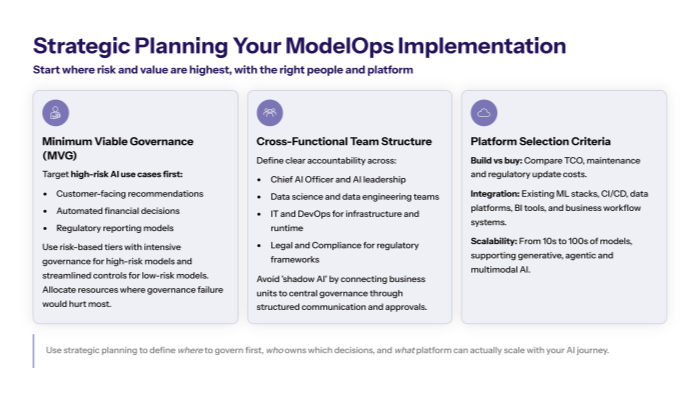
Effective strategic planning begins with comprehensive assessment of your current AI portfolio including active production models, data science experiments, shadow AI deployments, and third-party AI integrations across all business units, building on the inventory foundation established in governance fundamentals while introducing strategic prioritization frameworks.
Minimum Viable Governance (MVG) Approach for AI Use Cases
Prioritizing high-risk AI use cases such as customer-facing recommendation systems, automated financial decisions, and regulatory reporting models allows organizations to demonstrate governance value while managing implementation complexity. Risk-based governance tiers allocate intensive oversight to high-risk AI systems while applying streamlined processes to lower-risk applications, balancing AI innovation speed with necessary regulatory adherence.
Resource allocation strategy focuses governance investments on critical AI models first, establishing proven workflows and automated monitoring before scaling to comprehensive AI portfolio coverage. This approach enables compliance teams to build expertise with complex governance requirements while data science teams adapt to new approval and documentation processes.
Cross-Functional Team Structure to Implement Responsible AI
Defining clear accountability between Chief AI Officers responsible for strategic direction, data teams focused on model development, IT Operations managing infrastructure, Legal teams addressing regulatory frameworks, and Compliance Leaders ensuring risk management creates essential governance structures for enterprise AI. Unlike traditional IT governance structures, AI-specific accountability chains must address the unique decision-making authority required for autonomous AI systems and agentic AI applications.
Communication frameworks between decentralized business units and centralized governance teams prevent the formation of ungoverned shadow AI while enabling domain expertise to inform governance policies. Cross-functional collaboration becomes critical as AI decisions increasingly impact customer experiences and business outcomes across the entire enterprise.
Technology Platform Selection Criteria for AI Governance Platforms
Evaluation of build-vs-buy decisions requires total cost of ownership analysis including ongoing maintenance, regulatory compliance updates, and integration development costs against commercial AI governance platforms that provide pre-built compliance frameworks. Integration requirements encompass existing ML infrastructure, CI/CD pipelines, data management systems, and business intelligence tools to avoid creating governance silos.
Scalability considerations address growing AI portfolios, evolving regulatory requirements, and the need to govern emerging technologies like agentic AI systems and multimodal generative AI applications that may require specialized governance capabilities beyond traditional machine learning models.
Strategic planning frameworks provide the foundation for tactical implementation that translates governance requirements into operational workflows and technology deployments.
Implementation Framework and Step-by-Step Deployment of Model Operations
Building on strategic planning components, tactical execution requires structured deployment approaches that balance governance implementation speed with organizational change management and technology integration complexity across existing business processes.
Step-by-Step: 90-Day ModelOps Governance Implementation Timeline
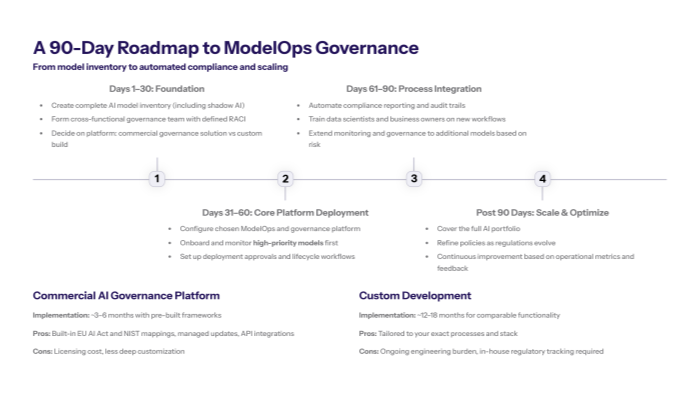
When to use this timeline: Organizations with 10-50 AI models, established MLOps infrastructure, and dedicated governance team resources.
-
Days 1-30: Foundation Establishment Complete comprehensive AI model inventory including shadow AI discovery, establish cross-functional governance team with defined roles and responsibilities, and finalize technology platform selection or begin custom development.
-
Days 31-60: Core Platform Deployment Deploy chosen AI governance platform with initial configuration, implement automated model monitoring for highest-priority AI models, and establish approval workflows for model deployment and lifecycle management.
-
Days 61-90: Process Integration Automate compliance reporting and audit trail generation, conduct governance process training for data scientists and business stakeholders, and expand monitoring coverage to additional AI models based on risk assessments.
-
Post-90 Days: Scale and Optimize Extend governance coverage to entire AI portfolio, implement continuous improvement cycles based on operational metrics, and refine policies based on regulatory updates and business feedback.
Technology Implementation: Platform vs DIY Comparison for Model Operationalization
Feature |
Commercial AI Governance Platform |
Custom Development |
|---|---|---|
Implementation Timeline |
3-6 months with pre-built compliance |
12-18 months for full functionality |
Regulatory Compliance |
Built-in EU AI Act, NIST frameworks |
Requires ongoing regulatory research |
Integration Complexity |
API-based connections to existing tools |
Custom integration development required |
Ongoing Maintenance |
Vendor-managed updates and patches |
Internal development and maintenance |
Total Cost of Ownership |
Licensing plus configuration costs |
Development plus ongoing engineering |
Commercial AI governance platforms like ModelOp Center provide pre-built governance frameworks with automated compliance reporting, while custom solutions enable deep integration with existing business processes but require substantial ongoing development resources. Organizations should prioritize commercial platforms when regulatory compliance automation is critical and choose custom development when unique business requirements demand specialized governance workflows that commercial solutions cannot accommodate.
Transition: Successful implementation requires addressing common organizational and technical obstacles that can derail ModelOps governance initiatives.
Common Challenges and Solutions in Managing AI Governance and Model Compliance
Implementation experience across enterprise AI initiatives reveals consistent obstacles that organizations encounter when deploying comprehensive ModelOps governance, requiring proactive solutions that address both technical and cultural barriers to adoption.
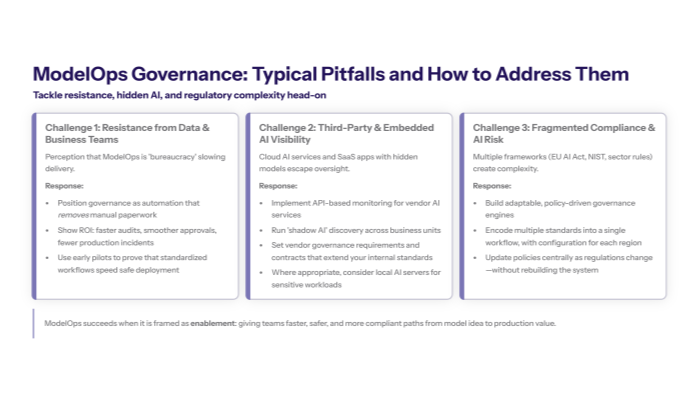
Challenge 1: Resistance from Data Teams and Business Leaders
Solution: Position ModelOps governance as enablement technology rather than bureaucratic gatekeeping by demonstrating how automation reduces manual compliance documentation work and accelerates model deployment through standardized approval processes.
Focus on quantifiable ROI including reduced audit preparation time, faster regulatory approval cycles, and decreased operational risks that enable data scientists to focus on model development rather than governance documentation.
Challenge 2: Third-Party and Embedded AI Visibility in AI Use
Solution: Establish API-based monitoring for vendor AI services including cloud AI platforms and software-as-a-service applications with embedded AI capabilities, while implementing shadow AI discovery processes that identify ungoverned AI systems across business units. For organizations interested in alternatives, consider implementing a local AI server as a secure, compliant option.
Create vendor AI governance requirements and contractual compliance obligations that extend internal governance standards to third-party AI providers, ensuring comprehensive AI portfolio visibility regardless of deployment model.
Challenge 3: Fragmented Regulatory Compliance and AI Risk
Solution: Build adaptable AI governance frameworks supporting multiple regulatory standards simultaneously through policy-driven automation that accommodates EU AI Act requirements, NIST guidelines, and sector-specific regulations within unified workflows.
Implement configuration-based compliance engines allowing governance policies to evolve with changing regulatory demands without requiring system rebuilds or workflow redesign.
Transition: Addressing these implementation challenges enables organizations to realize the full strategic value of ModelOps governance for scaling responsible AI practices.
Conclusion and Next Steps for ModelOps Implementation Strategy AI Governance
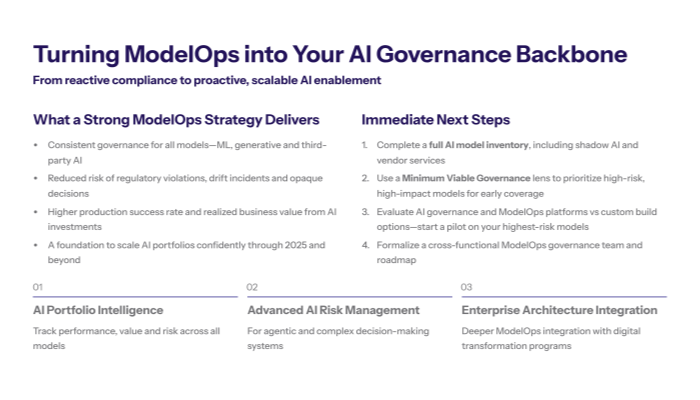
ModelOps implementation strategy transforms AI governance from reactive compliance burden into proactive business enablement, providing the essential foundation for scaling AI initiatives while managing regulatory pressure and operational risks that threaten enterprise AI adoption success.
2025 represents a critical year for establishing comprehensive governance foundations as regulatory enforcement intensifies globally and AI investments require demonstrable business value delivery through responsible innovation practices that balance competitive advantage with risk mitigation.
To get started:
-
Complete comprehensive AI model inventory including shadow AI discovery across all business units and third-party AI service integrations to establish baseline governance coverage requirements.
-
Assess current governance gaps using Minimum Viable Governance framework to prioritize high-risk AI systems requiring immediate oversight while identifying resource allocation needs for comprehensive implementation.
-
Evaluate AI governance platforms and begin pilot implementation with highest-risk AI models to demonstrate governance value and establish proven workflows before scaling to enterprise-wide deployment.
Related Topics: Consider exploring AI Portfolio Intelligence for ongoing optimization of AI assets performance and value delivery, plus Advanced AI Risk Management strategies for mature implementations addressing emerging technologies like agentic AI systems and complex decision making models.