What Role Does Cloud Computing Have With Edge AI in Modern Solutions?
The rise of edge AI has redefined how modern businesses handle artificial intelligence. Instead of relying solely on centralized cloud servers or traditional data centers, AI tasks are increasingly being shifted to edge devices like smart cameras, sensors, and wearables. By moving data processing closer to the source, organizations gain the ability to achieve real time decision making with minimal delay.
The implications are massive:
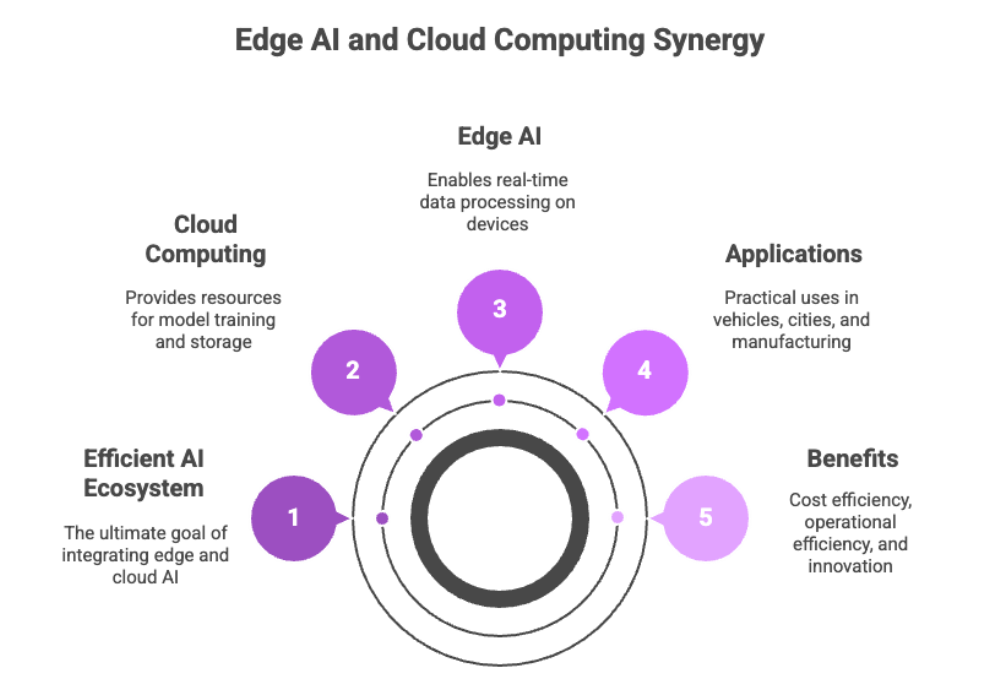
Real time data processing enables autonomous vehicles to make split-second decisions.
Smart cities use edge AI systems to analyze traffic patterns and enhance safety.
Manufacturers deploy edge artificial intelligence for predictive maintenance, reducing downtime in industrial equipment.
At the same time, cloud computing plays an equally important role. Cloud providers like AWS, Microsoft Azure, and Google Cloud deliver cloud resources that supply the necessary computing power and data storage for model training and large-scale analytics. The synergy between edge computing and cloud computing is not just convenient — it is essential for building an efficient AI ecosystem.
This article explores how cloud infrastructure empowers edge AI, why the integration of cloud computing and edge AI matters, and how businesses can leverage this convergence for cost efficiency, operational efficiency, and innovation.

Cloud Infrastructure for Edge AI
Without robust cloud infrastructure, edge AI would struggle to scale beyond experimental deployments. While edge devices excel at processing data locally, they cannot handle the intensive workloads required for large scale data analysis or model training. This is where cloud computing architecture comes in.
Key Elements of Cloud Infrastructure
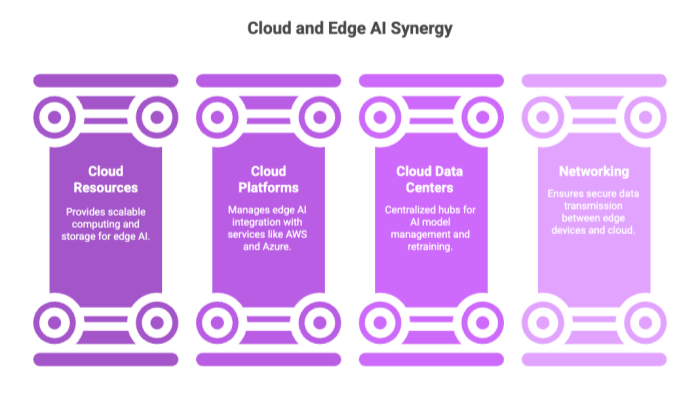
Cloud resources: Provide elastic scalability for computing services and data storage.
Cloud platforms: Offer managed environments like AWS IoT Greengrass, Microsoft Azure IoT Edge, and Google Cloud IoT Core for seamless edge AI integration.
Cloud data centers: Supply the centralized cloud resources needed for managing and retraining AI models.
Networking: Enables secure data transmission between multiple edge devices and centralized cloud servers.
How Edge AI Benefits from Cloud Infrastructure?
Enhanced computing power: Edge devices often have limited processing power. Cloud solutions supplement this with GPUs and TPUs for model training and complex data analysis.
Data storage & management: While processing data locally improves speed, long-term cloud storage ensures scalability.
Seamless cloud integration: Through APIs and cloud services, developers can manage AI models across both edge AI hardware and centralized servers.
In practice, this means a smart city might deploy edge devices to monitor intersections for traffic violations. The cloud infrastructure then aggregates raw data for predictive analytics, training better AI models, and pushing updates back to the edge AI systems.
Artificial Intelligence in Edge AI
At the heart of edge AI lies artificial intelligence itself. Whether it’s machine learning, deep learning, or natural language processing, AI models are what give edge devices the ability to make real time decisions.
Training in the Cloud, Running at the Edge
Large datasets: AI models are trained in centralized data centers where cloud computing refers to vast computing resources.
Deployment: Once trained, these models are pushed to edge AI hardware for real time processing.
Continuous learning: Through cloud services, updated models can be redistributed to thousands of edge devices simultaneously.
AI Applications at the Edge
Predictive maintenance in manufacturing, ensuring critical systems don’t fail.
Retailers utilize edge AI for real-time personalization, recommending products as customers browse.
Autonomous vehicles analyze sensor data locally, while cloud platforms handle continuous learning to improve navigation.
Smart cities integrate edge AI architecture for monitoring utilities, waste management, and public safety.
Edge AI Benefits from Cloud AI
While edge AI reduces latency through local data processing, it cannot fully replace cloud AI. Cloud environments are indispensable for:
Retraining AI models on large datasets.
Running complex data analysis across global inputs.
Coordinating multiple edge devices for cost efficiency and enhancing operational efficiency.
Together, cloud AI and edge AI deliver the best of both worlds: real time responsiveness at the network edge, combined with the long-term adaptability of cloud solutions.
Cloud Computing and Edge AI Convergence
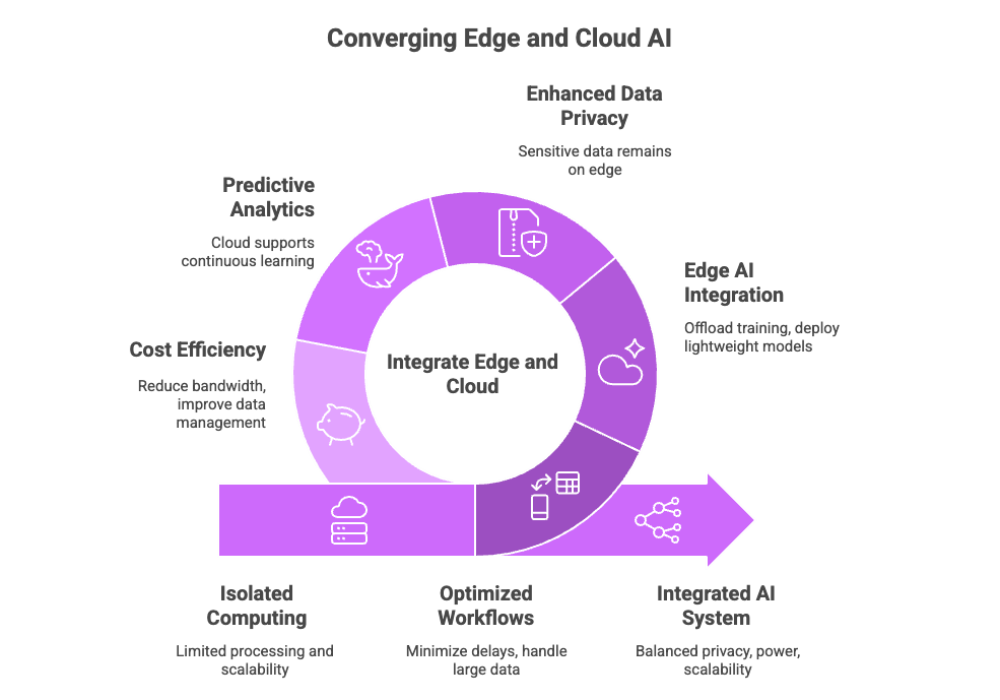
The true value of modern edge AI systems emerges not from edge computing or cloud computing alone, but from their convergence. Each solves problems the other cannot.
Edge computing ensures immediate real time processing and decision making at the network edge, where edge devices equipped with AI models handle local data processing.
Cloud computing refers to a framework where centralized cloud data centers provide limitless computing resources, cloud storage, and advanced cloud services.
Why Convergence Matters?
Optimized workflows: Processing data locally minimizes delays, while cloud resources handle large scale data analysis.
Edge AI integration: Developers can design edge solutions that offload model training to cloud platforms, but deploy lightweight AI models at the edge.
Enhanced data privacy: Sensitive transactions remain on edge AI hardware, while anonymized datasets are sent to cloud providers for retraining.
Predictive analytics: Cloud-enabled predictive analytics supports continuous learning, improving the performance of deployed AI models.
Cost efficiency: By leveraging both cloud solutions and edge computing, organizations reduce bandwidth usage, improve data management, and achieve real cost savings.
In short, integrating cloud computing with edge AI is no longer optional — it’s a core strategy for industries aiming to balance enhanced data privacy, computing power, and scalability.
How Industries Use the Convergence?
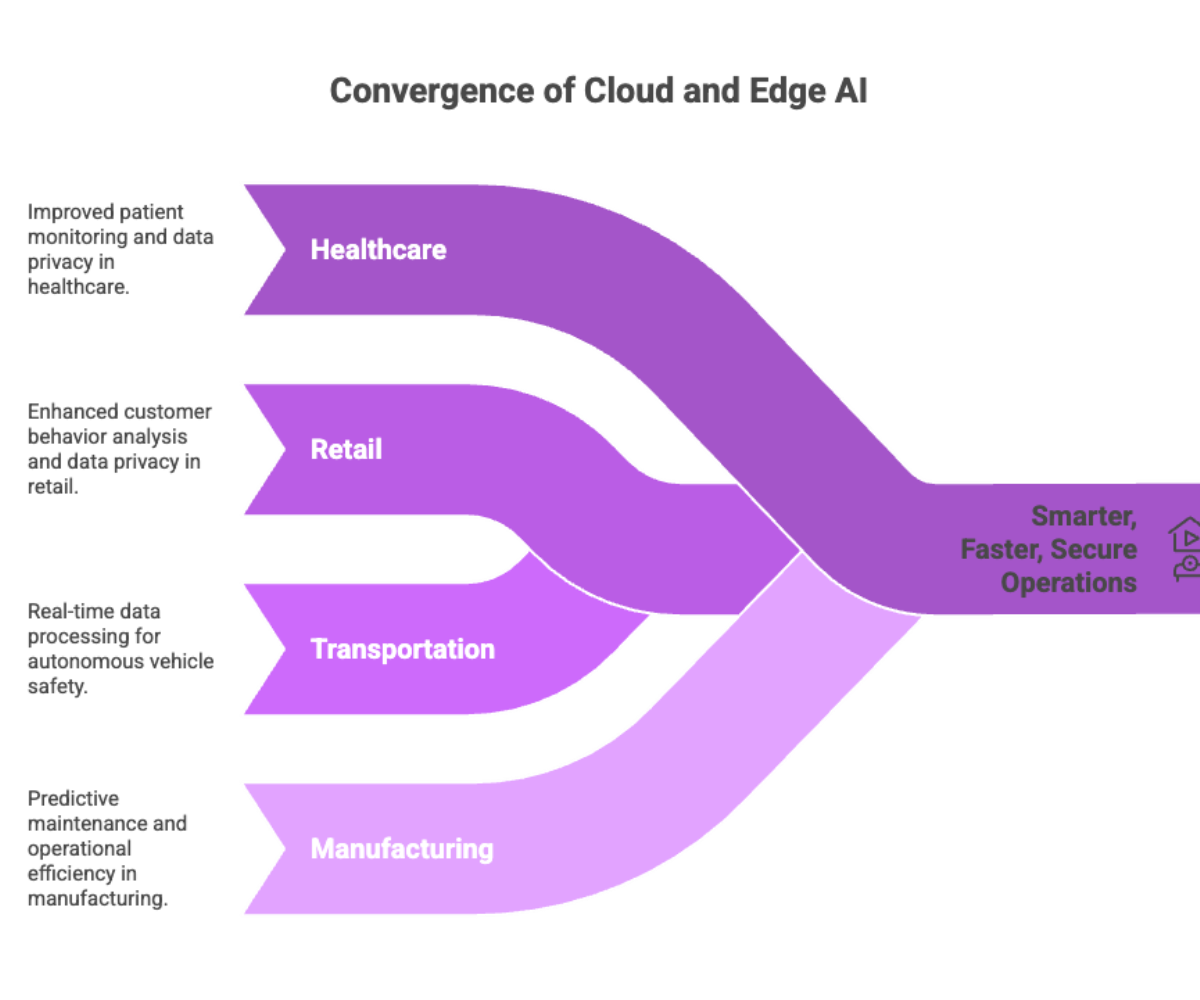
The convergence of cloud computing and edge AI is transforming various industries by enabling smarter, faster, and more secure operations.
Healthcare
Hospitals deploy edge devices in patient rooms for monitoring vitals.
Data transmission is minimized as sensitive health information is processed locally, protecting sensitive data.
Periodic uploads to cloud servers allow continuous learning and updates to diagnostic AI models. Learn more about patient care systems designed for secure, compliant healthcare operations.
Retail
Retailers utilize edge AI in-store cameras for foot traffic analysis.
Cloud computing architecture supports complex data analysis, retraining AI models across global store networks.
This hybrid approach balances enhanced data privacy with cloud solutions for predictive analytics in customer behavior.
Transportation
Autonomous vehicles require low latency and real time data processing from edge AI hardware to ensure safety.
At the same time, fleets connect to cloud data centers for centralized data analysis, continuous learning, and edge AI integration across multiple edge devices.
Manufacturing
Factories use edge computing for predictive maintenance of industrial machinery.
Historical data storage resides in cloud platforms, enabling large scale data analysis for operational efficiency.
This hybrid ensures downtime is minimized while cloud solutions improve long-term productivity.
Edge Computing vs. Cloud Computing: Key Differences
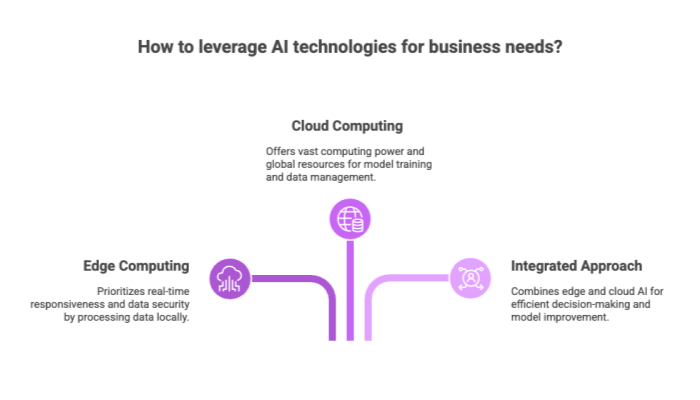
Although complementary, there are clear distinctions:
Edge computing → Prioritizes real time responsiveness, processing data locally, and keeping sensitive data secure.
Cloud computing → Provides vast computing power, global cloud resources, and centralized cloud resources for model training and long-term data management.
Edge AI Plays a Unique Role
By combining both, businesses gain an efficient AI ecosystem where:
Edge AI reduces latency for real time decision making.
Cloud AI improves AI models with large datasets from centralized servers.
Seamless cloud integration ensures updates are quickly deployed back to edge AI systems.
This balance of edge AI benefits with cloud solutions represents the future of emerging technologies in AI.
Challenges of Cloud–Edge Integration
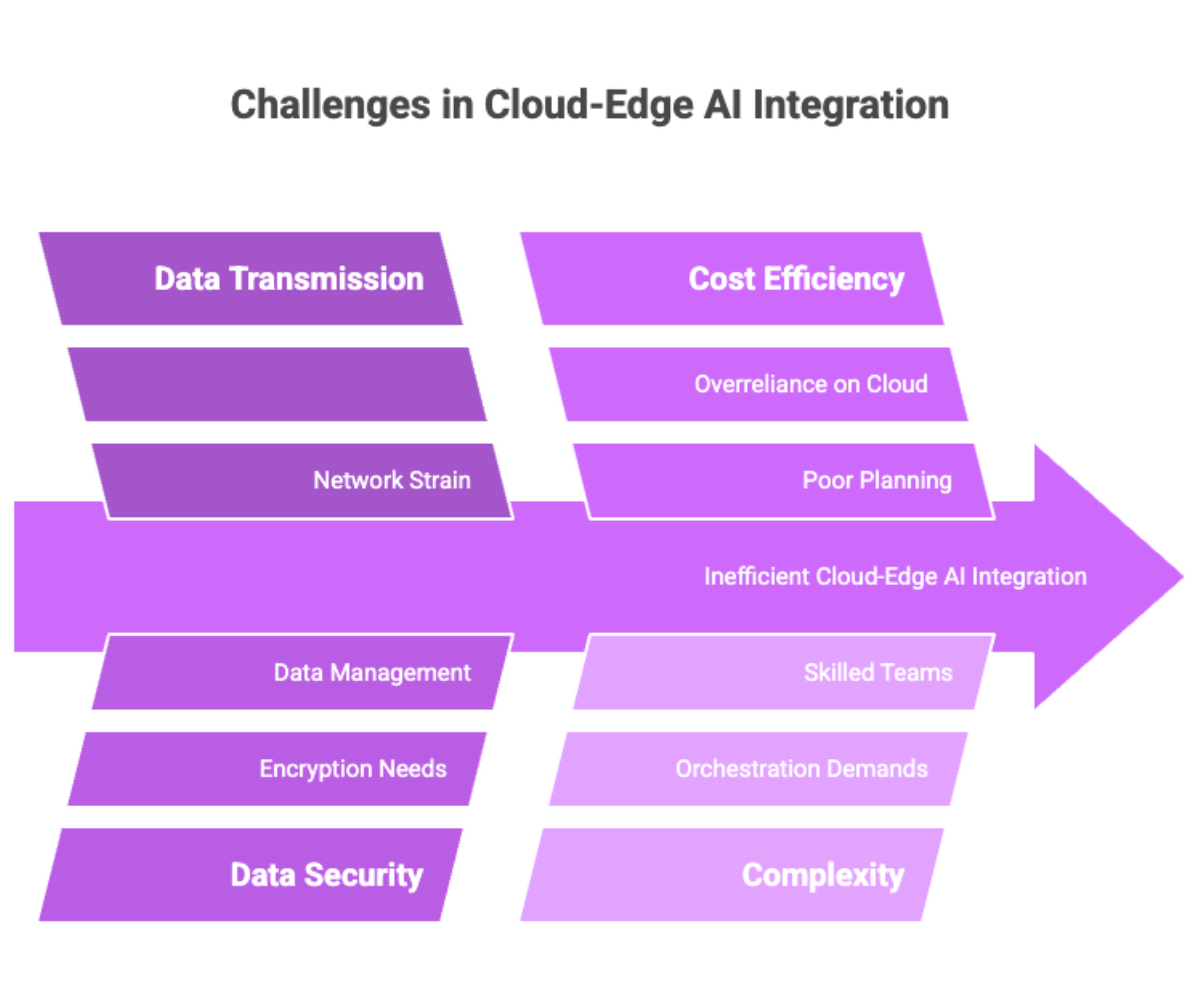
Despite the clear benefits, merging cloud computing with edge AI architecture brings challenges:
Data transmission: Sending large volumes from multiple edge devices to the cloud can strain network infrastructure.
Data security: Ensuring sensitive data remains private requires strong encryption and careful data management.
Cost efficiency vs. performance: While cost savings are possible, poor planning can lead to overreliance on cloud resources and inflated expenses.
Complexity: Managing cloud services, edge devices, and AI models simultaneously demands advanced orchestration and skilled teams.
Organizations that master these challenges achieve a seamless cloud integration that maximizes both computing power and operational efficiency.
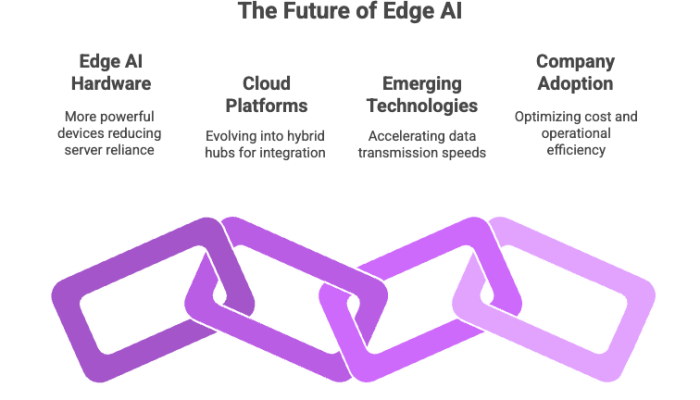
Future Trends in Cloud + Edge AI
Looking ahead, the convergence of cloud computing and edge AI will only deepen.
Edge AI hardware will become more powerful, reducing reliance on centralized servers for smaller tasks.
Cloud platforms will evolve into hybrid hubs, enabling smoother edge AI integration and continuous learning cycles.
Emerging technologies like 5G and quantum computing will accelerate data transmission speeds, reducing bottlenecks between edge devices and cloud solutions.
Companies will increasingly adopt cloud computing architecture designed specifically for edge artificial intelligence to optimize cost efficiency and enhancing operational efficiency.
Conclusion: Building an Efficient AI Ecosystem
So, what role does cloud computing have with edge AI in modern solutions?
It plays the role of enabler. Edge computing ensures real time processing, while cloud computing provides the cloud resources needed for model training, large scale data analysis, and continuous learning.
Together, they:
Allow businesses to optimize operations with real time decision making at the edge.
Enable predictive analytics for smarter forecasting.
Balance enhanced data privacy with scalable cloud services.
Drive cost savings while fueling innovation across industries.
The integration of edge AI and cloud computing is not just about technology. It is about creating an efficient AI ecosystem where organizations can deploy, manage, and analyze data seamlessly across edge devices and cloud data centers.
In short: Edge AI plays the role of immediacy, while cloud computing provides the depth. Their convergence is the blueprint for modern, scalable, and secure AI solutions.