
Best Local AI Models for Enterprise Development and AI Implementation in 2026
There is no single best local AI model for every enterprise workload. The strongest choice depends on the task, deployment package, available memory, context length, concurrency, license, and operating controls. For a development workstation with 24 GB of VRAM, Qwen3.8-27B is a capable general-purpose candidate for coding, reasoning, document work, and multimodal input. Ollama lists its Q4_K_M package at approximately 18 GB, but production capacity must also account for the key-value cache, runtime allocations, image processing, and concurrent requests.
Smaller environments have useful options. Phi-4-mini-instruct is a 3.8B text model designed for memory-constrained and latency-sensitive use cases. Granite 4.2 3B is a compact enterprise-oriented model for tasks such as retrieval-augmented generation, summarization, structured output, and tool use. gpt-oss-20b uses a mixture-of-experts architecture and native MXFP4 quantization; OpenAI documents it for systems with 16 GB of memory. These are candidates to evaluate, not automatic winners.
For multimodal work, Gemma 4 provides text and image input across several model sizes, with audio support on selected variants. For deliberate reasoning, DeepSeek-R1-Distill-Qwen-32B remains relevant, although its Q4_K_M package is approximately 20 GB before context and runtime overhead. The full DeepSeek-R1 model is a much larger 671B-parameter mixture-of-experts system and should not be confused with its 32B and 70B distilled variants.
This guide is for technology leaders and development teams deciding how local models fit into AI software development. It explains model categories, practical hardware tiers, evaluation criteria, integration patterns, and governance requirements. The objective is not to crown a benchmark leader. It is to help a team select the smallest model and deployment package that meets a measured business requirement.
By the end of the article, you will be able to:
-
Build a shortlist based on workload, modality, context, license, and hardware
-
Estimate memory using the exact model package rather than parameter count alone
-
Test local inference through Ollama or LM Studio before production integration
-
Compare model quality, latency, throughput, and operating risk on representative tasks
-
Define security, human review, monitoring, and rollback controls before release
Understanding Local AI Model Categories
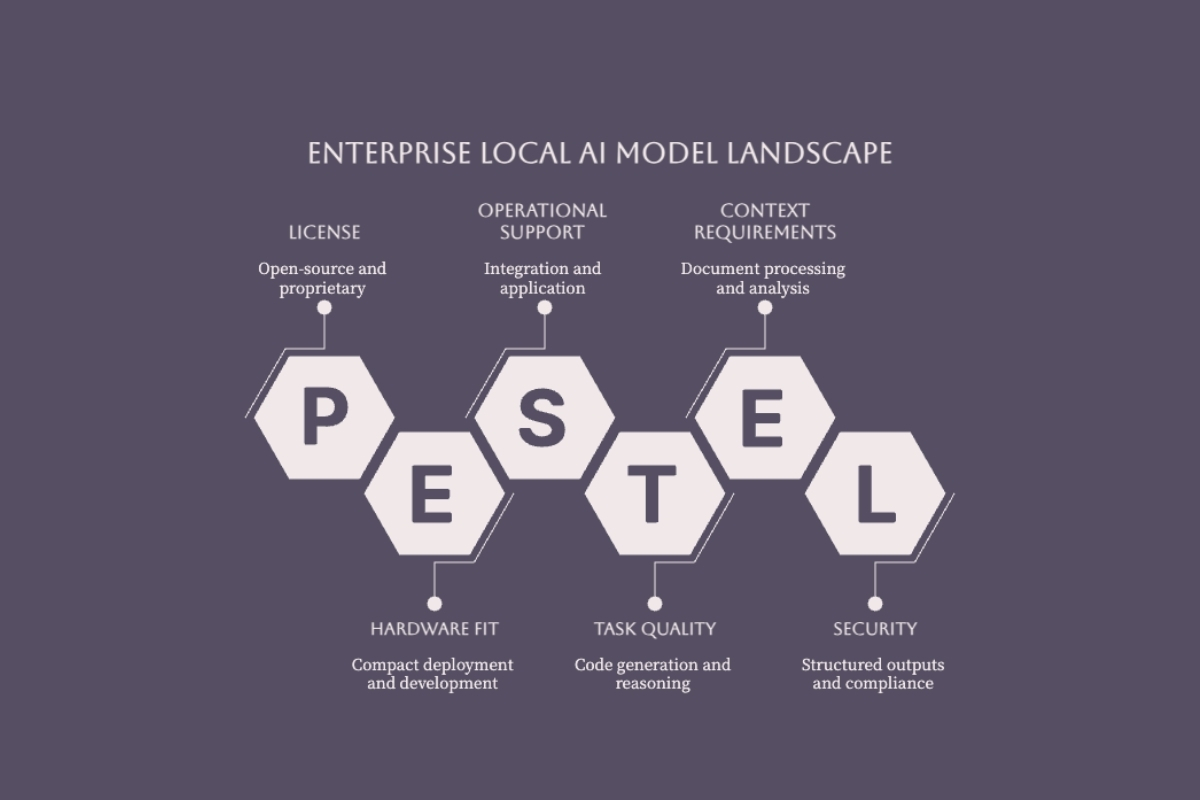
A local AI model is an open-weight or commercially licensed model executed on infrastructure controlled by the organization, such as a developer workstation, on-premises server, private cloud environment, or edge device. Local inference can reduce external data exposure and remove a hosted-model network round trip. It does not automatically guarantee privacy, compliance, low cost, or high availability. Applications may retain prompts, runtimes may write logs, model downloads can require external access, and connected tools may still transmit data.
Licensing must be reviewed at the exact repository and variant level. Qwen3.8, Gemma 4, Granite 4.2, and gpt-oss are released under Apache 2.0, while Phi-4 Mini and the main DeepSeek-R1 repository use MIT terms. DeepSeek's distilled models also inherit obligations from their Qwen or Llama base models. Enterprise teams should record the model source, license revision, checksum, quantization, runtime, and approved use before deployment.
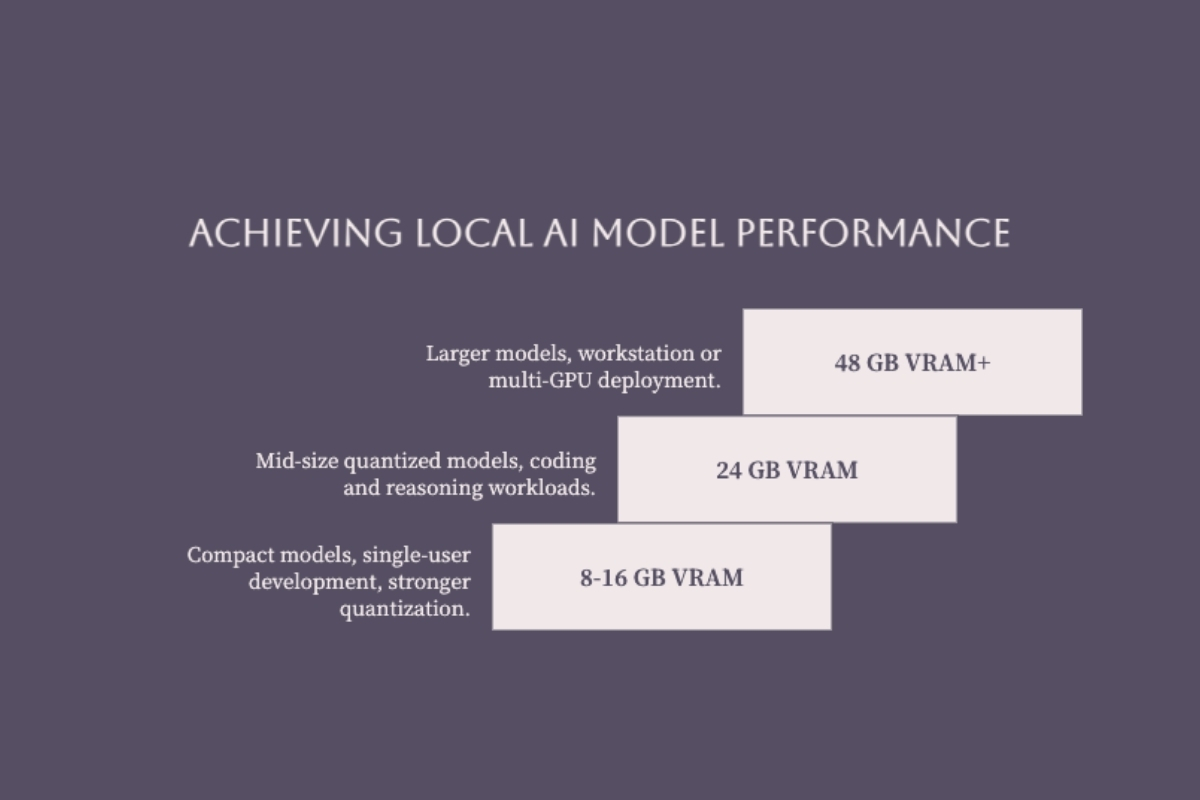
Consumer GPU Models (8-24GB VRAM)
This tier includes compact models for laptops and development workstations as well as quantized mid-sized models for 16 GB and 24 GB GPUs. Phi-4 Mini and Granite 4.2 3B are practical starting points when responsiveness and a small footprint matter more than maximum model capacity. Ollama lists Q4_K_M packages of approximately 2.5 GB and 2.2 GB respectively, leaving room for context, the runtime, and other applications on appropriately configured systems.
gpt-oss-20b is a stronger reasoning and tool-use candidate for a 16 GB class system when the selected runtime supports its native MXFP4 format. Its Ollama package is approximately 14 GB, and OpenAI's gpt-oss documentation describes the model's architecture and memory target. Gemma 4 12B adds image understanding and has an approximately 7.6 GB Q4_K_M Ollama package. Teams that run local LLMs on consumer hardware should still test the intended context length and concurrency rather than treating file size as total memory demand.
A 24 GB GPU expands the shortlist to packages such as Qwen3.8-27B Q4_K_M, Gemma 4 26B Q4, Gemma 4 31B Q4, and DeepSeek-R1-Distill-Qwen-32B Q4_K_M. These packages may fit by weight size, but a long context or multiple simultaneous users can exhaust the remaining memory. Start with a bounded context and one user, then increase capacity while observing actual allocations and latency.
Workstation-Class Models (32-48+ GB VRAM)
Workstation and server configurations support higher-precision versions, longer context, larger distilled models, or greater concurrency. The approximately 35 GB Q8 package for DeepSeek-R1-Distill-Qwen-32B, for example, belongs in this tier once runtime overhead is included. The 70B Llama-derived DeepSeek distill has an approximately 43 GB Q4_K_M package, so 48 GB is only a starting point and not a guarantee of useful context or throughput.
gpt-oss-120b is a specialized exception to simple parameter-count rules. Its mixture-of-experts design activates about 5.1B parameters per token, and its native MXFP4 distribution is designed to fit on a single 80 GB GPU. The full DeepSeek-R1 model is far larger: Ollama lists a Q4_K_M package around 404 GB. That requires distributed infrastructure and sits outside a normal single-workstation deployment.
At this scale, model selection becomes an architecture decision. Teams need to evaluate serving software, GPU topology, batch scheduling, authentication, observability, failover, energy use, and support ownership. A disciplined AI-first architecture keeps those infrastructure choices tied to the workflow and business outcome instead of assuming that the largest model is the best investment.
Hardware-Specific Model Recommendations
Hardware tiers are useful for creating a shortlist, but they are not model guarantees. A package's weight file is only one part of memory use. The runtime, context cache, batch size, vision projector, number of loaded models, and operating system all consume capacity. Unified-memory systems also behave differently from discrete-GPU workstations, so compare total available memory and bandwidth rather than translating VRAM guidance mechanically.
Small Hardware Configurations (8-16GB VRAM)
Phi-4-mini-instruct is a sensible text-only candidate for code explanation, structured extraction, classification, and bounded reasoning. Microsoft documents 3.8B parameters, a 128K maximum context, and an MIT license. Ollama's Q4_K_M package is approximately 2.5 GB. The maximum context should not be the default operating context; choose a smaller limit that preserves memory and latency for the actual task.
Granite 4.2 3B is another compact option for enterprise text workflows. IBM describes Granite 4.2 as supporting multilingual work, coding, RAG, tool use, reasoning, and structured JSON output. Ollama lists its 3B Q4_K_M package at approximately 2.2 GB with a 128K context window. Its small footprint makes it useful for controlled pilots where predictable formatting and retrieval behavior matter.
Gemma 4 12B is the stronger candidate in this tier when the workload includes images. Its Q4_K_M Ollama package is approximately 7.6 GB, with a listed 256K context window. Teams should reserve additional memory for the vision path and cache. For text reasoning and tool calls on a 16 GB class system, gpt-oss-20b is also worth benchmarking, but its approximately 14 GB package leaves less operational headroom.
The right compact model depends on the acceptance test. A smaller model can be sufficient for classification, extraction, summarization, or narrow coding assistance while failing on open-ended planning. Test exact prompts, expected schemas, refusal behavior, multilingual inputs, and edge cases before connecting it to a workflow.
Mid-Range Development Workstations (24GB VRAM)
Qwen3.8-27B is a strong general-purpose candidate for this tier. Its official Qwen3.8-27B model card describes a 27B dense vision-language model with a native 262,144-token context and an Apache 2.0 license. Ollama lists the Q4_K_M package at approximately 18 GB. A 24 GB GPU can load that package under suitable conditions, but the full advertised context may not be practical on the same card. Begin with a workload-specific context limit and measure memory under sustained use.
DeepSeek-R1-Distill-Qwen-32B is useful when deliberate reasoning is more important than multimodal input. The Ollama Q4_K_M package is approximately 20 GB and lists a 128K context window. Because the remaining memory margin is narrow, production evaluation should include the longest expected prompt, output budget, and concurrent request count. It is a distilled 32B model, not the full 671B DeepSeek-R1 system.
Gemma 4 26B and Gemma 4 31B provide multimodal alternatives. Ollama lists Q4 packages around 18 to 20 GB with 256K context metadata. A team using screenshots, diagrams, or image-backed documents may prefer one of these over a text-focused reasoning model. A practical local LLM coding evaluation should include repository retrieval, patch accuracy, test generation, and unsupported assumption rates.
Q4_K_M is a common starting format because it reduces weight memory substantially while preserving useful quality for many tasks. It is not automatically the best format for every model or runtime. Compare Q4, Q6, Q8, and native formats on the task's error tolerance, latency target, and memory budget rather than relying on a generic quantization rule.
High-Performance Enterprise Systems (32-48+ GB VRAM)
Systems in this tier can run higher-precision 20B to 32B packages, support more context or concurrency, and begin to accommodate 70B-class Q4 models. The DeepSeek-R1 70B distill's approximately 43 GB Q4_K_M package illustrates why a 48 GB configuration offers little spare capacity after the weights load. A 64 GB or 80 GB configuration gives more room, but exact requirements still depend on the serving stack and workload.
Do not assume multiple GPUs form one transparent memory pool. Model parallelism requires runtime support, and PCIe topology, peer-to-peer transfers, card spacing, power, and cooling can materially affect performance. For shared services, frameworks such as vLLM can improve continuous batching and throughput, but deployment hardening, compatible model support, and measured service-level objectives remain necessary.
Enterprise deployment should apply secure software development practices to the entire system around the model. That includes encrypted storage, least-privilege access, authenticated endpoints, secrets management, dependency controls, audit logging, model provenance, evaluation records, and rollback procedures. Local weights do not make the surrounding application secure.
Model Selection and Deployment Framework
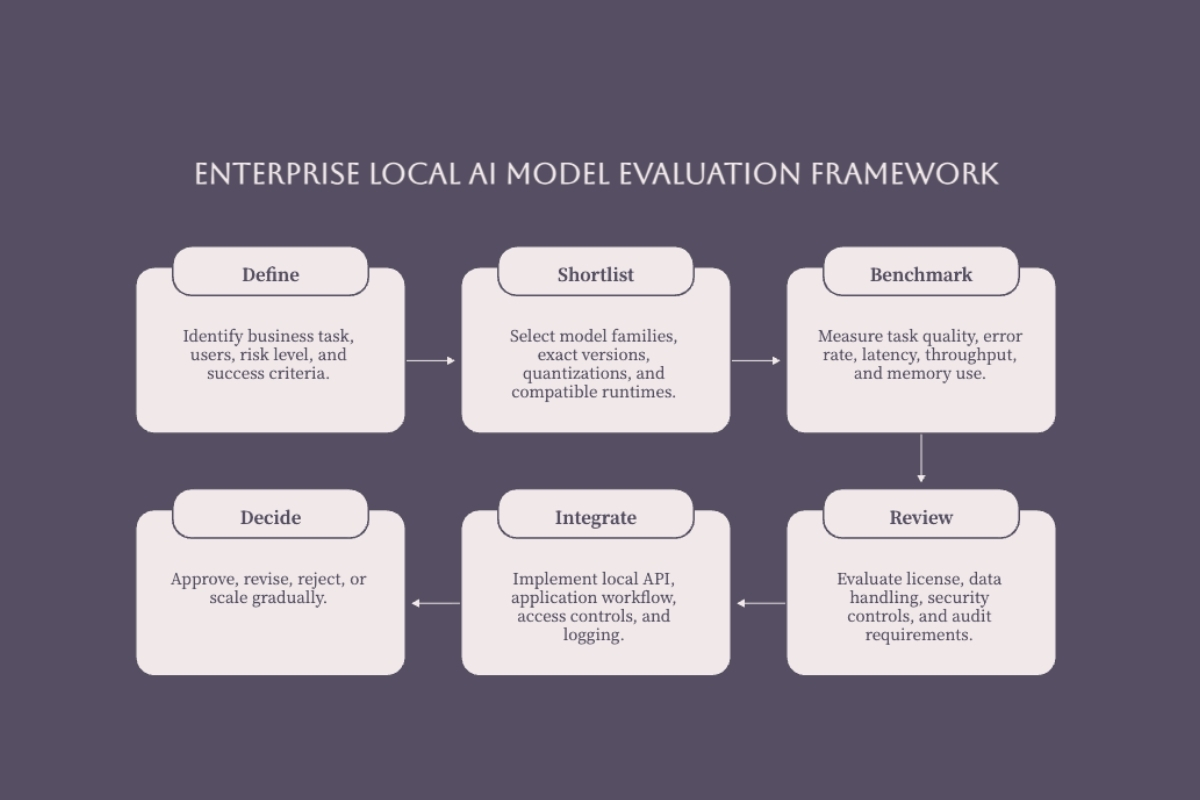
A reliable selection process begins with the business task and works backward to the model. Public benchmarks can help create a shortlist, but they do not establish performance on an organization's code, documents, languages, policies, or failure conditions. Use a versioned evaluation set with expected outputs, unacceptable behaviors, and measurable service targets.
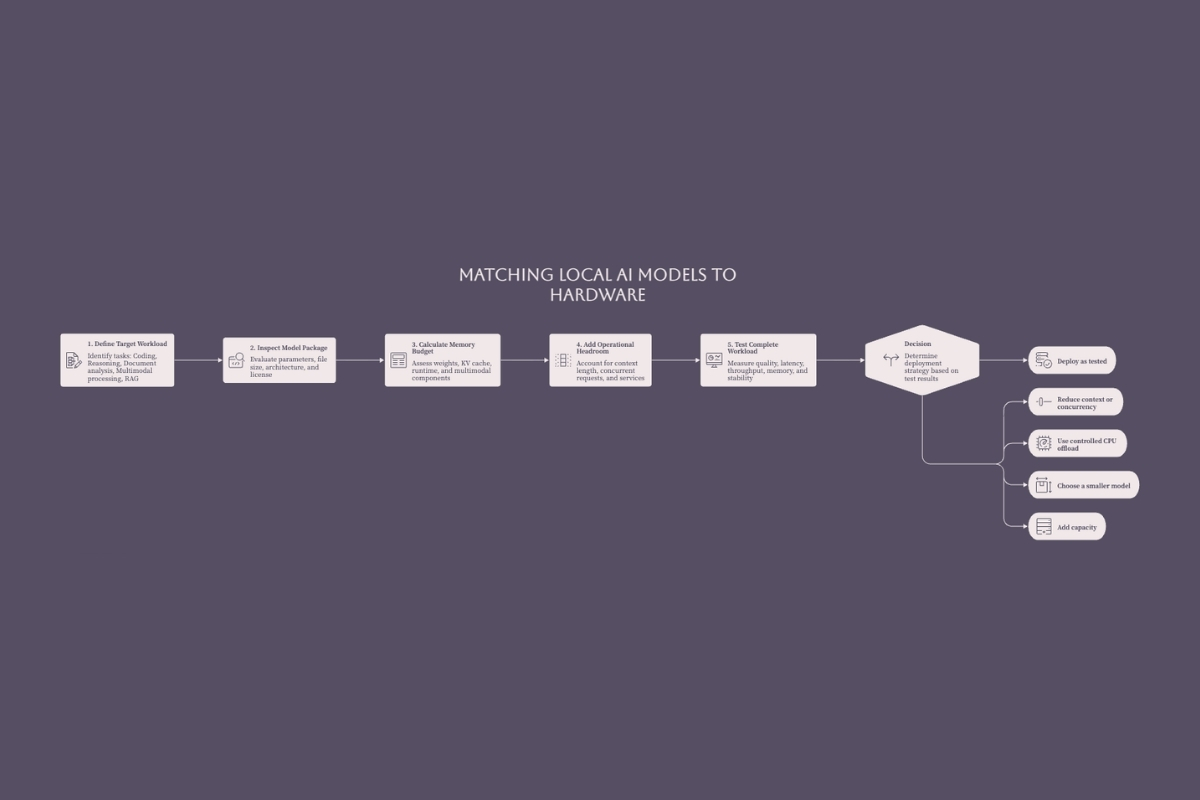
Hardware Assessment and Model Matching Process
-
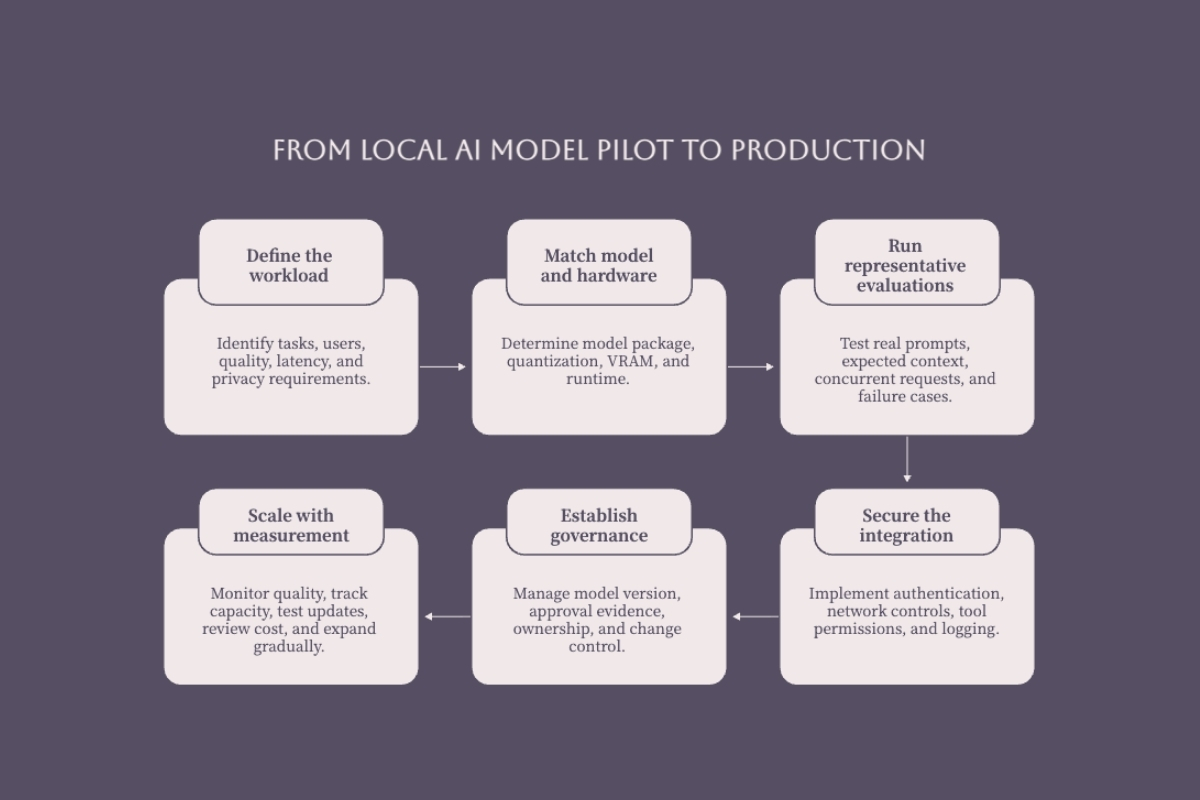
Define the workload. Record inputs, outputs, modality, context distribution, quality threshold, latency target, concurrency, data sensitivity, and required human review.
-
Inventory the environment. Document GPU or unified memory, system RAM, storage, drivers, runtime versions, network exposure, and any limits imposed by existing applications.
-
Select exact packages. Capture the model repository, tag, quantization, package size, license, checksum, and context configuration. Do not evaluate a family name without a reproducible artifact.
-
Run representative tests. Measure task accuracy, schema adherence, unsupported claims, time to first token, generation rate, peak memory, energy use, and failure recovery.
-
Review operating risk. Test prompt injection, sensitive-data handling, tool permissions, authentication, logging, fallback behavior, and escalation to a human owner.
-
Approve a bounded release. Start with limited users and a defined task. Monitor outcomes before increasing context, concurrency, tools, or workflow authority.
LM Studio provides desktop and headless server options with native and OpenAI-compatible APIs. Ollama provides its own API plus compatibility with parts of the OpenAI API. Both can support local evaluation, but endpoint and parameter compatibility should be checked against the application's actual requests. Teams still preparing the host and runtime can use this local AI server setup guide before beginning the model evaluation.
A minimal Ollama smoke test for the reviewed Qwen package is:
ollama pull qwen3.8:27b-q4_K_M
ollama run qwen3.8:27b-q4_K_M

curl http://localhost:11434/api/generate \
  -H "Content-Type: application/json" \
  -d '{
    "model": "qwen3.8:27b-q4_K_M",
    "prompt": "Return only the word READY.",
    "stream": false
  }'
Run this on an isolated development machine first. Before exposing any model endpoint to other systems, add authentication or an authenticated reverse proxy, restrict network binding, configure firewall rules, define request limits, and decide what request and response data may be logged.
Task-Specific Model Performance Comparison
|
Candidate |
Primary Evaluation Fit |
Official Context |
Example Local Package |
License Note |
|---|---|---|---|---|
|
Phi-4-mini-instruct |
Compact text reasoning, extraction, classification, and bounded coding help |
128K maximum; deploy with a task-specific limit |
Ollama Q4_K_M approximately 2.5 GB |
MIT |
|
Granite 4.2 3B |
RAG, summarization, structured JSON, tool use, and compact enterprise workflows |
128K native in the listed Ollama package |
Ollama Q4_K_M approximately 2.2 GB |
Apache 2.0 |
|
gpt-oss-20b |
Local reasoning, tool use, structured output, and developer workflows |
128K |
Ollama MXFP4 approximately 14 GB; designed for 16 GB memory |
Apache 2.0 |
|
Qwen3.8-27B |
General coding, reasoning, multilingual work, tools, and image understanding |
262,144 tokens native; practical limit depends on memory |
Ollama Q4_K_M approximately 18 GB |
Apache 2.0 |
|
DeepSeek-R1-Distill-Qwen-32B |
Deliberate text reasoning, mathematics, and algorithmic problem solving |
128K |
Ollama Q4_K_M approximately 20 GB |
MIT repository; review inherited base-model terms |
|
Gemma 4 12B or 26B |
Multimodal workflows combining text and images |
256K for these variants |
Ollama Q4 packages approximately 7.6 GB and 18-19 GB |
Apache 2.0 |
The table is a shortlist, not a universal ranking. A coding model should be evaluated on accepted patches and passing tests, not attractive explanations. A RAG model should be measured on retrieval quality, grounded answers, citations, and abstention. A multimodal model should be tested on the exact document and image types it will process. A tool-using model should be evaluated on permission boundaries, valid arguments, refusal behavior, and recovery from tool errors.
Local inference removes per-token API charges, but it introduces acquisition, electricity, maintenance, support, and opportunity costs. Compare total cost of ownership against the measured hosted workload. A local model that is cheaper per request but consistently fails the acceptance test is not the economical choice.
Common Implementation Challenges and Solutions
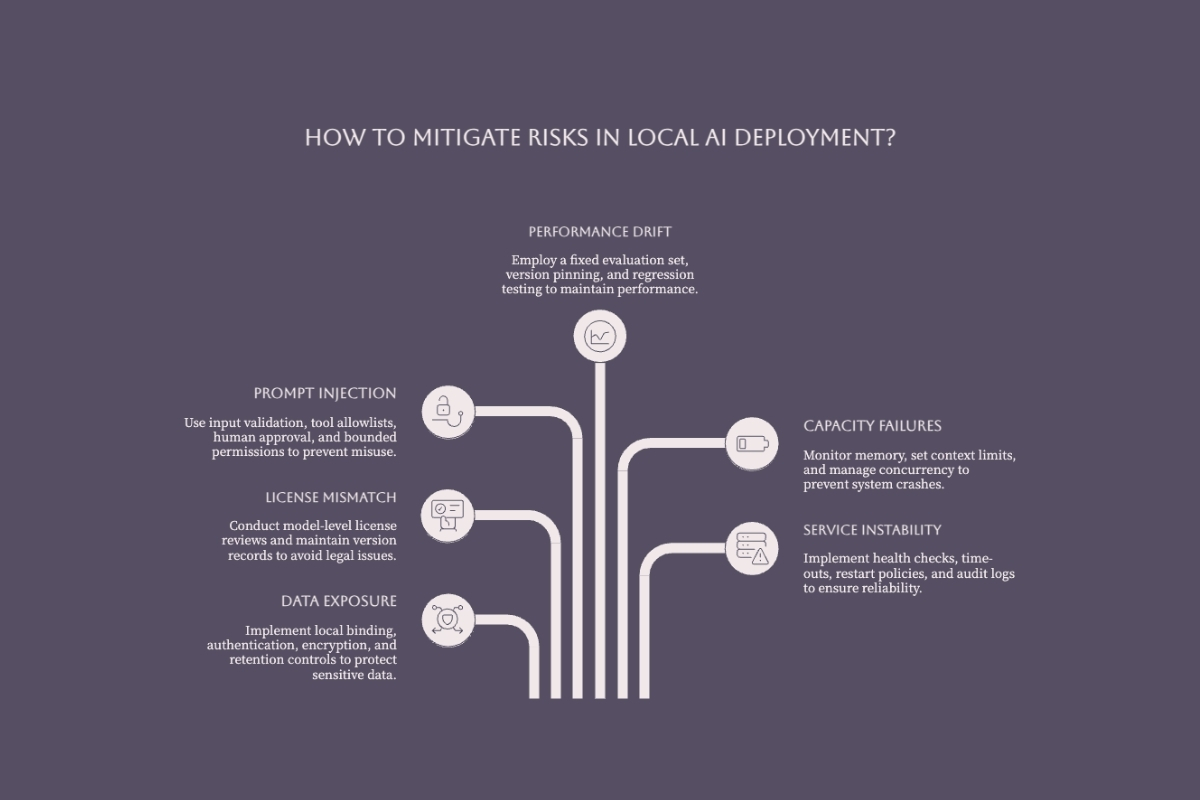
Most local deployments fail for predictable reasons: the package was selected from parameter count alone, the full context was enabled without memory testing, a development endpoint was exposed without controls, or public benchmark scores were treated as production evidence. A controlled rollout addresses capacity, integration, and governance together.
Memory and Performance Optimization
Start with the exact artifact. Record package size, quantization, runtime, context limit, GPU offload, and batch settings. Reducing precision can lower memory use, but the quality impact varies by model and task. This LLM quantization guide explains the main precision trade-offs; Q4_K_M remains a useful baseline for many GGUF deployments, not a blanket production standard.
Reserve operational headroom. Do not fill all available VRAM with weights. Context cache, image processing, concurrent requests, and runtime allocations need memory. Increase context and concurrency separately while monitoring peak use, time to first token, generation rate, and out-of-memory failures.
Right-size the model. A compact model that passes the task evaluation can be faster, cheaper, and easier to operate than a larger model. A larger, heavily compressed model does not automatically outperform a smaller one. Benchmark both packages on the same test set and service target.
Local execution can reduce network latency and improve offline availability, but it is not always faster than a hosted service. Hardware, model architecture, prompt length, output length, runtime, batching, and concurrency determine actual performance.
Integration with Development Workflows
Local runners can support IDE assistance, repository analysis, document processing, RAG, testing support, and internal applications. Keep inference behind a stable application boundary so the team can replace the model or runtime without rewriting every client. Validate the subset of OpenAI-compatible behavior the application actually uses; compatibility does not mean every endpoint or request field behaves identically.
For automated workflows, treat model output as untrusted input. Validate schemas, constrain file paths, isolate tools, enforce least privilege, set timeouts and retries, and require approval for higher-impact actions. Model endpoints should connect to existing systems through integration patterns that keep data flow, permissions, failure behavior, and operating ownership visible.
Air-gapped operation is possible only when model weights, dependencies, container images, drivers, and update procedures are prepared in advance. An installation that depends on live package registries or external model downloads is not air-gapped simply because inference later runs on localhost.
Security and Compliance Considerations
Local deployment can keep model inference within a controlled environment, but compliance depends on the complete processing system. Data classification, lawful use, retention, access control, encryption, vendor terms, incident response, human oversight, and evidence still apply. HIPAA, GDPR, PCI DSS, and sector-specific obligations are not satisfied by hosting location alone.
An AI governance consulting program should define approved models and use cases, accountable owners, evaluation standards, release gates, logging rules, monitoring thresholds, incident paths, and retirement procedures. Maintain an inventory that connects every deployed model to its source, license, package, configuration, data access, users, and workflow authority.
-
Protect data: minimize prompt content, filter secrets, encrypt storage and transport, and document permitted logging.
-
Protect tools: require explicit allowlists, validate arguments, isolate execution, and block unrestricted filesystem or network access.
-
Test adversarial inputs: evaluate prompt injection, data exfiltration, unsafe instructions, malformed tool calls, and attempts to override policy.
-
Preserve evidence: version prompts, evaluation sets, model artifacts, configurations, approvals, incidents, and rollback decisions.
-
Keep humans accountable: route consequential financial, legal, security, clinical, customer, or policy actions to authorized reviewers.
Prompt injection is an application and trust-boundary problem, not a property caused by a model displaying or hiding reasoning. Controls must govern what information the model receives and what actions the surrounding software permits.
Conclusion and Implementation Next Steps
The best local AI model is the smallest approved package that meets the workload's quality, latency, security, and operating requirements. Qwen3.8-27B is a strong general-purpose candidate for a 24 GB development workstation. Phi-4 Mini and Granite 4.2 3B provide compact text options. gpt-oss-20b offers local reasoning and tool use in a 16 GB class footprint. Gemma 4 is the main shortlist for multimodal evaluation, while DeepSeek-R1 distilled models remain relevant for deliberate text reasoning.
-
Define one bounded use case with an owner, baseline, acceptance test, and prohibited behavior.
-
Select two or three exact packages that fit the available hardware with operational headroom.
-
Run a reproducible evaluation covering quality, latency, memory, failure behavior, and security.
-
Integrate through a controlled service boundary with authentication, validation, logging policy, and human review.
-
Release to a limited audience and monitor business outcomes before expanding context, users, tools, or autonomy.
Model selection should remain part of the broader enterprise AI architecture. Data readiness, retrieval, integration, software quality, governance, and support usually determine whether a local model creates durable value after the benchmark phase.
When the use case requires bounded agents rather than a standalone model endpoint, the implementation should connect model choice to approved tools, observable actions, human review, and production ownership.
Additional Resources
-
Local model basics: Review what a local LLM is before comparing packages and runtimes.
-
Server setup: Document installation and infrastructure requirements before model evaluation.
-
Quantization: Compare Q4, Q8, and native compressed formats against the workload's quality and capacity requirements.
-
Implementation risk: Review common enterprise AI implementation challenges before production rollout.
-
Automation planning: Compare local inference with broader enterprise automation requirements when the model will influence operational work.
For current technical details, use official model cards and the Ollama model library for Qwen3.8, Phi-4 Mini, Granite 4.2, Gemma 4, DeepSeek-R1, and gpt-oss. Model versions, runner support, package sizes, and licenses can change; verify them again when the article is published or materially updated.