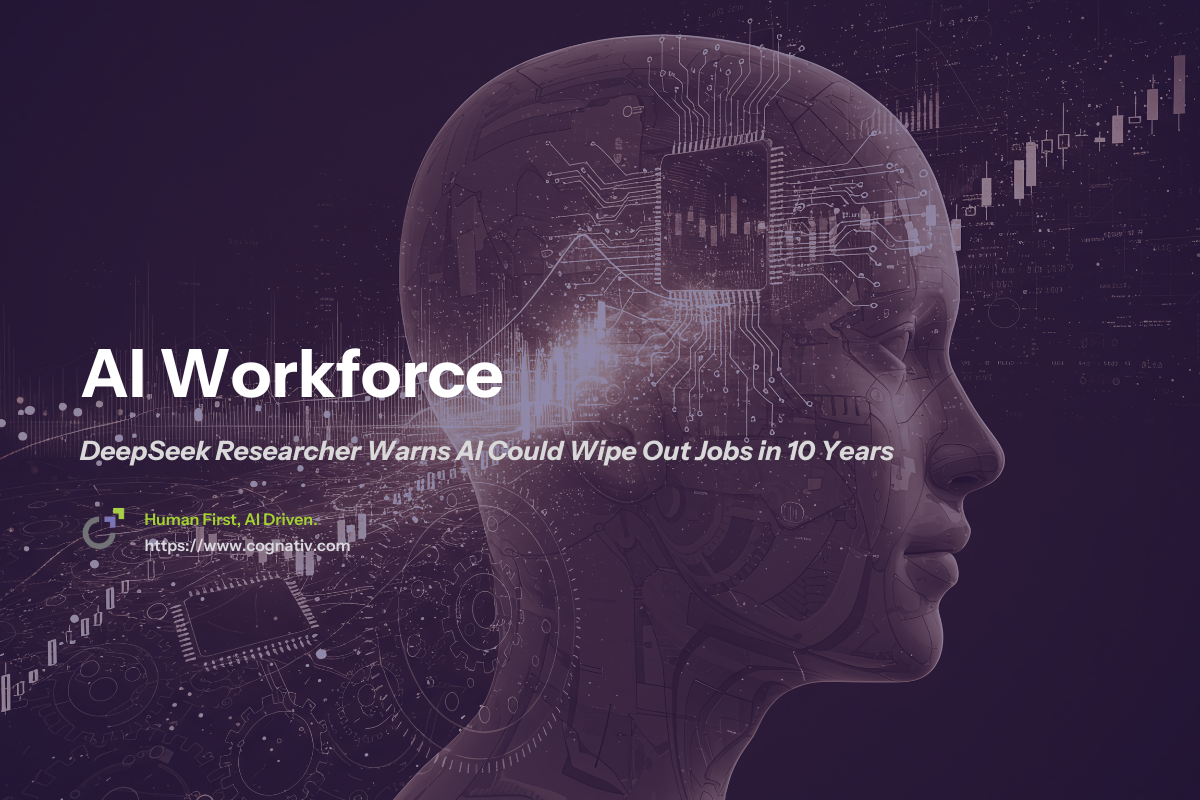
DeepSeek Researcher Warns AI Could Wipe Out Jobs in 10 Years
The rapid advancement of artificial intelligence (AI) continues to reshape industries worldwide, but a stark warning from Chen Deli, senior researcher at China’s AI firm DeepSeek, signals profound challenges ahead. Speaking at the World Internet Conference in Wuzhen, Chen represented DeepSeek during a rare public appearance, where he predicted that AI could wipe out most human jobs within the next decade, posing a massive challenge to societal order and the global workforce.
This development matters deeply for enterprises navigating digital transformation, as AI’s capabilities evolve from a productivity “honeymoon phase” to a disruptive force demanding strategic reassessment. DeepSeek, a rising star in the US-China AI race, symbolizes China’s technological ambitions with its low-cost reasoning models competing against industry leaders like OpenAI’s GPT-oss large language models and ChatGPT.
As AI systems become increasingly capable yet still cannot independently complete tasks, Chen’s warning underscores the urgent need for tech companies to act as “guardians of humanity,” prioritizing human safety and reshaping societal structures to mitigate risks.
Key Takeaways
-
AI could replace most human jobs within 10 to 20 years, warns DeepSeek’s Chen Deli.
-
Tech firms must serve as whistleblowers, protecting human safety and societal order.
-
DeepSeek’s rise exemplifies China’s growing influence and national pride amid the global AI race.

Understanding the Technology's Long Term Risks
The warning from Chen Deli highlights a turning point in the AI industry, where the initial productivity gains from AI—dubbed the “honeymoon phase”—may soon be overshadowed by significant job displacement risks.
For enterprises, this signals a critical juncture to evaluate AI’s role beyond automation and efficiency, considering broader societal implications. Chen’s insights come amid DeepSeek’s company's rare public appearances, emphasizing the company’s growing influence and responsibility in shaping AI’s trajectory.
The US-China AI race intensifies as DeepSeek’s low-cost reasoning model, R1, challenges established players, reflecting competitive performance benchmarks that could redefine global AI standards. This evolving landscape demands that tech companies not only innovate but also anticipate AI’s societal impact, balancing advancements with ethical stewardship.
AI’s Potential to Displace Human Jobs
Chen predicted that within 10 to 20 years, AI systems could take over a substantial portion of work currently performed by humans, triggering a massive societal challenge. While AI cannot yet independently complete tasks, its increasing capability threatens to disrupt various industries, from entry-level white-collar jobs to complex operational roles. This displacement risk necessitates proactive strategies from enterprises to safeguard human jobs and adapt workforce models accordingly.
The Role of Tech Companies as Guardians of Humanity
Chen emphasized that time tech companies must act as whistleblowers, warning society about potential risks while prioritizing human safety. This responsibility includes protecting human jobs and helping to reshape societal order amid AI’s disruptive influence. The call for tech firms to become guardians of humanity reflects a broader ethical imperative to balance innovation with social responsibility, at the very least protecting human safety.
DeepSeek’s Position in the AI Industry
DeepSeek’s rise, marked by making headlines earlier this year and rare public appearances such as at the World Internet Conference in Wuzhen, symbolizes China’s technological ambitions and national pride amid the AI race. The company’s R1 model jolted the US stock market with its competitive performance benchmarks and low-cost approach, challenging Chinese counterparts and global competitors alike. This dynamic places DeepSeek at the forefront of the AI race, influencing market trends and innovation pathways.
|
Aspect |
Details |
|---|---|
|
AI Job Displacement Timeline |
10 to 20 years |
|
DeepSeek Model |
R1 low-cost reasoning model |
|
Competitive Benchmark |
Comparable to ChatGPT’s o1 |
|
Key Event |
World Internet Conference in Wuzhen |
|
Market Impact |
Significant influence on US stock market |
The AI Race Between the US and China: Competitive Dynamics and Consequences
The intensifying US-China AI race shapes the strategic landscape for enterprises and governments alike. DeepSeek’s innovations, including its low-cost R1 reasoning model, have narrowed the performance gap with leading US models such as OpenAI’s GPT-oss large language models. Analysts like Ray Wang told Business Insider in an August report that these Chinese counterparts have achieved competitive performance benchmarks, forcing a recalibration of AI development strategies worldwide.
This rivalry extends beyond technology to national pride and economic influence, with China’s leader Xi Jinping underscoring AI’s strategic importance. Enterprises must navigate this geopolitical context while leveraging AI advancements responsibly.
DeepSeek’s Competitive Edge
DeepSeek jolted the AI industry and the US stock market with its R1 model, which offers performance on par with top competitors at a fraction of the cost. This model exemplifies emerging technology trends emphasizing efficiency and scalability, making AI more accessible across sectors. Chen shared the stage with executives from companies collectively known as China's "six little dragons," which includes Alibaba Cloud and Unitree, highlighting the collaborative and competitive nature of China's AI ecosystem.
OpenAI’s Response and Industry Impact
OpenAI CEO Sam Altman introduced GPT-oss, a family of large language models with open weights, influenced by the success of open-sourced Chinese models like DeepSeek’s. This move promotes transparency and collaboration, potentially mitigating some risks associated with proprietary AI development. OpenAI’s GPT-oss models have become a default foundation for many AI applications, reflecting a shift towards openness in the AI community.
Geopolitical and Strategic Dimensions
The AI race is not merely technological but also geopolitical, with the US government and tech companies under pressure to maintain leadership. DeepSeek’s rise amid national pride highlights the need for enterprises to consider regulatory and strategic factors in AI adoption and innovation.
|
Entity/Aspect |
Description |
|---|---|
|
DeepSeek’s Model |
R1 low-cost reasoning model |
|
GPT-oss large language models | |
|
Geopolitical Context |
US-China AI race and national pride |
|
Industry Influence |
Competitive performance benchmarks |
|
Strategic Importance |
Emphasized by China’s leader Xi Jinping |
Mitigating AI Risks: Responsibilities and Strategies for Tech Companies
Chen Deli’s stark warning comes with a call to action for tech companies to embrace their role as “guardians of humanity.” This involves not only advancing AI but also serving as whistleblowers, warning society about potential risks and mitigating negative impacts on human jobs and societal order. Enterprises must develop responsible AI practices that prioritize protecting human safety and jobs, balancing innovation with ethical governance.
Ethical and Social Responsibilities
Tech firms must prioritize protecting human safety and jobs, recognizing AI’s potential to disrupt societal order negatively. This includes transparent communication about AI’s risks and benefits, fostering trust among stakeholders.
Collaboration and Transparency in AI Development
Open-sourced models like OpenAI’s GPT-oss and Chinese counterparts promote transparency and collaboration, essential for mitigating AI risks. Such openness enables shared standards and responsible innovation across the industry.
Strategic Approaches to Workforce Adaptation
Enterprises should implement workforce strategies that prepare for AI-driven changes, including reskilling programs and new job creation aligned with AI capabilities. This proactive approach can lessen societal disruption and enhance long-term sustainability.
|
Responsibility |
Description |
|---|---|
|
Protecting Human Safety |
|
|
Whistleblowing |
Alert society to AI risks |
|
Transparency |
Promote open-source AI development |
|
Workforce Strategy |
Reskilling and job creation |
|
Ethical Governance |
Balance innovation with social responsibility |
Strategic Outlook and Implications
Looking ahead, the AI ecosystem faces a pivotal evolution where technological advancements must be matched with ethical stewardship and strategic foresight. Enterprises, policymakers, and tech teams must collaborate to shape AI’s development responsibly, ensuring it benefits society while minimizing harm. The US-China AI race will continue to drive innovation but also demands vigilance to address societal challenges, such as job displacement and regulatory compliance. For enterprises, the actionable insight is clear: integrate AI thoughtfully, prioritize human safety, and prepare workforce strategies that embrace transformation while safeguarding societal order.
Stay ahead of AI and tech strategy. Subscribe to What Goes On: Cognativ’s Weekly Tech Digest for deeper insights and executive analysis.