
Apple M5 Chip: Enterprise Guide to Local AI Processing and Custom Software Development
Apple rebuilt its entire desktop Mac line around local AI, and the M5 chip family sits at the center of that bet. The new Mac Studio models began shipping September 22, 2026, with the M5 Max and M5 Ultra delivering the unified memory capacity and neural processing power that enterprise teams need to run AI models entirely on-device. This isn't Apple challenging NVIDIA for data center supremacy—it's Apple saying that a meaningful share of valuable AI work belongs on the machine sitting on your desk, not in a cloud someone else controls.
This guide covers the M5 Pro, Max, and Ultra variants through the lens of enterprise deployment: custom software development, AI-driven automation, and the cost math behind owning versus renting intelligence. Consumer features, Apple Intelligence features like the Photos app or Image Playground, and iPhone models fall outside our scope. We're focused on what CTOs, engineering leads, and decision-makers need to know when evaluating local AI infrastructure for production workloads.
The direct answer: M5 Ultra supports configurations with up to 512GB of memory and 1.2TB/s memory bandwidth, enabling organizations to run models with hundreds of billions of parameters locally—no token meter, no cloud bills, no data leaving the building. M5 Max starts at $2,499 and handles serious multi-agent workloads at 128GB unified memory, making it the practical entry point for teams building AI-first architecture.
By the end of this article, you will understand:
-
M5 architecture specifications and how they translate to enterprise AI capability
-
Which M5 variant fits which class of business workload
-
How to plan implementation and measure ROI against cloud AI alternatives
-
Common deployment challenges and proven solutions for Apple Silicon environments
-
The strategic question every organization faces: own your intelligence or rent it

Understanding Apple M5 Architecture on Apple Silicon
The M5 represents Apple's most deliberate push into professional AI compute. Rather than adding a neural engine quietly and hoping nobody notices, Apple is explicitly selling the Mac as the computer where AI agents can live. For enterprise teams building custom software on secure platforms, this architecture provides the foundation for on-device model deployment, AI-driven automation, and workflow processing that never touches an external server.
M5 Core Technologies
The defining feature of Apple Silicon has always been unified memory—CPU, GPU, and Neural Engine sharing a single memory pool instead of shuttling data between discrete components. The M5 takes this further. M5 Ultra supports configurations with up to 512GB of memory shared across 36 CPU cores, an 80-core GPU, and a 32-core Neural Engine working in concert. There is no discrete GPU VRAM bottleneck, no remote direct memory access overhead, and no data transfer penalty when switching between processing stages.
M5 introduces dedicated Neural Accelerators embedded within each GPU core for the first time. These accelerators make matrix multiplication approximately 4× faster than on the previous generation when running MLX workloads—Apple's open-source framework for local AI models. The practical result: AI tasks that previously required cloud compute or specialized GPU hardware now run efficiently on a single machine sitting under a desk.
For enterprise teams, this architecture eliminates the operational friction of managing separate compute pools. When your on-device model, your code compilation environment, and your data processing pipeline all share the same memory space, deployment complexity drops significantly. Cognativ specializes in custom enterprise software development that leverages exactly this kind of architectural advantage—reducing operational friction and improving time-to-market for organizations with complex operating environments.
Enterprise-Grade Performance Metrics
Memory bandwidth determines how fast your models can actually process tokens, and the M5 lineup delivers a clear performance ladder. M5 Pro provides approximately 307 GB/s bandwidth with up to 64GB unified memory. M5 Max offers up to 614GB/s memory bandwidth with 128GB capacity. M5 Ultra reaches 1.2TB/s—roughly 50% more than the M3 Ultra it replaces and enough bandwidth to keep multiple large models saturated simultaneously.
Relative to the previous generation, M5 Ultra delivers approximately 4.3× peak AI compute performance over M3 Ultra, up to 1.8× faster graphics, and meaningful CPU improvements in both single-threaded (~1.25×) and multithreaded (~1.3×) workloads. M5 Max features an 18-core CPU and up to 40 GPU cores, making it suitable for multi-stream 4K and 6K editing alongside AI inference workloads.
The UltraFusion interconnect in the M5 Ultra deserves attention from infrastructure teams. It connects four dies (two dual-die Max chips) with over 4.4 TB/s inter-die bandwidth—enough that the system behaves as a single coherent processor rather than a cluster of loosely coupled chips. For organizations evaluating AI infrastructure solutions, this means scaling compute without the distributed systems complexity that typically accompanies multi-node architectures.
These specifications connect directly to deployment reality: the memory capacity determines which models fit on-device, the bandwidth determines inference speed, and the Neural Accelerators determine whether AI workloads run efficiently enough to justify the hardware investment.

Apple Intelligence and AI Agents on M5 Devices
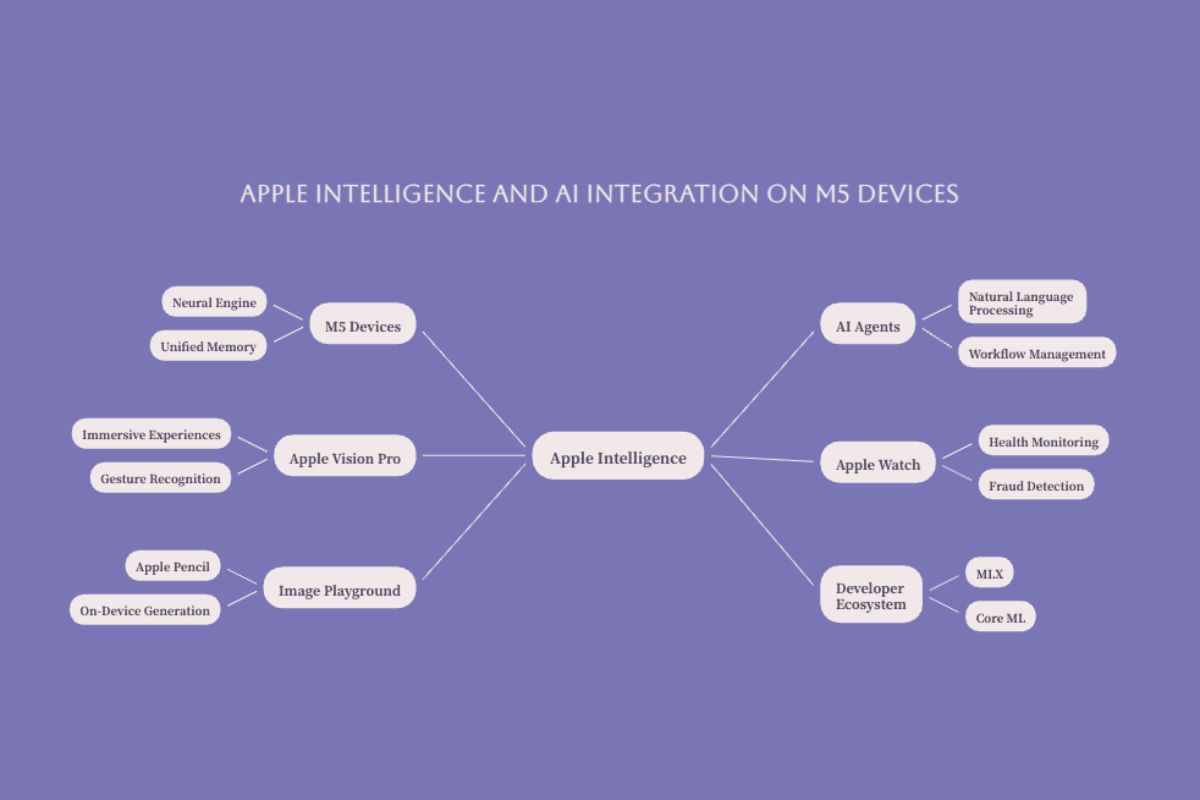
Apple Intelligence is Apple's integrated AI framework powering features across Apple products, including the new Siri AI, Image Playground, and real-time translation. On M5-powered Mac models, Apple Intelligence leverages the powerful Neural Engine and unified memory architecture to enable seamless AI-driven automation and local inference.
AI agents running on M5 devices benefit from this tight integration, allowing persistent, always-on deskside computing without cloud dependency. These agents can process natural language, manage workflows, and interact with multiple applications, all while maintaining user privacy by processing data locally on the device.
The Control Center on macOS and iPadOS offers quick access to AI features and agent management, giving users and enterprise teams the ability to monitor and control AI workflows efficiently. Developers can integrate AI agents into custom software, using frameworks like MLX and Core ML, optimizing for Apple Silicon's unique architecture.
Apple Vision Pro Models and Enterprise AI
Apple Vision Pro models, powered by Apple Silicon including variants of the M5 chip, represent Apple's push into spatial computing with AI capabilities. These devices integrate Apple Intelligence to support immersive experiences, professional camera capture, and advanced image processing.
For enterprises, Apple Vision Pro offers new modalities for AI-driven applications, combining ambient lighting sensing, gesture recognition, and voice interaction through new Siri enhancements. Apple Vision Pro models support seamless integration with other Apple devices, including iPads and Apple Watches, enabling a unified ecosystem for AI-enabled workflows.
M5 Chip and Apple Watch Integration
Apple Watch, another key device in the Apple ecosystem, benefits indirectly from the M5 architecture through seamless connectivity with Macs and iPads. AI-driven automation on M5 Macs can integrate with Apple Watch data for health monitoring, notifications, and workflow triggers.
The Apple Wallet on Apple Watch and iPhone facilitates secure payment methods and identity verification, which can be enhanced with AI models running locally on M5 devices to improve fraud detection and user experience.
AI Models and Image Playground on Apple Devices
The Image Playground app, powered by Apple Intelligence, enables users to generate images from rough sketches made with the Apple Pencil across iPad models and Macs. This feature utilizes AI models optimized for Apple Silicon to deliver real-time, on-device image generation without cloud dependency, preserving privacy and reducing latency.
AI companies developing models compatible with Apple devices are increasingly focusing on lightweight, efficient architectures that run well on M5 chips, supporting workflows from professional camera capture to creative content generation.
Apple Store, Mac App Store, and Developer Ecosystem
Apple launched new features in the Apple Store and Mac App Store to support the distribution of AI-enabled applications optimized for M5 Macs and other Apple devices. Developers can leverage the Apple ID and Apple Account infrastructure for secure authentication and payment methods, including trade-in programs and subscription management.
Quick access to app settings via Control Center and integration with new Siri AI provides users with intuitive control over AI agents and workflows. The ecosystem supports seamless updates and deployment of AI models, ensuring enterprises can maintain model freshness and compliance.
Enterprise Use Cases: Device AI and AI-First Architecture
Device AI on M5-powered Macs and mobile devices enables enterprises to implement AI-first architecture that prioritizes local compute for sensitive data and latency-critical applications. This approach complements cloud AI services, offering a hybrid model that balances control, cost, and capability.
Use cases include AI-driven automation in logistics, healthcare, and finance, where compliance and data residency are paramount. AI agents running on M5 Macs can handle complex workflows, integrating with legacy systems and modern APIs to deliver measurable operational efficiency gains.

Conclusion and Next Steps
The M5 chip family gives enterprises a credible foundation for local AI infrastructure and custom software modernization. M5 Max delivers the performance-per-dollar sweet spot for most teams—128GB of unified memory, 614GB/s bandwidth, and enough GPU core count to run serious multi-agent workloads without cloud dependencies. M5 Ultra extends that capability to frontier-scale model deployment for organizations whose data sensitivity, latency requirements, or volume justify the investment. Cognativ targets mid-market and enterprise organizations with complex operating environments, and the M5 hardware lineup maps directly to the infrastructure needs these organizations face.
The strategic bet Apple is making—that useful intelligence will keep getting smaller, cheaper, and easier to run locally—aligns with what we see in the field. The frontier labs will continue pushing the boundaries of what cloud agents can do, and those capabilities matter. But 80–90% of the AI work most organizations need done can run locally on hardware they own, with zero token costs, complete data control, and response times measured in milliseconds rather than network round-trips.
Your next steps:
-
Conduct a focused assessment of AI automation opportunities within existing workflows, identifying which workloads are sensitive, latency-critical, or high-volume enough to justify local processing.
-
Plan a pilot deployment using an M5 Max configuration for your development team—128GB is the practical starting point for evaluating what local AI can actually do in your environment.
-
Measure performance gains and compliance improvements against your cloud AI baseline over 60–90 days, establishing the ROI data needed for broader investment decisions.
-
Scale successful implementations across broader enterprise operations, moving from pilot to production with the deployment frameworks and memory optimization practices validated during evaluation.
Related topics worth exploring: enterprise AI architecture planning before model selection, building private LLMs for secure AI development, and technology ROI measurement frameworks for justifying infrastructure investments.
Additional Resources
-
M5 variant specifications: M5 Pro (64GB / 307 GB/s), M5 Max (128GB / 614 GB/s / 18-core CPU / 40 GPU cores), M5 Ultra (512GB / 1.2 TB/s / 36-core CPU / 80 GPU cores). Mac Studio ships September 22, 2026; 512GB Ultra configuration arrives late October.
-
Enterprise AI deployment frameworks: MLX for local agentic workflows and tool calling, Core ML for optimized inference, Metal for GPU compute. Quantization benchmarks available through BaseRT research for Apple Silicon optimization.
-
Custom software development on Apple Silicon: Containerized model serving, API-first integration patterns, and next generation SSD architecture considerations for high-throughput local inference pipelines.