Enterprise AI Architecture: Decisions Before You Choose a Model
Enterprise AI architecture is the foundational framework that connects business requirements, data systems, integration patterns, governance controls, identity management, and operational responsibilities into a coherent system capable of supporting artificial intelligence at scale. It is not a model-selection diagram. It is not a vendor comparison. It is the set of decisions that determines whether AI systems deliver reliable business value or become expensive, ungoverned experiments.
This guide covers the architectural decisions required before selecting ai models, vendors, or platforms for enterprise AI implementations. It is written for enterprise and complex mid-market technology leaders, architects, security leaders, data engineers, data scientists, and product owners evaluating how AI capabilities should fit into existing systems. If you are trying to decide which large language models to adopt or which ai platform to purchase, this article will explain why that decision comes later-and what must come first.
Enterprise AI architecture requires defining workflow requirements, data boundaries, integration patterns, identity controls, deployment constraints, continuous monitoring systems, human oversight mechanisms, and vendor dependencies before model selection. Organizations that skip these decisions and lead with model evaluation consistently face governance failures, integration breakdowns, and technical debt that undermines the entire initiative.
By the end of this guide, you will understand:
-
The core components of enterprise AI architecture and how they interact
-
Why architectural decisions must precede model, vendor, or platform selection
-
A structured requirements-gathering process covering workflows, data, integrations, identity, and deployment
-
How to embed data governance, security controls, and human oversight into architecture from the start
-
A comprehensive decision framework and checklist for planning enterprise AI architecture
Understanding Enterprise AI Architecture
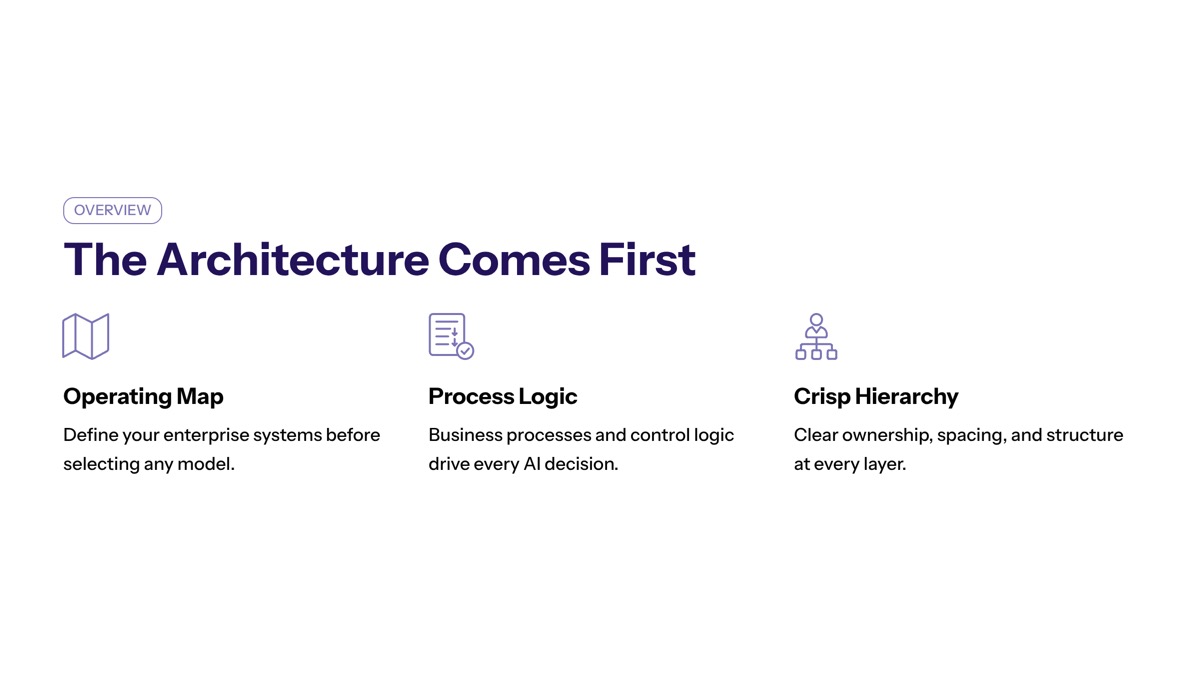
Enterprise AI architecture is the blueprint that connects business workflows, data management systems, security controls, governance frameworks, and operational processes into a unified AI capability. It defines how ai systems interact with enterprise data, how business logic is enforced, how sensitive data is protected, and how intelligent systems are monitored, maintained, and improved over time.
Enterprise AI architecture defines how AI systems interact. It includes data ingestion, model training, and governance layers. A strong architecture reduces operational risk in AI initiatives. This is distinct from infrastructure, which supplies the hardware, networking, and computational resources for processing ai workloads. Architecture governs how components interact; infrastructure governs where and on what they run.
Core Architecture Components
Enterprise AI architecture includes multiple interconnected layers. The core components of enterprise AI architecture include data foundation and infrastructure, but extend well beyond them:
-
Workflow orchestration : How steps-data ingestion, processing, model inference, feedback loops-are sequenced, managed, and monitored across business processes
-
Data management and governance : How enterprise specific data is discovered, cataloged, quality-assessed, governed, and made available for model training, inference, and retrieval augmented generation
-
Integration layer : How AI services communicate with enterprise systems-ERPs, CRMs, billing platforms-through APIs, event buses, or batch pipelines
-
Identity and access management : How access controls enforce who and what can access data, invoke ai models, or modify system behavior
-
Deployment patterns : Where and how models are served-cloud-native, hybrid, on-premises, or edge environments
-
Monitoring and observability : How performance, accuracy, drift, and operational events are tracked post-deployment
-
Governance and security controls : How regulatory compliance, audit trails, encryption, and risk management are enforced throughout the system
-
Vendor and dependency management : How portability, standards, and exit strategies are maintained
Each component connects directly to business outcomes. Workflow orchestration determines whether AI interventions happen at the right moment in business operations. Data governance determines whether ai outputs are trustworthy. Identity controls determine whether sensitive data is exposed only to authorized users and systems.
Architecture vs Infrastructure Distinction
Architecture decisions shape system behavior: what data flows where, which systems can communicate, how failures are handled, what governance rules are enforced. Infrastructure decisions affect performance and availability: how much compute is allocated, which cloud regions are used, what networking topology supports the workloads.
A common mistake is treating infrastructure provisioning as architecture. Spinning up GPU clusters or subscribing to a managed AI platform does not constitute enterprise architecture. Without decisions about data boundaries, integration patterns, access controls, and failure modes, infrastructure is an expensive foundation with no blueprint on top of it.
This distinction matters because model selection-choosing between foundation models, deep learning models, custom models, or specialized machine learning models-depends on architectural requirements that must be defined first.
Why Model Selection Should Not Be the First Decision
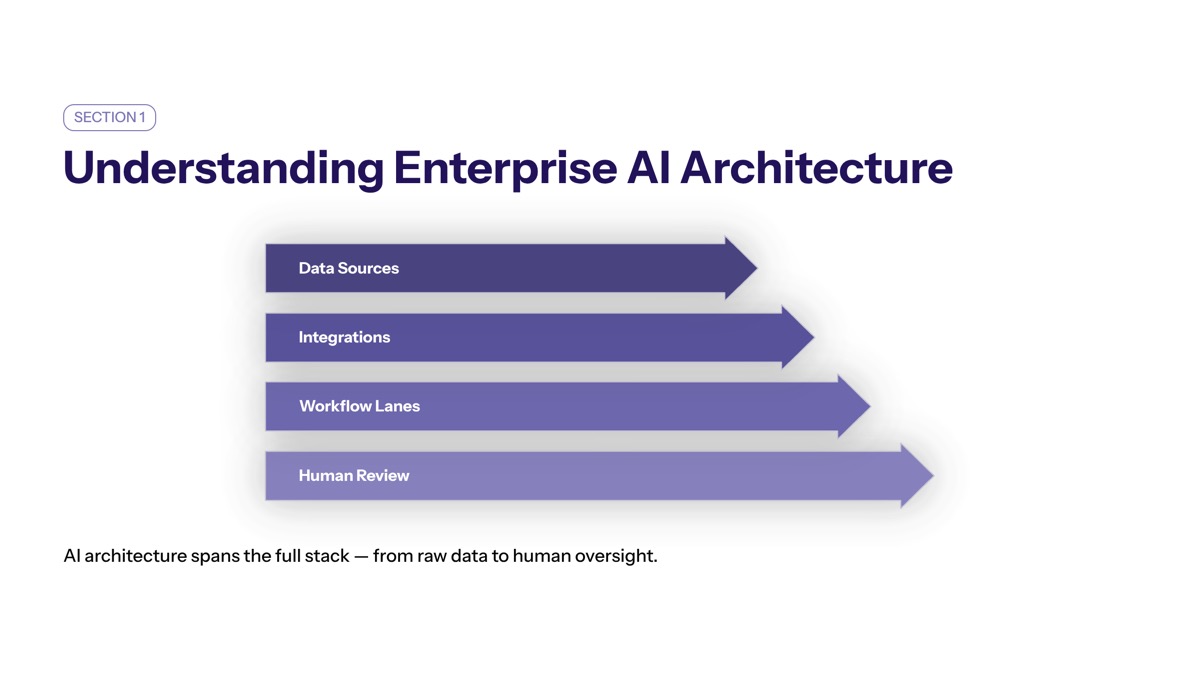
Choosing a model first constrains every subsequent decision about data pipelines, system integration, deployment environments, security architecture, and observability. In practice, when organizations lead with model evaluation, they build architecture around model limitations rather than business requirements.
Reports suggest that 60–90% of AI projects may fail by 2026 due to non-architectural issues-lack of governance, poor data quality, inability to scale enterprise workflows-rather than model accuracy. The failure mode is rarely "we picked the wrong model." It is almost always "we had no architecture to support the model we picked."
Business Requirements Drive Architecture
Business requirements-workflow complexity, data sensitivity, regulatory scope, latency expectations, explainability needs-must determine architectural patterns before model capabilities are evaluated. Consider:
-
If regulatory compliance requires data residency within specific jurisdictions, deployment choices (on-premises, sovereign cloud, hybrid) are constrained before any model is selected
-
If inference must be real-time for fraud detection or trading systems, batch processing pipelines are inadequate; streaming data and event-driven architectures become requirements
-
If business processes require explainable decisions (lending, healthcare diagnostics), certain model types may be architecturally incompatible regardless of their accuracy
Gartner reports that over 75% of organizations are prioritizing making their data AI-ready because traditional data architectures cannot support the scale, trust, and velocity AI demands. The architecture must be designed around business context and constraints, not around which generative ai model has the best benchmark scores.
Model Capabilities as Architecture Inputs
Model requirements-latency tolerance, throughput needs, accuracy thresholds, explainability, context window size-are inputs to architecture, not drivers of it. A model that requires millisecond inference creates different deployment and scaling requirements than one running batch predictions overnight. A model that needs retrieval augmented generation requires vector search infrastructure, a data layer for knowledge retrieval, and prompt management pipelines that would not exist in a simpler architecture.
AI architecture must support real-time data processing for low-latency applications, but that requirement comes from the business workflow-not from the model specification sheet. Language models and machine learning models are components within architecture, not the architecture itself.
Start with Workflow, Users, and Required Outcomes
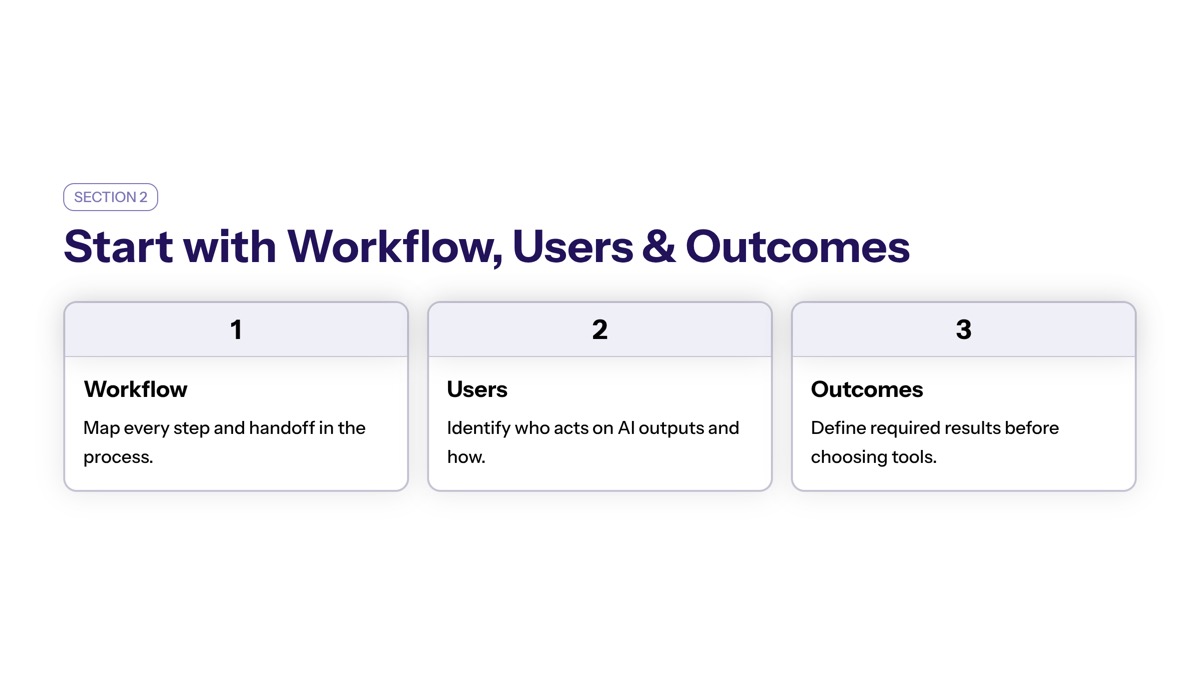
Every enterprise AI architecture engagement should begin with workflow analysis. Before evaluating ai technologies, map the business processes where AI will intervene, identify decision points, define success criteria, and document failure conditions.
Workflow Analysis Framework
A structured workflow analysis follows these steps:
-
Map current processes end-to-end : Document each step in the workflow, including inputs, outputs, decision points, handoffs between teams, and dependencies on enterprise systems. For example, a hypothetical customer support workflow might include: ticket creation → initial classification → knowledge base search → response generation → quality review → resolution tracking.
-
Identify AI intervention points : Determine where AI can add value-classification, recommendation, automation, natural language processing, content generation-and where human judgment remains essential. Not every step benefits from AI, and forcing AI into inappropriate workflow stages creates complexity without value.
-
Define success metrics : Establish key performance indicators for each intervention point. These might include processing speed, accuracy rates, cost per transaction, user satisfaction scores, or error rates. AI architecture should provide measurable outcomes and align with business metrics.
-
Analyze failure conditions : Document what happens when AI is wrong, slow, or unavailable. If a classification model misroutes a high-priority support ticket, what is the business impact? What fallback exists? These failure conditions drive requirements for human oversight, monitoring systems, and safe failure design .
-
Map user experience requirements : Define latency expectations, interaction patterns, and interface requirements for each user type interacting with the AI capability.
User Role and Permission Mapping
Different user roles require different AI capabilities, different data access levels, and different explainability features:
-
Business analysts and executives need summarized outcomes, dashboards, and ROI reporting-not model internals
-
Data scientists and data engineers need detailed logs, experiment tracking, model versioning, and access to training data and evaluation metrics
-
Operations teams need alert dashboards, incident response procedures, and real-time system health indicators
-
End users (customers, employees) need intuitive interfaces with appropriate transparency about when AI is involved in decisions
This role mapping directly drives identity management, governance controls, and monitoring system design . It also determines what audit trails are necessary for regulatory and internal oversight.
Define Data Sources, Quality Requirements, and Governance
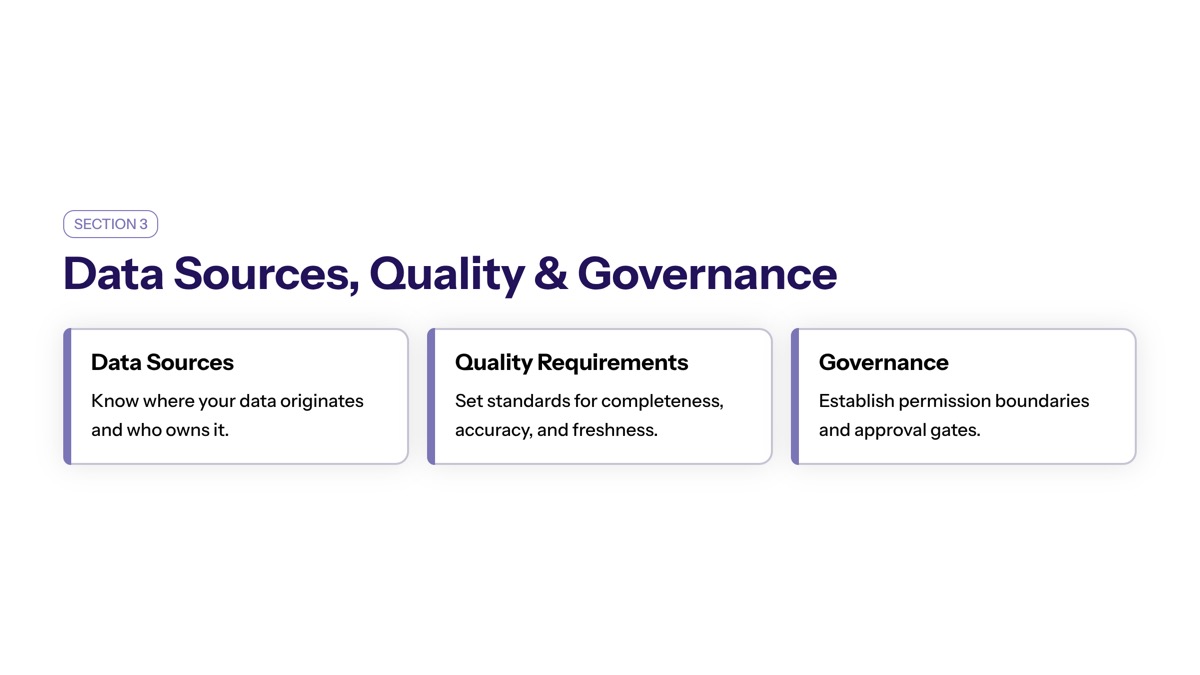
Enterprise data is the foundation on which AI capabilities are built. The data foundation layer consolidates structured and unstructured information into an AI-ready state. Without deliberate architectural decisions about data discovery, quality, permissions, retention, and governance, ai models operate on unreliable inputs and produce untrustworthy outputs.
Data Discovery and Quality Assessment
Enterprises typically possess both structured data (ERP transactions, CRM records, financial data) and unstructured data (documents, transcripts, images, multimedia). For unstructured data especially, definitions, formats, schema enforcement, and metadata are often inconsistent.
A thorough data quality assessment covers multiple dimensions:
-
Lineage : Where does each data element originate? What transformations has it undergone? Can you trace raw data to its source?
-
Freshness : How current is the data? Is it updated in real time, daily, weekly? Does model accuracy degrade with stale data?
-
Completeness : Are critical fields populated consistently? What percentage of records have missing values?
-
Consistency : Do the same entities have the same identifiers across systems? Are naming conventions standardized?
-
Bias : Does the training data reflect the population the model will serve? Are there systematic gaps that could produce discriminatory ai outputs?
Effective data governance maintains visibility across fragmented data landscapes. Data governance is essential for managing sensitive data in regulated industries. Tools like data catalogs, schema registries, semantic layers, and knowledge graphs help enterprises understand what data they have, where it lives, and how it can be used for ai workloads.
Data Governance and Compliance Integration
Centralized data governance is crucial for enterprise AI architecture. Governance must be embedded in AI architecture from the start-not added retroactively. Data governance frameworks ensure data quality and compliance across the full lifecycle:
-
Permissions mapping : Who owns each data source? Who can access it for model training versus inference versus retrieval augmented generation? Centralized data governance regulates access and supports risk management.
-
Retention policies : How long is data kept? When must it be deleted? How do retention policies interact with model training requirements?
-
Regulatory compliance : GDPR, HIPAA, EU AI Act, and sector-specific regulations impose constraints on data collection, storage, processing, and deletion. Architecture must enforce these constraints at the data layer, not rely on manual compliance checks.
-
Consent and audit : For personal data, architecture must track consent, enable data subject access requests, and maintain audit trails for regulatory and internal oversight.
-
Data preparation pipelines : How is raw data cleaned, transformed, enriched, and validated before it reaches ai models? These data pipeline decisions are architectural, not operational.
Data governance connects directly to model performance: models trained on poorly governed data produce unreliable results regardless of their theoretical capabilities. Governance controls are critical for ensuring AI model compliance and security.
Map Integrations, APIs, and Systems of Record
AI capabilities rarely operate in isolation. They read from and write to enterprise systems, depend on external services, and must interact reliably with systems of record where canonical business data lives. Integration architecture determines whether AI becomes a connected part of business operations or an isolated experiment.
Integration Pattern Selection
The choice between integration patterns depends on business requirements-not on what is easiest to implement:
|
Pattern |
Best For |
Trade-offs |
|---|---|---|
|
Synchronous API |
Low-latency, request-response interactions (e.g., real-time recommendations) |
Tight coupling; failure in one service blocks the caller |
|
Asynchronous messaging |
Decoupled workflows, event processing, multi-step orchestration |
Added complexity; harder to debug; requires message queue infrastructure |
|
Batch processing |
Periodic retraining, reporting, bulk data transformation |
High latency; not suitable for real-time use cases |
|
Streaming / Event-driven |
Fraud detection, real-time data processing, streaming data analytics |
Infrastructure complexity; requires stream processing frameworks |
APIs facilitate communication between AI systems and enterprise software. For ai agent workflow automation , event-driven patterns often provide the flexibility needed for agentic AI systems that can plan and collaborate toward complex goals. AI architectures must support multiple agent workflows for adaptability.
System of record interactions require strict boundaries: which data is authoritative, which is derived, which interactions are write-through (AI updates the system directly), and which are read-only (AI reads but a human approves any updates). For example, an AI agent might suggest a CRM record update, but business logic may require human approval before the change is committed.
System Dependency and Reliability Planning
Define how the system responds when integration points fail. External APIs become unavailable. Data latency spikes. Model serving infrastructure slows under load. Proven architectural design patterns help build reliable AI systems, including:
-
Circuit breakers : Stop calling a failing service after repeated failures; redirect to fallback behavior
-
Retry policies with backoff : Automatically retry transient failures with increasing delays
-
Graceful degradation : If a retrieval augmented generation corpus is unavailable, fall back to cached answers or human escalation rather than returning no response
-
Timeout management : Set explicit timeouts for every external dependency to prevent cascading failures
Transitioning from legacy systems requires a structured approach to modernization. Many existing systems lack modern APIs, have outdated schemas, or have rudimentary security controls. Architecture must account for these constraints and define integration strategies that work with legacy realities rather than assuming greenfield environments.
Design Identity, Access, and Security Controls
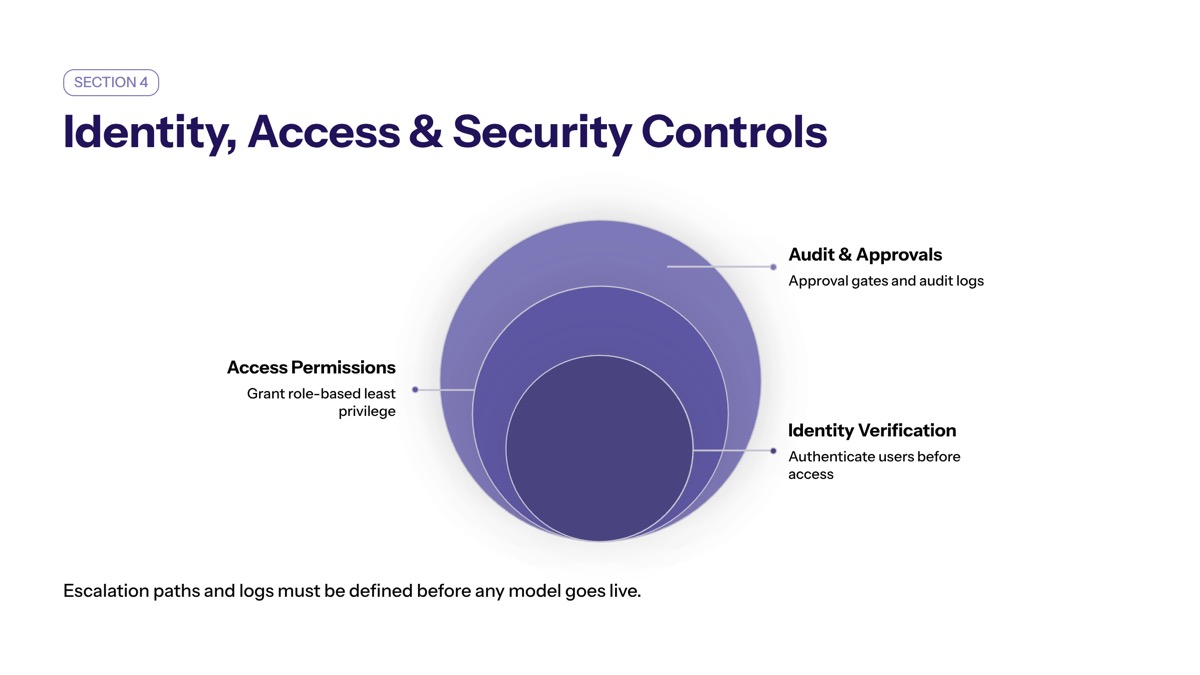
Security and compliance are foundational for enterprise AI architecture. Identity, access management, and security controls must be designed as integral parts of the architecture-not bolted on after deployment.
Identity and Access Management Integration
Identity and access management for ai systems extends beyond user authentication. It must enforce permissions at the data, model, and output levels:
-
Authentication : Single sign-on, federated identity, service-to-service authentication via certificates or tokens. Every component in the AI architecture that accesses data or invokes a model must have a verified identity.
-
Authorization : Role-based or attribute-based access controls that determine not just who can use the system, but what data they can access through it. A customer support AI assistant should only retrieve data relevant to the authenticated user's role and permissions-not the entire customer database.
-
API security : Token management, rate limiting, session handling, and input validation for all AI service endpoints. This includes defense against prompt injection and adversarial inputs that attempt to manipulate model behavior.
-
Least privilege : Every component-human users, service accounts, ai agents-should have the minimum permissions necessary for its function. This principle applies to model context protocol implementations, data access patterns, and system integration endpoints.
Secrets Management and Encryption
Encryption is essential for data in transit and at rest. Beyond encryption, architecture must address:
-
Secrets rotation : Credentials, API keys, tokens, and certificates must be stored in dedicated secrets management systems and rotated on defined schedules
-
Model artifact integrity : Model weights and configuration files must be integrity-protected to prevent tampering
-
Secure configuration management : Environment-specific configurations (connection strings, feature flags, model endpoints) must be managed separately from code and protected from unauthorized access
-
Access logging : Every access to sensitive data, model artifacts, or administrative functions must be logged for governance and security audit purposes
Architecture security must also address emerging threats specific to AI: prompt injection attacks, training data poisoning, model extraction, and output manipulation. Risk assessment layers should evaluate inputs and outputs for anomalies. For regulated industries, the architecture must support certifications (ISO 27001, SOC 2) and provide the evidence trail necessary for compliance audits.
Select Deployment and Model Patterns
With workflow, data, integration, identity, and security requirements defined, deployment pattern selection becomes a constrained decision rather than an open-ended evaluation.
Deployment Pattern Decision Framework
Deployment patterns should be selected based on the intersection of performance, cost, security, regulatory compliance, and operational requirements:
|
Requirement |
Cloud-Native |
Hybrid |
On-Premises / Edge |
|---|---|---|---|
|
Scalability |
Elastic, on-demand |
Moderate flexibility |
Fixed capacity, requires planning |
|
Data residency |
Provider-dependent |
Controlled |
Full control |
|
Latency |
Network-dependent |
Optimized for local workloads |
Lowest for local inference |
|
Operational burden |
Managed services reduce ops |
Split responsibility |
Full internal ops responsibility |
|
Cost model |
Pay-per-use, variable |
Mixed |
Capital expenditure, predictable |
|
Compliance |
Shared responsibility |
Customizable |
Full organizational control |
Cloud-native environments support scalable AI architecture development, but models handling sensitive patient data may need to run in a private datacenter or on local infrastructure . Sovereign AI infrastructure and disconnected cloud deployments are emerging options for organizations facing data residency requirements.
AI infrastructure supplies the hardware and networking for processing workloads. The choice between managed services and self-hosted infrastructure affects resource allocation, resource utilization, and operational staffing requirements. Key patterns include lakehouse approaches and microservices for scalability.
Model Serving and Scaling Architecture
Once deployment patterns are determined, model serving architecture addresses how ai models are delivered to production:
-
Model versioning : A centralized model registry enhances collaboration and governance of AI models. Model versioning allows tracking iterations over time, enabling rollback to previous versions when issues are detected.
-
A/B testing and canary rollouts : Deploy new model versions to a subset of traffic before full rollout. This requires routing infrastructure, metric collection, and automated comparison.
-
Autoscaling : Configure scaling policies based on request volume, latency thresholds, and resource utilization. Generative ai workloads often have spiky demand patterns that require different scaling strategies than traditional machine learning workloads.
-
Caching : For deterministic or near-deterministic queries, response caching reduces latency and compute costs.
-
Model serving and prompt management are critical for generative AI : When serving large language models, prompt management infrastructure-including template versioning, context injection, and prompt optimization-becomes a distinct architectural concern.
Modern AI platforms support real-time analytics and batch processing, and the architecture must define which workloads use which pattern. AI first architecture optimizes workflows through integration and automation across these serving patterns.
Build Evaluation, Observability, and Monitoring Systems
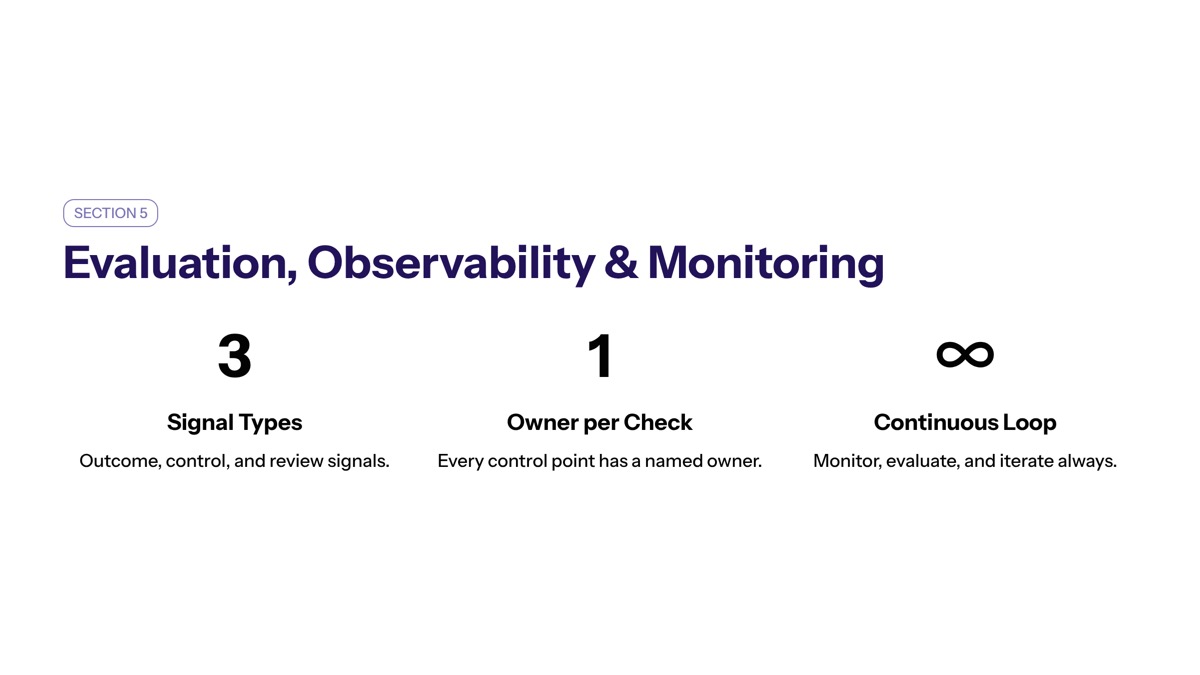
AI observability includes tracking performance, accuracy, and operational events post-deployment. AI systems require continuous monitoring for compliance and security. Deployed models must never be treated as static components-they require ongoing evaluation, drift detection, and business impact measurement.
Model Performance and Drift Monitoring
Monitoring ensures AI models remain reliable and accurate over time. Continuous monitoring detects drift and performance degradation across multiple dimensions:
-
Accuracy tracking : Compare model predictions against ground truth data on an ongoing basis. For classification tasks, track precision, recall, and F1 scores. For generative AI, evaluate output quality through automated metrics and sampling-based human review.
-
Data drift detection : Monitor whether the distribution of incoming data has shifted from what the model was trained on. Significant drift often precedes accuracy degradation.
-
Bias monitoring : Track model outputs across demographic groups or business segments to detect emerging bias patterns.
-
Performance degradation alerts : Define thresholds for latency, error rates, and accuracy. When thresholds are breached, automated alerts trigger investigation or model refresh workflows.
-
Automated retraining triggers : Define conditions under which models should be retrained-drift thresholds, accuracy floors, or scheduled intervals. Machine learning operations (MLOps) automates model training, testing, and deployment processes.
Adaptive AI systems continuously learn from new data inputs, which means monitoring must account for both model behavior and the data feeding into it. Continuous learning enables AI systems to adapt in real-time, but adaptive AI systems require robust governance for effective operation.
Business Metrics and ROI Tracking
Technical metrics alone are insufficient. Architecture must connect model performance to business outcomes:
-
Business outcome measurement : Track how AI interventions affect the business metrics they were designed to improve-resolution time, conversion rate, cost per transaction, error reduction.
-
Cost tracking : Monitor compute costs, API usage costs, data storage costs, and operational costs associated with each AI capability. Compare against the business value delivered.
-
User satisfaction monitoring : Collect feedback from users interacting with AI capabilities. Track adoption rates, abandonment rates, and satisfaction scores.
-
ROI calculation : Establish a framework for calculating return on investment that accounts for both direct value (cost savings, revenue impact) and indirect value (speed improvements, quality improvements, risk reduction).
These metrics inform decisions about whether to expand, modify, or retire specific AI capabilities-making business teams and technology teams jointly accountable for outcomes.
Define Human Review, Escalation, and Safe Failure
Human-in-the-loop mechanisms assess AI output for accuracy. No enterprise AI architecture should assume that models will always produce correct, appropriate, or safe outputs. Architecture must define how and when humans intervene, how escalation works, and what happens when systems fail.
Human Oversight Integration
Design human oversight as a first-class architectural component, not an afterthought:
-
Confidence scoring : Implement confidence thresholds below which AI defers to human judgment. For example, in a hypothetical healthcare diagnostics scenario, an AI might flag cases with confidence below 85% for radiologist review.
-
Manual review workflows : Build queuing, assignment, and tracking systems for cases requiring human review. These workflows need their own SLAs, monitoring, and resource allocation.
-
Expert feedback integration : Create feedback loops where human corrections improve future model performance. This requires logging human decisions, connecting them to model inputs, and incorporating them into retraining pipelines.
-
Decision authority mapping : Define clearly which decisions AI can make autonomously, which require human approval, and which AI should only recommend. This mapping should align with governance frameworks and regulatory requirements.
Safe Failure and Recovery Procedures
Safe failure design ensures that when AI systems fail-and they will-the impact on business operations is contained:
-
Graceful degradation : When a primary model is unavailable, fall back to a simpler model, a rules-based system, or a manual process. Define the degradation hierarchy for each AI capability.
-
Fallback mechanisms : For retrieval augmented generation systems, if the knowledge base is unavailable, define whether the system serves cached responses, declines to answer, or routes to a human agent.
-
Emergency shutdown : Define conditions under which AI capabilities should be immediately disabled-error rates exceeding thresholds, detected security breaches, or regulatory compliance violations.
-
Recovery procedures : Document how to restore service after failures, including model rollback, data pipeline repair, integration restoration, and stakeholder communication.
These procedures connect to broader business continuity planning and incident response frameworks. Enterprise automation with agentic AI requires particularly robust failure handling because agentic AI systems operate with greater autonomy.
Plan Versioning, Change Control, and Support
Enterprise ai systems are not static. Models evolve, data schemas change, integrations are updated, and business requirements shift. Architecture must include comprehensive change management and operational support.
Change Management and Deployment Pipelines
-
Version control : Apply version control to models, data schemas, API contracts, configuration files, and documentation. Every artifact deployed to production should be versioned and traceable. AI tools enhance workflows with features like version control and experiment tracking.
-
Testing procedures : Regression testing, integration testing, performance testing, and bias testing should gate every production deployment. Central model registries enhance collaboration and governance by providing a single source of truth for model artifacts and their test results.
-
Deployment automation : Automated deployment pipelines reduce human error and enable consistent, repeatable deployments. AI architecture generators automate repetitive tasks in AI development, but human review of deployment outcomes remains essential.
-
Rollback strategies : Every deployment must have a defined rollback procedure. If a new model version degrades performance, the system should be able to revert to the previous version within a defined time window.
-
Change approval workflows : Define who must approve changes (model owners, security reviewers, business stakeholders) and what evidence is required (test results, impact assessments, compliance reviews).
Operational Support and Documentation
-
Ownership definition : Assign clear ownership for each component-who monitors performance, who handles incidents, who manages retraining, who communicates with business teams.
-
Troubleshooting guides : Create runbooks for common failure scenarios, including diagnostic steps, resolution procedures, and escalation paths.
-
Knowledge management : Document architectural decisions, design rationale, and operational procedures. Ensure knowledge transfer so that the system can be maintained by internal teams or external partners as needed.
-
Training requirements : Define training programs for different user roles-data scientists working with model pipelines, business analysts interpreting ai outputs, operations teams managing infrastructure.
Address Portability and Vendor Dependency
Vendor lock-in is a real and frequently underestimated risk in enterprise ai architecture. Decisions about model providers, cloud platforms, data formats, and tooling create dependencies that can limit flexibility, increase costs, and constrain future options.
Vendor Risk Assessment and Mitigation
-
Dependency mapping : Identify every vendor dependency in the architecture-model providers, cloud services, data platforms, monitoring tools, security services. Assess the switching cost and effort for each.
-
Contract negotiation : Negotiate data portability clauses, SLA guarantees, and exit provisions before committing to vendors. Understand what happens to your data and model artifacts if the relationship ends.
-
Service level agreements : Define performance, availability, and support expectations with measurable criteria. Include remedies for SLA violations.
-
Risk mitigation strategies : For critical components, maintain the ability to operate with alternative vendors. This may mean running parallel evaluations, maintaining abstraction layers, or investing in open source alternatives .
Portability and Standards Implementation
-
Container standards : Use standard container formats (OCI) for packaging model serving infrastructure. Avoid proprietary deployment formats that only work on specific platforms.
-
Model format standards : Where possible, use open model formats (ONNX, SafeTensors) that can be served across multiple platforms. This applies to both custom models and fine-tuned foundation models.
-
API abstraction : Design abstraction layers between business logic and model providers so that swapping one language model provider for another requires configuration changes rather than architectural redesign.
-
Data format standardization : Use open data formats (Parquet, Delta, Iceberg) and avoid proprietary metadata systems that lock enterprise data into a single platform.
-
Sovereign AI considerations : For organizations facing data residency or sovereignty requirements, architecture must support deployment options that are independent of specific cloud providers. This is an accelerating trend across regulated industries and geographies.
Enterprise AI Architecture Decision Framework
The following decision table provides a comprehensive framework for enterprise AI architecture planning. Each row represents a decision area that must be addressed before model selection.
|
Decision Area |
Business Requirement |
Technical Options |
Constraints |
Required Evidence |
Owner |
Revisit Trigger |
|---|---|---|---|---|---|---|
|
Workflow |
Process automation, decision support |
Orchestration engines, rule engines, agent frameworks |
Existing enterprise workflows, user expectations |
Workflow mapping, stakeholder interviews |
Product / Business Owner |
Process change, new use case |
|
Data |
Quality, completeness, freshness |
Data lakes, lakehouses, data mesh, federated catalogs |
Residency, retention, consent, schema maturity |
Data quality audit, lineage mapping |
Data Leader |
Schema change, new source, regulation |
|
Context & Retrieval |
Relevant, accurate context for AI |
RAG pipelines, vector search, knowledge graphs |
Latency, data freshness, corpus size |
Retrieval accuracy testing |
AI Architect |
Corpus growth, accuracy degradation |
|
Model |
Accuracy, latency, explainability |
Foundation models, fine-tuned models, custom models, deep learning models |
Cost, compliance, intellectual property |
Evaluation benchmarks, bias testing |
Data Science Lead |
Drift, new model availability |
|
Integration |
System connectivity, data flow |
REST APIs, event buses, streaming, batch ETL |
Legacy system limitations, latency |
Integration testing, failure simulation |
Integration Architect |
System upgrade, new dependency |
|
Identity & Permissions |
Least-privilege access, audit |
RBAC, ABAC, federated identity, service mesh |
Compliance requirements, user directory maturity |
Access review, penetration testing |
Security Lead |
Policy change, new user role |
|
Deployment |
Availability, performance, cost |
Cloud-native, hybrid, on-premises, edge |
Data residency, compliance, budget |
Load testing, cost modeling |
Platform / Ops Lead |
Scale change, regulation, cost |
|
Evaluation |
Model quality assurance |
Hold-out testing, shadow deployment, A/B testing |
Ground truth availability, evaluation cost |
Evaluation pipeline validation |
Data Science Lead |
Accuracy threshold breach |
|
Observability |
Operational visibility, compliance |
Logging, metrics, dashboards, alerting |
Retention, storage cost, real-time requirements |
Observability pipeline testing |
Operations Lead |
Incident, compliance audit |
|
Human Oversight |
Safety, quality, accountability |
Confidence thresholds, review queues, escalation paths |
Staffing, response time SLAs |
Workflow simulation, threshold testing |
Business / Compliance Lead |
Error rate increase, regulation |
|
Security |
Data protection, threat mitigation |
Encryption, input validation, output filtering, WAF |
Certification requirements, threat landscape |
Security assessment, threat modeling |
Security Lead |
Threat change, certification cycle |
|
Support |
Operational continuity |
Runbooks, on-call rotation, escalation procedures |
Team capacity, knowledge distribution |
Incident response drill |
Operations Lead |
Team change, system complexity |
|
Change Management |
Controlled evolution |
CI/CD pipelines, staging environments, approval gates |
Release velocity, testing capacity |
Deployment pipeline validation |
Engineering Lead |
Failure in production, audit finding |
|
Vendor Dependency |
Flexibility, cost control |
Open standards, abstraction layers, multi-vendor strategy |
Switching cost, feature parity |
Vendor risk assessment, exit plan review |
Architecture Lead |
Contract renewal, vendor change, new option |
Use this framework as a living document. Each decision area should have a designated owner, documented rationale, and defined triggers for revisiting the decision as business requirements, regulations, or technology options change.
Common Challenges and Solutions
Enterprise AI architecture initiatives encounter predictable challenges. Recognizing them early and building architectural responses is more effective than addressing them reactively.
Integration Complexity and Legacy System Constraints
Many organizations operate enterprise systems that predate modern API standards. These existing systems may lack RESTful interfaces, use outdated data schemas, or have minimal security controls. Research consistently shows that poor data and integration readiness remain among the biggest blockers to enterprise AI success.
Architectural response : Design integration adapters that translate between legacy protocols and modern ai services. Implement an API gateway layer that provides a consistent interface regardless of backend system age. Plan integration modernization incrementally-don't attempt to replace all legacy systems simultaneously.
Security and Compliance Requirements
Governance and security are frequently underestimated in early architecture planning. Organizations deploying ai tools without governance controls risk privacy violations, regulatory penalties, and loss of stakeholder trust.
Architectural response : Embed governance and security from the start rather than retrofitting. Automate compliance checks where possible-automated PII detection, consent verification, audit trail generation. Design architecture to support compliance evidence generation, not just compliance behavior. Managing risk requires treating security as a continuous architectural concern, not a one-time checklist.
Performance and Scalability Planning
Enterprise scale AI workloads create performance demands that differ significantly from proof-of-concept environments. A model that performs well in testing may struggle under production load. Generative AI architectures should connect models to real-time enterprise information, which adds latency and complexity.
Architectural response : Conduct capacity planning based on realistic production scenarios, not demo workloads. Implement performance testing as part of deployment pipelines. Design autoscaling policies that account for the specific resource patterns of AI workloads-GPU utilization, memory consumption, and network throughput all behave differently than traditional web application workloads. Modern AI platforms support real-time analytics and batch processing, and architecture should separate these workloads to optimize resource utilization.
Conclusion and Next Steps
Enterprise AI architecture is a connected set of decisions about workflows, data, integrations, identity, deployment, monitoring, human oversight, and vendor dependencies. The correct model is only one component. Architecture starts with the workflow, required outcome, constraints, data boundaries, operating responsibilities, and failure conditions.
Organizations that invest in architectural decisions before model selection build AI capabilities that are governable, maintainable, and aligned with business objectives. Those that skip architecture and lead with model evaluation consistently face integration failures, governance gaps, and technical debt that undermines the business case for AI.
Immediate next steps:
-
Conduct workflow analysis : Map the business processes where AI capabilities will be deployed. Identify decision points, failure conditions, and success metrics.
-
Assess data readiness : Audit enterprise data sources for quality, lineage, governance, and compliance. Identify gaps that must be addressed before AI deployment.
-
Align stakeholders : Bring business teams, technology leaders, security teams, and compliance teams together to define architectural requirements collaboratively.
-
Design a pilot architecture : Select one well-defined use case and apply the decision framework to design a complete architecture before selecting models or vendors.
-
Establish governance early : Define data governance, access controls, monitoring, and change management procedures as part of the initial architecture-not after deployment.
For organizations seeking a structured approach to these decisions, Cognativ's AI-First Architecture work connects business requirements, data, models, integration, governance, monitoring, and production support into a coherent enterprise AI architecture. Related topics worth exploring include enterprise AI implementation challenges , generative AI strategy , and AI governance frameworks for managing risk at enterprise scale.