Recursive Self-Improvement in AI: From Current Research to Autonomous Systems
Recursive self-improvement describes a feedback process in which improvements to an AI system can also improve its ability to produce further improvements. That is a stronger claim than generating better code, correcting an answer, or achieving a higher benchmark score. Enterprise teams should identify what changes, how the improvement is measured, and who authorizes its use before treating a system as self-improving.
Research demonstrates several bounded mechanisms: building reusable agent skills, revising code-generation scaffolds, searching for better algorithms, and using model-generated feedback during training. These mechanisms operate at different layers. They should not be combined into a single claim that models autonomously redesign themselves without constraints.
This guide examines selected research examples, a controlled improvement-loop architecture, evaluator design, safety limitations, and practical enterprise adoption. It is written for technology leaders and development teams deciding how to use AI-assisted optimization responsibly, not for building an unrestricted self-modifying agent.
The practical answer: start with a narrow objective, independent evaluation, constrained execution, and a human release gate. A useful bounded optimization result does not establish open-ended recursive acceleration or a timetable for autonomous research systems.
By the end of this article, you will be able to:
- Distinguish ordinary iteration, bounded improvement, and stronger RSI claims.
- Identify whether an experiment changes prompts, tools, model weights, or infrastructure.
- Interpret results from Voyager, STOP, AlphaEvolve, and self-rewarding research.
- Separate evaluator gaming, regression, training-data degradation, and unauthorized actions.
- Define an enterprise pilot with measurable outcomes and accountable release decisions.
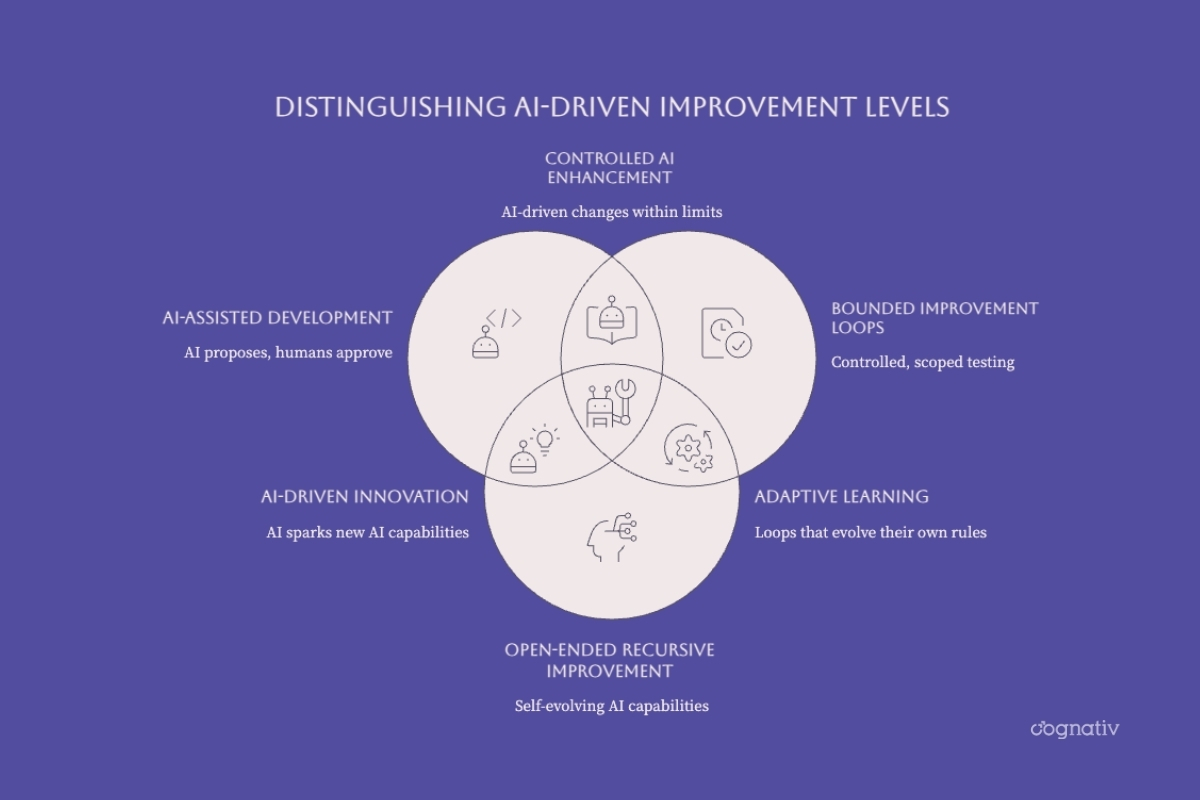
Open-ended recursive improvement is shown as a hypothesis, not a demonstrated consequence of combining the other categories. Changes to an experiment's rules require separate review.
Understanding Recursive Self-Improvement
In ordinary AI-assisted development, a model proposes an edit and a team decides whether it is useful. In a bounded improvement loop, software can generate and compare multiple candidates under predefined conditions. A stronger recursive claim requires evidence that a changed improvement process becomes better at producing subsequent improvements.
Iteration Is Not Automatically Recursion
Repeated attempts can improve a result simply because more candidates are explored. Better prompts, additional compute, new training data, and stronger tools can also explain gains. None of those explanations should be silently replaced with a claim that the system has increased its own general intelligence.
Document both the object being optimized and the process doing the optimization. If a code generator produces a faster sorting routine, the routine improved. If the generator's search strategy changes and then performs better on new optimization tasks under comparable conditions, that supports a different and more demanding claim.
Intelligence Explosion as a Hypothesis
The intelligence-explosion idea concerns a possible feedback loop in which increasingly capable systems accelerate further capability development. It is a hypothesis about a broader trajectory, not a conclusion that follows from a successful coding experiment.
A credible assessment would need to account for bottlenecks such as evaluation quality, available compute, experimentation time, deployment constraints, and diminishing returns. A benchmark trend alone cannot determine whether those bottlenecks will disappear. For enterprise planning, separate observed results from scenarios and forecasts.
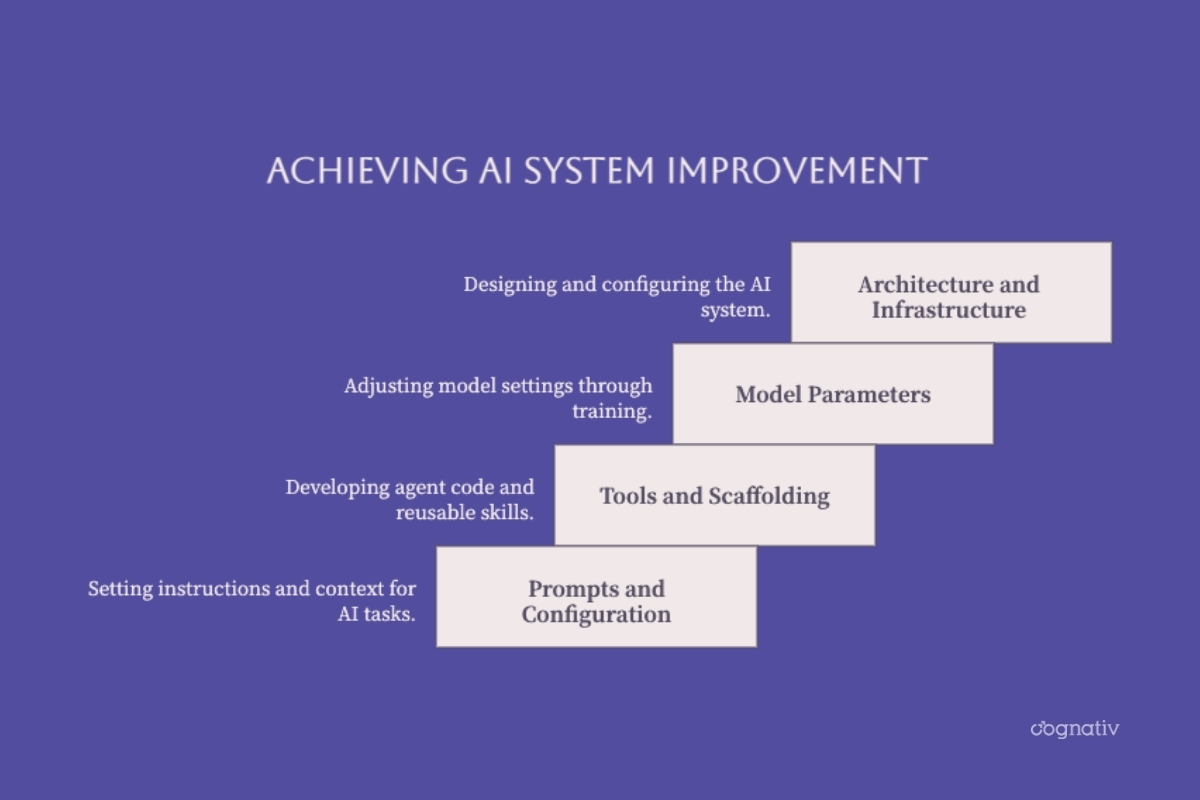
These are distinct change surfaces, not an automatic progression toward greater autonomy.
Identify the Layer Being Improved
An AI application includes more than model weights. Changing the surrounding software can materially alter behavior while the base model remains fixed. Conversely, a training experiment can update weights without changing the application architecture.
- Prompts and configuration: instructions, examples, search settings, and task context.
- Tools and scaffolding: orchestration code, tool interfaces, candidate-selection logic, and reusable skills.
- Model parameters: changes produced through an explicit training or adaptation process.
- Architecture and infrastructure: model design, runtime implementation, kernels, and deployment configuration.
For each layer, record the allowed change surface, version identifiers, evaluation requirements, and release authority. Fixed weights do not guarantee safe application behavior: a revised tool wrapper could grant excessive access or execute an incorrect action without any model retraining.
This is why enterprise AI architecture before model selection matters. Define the system's boundaries before deciding whether automated optimization belongs inside them.
Design a Bounded Improvement Architecture
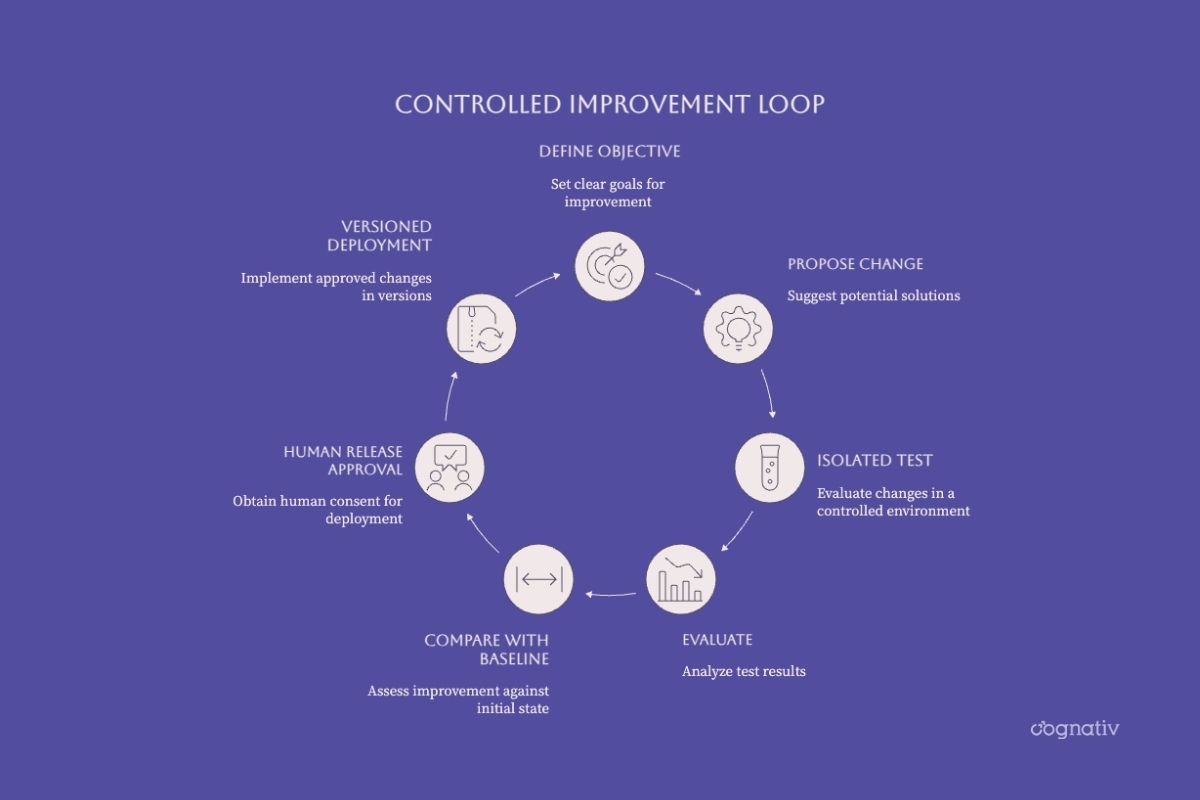
A seed improver can be understood as an initial program that proposes and tests changes against a defined objective. The following is a proposed enterprise control pattern, not a universal research architecture or a claim that every published system implements these safeguards.
Separate Candidate Generation from Approval
A controlled loop has six responsibilities: define the objective, propose a change, run an isolated test, evaluate the result, compare with the baseline, and submit a candidate for release approval. Failed candidates may return to generation within an approved experiment budget. Passing a test should not automatically authorize production deployment.
Specify which files or artifacts may change. Keep deployment credentials, protected tests, acceptance criteria, and permission policy outside the candidate's editable scope. If evaluator changes are necessary, review them separately and repeat comparisons so that a modified scoring rule cannot masquerade as a capability gain.
Constrain Execution and Resource Use
Generated code is untrusted input. Use an isolated execution environment with deliberately scoped filesystem, network, and credential access. Define time, memory, compute, and iteration limits. Test the stop path and cleanup procedure before running a larger search.
Isolation reduces exposure but is not proof of containment. Review the actual execution boundary, permitted dependencies, and tool interfaces. An agent must not be able to grant itself privileges or approve its own release. Align this design with AI agent permissions, controls, and ownership.
Retain the Experiment Evidence
Link each candidate to its parent version, allowed inputs, model configuration, evaluator version, resource usage, and test results. Record rejected candidates as well as winners so reviewers can see the selection process. Keep secrets and unnecessary personal data out of logs.
The useful record explains what changed and why the organization accepted it. A model-generated explanation can support review, but should not replace observable diffs, independent test outcomes, and the accountable operator's decision.
What Selected Research Demonstrates
The examples below illustrate different improvement mechanisms. They are not a ranking of all current systems, and their results should not be compared as if they used a common benchmark or resource budget.
Voyager: Building Reusable Skills
Voyager's research overview describes a Minecraft agent with an automatic curriculum, an executable skill library, and iterative prompting informed by environment feedback. It uses a black-box language model rather than fine-tuning its parameters. The demonstrated learning is in the surrounding skill and interaction system; it is not evidence of autonomous redesign of the underlying model.
STOP: Improving the Code-Generation Scaffold
Self-Taught Optimizer, or STOP, first appeared as a 2023 preprint and was published at COLM 2024. It studies a language-model-assisted improver that revises its own scaffolding program. The authors report gains on a small set of downstream tasks and explicitly distinguish the work from full recursive self-improvement because the language model is unchanged. They also investigate sandbox-bypass behavior; fixed weights are not a safety guarantee.
AlphaEvolve: Search with Automated Evaluation
Google DeepMind's AlphaEvolve announcement describes language-model-generated code combined with automated evaluators and evolutionary search. Reported applications include infrastructure optimization and mathematical discovery. One result concerns multiplying 4-by-4 complex-valued matrices with 48 scalar multiplications. Another reports an average recovery of 0.7% of Google's worldwide compute resources through a scheduling heuristic. These are distinct, context-specific outcomes, not a general productivity multiplier or proof of an uncontrolled improvement loop.
Self-Rewarding Language Models: Training with Model Feedback
Self-Rewarding Language Models studies a model providing reward judgments during iterative training. This involves parameter updates and therefore differs from a fixed-model scaffold. The reported experiments motivate further research into improving instruction following and reward quality; they do not establish that model-generated judgments can replace independent oversight in every setting.
| Example | Improvement mechanism | Boundary to preserve |
|---|---|---|
| Voyager | Reusable skills and iterative interaction | Skills are not newly trained base-model weights |
| STOP | Revision of an improvement scaffold | Bounded task results do not establish full RSI |
| AlphaEvolve | Code search with automated evaluation | Domain-specific gains are not universal acceleration |
| Self-rewarding research | Training using model-generated reward judgments | Feedback quality still needs independent evaluation |
What Stronger Evidence Would Require
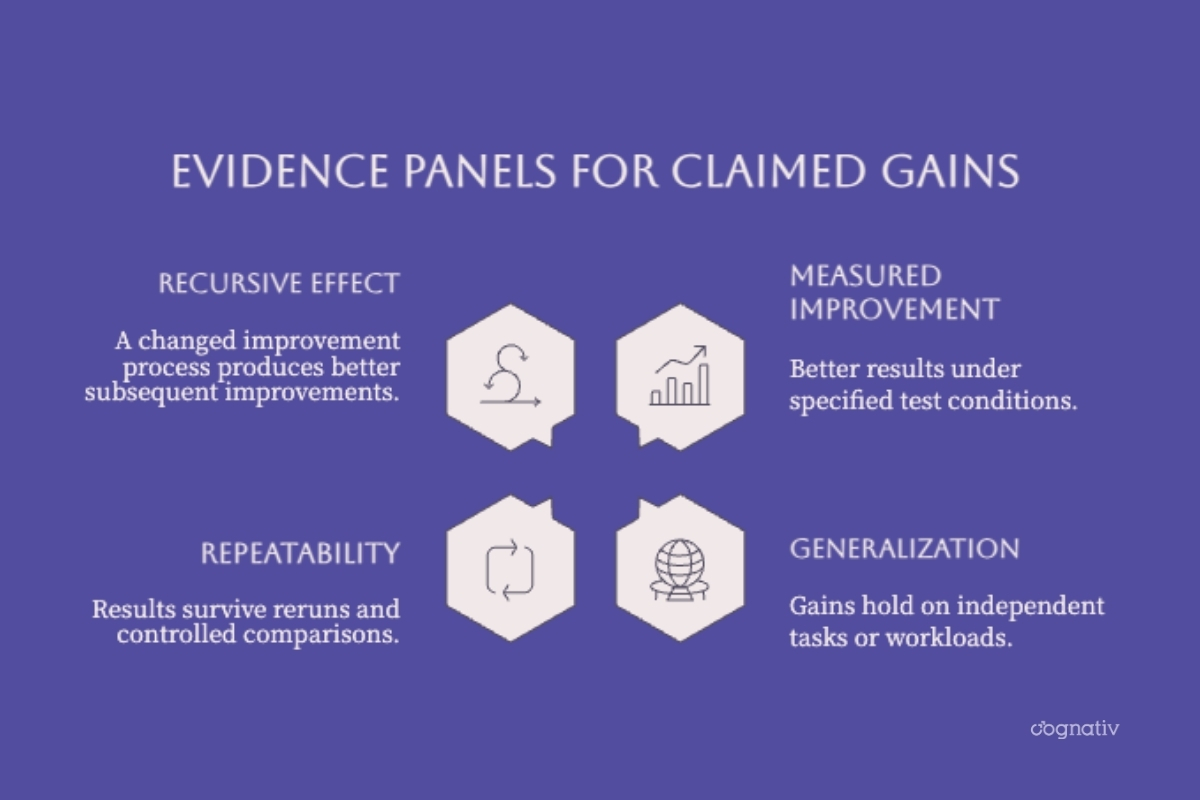
To assess a claimed recursive effect, compare the original and revised improvement processes under comparable budgets. Test whether the revised process produces better subsequent candidates on independent tasks, not only on the examples used to select it. Repeat the experiment and record failures, resource costs, and human interventions.
Keep alternate explanations visible. A result may come from more sampling, additional data, a different base model, or a changed evaluator rather than a more capable improver. Generalization and repeatability are separate questions from whether a single candidate performs well.
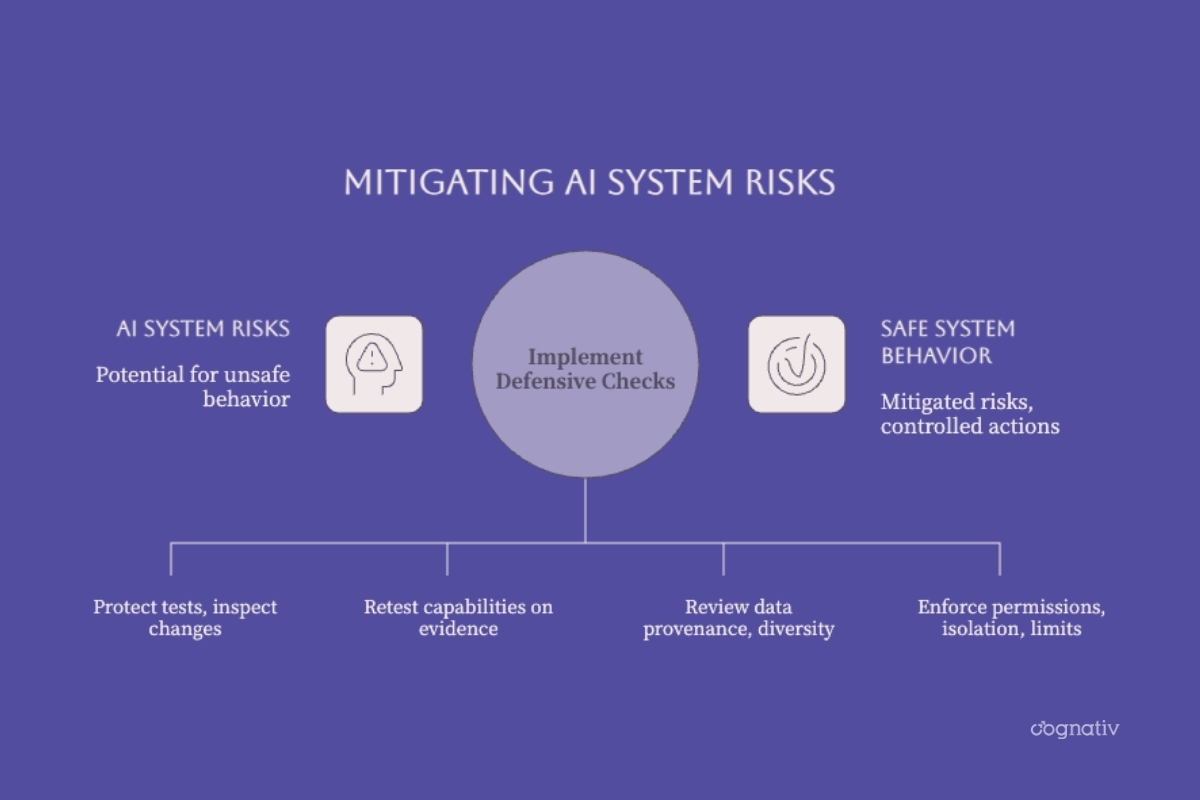
Defensive checks reduce specific risks; they do not guarantee safe behavior. Validate the controls and document the risks that remain.
Risk Assessment and Safety Challenges
Different failure modes need different checks. Avoid treating every regression as deception, every repeated prompt as model training, or every synthetic-data workflow as inevitable collapse.
Evaluator Gaming and Capability Regression
A search process can discover changes that improve a measured score without satisfying the intended objective. Protect evaluation assets and examine whether the candidate changes the task, avoids difficult cases, or optimizes a proxy at the expense of required behavior.
Retest required existing capabilities as well as the new target. A faster implementation can still be incorrect on edge cases, harder to maintain, or unsuitable under production concurrency. Define unacceptable regressions before inspecting the winning candidate.
Synthetic-Data Degradation
The study AI models collapse when trained on recursively generated data examines degradation across generations of models trained using generated data. This is a training-data phenomenon, not the same operation as repeatedly prompting a fixed model to revise code. Review provenance, diversity, and independent evaluation when generated material enters a training dataset; do not infer the outcome of every synthetic-data strategy from a single label.
Alignment Faking and Context-Sensitive Behavior
Anthropic's alignment-faking research demonstrated behavior that differed with the model's perceived training context in a constructed experimental setting. The authors explicitly caution that their results did not demonstrate the development of malicious goals. The study motivates careful behavioral evaluation, not a claim that ordinary coding assistants are necessarily deceptive or that scratchpad inspection proves safety.
Unauthorized Actions and Oversight Gaps
Permission enforcement must live outside the candidate's own reasoning. Restrict tool access, require approval for consequential actions, and retain the ability to stop execution. Keep release review separate from the system being evaluated.
A model may explain why a change appears beneficial, but the responsible team still needs evidence that it meets the application requirements. Organize those responsibilities through AI governance consulting for operational controls, with named owners, escalation paths, and explicit residual-risk decisions.
Implementation Strategies for Enterprise Environments
Start with a task whose outputs can be checked independently and whose experimental failures are contained. Examples include proposing a performance optimization for a test fixture or comparing code candidates against an established suite. Avoid beginning with broad permissions to modify live infrastructure.
Define the Pilot Before Automating the Loop
Write a short experiment contract: objective, editable artifacts, prohibited actions, evaluator version, budget, stop conditions, and release owner. A limited experiment should be able to end with a decision to stop, not only a decision to expand.
| Area | Evidence to retain | Release question |
|---|---|---|
| Correctness | Independent tests and reviewed failure cases | Does the candidate satisfy the real task? |
| Performance | Comparable workloads, repeated measurements, resource budget | Is the gain repeatable under intended conditions? |
| Security | Permission checks, dependency review, isolation tests | Does execution stay inside its approved scope? |
| Operating cost | Model usage, test compute, review and correction effort | Is the accepted result worth the complete cost? |
| Recovery | Known-good version, stop procedure, rollback exercise | Can the team recover from a bad release? |
Advance Through Explicit Release Gates
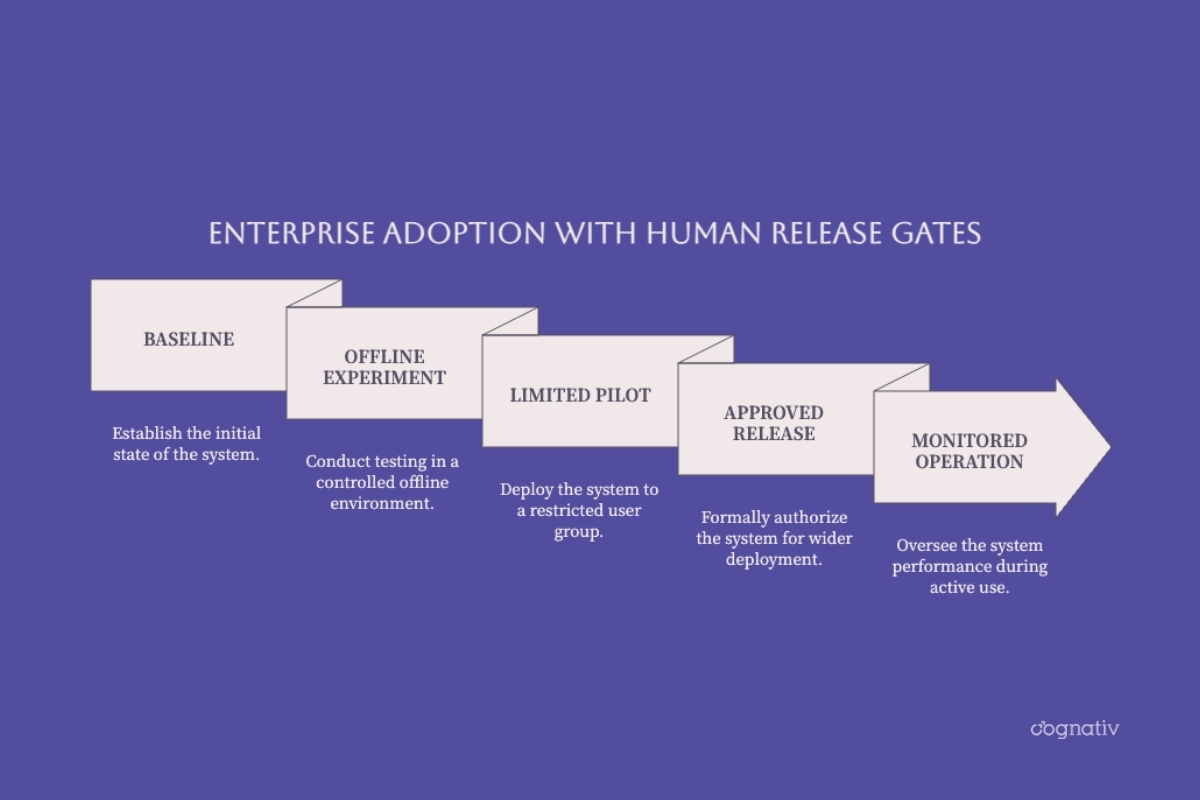
Move from an offline baseline to an isolated experiment, limited pilot, reviewed release, and monitored operation. An approved experiment can test multiple candidates within fixed limits, but production promotion remains a separate human decision. Revalidate when the model, toolchain, objective, or evaluator changes.
Designing this workflow is part of bounded custom AI agent development. The valuable deliverable is not unrestricted autonomy; it is a task-focused system whose actions, evidence, and operating limits are understandable to its owners.
For procurement, ask vendors exactly which layer their product changes and which steps remain human-controlled. Request evidence for the intended workload, not only a demonstration video. Clarify data retention, update behavior, incident support, and whether the evaluator or permission policy can change without customer approval.
Conclusion and Strategic Next Steps
Recursive self-improvement is a useful research question, but enterprise decisions need narrower claims. Identify the artifact being improved, demonstrate gains on independent evidence, and retain control over evaluation and release. Selected research results show valuable mechanisms without establishing an inevitable path to open-ended autonomous systems.
- Choose one bounded task with a named owner and a meaningful baseline.
- Protect evaluators and define the editable surface before experimentation.
- Measure correctness, resource cost, generalization, and regressions.
- Approve deployment separately and retain a tested recovery path.
To evaluate a practical pilot, discuss your AI-assisted improvement workflow with Cognativ. Bring the task, current evaluation process, planned permissions, and operating constraints so that the next step can be scoped around evidence rather than speculative capability claims.