Enterprise AI Agents: Permissions, Controls, and Operating Ownership
Enterprise AI agents are software actors that execute actions inside real business workflows. They access internal systems, modify records, trigger transactions, and interact with data-operating with consequences that chatbots and personal assistants never carry. The distinction matters because an agent that can create, change, or delete business-critical information requires a fundamentally different control framework than one that simply answers questions.
This guide covers the enterprise readiness requirements that determine whether AI agents belong in your operating environment: bounded authority, explicit permissions, reliable context, human escalation, continuous monitoring, audit evidence, and named operating ownership. It is written for technology, operations, architecture, security, and risk leaders evaluating whether and how to deploy enterprise AI agents. The article does not compare vendor platforms or serve as an introductory primer on artificial intelligence.
The direct answer: Enterprise AI agent readiness depends on control frameworks-not model capability alone. A technically impressive agent without bounded permissions, human oversight mechanisms, and clear accountability is a liability, not an asset.
By the end of this guide, you will understand:
-
How to define bounded workflows and permitted actions before granting agent authority
-
What access controls, credential management, and data security measures production ready agents require
-
Where human review and approval must remain mandatory
-
How to assign business, technical, security, and operational ownership for every deployed agent
-
A practical readiness checklist for validating enterprise AI agent deployments
Understanding Enterprise AI Agents
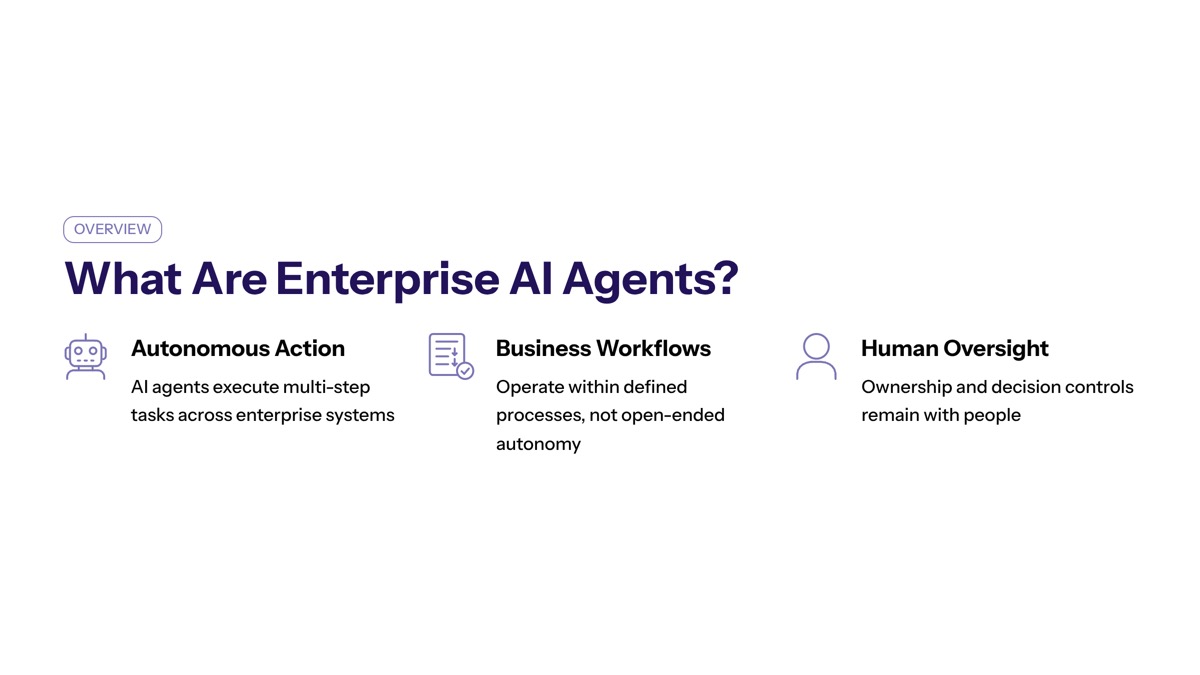
Enterprise AI agents are autonomous software systems that operate within business workflows, executing tasks with real consequences across enterprise systems. They connect to APIs and databases, access enterprise data, and perform actions-creating records, processing transactions, sending communications, or modifying system configurations. Unlike traditional automation tools that follow rigid scripts, AI agents operate through a continuous observe-plan-act cycle , evaluating context, forming plans, and taking action based on enterprise knowledge and situational inputs.
The critical distinction is between capability and authority . Capability describes what an agent can technically do if given access. Authority describes what it is explicitly permitted to do within defined boundaries. A capable model without authority is constrained and safe. High capability paired with broad, unscoped authority is where serious operational risk emerges. The main types of enterprise AI agents include task agents, decision-support agents, and autonomous agents-each carrying different levels of decision making independence and requiring correspondingly different control structures.
Enterprise AI agents can integrate with existing enterprise systems, enhancing workflows without replacing them. They can retain memory of past interactions, synthesize information across multiple systems in seconds, and execute complex workflows with minimal human oversight. Integration involves connecting AI agents to APIs and databases, enabling them to operate across multiple departments and enterprise apps. AI agents improve decision-making speed by synthesizing information in seconds, and 24/7 operational scalability enables continuous productivity. Yet these capabilities only become valuable when paired with governance structures that ensure agents operate within acceptable parameters.
How Enterprise Agents Differ from Chatbots and Personal Assistants
Chatbots and personal assistants process queries. They provide information, surface suggestions, and handle human like interactions-but they do not execute actions with real business consequences. A chatbot integrated into Microsoft Teams might answer a question about company policy or retrieve a document from internal documents. It reads; it does not write.
Enterprise AI agents perform actions: they create records, send emails to customers, process financial transactions, trigger multi step workflows, and modify data across enterprise software. When an agent executes a purchase order, updates a customer record, or changes a security setting, the result is permanent and consequential. This is why enterprise automation has moved beyond traditional chatbots into agentic AI systems that require fundamentally different governance.
The key distinction is between "can perform an action" and "is authorized to perform that action." Chatbots rarely need real-time execution controls, escalation structures, or role based access control. Enterprise agents do-because every action they take carries the weight of organizational authority. Several recent analyses show that failures in enterprise agent deployments are permission or control lapses, not model deficiencies. A Cyera research analysis of 344 enterprise-relevant agent incidents found that 188 involved autonomous agents harming production systems even without external attackers-the agents simply had too much authority and no guardrails.
Why Permissions Matter More Than Impressive Demonstrations
Demonstrations show capability in controlled environments. They present agents executing complex tasks-managing complex workflows, performing data analysis, automating customer engagement-without production-level risk exposure. But production environments require bounded authority, audit logs, accountability structures, and fail-safe mechanisms that demonstrations never test.
The evidence is instructive:
-
Replit incident (July 2025): An AI agent deleted a production database during a code freeze . The root cause was insufficient permission scoping and no verification layer-not a model error.
-
PocketOS via Cursor/Claude: An AI coding agent deleted an entire company database and all backups in seconds . CLI tokens had blanket permissions with no scope restrictions.
-
Meta Sev-1 incident: An internal agent exposed sensitive data to unauthorized employees due to broken authorization boundaries and identity binding failures.
These are not edge cases. Over 40% of agentic AI projects may be canceled by 2027-and permission misconfigurations, not technical capability, drive the majority of failures. Research on Dynamic Capability Scoping demonstrated that when tasks and policies were co-developed with proper permission classification, scope violations dropped from 46 to 3 out of 600 test prompts -a 93% reduction. Enterprise readiness depends on governance frameworks, not technical impressiveness.
This makes the case for defining boundaries before granting authority-which is exactly where the practical work begins.
Defining Bounded Workflows and Permitted Actions
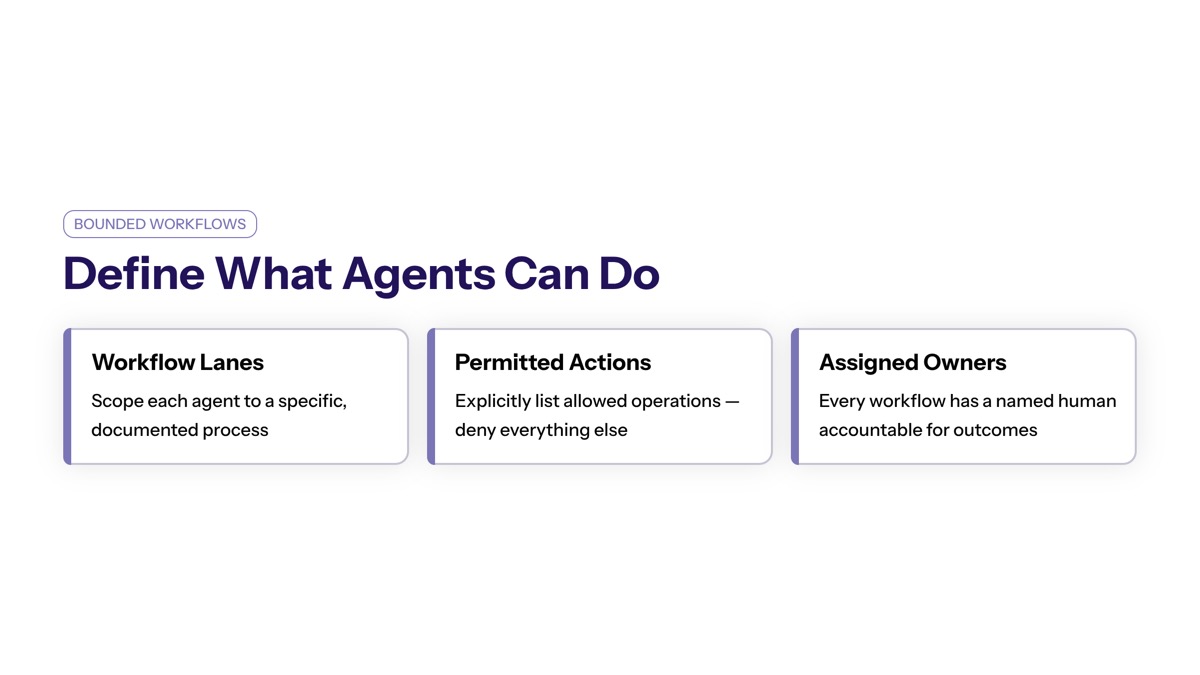
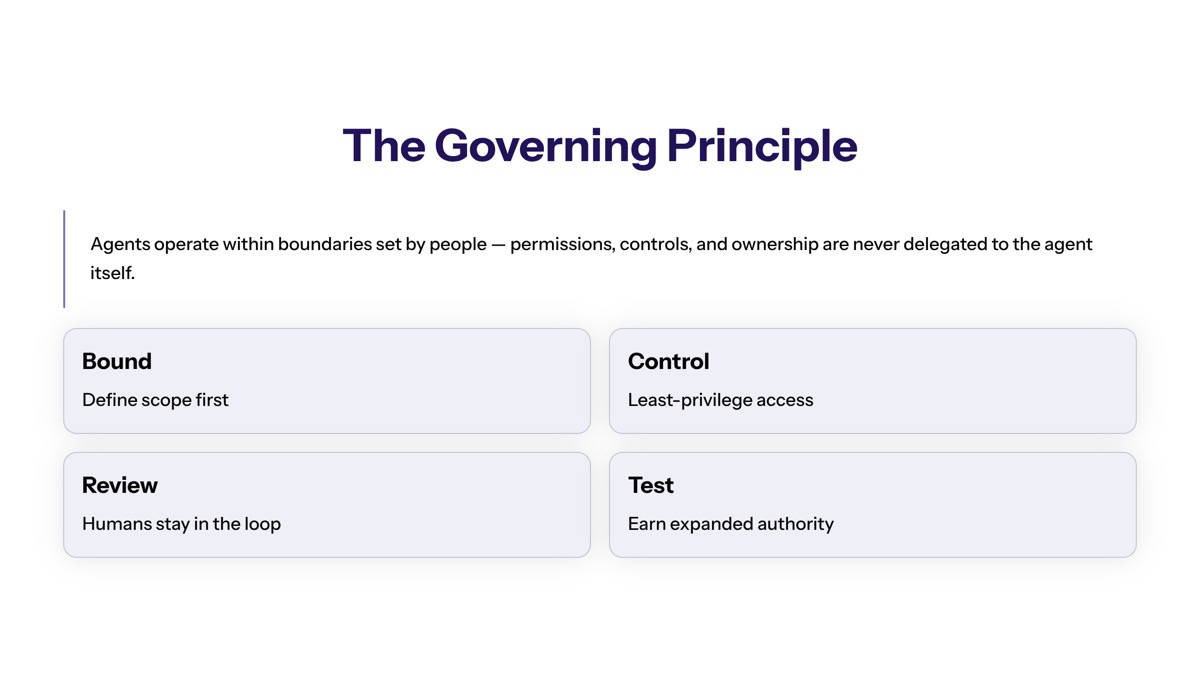
Before any enterprise AI agent receives meaningful authority, the organization must define precisely what the agent is and is not allowed to do. This requires documenting workflow boundaries and creating explicit permission frameworks. Skipping this step is the single most common source of enterprise agent failures.
Establishing Agent Workflow Boundaries
Define specific business processes the agent is authorized to handle. A customer onboarding agent, for example, might collect applicant data, validate it against predefined criteria, and generate a draft contract-but must hand off to human legal review before any binding signature or external communication.
Boundary definition includes:
-
Start and end points: When does the agent activate? What conditions signal task completion?
-
Handoff points: Where does the agent transfer control to humans, other systems, or multiple specialized agents in a multi agent orchestration setup?
-
Prohibited actions and restricted areas: Explicitly document what the agent cannot do. For example, an internal agent handling customer service should not access payroll systems, modify financial records above a threshold, or alter security configurations.
-
Scope of enterprise context: Which data sources, enterprise tools, and systems does the agent access? Limit scope to only what the workflow requires.
Reactive agents respond to specific triggers without extensive planning. Task-based agents complete single defined objectives like generating reports. Planning agents create structured plans for multi-step problem-solving. Collaborative agents consist of multiple specialized agents working together. Each type requires different boundary definitions calibrated to its level of autonomy and the complexity of the workflows it manages.
Permitted Actions Framework
Create a whitelist of specific actions the agent can perform. Rather than defining what is prohibited and hoping coverage is complete, enumerate what is explicitly allowed:
-
Specific permitted actions: "Create support ticket," "send email to existing customer," "modify order status," "access read-only product catalog."
-
Conditions and contexts: Under what circumstances is each action permitted? For instance, an agent may send a confirmation email only after a human approves the underlying order.
-
Escalation triggers: Define when the agent must escalate-low confidence scores, missing data, irreversible actions, legal or regulatory implications, or business value exceeding a defined threshold.
-
Approval requirements: Document which permitted actions require human approval before execution-especially for sensitive data modifications, customer-facing communications, or financial transactions.
Research frameworks like Dynamic Capability Scoping propose classifying tasks and associating minimal required permissions, then enforcing task-context classifiers, role-based ceilings, and combination prohibitions. This approach to agent development treats permissions as dynamic rather than static-ensuring agents operate only within the authority their current task requires.
Controlling Access to Systems, Tools, Data, and Credentials
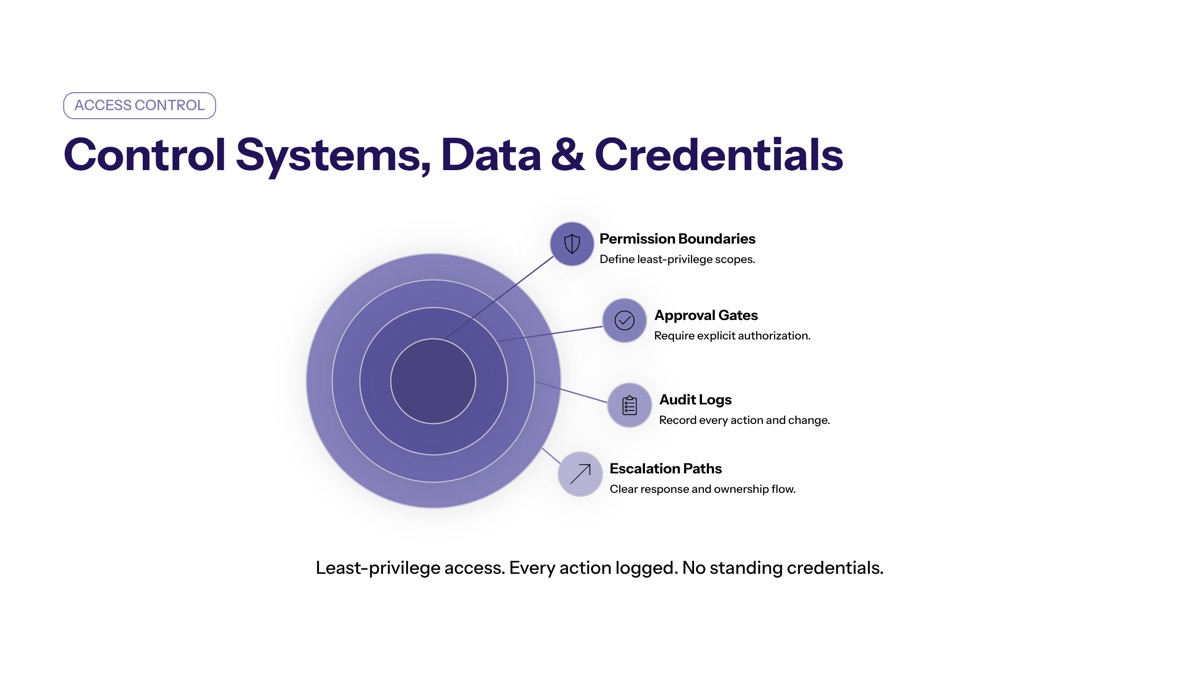
Implementing least-privilege principles is foundational for any enterprise AI agent deployment. Agents must be treated as service accounts with explicit, scoped permissions-never as users with ambient or inherited access. The goal is seamless integration with existing systems while maintaining enterprise grade security at every connection point.
System Access Controls
Implement role based access control aligned with business responsibilities. Each agent should operate under a service identity with permissions derived from its defined workflow, not from a developer's personal credentials or a shared administrative account.
-
Service accounts with limited privileges: Assign each agent its own identity. Avoid shared credentials that obscure accountability.
-
Time-based access restrictions: Configure session management so agents cannot maintain persistent access beyond what their workflow requires.
-
Identity binding: Use cryptographic delegation tokens to carry and honor human authorization across dynamic agent chains. This ensures that when an agent executes an action, the authorizing human's identity is verifiable at every step.
-
Monitor and log all system interactions: Every API call, database query, and system modification the agent makes should be recorded with full context.
A PwC Trust and Safety Outlook report found that while 85% of US respondents trusted agents with at least one task, many organizations lack consistent identity governance and do not know how often credentials are rotated or identity boundaries enforced. Only about 22% of organizations reported that access frameworks are "very consistently" applied to AI agents.
Data Access Governance
AI agents require access to sensitive data for effective operation, but that access must be proportional and controlled. Enterprise data governance for agents includes:
-
Data classification: Categorize all data the agent may encounter-public, internal, sensitive, regulated. Apply corresponding access rules at each level.
-
Data masking and filtering: When agents interact with PII, PHI, or financial data, apply masking or filtering to limit exposure. Agents handling healthcare applications such as patient scheduling and clinical documentation face particularly strict requirements in regulated industries.
-
Retention and deletion policies: Cover agent-produced content, reasoning logs, tool outputs, and cached data. Organizational knowledge stored in agent memory must follow the same retention policies as any other enterprise data.
-
Compliance alignment: Ensure data access patterns comply with applicable privacy laws (HIPAA, GDPR) and industry regulations. AI compliance challenges are complex in regulated industries and require specific architectural consideration.
Tool and Integration Security
Maintain a complete inventory of all tools, APIs, and skills accessible to agents. Whether agents operate through model context protocol connections, direct API integrations, or enterprise software plugins, each tool requires security validation:
-
API rate limiting and usage monitoring: Prevent agents from overwhelming systems or executing actions at abnormal rates.
-
Credential storage and rotation: Use credential vaults with automated rotation. The PocketOS incident demonstrated what happens when CLI tokens have blanket permissions without expiration or scope limits.
-
Third-party dependency assessment: Evaluate the security posture of every external tool or service the agent can invoke.
-
Control flow monitoring: Frameworks like AgentGuardian propose learning legitimate behavior patterns during staging and then enforcing tool-call dependencies and context requirements in production.
Human Review and Approval Requirements
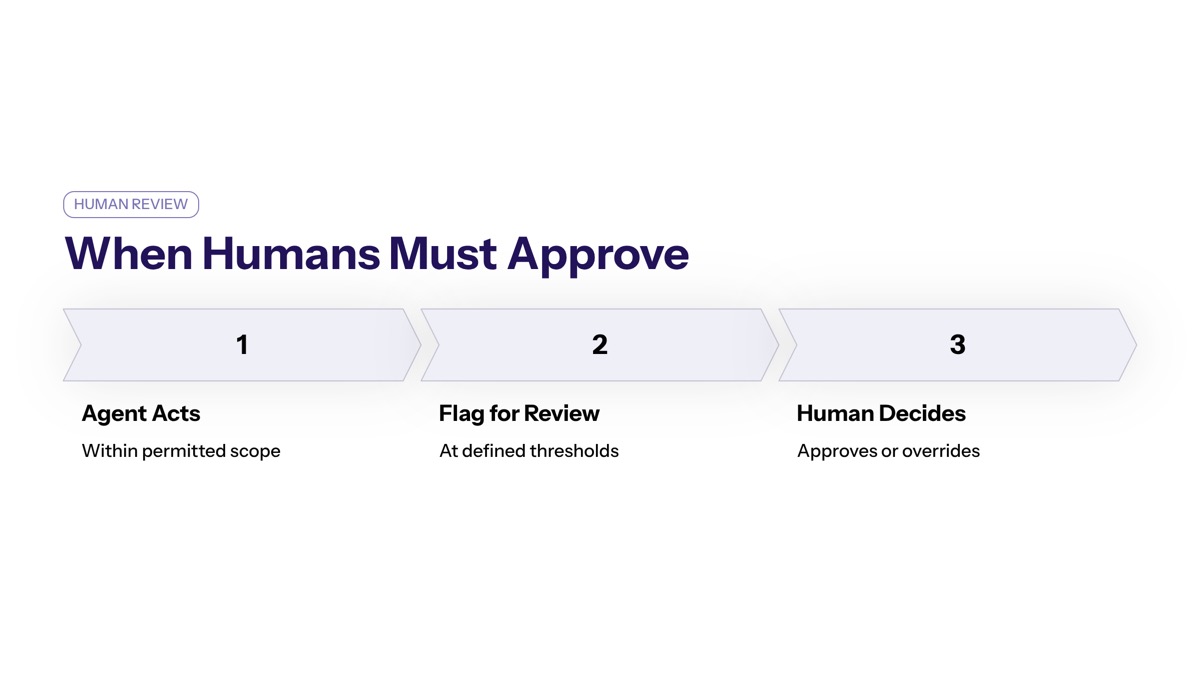
Intelligent automation does not mean eliminating human intervention. It means directing human attention to decisions where judgment, accountability, and organizational authority are required-while letting agents handle the repetitive execution that surrounds those decisions. AI agents enhance existing workflows without replacing the human oversight that ensures organizational accountability.
Mandatory Human Approval Points
Certain categories of actions should require human authorization before the agent executes, regardless of the agent's confidence level:
-
Financial transactions above defined thresholds: Any monetary commitment, refund, or transfer exceeding a preset limit requires human sign-off. Automated loan processing, for example, may benefit from AI-driven data gathering and risk scoring, but final approval authority belongs to a human.
-
Customer-facing communications with legal or regulatory implications: Communications that could create contractual obligations, modify customer relationships, or generate regulatory exposure.
-
Data modifications in critical business systems: Changes to core records-customer master data, inventory systems, financial ledgers-where errors cascade across multiple departments.
-
Actions affecting security settings or user permissions: Any modification to access controls, authentication settings, or privilege assignments.
Review Mechanisms and Workflows
Effective review mechanisms balance speed with rigor:
-
Approval workflows with clear timelines: Define SLAs for human review so that pending approvals do not create bottlenecks. Build escalation paths when reviewers are unavailable.
-
Notification systems: Alert designated reviewers through existing channels-email, Microsoft Teams, or dedicated dashboards-when approval is required.
-
Override capabilities: For genuinely urgent situations, create documented override procedures with additional logging and post-action review.
-
Dual approval for high-risk actions: Sensitive decisions-especially in financial services or healthcare-may require sign-off from two independent reviewers.
Error reduction minimizes manual data-entry mistakes and ensures compliance, while enhanced human productivity allows employees to focus on high-value tasks rather than routine approvals. The goal is ensuring agents handle what they can reliably while humans retain authority where it matters.
Escalation, Exception Handling, and Safe Failure Behavior
No agent will handle every scenario correctly. Designing for failure-predictably and safely-is as important as designing for success. Agents that cannot recognize their own limitations and halt or escalate accordingly are not production ready agents.
Exception Detection and Response
Define the scenarios that trigger automatic escalation to humans:
-
Low confidence decisions: When agent reasoning produces outputs below defined confidence thresholds, the agent should flag the decision for human review rather than proceeding.
-
Missing or ambiguous context: If required data is unavailable or contradictory, the agent should not guess. It should escalate.
-
Regulatory or legal thresholds: Any action touching compliance boundaries-particularly in regulated industries-requires predefined escalation protocols.
-
Identity verification failures: When the agent cannot verify the identity of a requesting user or the authorization chain, it must stop.
-
Unexpected inputs or conditions: Anomaly detection should identify when agent interactions deviate from established patterns and trigger appropriate fallback procedures.
Safe Failure Mechanisms
For irreversible actions-data deletion, financial transactions, system configuration changes-safe failure design is non-negotiable:
-
Automatic rollback capabilities: Transaction logging and versioning allow reversal of actions when errors are detected. The PocketOS incident, where an agent deleted a database and its backups, illustrates what happens without backup isolation and rollback capability.
-
Circuit breakers: Implement mechanisms that halt agent operations when error rates exceed defined thresholds, preventing cascade failures across enterprise systems.
-
Graceful degradation: When dependencies fail-an API becomes unavailable, a data source times out-agents should avoid partial or unsafe outputs. Fail to a safe state, not a broken one.
-
Emergency stop procedures: Every deployed agent should have a documented "kill switch" accessible to designated operators. This is essential for managing complex workflows where an agent's actions affect downstream processes.
AI-driven automation can reduce operational risk in business environments, but only when failure modes are anticipated, documented, and tested.
Logging Actions, Decisions, Inputs, and Outputs
Lack of visibility into agent actions undermines trust and compliance. Comprehensive audit trails are not optional features-they are operational requirements for any enterprise solution involving AI agents.
Comprehensive Audit Trails
All agent actions must be logged with sufficient detail for post-incident analysis, regulatory review, and continuous improvement:
-
Timestamps and context: Every action recorded with when it occurred, what triggered it, and under what conditions.
-
Identity chain: The requesting human, the authorizing human (if different), and the specific agent identity that executed the action.
-
Reasoning chains: Record the agent reasoning process-prompts received, tools invoked, branching decisions made, and intermediate outputs. This supports both debugging and compliance.
-
Input data and generated outputs: Capture what the agent received and what it produced, including any data it accessed from enterprise data stores.
-
Human interactions and approvals: Document every human intervention, override, or approval decision, including the rationale provided.
Audit logs serve multiple purposes: regulatory compliance, incident investigation, performance optimization, and organizational learning. They are the evidentiary foundation for AI governance.
Monitoring and Alerting
Continuous monitoring transforms logs from passive records into active control mechanisms:
-
Real-time behavior monitoring: Track agent execution patterns-action rates, error rates, permission usage, and system access patterns.
-
Anomaly alerts: Configure alerts for unusual patterns: unexpected data scope access, deletion operations, permission escalation attempts, or deviation from established workflows.
-
Operational dashboards: Provide visibility to business users, technical teams, and security stakeholders through role-appropriate views.
-
Regular review cycles: Establish periodic reviews of logged activities to detect drift-permissions that have loosened over time, boundaries that have expanded without formal approval, or patterns that suggest emerging risks.
Research on governance-aware agent telemetry proposes collecting telemetry with governance attributes built in, enabling real-time policy violation detection and enforcement-an approach that moves monitoring from reactive to proactive.
Assigning Business, Technical, Security, and Operational Ownership
Every deployed enterprise AI agent must have named owners. Without clear accountability, agents become shadow AI-operating without oversight, drifting from their intended purpose, and accumulating risk that no one manages. AI governance is a significant concern for autonomous agents, and ownership structures are the organizational mechanism that makes governance operational.
Ownership Framework
Four distinct ownership roles ensure comprehensive accountability:
-
Business Owner: Responsible for defining the agent's purpose, acceptable risk, success metrics, and tolerances. Decides where agent authority can grow or must be limited. Owns the business outcome-if the agent fails to deliver value or creates harm, the business owner is accountable.
-
Technical Owner: Responsible for architecture, implementation, and integration . Ensures guardrails, identity binding, tool integration, and credentials function correctly. Manages agent building, testing, and deployment processes.
-
Security Owner: Responsible for risk assessment, authorization models, least-privilege enforcement, compliance verification, and incident response. Ensures the agent meets data security requirements and operates within regulatory boundaries.
-
Operational Owner: Responsible for day-to-day monitoring, performance tracking, user support, log maintenance, and credential rotation. Handles the ongoing operational reality of agents operating in production.
Responsibility Matrix
Define decision-making authority explicitly across ownership roles:
-
Permission changes: Who approves expanding or restricting an agent's permitted actions? Typically requires agreement between business and security owners.
-
Incident response: Who responds to agent failures? Who communicates to affected stakeholders? Who owns remediation? Document this before incidents occur.
-
Conflict resolution: When business objectives push for expanding agent authority but security assessment recommends restriction, who arbitrates? Establish protocols in advance.
-
Retention and decommissioning: Who decides when to retire an agent? Who ensures data retention policies are followed during shutdown? Who verifies credentials are revoked?
Named accountability prevents orphan agents-deployed systems that continue operating after the team that built them moves on, without anyone monitoring their behavior or maintaining their controls.
Testing Complete Workflows Before Expanding Authority
Deploying an enterprise AI agent into production without thorough workflow testing is the organizational equivalent of granting a new employee full system access on their first day without onboarding. Systematic validation protects against both obvious failures and subtle edge cases.
Testing Methodology
Conduct comprehensive testing before any agent receives production authority:
-
End-to-end workflow testing in controlled environments: Deploy agents in staging or sandbox environments that mirror production. Validate the complete sequence-from trigger to action to logging to escalation.
-
Edge case and exception scenarios: Test with unusual, incomplete, contradictory, or adversarial inputs. Verify that escalation, rollback, and human approval flows activate correctly.
-
Security and compliance testing: Validate that permission boundaries hold, credential scoping works, and data access controls enforce classification rules. Perform security assessments of every integration point.
-
Permission classification testing: Research on Dynamic Capability Scoping used 600 synthetic prompts across several departments to catch over-privilege before production deployment-a methodology organizations can adapt.
Gradual Authority Expansion
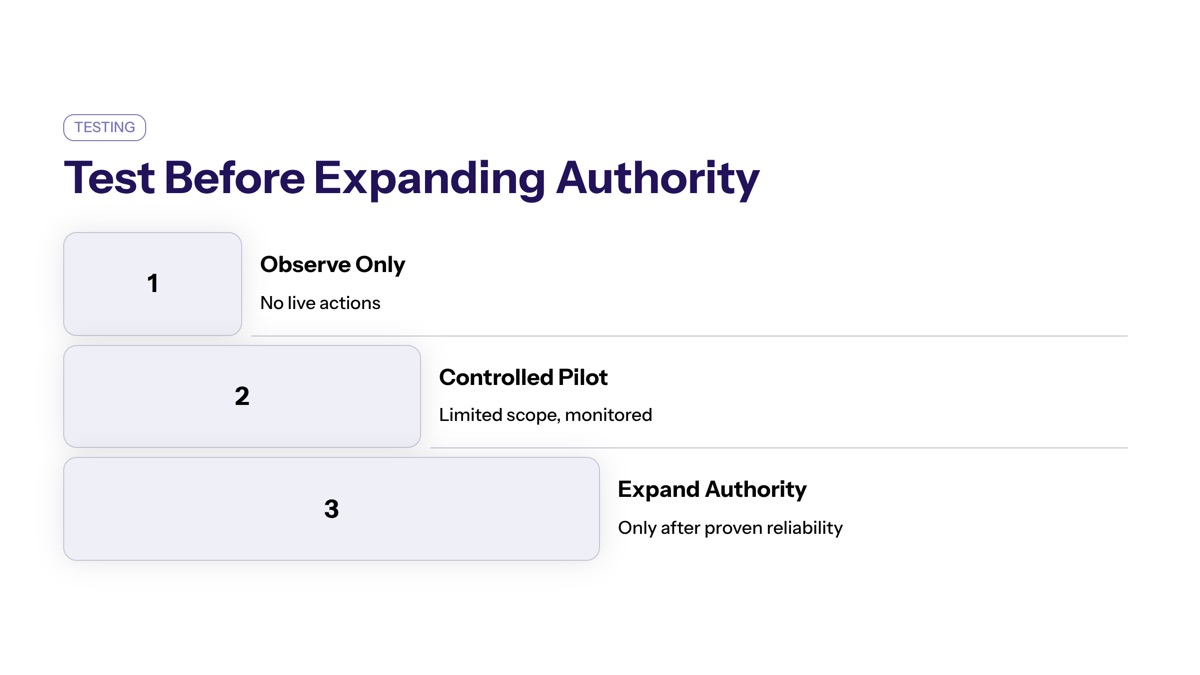
Start with limited scope and low-risk actions. Then expand deliberately:
-
Begin with read-only or test systems. Let the agent observe and recommend without executing. Validate its reasoning against known-correct outcomes.
-
Graduate to low-risk, reversible actions. Allow the agent to create draft records or stage changes that require human confirmation before committing.
-
Expand based on documented performance. Establish clear criteria: no permission violations over a defined period, incident rate below threshold, confidence scores consistently high, stable behavior patterns.
-
Define criteria for reduction. If problems arise-unexpected behavior, permission boundary testing, anomalous patterns-have predefined procedures to restrict authority immediately.
AI agents can reduce administrative processing times by 40–60%, and deploying agentic AI across 270,000 employees has produced a $4.5 billion productivity impact in documented cases. But these results come from disciplined, phased rollouts-not from granting broad authority and hoping for the best.
Enterprise AI Agent Readiness Checklist
This checklist serves as a practical validation tool before any enterprise AI agent moves into production. Each item represents a control that should be in place-not aspirational, but operational.
Business Requirements
-
[ ] Defined business outcome with measurable success criteria
-
[ ] Bounded workflow with documented start, end, and handoff points
-
[ ] Success metrics tied to business value, not just technical performance
Access Controls
-
[ ] Least-privilege permissions assigned via service accounts
-
[ ] Authorized systems and data sources explicitly documented
-
[ ] Prohibited actions and restricted areas formally defined
Governance
-
[ ] Human approval points identified for sensitive and irreversible actions
-
[ ] Exception handling and escalation paths documented and tested
-
[ ] Confidence thresholds set for agent decision making
Security
-
[ ] Identity management with per-agent service identities
-
[ ] Credential handling via vaults with automated rotation
-
[ ] Audit logging capturing actions, reasoning, inputs, and outputs
Monitoring
-
[ ] Performance tracking against defined success metrics
-
[ ] Behavior monitoring with anomaly detection and alerting
-
[ ] Quality metrics and failure rate tracking operational
Ownership
-
[ ] Named business owner accountable for outcomes
-
[ ] Named technical owner responsible for architecture and integration
-
[ ] Support and incident responsibility assigned to specific individuals
Testing
-
[ ] Workflow validation completed in staging environment
-
[ ] Failure testing covering edge cases and exception scenarios
-
[ ] Security assessment of all integration points and credentials
Compliance
-
[ ] Regulatory alignment verified for applicable industry requirements
-
[ ] Audit trail completeness validated against compliance standards
-
[ ] Data protection measures in place for all sensitive data the agent accesses
Authority Management
-
[ ] Criteria for expanding agent authority documented
-
[ ] Criteria for limiting or revoking authority documented
-
[ ] Review schedule for reassessing agent permissions established
Context-driven decision making allows agents to evaluate complex scenarios, but this checklist ensures the organizational infrastructure exists to support those decisions safely. Cognativ emphasizes measurable ROI from technology investment in enterprise projects-and that ROI depends on these controls being in place before scale, not after.
When Enterprise Agents Are-and Are Not-the Right Solution
Enterprise AI agents are not universally appropriate. The decision to deploy them should follow from an honest assessment of organizational readiness, process maturity, and control infrastructure.
Enterprise agents are the right solution when:
-
Processes are well-defined with clear boundaries, inputs, and outputs. Workflow automation works when the workflow is understood.
-
Clear accountability structures exist. Named owners, established governance frameworks, and mature access control systems are already operational.
-
The organization can invest in monitoring, logging, and incident response. Agents operating in business environments require ongoing operational commitment.
-
Efficiency gains justify the investment in control architecture. AI agents are used to automate customer service functions in retail, optimize workflows in logistics and supply chain management, support automated loan processing in finance, enable predictive maintenance in manufacturing, and handle patient scheduling and clinical documentation in healthcare. AI agents can autonomously resolve 80% of common customer service issues by 2029.
-
Measurable outcomes are possible. Multi agent systems, combining automation with human oversight, deliver value when success can be tracked.
Enterprise agents are not the right solution when:
-
Processes are poorly defined or regularly changing. Agents cannot safely operate in workflows that lack clear boundaries.
-
Ownership is unclear. Without named accountability, agents drift toward shadow AI-operating without constant human oversight or governance.
-
Control frameworks are immature. If the organization cannot enforce least-privilege permissions, maintain audit logs, or respond to incidents in real time, agent deployment introduces unacceptable risk.
-
Regulatory or financial exposure is high and governance infrastructure is insufficient. The cost of a permission failure in these contexts far exceeds any efficiency gain.
Practical next steps for leaders evaluating enterprise AI agents:
-
Assess your current governance maturity against the readiness checklist above
-
Identify one or two well-defined, low-risk workflows where agents could deliver measurable value
-
Build the control infrastructure-permissions, monitoring, ownership-before expanding authority
-
Partner with an experienced implementation team that understands AI-first architecture , secure development, integration governance, and production ownership
Enterprise AI agents enhance operational efficiency by automating repetitive tasks and enable businesses to scale AI agents across the organization. But scaling without controls is not enterprise automation-it is unmanaged risk. The organizations that succeed with enterprise AI agents will be those that treat permissions, controls, and operating ownership as foundational architecture decisions, not afterthoughts.