AI Implementation Roadmap: From Bounded Use Case to Production
An AI implementation roadmap is a strategic plan that connects a business problem to production-ready artificial intelligence through a sequence of evidence-based decisions. It is not a project timeline, a list of AI tools, or a technology procurement exercise. The roadmap aligns business goals with technical capabilities for AI by forcing teams to collect specific evidence, assign clear ownership, and make auditable go/change/stop decisions at every stage before committing further resources.
This guide covers the implementation process from a bounded pilot through reliable production deployment. It does not address enterprise-wide AI procurement, general AI strategy frameworks, or vendor selection methodology. The target audience is mid-market product, technology, and operations leaders responsible for moving an AI initiative from idea or pilot into production systems that deliver real value.
An effective AI implementation roadmap is a sequence of decisions and validation gates, not a fixed schedule. Each gate requires defined evidence before a team advances, revises scope, or stops the initiative. Organizations with structured roadmaps achieve a 92% success rate, while 95% of generative AI pilots fail to reach production. The gap between those numbers reflects the difference between disciplined evidence collection and unstructured experimentation.
After reading this guide, you will understand:
-
How to define bounded use cases that enable measurable validation
-
The eight-stage implementation process with specific decision gates
-
What evidence each gate requires and who is responsible for collecting it
-
How to avoid the three roadmap mistakes that cause most ai failures
-
How to build a stage-gate framework your cross-functional team can use immediately
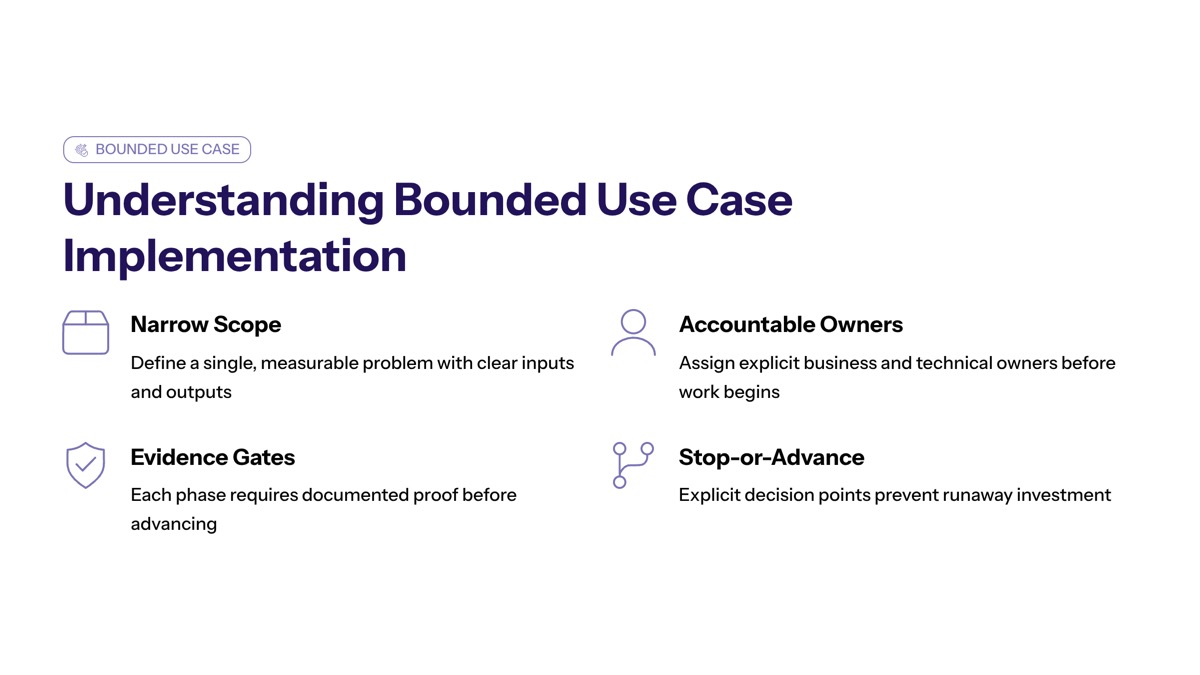
Understanding Bounded Use Case Implementation
A bounded use case defines a narrow workflow, data domain, or decision boundary rather than attempting to solve broadly with multiple ai models from day one. Successful AI projects target specific outcomes, not vague goals. Starting with boundaries makes validation possible, risk containable, and business value measurable.
Boundaries matter for three reasons. First, they make success metrics concrete: instead of "improve customer service," a bounded use case specifies "reduce manual triage time for non-emergency patient queries by 50% within six weeks using prior patient history data." Second, they limit blast radius when something fails. Third, they clarify who owns the outcome, what data is required, and when to stop. The entire workflow should be redesigned rather than just inserting AI into existing processes; boundaries make that redesign tractable.
The connection between business workflow boundaries and technical implementation scope is direct. A bounded workflow tells data scientists which data sources matter, what latency is acceptable, and what fallback behavior looks like. Without that boundary, teams build ai systems against assumptions that collapse under production conditions. TDWI research shows that performance under demo conditions versus production can diverge when long-tail inputs, cost surprises, and provider variance are not tested within defined scope.
Business Outcome Definition
Every AI initiative needs an owner: a business leader accountable for the outcome, not just the technology. Clear stakeholder roles should be defined from day one. Discovery and vision setting involves identifying business challenges for AI, and alignment with business strategy involves tying AI to core business objectives. Without this, ai projects drift toward interesting technical work that never produces business value.
A well-defined outcome looks like this: "Reduce manual invoice-processing time from submission to approval by 50% within six weeks, measured against current 4.2-day average, owned by VP of Operations." A poorly defined outcome looks like this: "Make invoice processing more efficient." The first version enables a stop/go decision. The second enables endless scope creep; 52% of AI projects experience scope creep for exactly this reason.
Bounded outcomes also make it possible to define success metrics and stop conditions before any code is written. If the team cannot articulate what success looks like in measurable terms, the initiative is not ready for implementation.
Risk and Constraint Identification
Data readiness is the foundation. Assessment of readiness evaluates data maturity and infrastructure before AI development. Data audits evaluate quality, availability, and governance of data. Poor data quality costs organizations an average of £12.9 million annually, and one in four organizations cite inadequate data governance as a critical barrier. A data audit within the bounded scope should inventory what data exists, whether it is structured or unstructured, whether access permissions are in place, and whether privacy requirements (GDPR, HIPAA, data sovereignty) apply.
Integration complexity and existing workflow dependencies must be mapped before building anything. Which existing systems will the AI output connect to? What API limits exist? What latency constraints apply? Identifying these constraints early prevents the implementation challenges that stall production deployment.
Human review requirements and fallback procedures need explicit definition. Where must outputs be reviewed by a person? What happens when the model fails, receives out-of-domain inputs, or produces low-confidence results? Establishing governance requires incorporating risk, compliance, and oversight standards into AI processes from the start, not after production incidents force the issue.
The Stage-Gate Implementation Process
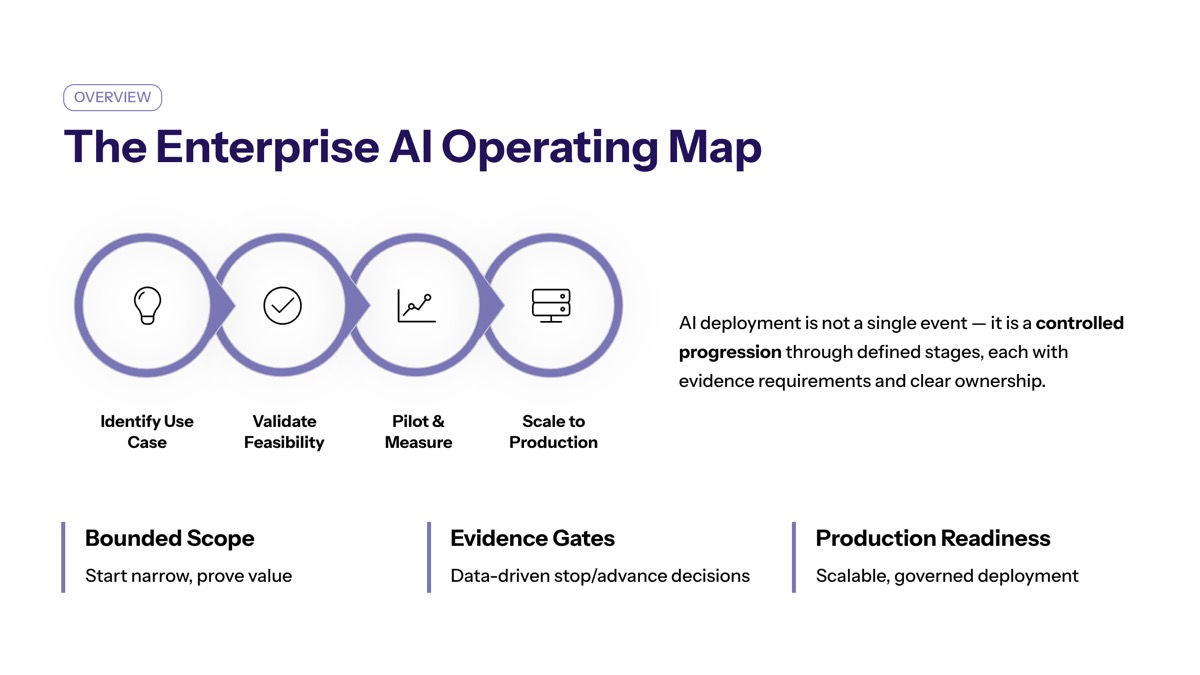
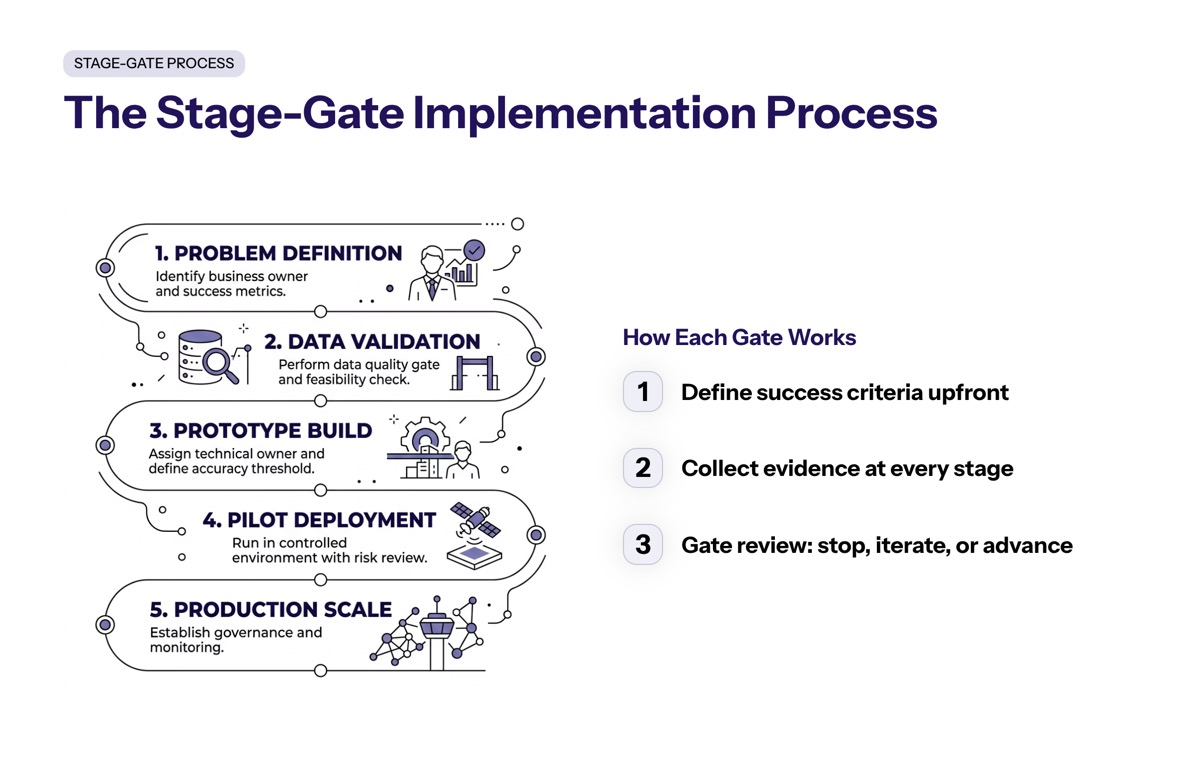
The implementation process follows eight stages from definition through production optimization. Each stage ends at a decision gate where evidence is evaluated. The team advances, revises scope, or stops based on what the evidence shows.
Stages may overlap or repeat depending on the workflow and evidence. A team that discovers data quality problems in Stage 4 may return to Stage 2 for remediation. A team that uncovers new integration constraints during gradual release may need to revisit Stage 3. A phased implementation approach breaks AI development into manageable milestones, but the sequence adapts to reality rather than following a rigid calendar. AI implementation roadmaps typically span 6 to 8 weeks for initial assessment through pilot, though production readiness takes longer. Realistic ROI timelines span 18 to 36 months for enterprise AI.
The emphasis at every gate is on decisions and evidence, not deliverables or ceremonial reviews. Projects without executive sponsorship are 2.5× more likely to fail, so each gate should involve the business owner, technical lead, and compliance stakeholder.
Early Stages: Definition and Validation (Stages 1-3)
Stage 1 establishes the business case. The team documents the business outcome, assigns an owner, identifies constraints, and sets explicit stop conditions. AI implementation requires clear business objectives for success. The exit evidence is a documented business case with measurable success metrics, a named outcome owner, listed constraints, and conditions under which the initiative should be abandoned. An AI use-case portfolio helps prioritize potential applications based on value and feasibility at this stage.
Stage 2 validates whether the bounded use case is feasible. Data preparation ensures data governance and quality control for AI models. The team inventories data sources, checks availability and quality, confirms legal and privacy reviews, and maps the existing workflow. Data foundation and governance establish robust data pipelines and compliance frameworks. First 90 days should include a data audit and governance framework documentation. The exit evidence is a data readiness report, a risk and regulatory checklist, and a mapped workflow showing where AI will intervene.
Stage 3 designs the architecture. The team defines infrastructure, integration points, security controls, AI governance requirements, and vendor or model selection rationale. Architecture decisions include whether to build or buy; purchased AI solutions succeed 67% of the time compared to 33% for internal builds. The exit evidence includes an architecture diagram, security and privacy controls, vendor contract review, and defined roles and responsibilities. Companies that defer governance until post-deployment face higher remediation costs.
Development and Decision Stages (Stages 4-5)
Stage 4 builds a bounded proof within defined scope. Proof of concept (PoC) tests the feasibility of the AI use case. The pilot uses limited users and data, includes human-in-the-loop oversight, captures error modes, and logs outcomes against the baseline established in Stage 1. Pilots should be designed for eventual production scaling after initial testing. Evidence collection covers technical performance metrics (accuracy, latency, throughput), business outcome measurements (time saved, errors reduced), user feedback, and a risk log documenting failure modes and edge cases.
Testing and evaluation rigorously assess the AI system prior to wider rollout. The team should test long-tail inputs, malformed data, system outages, and model misbehavior. Pilot projects should target user adoption rates above 70%. AI solutions can save employees hundreds of hours annually, but only if the proof demonstrates that savings against real conditions, not demo data.
Stage 5 is the gate decision. Based on collected evidence, the cross-functional team chooses one of three paths:
-
Go : Evidence meets or exceeds criteria, constraints are manageable, stakeholder buy-in exists, risks are addressed
-
Change : Partial success requiring redesign (data gaps, performance gaps, unexpected failure modes, integration issues)
-
Stop : Evidence does not justify continued investment (cost exceeds benefit, risk too large, outcome not achievable)
This decision must be explicit and documented. Not every AI initiative should advance to production. 88% of AI projects fail to reach production due to unrealistic expectations; a disciplined stop decision at Stage 5 prevents wasted AI investments.
Production and Optimization Stages (Stages 6-8)
Stage 6 transfers ownership from a pilot team to a permanent business unit with production support capabilities. Development and integration scale the validated AI model within workflows. The team builds observability, defines monitoring dashboards, establishes alert rules, assigns on-call roles, and documents incident response procedures. Secure development practices, security approvals, and compliance sign-offs must be completed before production deployment.
Continuous monitoring sets up performance tracking and model validation protocols. The team defines SLAs, establishes processes for rollback or kill switches, and ensures human oversight where required. Without this infrastructure, successful pilots become production failures.
Stage 7 releases gradually with validation of real operating behavior. The team starts with a limited set of users, geographies, or features, then monitors performance, user behavior, adoption, and costs under production conditions. An adoption and change-management plan is essential for securing employee buy-in for AI systems. Change management and training address employee concerns regarding AI adoption. 70% of change initiatives fail without employee involvement, and organisations with change champions see 70 to 80% higher adoption rates.
Continuous monitoring is necessary for ethical AI guidelines and performance tracking. The team watches for data drift, concept drift, unexpected failures, and cost anomalies. Customer service AI can achieve 210% ROI over three years, but only when validated through gradual release against production traffic.
Stage 8 decides the initiative's future based on production evidence. Options include expanding to other business units or workflows, optimizing performance or cost, limiting scope if risks grow, or retiring the use case if business priorities shift. AI roadmaps should be treated as living documents that evolve with changing conditions. Identification and prioritization of use cases selects high-value AI projects for the next cycle, feeding back into Stage 1 for new bounded use cases.
Stage-Gate Framework and Decision Matrix
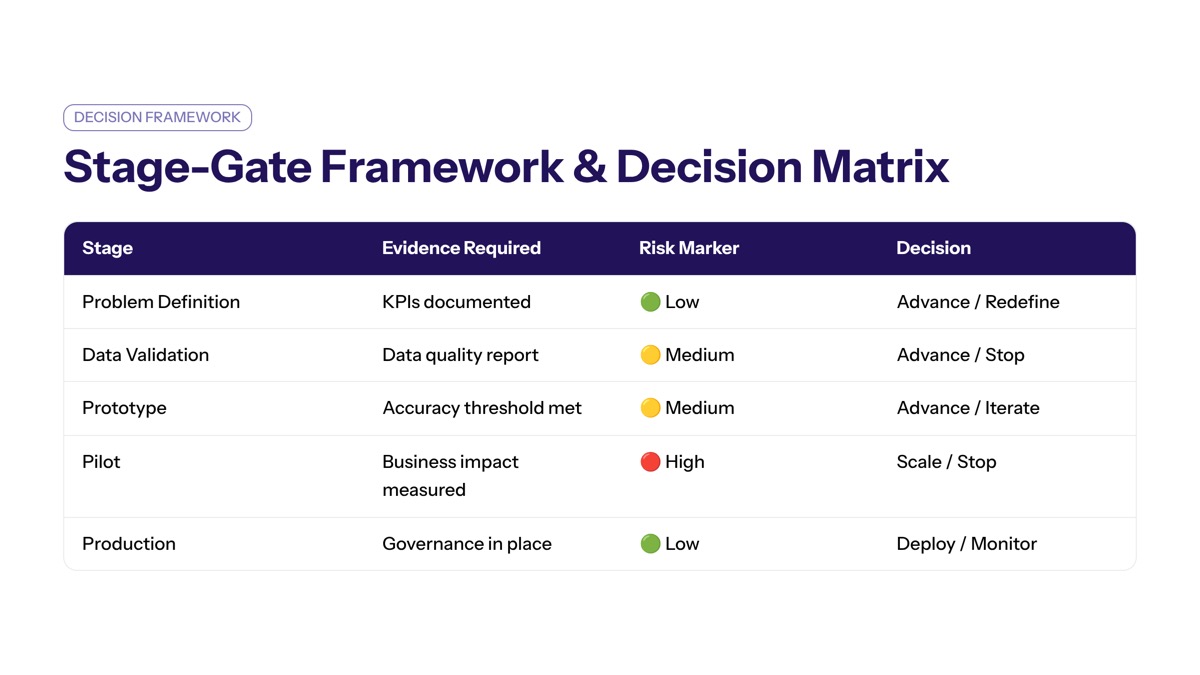
Structured decision-making at each gate transforms an AI initiative from a one-off project into an auditable implementation process. The framework below defines what evidence is required, who is responsible, and what conditions justify stopping or revising. Cross-functional collaboration includes diverse teams to ensure usability and ethical oversight at every gate.
Implementation Stage-Gate Table
|
Stage |
Primary Decision |
Responsible Owner |
Required Inputs |
Required Evidence |
Exit Criteria |
Reasons to Stop/Revise |
|---|---|---|---|---|---|---|
|
1. Definition |
Pursue this use case or drop it |
Business sponsor + AI product owner |
Strategic priorities, workflow analysis, stakeholder input |
Documented business case, named owner, success metrics, stop conditions |
Business case approved with measurable outcomes |
No clear business outcome; no owner willing to be accountable; misalignment with business strategy |
|
2. Data & Risk Validation |
Data and risk profile support a pilot |
Data engineering lead + compliance officer |
Data inventory, regulatory requirements, workflow maps |
Data readiness report, risk checklist, privacy review, mapped workflow |
Data accessible, quality sufficient, regulatory path clear |
Data unavailable or unusable; regulatory blockers; compliance cost exceeds value |
|
3. Architecture & Governance |
Technical approach meets production requirements |
Technical architect + security lead |
Integration requirements, vendor options, security standards |
Architecture diagram, security controls, governance framework, role definitions |
Architecture approved, vendors selected, governance plan documented |
Integration complexity exceeds budget; security gaps unresolvable; vendor terms unacceptable |
|
4. Bounded Proof |
Pilot evidence supports production consideration |
AI/ML lead + business owner |
Pilot plan, evaluation criteria, baseline metrics |
Performance vs baseline, error analysis, user feedback, risk log, cost estimates |
Performance metrics meet thresholds; failure modes documented |
Performance below threshold; cost projections unsustainable; critical failure modes discovered |
|
5. Gate Decision |
Go, change, or stop |
Cross-functional review board |
All Stage 4 evidence, stakeholder input |
Gate review covering technical, business, and regulatory dimensions |
Decision documented with rationale |
Evidence insufficient across any dimension; stakeholder alignment absent |
|
6. Production Readiness |
Infrastructure and ownership ready for deployment |
Operations owner + security lead |
Monitoring requirements, support plan, incident procedures |
Dashboards, alert rules, SLAs, on-call assignments, compliance approvals |
All production systems operational; ownership transferred |
Infrastructure gaps; no named production owner; security approvals incomplete |
|
7. Gradual Release |
Real-world behavior validates production viability |
Operations owner + business sponsor |
Release plan, monitoring criteria, training materials |
Roll-out reports, adoption metrics, performance stabilization, cost validation |
Metrics stable; user satisfaction acceptable; error rates within bounds |
Performance degrades under load; user adoption below targets; cost exceeds projections |
|
8. Improvement/Retirement |
Expand, maintain, limit, or retire |
Business sponsor + operations owner |
Production metrics, maintenance costs, strategic alignment review |
Long-term ROI, maintenance burden, risk assessment, expansion feasibility |
Decision documented with evidence |
ROI negative; maintenance cost excessive; strategic direction changed |
Evidence Collection and Validation Methods
Evidence falls into three categories, and each stage requires specific types.
Technical performance evidence includes accuracy, precision, recall, latency, throughput, error rates, and cost per inference. These metrics must be measured against the baseline established in Stage 1, not in isolation. Effective data governance ensures integrity, veracity, and adequacy of data feeding these measurements.
Business outcome evidence includes cost savings, time savings, error reductions, revenue impact, and process efficiency gains. These connect directly to the business objectives defined in Stage 1. Without this connection, technical success means nothing. Companies investing in cultural change see 5.3× higher AI success rates, so evidence should also capture organizational readiness and adoption indicators.
User acceptance evidence includes adoption rates, frequency of use, satisfaction scores, fallback frequency, and qualitative feedback from users interacting with the system. Training programs tailored to specific user groups improve adoption. Documentation requirements for auditable decision-making include traceability of data lineage, model versions, decision rationale at each gate, and compliance artifacts.
Common AI Implementation Roadmap Mistakes
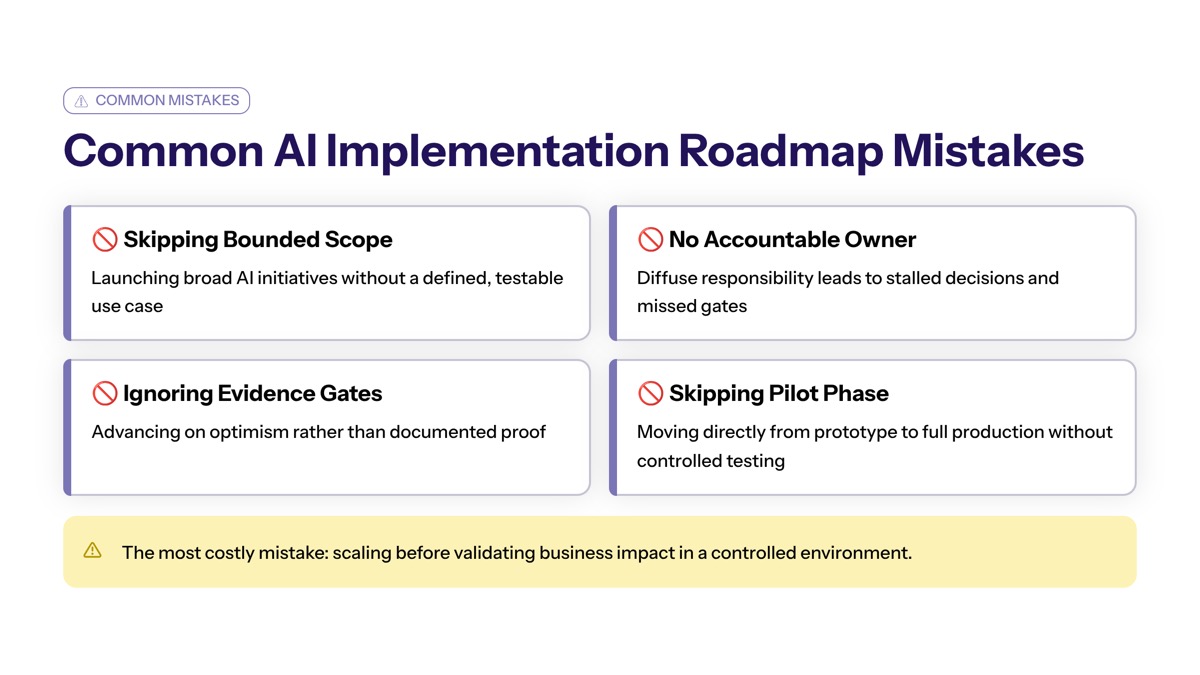
Most ai projects fail because of roadmap discipline problems, not technology limitations. The obstacles are well-documented: approximately 39% of stalled AI projects cite governance, security, or compliance issues; 37% cite cost overruns; 30% cite limited talent access; and 29% cite integration complexity . Three patterns recur across these failures.
Skipping Constraint Definition
Teams that start with a model or vendor before defining business boundaries and constraints build solutions looking for problems. Research from SeidrLab shows that firms focusing on defined workflow problems outperform those chasing technology. The fix: begin with bounded workflow decisions, map constraints (data, regulatory, integration, human review), and document stop conditions before evaluating any AI tools or ai models.
Ignoring Evidence Gates
Advancing stages without collecting required validation evidence is the most common path to wasted ai investments. Many organizations treat pilot success loosely, accepting demo performance as proof of production readiness. According to TDWI's production readiness checklist, requirements like representative evaluation sets, cost dashboards per user cohort, fallback paths, kill switches, and named owners are frequently skipped. The fix: enforce stage-gate discipline with explicit go/no-go decisions at each gate, requiring documented evidence before proceeding. AI implementation roadmaps should be business-led and measurement-focused.
Inadequate Production Planning
Building proofs without considering production ownership and support requirements creates successful pilots that become production failures. TechTarget analysis found that infrastructure and monitoring gaps are root causes when features fail post-pilot. The Deloitte C-suite guide emphasizes defining production requirements from the proof of concept stage, not after a pilot succeeds. The fix: address monitoring, incident response, ownership transfer , and ongoing maintenance requirements starting in Stage 3, before building anything.
Conclusion and Next Steps
An actionable AI roadmap replaces hope with evidence at every decision point. The stage-gate approach reduces risk by catching problems early, creates accountability through named owners at each gate, and produces auditable evidence that supports cross-functional decision-making. Not every initiative should reach production; the roadmap's value is in making that determination based on evidence rather than momentum.
To apply this framework immediately:
-
Identify where your current AI initiative sits in the eight-stage process
-
List the evidence you have collected for the current stage and the evidence you are missing
-
Assign a named owner for the next gate decision and define the criteria for go, change, and stop
-
Schedule a cross-functional gate review within two weeks
For teams ready to move from assessment to production, Cognativ's AI implementation services connect business strategy , AI-first architecture , secure engineering, and production ownership into a single engagement. Cognativ helps teams make and execute evidence-based implementation decisions at every stage.
Related topics for continued ai journey planning include enterprise AI governance frameworks, proof of concept exit criteria, and production monitoring for deployed ai systems.
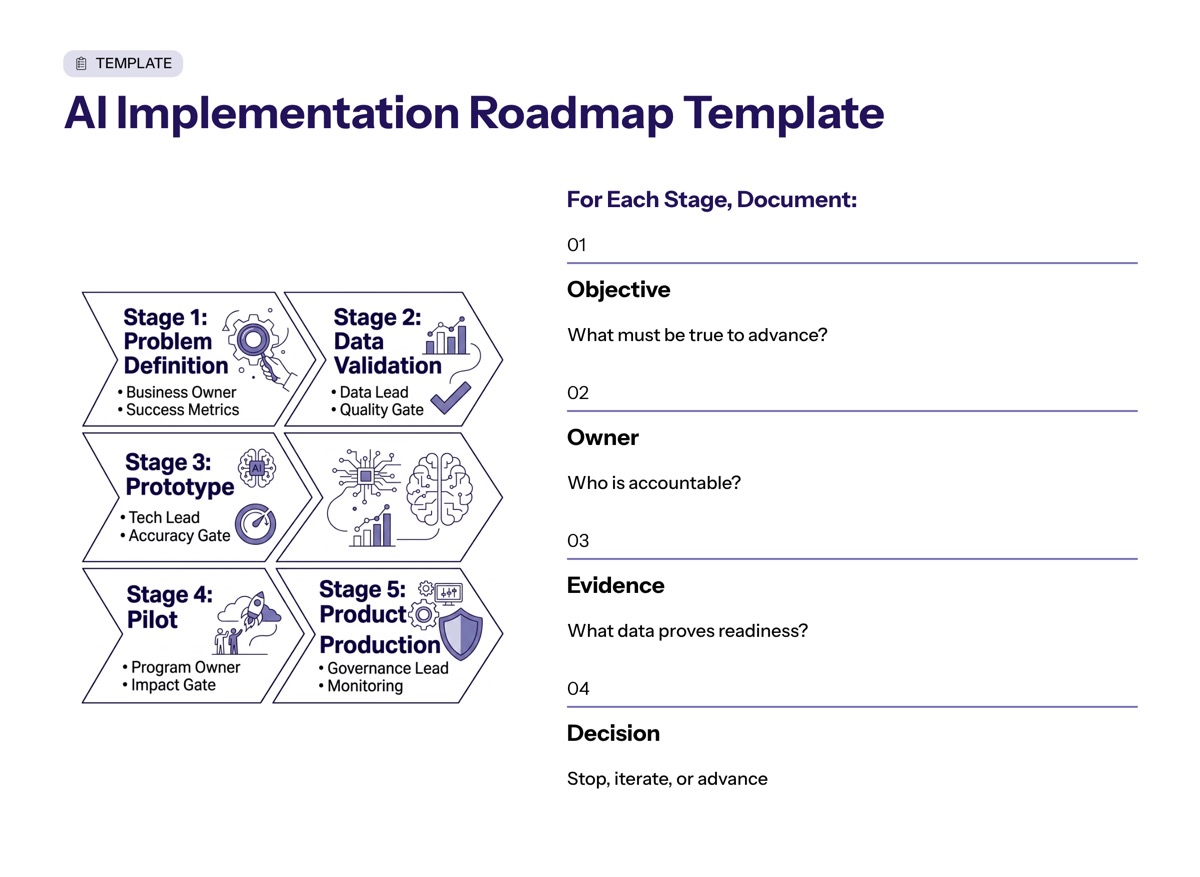
AI Implementation Roadmap Template
The stage-gate framework above functions as a practical ai implementation roadmap template. To adapt it for your organization:
For each stage, document:
-
The specific business outcome being validated
-
The named owner accountable for the gate decision
-
The required inputs and where they will come from
-
The evidence threshold that must be met before advancing
-
The conditions under which the team will revise scope or stop
Customization by organization size: Mid-market organizations with fewer internal data scientists should weight Stage 3 toward build-vs-buy analysis and vendor evaluation. Smaller teams benefit from combining the compliance and architecture reviews into a single gate. Larger organizations operating in regulated industries (healthcare, financial services, fraud detection) should strengthen Stage 2 and Stage 3 with external legal review, audit log requirements, and regulatory documentation.
Integration with existing governance: Map each stage to your organization's existing project management and data governance frameworks. The stage-gate table's columns (decision, owner, inputs, evidence, exit criteria, stop conditions) align with standard governance review structures. Successful AI implementations require clear stakeholder roles from day one; this template ensures those roles are assigned and documented at every gate.
Cultural change investment leads to 5.3× higher AI success rates. Include change management, continuous learning plans, and ai champions in your template alongside technical milestones. An effective ai implementation roadmap treats adoption and organizational readiness as evidence requirements, not afterthoughts.