AI Proof of Concept Exit Criteria: Move Forward, Change, or Stop
An AI proof of concept should move forward only when it produces evidence across business value, technical performance, data readiness, architecture, user workflow, security, economics, ownership, and production operations. A successful demonstration proves that something worked under particular test conditions. It does not automatically prove business value, user adoption, production reliability, integration feasibility, security, scalability, acceptable operating cost, or supportability.
This guide helps technology leaders evaluate AI PoC evidence and make one of four decisions: move forward, change approach, run another bounded test, or stop. It is written for product, engineering, innovation, data, and operations leaders who are planning an AI proof of concept or deciding whether an existing experiment should move toward production. The distinction matters because more than 50% of AI projects are abandoned before reaching production, often due to poor data quality, unclear business outcomes, or inadequate risk controls. A well-defined PoC guides teams to either pivot or proceed with a minimum viable product-but only when exit criteria are met.
After reading this guide, you will have:
-
A structured decision framework covering ten evaluation areas for AI proof of concept development
-
Evidence-based exit gates that distinguish technical feasibility from production readiness
-
A practical exit criteria decision table adaptable to your use case
-
Four explicit decision paths with clear conditions for each
-
Warning signs and common mistakes that lead to poor exit decisions
Understanding What an AI Proof of Concept Should Actually Prove
A useful ai proof of concept tests the riskiest material assumptions-those that, if false, would invalidate the case for production investment. It should not attempt to simulate an entire production system unless that scope is explicitly necessary. An AI PoC tests technical feasibility within a limited scope, typically running for a few weeks to reduce costs while generating evidence for real-world applicability. Building the smallest technically credible prototype is essential in a PoC. Choosing the simplest viable ai approach keeps the experiment focused on what matters.
A successful AI PoC answers specific feasibility questions. It does not create a miniature full system. The difference between validating feasibility and building for scale is fundamental: attempting both at once wastes effort, obscures evidence, and makes exit decisions harder.
Business Problem Validation
The first material assumption is that the business problem is worth solving and that artificial intelligence is the appropriate solution. Defining a single clear problem is critical for building an effective PoC. The PoC should clearly identify the expected business outcomes and benefits before development begins.
This means identifying a clear intended user and establishing measurable improvement expectations-such as reducing manual review time by a specific percentage or increasing throughput by a defined factor. Vague claims like "improve efficiency" do not qualify as defined success metrics. A successful poc provides evidence for making rational investment decisions, not enthusiasm for a proposed solution.
Technical and Data Assumptions
The second set of material assumptions concerns whether the required data is usable and accessible for production workflows, and whether the ai model can perform the bounded task under realistic conditions. AI PoCs help identify data readiness and expected outcomes early, before committing to full scale implementation.
Using a small, clean set of real data is important in testing AI concepts. Auditing data for quality, bias, and volume is crucial before an AI PoC. If the ai poc model was tested only against curated data or synthetic data, that gap must be documented. Data availability and data quality issues surface here-not after production investment has been approved.
Operational Readiness
The third assumption cluster addresses whether real users can review and apply the output within existing workflows, whether the architecture supports the workflow with controllable risks, and whether a production owner exists with clear accountability. Involving real users during a PoC helps gather practical feedback that demo conditions cannot replicate.
AI PoCs help uncover hidden bottlenecks in workflows. Without testing operational readiness, a technically viable ai solution may still fail in production because it introduces extra steps, review overhead, or delays that erase the expected business value. Lack of ownership can result in unused AI PoC outcomes-a pattern that recurs across industries.
Evidence Requirements for Production Readiness Decisions
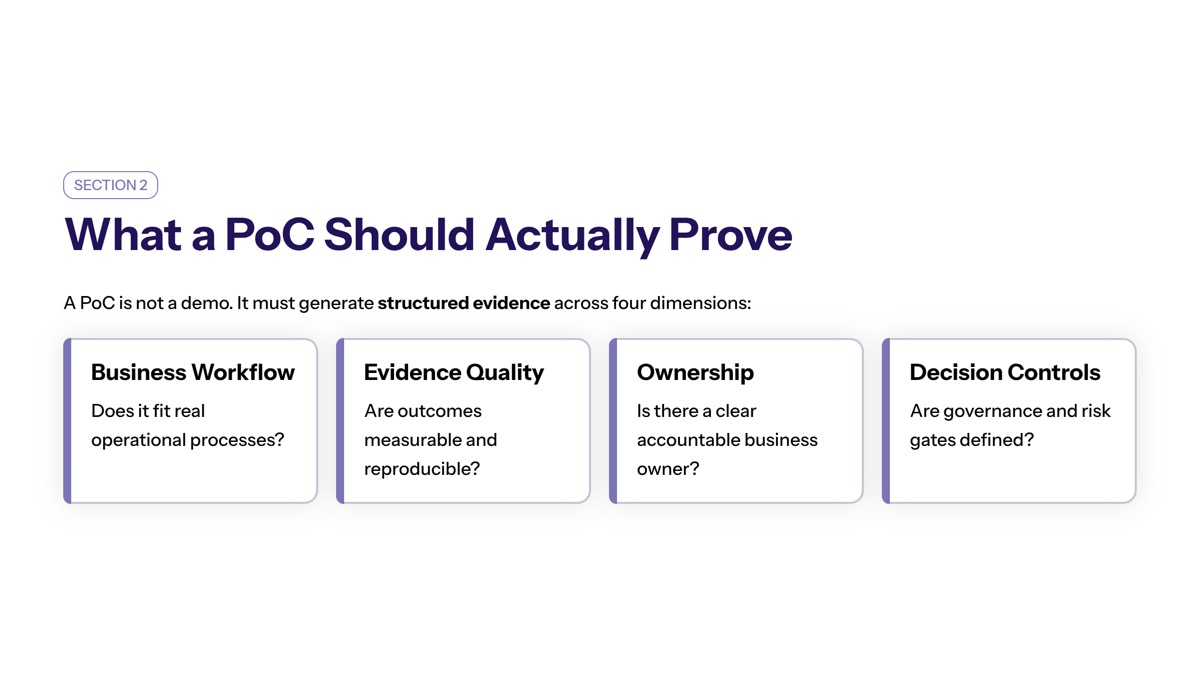
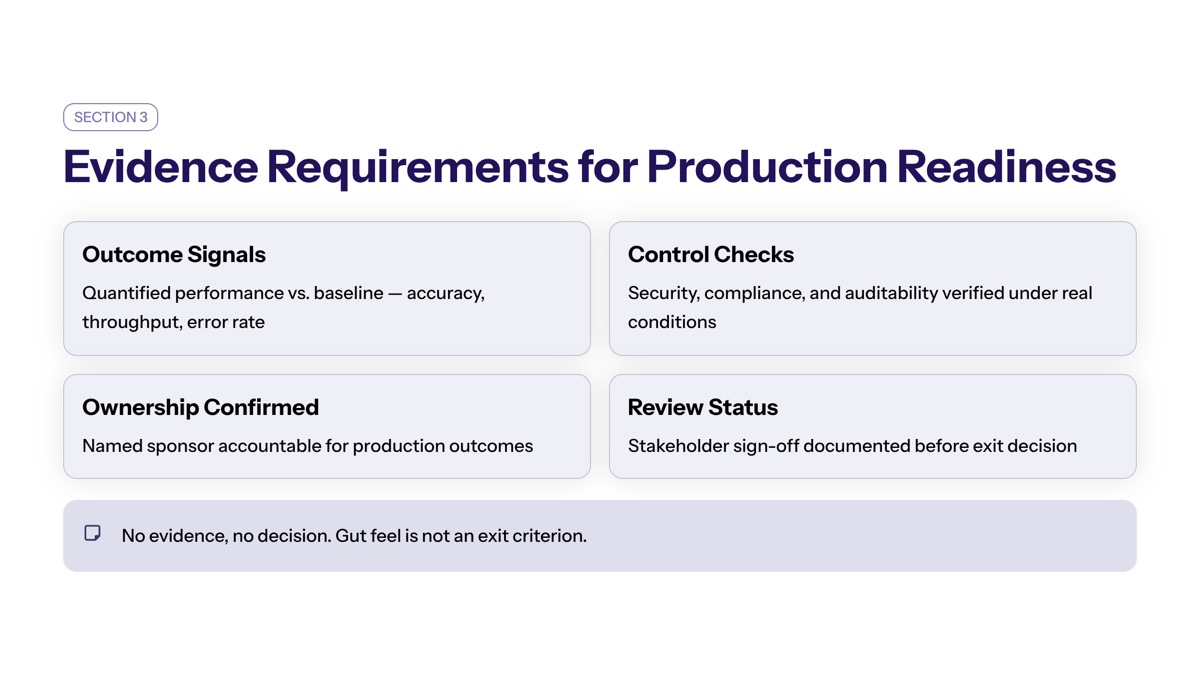
Ten critical evaluation areas determine whether an AI proof of concept is ready for production. Evidence collection differs from assumption validation: assumptions guide what to test, while evidence documents what was actually observed. AI PoCs provide actionable insights for informed decision-making only when evidence is collected systematically against predefined criteria.
Organizational readiness differences account for roughly 48% of the success difference in capturing AI value-suggesting that data governance, architecture, ownership, and change management matter nearly as much as model performance .
Business Evidence Assessment
Before the PoC begins, document baseline models of current workflow: time spent, cost, quality levels, error rates, throughput, and user pain points. These workflow observations and time/quality baselines form the reference against which improvement is measured.
Evidence should include error patterns and user feedback with measurable improvement indicators. Business evidence must also include attribution-did changes stem from AI or other concurrent interventions? Use A/B tests, control groups, or other comparative designs when possible. Service or customer evidence showing the ai solution meets expectations strengthens the case.
Questions to answer:
-
Is the business problem material?
-
Who experiences it?
-
What is the current baseline?
-
What should improve, and by how much?
-
Can the improvement be observed?
-
Is AI responsible for the observed change?
-
Does the expected business value justify further work?
Do not invent ROI or productivity assumptions. Implementing AI PoCs can drive up to 2x higher ROI, but that outcome depends on rigorous evidence, not optimistic projection. Measuring economics is necessary to assess the business viability of a PoC.
Model and Technical Performance Validation
Technical performance metrics include accuracy, precision, and recall-but these must be evaluated against representative inputs, not cherry-picked successes. Test sets should include normal cases, edge cases, ambiguous inputs, adversarial inputs, missing values, incorrect source material, and realistic output requirements. Testing failure modes and risks is crucial in evaluating AI solutions.
Require a defined test set with reproducible evaluation. Document the model and version, record limitations, and establish clear human-review requirements and failure conditions. Define acceptance thresholds before testing-such as 95% precision, less than 2% false negatives, or latency under 200ms under load. AI project PoCs must be evaluated against predefined quantitative metrics.
A compelling demonstration using selected examples is weak evidence. Using a minimal viable model allows quick testing of AI ideas in a PoC, but the evaluation must reflect real world conditions, not controlled environment performance alone. Error analysis must document where and how the model fails, not just where it succeeds.
Data Exit Criteria
Evaluate data availability, ownership, access, data quality, and classification before declaring the PoC successful. Verify that the data used is available and usable in production: ownership rights, access latency, label quality, and clean data pipelines must all be confirmed. Data preparation is crucial for AI PoC success and involves cleaning, normalization, and validation.
Confirm data classification (sensitive, personal, proprietary), privacy permissions, retention policies, and compliance with regulations such as GDPR or HIPAA. Representative coverage-across demographics, edge cases, and operational scenarios-ensures fairness and robustness in the data assessment.
Expect ongoing maintenance: periodic retraining, drift detection, data label refreshes. If manual preparation required in the PoC cannot scale, that becomes a critical gap. The warning sign: the proof of concept succeeds only with carefully cleaned or manually selected data. Using non-representative data can yield misleading AI PoC results.
Architecture and Integration Requirements
Assess whether existing systems support model hosting, inference latency, API interfaces, identity and permissions, logging, monitoring, and failure isolation. A PoC may accept temporary infrastructure, but production requires defined architecture with clear integration paths to user interfaces, data storage, authentication, version control, and configuration management.
Check vendor dependencies, portability, and failure handling. Is the ai model tied to a third party tools provider with licensing risk? If cloud or external services are used, understand scalability, cost, and lock-in. Document which shortcuts were acceptable for the proof of concept and which must be replaced before full scale development .
Require a visible list of:
-
Temporary components
-
Production gaps
-
Technical debt
-
Integration assumptions
-
Required architecture decisions
User and Workflow Evidence
Representative users must test the PoC-not just analysts or technical teams. Observe how output integrates into the actual workflow and whether users trust it, understand it, and can detect errors. Survey or observation data should show usability, not just satisfaction. A successful AI PoC balances speed with rigorous validation processes, and that includes validating user adoption.
Look for workflow fit: does AI introduce extra steps, review overhead, or delays? If error correction takes more time than savings, measurable value evaporates. Clarify escalation paths and human oversight: when the model fails or behaves unexpectedly, is there a human-in-loop or a fallback plan?
Distinguish between:
-
Positive demo feedback
-
Repeatable workflow adoption
-
Evidence of improved work
Do not equate user enthusiasm with validated ai adoption. Operational impact indicators assess process-level improvements, not impressions.
Security and Risk Assessment
Evaluate data exposure, identity management, access controls, and-for generative ai-prompt injection risks, hallucinations, and sensitive output disclosure. The PoC should include threat models. For production, security and compliance requirements must be assessed early, not deferred.
Require a named risk owner with documented material risks and production controls. Define which risks are accepted and which must be mitigated before going to production. Incident response and reversibility strategies-rollback, error correction, logging, monitoring for drift or misuse-should be designed even if not fully implemented during the PoC.
Do not claim compliance assurance. Instead, document:
-
Unresolved risks visible to decision makers
-
Production controls identified
-
Explicit acceptance or remediation decisions
Economic Evidence Evaluation
Map the full cost structure: model usage, infrastructure, data preparation, integration, engineering, human review, monitoring, support, security, vendor licensing, and change management. PoC often omits many of these costs; those omissions must be accounted for before production approval.
The economic model should show how costs and benefits scale: what happens at production volume versus PoC sample size? Include sensitivity analyses-what happens if usage is less than expected, if error rate is higher, if computing cost increases. AI PoCs can reduce costs by testing models without full investment, but the economic case must hold at production scale.
Questions to answer:
-
Which costs were excluded from the proof of concept?
-
Does the economic case change at production volume?
-
Does human review remove expected savings?
-
What operating costs continue after launch?
-
What uncertainty remains?
Ownership and Accountability
Require named ownership for business outcome, product workflow, data pipelines, architecture, security, user adoption, measurement, production operation, incident response, and budget. Without clear ownership, accountability is diffuse and projects stall-even with strong technical results. Unclear ownership is one of the most common reasons ai initiatives fail to reach production.
Ownership includes budget authority, decision-making, incident response, and support post-launch. All need an identified person or team. A proof of concept with no production owner is not ready to move forward. This is not a procedural formality; it determines whether anyone is accountable for business performance after launch.
Exit Criteria Assessment Framework
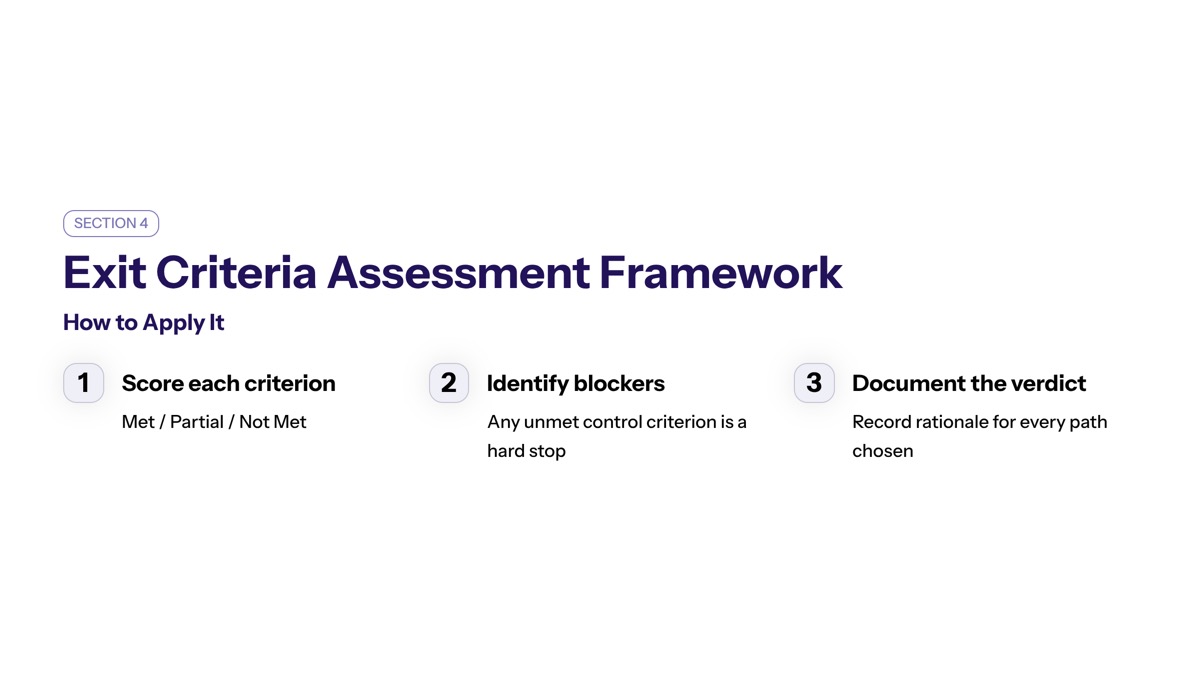
Establishing decision gates and predefining criteria before the PoC begins are among the strongest signals of success. AI PoCs should define measurable success criteria before development. Criteria written after seeing the result create confirmation bias-a pattern that undermines many ai projects .
Pre-Development Decision Definition
Before any code or model development begins, document:
-
Business problem and intended user
-
Workflow the AI will affect
-
Hypothesis to test
-
Riskiest assumptions that, if false, invalidate the investment
-
Test scope and evidence required
-
Acceptance criteria with specific performance metrics
-
Failure criteria that trigger a stop decision
-
Decision owner with authority to act
-
Review date with possible next decisions
Establishing clear success metrics is essential for an effective AI PoC. Unclear success criteria often lead to ineffective AI PoCs because teams cannot distinguish between evidence and enthusiasm. Confusing validation with justification undermines AI PoC value-a trap that predefined criteria prevent.
Exit Criteria Decision Table
The following table provides a structured framework for evaluating PoC evidence. Criteria must be contextual-appropriate to the use case and its consequences-not universal thresholds.
|
Decision Area |
Evidence Required |
Acceptance Criterion |
Failure Signal |
Unresolved Gap |
Owner |
Decision |
|---|---|---|---|---|---|---|
|
Business Value |
Baseline workflows documented, improvement measured |
Improvement exceeds minimum threshold relative to baseline |
No measurable improvement or unclear attribution |
Scale of improvement at production volume |
Business lead |
Move / Change / Stop |
|
AI Fit |
Hypothesis tested against material assumptions |
AI outperforms or matches baseline models with acceptable overhead |
Non-AI approach achieves comparable results at lower cost |
Edge case coverage |
Product lead |
Move / Change / Stop |
|
Model Behavior |
Tested on representative, edge, adversarial, and missing inputs |
Meets predefined accuracy/precision/recall thresholds |
Performance below thresholds on representative data |
Drift detection, retraining requirements |
Data science lead |
Move / Change / Test |
|
Data |
Availability, quality, classification, privacy verified |
Production data path exists and is legally accessible |
Data requires manual preparation that cannot scale |
Ongoing label refresh, drift monitoring |
Data engineering lead |
Move / Change / Stop |
|
Architecture |
Integration path documented, temporary components identified |
Existing systems support model hosting, APIs, monitoring |
No viable integration path or unacceptable vendor lock-in |
Production infrastructure buildout |
Architecture lead |
Move / Change / Stop |
|
Integration |
End-to-end workflow tested including data movement |
Latency, permissions, failure handling meet requirements |
Critical integration dependencies unresolved |
Third-party API stability |
Engineering lead |
Move / Change / Test |
|
User Workflow |
Representative users tested output in realistic workflow |
Users can detect errors, trust is calibrated, adoption repeatable |
Users avoid or override output, review creates more work |
Training, change management needs |
Product lead |
Move / Change / Stop |
|
Security |
Threat model created, risks documented, controls identified |
Material risks mitigated or explicitly accepted |
Unacceptable data exposure or no risk owner |
Full penetration testing, compliance audit |
Security lead |
Move / Change / Stop |
|
Economics |
Full cost structure mapped including omitted PoC costs |
Economic case holds at production volume with sensitivity analysis |
Human review removes expected savings, costs scale poorly |
Long-term operating cost uncertainty |
Finance / Business lead |
Move / Change / Stop |
|
Ownership |
Named owners for all ten areas |
Every area has accountable person with budget authority |
No production owner identified |
Post-launch support staffing |
Executive sponsor |
Move / Stop |
|
Production Ops |
Monitoring, logging, alerts, rollback, documentation scoped |
Reliability targets achievable with planned infrastructure |
No viable operations path |
Training, business continuity planning |
Operations lead |
Move / Change / Stop |
Note that criteria must be appropriate to the use case and its consequences. High-risk domains (healthcare, finance) demand stricter thresholds than internal productivity tools.
Four Exit Decision Paths
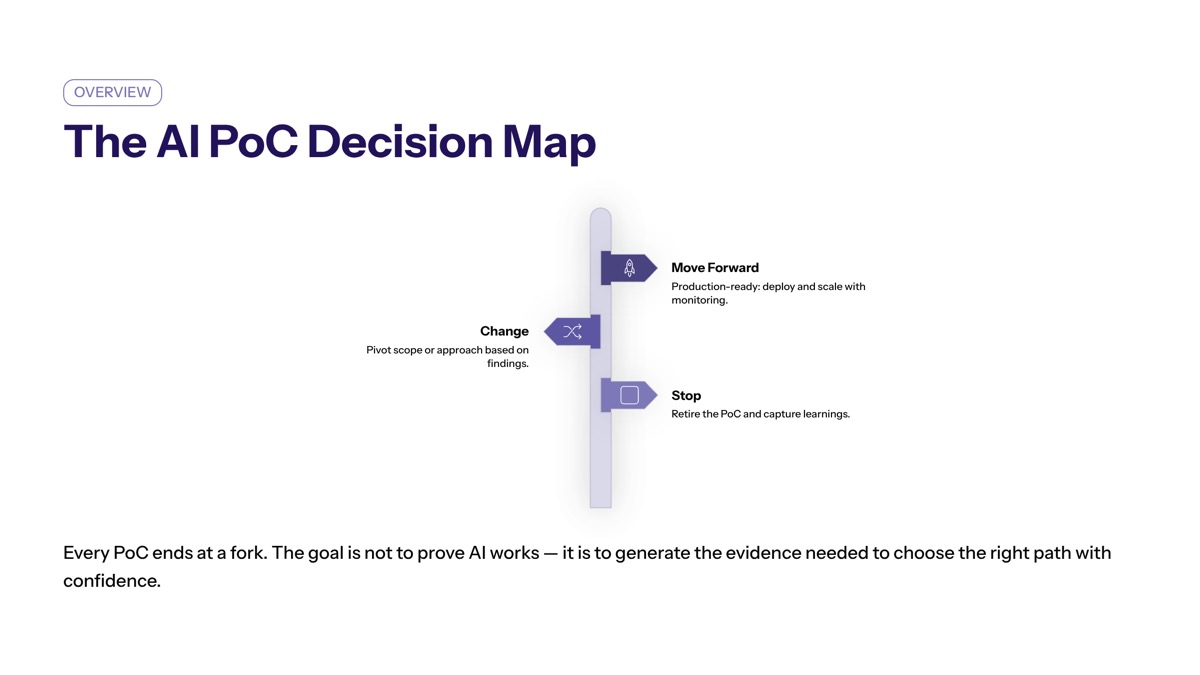
A well-measured PoC leads to clear decision outcomes: proceed, adjust, or stop. Based on the evidence collected across all evaluation areas, leadership should choose one of four paths.
Move Forward when:
-
The business problem remains valuable
-
Material assumptions have supporting evidence
-
Known limitations are acceptable or manageable
-
Production gaps are visible and bounded
-
Owners are named for every area
-
The next investment is bounded with continued success criteria and stop criteria
Move forward does not mean "launch immediately." It may authorize production preparation-architecture buildout, integration engineering, security hardening, operations planning. An MVP validates whether an ai solution delivers user value; a pilot evaluates readiness for wider deployment in real conditions.
Change Approach when:
-
The business problem remains valid
-
AI is only partially appropriate or a different ai approach may be better
-
A different model, workflow, architecture, data path, or human-review design could address gaps
-
The original scope is too broad
-
The economic case requires redesign
Require the changed hypothesis and new evidence needs to be documented before the next iteration begins. Resource allocation for the changed approach should reflect lessons from the initial PoC.
Run Another Bounded Test only when:
-
One or more material assumptions remain genuinely unresolved
-
A focused test can produce the missing evidence
-
The test has a defined end, scope, timeline, and decision criteria
-
Leadership knows what decision the result will support
Do not recommend another test simply to avoid stopping. AI PoCs typically run for a few weeks; extending without clear evidence needs wastes resources and delays decisions.
Stop when:
-
The business problem is not material
-
AI is not the appropriate model for the problem
-
Evidence does not support the expected business value
-
Data cannot be used responsibly
-
Risk is disproportionate to value
-
Users cannot apply the output
-
Economics are not defensible
-
No accountable owner exists
-
The production burden exceeds the value
Stopping a weak ai proof of concept is a successful decision when it prevents greater waste or risk. A well-defined PoC guides teams to either pivot or proceed-and "stop" is a legitimate outcome that protects strategic priorities and resource investment.
Production Operations Assessment
Before moving forward, evaluate whether the future system requires authentication, monitoring, logging, alerts, support, incident response, configuration management, model-version management, cost monitoring, reliability targets, documentation, training, business continuity, and retirement or rollback capabilities.
These capabilities may not belong inside the proof of concept, but their scope and ownership must be visible before production approval. Determine reliability targets: uptime, latency, error tolerances. Infrastructure must support those under production-grade load . A PoC often runs under simplified conditions; assess whether production conditions differ meaningfully.
Support, change management, and training for both users and maintainers must be defined. Identify who maintains models, who stages updates, who handles drift or fairness issues, and who manages ai literacy across affected business units.
Common PoC Exit Decision Mistakes
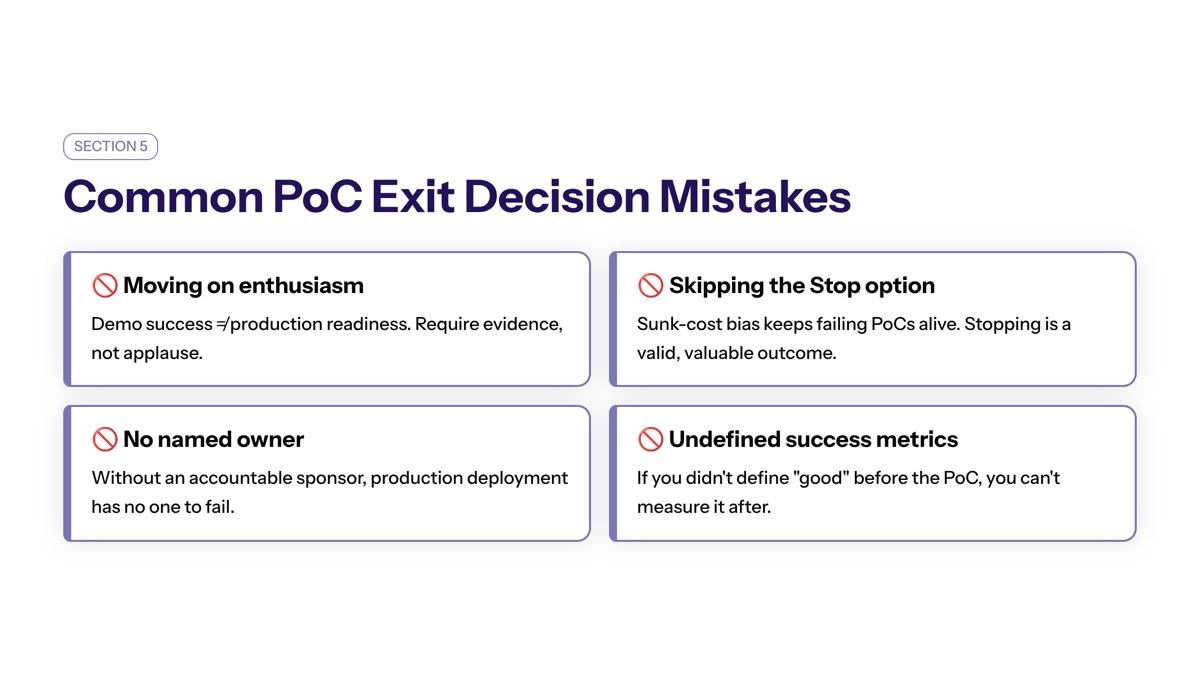
The most frequent errors that lead to poor exit decisions share a common pattern: they substitute impression for evidence. Recognizing these pitfalls before they influence decision-making is essential for any ai initiative.
Declaring Success Based on Demo Performance
Mistaking a compelling demonstration with selected examples for strong evidence is the most common exit mistake. A demo uses curated data, ideal inputs, and controlled conditions. Production confronts real world variability, missing values, ambiguous inputs, and adversarial conditions. Overengineering can complicate AI PoC projects unnecessarily, but under-testing is far more dangerous.
The fix: evaluate against the full test set including edge, adversarial, and failure cases. If the team identifies strong demo results but weak performance on representative data, the PoC has not validated technical feasibility.
Changing Criteria After Seeing Results
Post-hoc rationalization creates confirmation bias. When success criteria shift to accommodate weak results, the PoC becomes justification theater rather than evidence collection. AI PoCs should define measurable success criteria before development-and maintain those criteria through evaluation.
The fix: lock acceptance and failure criteria before the PoC begins. If the original criteria prove inappropriate, document why and run a new test with revised criteria rather than retroactively declaring success.
Ignoring Integration and Human Review Costs
Testing with carefully cleaned data that cannot scale to production is a data readiness failure. Leaving security, real users, and architecture decisions until the production phase creates surprises that can invalidate the entire business case. Human review costs are particularly insidious: if every AI output requires manual validation, the expected savings may disappear entirely.
The fix: include integration complexity, human review time, and security assessment in the PoC evidence requirements. Estimate effort for production-grade data pipelines, not just PoC-quality extracting data workflows.
Funding Production Without Clear Ownership
Treating temporary architecture as final and moving forward without accountable owners is a structural failure. Avoiding decisions by recommending another test without clear evidence needs delays the inevitable. Unclear business problem definitions compound this-without an owner who understands the intended outcomes, ai development drifts.
The fix: require named ownership across all ten evaluation areas before approving production investment. A proof of concept with no production owner is not ready to move forward, regardless of model quality or technical performance.
Conclusion and Next Steps
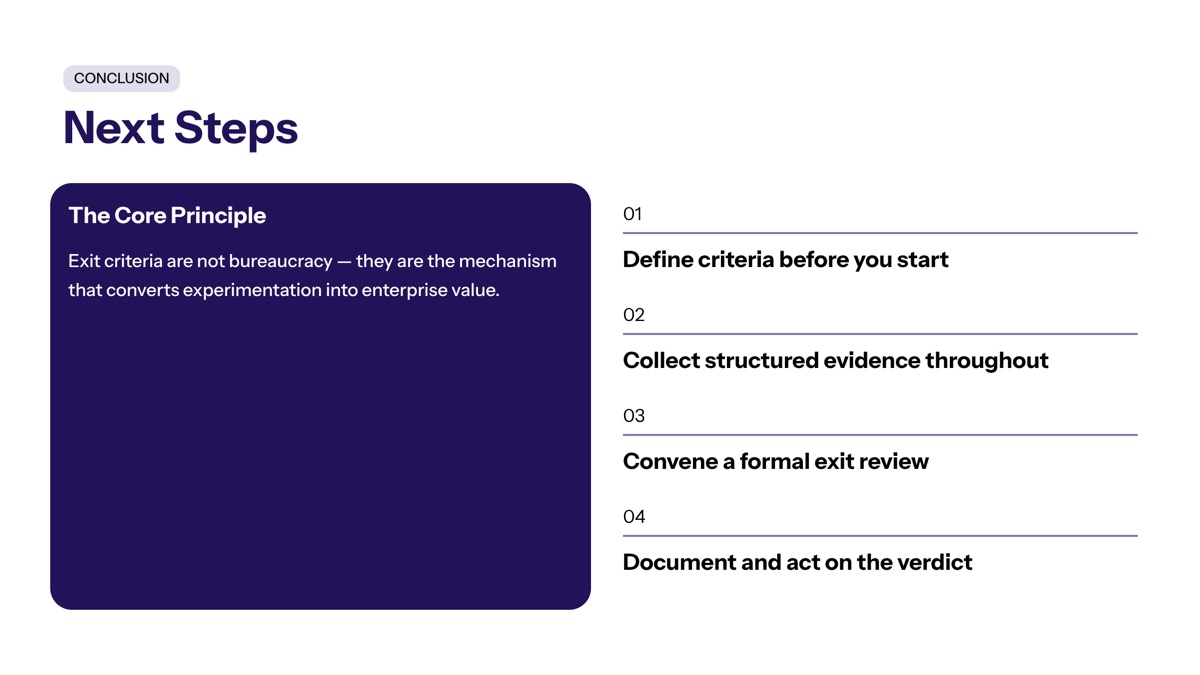
Successful PoC exit decisions require evidence across all ten evaluation areas-business value, AI fit, model behavior, data, architecture, integration, user workflow, security, economics, ownership, and production operations. Technical performance alone is insufficient. A successful poc balances concept development rigor with practical evidence collection, and stopping a weak PoC is a successful decision when it prevents greater waste or risk.
Immediate Action Steps
-
Document current PoC evidence against the ten evaluation areas using the exit criteria table above
-
Schedule a stakeholder review with predefined decision criteria and named decision owners
-
If gaps exist , define focused tests with bounded scope and timeline, or establish stop criteria rather than continuing indefinite experimentation
Production Planning Considerations
-
For PoCs ready to move forward: Plan an AI-first architecture assessment that addresses integration, security, operations, and scalability before full scale implementation
-
For PoCs requiring changes: Document the new hypothesis, revised evidence requirements, and adjusted success criteria before the next iteration. Apply learnings from the initial ai poc development cycle
-
For stopping decisions: Apply learnings to future AI readiness assessment and use case selection. Stopping preserves resources for higher-value ai strategy opportunities
To plan production AI based on your PoC evidence, schedule a conversation with Cognativ .
Fictional Example: Enterprise Document Processing PoC
This example is fictional and does not represent a Cognativ client engagement.
Initial idea: AI-powered invoice processing to reduce manual review time by 60%.
Business problem: A mid-market finance team spends 15 hours weekly on invoice validation across three business units. Error rates average 4%, and late processing creates vendor payment delays.
Hypothesis: A generative ai extraction model can identify and extract key invoice fields (vendor, amount, line items, dates) with 95% accuracy, reducing manual validation to exception handling only.
Evidence collected:
-
The ai poc model achieved 94% accuracy on a test set of 500 invoices-close to the 95% threshold
-
Technical metrics showed strong performance on standardized invoice formats but 78% accuracy on non-standard layouts (approximately 30% of production volume)
-
Data assessment revealed that the PoC used pre-cleaned invoice images; production invoices include scans with variable quality, handwritten annotations, and missing values
-
Manual data cleanup during the PoC consumed 6 hours weekly-negating nearly half the expected time savings
-
Foundation models used required cloud-based API calls; security review identified sensitive financial data exposure risks
-
No production owner was named for ongoing model maintenance or data pipeline operations
Positive result: The model demonstrated technical feasibility for standardized invoices and users reported the output was understandable and useful for the majority of cases.
Material unresolved gap: The data preparation overhead and non-standard invoice accuracy gap erased expected time savings. The operational constraints of manual cleanup could not scale, and the security risk of cloud-based processing of financial data required remediation.
Final decision: Change approach. The team documented a revised hypothesis focused on automating data quality preprocessing before AI extraction, narrowing scope to standardized invoices first, and evaluating on-premises model hosting to address security concerns. New success criteria, a revised timeline, and named owners were established before the next bounded test.
This decision preserved the business case while preventing premature production investment in an ai solution that had not yet demonstrated viable economics or acceptable security posture under real world conditions.