AI Consulting Costs: Scope Drivers and Engagement Models
AI consulting costs are determined by six primary scope drivers: business problem complexity, data condition and infrastructure readiness, integration and production requirements, regulatory and security risk, delivery scope (strategy, proof of concept, or production), and internal organizational readiness. No single hourly rate or project fee answers the question of how much AI consulting services cost because the same consulting firm can deliver a $20,000 discovery engagement and a $500,000 production deployment depending on what the work actually requires.
This article covers the cost drivers and engagement models that mid-market business, technology, operations, and procurement leaders need to understand before requesting estimates from AI consulting providers. It is not a general introduction to artificial intelligence or a catalog of AI tools. It is focused on what changes the scope, what you're paying for, and what information you need to prepare before productive conversations with potential AI consultants begin.
AI consulting costs vary from low five-figure discovery engagements to six- and seven-figure production implementations, with the primary variation driven by problem scope, data readiness, integration depth, and whether the deliverable is a strategy document, a working proof of concept, or a production system with monitoring, security, and ongoing optimization.
By the end of this article, you will understand:
-
What specific factors drive AI consulting pricing and why simple price comparisons mislead
-
How common engagement models structure scope, risk, and payment terms differently
-
What work categories your AI consulting investments actually fund
-
Why inexpensive proof of concepts often become expensive production projects
-
What information to prepare and what questions to ask before your first AI engagement
Understanding AI Consulting Cost Drivers
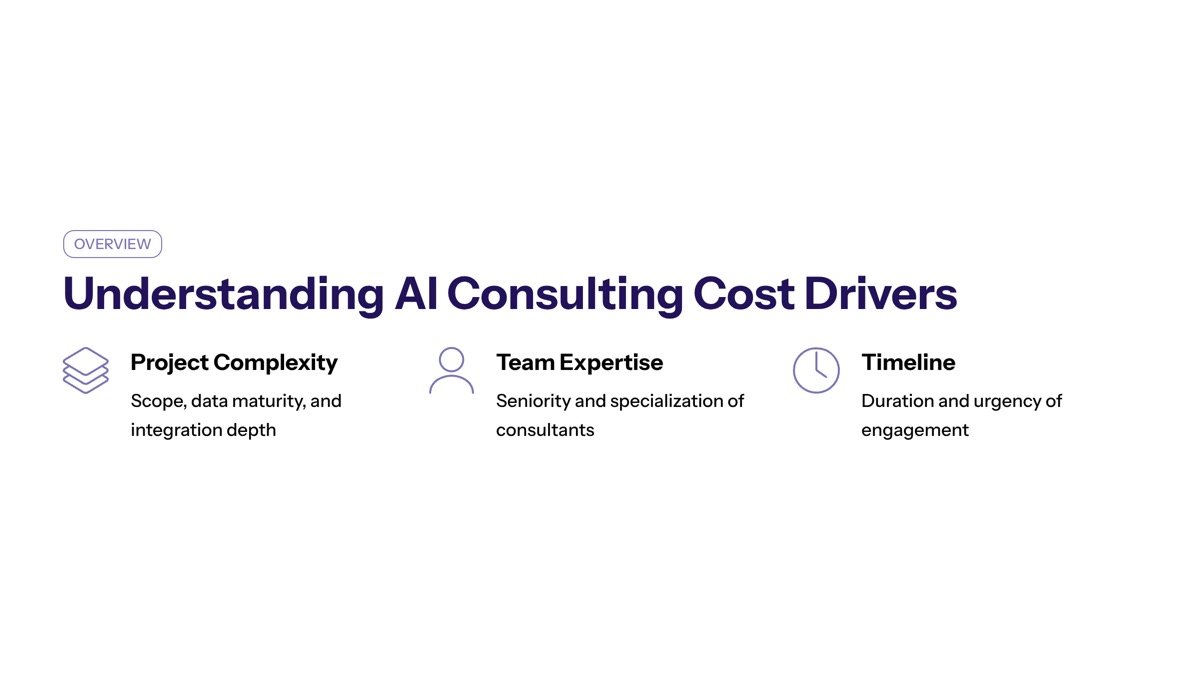
Cost drivers determine project effort, risk, and required expertise more than any consultant's hourly rate. Two engagements with identical billing rates can differ by hundreds of thousands of dollars based on the scope each driver introduces. The largest cost drivers in AI consulting include project complexity and data readiness, and understanding each one gives buyers the ability to influence total cost before AI work begins.
Business Problem Clarity and Complexity
A well-defined problem-"reduce invoice processing time by 50% for the accounts payable team"-with clear success metrics, identified users, and measurable business outcomes reduces discovery time and scope uncertainty. When the problem statement is vague, spans multiple business units, or lacks stakeholder alignment, expect additional workshops, requirement gathering, and governance setup before any technical work begins.
Complexity also determines the seniority of the team required. Strategic design and architecture decisions for multi-departmental AI initiatives require senior AI architects and enterprise strategists whose specialized expertise commands premium consulting rates. A single-workflow automation project may need a smaller, more focused team. Specialized expertise can add a 20-30% premium to consulting rates, which is justified when the alternative is costly rearchitecture downstream.
Data and Infrastructure Readiness
Data readiness is where most AI consulting project budgets expand beyond initial expectations. Clean, accessible, well-documented data is assumed but rarely present. According to industry analyses, data cleaning often consumes 30% to 50% of total project efforts and budgets. When sources include unstructured data (documents, emails, media), missing metadata, poorly documented source systems, or privacy-sensitive records, each issue adds preparation effort before any model development begins.
Organizations that invest in data readiness save 20-30% on AI consulting costs ( McKinsey ). Existing architecture and technical debt also matter. Connecting AI to legacy systems increases engineering and testing requirements, particularly when those systems lack modern APIs or use custom data formats. An AI readiness assessment conducted before implementation scoping can surface these issues early, before they become budget surprises.
Integration and Production Requirements
The difference between an isolated proof of concept and a production deployment is substantial. A proof of concept can run with limited features, sample data, and a demonstration interface. Production deployment demands scaling, stable model serving, API integrations, identity and access management, monitoring, logging, rollback procedures, security controls, audit trails, and failover capability.
In regulated industries-healthcare, financial services, government-compliance requirements (HIPAA, EU AI Act, SOC 2) add documentation, governance, and testing work. Industry sources estimate that hidden costs from compliance, security, and governance can add 20-40% to consulting fees ( Corporate AI Consultants ). The number of users, workflows, and business units further compounds scope: more stakeholders raise coordination overhead, change management requirements, and testing complexity. Platform and infrastructure costs can add 10-30% to budgets beyond consulting fees, including cloud compute, storage, and API usage. API usage can create variable costs depending on input/output tokens and workload volume.
Common AI Consulting Engagement Models
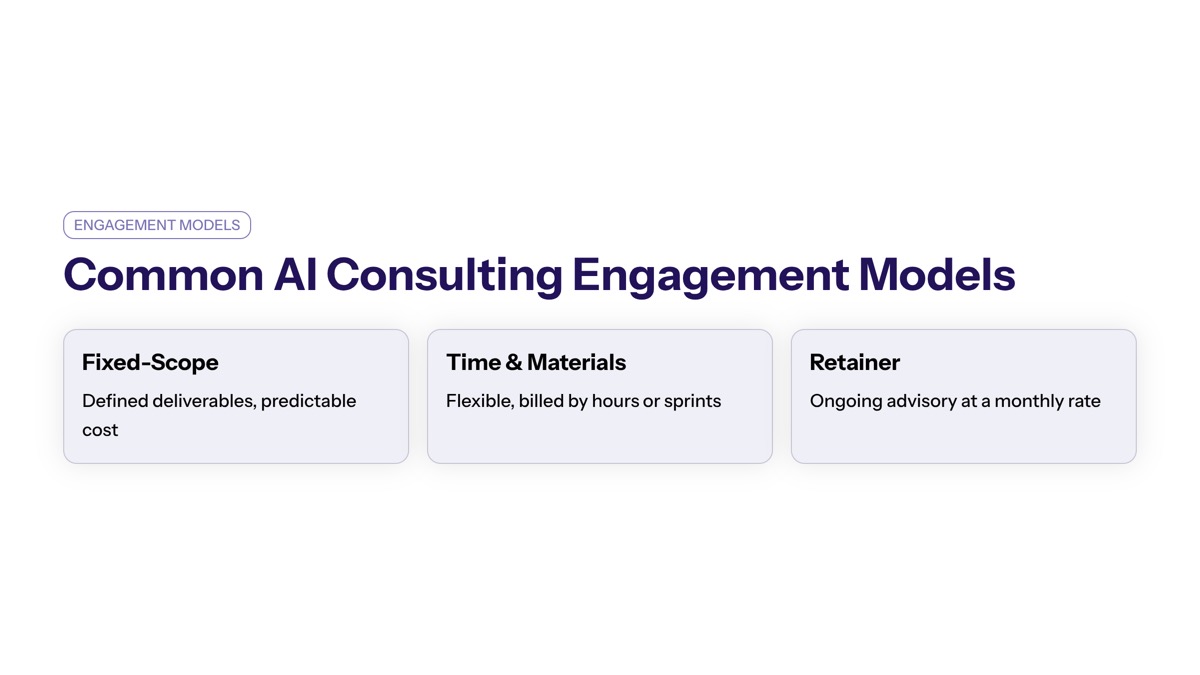
Engagement models structure scope, risk, and payment terms differently. Understanding which model fits your situation prevents misaligned expectations between consulting clients and providers. AI consulting pricing includes fixed project, retainer, and value-based pricing models-each appropriate for different levels of scope certainty and organizational readiness.
Discovery and Readiness Assessment
A discovery or AI readiness assessment covers current state analysis-data infrastructure, team capabilities, technology stack-and identifies AI opportunities, feasibility, and a high-level roadmap. Typical deliverables include architecture assessments, gap analyses, and risk evaluations.
Timeline usually runs 2–4 weeks. Industry sources indicate that focused discovery engagements covering one or two use cases commonly range from $15,000 to $40,000 for mid-market companies ( Moweb ). AI strategy and readiness assessments are relatively inexpensive compared to production deployments. Discovery is essential when the business problem is not clearly defined, data readiness is unknown, or when leadership needs confidence before committing a larger budget. It is optional when the problem, data, and technical environment are already well-documented and validated.
Strategy and Roadmap Development
Strategy engagements go deeper than discovery: they define architecture direction, build business cases, identify decision makers, evaluate vendor and technology options, assess regulatory and compliance risks, and document organizational readiness. These are typically fixed-scope engagements with clearly defined deliverables-strategy documents, implementation roadmaps, cost projections, and risk matrices.
Strategy work sets clear expectations for subsequent AI implementation scope and connects directly to implementation planning. Without it, implementation teams often discover fundamental misalignments mid-project, leading to scope creep and timeline extensions. AI strategy and implementation planning performed before engineering work reduces the risk of building the wrong solution.
Implementation and Production Deployment
Implementation engagements cover the full build: data engineering, model development or integration (fine-tuning, RAG, workflow automation), system integration, user interfaces, security controls, testing, documentation, knowledge transfer, training, and production rollout. AI consulting engagements typically range from $10,000 to $2 million depending on scope.
Two primary contract structures dominate:
-
Time-and-materials (T&M): Appropriate when scope includes significant uncertainty-data preparation, integration complexity, evolving requirements. Offers flexibility but requires milestone oversight to manage project costs. Hourly billing under T&M contracts provides transparency but demands active project management.
-
Milestone-based delivery: Payments tied to completed phases. Balances flexibility with cost visibility. Each milestone has acceptance criteria, making progress measurable.
Project pricing often reflects fixed-scope proposals with explicit assumptions and acceptance criteria. Fixed fee project structures work when requirements are thoroughly documented and risks are bounded. When scope is uncertain, project based pricing works best with built-in review gates.
For mid-market organizations, first production deployment (discovery through production) commonly runs $80,000 to $200,000 with specialist consulting firms ( Moweb ). ClearForge reports mid-market implementation sprints ranging from $75,000 to $250,000, with enterprise programs reaching $500,000 to $2 million or more ( ClearForge ).
Advisory retainers provide ongoing access to senior AI consulting expertise for strategic guidance, optimization oversight, and emerging opportunity evaluation. Monthly retainers for AI consulting range from $2,000 to $50,000, depending on the scope of embedded support ( Frogslayer ). Retainer models suit organizations that need continuous strategic guidance rather than project-bounded work.
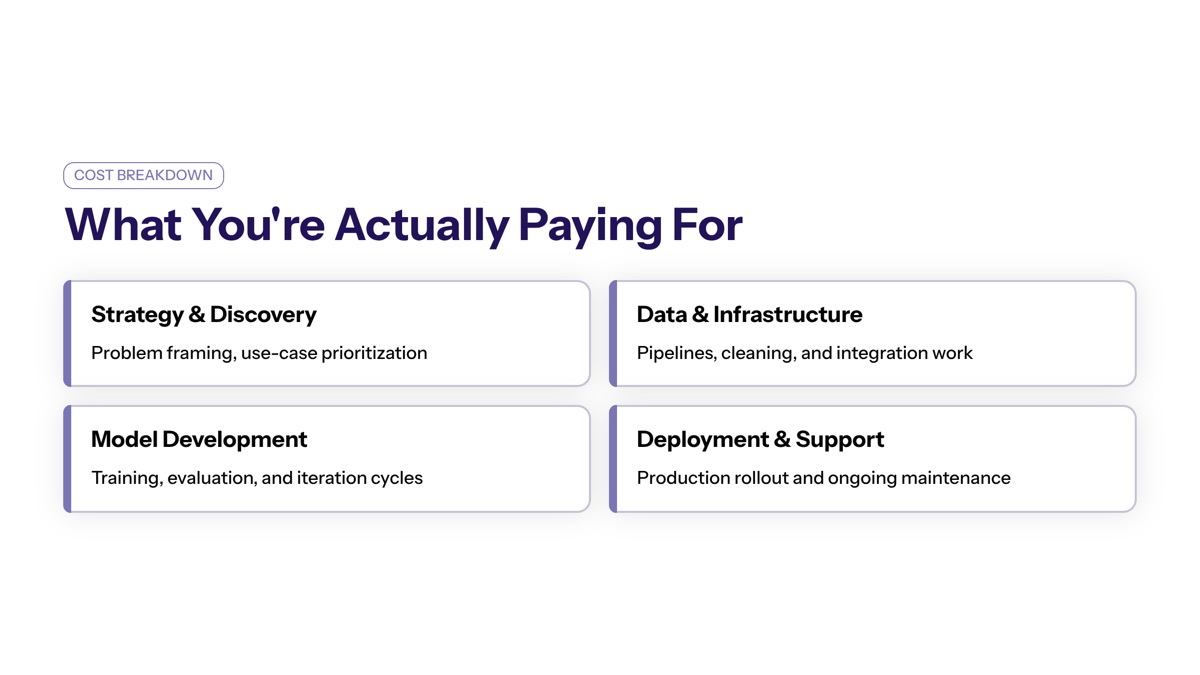
What You're Actually Paying For
Understanding the work categories within an AI consulting engagement helps buyers evaluate proposals and compare AI consulting services on substance rather than surface-level project fees. Each category carries different cost drivers, risk profiles, and value characteristics.
Senior Judgment and Strategic Design
Senior AI consultants and architects contribute problem definition, success metric identification, roadmap design, technology and vendor evaluation, and architectural decisions. Their work includes evaluating trade-offs-custom versus off-the-shelf AI solutions, real-time versus batch inference, RAG versus fine-tuning approaches-that determine downstream cost and performance.
Senior judgment justifies premium AI consulting rates because it prevents costly implementation mistakes and accumulated technical debt. A wrong architectural decision at the design stage can cost multiples of the original consulting fee to correct during or after implementation. Most AI consultants at the senior level command hourly rates from $200 to $400+ per hour for this caliber of work ( Frogslayer ). This is where the ai consulting worth question is answered most clearly: the opportunity cost of poor design decisions typically exceeds the premium paid for experienced architects.
Technical Implementation and Integration
This is the largest work category by volume in most AI consulting engagements. It includes:
-
Data and integration work: Extracting, cleaning, labeling, and transforming data; building pipelines; linking structured and unstructured sources; setting up APIs and embedding stores
-
Software engineering: Model development, prompt engineering, fine-tuning, UI/UX development, back-end services, CI/CD pipeline setup, and performance optimization
-
Testing and validation: Unit tests, integration tests, model evaluation (accuracy, safety, bias), load testing, user acceptance testing, and production validation
-
Documentation and knowledge transfer: Technical documentation for future maintenance, internal team ramp-up materials, and training sessions that build internal capability
Knowledge transfer is a particularly important deliverable. Without it, organizations remain dependent on external consultants for every adjustment, making ongoing optimization permanently expensive. Internal team time can cost six figures during AI projects when accounting for the hours your staff spends on data access provisioning, requirements discussions, testing, and adoption.
Risk Mitigation and Governance
In regulated environments, governance work often exceeds technical development effort. This category includes compliance framework development (HIPAA, SOC 2, EU AI Act), security controls implementation, audit trail configuration, access management, data privacy enforcement, and encryption protocols.
Change management is the largest hidden cost in AI consulting. Organizational adoption-training programs, workflow redesign, stakeholder communication, and resistance management-determines whether a technically sound AI implementation delivers measurable business outcomes or sits unused. A risk management framework that addresses both technical and organizational adoption risks should be part of any serious enterprise AI engagement.
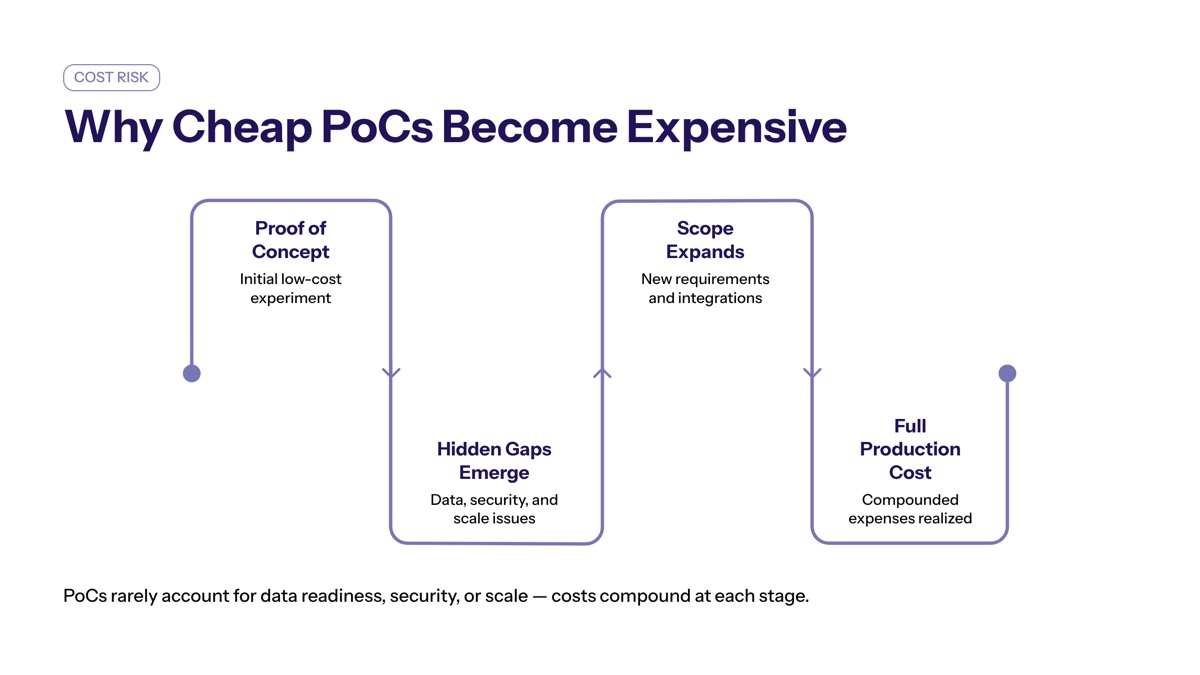
Why Inexpensive Proof of Concepts Become Expensive
A proof of concept built for $30,000–$80,000 can demonstrate that an AI approach works under controlled conditions. What it typically omits tells the real cost story.
Isolated demonstrations routinely exclude identity and access management, multi-tenant architecture, enterprise system integration, real-time inference at production throughput, comprehensive error handling, scaling infrastructure, monitoring and alerting, logging and audit trails, security controls, and ongoing support infrastructure. These are not optional features for working systems-they are requirements for production deployment.
The structural problem is that moving from demonstration to production often requires rebuilding rather than extending. A proof of concept built with sample clean data will encounter production data with missing fields, inconsistent formats, and unstructured content. The data engineering effort that was trivial with curated samples balloons with real-world data. Follow-up consultations can inflate initial project costs by 15-30% when proof of concept assumptions prove incorrect.
A proof of concept approach is appropriate when technical feasibility is genuinely unproven: a novel model architecture, an untested data source, or an approach where the core question is "can this work at all?" When the question is instead "how do we build this for production?"-and production readiness, scale, or regulatory compliance matters from the start-investing in production-grade development from the beginning avoids the cost of building twice.
Properly scoped AI projects deliver faster measurable returns within 6-18 months, while poorly scoped projects that begin as cheap proofs of concept often take longer and cost more in total when production requirements are addressed retroactively.
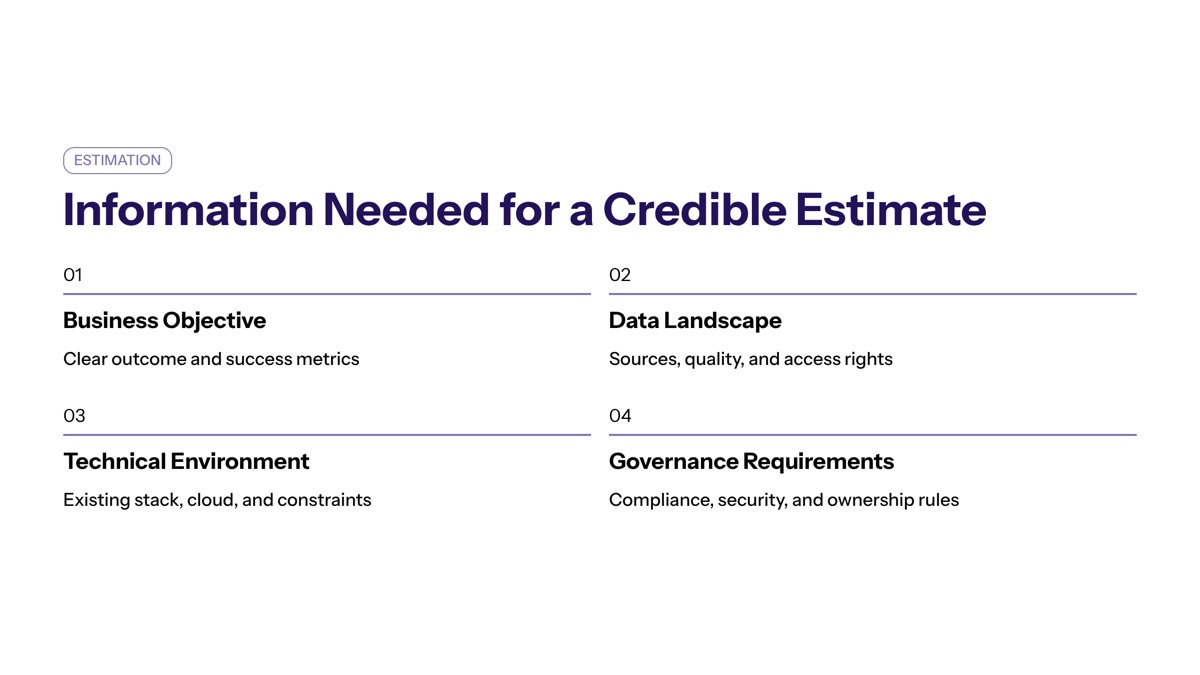
Information Needed for a Credible Estimate
A useful AI consulting estimate requires a bounded problem and visible assumptions. The more precisely you define scope inputs, the more accurately potential AI consultants can model effort, staff appropriately, and propose realistic pricing models. Preparing this information before your sales process with providers begins saves time for both parties.
Business Scope and Requirements
-
Clear business outcome: What metric will move? Efficiency, revenue, error rate, throughput, cost of manual work, user satisfaction. Without a measurable target, no ai consultant cost estimate is meaningful.
-
Users and workflows: Who uses the solution, how many users, what data volume, how many departments or business units are affected.
-
Success criteria: What evidence demonstrates the engagement succeeded? Quantified targets tied to business outcomes.
-
Decision ownership: Who makes trade-off decisions, approves scope changes, signs off on deliverables. Unclear decision ownership extends timelines and increases consulting costs.
-
Timeline and rollout: When is the outcome needed? Phased rollout versus full deployment? Pilot scope versus enterprise scale?
Technical Environment Assessment
-
Current systems inventory: What systems hold relevant data? What APIs exist? Cloud or on-premises infrastructure? Current tech stack and integration points.
-
Data availability and quality: Structured versus unstructured data, volume, format, quality, existing documentation, metadata, privacy classifications, and sensitivity levels. Overall budgets for AI projects should account for data preparation and a contingency buffer.
-
Security and compliance constraints: Industry sector, required standards (HIPAA, SOC 2, EU AI Act), regulatory constraints that will affect architecture and testing scope.
-
Internal technical capacity: Does your team include data engineers, ML engineers, or DevOps staff who can handle portions of integration or ongoing operations? Greater internal capability reduces consulting scope and cost. Ongoing operations include cloud infrastructure and model monitoring after initial deployment.
-
Support expectations post-launch: Monitoring requirements, maintenance, model drift handling, user training, support SLAs, and ongoing optimization needs.
Questions to Ask AI Consulting Providers
Evaluating an ai consulting firm requires understanding their assumptions, capabilities, and engagement terms before signing. These questions surface the information that distinguishes credible proposals from optimistic estimates.
Scope and assumptions:
-
What assumptions underlie the proposed scope regarding data condition, integration complexity, and access to users and stakeholders? What is explicitly excluded?
-
How are change orders handled? What processes govern scope changes and timeline adjustments?
-
How does the firm handle scope creep-through change control documentation, budget reallocation, or renegotiation?
Ownership and deliverables:
-
Who owns deliverables-code, models, trained weights, data artifacts, embeddings, documentation? Is IP ownership clear in the contract?
-
What are the acceptance criteria for each deliverable or milestone?
Architecture and technical approach:
-
What is the proposed architecture? Custom model, fine-tuned model, RAG pipeline, commercial LLM integration, or hybrid? What trade-offs does each choice involve?
-
How does the architecture handle scaling, latency requirements, and production workload?
Security, compliance, and governance:
-
What security, governance, and compliance requirements are included in scope? Audit logging, data privacy, encryption, access controls?
-
How does the provider approach AI implementation challenges specific to your regulatory environment?
Post-launch and support:
-
What support is included after launch-monitoring, drift detection, model updates, bug fixes? What SLAs apply?
-
What does the transition to internal operations look like? Is knowledge transfer included as a deliverable?
Experience verification:
-
Does the provider have prior experience with similar industry constraints, data complexity, regulatory requirements, and user scale?
-
Can they provide reference conversations with consulting clients in comparable situations?
These questions help identify the right AI consultant for your specific situation rather than selecting based on consultant pricing alone. Consultant quality and relevant experience matter more than firm tier hourly rate comparisons.
Conclusion and Next Steps
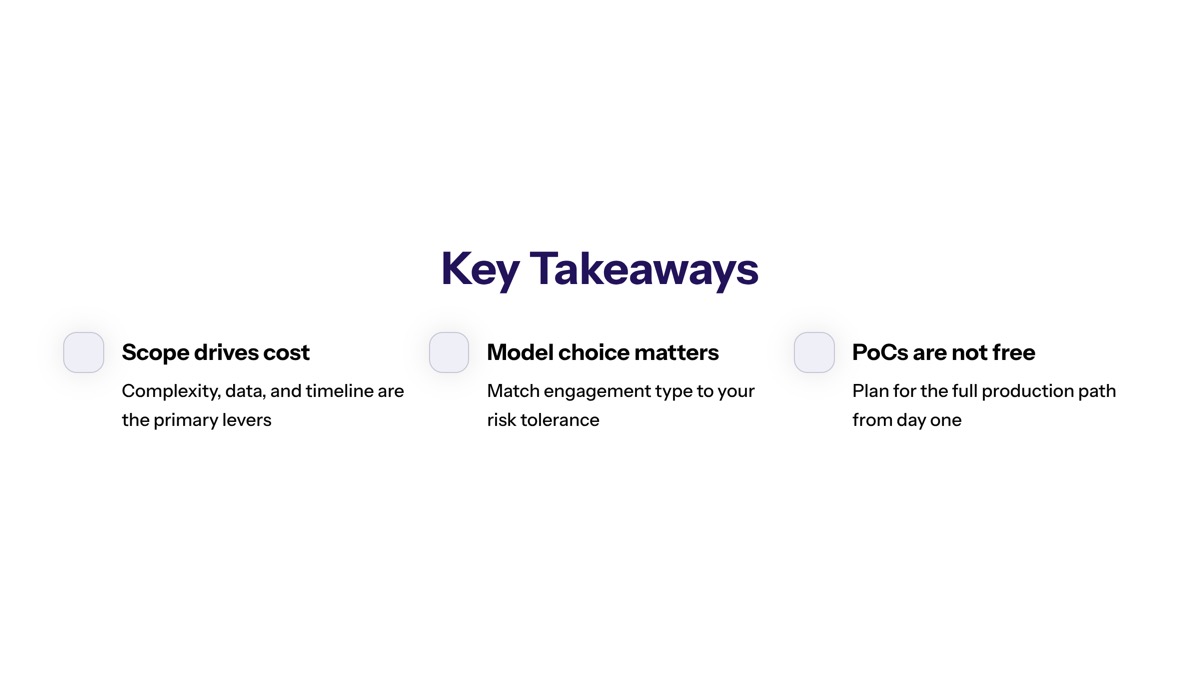
AI consulting costs reflect problem complexity, data readiness, integration requirements, and production scope rather than simple hourly rate calculations. The variation between a $15,000 readiness assessment and a $300,000 production deployment is not arbitrary-it corresponds to fundamentally different amounts of work, risk, expertise, and ongoing support. Typical AI consulting pricing spans hourly rates and project-based fees, with AI consulting hourly rates ranging from $150 to $1,000+ and project-based fees ranging from $10,000 to $2 million depending on scope. Independent consultants charge $150 to $350 per hour, while boutique AI firms charge $350 to $650 per hour. European AI consulting rates are typically 10-20% lower than US rates.
Value-based pricing ties fees to measurable business outcomes, and more organizations in the ai consulting market now prefer pricing models tied to demonstrated results. AI consulting investments can yield 3x to 8x ROI within 24 months when scoped against clear business problems with adequate data readiness.
To prepare for productive conversations with providers, take these steps:
-
Define your business problem clearly with measurable outcomes, identified users, and success criteria
-
Assess your data and technical readiness including data quality, system architecture, and internal capability
-
Determine production requirements including security, compliance, integration depth, and scale expectations
-
Prepare scope information using the checklist above so providers can offer credible, assumption-transparent estimates
-
Use the evaluation questions to compare providers on substance-architecture approach, ownership terms, support model, and relevant experience
Your AI journey toward implementing AI effectively starts with a bounded problem and honest assumptions, not a price tag. Discuss your scope and requirements with Cognativ's AI consulting team to develop realistic project estimates grounded in your specific business context, data environment, and production needs. You can also explore Cognativ's AI software development services for a detailed view of technical capabilities.