

Enterprise Software: Seven Categories and How to Select Them
Enterprise software coordinates business records and work across teams, roles or locations. ERP, CRM, supply-chain management, business intelligence, HR management, project management and asset management address different responsibilities.
Enterprise software coordinates business records and work across teams, roles or locations. ERP, CRM, supply-chain management, business intelligence, HR management, project management and asset management address different responsibilities. A suite may cover several; buying one brand does not eliminate the need to decide which component owns each record.
Select the category from the process you need to improve, then test a real transaction across its boundaries. Company size and feature count are poor substitutes for that analysis. A smaller organization can need strong record ownership, while a large organization may solve a particular problem with a focused integration rather than a new suite.
Seven Enterprise Software Categories With Real Examples
These products illustrate category membership, not a ranking or a recommended purchasing stack. Vendor documentation supports the broad capability; edition, jurisdiction, integration and implementation requirements must be verified separately.
| Category | Example | Core responsibility | Test before selection |
|---|---|---|---|
| ERP | Oracle Fusion Cloud ERP | Selected finance, procurement and operating processes. | Reconcile an opening balance, a purchase and a correction with the responsible finance team. |
| CRM | Salesforce Sales Cloud | Customer, prospect, opportunity and interaction records. | Transfer an opportunity between owners without losing visibility or duplicating the customer. |
| SCM | SAP Supply Chain Management | Supply planning, movement and fulfillment coordination. | Trace a partial receipt and a delayed shipment through the receiving and planning decisions. |
| BI | Tableau Cloud | Analysis and presentation of defined business measures. | Reproduce a known measure from source records, then explain a corrected input. |
| HRM/HCM | Workday HCM | Employee records and related workforce processes. | Onboard, change a role and offboard a synthetic employee with appropriate access controls. |
| Project management | Asana | Work ownership, dependencies and delivery status. | Change a prerequisite and verify that the affected work and accountable owner are visible. |
| EAM | IBM Maximo Application Suite | Asset history, inspections and maintenance work. | Trace an asset through inspection, corrective work and retirement, including overdue actions. |
ERP: define modules and record ownership for the implementation. A shared database does not reconcile incorrect units, product identifiers or approval rules automatically. Consolidated reporting is only as dependable as those definitions and opening data.
CRM: define identity matching, sales stages, permitted access and service handoffs. A centralized customer view can support a decision, but it does not by itself prove higher revenue or retention. The workflow should make the next responsible action clear.
SCM: distinguish planned, acknowledged, shipped and received quantities. A predicted arrival is not a confirmed receipt. Assign an owner to shortages, contradictory updates and stale information rather than allowing a forecast to become an unqualified promise.
BI: specify each measure's source, definition, refresh interval and audience. Test filters and aggregation before judging dashboard appearance. Users need to distinguish missing data from a real operational change.
HRM/HCM: these product labels overlap; compare actual modules rather than assuming a fixed boundary. Employee information requires appropriate access and retention. Check payroll, identity and time integrations for the actual jurisdictions and employment arrangements.
Project management: statuses must reflect work and acceptance, not merely a populated board. Test blocked work, reassignment and returned work. An automation should not mark a task complete when the required acceptance decision is missing.
EAM: connect asset identifiers and service history to inspections, spare parts, work orders and accountable maintenance decisions. Organizing those records supports operation; it does not guarantee lower downtime without effective maintenance action.
Worked Example: Follow an Order Across Systems
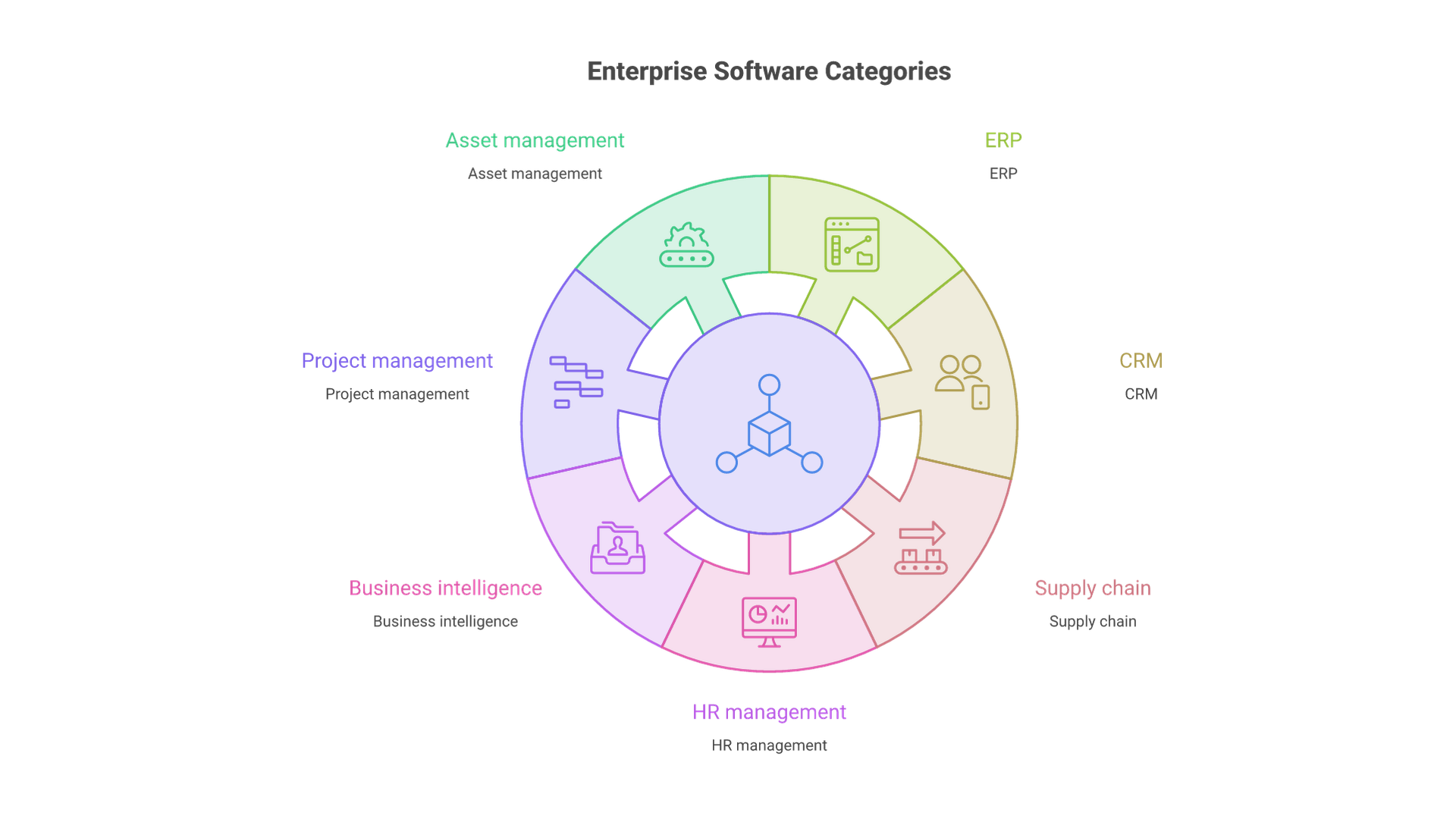
In a hypothetical distributor, CRM owns the opportunity and commercial contact, ERP owns the accepted order and financial posting, and warehouse software owns physical fulfillment. Supply-chain functions coordinate availability and movement; BI analyzes defined outcomes. The same responsibilities remain when a suite packages several of these functions together.
Begin with a normal order, then change the conditions. A customer changes the address after warehouse release. A shipment is partial. A receipt quantity is corrected. A return arrives before a financial adjustment. A message is delivered twice. Ask the vendor to demonstrate each complete transition and the evidence used to resolve it.
For each case, identify the authoritative field, permitted change, consumer and exception owner. Record how stale information is shown. An interface displaying one customer view does not resolve a disagreement between an accepted order and a physical shipment.
Use Constraints First, Then Compare Preferences
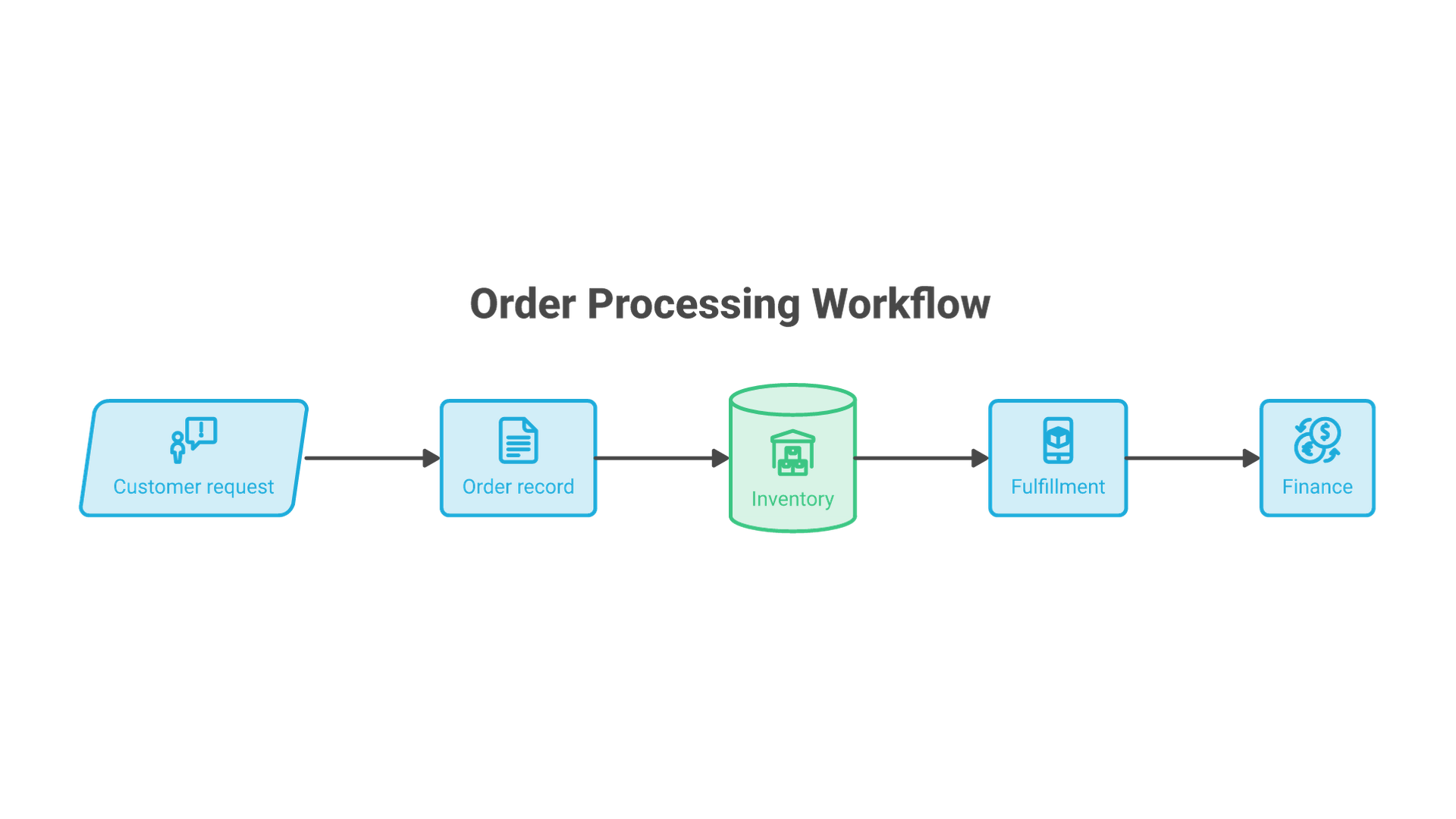
- Define the process and problem. Identify the decision or handoff that fails, its current cost and the operating owner. Avoid starting with an undifferentiated list of desired features.
- Apply nonnegotiable constraints. Check required jurisdictions, integrations, data boundaries, access, portability and support obligations. A high score for interface polish cannot offset a critical missing requirement.
- Run the same demonstration script. Use representative transactions, including incomplete or conflicting records. Record what is standard, configured, customized or unavailable.
- Include the people who operate the process. Involve business owners, technical teams and relevant security/control specialists. Distinguish a training need from a genuine functional gap.
- Document the decision. Record evidence, tradeoffs, unresolved conditions and the owner who accepts each remaining risk.
An RFP can make requirements comparable, but a written response still needs verification. A product suite may be appropriate; a narrower product or integration may address the same requirement with less disruption. Test supported configuration before commissioning custom code.
Every customization creates an upgrade and support responsibility. Record why it exists, how it is tested and who maintains it. Changing a process can sometimes be more practical than preserving every historical exception in a new application.
Separate Initial Cost From Ongoing Ownership
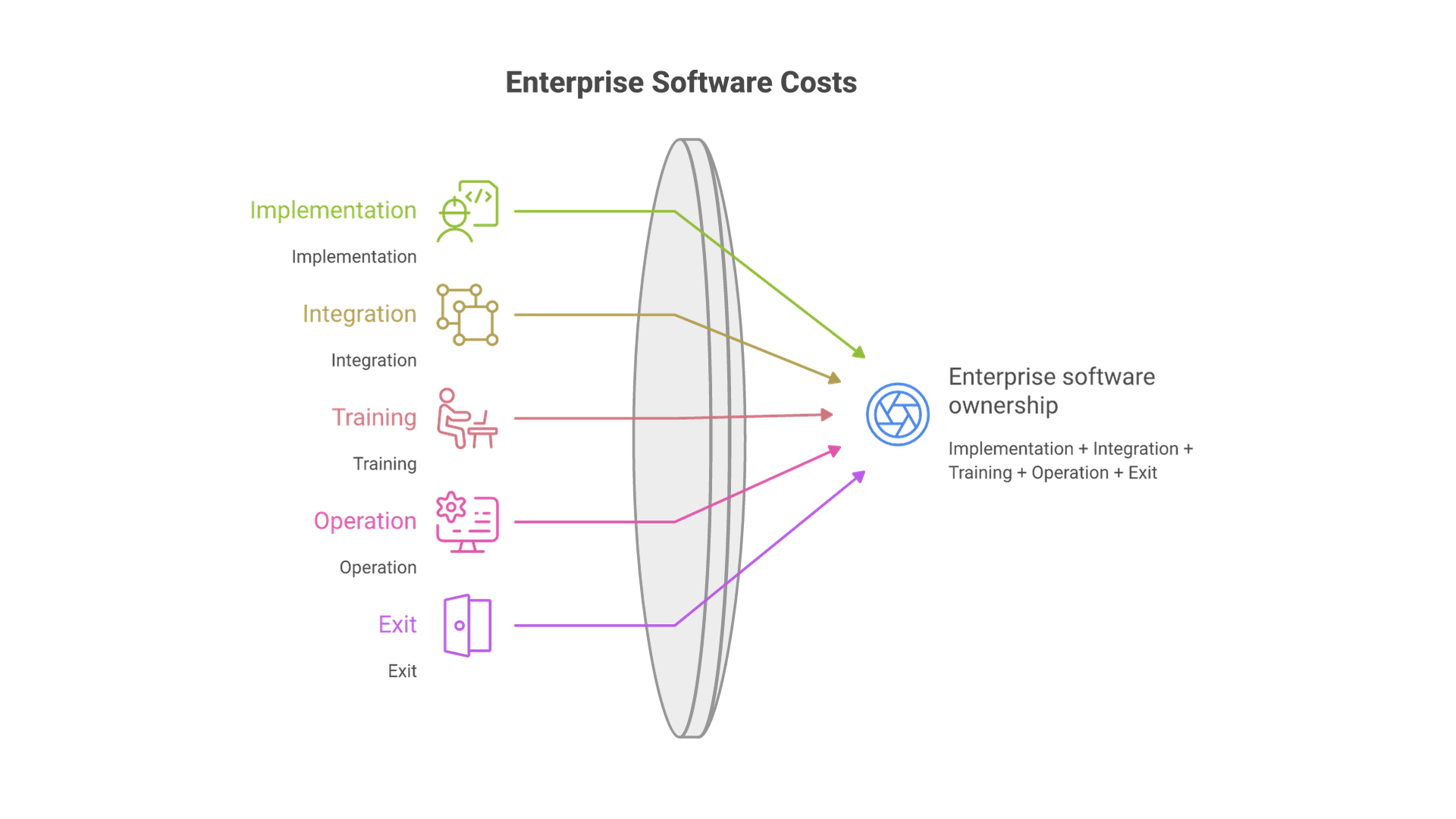
Include licenses or subscriptions, implementation, data cleanup, integrations, retained internal work, training, administration and exit. Compare equivalent scope and coverage; a license quote is not the whole implementation budget.
| Cost input | First year | Subsequent unchanged year |
|---|---|---|
| Implementation | $60,000 | $0 |
| Annual service | $24,000 | $24,000 |
| Internal administration | $12,000 | $12,000 |
| Subtotal | $96,000 | $36,000 |
These assumptions exclude taxes, usage changes and other costs. Replace them with the actual proposals and test sensitivity to integration effort, user growth and support. Do not use an assumed ERP savings percentage as evidence of return.
Measure benefits against a baseline: fewer unexplained reconciliations, usable record freshness, task completion and recovery. Separate software changes from staffing, demand and process changes when interpreting outcomes. Automation that creates a larger exception queue may not have removed work.
Rehearse Migration, Adoption and Exit
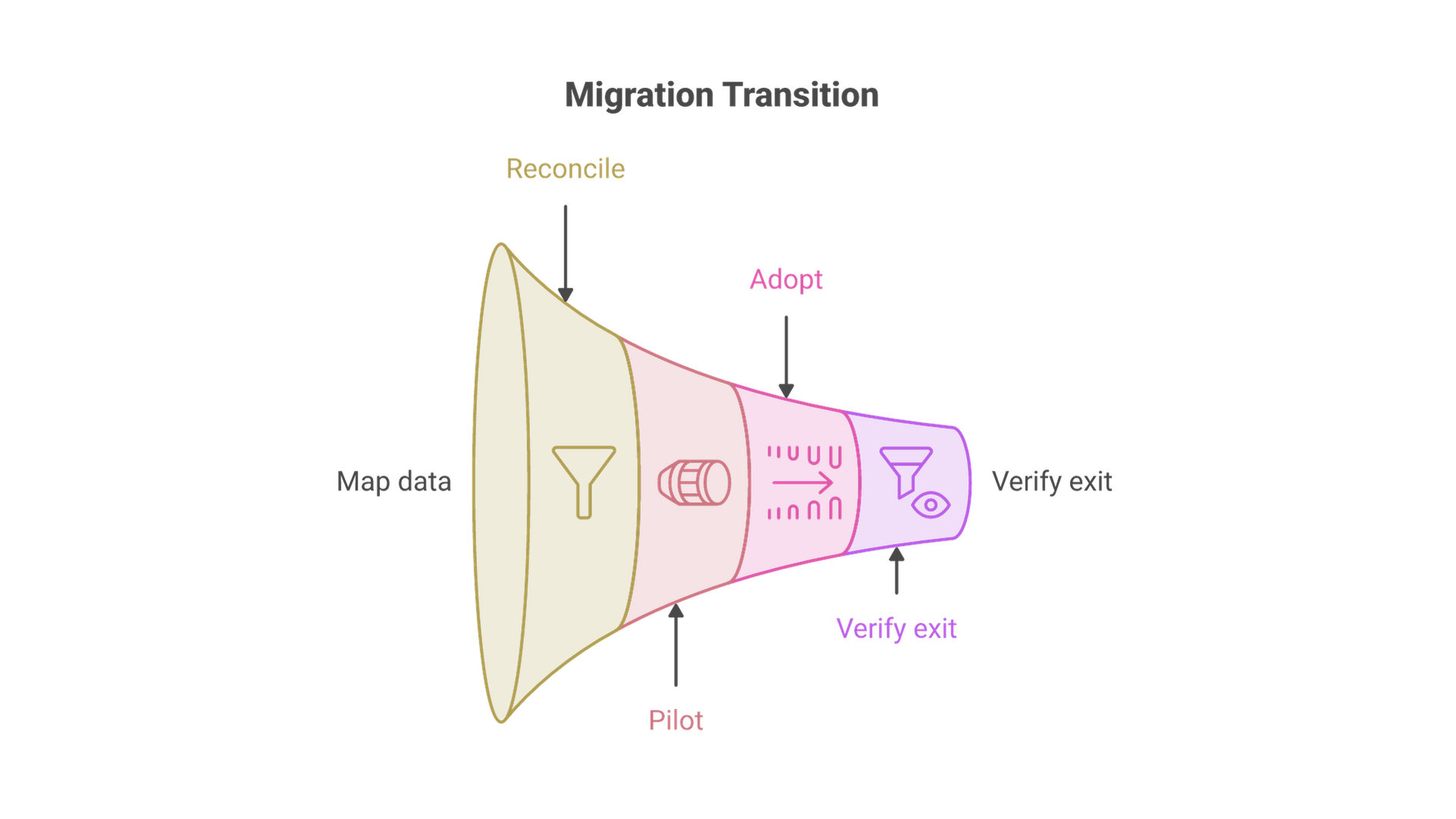
Specify identifiers, field mappings, relationships, attachments and audit-history requirements before import. Reconcile totals and representative records; a matching row count does not establish that the data can support the intended workflow.
Test incomplete and conflicting records. Preserve unresolved differences with an owner instead of silently selecting one system's value. Define changeover and recovery for transactions created during the transition, not only for the initial import.
Observe users performing the changed workflow. Permissions, approvals and exception handling can create legitimate usability problems. Treat their feedback as acceptance evidence, not automatically as resistance to change.
Test exit with a sample export while selection is still reversible. Verify that another system can use the records and relationships, that required attachments are present and that contract terms support the intended transition. A successful export command is not proof of a maintainable exit.
Keep Delivery Model and AI Features Separate From Category
SaaS describes a provider-operated application delivery model; ERP and CRM describe business responsibilities. Compare both dimensions. A hosted application still requires customer-side configuration, users, data and integration ownership.
For cloud or AI features, identify which data leaves the organization, who can inspect recommendations and how work proceeds when a provider is unavailable. An agent's ability to propose an action is different from permission to change a financial or employee record. Evaluate those boundaries against the real process rather than a roadmap label.
Choose the smallest coherent set of systems that meets the workflow and can be operated by the available team. For unresolved integration or custom implementation needs, Cognativ's software engineering services provide a route to discuss scope, record ownership and acceptance evidence.