Do You Need an AI Center of Excellence? Centralized, Federated, or Hybrid Operating Models
Not every organization needs an AI Center of Excellence. The decision to establish one-and the form it takes-depends on your AI portfolio complexity, regulatory exposure, internal capabilities, and where decision bottlenecks actually exist. Before investing in a dedicated unit or engaging ai center of excellence consulting, leadership must determine which operating model fits the organization's current reality rather than adopting a fashionable template.
This guide covers the operating model decision for AI governance, coordination, and delivery. It does not cover generic ai strategy guidance or promote a fixed consulting package. Instead, it provides decision frameworks for mid-market and enterprise executives, technology leaders, and governance stakeholders who need to determine how AI responsibilities should be organized-whether through a centralized ai coe, a federated business-unit model, a hybrid structure, or a lightweight coordination mechanism.
The core answer: an artificial intelligence center of excellence is not automatically a sign of maturity. Only 37% of large US companies have established an AI/ML CoE, and for many organizations, a smaller governance council or enablement group may deliver equivalent coordination without the overhead. The right model depends on trade offs between consistency, speed, risk tolerance, and internal capability.
By the end of this article, you will have:
-
A clear definition of what an AI Center of Excellence is-and what it is not
-
A framework for assessing whether your organization needs formal AI coordination
-
A detailed comparison of centralized, federated, and hybrid operating models across 12 decision criteria
-
An understanding of common failure modes and how to prevent them
-
A practical checklist for selecting and implementing the right operating model

Understanding AI Centers of Excellence and Operating Models
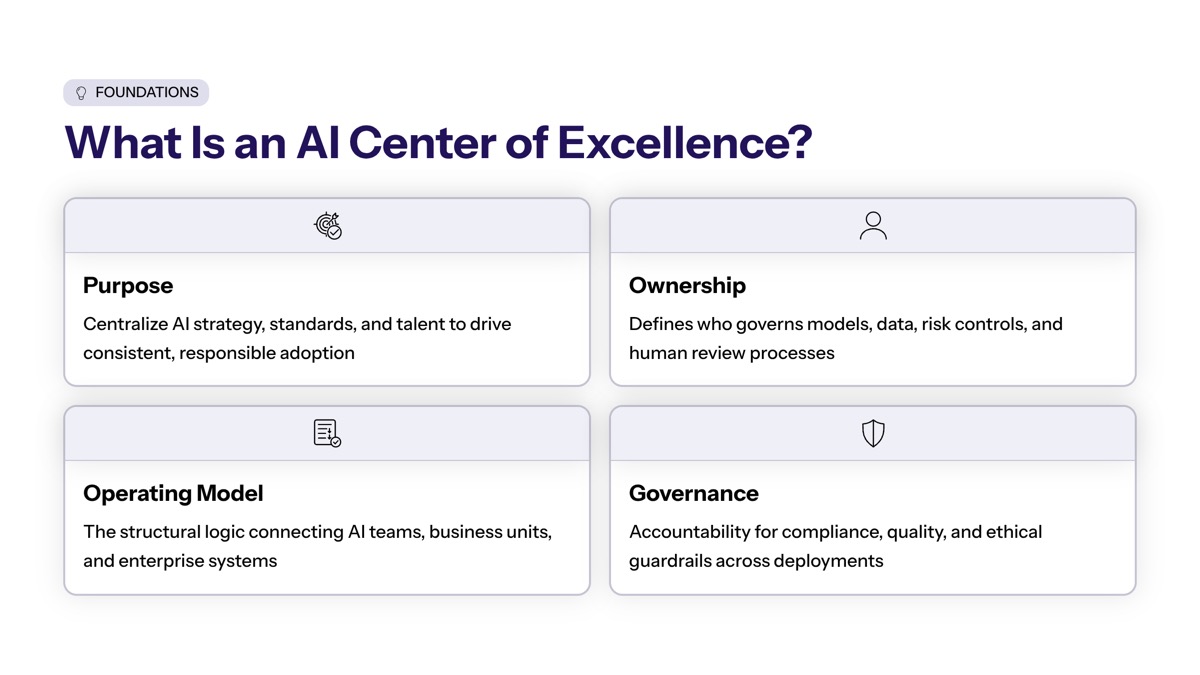
An AI Center of Excellence is a coordination mechanism, not a fixed organizational template. Understanding its actual function-and recognizing when lighter structures suffice-prevents organizations from building bureaucracy where they need agility, or leaving critical decisions unassigned where they need governance.
What Defines an AI Center of Excellence
An AI CoE is a cross-functional structure with shared decision rights for architecture, governance, use-case intake, and tool provisioning. According to IBM , it is "an operational structure dedicated to encouraging the adoption, optimization and governance of AI across an organization," aligning AI work with strategic priorities and delivering repeatable, governed outcomes. A Center of Excellence serves to guide enterprise-wide ai adoption by centralizing ai expertise and ai resources around business value delivery-not merely technology orchestration.
What it is not : an AI CoE does not automatically own all ai initiatives, replace accountability of business units, or serve as a prerequisite for AI maturity. It is not a central hub that absorbs every machine learning project or removes domain expertise from the teams closest to the work. An AI CoE establishes governance and risk controls for AI use and helps define policies for legal, compliance, and security-but ownership of business outcomes remains with the business.
When Organizations Need Structured AI Coordination
Organizations should consider formal AI coordination when multiple conditions converge:
-
AI portfolio complexity : More than a few use cases across business units, diverse data sources, experiments extending into production systems. 80% of enterprises will have AI deployed by 2026 according to Gartner, which means coordination demands are increasing rapidly.
-
Regulatory or risk requirements : Industries with strong compliance needs-finance, healthcare, energy-benefit from centralized or hybrid governance. Only 22% of healthcare organizations implemented AI tools by 2025, partly because managing risk in regulated environments requires structured coordination.
-
Lack of shared standards or platform capability : Tool sprawl, inconsistent evaluation methods, or no shared infrastructure for ai models creates duplication and risk exposure.
-
Growth from pilot to production : When ai projects move beyond proofs-of-concept, organizations need coordination for lifecycle management, ai governance , and production ownership.
Conversely, lighter coordination suffices when AI adoption is nascent, use cases are few and low-risk, or internal capabilities are limited. Organizations under approximately 500 people, or those already mature in machine learning with embedded teams across business units, may only need a governance council or working group rather than a full CoE.
Core Decisions Every AI Operating Model Must Address
Regardless of model structure, every AI operating model must assign decision rights across these domains:
-
Use-case intake and prioritization : Who evaluates proposals? What criteria-ROI, technical feasibility, risk, strategic alignment-determine selection? AI CoEs help prioritize high-value ai use cases for implementation.
-
Strategic roadmap and AI capability scope : Which capabilities are enterprise differentiators versus local optimizations?
-
Architecture and technical standards : Infrastructure patterns, reference architectures, model registries, feature stores, data storage standards.
-
Governance oversight and risk acceptance : Central policy versus local risk assessment, high-risk approvals, compliance with privacy regulations.
-
Vendor evaluation and tool selection : Who approves third-party ai services, defines vendor requirements, and manages cloud platforms integration?
-
Delivery ownership : Who builds, deploys, and integrates ai solutions? Is execution centralized, embedded, or shared?
-
Enablement and training : Who provides guidance, training programs, machine learning operations skills, and knowledge sharing across the organization?
-
Shared tooling and infrastructure : Model deployment environments, monitoring pipelines, version control, drift detection, feedback loops.
-
Metrics, evidence, and portfolio visibility : Tracking key performance indicators, lifecycle management from pilot to production to retirement.
-
Funding models and cost allocation : Central budget, business-unit budgets, hybrid or chargeback mechanisms.
How these decisions are allocated-centralized, distributed, or shared-defines the operating model. The structure follows from the decision map, not the other way around.
AI Operating Model Options and Tradeoffs
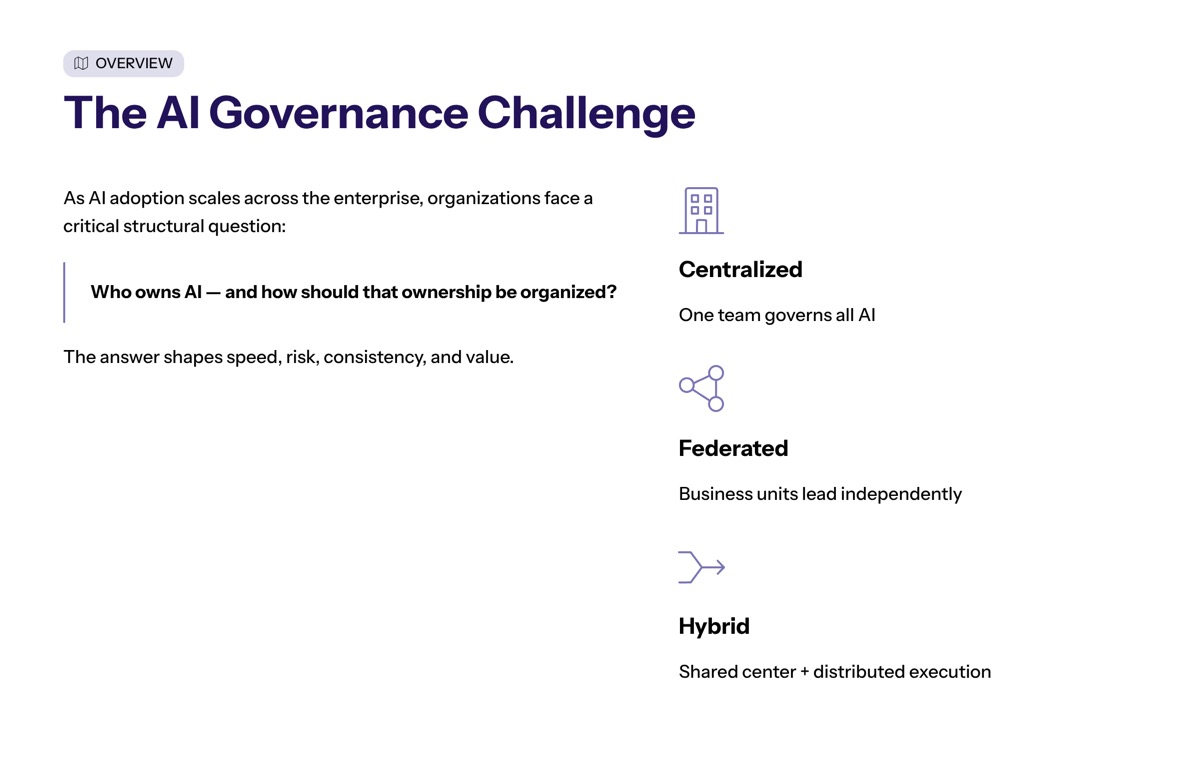
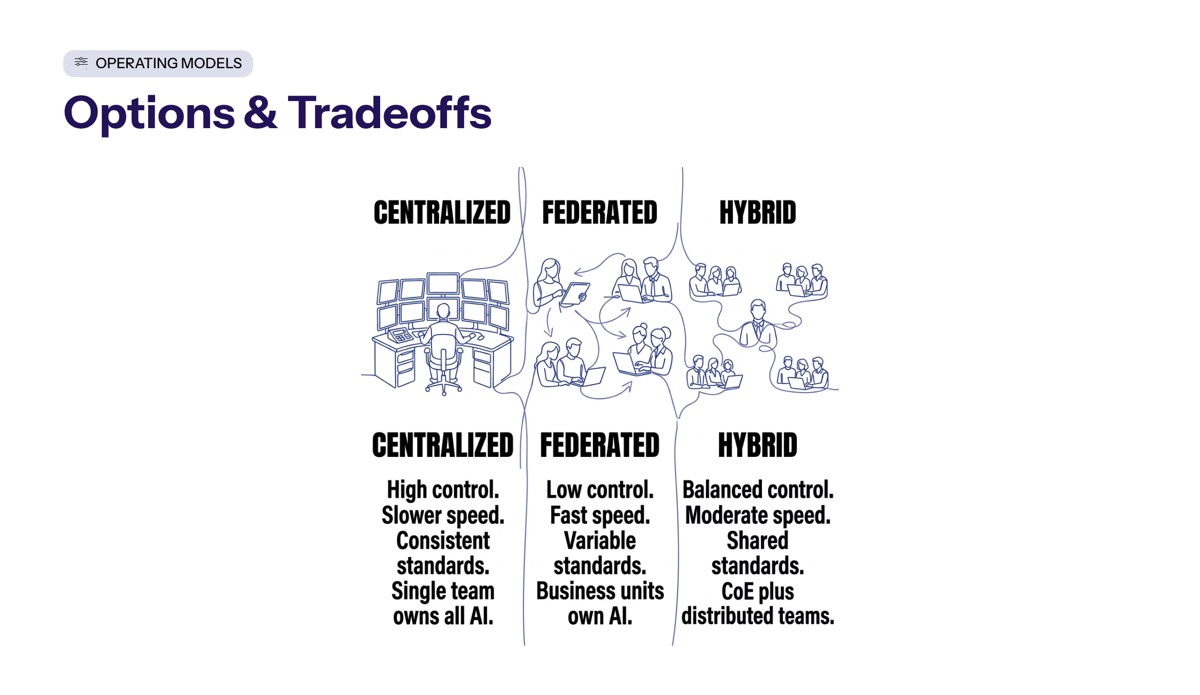
Three primary operating models emerge from how organizations assign the decisions above. Each carries distinct advantages and constraints. The right choice depends on organizational context-not on which model appears most sophisticated.
Centralized AI Center of Excellence Model
In a centralized model, most decision rights-strategy, architecture, delivery, and governance-reside with the central team. Business units submit use cases; delivery happens through the CoE or under CoE-controlled processes. A centralized CoE can accelerate time-to-value by streamlining AI deployment processes and building reusable assets that prevent redundant efforts across teams.
Best-fit scenarios : Organizations early in ai adoption with limited artificial intelligence expertise outside central IT or R&D. Highly regulated industries where data governance, data privacy, and auditability require strict controls. Environments where standardization, security, and talent concentration matter more than local speed. An ai center of excellence consulting engagement often begins here when organizations need to establish foundational governance before scaling.
Limitations : Centralized models risk becoming bottlenecks when demand outpaces central capacity. They can disconnect from business context, delivering technically competent ai applications that poorly fit specific workflows.
Federated Business-Unit AI Model
In a federated model, governance standards and shared services may be defined centrally, but execution, design, and deployment are distributed across business units. Local teams own use-case definition, may influence vendor selection, and embed ai technologies into their own workflows. Domain expertise and business-context proximity drive faster, more relevant ai solutions.
Best-fit scenarios : Organizations where data scientists and ML engineering teams already exist in business units. Markets where speed, customer satisfaction, and business alignment outweigh consistency concerns. Environments with strong domain expertise that would be diluted by centralized control.
Limitations : Federated models risk tool sprawl, inconsistent application of governance, duplication of infrastructure, and unclear accountability. Without central standards, different business units may build overlapping ai agents or machine learning models on incompatible platforms.
Hybrid Model with Shared Standards
A hybrid model combines centralization of strategic, high-risk, and platform-level decisions-such as vendor approval, security standards, ai-first architecture ownership-with federated execution of local use cases and lower-risk ai system deployments. Decision rights are allocated explicitly by decision domain. Establishing a federated operating model helps balance central governance with local autonomy.
Best-fit scenarios : Enterprises transitioning from pilot to scale. Organizations managing risk while enabling teams to move quickly on business-aligned ai initiatives. Companies with both regulated and agile product lines needing different governance intensities.
Lightweight Enablement Approach
Not every organization needs a formal CoE. For smaller AI portfolios or early-stage adoption, a governance council or enablement group can define standards, run prioritization, and provide guidance to business units. This avoids large fixed headcount or organizational disruption until the internal pipeline or risk exposure justifies more structure. A clear ai strategy and objectives can be maintained through a working group with representative stakeholders from business, legal, compliance, IT, and analytics-without standing up a dedicated unit.
Operating Model Comparison and Selection Framework
With the three primary models defined, practical selection requires comparing them across the specific dimensions that matter to your organization. The following framework connects model structure to operational consequences.
Operating Model Tradeoffs Matrix
Use this comparison to identify which trade offs align with your organizational goals, risk tolerance, and current capabilities:
|
Decision Area |
Centralized |
Federated |
Hybrid |
|---|---|---|---|
|
Decision speed |
Slower due to central queue |
Fast locally |
Medium, with guardrails |
|
Business context proximity |
Low |
High |
Moderate to high |
|
Architecture consistency |
High |
Low to moderate |
High where central defines standards |
|
Security & governance |
Strong centralized control |
Risk of deviation if units are insufficiently governed |
Strong for high-risk, delegated for low-risk |
|
Talent concentration |
Central experts |
Distributed domain expertise |
Central core plus embedded roles |
|
Delivery ownership |
Central assumes most delivery |
Local owns delivery |
Split: central for shared, local for use cases |
|
Funding models |
Central budget |
BU budgets, local funding |
Mixed or shared funding |
|
Reuse potential |
High if shared infrastructure is built |
Low-risk of reinventing per unit |
Moderate to high with central platform |
|
Accountability clarity |
Clear central ownership |
Risk of blurred accountability |
Must define clear division of responsibilities |
|
Portfolio visibility |
High central visibility |
Risk of siloed visibility |
High if central monitoring/reporting implemented |
|
Bottleneck risk |
High under high demand |
Low central bottlenecks, but duplication risk |
Moderate-central gatekeepers but shared execution |
|
Risk of duplication |
Low |
High |
Moderate-managed via central oversight |
Interpreting these trade offs depends on your context. Regulated industries typically weight security, governance, and architecture consistency heavily-favoring centralized or hybrid models. Organizations in fast-moving markets where business impact depends on speed may lean federated, accepting higher coordination costs. Generative AI is projected to deliver $400 billion in productivity benefits, but capturing that value requires the right organizational structure-not just the right technology.
AI Capabilities That May Require Coordination
Even in federated setups, certain capabilities often require central coordination or oversight. Assessment and evaluation should be continuous rather than initial before deployment:
-
Use-case intake and prioritization framework - AI CoEs help connect technical metrics to business value
-
Strategic roadmap planning aligned with organizational goals
-
Architecture standards including model design, reference architectures, and proven patterns
-
Shared platforms and infrastructure - feature stores, model registries, compute, deployment pipelines, vector databases
-
Governance and risk coordination - high-risk approvals, compliance, data protection frameworks , privacy controls
-
Evaluation standards - business metrics, evidence gathering, ROI measurement, lifecycle management
-
Shared tooling and vendor evaluation - reducing tool sprawl and protecting sensitive information
-
Enablement programs and training - building ai skills and AI literacy across the workforce. Democratizing AI knowledge involves providing upskilling and training to non-technical employees
-
Monitoring, observability, and drift detection in production systems - ensuring model accuracy over time
-
Production-grade deployment ownership boundaries - clarity on who maintains machine learning models in production
-
Portfolio evidence gathering and reporting - AI centers of excellence help measure business impact with KPIs
-
Funding and cost allocation frameworks - cost transparency across central and business-unit budgets
The burden of each capability shifts based on the operating model. Centralized CoEs may handle end-to-end execution; federated models limit the central role to standards while local teams take on deployment and model development.
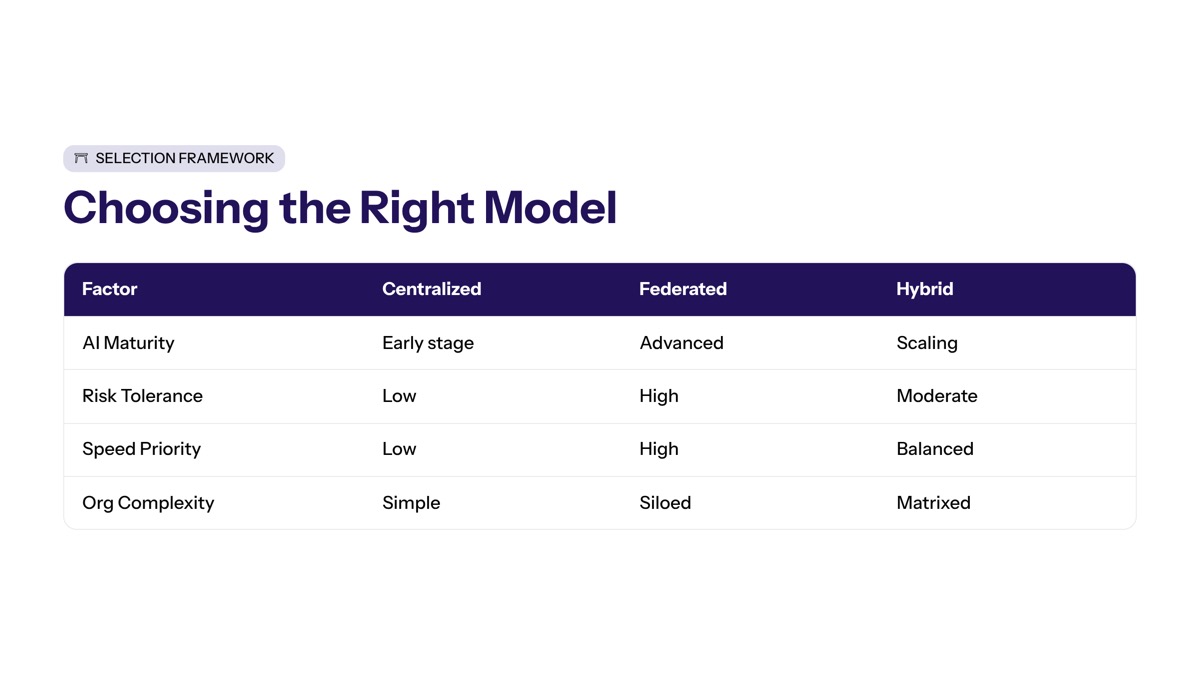
Decision Framework for Operating Model Selection
To select the appropriate model, follow this sequence:
-
Assess AI portfolio complexity : Count active and planned use cases. Map them across business units and risk levels. Organizations with fewer than five low-risk use cases rarely need a full CoE.
-
Evaluate risk and compliance requirements : Governance and Compliance establishes frameworks for ethical AI usage and regulatory adherence. Implementing a robust governance framework is essential throughout the AI lifecycle. Identify where privacy regulations, data quality standards, or industry mandates require structured oversight.
-
Analyze internal capabilities : Do business units have data scientists, ML engineers, and operational ai expertise? If so, federation or hybrid works. If not, centralization builds capability before distributing it. Note that 53% of teams rate their generative ai skills as intermediate while 64% of senior leadership rate their generative ai skills as novice-a gap that shapes model design.
-
Identify decision bottlenecks : Where are decisions stalling? If architecture reviews delay every project, centralize architecture but federate delivery. If governance approvals are blocking low-risk work, implement risk tiering.
-
Determine coordination needs : Map which of the capabilities listed above are already covered, which are gaps, and which create the most friction.
-
Select and scope the model : Choose the operating model that addresses your highest-priority gaps while preserving what already works. Start with minimum viable structure-add headcount and formalization as the pipeline justifies it.
High-impact pilot projects should be selected to validate concepts quickly before expanding the model across the organization.
Common AI Center of Excellence Failure Modes
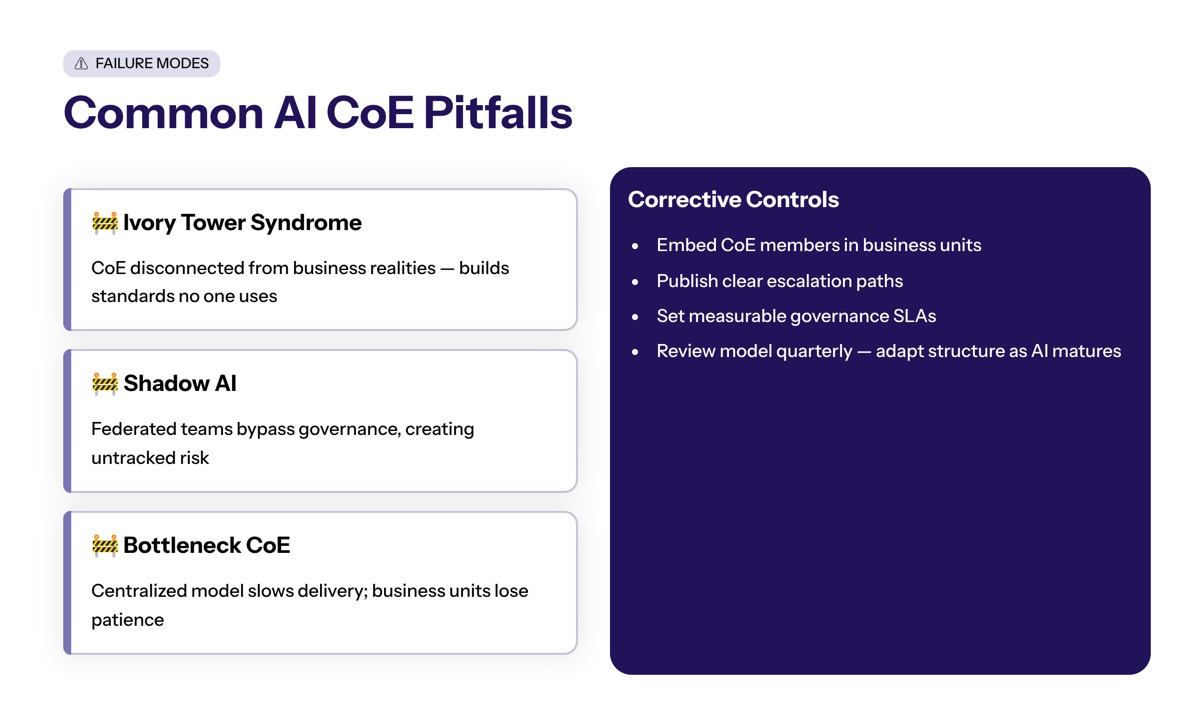
Operating model failures are typically structural rather than technical. Understanding these patterns helps leadership design structures that avoid common traps. Gartner reports approximately 50% of generative AI projects are abandoned after POCs, and OECD research indicates more than 80% of AI projects fail to deliver value-often because governance, ownership, and expectations were poorly designed.
Bottleneck Creation and Slow Decision-Making
When every vendor choice, every high-risk use case, and every architecture decision must flow through a central team, demand overwhelms capacity. Prevention requires explicit triage thresholds, risk tiering, and delegation of low-risk decisions. Centralized CoEs should define what requires central approval versus what can proceed under documented standards. Regular audits of AI models ensure fairness and compliance with ethical standards without requiring central approval for every model iteration.
Disconnection from Business Value and Context
Centralized teams may deliver ai solutions that are technically competent but poorly suited to specific workflows, failing to generate operational efficiency or customer satisfaction improvements. Successful AI initiatives depend on support from executive leadership and a clear mandate, but they also depend on continuous engagement with the business units that will use the output. Prevention: embed roles in business units, rotate business liaisons, build feedback loops, and tie ai projects to business outcomes rather than technical milestones.
Over-Engineering Governance Without Delivery Focus
CoEs can become heavy with policy, documentation, and layers of approval-yet unable to ship usable models. When governance becomes the goal rather than the enabler, execution falters. Prevention: implement minimal viable governance, introduce controls incrementally, and focus governance energy on critical safety and regulatory obligations first. AI CoEs can help organizations comply with evolving regulations without creating approval overhead that blocks value delivery.
Talent Hoarding Without Knowledge Transfer
Central experts may centralize not just work but all knowledge. Business units become dependent rather than capable. This limits scale and sustainability.
Prevention: focus on building embedded capability through training programs and workshops, internal talent development, and rotating team members between the CoE and business units. An AI CoE can provide training programs and workshops, but the goal should be enabling teams rather than creating permanent dependencies.
Cultural transformation is needed to foster a data-driven mindset within organizations-which requires distributing knowledge, not concentrating it. AI knowledge management captures lessons learned and prevents duplication of efforts across the enterprise.
Implementation Approach and Next Steps
The right operating model aligns with organizational context-portfolio size, risk profile, internal capability, and strategic goals. It does not follow from templates, industry trends, or what competitors have announced. Building reusable AI components helps organizations avoid redundant efforts across teams, but the organizational structure must match the complexity you actually face.
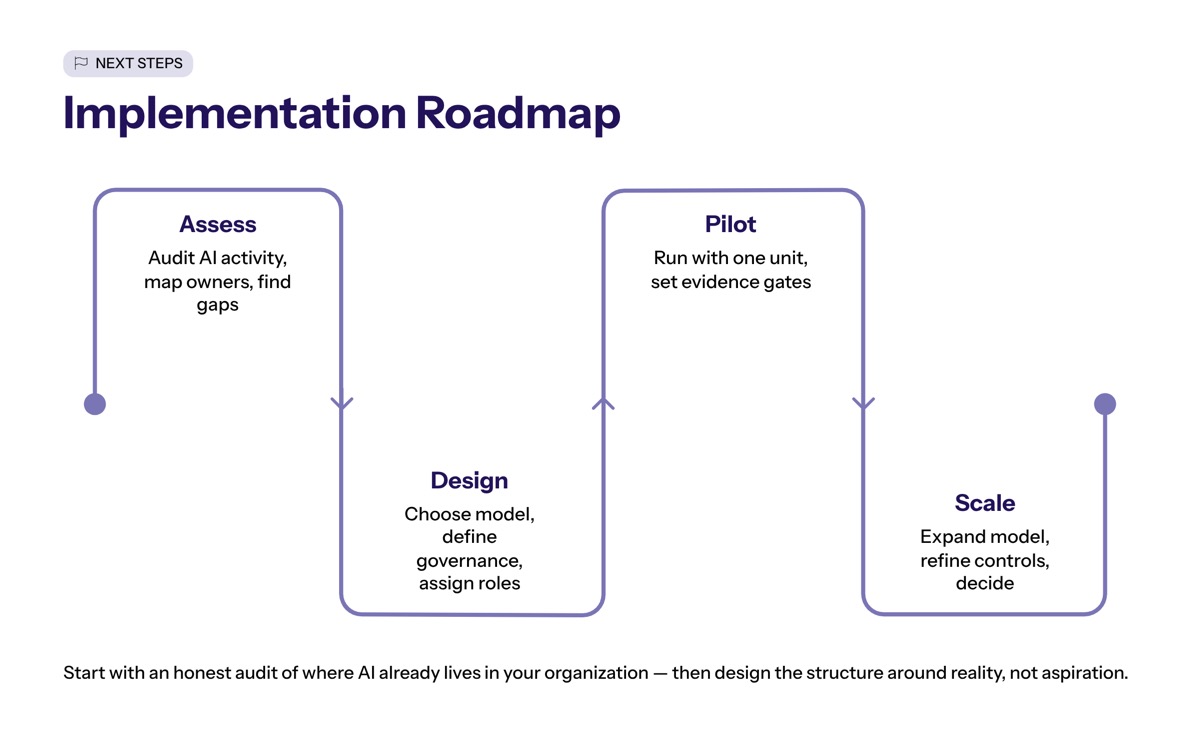
To move forward:
-
Conduct a capability maturity assessment covering AI, data management, platform, and governance readiness. Use this to identify whether existing structures can absorb AI coordination or whether new structures are needed. An efficient digital transformation assessment template can help structure this evaluation.
-
Draft a charter defining scope, decision rights, and responsibilities. Explicitly map which core decisions are central versus delegated. Secure executive sponsorship before formalizing the structure-successful ai initiatives depend on support from executive leadership and a clear mandate.
-
Stand up a minimum viable structure -a working group or enablement council with representative stakeholders from business, legal, compliance, IT, and analytics-before committing to full CoE headcount.
-
Select and execute a first use case in one domain to validate the operating model. Measure against business metrics, not just technical performance. AI CoEs improve data governance and data quality management, but proving value delivery through a concrete pilot builds organizational confidence.
-
Invest in infrastructure foundations that scale: shared model registries, common tooling for machine learning operations, monitoring pipelines, and operationalized governance frameworks .
-
Define the funding mechanism -central, distributed, or hybrid-covering shared infrastructure and creating incentives for business-unit participation. AI CoEs provide common infrastructure to reduce costs and improve security.
When to engage external expertise: ai center of excellence consulting may provide valuable perspective when internal bias creates blind spots around trade offs, when organizations lack experience mapping decision rights across centralized and federated models, or when complex regulated environments require expertise in compliance frameworks (GDPR, EU AI Act, ISO 42001).
Organizations facing fragmented systems-tool sprawl, inconsistent data patterns, overlapping ai applications-may also benefit from external assessment before building internal structures. Cognativ's AI services and business strategy practice focus on helping leadership connect strategy, prioritization, architecture, governance, and operating ownership-designing the decision system rather than selling a fixed package.
To discuss your AI operating model, contact Cognativ .
AI Operating Model Decision Checklist
Use this checklist to assess your organization's readiness and determine which operating model fits. Score each criterion and use the pattern of responses to inform your decision.
Portfolio Complexity
-
[ ] Number of AI use cases in production or planned in the next 12 months (fewer than 5 / 5–15 / more than 15)
-
[ ] Number of business units actively requesting or building ai applications
-
[ ] Diversity of ai technologies in use (deep learning, neural networks, generative ai, ai agents, traditional machine learning models)
-
[ ] Whether scalable solutions exist or each project is built from scratch
Risk and Compliance Requirements
-
[ ] Regulatory exposure level (low / moderate / high) across your AI portfolio
-
[ ] Current governance frameworks in place for AI-policies, risk review, audit readiness
-
[ ] Requirements for managing risk around sensitive information, data privacy, and data quality
-
[ ] Need to protect sensitive information across multiple deployment environments
-
[ ] Compliance readiness for evolving regulations (EU AI Act, ISO 42001, industry-specific mandates)
Internal Capabilities
-
[ ] AI and data science talent distribution: centralized versus embedded in business units
-
[ ] Maturity of existing data infrastructure, data governance, and integration patterns
-
[ ] Existing infrastructure for AI deployment, monitoring, drift detection, and model accuracy tracking
-
[ ] Level of ai skills among business leaders and non-technical teams (novice / intermediate / advanced skills)
-
[ ] Presence of diverse team composition including right talent in both technical and domain roles
Coordination Needs
-
[ ] Current decision bottlenecks in AI initiative approvals, architecture reviews, or vendor evaluation
-
[ ] Degree of tool sprawl or inconsistent methods across teams
-
[ ] Speed requirements versus tolerance for centralized decision delays
-
[ ] Need for standardization and architecture consistency across units
-
[ ] Whether continuous improvement processes exist for deployed ai models
Implementation Readiness
-
[ ] Executive sponsorship confirmed for AI coordination structure
-
[ ] Budget visibility and cost allocation clarity between central and business-unit teams
-
[ ] Strategic alignment between AI portfolio and broader organizational goals
-
[ ] Capacity to provide guidance, enablement, and training alongside governance
-
[ ] Readiness for holistic approach to AI lifecycle-from ideation through production through retirement
Interpreting results : If your responses cluster toward high portfolio complexity, significant regulatory exposure, and limited internal capabilities-a centralized or hybrid model typically fits. If business units already have strong ai expertise, domain-specific data sources, and operational ownership, a federated or hybrid model preserves speed while adding coordination. If portfolio complexity is low and risk exposure is manageable, a lightweight enablement group may be sufficient. AI CoEs can accelerate technology adoption and ROI, but only when the structure matches the organization's actual coordination needs.